Some movies rely on the chemistry of their lead co-stars in order to engage their audience, hoping that the thrill of watching two sexy movie-stars romancing and eventually getting it on with each other will provide sufficient escapism to make the reality lurking outside seem a world away. It's difficult to think of a film as reliant on the raw sex appeal of its superstars than Norman Jewison's 1968 heist thriller The Thomas Crown Affair, and Steve McQueen, as the titular millionaire playboy, and Faye Dunaway, as the sultry insurance investigator hot on his tail, positively sizzle with chemistry. In fact, they are so gorgeous that they manage to turn a game of chess into a playful game of seduction. The duo have certainly given much better performances during their careers, but they have never looked so good.
This pretty much sums up The Thomas Crown Affair: a polished, colourful star vehicle with an unashamedly glossy veneer. At the very centre of the story is a bank heist gone right, masterminded by the rather smug Thomas Crown (McQueen) after he handpicks his crew without ever letting them see his face. The thieves escape with over 2 million dollars, and nobody, including the rather clueless Detective Eddy Malone (Paul Burke), has any idea who it was. Enter Vicki Anderson (Dunaway), a no-nonsense independent woman with a love of the finer things in life. She quickly figures out that Crown was behind it all, but remains puzzled at why a man with everything would want to steal money he doesn't need. Of course, it's all a game, and the couple start their own game of cat-and-mouse as they embark on a steam affair.
Taking inspiration from the Expo 67 film A Place to Stand, which greatly impressed McQueen, Jewison employs 'multi-dynamic image technique', splitting the screen into sections with each part showing a different viewpoint. It gives the film a unique style, especially during the opening heist, and when combined with 60s kitsch, everything is wonderful to look at. While the visuals still impress, the characters are somewhat dated. He's the rich, philandering charmer, and she is bowled over by his fast-living and expensive possessions. It makes it all the more difficult to warm to a character I would detest in real life, but McQueen has more than enough charisma to pull through. There are never any real stakes, but it's pretty fun while it lasts, just a little hollow at its centre. The Pierce Brosnan/Rene Russo remake from 1999 makes for a more satisfying ride.
When promotion started for Daniel Espinosa's space-set horror, a popular fan theory emerged that the movie was in fact an origin film for Sony's upcoming Venom movie, in which an alien symbiote arrives on Earth and attaches itself to Spider-Man, or so the comics and Sam Raimi's terrible Spider-Man 3 go. It speaks volumes about fans' eagerness to attach an original story to some ongoing franchise as part of a bigger, expanding world, as is the fad nowadays brought on by the success of Marvel's nine-year strong 'cinematic universe'. Life is not a Venom origin movie, but is in fact a throwback to popular, adult genre movies that flourished in the 1970s and 80s, although the potential for sequels is purposely there. That said, you have no doubt seen this movie before, as it rests comfortably into a well-worn formula and has no qualms about its own lack of originality.
The crew of the International Space Station manage to pull of the dangerous feat of capturing a fast-moving probe returning from Mars carrying soil samples. The six-strong team, captained by Russian Ekaterina (Olga Dihovichnaya), quickly discover that the package contains evidence of alien life in the form of dormant cells. Biologist Dr. Hugh Derry (Ariyon Bakare) manages to revive one cell by turning up the temperature, witnessing the alien's rapid growth and quick-learning. Back on Earth, school children name the discovery 'Calvin', but on the space station the creature becomes aggressive, attacking Derry and causing the rest of the crew, consisting of medical officer David Jordan (Jake Gyllenhaal), quarantine officer Miranda North (Rebecca Ferguson), pilot Sho Murakami (Hiroyuki Sanada) and wise-cracking engineer Rory Adams (Ryan Reynolds), to flee for their lives. Soon enough, preventing Calvin from reaching Earth becomes the top priority.
Drawing inspiration from the swirling camerawork of Gravity, the horror bursts of Event Horizon, the culturally diverse line-up of Sunshine, and, most of all, the claustrophobic man-versus-beast panic of genre classic Alien, Life offers nothing new to the genre, and will likely be all but forgotten in a few years. If you're expecting atmosphere, characterisation, gore or surprises, this is not that movie. However, your enjoyment of the film will depend on how quickly you come to accept the formulaic way it goes about its business, and the sooner the better. While it's nothing like the dizzying innovation of Gravity, Espinosa's film offers some spectacular visuals, blurring the line between reality and CGI. It also feels short, which is always a good thing. Life is a time-waster; something to switch your brain off to and kill 100 minutes. You may wait for a twist or the story to change direction, but it doesn't, and when the film attempts to deliver a surprise, chances are you'll have already guessed it.
Stuart Cooper's Overlord is a meditation on the mechanics of war and the young souls swept into it. After winning the Silver Bear at the 25th Berlin International Film Festival, the film became incredibly obscure until recently, when it was given the restoration it deserved by the lovely folks at Criterion. Beginning in a quaint English home and ending on the beaches of Normandy for 'Operation Overlord' during World War II, it's a simple yet hypnotic story of a young private named Tom (Brian Stirner) and his slow journey to a death he feels is inevitable. The very first scene shows an out-of-focus soldier running from or towards an unknown threat before being shot down, only to be revealed as a dream sequence. This vision plagues Tom's thoughts, but he nevertheless remains somewhat chipper about it.
What makes this very personal journey so incredibly powerful is the sense of impending doom. Tom always seems to be on the move, be it on a train or an army jeep, as if he is making a slow trek towards his fate, and he chooses this time to daydream. Despite not knowing where the war is heading or if he'll even see combat, he somehow knows he is going to die but remains nonchalant about it. A nice boy, well spoken and slight, Tom is not built for the army, but he does what he is told and makes friends. The only time we really see his personality come to the fore is when he meets a pretty young lady (Julie Neesam) and the pair enjoy what little time they have together. He tells her they'll meet again, but we know they won't. In making Tom such an everyman, Overlord studies the anonymity of battle, and celebrates the millions of unknown soldiers who have charged into certain death without really understanding why.
Starting out life as a documentary, Cooper later made the bold decision to use the startling archive footage provided by the Imperial War Museum and weave a narrative through it. Cinematographer John Alcott (who collaborated with Stanley Kubrick on the likes of 2001: A Space Odyssey and Barry Lyndon) employs grainy black-and-white photography for the central story so it is interchangeable with the stock footage. The result is staggering. By adding sound, scenes of devastating city bombings become hellish nightmares, and a beach landing turns into something out of science-fiction. In a bizarre scene, a water wheel device powered by mini rockets rolls across the water and onto land, hoping to detonate any landmines or unexploded bombs before mightily toppling over. It's World War II like you've never seen it before, and it's real. It's a winning combination of observational and personal, making Overlord one of the most innovative and devastating humanist war films ever made.
William Lustig's original Maniac, released in 1981, was both a personal project for lead character actor Joe Spinell, who also co-wrote the screenplay, and an exercise in exploitation scuzziness destined for grindhouse notoriety. For all the flaws that came with such a low-budget guerilla horror movie, it was an interesting portrayal of an unhinged killer bolstered by an impressive, underrated performance from the genuinely intimidating Spinell. As the trend goes these days, it was always destined for a remake, and this 2012 update from director Franck Khalfoun and producer Alexandre Aja at least attempts to be its own movie by making the risky decisions of shooting the entire thing POV style from the psychopath's perspective, and in casting baby-faced nice guy Elijah Wood as the titular maniac.
Frank Zito (Wood) is a mannequin restorer living a reclusive lifestyle in his dingy store. By day he obsessively fiddles with his antiques and talks to the voices in his head, but by night he stalks the streets for potential prey. He meets a pretty photographer named Anna (Nora Arnezeder) who is impressed with his collection and wants to utilise them for her art opening, and the two seem to hit it off. Frank becomes enamoured but doesn't want to kill her, so he scours dating sites for unwitting victims instead. He has a fondness for scalping his victims after they have been strangled, and decorates his mannequins with them as he tries to recreate the various women in his life, including his mother, who we learn from flashbacks was promiscuous to say the least. Alone in his room, Frank communicates with the figures, using insect repellent as the flies gather around the decomposing flesh. With Anna, he seems to have finally developed a normal, sustainable relationship, until he finds out she has a boyfriend.
A lot of positive things have been said about Maniac, from the ambitious technical approach to the against-type performance from Wood. While it gets tiresome rather quickly, the POV gimmick is at least interesting, forcing us to try empathise with a remorseless monster as he carries out his heinous crimes, and offering only glimpses of Wood's saucer-eyes in reflections. Yet Wood is merely okay in the role, and most of the plaudits seem to stem from the fact that film plays with our expectations in casting an actor of such small physical stature. Although, in his defence, he spends the majority of time off-screen. The remainder of Maniac consists of extreme, ugly violence towards women, sensationalised ever further by the visual gimmickry on show, and late night chases through inexplicably abandoned streets, where all roads lead to dark alleyways. This schlock approach could almost be forgiven if the film had the aesthetic and mood to get under your skin (something the original succeeded in doing), but it doesn't. It's certainly something gore-hounds will love, but I enjoy my horror served with more substance.
When sitting down to pen a review of such a colossal slice of cinema as George Lucas' original Star Wars, it's difficult to know quite where to start. What can be said about this movie that hasn't already been discussed to death by nerds, or studied to no end by film historians? Chances are you'll have already seen the movie and either love it or hate it, or you're one of those strange beings who has reached adulthood without seeing any of theseries and have no doubt already formed a dismissive opinion of the space opera. The best approach is to simply talk about the film from a personal point of view, as if any movie has had such a personal effect on an audience, it's Star Wars. I'll state from the off that A New Hope - Episode 4 in Lucas' sweeping epic, but released first - was never my favourite as a child. That honour went to Return of the Jedi, the movie I now consider to be the worst by far of the original trilogy.
For those who haven't seen it yet, Star Wars is set "a long time ago, in a galaxy far, far away." The galaxy is in a state of civil war, and the threat of the Galactic Empire - led by the powerful Darth Vader - looms large, quite literally. Their latest weapon in the war is the Death Star; a moon-sized space station capable of destroying entire planets with the push of a button. Luckily for the Rebel Alliance, Princess Leia (Carrie Fisher) gets her hands on the plans to the Death Star, which reveal a flaw in its construction that could be exploited to destroy it. She uploads the plans to droid R2-D2 (Kenny Baker) and sends him to find Obi-Wan Kenobi, who is currently laying low on desert planet Tatooine. The rather cute robot eventually comes into the possession of young farmer Luke Skywalker (Mark Hamill), who believes the message may be for the reclusive old man Ben Kenobi (Alec Guinness). After locating the former Jedi, Luke starts to learn about the Force - a supernatural power derived from the galaxy's natural energy. Teaming up with smuggler Han Solo (Harrison Ford), Luke must get the plans to the Rebels before the Empire seize control.
Visiting it again at least 15 years since I last saw it, and coming off the back of watching the prequel trilogy first in my re-viewing, the film shone in a whole new light. From a cinephile's perspective, the influence of some of cinema's greats is as clear as day, something that escaped me as a child. Science fiction classics such as Stanley Kubrick's 2001: A Space Odyssey, Nicolas Roeg's The Man Who Fell to Earth and the 1936 version of Flash Gordon immediately came to mind, but George Lucas made sure Star Wars also felt fresh and new. He did this by blending space battles, humanoid droids and laser gun with an old-fashioned sensibility. This drew from the westerns of John Ford and Howard Hawks and the period adventures of Akira Kurosawa just as much as pulp science-fiction, and the result was something that audiences had never experienced before. It was a smash hit and quickly became a pop culture phenomenon, inspiring a whole generation of geeks to bring their own personal visions to the screen.
But Lucas also brings his own cards to the table in the form of some of the most bizarre and memorable collection of droids, monsters and aliens ever brought to the screen. There's the Sand People, the Jawas, Chewbacca the Wookie (Peter Mayhew), bickering robots C-3PO (Anthony Daniels) and R2-D2 (although they are clearly a rip-off of the peasants from Kurosawa's The Hidden Fortress), and of course that weird band of creatures playing in the bar. With such imagination on display, it's hard to believe that the best Lucas could come up with 22 years later was Jar-Jar Binks. The humans fare well too, with Ford on the top of his charm game, and Guinness bringing a thespian gravitas to the fantasy world. With the nightmare of the prequels over and the rights to the franchise now out of Lucas' tinkering hands, fans can now sleep somewhat easier, but Lucas will remain forever beloved for the work he did here back in 1977. He really should be remembered for that and not as the joke he became in his later career, and no doubt this cinematic milestone will continue to astound young audiences for plenty of years to come.
For the third time in six years, I left the cinema back in 2005 after a screening of the eagerly anticipated conclusion to George Lucas' Star Wars prequel trilogy with a smile on my face, and satisfied with a decent addition to the franchise canon. Yet again, as time went by, I felt my opinion towards the film rapidly decline after subsequent viewings. I decided to re-visit the Star Wars series again in the hope of finding some unique charm to the prequels, be it nostalgia or just my general love for the universe I frequently visited as a child. Yet there is little fun to be had with Episodes I-III, and the films now seem more rigid, humourless and just plain boring as they ever did. Revenge of the Sith does offer some slight relief however, and ends the trilogy on a minor high thanks mainly to a darkness Lucas had promised previously but failed to deliver.
The plot is more convoluted than ever, jumping ahead three years from the events of Attack of the Clones and having to explain the events in between. The galaxy is now in a state of civil war, and Jedi Knights Obi-Wan Kenobi (Ewan McGregor) and Anakin Skywalker (Hayden Christensen) are on a mission to rescue the kidnapped Supreme Chancellor Palpatine (Ian McDiarmid) from the wheezing Separatist leader General Grievous (voiced by Matthew Wood). With the Chancellor now safe to spread his mischief throughout the Republic while Jedi Masters Yoda (Frank Oz) and Mace Windu (Samuel L. Jackson) remain powerless and clueless to his influence, Anakin reunites with his secret wife Padme (Natalie Portman), who reveals herself to be pregnant. Elsewhere in the galaxy, Obi-Wan heads out to confront Grievous, while Yoda travels to a distant planet to prepare for an invasion.
Much of the build-up of the previous two movies focused on Anakin becoming the iconic villain Darth Vader, and the events which drove him down such a dark path. With Jake Lloyd and Hayden Christensen tasked with handling such a complex character arc, combined with the consistently awful scripts, it's been an unconvincing journey to say the least. With so much time spent previously navigating through murky sub-plots and distracting diversions such as the development of a secret clone army, Anakin hasn't really been given the opportunity to do much other than mope around like a typical teenager and get a bit snarky with authority. Near enough the second half of the movie is primarily focused on Palpatine's influence over the brooding Jedi, so it feels a rushed sprint to fit everything in rather than the slow-build the character really needs. Naturally, there must also be an explanation as to why the Emperor is so disfigured and why Anakin has the need to wear a mask, and of course we must see Luke and Leia come into the world.
However, despite how flimsy Anakin's sudden turn to the Dark Side may be, there are some moments during his brief reign of terror that made the hairs on the back of my neck stand up. Hats off to Lucas, as he does allow the youngster to carry out some truly heinous acts that help to understand how he became so feared by his enemies. The visuals are also quite splendid, bursting with colour and imagination, and once again Ewan McGregor tries his very best to make the script work while trying to keep up his Alec Guinness impersonation. Aside from this, Episode III is still plagued with all the problems that came before: tedious conversations, risible dialogue, awkward comedy, bad acting, and so on. Yet it scrapes a pass, as it does with most Star Wars fans, simply for not being completely terrible. It says a lot for a trilogy when a film of this quality is dubbed 'the good one'.
For her debut feature film, writer and director Julia Ducournau opted for the particularly taboo subject matter of cannibalism. It's a bold and admirable move, as if there's anything that gets audiences members up in arms and storming out of a movie theatre, it's the sight of a non-zombie human being chowing down on another of their kind. Making its way onto movie screens after a successful festival run, Raw arrives with both critical acclaim and a sense of notoriety, having apparently rendering festival-goers faint and puking in the aisles, to the point where the paramedics were called. As it usually the case with movies that have generated similar controversy, Raw really isn't that gruesome, and is in fact very careful and patient when delivering those squirm-in-your-seat moments.
The incredibly bright but socially awkward Justine (Garance Marillier) has been mollycoddled by her parents from a young age and raised a strict vegetarian. We meet her on her first day at veterinary school, following the same path as her parents before her, and that of her older sister Alexia (Ella Rumpf), who still attends. As she settles down for a quiet read at night, the dorm is invaded by older pupils who don balaclavas and proceed to trash the place, forcing Justine and her gay roommate Adrien (Rabah Nait Outfella), along with her fellow freshmen, into submissive behaviour before introducing them to a crazy rave. The rituals don't stop there, and the new starters must also spend a day drenched in animal blood and eat raw rabbit kidney. Of course, the eating of meat goes against Justine's beliefs, but she gobbles the kidney down after some guidance from her sister. This first taste of the forbidden seems to awaken something inside of the teenager, and she is soon covered in a nasty body rash and craving raw flesh.
Anyone reading the synopsis will likely assume this to be a story of a twisted college campus turning its pupils into blood-drinking monsters, but this is not the case. While the school is rather weird in its inauguration traditions, this is a far more personal story of sibling rivalry and sexual awakening. It could be labelled a feminist piece, but I believe its themes will be familiar to both sexes. Why these themes play out within a story of cannibalism, I don't quite know, but they provide the opportunity for some memorable set-pieces that reach Cronenbergian levels of body horror repulsiveness. The instinctive, almost absent-minded suck on the end of a severed finger will leave you open-mouthed, but Ducournau films the scene with such gravitas that it doesn't just disgust, but also represents the emergence of something primal and confusing within its protagonist. Marillier's youthful beauty and timid curiosity brings life to the character, and the actress puts herself through many difficult scenes that would have most actors turning their nose up at. Visceral and quite unforgettable, Raw is a very rare beast - an excellent cannibal movie.
After the colossal letdown of 1999's The Phantom Menace - the Star Wars franchise's big return to our screen after a 19 year hiatus - I recall leaving the cinema back in 2002 with a smile on my face and an eagerness to see the entire thing again. After all, it had lightsaber duels, dazzling battle scenes, giant monsters, Yoda fighting, and of course, Jar Jar Binks (Ahmed Best) was reduced to little more than a blink-and-you'll-miss-him cameo. It seemed as though George Lucas had listened to the many complaints made about the previous film and took these on board when developing the next script. I did see it again at the cinema, and a few more times on DVD, and each time I disliked it more and more. It became apparent that I had blinkers on in 2002, and I was simply relieved that it wasn't the stilted mess it had been 3 years earlier. Yet Attack of the Clones is worse than The Phantom Menace, and by a long margin.
Picking up ten years after dealing with the Trade Federation's invasion of Naboo, the Republic now face a deadlier threat in a Separatist movement headed by a mysterious figure. After narrowly surviving an assassination attempt, Senator Padme Amidala (Natalia Portman) is provided with protection in the form of Jedi Knights Obi-Wan Kenobi (Ewan McGregor) and his apprentice, the cocky yet talented Anakin Skywalker (Hayden Christensen). It isn't long before an another attempt is made on the Senator's life and the Jedis chase down the shape-shifting would-be assassin Zam Wesell (Leeanna Walsman), but aren't able to extract any useful information before she is murdered by her bounty hunter employer. At this point, the story splits. Obi-Wan investigates a lead on the whereabouts of the bounty hunter, putting him on the path to remote planet Kamino, while Anakin is assigned to be Padme's personal bodyguard. We already know these two will birth children, so romance is afoot.
Luckily for Anakin, Padme seems to have spent their ten years apart learning how to dress and talk like a real person. Unluckily for us, these scenes of tortured glances and actual rolling through the grass are some of the series' most embarrassing endeavours. Lines such as "I don't like sand, it's course and rough and irritating and it gets everywhere, not like here, here everything is soft and smooth," are spoken with a straight face as if coming from Cyrano de Bergerac, and Hayden Christensen fails to deliver these lines with even a whiff of emotion. Although he's a slight improvement on Jake Lloyd, it's easy to criticise Christensen's awkward performance, but it's difficult to imagine an actor who could convincingly make this dialogue feel remotely natural. The blame lies firmly with George Lucas, a once-great director whose years of tampering with the classic trilogy seems to have blunted his grip on reality. Even seasoned actors like Samuel L. Jackson and Ewan McGregor seem awkward in front of his camera.
The rest doesn't fare much better. During Obi-Wan's mission to Kamino, all we hear about are clones. Understandable, as they are in the title after all, but their importance to the overall story is never really made clear, not to most people outside of Star Wars fandom anyway. Jedi Masters Yoda (Frank Oz) and Mace Windu (Samuel L. Jackson) talk about them too, but they're caught up in their own little sub-plot regarding the Separatists and the shady Count Dooku (Christopher Lee). With all Star Wars films, there's exposition from the very get-go. Attack of the Clones has ten years of history to fill in, and spends a lot of time in council meetings where characters you probably won't recognise discuss politics via some of the most on-the-nose dialogue you're likely to hear. The 15 years since the movie's release, the advancements in CGI has led to its overuse and feelings of numbness whenever a screen is festooned with a computer-generated smack-down, and so the climactic battle in Episode II only adds to the overall sense of boredom and lack of substance. At least The Phantom Menace had Liam Neeson.
Despite having a loyal legion of fans and cementing his name as one of the pioneers of Italian splatter, the work of the so-called 'Godfather of Gore' (a title I reserve for Herschell Gordon Lewis and nobody else), Lucio Fulci, has never completely won me over. Arguably his most popular film, Zombie Flesh Eaters, left me struggling to stay awake, and the likes of The Black Cat, The New York Ripper and Warriors of the Year 2072 range from piss-poor to tedious at best, although it could be said that these are minor works in an extensive filmography. However, I adored The Beyond and City of the Living Dead, and there is something quite spectacular about his early gialli. A Lizard in a Woman's Skin was dazzling and truly weird, and Don't Torture a Duckling, made the following year, stands on its own as one of the strangest and most engrossing thrillers to be found in the genre.
In a remote Italian village, three young boys spy on couples about to engage in sex through a barn door and later torment the local idiot and peeping tom Giuseppe (Vito Passeri). Soon enough, the boys start turning up dead, murdered and discarded in the surrounding areas. Giuseppe is arrested, but is soon released when another boy is killed while the simpleton is in custody. A media circus descends on the town, while intrigued journalist Andrea (Tomas Milian) and police chief Captain Modesti (Ugo D'Alessio) search for clues. Tongues start to wag as the beautiful Patrizia (Barbara Bouchet) arrives in town with a shady past and skimpy outfits, as she is quickly viewed with suspicion. Yet with a town full of eccentrics and loners, it's difficult to figure out just who the killer is. Is it the old nut at the top of the hill, or are the murders the result of black magic performed by demented witch Maciara (Florinda Bolkan)?
The village of Accendura and its surroundings are a beautiful backdrop for the carnage and unspeakable horror playing out in the story. The ignorance of isolated small-town folks and the dangers of pitch-fork-waving mentality seems to be the main theme, something that Fulci explored later in his zombie movie City of the Living Dead. However, themes tend to take a back-seat in a film this bonkers, and Fulci has fun lining up the band of possible suspects and weaving in convoluted red-herring sub-plots to keep the audience guessing. There are many strange moments, including a scene in which Patrizia seems unnervingly comfortable displaying her naked body in front of a nervous young boy. Fulci can't resist dabbling in a bit of gore, and it's here that Don't Torture a Duckling stutters, climaxing with an unintentionally hilarious death featuring some diabolical special effects. Still, it's up there with the director's best work, and a must-see for fans of the more out-there gialli.
After the enormous success of Monty Python, the individual members of the innovative troupe started to branch out to work on their own passion projects, which often yielded fantastic results. Terry Gilliam's Time Bandits, for example, is now considered a family classic and remains a firm childhood favourite for many who grew up in the 1980s. A Fish Called Wanda, starring Pythonalumni John Cleese and Michael Palin was a hilariously farcical movie that went on to be Oscar nominated for Best Director and Best Screenplay, and winning for Kevin Kline's unhinged supporting turn. Some ventures, however, were less successful, although some Python loyalists may insist otherwise. Terry Jones adapted his own children's book for Erik the Viking, a movie that shares much in common with the aforementioned Time Bandits, but shares little of its sense of wonder, imagination and wit.
While on a routine raping-and-pillaging expedition, Viking Erik (Tim Robbins) realises he has grown tired of the never-ending circle of violence and misery celebrated by his people. He falls for a girl (Samantha Bond) after saving her from some of his bloodthirsty brothers, before accidentally killing her. The experience sends him seeking answers and wisdom from the wise woman Freya (Eartha Kitt), who explains to Erik that Fenrir the wolf has gobbled up the sun and plunged the world into the dark days of Ragnarok. Determined to see the sun again, Erik sets off on a quest to find the Horn Resounding which, when blown, will transport him to Asgard where he can confront the Gods. However, such a miracle will spell the end of war, thus putting blacksmiths Keitel (Gary Cady) and his underling Loki (Antony Sher) out of business, as well as threatening the reign of the brutal Halfdan the Black (John Cleese).
Erik the Viking takes Norse mythology so seriously that there are long stretches of the film during which it is easy to forget that it's a comedy. 10 or 20 minutes can easily go by without so much of a giggle, as Jones struggles to keep the tone consistent and, with an obviously limited budget, the action exciting. Still, although Erik pales in comparison to some of the wonderful work Jones has been involved in over the years, it certainly isn't a bad movie, and in no way deserves the stigma still attached to it. There are some laugh-out-loud moments, including the bickering relationship between beserks Sven (Tim McInnerny) and his father (Charles McKeown), and a Japanese slave master who berates his subjects with racial slurs ("You incomprehensible. horizontal-eyed western trousers wearers/How I abominate your lack of ancestor worship!"). Ultimately, the film is too inconsistent and tonally uneven to work, but go in expecting a handful of laughs and a few famous cameos and you may not be too disappointed.
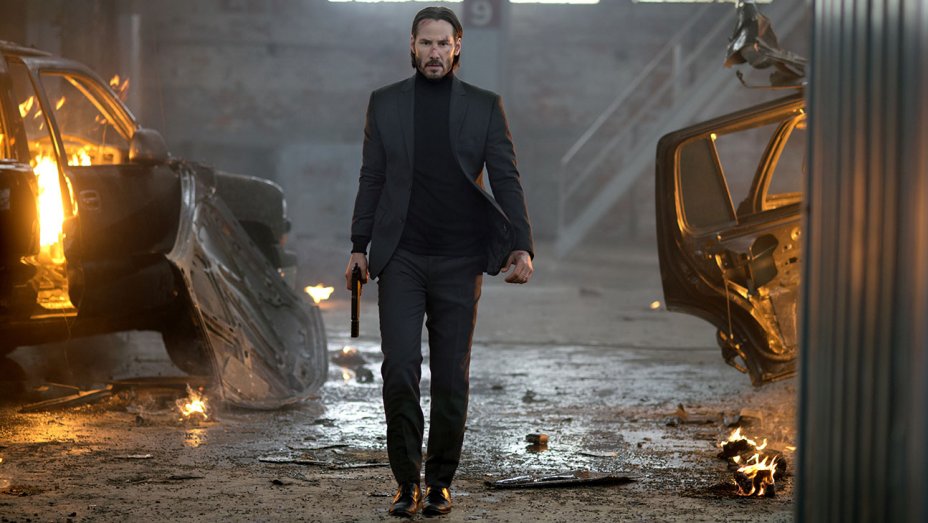
John Wick was thesleeper hit of 2014, elegantly combining kinetic fist and gun fights, fluid camerawork, and an effective, stoic performance from its lead, Keanu Reeves. There was a beauty in its simplicity: a former assassin grieving over the recent death of his wife gets done over by a small gang of scumbag Russian mobsters, who proceed to beat him to a pulp and kill his dog, and who are soon running for their lives as the slick-suited killing machine routinely takes them out one by one. Animal lovers can breathe easy as no dogs die in this sequel, although the anti-hero has found himself a new four-legged sidekick. The film's surprising success, as well as the shady underground universe it only hinted at, had action fans salivating at the thought of a follow-up.
Fans will be pleased that stuntman-turned-director Chad Stahelski is back at the helm, as is writer Derek Kolstad, who, although obeying the expected rule of sequels by making everything bigger and louder, both ensure that everything that set our pulses racing the first time around is present and suitably breathtaking. Opening with what can only be described as a ballet of fisticuffs and impressive stunt driving, we are instantly on familiar grounds. Having done everything but retrieve his 1969 Ford Mustang Mach 1 as he took his vengeance on anybody stupid enough to stand in his way, Wick lays siege to a dingy chop shop ran by Russian Abram Tarasov (Peter Storemare), the brother of Viggo from the first film. With pal Aurelio (John Leguizamo) restoring the classic vehicle, Wick can finally move on with his life. Only clearly somebody hasn't informed him that he's in a sequel. Soon enough, old colleague Santino (Riccardo Scamarcio) is at his door insisting on a favour.
Wick politely refuses, but Santino lays down a marker which symbolises an unbreakable oath. Although they kill mercilessly for a living, these contract killers have a code and a set of rules they must obey under penalty of death. Having left the game, Wick isn't having any of it, but the quick destruction of his home soon has him jetting off to Rome to carry out the job. His target: Santino's sister Gianna (Claudia Gerini), who was chosen by their father to take his place at the high seat of international crime bosses. The organisation of the underground assassins only hinted at previously really opens up in Rome. Met by the boss Julius (Franco Nero), Wick is soon getting fitted for expensive suits and choosing his arsenal with the assistance of Sommerlier (Peter Serafinowicz) for his so-called 'impossible task'. A smooth operation wouldn't make for a particularly exciting time, so Wick quickly finds himself under threat from bodyguard and colleague Cassian (Common), and Santino himself, who wants to leave no loose ends.
John Wick: Chapter 2 could have easily gotten ahead of itself. By opening up what was such a personal and emotional revenge mission last time into a continent-hopping world of hotel safe-houses and spies masquerading as the homeless, this could have become very silly very quickly. Instead, the film hypnotises you by making the action even more bombastic, and infinitely more violent (if you liked The Joker's death-by-pencil in The Dark Knight, just wait for this one). Even when events take strain credibility to the max by introducing the 'Bowery King' (Laurence Fishburne, in a nice reunion with Reeves), a man in charge of a huge network of tramp hitmen, and revealing that a startling number of the general public are in fact one text away from slitting your throat, you'll be too busy admiring the balletic carnage to roll your eyes. The bad guy may be even less interesting than the already-bland big boss from the previous movie and it's lost that element of surprise, but I was ready for part 3 the second the credits started to roll.
From the opening moments of sitcom-inspired office hi-jinks in this plinky-plonky rom-com, the outcome is never in doubt. When we first glimpse our leads - beautiful people Sandra Bullock and Ryan Reynolds - the inevitability of how this film will leave us is cemented even further. There's a set formula to these kinds of movies, and knows well enough just how the target audience it so aggressively pursues wants to be left feeling. The key to a decent rom-com is having a funny script; one that will have you laughing and hoping the mismatched couple will finally realise their love for one another to care about how predictable the whole things is. Anne Fletcher's The Proposal does none of these things, and instead betrays the likeability of its leads by having little zip, and keeping them apart for what seems like a large chunk of the movie.
Margaret Tate (Bullock) is executive editor-in-chief in a successful New York-based publishing company. She has an icy reputation in the office, and her panicked underlings frequently alert the others of her arrival via group e-mail. Her dedicated but overworked assistant Andrew Paxton (Reyolds) is the only one who tolerates her, and that is because he hopes to win himself a promotion through his loyalty and hard work. Margaret also happens to be Canadian, and after a minor violation of the terms of her work visa, she finds herself facing deportation and without the job she has worked so hard to get. In a panic, she announces that she has been seeing Andrew for the past year and the happy couple are soon to be married, much to Andrew's dismay. Sensing foul play, U.S. immigration agent Mr. Gilbertson (Denis O'Hare) keeps a close watch on them, forcing Margaret to accompany Andrew to a family get-together in Sitka, Alaska.
Despite never really convincing as a couple, and neither really having moments of clarity that will help us understand when the script starts to push the two closer together, the two leads are a joy to watch. Bullock is now a legend of the genre, and Reynolds demonstrates the cheeky charisma he wouldn't be allowed to fully embrace until 2016's Deadpool. It's solid proof that the fault lies with the material they're given. Once in Alaska, The Proposal becomes a sickly loop of increasingly bizarre comedy set-pieces, including a moment where Margaret must fend off an eagle attacking the yappy family dog. It's a sea of white, middle-class faces, and the only person of colour seems to be the Hispanic Ramone (Oscar Nunez) who, in a slight racist twist, works just about every job in town from store-owner to stripper. There's also the dull sub-plot involving Andrew's father (Craig T. Nelson), who wants his son to ditch his New York adventure to join the family business, which exists solely to give Andrew something to do away from Margaret. The stars deserve much better.
In 1955, with interest having waned in their other monster-based franchises such as Dracula, Frankenstein and The Wolf Man, Universal tried to capitalise on the success of their brand new monster - the Gill-Man - from the year before. Jack Arnold's Creature from the Black Lagoon was a rather sophisticated creature-feature: creepy when it needed to be, and effortlessly entertaining for the remainder. Arnold returned for directorial duties on Revenge of the Creature, but fails to inject the same level of excitement that saw Black Lagoon become a genre classic. It does what most sequels do and treads on familiar ground. Once again, the creature is set on a murderous rampage by the actions of humans, eventually falling in love with a beautiful woman it will inevitably kidnap.
After surviving the events of the previous film, the Gill-Man is rendered unconscious in his native swamp by some well-placed dynamite and transported back to the Ocean Harbour Oceanarium in Florida. Before he is even resuscitated, he becomes an instant media sensation, with flocks of sandal-wearing tourists arriving to catch a glimpse of the oddity. The Gill-Man is studied by square-jawed animal psychologist Clete Ferguson (John Agar) and student Helen (Lori Nelson), whose scientific methods include chaining the poor creature to the bottom of a water tank and zapping it with a cattle-prod any time it shows signs of aggression. It's not long before Clete and Helen are falling in love, and the envious Gill-Man gets to watch it all unfold through a tiny window. Naturally, events see the creature see free to stalk and terrify the surrounding areas.
Revenge of the Creature is an obvious retelling of the King Kong story, with a mystery of nature kidnapped from its habitat to be gawked at by humans. Despite his barbaric treatment, it never feels like the film is trying to generate sympathy for the Gill-Man. I certainly did feel sorry for him, but there was no sense of any of the characters involved acknowledging their error. It's hugely inferior to its predecessor, with little fun to be had with the charisma-free actors when the action is away from the monster. There are only two things of note in Revenge of the Creature: the costume for the Gill-Man is fantastic and is performed well underneath the prosthetics by both Ricou Browning and Tom Hennesy; and a cameo from a goofy, comic-relief character named Jennings, played with no suggestion of the legendary career to come by Clint Eastwood. The film was followed the next year by The Creature Walks Among Us, although Arnold didn't return.
The warning comes early on in Get Out, comedian Jordan Peele's deliciously unsettling horror and directorial debut. As successful New York photographer Chris (Daniel Kaluuya) phones his best friend Rod (a hilarious LilRel Howery) to break the news that he is to meet his white girlfriend's middle-class parents at their countryside home, Rod immediately voices his concerns. He is adamant that there is bound to be some weird, sex-slave shit going down, but Chris laughs it off with no idea with what is in store for him. In years to come, I have no doubt that Get Out will be a key case study in trying to understand the racial minefield that is modern America. While many have convinced themselves that such medieval attitudes are now behind them, it's quite clear that tensions are as high as ever in the #BackLivesMatter, post-Obama world we live in.
On their journey, Chris and his girlfriend Rose (Allison Williams) hit a deer. When being questioned by the police, the white officer can't resist giving Chris a hard time, even though he wasn't the one driving. He receives a telling-off from Rose, but the tone is set. Chris shrugs it off because he is no doubt used to it. Upon arriving at the impressive home of the potentially future in-laws, father and neurosurgeon Dean (Bradley Whitford) insists they are 'huggers', and appears to embrace Chris. He nonetheless lets slip opinions about wiping out the race of pesky deer who roam their land and voices his frustration at his own father missing out on the Olympic Games due to Jesse Owens, but again this is nothing Chris hasn't seen before from middle-class, white Obama-voters. Rose's mother Missy (Catherine Keener) is more steely, but is a trained hypnotist and offers to help Chris rid himself of his nicotine addiction. So far, so uncomfortable, but things soon get seriously weird.
For such apparently racially-blind liberals, their household staff are all black. Not only that, but they are like dead-eyed robots, all smiles and pleasantries masking pleading and inner turmoil. When Chris tries to bond with groundskeeper and fellow brother Walter (Marcus Henderson), the conversation is awkward and stiff, and maid Georgina (the brilliant Betty Gabriel) seems to do little during her off-hours but stare at herself in the mirror. At a gathering at their home, the only black face in the large crowd seems unnervingly familiar, but he is dressed up like a trophy pet by his fat, much older white wife. When Missy finally gets Chris to sit down for a session and open up about the death of his mother, his worst fears are truly realised. Taking inspiration from, of all films, Being John Malkovich (which also starred Keener), Peele directs these moments with the eye of a horror maestro, proving to be truly uncomfortable, claustrophobic viewing.
Get Out wears its heart on its sleeve, with an almost complete disregard for subtlety. However, this works in the film's favour. It's hugely entertaining and frequently very funny, so it will appeal to just about any audience, reaching more people in the process. Word-of-mouth has already gotten around, so the message is clearly resonating. It's sharp and unique in a way that modern horror movies rarely are, and in no way feels like an elongated sketch from the Key and Peele TV show. Although I've seen relatively little of his work outside of sketches on YouTube and his appearance with Keegan-Michael Key in season 1 of Fargo, there is nothing in his previous output to suggest he was capable of crafting such an intelligent and engaging horror movie. Satirically savvy and edgy, Get Out is also creepy and thoughtful, proving that a black man alone in the white suburbs is just as terrifying as a pretty white girl lost in the woods.
As we are frequently reminded during the course of T2, it's been 20 years since Danny Boyle's iconic and culturally eye-opening Trainspotting. Mark Renton (Ewan McGregor) and his cronies, in a monologue no doubt quotable to anybody who was a teenager in 1996, famously decided not to choose life, and instead were on course for a wasted existence of heroin addiction and crime. The main question asked by this sequel is: Was it worth it? The group fans were so eager to see back together may have less hair and more body fat, but they have finally put aside personal squabbles (McGregor and Boyle made up after the former was overlooked in favour of Leonard Di Caprio for The Beach) and worked around ongoing contracts to reunite. While T2 struggles to find a consistent tone and somewhat falls apart during its final act, it will no doubt put a smile on any fan's face.
The fragility of male machismo and the sudden emergence of middle-age are key themes running throughout the film, constantly harking back and reminding the audience with sly nods of how much fun these guys were 20 years ago. Trainspotting began with a skinny, pale-faced Renton running from store security, but here he runs dead-eyed on a treadmill. Although it would seem that Renton successfully put himself on the straight-and-narrow in Amsterdam after robbing his friends blind at the climax of the first film, he finds himself compelled to visit his past after suffering a medical scare. Returning to Edinburgh, not much has changed. Simon, aka Sick Boy (Jonny Lee Miller), is still running scams, now with his Bulgarian 'girlfriend' Veronica (Anjela Nedyalkova); Spud (Ewen Bremner) lives alone and is hated by his embarrassed son, successfully getting himself off heroin before making his way back to it; and the psychopathic Begbie (Robert Carlyle) is behind bars serving a 25 year jail term.
Irvine Welsh's sequel to the hit novel, Porno, has been talked about as a film adaptation ever since the first film struck so many chords with its audience. T2 is not this adaptation, but instead takes inspiration from Porno, as well as unused material from its predecessor, to create an original story. A straight-forward follow-up would not have done the fans justice. The cultural impact was so significant that Trainspotting played a big part in many young people's lives, to the point where just to hear the opening few seconds of Lou Reed's Perfect Day or Underworld's Born Slippy could transport any 30-40 year old back to their youth. Boyle knows this, and teases us in a scene where Renton re-visits his childhood home and fiddles with a record player. The stomping drums of Iggy Pop's Lust for Life pumps out before he suddenly takes the needle off the record. In that split second, the excitement comes flooding back. Yet T2 isn't just a trip down nostalgia lane, it confronts you with the difficult question of whether or not you are where you thought you'd be when life seemed more care-free.
Cinematographer Anthony Dod Mantle infuses the sequel with a modern energy, opting for a more colourful palette made dirtier with digital grain. It contrasts the films' two different styles by slotting in actual scenes from the original, often juxtaposing events happening now with the characters' memories. The main conflict revolves around Begbie's escape from prison and his learning of Renton's reemergence in Edinburgh, as well as Sick Boy's resentment of his former best friend robbing him of his share in the drug deal gone right. Begbie uneasily shifts between comic relief and genuine antagonist, and Boyle seems unsure what to do with the character. The biggest revelation is Bremner's Spud, who is still the most sympathetic reprobate ever to emerge from Welsh's text. Boyle and screenwriter John Hodge ingeniously find a way to make him front and centre, turning this into his story, and Bremner's performance is truly heartbreaking. A mishandled climax and a lack of development for Veronica means that T2 falls way short of its predecessor, and this will perhaps not have the same impact on any audience members who saw Trainspotting outside of the '90s. But for those of us who did, this is a welcome send-off.

 This pretty much sums up The Thomas Crown Affair: a polished, colourful star vehicle with an unashamedly glossy veneer. At the very centre of the story is a bank heist gone right, masterminded by the rather smug Thomas Crown (McQueen) after he handpicks his crew without ever letting them see his face. The thieves escape with over 2 million dollars, and nobody, including the rather clueless Detective Eddy Malone (Paul Burke), has any idea who it was. Enter Vicki Anderson (Dunaway), a no-nonsense independent woman with a love of the finer things in life. She quickly figures out that Crown was behind it all, but remains puzzled at why a man with everything would want to steal money he doesn't need. Of course, it's all a game, and the couple start their own game of cat-and-mouse as they embark on a steam affair.