Elke Sommer (the premier German actress (sic)), plays Magdalene Kruschen, a gold digging model, whose marriage to rich Charles, loses its verve. Each of them conspires to hire killers to knock off one another. The film is structured using court room scenes, mixing this with flashbacks to the events that are discussed on the stand. Based upon the true-life murder of Christine Demeter, one of the most famous crimes in Canadian modern history, this film, with its made-for-television aesthetic, is cheep, and fundamentally flawed.
We follow as the married couple (the names were changed for legal reasons), as they conspire against each other, Charles embarking on an affair with the young Pauline Corte (Cindy Girling - Miss Canada 1977). Magdalene, simply fucks anyone with money, power, and connections with killers-for-hire. It's an incredibly dull affair, pacing through severely wretched people, and their petty affairs. And of course, what these "wonderful" characters want, is the large insurance payoff in the event of deaths.
Whilst taking much of the real-life crime, it obviously needs to change it slightly. But it is left a little ambiguous as to Charles' actual guilt. He is (as in life) convicted of hiring a murderer, we are left guessing as to whether he actually did it. Still, awful film, with very little merit - although Howard Shore composed the score (his first feature film), and we of course know his subsequent scores include David Cronenberg's output, and The Lord of the Rings trilogy.
Since the 1995 release of Toy Story, Pixar was the unbreakable house with its stream of hits catering for both children and adults. Now in its seventeenth year of feature film production, it seems that it is the house of Disney that is most effecting their cinematic output. This years Brave, continues the standard of breathtaking animation, but does not innovate in this field - as was usually expected. Unfortunately, whilst previous hits such as Finding Nemo (2003), Wall-E (2008), and Up (2009), brought inventive new animation tricks, they also brought to the screen some fundamentally beautiful innovations to animated storytelling. Not only did they manage to enthral and delight children, the studio managed to amuse and cater for the parents (and adults without children), in a manner that seemed more, well, adult.
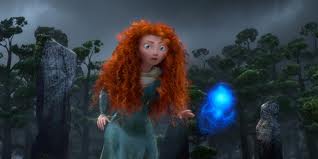
Brave tells the traditional fairytale set in the Scottish highlands. A young, red-haired princess, Merida (Kelly MacDonald), is forced by tradition to be married off to a young man from another clan, something that will be determined with an archery contest. Merida, however, does not wish to be married off and argues with her mother, Quenn Elinor (Emma Thompson). Taking off on her steed, she encounters a witch in the woods (voiced by Julie Walters), and she collects a spell in the form of a cake, that will change her mother, so that she will not have to marry. Unfortunately, the cake changes her mother physically, and in the form of a bear, they must break the spell.
Whilst not groundbreaking in animation or storytelling, Brave does have heart. The plucky princess wants to break tradition, making it an interesting feminist concept within the context of children's entertainment. It also holds the strong message that age divisions should stop to listen to each others own wishes (here the mother-daughter relationship is strained due to this lack of communication). But unfortunately, the film seems simply to tread themes and story ideas that have been exhaustively explored by Disney's more traditional output, with slight modernisations. And this is the problem I have with this release. Perhaps it is due to the complete merger between Pixar and Disney that the more conventional stories will begin to be their output. I really hope that this is not to be the beginning of the demise of Pixar's genuine genius. But criticism of their latest releases may aid the studio in developing the kind of stories that bring in kids, and entertains the parents/adults also.
With some other great voice work though (Billy Connolly, Robbie Coltrane, Kevin McKidd), the film is not a total failure, and will delight children. It does have some genuine laughs, particularly from Merida's younger triplet brothers, whose mischievousness brings some delectable comedy moments. Something other is also happening to cinema, and that is the influence of video games. Whilst Merida is "on her quest", she is often helped by willow-the-wisps (small illuminated apparitions), that direct her through forests to get to her destination. The unfortunate thing about this is that none of them sounded like Kenneth Williams - what a missed opportunity. Although, I guess they simply didn't know the reference. (Sad face).
Former Time Out critic, Christopher Petit's directorial debut, Radio On, shows its European credentials well. I say this for a couple of reasons. For one, like the French New Wave participants, Petit began as a film critic, and the sparing nature of this existential road movie, was self-consciously attempting to move British cinema towards a European style. Secondly, and far more telling, is the influence and participation of the New German Cinema of the 1970's. Whilst interviewing Wim Wenders, the subject of Petit's own screenplay arose, and Wenders was impressed. Therefore, Wenders became associate producer, and also lent the use of his cinematographer, Martin Schafer.
Beautifully shot in monochrome, the black and white imagery displays its artful intentions. We follow Robert (David Beames) as he drives from London to Bristol, after being informed that his brother has committed suicide. On his journey, he encounters several unhinged British citizens, including a Glaswegian squaddie with anger management issues, as well as meeting Sting at a petrol station, who seems to be obsessed with Eddie Cochran. Not much really happens in the film, but the most significant (at least the longest) "relationship" is with a German woman, Ingrid (Lisa Kreuzer - who was in Wenders' Alice in the Cities (1974 - Review #96)), who is searching for her missing daughter named Alice (a possible reference to the aforementioned German film.
This is a bleak representation of 1970's Britain. Not a hard task in itself (you could have pointed a camera anywhere in '70's Britain, and it would have been depressing). But what was fundamental to Petit's intentions, was actually a comment on the decline of British cinema. The main output of British cinema was within the prurient genre of the repressed "sex comedies" such as the on-going Carry On.. films, or the equally lamentable Confessions... series with Robin Askwith. When there was any serious attempt at British cinema, they were barely seen. Petit, felt that the Americanisation of our cinema's and the fact that our national cinema was laughable, was decreasing our cultural identity. Radio On is an attempt to move our cinema towards a more European, existential path, and with a more political consciousness.
Another day, another grossly absurd video nasty slasher film. J. S. Cardone's The Slayer offers nothing new to this (even by 1982) very tired sub-genre, each bringing nothing new to the screen - a tiresome effort to profit, and take advantage of horror tropes. Two couples go to a remote island on holiday, the two females based on cliche, as they appear aggressively unhappy about the trip before it even starts (typically ungrateful women! (sic)). Kay (Sarah Kendall) is an artist who paints from her nightmares, and she instantly feels uncomfortable on setting foot on the island.
Of course, once they have spent one night in the rental house, they begin to be mysteriously killed off, a fact that Kay believes she is responsible, as she had dream-premonitions of the gruesome events. With its dull colour pallet of browns, greys and yellows, this is pretty dull stuff. The plodding story could have been trimmed by at least 20 minutes, as the director seems to simply fill time with tedious rummaging, and bizarre and pointless dialogue.
One thing that does elevate this "shocker" is the supernatural manifestation of the monster, with its skeletal head, brightly lit in flaming orange colours. However, this image is left for the last shot on the island, and despite the movie tradition of not showing the beast until the end, this film may have benefited from a more prominent monster. The epilogue is bizarre in itself, bringing nothing to what had happened previously and possibly not really having any relation to the film at all - although, by this time I was so disinterested that I may have even distracted myself purposely to get away from the atrocity.
Based on Yasutaka Tsutsui's 1967 novel, - which has been adapted several times over the years, including 1983's The Little Girl Who Conquered Time - The Girl Who Leapt Through Time is a charming mix of drama and romantic comedy, with a slight infusion of science fiction ideas. Makoto (Riisa Naka) is a high school girl who, through serendipity, gains the ability to leap back in time (but she only manages moments or hours back). She has platonic relationships with two high school boys, Chiaki (Takuya Ishida) and Kousuke (Mitsutaka Itakura), and they spend their time playing baseball.
With her new-found abilities, she does nothing spectacularly profound, and the films intentions aren't to comment on paradoxes or to shift the space-time continuum as is usually the case with time travel narratives. Makoto uses her abilities to repeat events that pleasure her, to ace a school test, and also to avoid certain embarrassing situations with her friends. But as her relationships with, particularly, Chiaki and Kousuke, her leaps become more personally profound, as she attempts to possibly save the people she cares for (within the context of small human moments of danger, and not the usual global/country catastrophes.
I love the fact that in Japan, they do not distinguish between live-action cinema and animated (anime if you like) films, they are all simply movies. Now I'm going to contradict this with a Western perspective: This beautifully animated film is a delight to view, with its traditional two-dimensions, it is evidence to the west that 3D, computer generated animation is not the overbearing format, and 2D is still a genuinely viable medium. The film is filled with charming human moments, both touching and thoughtful. Teenage comedies rarely have this level of tenderness of character, that also explores concepts of fate, the passage of time and the intricacies of small human moments, and the delicate nature of human relationships.
Exiled from his native Russia, Andrei Tarkovsky shot his final film, The Sacrifice, on Faro Island, where Ingmar Bergman produced his body of work (and also lived). Tarkovsky also used Bergman's cinematographer, Sven Nykvist. He was also aware that this would be his ultimate film, as he had been diagnosed with terminal cancer. Unfortunately, whilst he survived till the release of the film, he died shortly afterwards, in the same year. The subject of his concluding piece is telling of his knowledge of his impending departure from the world, and it is fitting and profound, as you might expect from the Russian master of the poetic, and aesthetic.
Alexander (played by Erland Josephson - a Bergman regular, who also worked on Tarkovsky's 1983 Nostalgia), has a birthday, where some family and close island friend, Otto (Allan Edwall), come to offer their congratulations. They here on a statically-interrupted television broadcast. that a nuclear strike is imminent. With this news the family break down emotionally, and Alexander pleads to God to alter this reality, and offers himself in sacrifice to the ones he loves. This offering is seen to its fundamental conclusion when he wakes (possibly from a dream), and all is as it was, the threat of World War III seemingly never a subject of genuine certainty. Towards the climax of this film, is a one-shot take lasting several minutes, whose logistics are incredible, but Tarkovsky still manages to infuse the scene with some kind of mystical power, that I believe permeates all of his films.
As you would expect from a Tarkovsky film, the pace is slow (which gives the audience time to immerse themselves within the intricacies of philosophical thought, and the profound nature of the situation). But with this comes a flurry of beautiful imagery. The muted colours reflect the setting, with its cold, and subdued backdrop. And what is it that we do when we face death - a difficult moment to comprehend? We perhaps reflect on our achievements, and speak to our friends and family. And perhaps when we die, our spirit lives on in others, or new beings. Or maybe we simply continue in the minds and spirits of our offspring, passing on knowledge, character, and morality.
Another one of those horror films that has more alternate titles than it has ideas, this zombie movie uses the moral standpoint of the anti-drug governmental policy for its main premise. A group of young people are growing their own cannabis plants in a remote area of wilderness. A strange and cheap looking government body, arranges a toxic chemical crop spray, to eliminate these plants. However, the secretive chemical used, turns its victims into flesh eating aggressors.
After this event, of course, various groups of campers are attacked, eviscerated and left in parts around the forests. The groups are filled with generic characters with uninteresting stories. The opening moments of the film is intriguing and slightly dramatic, but this moment of interest is short-lived, as it simply falls back into the standard zombie film of the time - and of course the trend for the zombie increased again in the 21st century, but this wave was indisputably horrific (in the sense that almost 90% of output was awful).
It was obviously a project made from the heart, with passion at its centre, as director Charles McCrann also wrote, edited produced, and even played the lead role of Tom Cole. This passion does show, despite the shoddy production - and you have to give someone a little credit for at least attempting to realise their dream. With a slight ecological message within the plot, it is absolutely not the worst of its kind, but not enough for a thorough recommendation. Also alternately known by Bloodeaters and Toxic Zombies (amongst others), we at least have a denouncement of right-wing governmental policy amongst the grue, lame zombie attacks and distressingly annoying screaming women.
Like Carl Dreyer's Vampyr (1932), Hammer's The Vampire Lovers (1970), and Roger Vadim's Blood and Roses (1960), The Blood Spattered Bride adapts the 1871 Gothic novel 'Carmilla', a story of feminine control over masculine dominance. The 1970's saw a rise in lesbian vampire narratives, partly due to the cultural openness to the representation of female nudity in the cinema. Here Susan (Maribel Martin) is the young, newly married bride, who's husband's (Simon Andreu) sexual desires become increasingly horrific to her. With this escalation of pressure for sex, Susan's dreams become permeated with nightmares of rape. However, after hearing about the 17th century legend of Mircalla Karstein (Alexandra Bastedo), - who murdered her husband on their wedding night - her nightmares entwine inextricably with the ancient brides hatred towards men's sexual demands.
The husband increasingly becomes suspicious of Susan's behaviour, as her dreams lead her to a specific knife, that seems to be intended for him. In a strange introduction, he discovers a beautiful and mysterious woman hidden beneath the sand on a beach. This manifestation of the 17th century bride, comes into their home, and begins a sexual and dominating relationship with the young Susan. Whilst this is not over explicit, the two almost become one singular body, as many of the idiosyncrasies of the "ghostly" manifestation are transposed onto Susan.
The Blood Spattered Bride is an interesting film. It offers nothing particularly revelatory or new to this story, but it holds back where many would have been over-explicit, particularly with female nudity. The sensational aspects are kept subdued and this creates a more atmospheric experience (something that Jess Franco would certainly not have done). The languid pace of the film is in no way a hindrance, and offers time for contemplation. Whilst the climax of the film is very conspicuous early on, the short moments of gory violence do tend to come as a little shock amongst the usual beauty of the leading ladies. But this juxtaposition is pretty much all the shock you will get - the violence isn't as surprising if considered separately, and therefore has the same effect as seeing a shot of a crying baby, after seeing a shot of a knife wielding maniac.
While his set-pieces were certainly on a lower scale than Harold Lloyd, and his films were less politically and socially aware than Charles Chaplin, the great Buster Keaton was certainly a resourceful man, and wholly dedicated to the art of prop comedy. In 1924, he would buy his biggest prop in the USAT Buford, a liner that served in World War I and was destined for the scrap heap until Keaton stepped in. Keaton and co-director Donald Crisp sat down to write a new comedy based around their new toy, a giant ship that was ripe with endless comedic possibilities, and one which Keaton had free reign. And out of this came The Navigator, one of Buster Keaton's most loved comedies.
Bored rich-kid Rollo Treadway (Keaton) decides one day to get married, and travels across the street to propose to neighbour Betsy (Kathryn McGuire). Confident that she will say yes, he asks his servant to book honeymoon tickets for Honolulu that very night, but naturally, she turns him down. Rollo decides to go anyway, and a mistake leads to him getting on the wrong ship, the SS Navigator, which has just be sold to an enemy by Betsy's father in an unknown war. Her father is seized while checking the ship by some local gangsters, and Betsy, hearing her father's shouts, wanders onto the ship before it is cut loose. The ship drifts out into the Pacific Ocean, with Rollo and Betsy all alone to face the perils of savage tribes, dodgy equipment, and having to make breakfast all by themselves.
While I do prefer the films of Chaplin, Keaton's reputation as the greatest physical comedian of all time is well justified, with his doe-eyed, helpless expression providing some great subtle comedy between the prat-falls (his nickname was the Great Stone Face). One of the opening scenes aboard the ship has the two characters sensing each other's presence and running manically around the ship, missing each other by inches. It's a remarkably well-timed moment, and McGuire (who co-starred in other Keaton films) proves game and much more than the archetypal love interest. Although I much preferred the likes of Sherlock, Jr. (1924), The General (1926) and Steamboat Bill, Jr (1928), there are some inspired moments here involving Rollo's helpless attempts to open a can of food, a rickety deck-chair, and an underwater sword-fight with a swordfish. If the ending is tinged with a bit of racism (they're black and on an island, of course they're cannibals!), it seems to be more of a case of innocent ignorance, and The Navigator is a 60-minute hoot, though some plot-strands are left somewhat neglected and open-ended.
Over the past thirty or so years, the horror and science-fiction genre's of cinema have created vast armies of devotional fanatics, that they have somehow become somewhat powerful within the film making world. We now lovingly call them "fanboys", and as a public we view them as geeks. However, in the genre cinema world, their opinions, and attentions upon the minutia of a particular film, or film series, can sometimes alter the direction the film makers were originally going to take on the film. The horror genre is certainly one of these more scrupulously deconstructed filmic forms, perfectly illustrated with Wes Craven's Scream (1996 - 2011) films. But what The Cabin in the Woods does within this deconstructionist context, is to actually take a stab at criticising the level of involvement in the making of a film of the fanboys, and their connection with keeping something almost uniform, such as if the "conventions" of a genre are changed, it becomes an issue for the gimpy-kids.
Writer Joss Whedon and writer/director Drew Goddard have constructed a rather witty, and intelligent screenplay, that does everything within it's power to keep the conventions of a kids-go-to-the-woods horror movie. We follow five friends as they go to a remote cabin. They meet a desolate garage owner, who has no "gas". They begin acting within film-world stereotypes, and horror film images build. However, parallel to this action, we follow two white-collar workers begin their day at a production studio, pushing buttons at a console. These suit and collar workers structure, manipulate, and construct the horror narrative, making sure that every detail adheres to the set conventions.
Okay, so it could be argued that this is simply another criticism of reality television, and another apocalyptic view of our future entertainment. I would have to say that it is a little more complex than that notion. Whilst the films poster visualises a mechanical nature of this "puzzle house", the films secrets do not fully expose themselves to the climax. With many, many references to other horror films, - The Evil Dead (1982), gets the most - and a finale that will have horror fans delighted (if somewhat perplexed if they "get" it). The script is very knowing of horror history, and manages to maintain interest throughout, despite its more metaphysical concept. It's also good to see that Joss Whedon is finally getting the opportunity to flex his more cinematic muscles, instead of his usual relegation to television.
Continuing in a wave of ultra-violent revenge films from South Korea, - crystallised in Chan-wook Park's excellent Vengeance Trilogy (Sympathy for Mr. Vengeance (2002), Oldboy (2003) and Sympathy for Lady Vengeance (2005)) - I Saw the Devil takes the genre into brutal, kinetic, and near-to-the-knuckle gornography. Oldboy's Min-sik Choi plays a serial killer, Kyung-chul, who kills Joo-yeon (San-ha Oh) in her car in the opening of the film. She is the girlfriend of secret agent Kim Soo-hyeon (Byung-hun Lee), who then embarks on a no-holds-barred mission to find and kill the man who killed her.
It's your standard revenge film, filled with over the top grand guignol-like moments of gore, as heads are particularly targeted for tense battering, aided by the frenzied camera. But what makes these moments far more ferocious is the fact that between these contained flourishes of violence are connected with the more serene, delicate moments - it can become jarring. However, the use of this technique is an easy trick, and this is the issue with most films by Jee-woon Kim. Kim has that post-MTV generation paradox, - with its influence of short cuts fast camera movements, and stylisation - the content is largely left behind in favour of style. Since the 1980's, a film's look has often been more important than a message, or at least string narrative cinema.
The fact that Kim, and writer Hoon-jung Park have imbued the film with it's knowledge of the serial killer movie into the revenge film is a nice touch, but it is still thematically no different than any other revenge film. In bold strokes, I Saw the Devil, simplistically relates to the themes of the duality of mankind, as the agent digs deeper into an encompassing psychology of hatred, effecting all around him. To catch the killer, Kim Soo-hyeon has to become the killer, bringing him to the same level of depravity. It's a very stylish film, and the filmic touches are often stunning. However, with a rather long running time for this type of film, it does become increasingly nasty, and the beating, stabbings, and torture almost become the entire film, missing an opportunity to explore in an interesting and complex duality of the lead killer/agent.
In a small apartment complex that contains an alarming amount of beautiful women living on their own, a masked killer stalks carrying a toolbox full of weapons. Women are butchered with a hammer, a nail-gun, and a power-drill in a short period of time, and Detective Jamison (Tim Donnelly) is assigned to investigate. The killer, Vance (Cameron Mitchell), also kidnaps Laurie Ballard (Pamelyn Ferdin), a 15 year-old girl who bears an uncanny resemblance to his dead teenage daughter. With the inept Jamison refusing to believe it's kidnapping, Laurie's brother Joey (Nicolas Beauvy) starts to investigate the disappearance along with Vance's nephew Kent (Wesley Eure).
Traditional gore-hounds tend to turn their noses up at this movie, as after the extremely bloody opening half an hour, the film grinds to a halt and spends time developing it's somewhat tedious plot and characters. But the opening murders are very well done, with Donnelly taking time to develop the set-pieces, and they're usually played out with crooning music in the background that works well as a contradiction to the bloodshed. The killer isn't an unseen madman that seems to have supernatural powers of movement which is usually the norm in slasher flicks, but he is clumsy and awkward, bumbling his way around the room with a lop-sided ski mask, which makes him all the more real.
Another plus point is the performance of Cameron Mitchell. Like so many veterans of 1950's and 60's Hollywood, Mitchell ventured into European horror and TV in the 70's and 80's, as his old-fashioned style of acting didn't suit mainstream Hollywood, yet added the required gravitas to many a low-budget horror. His obsession with Laurie forms the most interesting aspect about the film, but it is criminally underdeveloped, and is resigned to just one extended scene. It spends far too much time focusing on the rather crap detective skills of her brother Joey, and his homoerotic relationship with Kent. I'm all for a horror film to slow down and take time to develop its characters, but they're executed with such an alarming blandness that the film becomes simply boring. But the film is well worth a look for a strong opening and Mitchell's performance, as well as the sight of the red-headed victim, who is one of the most stunning victims I've ever seen in horror.
Kuzco (David Spade), is a spoilt and heartless 18-year old ruler of the Inca Empire, who is planning to build himself a giant holiday home. He summons Pacha (John Goodman) to tell him that he, his family, and the rest of the village must make way for his lavish plans and find somewhere else to live. Kuzco also fires Yzma (Eartha Kitt), his advisor, and in her fury she plans to poison him and ruling in his absence. Yzma's dim-witted but loveable henchman Kronk (Patrick Warburton) gives Kuzco the wrong poison, and instead turns him into a llama. She trusts Kronk to finish the job, but he doesn't have the heart to let Kuzco die and eventually loses him amongst the villagers. Stranded in the jungle with his new llama body, he entrusts Pacha to protect him and return him to his palace, without having any intentions of changing his holiday home plans.
After a hugely troubled production (the title was originally Kingdom in the Sun and the plot involved a peasant look-a-like and a llama herder love-interest), The Emperor's New Groove arrived in 2000 to enjoy slim box-office success, something that Disney would have to get used to. The decision to swap the old-fashioned love story and moral preachings for a more silly and modern buddy-movie was a wise one, and film benefits especially from the work of Patrick Warburton, the man with possibly the best voice in comedy (he also does the voice of paraplegic Joe in Family Guy). Yet the tale is still an overly-familiar one, with the enlightenment of an ignorant rich kid amongst mixing with the lower-classes failing to find anything original to say.
The character of Kuzco is especially loathsome, but where usually the actor/voice artist would be talented enough to make the character endearing, in the hands of David Space, an actor of such a startling lack of talent, is annoying, and remains annoying throughout. There were times where I felt like shouting at Pacha to just kick him off a cliff. I found the whole experience quite charmless, and in an age of high-definition CGI animation, it is nice to see Disney take a traditional approach. Yet where their early films such as Snow White and the Seven Dwarfs (1937) and Bambi (1942) were drawn with expert beauty and love, Groove just looks lazy and heartless. It's not a total failure, the film is sporadically funny with the aforementioned Kronk getting most of the laughs, and Earth Kitt does some fine work as the twisted Yzma. But it's no wonder Disney would buy Pixar, as judging from this they were lacking from anything resembling inspiration or innovation.
Back when I was in my early teens, and starting to form a morbid curiosity with death (the arrival on the internet fuelled many a child's lust for real and graphic violence), I was discussing something horrific I'd seen whilst browsing this new medium with my mother. She told me about when her and my dad were married (my dad was then a police officer during the Video Nasty-era), they would often watch the films he had seized (I don't think he was supposed to be doing that, but oh well), and how they had once stumbled upon a real snuff film. I argued that snuff films don't actually exist, and are merely a myth, but she told me in detail about the film ending, and how the crew butchered one of the actresses, cutting off her fingers before disembowelling her. I didn't believe her, but she was adamant. So over ten years on, I text her to re-assure that she had been duped by Snuff, a massive shit-stain of a movie whose faux-snuff climax was exactly how she described. I actually wish it had been real snuff, because I wouldn't have had to waste 90 minutes of my life on this absolute drivel.
Snuff is actually a shelved film called The Slaughter from 1971, directed by Michael Findlay. Given it had a very limited theatrical run and was a babbling, incoherent mess, the film was shelved for four years until producer Allan Shackleton heard about the taboo-of-the-week snuff films, which were reportedly being made in South America. The Slaughter tells the story of a porn actress Terry London (Mirtha Massa) who is frolicking with her rich lover Horst (Clao Villanueva), while somewhere else, a man called Satan (pronounced Sa-taan, played by Enrique Larratelli) is a Charles Manson-type cult leader who has somehow managed to enslave a bunch of sexy biker chicks. Some murders happen, I don't really know why, but it has something to do with Terry and Horst producing a baby for sacrifice. For what reason, again, I don't know. Shackleton seized the opportunity and tacked on an ending filmed by Simon Nuchtern, which depicted one of the actresses filming The Slaughter being murdered by the crew, and re-released it as Snuff.
I'll hand it to Shackleton, it was a bloody clever idea to turn one of the most ludicrously muddled and pointless film I've ever seen into something that would make money. Although nowadays, the 'snuff' murder at the end is not convincing (the scene is edited, features bad dubbing, and has sound effects), I can imagine it convincing people back in the day. And it's actually well done - the moving hand after it has been chopped off was particularly effective - but whether it's more convincing because it's coming after an hour and a half of absolute wank, I don't know. But it's a lot to get through, even with it's slender running time, and when you think the film is about to start to make sense, it cuts to a nonsensical scene where somebody inevitably gets their tits out and the whole thing falls apart. Add to that the worst dubbing ever committed to screen, actors that would embarrass H.G. Lewis, and a plot of such astounding levels of bull-shit it would make Ed Wood jealous, you have one of the worst experiences that cinema has ever offered. Avoid at all costs.
If there was ever any proof that Roger Corman's New World Pictures would produce anything to make a buck, Night Call Nurses is it. Although, how this made money is beyond my comprehension (it is common knowledge that Corman never lost money with any films he produced). But then again, I assume this would have been predominantly show at drive-ins, and how many spectators would actually be watching the film? Anyway, the film begins with a topless girl jumping from the roof of a hospital, and then is never mentioned again, as we are introduced to our trio of "sexy" psychiatric nurses, Barbara (Patty Byrne), Janis (Alana Stewart), and Sandra (Mittie Lawrence).
The film is simply a series of non-sequential, rambling, unconnected stories (and story is too strong a word for the concept). We see a cowboy-style trucker, Kit (Dennis Dugan), who comes in cause he is tripping, starring at his hands (this scene is repeated later, as he enters a lighting fantasy in a truck cab, as he stars at his mirrored hands). Bathrode Benny (Martin Ashe) exposes himself at regular intervals, and the nurses break several doctor/patient restrictions by have relationships with patients (Janis with the tripping trucker, and Sandra with a black revolutionary that wasn't pleasant when they first met).
Barbara however, bizarrely gets therapy, but is then forced into psychosis, which manifests itself in a group meeting, where a bunch of cliched hippie-types sitting round a living room, as the male doctor encourages the women in the group to take their clothes off, in a bid to shake off any lack of confidence - it's this side of the sexual revolution that is rarely talked about, the lecherous side of men. There are also a series of car chases, explosions and smuggling out a revolutionary, but it's all just very silly and pointless. Kit does however, have one great (but very silly) piece of dialogue. Being seen out of the hospital by Janis, he reads her name badge: "Janis. Is that your name, or the name of your left titty?" Yeah, it's juvenile, but within the context of this pointless drama, it is a joy amongst the nonsense.