The Necronomican (a mythical book said to be a tool to open a gateway to an alternate universe) becomes the prized exhibit of Dr Armitage (Ed Begley) at the local library, and gets interest from the eccentric, and locally feared Wilbur Whateley (Dean Stockwell), who was born of a deformed mother who is now held in an institution. An encounter at the library leads him to Nancy (Sandra Dee), a pretty young blond girl; he seduces her and takes her back to his mansion - a local 'old dark house' shrouded in local fear and loathing to the population of the fictional town of Dunwich, Massachusetts. Nancy becomes embroiled in a necro-nightmare, where she has visions of strange ritualistic, tribal torture and sacrifice, and Wilbur manipulates her to become a vehicle to open the gateway open to let the "old ones" through to our world.
Based on the short story, published in 1929, by H. P. Lovecraft, the story is grounded in two of his most famous creations. One being the Necronomicon (a creation that has been used several times in popular culture - including Sam Raimi's Evil Dead Trilogy (1981 - 1992)), and the tentacled beasts of the other world, epitomised by Cthulhu (yeah, no one knows how exactly it is pronounced). Whilst much of his writings have now been adapted into films (most famously Re-Animator (1985) and From Beyond (1986)), his adjective-heavy prose is regarded less than the work of that other American horror writer, Edgar Allen Poe; perhaps symptomatic of his anti-Semitic attitudes in life.
Like the films pop art stylings of the Sandy Dvore title sequence, with it's bold colours and silhouetted figures, the films "horrific" action is marked with various coloured filters, giving a very '60's charm to it. Oranges, reds and blue filters flash on screen, the editing at times too quick to register, as the screams of victims, and the flight of a beast are signified simply, for budgetary purposes no doubt. Stockwell gives a fantastically hammy, yet suave performance as the tortured, yet controlling man, who's past is shrouded in mystery. The climax reveals a potent edge of cerebral, nightmarish horror, a conclusion of twisted, monstrous proportions. Produced by Samual Z. Arkoff's AIP, it sometimes feels like a very East-coast American Hammer film, but the tentacled monstrosity (which we don't really see exactly) is absolutely from the imagination of Lovecraft. It's preposterous, but a hell of a lot of fun - helped by Stockwell's furry eyebrows and moustache.
At the start of Robert Bresson's profoundly touching drama, the children who had been at the purchase of the young titular donkey, Balthazar, baptise the animal, which in essence renders him with a soul, and one which will encounter the cruelties and beauty of humanity. In this early life, the children, particularly Marie and Jacques (later playing as teenagers by Anne Wiazemsky - who later married Jean-Luc Godard - and Walter Green respectively), play with him lovingly, jostling in the hay. With monetary issues, Balthazar is taken into adult life, abused by masters who use his prowess to pull carts, whipping him regularly. He escapes, and goes back to that place of beauty, where the children had so adored him. Of course, they are grown, and Marie (the only one who actually lives at the farm) takes him back in, however, the farm is struggling, and this relationship is soon split.
As Balthazar is then moved from owner to owner, he is used to deliver bread, to again pull carts. He is saved at one point by a drunk, Arnold (Jean-Claude Guilbert), who is accused of murder - although this infraction is never elaborated on, and he is only accused several times by local teen-thug and thief, Gerard (Francois Lafarge). Balthazar also briefly becomes a star in a circus, making mathematical calculations using his hoof. Aside from the various moments of violence inflicted upon the poor animal, he is witness to the violence that the people he comes in contact with have over each other. Marie, ignoring the protestations of her fathers wishes to stay away from Gerard, she ignores him and continues a sexual relationship with the petty criminal, which inevitably leads to heartache.
Beautifully shot in black and white, the French rural countryside becomes a majestic, and yet horrific backdrop for the sins of humanity, and the innocence of an animal that is forced to do the bidding of the people. Bresson often frames Balthzar at the centre of the image, his large eyes portraying utter pathos - and we, the audience adore him. The final moments of the film are some of the most simple, yet moving moments in cinema history. Gerard, using the now old and work-tired Balthazar, steal him to carry contraband over the border. Fleeing the area due to gun fire from the border patrol, Balthazar escapes into a field where sheep are grazing. Having been shot he walks slowly and joins the flock, sitting, his eyes displaying something that resembles happiness - or at least a relief to be with other animals. The end, however, is also incredibly heartbreaking.
Based upon British bondage photographer and illustrator John Willie's 1950's and '60's fetishist character in the 'Sweet Gwendoline' comics, this French adaptation, vies more towards the adventure iconography of contemporary action cinema, than the Betty Page inspired submission-and-BDSM. Of course, the Gwendoline of the film does often - like the comic character - become tied in bondage (captured), but is not as sexualised, or eroticised - in the first two thirds at least. The film opens in China, and Gwendoline (Tawny Kitaen) has smuggled herself in a cargo case, - strangely her companion, Beth (Zabou), has not smuggled herself, leading to a questionable customs system - and has travelled in search of her father, who had been searching for a rare butterfly, in the mysterious region known as Yik Yak.
After being caught and bound by locals, she is inadvertently saved by American adventurer (in the vein of Indiana Jones), Willard (Brent Huff), a seeming misogynist rouge. Employing him as a guide, the three protagonists head for the land of the Yik Yak, in search of her father, and the mythical insect. After encounters with primitive tribes, and the inevitable capture-and-binding, the team enter a cave, that leads to a subteraenean world, where only women stay, mining for diamonds. Willard is used as a sex object, as several women fight to the death for the chance to be impregnated by him - and his death would be the inevitable end, after doing his duty.
The film has been often compared to Raiders of the Lost Ark (1981) and Barbarella (1968), and it certainly shares the latter's kitsch styling's. Luckily, considering the awful delivery of dialogue, and often terribly cliched lines, the film has it's tongue firmly lodged in it's proverbial cheek. However, this does not save it from coming across as crass, juvenile nonsense. In the subterranean world that the narrative climaxes in, it's iconography is filled with scantily clad, leather-bound women, which is a simple attempt at titillation - quite literally.
Directed by Just Jaeckin (a name that seems like a farcical mock - as in "just joking" pronounced in an Edinburgh accent) who previously had international attention with erotic hits, Emmanuelle (1974) and The Story of O (1975), he seems out of place in this fantasy adventure context. The saccharine relationship that develops between the male and female leads is horribly infantile, but as I previously said, this may be intentional, as the film makers may even have contempt for this kind of genre film - this is speculation. However, even if the "humour" was intentional, humorous is ain't, and simply comes across as callow and immature - and mostly seems like an excuse to show some tits.
Crime lord Frank White (Christopher Walken) is released from prison, and on his long drive back to New York City, witnesses the filth his city has descended into since his incarceration. His old friend Jimmy Jump (Laurence Fishburne) has just wiped out a Colombian drug operation and welcomes Frank back with a suitcase full of money and cocaine. Eager to win his city back, and also help fund the saving of an inner city hospital through his drug operation, he sets the wheels to his crowning in motion. But cops Roy Bishop (Victor Argo), Gilley (David Caruso) and Flanigan (Wesley Snipes) are on his case, but after struggling to bring Frank in under regulations, resort to more illegal methods of getting him off the streets.
King of New York was booed upon its initial screenings, with mass walk-outs and cult director Abel Ferrara being bombarded with uncomfortable questions. Audiences were apparently appalled by the films seemingly glamorous depiction of man who was essentially a homicidal maniac, encouraging violence and sleaze wherever he went. The film is certainly guilty of that, but the character of Frank is a little different to the likes of Tony Montana or Henry Hill. He seems to style himself as a champion of the lower-classes, using his influence and vast wealth to push a councilman to put forth the money to save a hospital in a poverty-stricken area, and then fund it himself when that fails. He and his girlfriend Jennifer (Janet Julian) are robbed on the subway by inner-city youths. Frank shown them his gun, and they back off, but Frank throws them a wad of money and tells them there is work for them if they want it. A crime-lord he may be, but is he any worse than the fat politicians that soak up the city's money, or the bent cops that are on his back?
In Walken's hands, White is a charismatic, unconventional crime boss, and is in turns charming, strange, and deranged. It's a fabulous performance, but for me it was Laurence (here still credited as Larry) Fishburne that steals the show, as the swaggering, loud-mouthed gun-man Jimmy ("yo, where the chicken at?" he says after killing a cop), a man of such ridiculous posturing that he almost becomes a cartoon character. And this is one of the main reasons I loved this film. It is, at times, so outlandishly over-the-top that it should betray its gritty roots, but its so steeped in atmosphere and that key element, grime, that it becomes a fantasy-laden, insane ride amongst a decaying city and one its most colourful characters.
For anyone who has seen the work of Abel Ferrara, especially two of his most popular films, The Driller Killer (1979) and Bad Lieutenant (1992), will know what they are in for. His New York is not the one you see in the earlier works of Woody Allen, but one of whacked-out prostitutes, cocaine-sniffing criminals, inner-city poverty, and angry, sweaty, middle-aged detectives. We do glimpse the glitzier side of the city in King of New York, as Frank often mingles with the politicians and power-players, but it is a world of black suits and orange lighting, and a world that shares the same depravity and sleaze as the lower-classes. It's a grim thing to see through Abel Ferrara's gaze, but boy is it brimming with atmosphere. This will always play second or third fiddle to the likes of Scarface (1983), but King of New York is the film the former could never be, and in its own depressing way, is a much better film. Undoubtedly Ferrara's finest, and most 'polished' work.
Like the Hollywood western in the 1960's, the "wild west" depicted in The Valley of Gwangi - set at the turn of the century - was the post-cowboy sideshow, as displayed in reality by its most famous component, Buffalo Bill. It was this type of circus show that actually inspired much of the iconography of the filmic western. In this 1969 film (a time when westerns were more popular in television, and Hollywood was dissipating), we are introduced to a Mexican rodeo owner, the "cowgirl" T. J. (Gila Golan), and her once fiancee, Tuck (James Franciscus), T. J. being the owner of a struggling rodeo. After Carlos (Gustavo Rojo) returns from the "forbidden valley" he has in a burlap bag, a tiny, pre-historic ancestor of the modern day horse. After its escape, a team are set up to recapture the profitable little tyke, and return it for display. On entering the forbidden zone, they discover a wealth of creatures directly out of the past, extinct only to the outer area of the zone.
The film is largely a combination of Sir Arthur Conan Doyle's story, 'The Lost World' (which was itself filmed in 1925), and the 1933 genre defining King Kong.Gwangi was penned by the special effects wizard of Kong, Willis O'Brien, but was shelved, and not considered as a conceivable project until after his death in 1962. (Incidentally the script inspired a very similar film in 1956's The Beast of Hollow Mountain.) However, by its release, even the monster movie was a dying breed of film, as the New Hollywood began to take over. Of course, as with the film version of The Lost World, and King Kong, the group capture a beast to take back for a unique public show, which inevitably leads to destruction and disaster.
Whilst this genre mash-up was clearly treading ground already exhaustively explored, the film has much period charm. The film is helped a great deal by the genius of Ray Harryhausen (a protege of O'Brien - and instigator for the production of this film). His attention to detail is incredible, and he imbues character into the monsters. There are an incredible amount of his special effects (dynamation as it is known here), and he delivers with aplomb. When the horseback riders capture a dinosaur using ropes, the sequence must have been a logistical nightmare, but the effect is brilliant - this highlights the reason Harryhausen is a legend. Gwangi also marked the last project that he would animate his beloved dinosaurs, and his later projects largely involved the mythical creatures of Sinbad's '70's outings (Golden Voyage (1973) and Eye of the Tiger (1977)) and Clash of the Titans (1981).
Henry Darger, an unassuming, reclusive janitor, working and living in Chicago, died at the age of 81. To his landlady and neighbours, he was a simple man, who rarely conversed with them, and died in 1973 a lonely man, with no family or friends to speak of. Before he passed in a nursing home, a neighbour visited him, telling him that he had seen Darger's work, and was deeply impressed. He replied: "It's too late now." His landlady, Kiyoko Lerner, entered Darger's small flat to clear it and found, to her amazement, rows of manuscript, along with hundreds of accompanying paintings. The book, a fantasy world constructed over decades, was over 15,000 pages long, and completely unique to the unknown inner world of the man.
Darger had created a totally specific world, titled 'The Realms of the Unreal', that told the story of the Vivian girls, and their adventures during many Christian-led wars, the Glandeco-Angelinnian War, caused by the child slave rebellion. The paintings, constructed with various mediums and methods, illustrated this fantasy world, using collage, ink and paint, and he collected images, xeroxing many particular images over and over, to portray his beloved Vivian girls. With no exterior life, and a lack of social skills, Darger had lived completely within this inner world, where he kept intricate details and charts detailing the events in the "realm", and documented the wars - including names, dates of soldiers deaths, the costs of each of these wars: immensely detailed, impeccably assembled.
Whilst the actual reality of Darger's life is difficult to portray - only three photographs of him exist - he did begin a diary of his life after he retired. His life was one of desolation, separated from life, he was a devout Christian; he seemingly never had a relationship with someone of the opposite sex, but wanted deeply to have children. Many of the images he left behind hint at a man, whose asexuality, seems to be more about naivety. Often, naked little girls are portrayed in the paintings as having penises. This could point to a complete lack of knowledge of gender difference. However, without any actual input from the man, it is difficult to fully understand, and we can only speculate - it would be easy to accuse the man of unnatural desires, but I think this may be a cruel conclusion.
Jessica Yu's film is constructed of interviews with the few neighbours (I can't say they knew him, as clearly no one did), and a narration by Dakota Fanning - Larry Pine also recites passages from the Darger diary, expressing his inner desires. Visually, Yu uses Darger's paintings, animating the figures, and constructs a narrative largely connected with the stories in the book. It is an incredibly touching, disturbing, enlightening and beautiful story, but one which is tainted by many insidious conclusions and speculations. I saw this about five years ago, and it never really left my mind. The opportunity to watch it again filled me with questions as to whether it would touch me quite as much. It's hard not to be moved by this story. After all, Darger created one of the most colossal, detailed, and epic pieces of outsider art that I have ever encountered. A portrait of a damaged, complex person, who never really had the opportunity to share his body of work, until his death. Posthumously, his work is now displayed for the public. In 2001 the Henry Darger Centre was opened in The American Folk Art Museum in New York.
The propagation of fear of the "other", or the unknown, is a fervent device used by governments for the control of the masses (the population). In the 1940's and 1950's in the west (particularly the United States - and to a lesser extent the UK), the common object of fear was the spread of Communism. In 1947, this paranoia about the infiltration of socialist ideologies into US politics, culminated in the organisation of HUAC (House Un-American Activities Committee), which began a witch hunt for any persons involving themselves (allegedly) in Communist politics and ideas. Propaganda was in full swing by 1954, and the hunt was extended into the arts, particularly Hollywood - with its "Harbouring" of socialism - which led to the imprisonment of "The Hollywood Ten" which included the writers and filmmakers involved in the making of Salt of the Earth - which was inevitably blacklisted.
With a largely non-professional cast (only five were professionals), this neo-realist style film tells the story - based on real events - of a workers strike for equality of pay and conditions for American-Mexicans working in the Delaware Zinc mines in New Mexico. Told from the perspective of Esperanza Quintero (Rosaura Revueltas - one of the five actual actors), the film opens with a domestic scene and her narration, as she outlines their social conditions, and the small community. Her husband, Ramon (incredibly heartfelt performance by non-professional, Juan Chacon), signifies the "traditional" male, whose displays a reluctance for his wife to involve herself with nothing but the upkeep of the home, and the raising of their children (not a particularly revelatory experience in the 1950's).
After the failure of the men - bound by union restrictions - to successfully picket the mine, the women of the village take their places, creating a barrier to the entrance. This destabilises the workers union to begin with, and fundamentally disrupts the home life of Ramon and Esperanza - whose conventional roles are reversed, creating an emasculated man-of-the-house. The reactions of the mining management/owners leads to the arrest of all the women, which creates an even greater sense of solidarity between the women, and eventually (once they realise the importance of this strike) the men.
Within the context of this film, it is hard to believe in this day that this film (which perpetuates socialist ideas - Communist theories) was regarded as dangerous to the point of being blacklisted. However, what this part of history highlights is that these political ideas are simply dangerous to a hegemony of market power. That is, the fear of Communism (or socialism) is simply that it would - in theory - give equal rights and fair wages to the workers of any company or corporation. Of course, if socialism did spread, this would mean the obliteration of the free market economy that has so far simply created a greater divide of rich and poor in the West, and ultimately led to such incredible greed, and intrinsically creating the banking crisis of 2008.
With a strong cast of actors and locals, this film is both enlightening and emotionally mature. It is itself a piece of pure propaganda, but it skillfully emphasises the socialist ideal of equality. The film also raises some interesting feminist questions - a movement that didn't really become part of popular culture until the late '60's and '70's - and gravitates towards alternative social roles for women. It was of course ignored by the Hollywood system, but eventually found audiences within film schools and workers unions. A common reaction was astounding: The Hollywood Reporter (a trade magazine) made a bold and frivolous statement claiming that the film was made under the direct orders of the Kremlin. It is an incredibly important piece of social history, that is also successful as an interesting and entertaining slice of cinema.
Professor Henry Jarrod (Vincent Price) is a wax sculptor who prides himself of making pure artistic creations of historical figures such as John Wilkes Booth and Marie Antoinette. His business partner and main investor, Matthew Burke (Roy Roberts), pushes Jarrod for a more gruesome 'Chamber of Horrors' display, but when Jarrod refuses to be drawn into such exploitative tactics to lure an audience, Burke sets his workshop alight to claim the insurance. Leaving Jarrod for dead, Burke receives the payout but is murdered by a strange disfigured man, and made to look like a suicide. Jarrod turns up eighteen months later with a new exhibit, and thinks he has found his perfect Marie Antoinette in Sue Allen (Phyllis Kirk). But Sue thinks she recognises some of the faces on the displays, namely her recently murdered best friend Cathy Gray (Carolyn Jones).
House of Wax was the first major studio release in 3-D, after the success of Bwana Devil (1952), and really kicked off what is now known as the 'golden age' of 3-D cinema. Of course, 3-D would enjoy revivals in both the 1980's and the modern day, with the release of James Cameron's Avatar (2009) really re-inventing the medium. Watching it in regular 2-D, the film does raise a lot of unintentional laughs in scenes where 3-D is obviously being used, but playing no real part in the narrative. Just before the opening night of Jarrod's new display, an entertainer stands outside with two paddleballs, batting the balls at the screen and even talking to the audience ("Hey, look, there's someone with popcorn!"). It is really a cheap trick in order to add a niche to a horror movie that adds relatively nothing new to the genre, but it also gives the film an irresistible charm, and a nice window into one of many little crazes that pop up in cinema from time to time.
The film itself is thoroughly enjoyable, regardless of being pretty run-of-the-mill. Remaking the marvellous pre-code horror Mystery of the Wax Museum (1933), Andre de Toth's re-imagining has the benefit of being able to be a little more sinister, and with the added luxury of Vincent Price. Price is pretty much the same character here as he is in most of his other horror appearances - charming, softly-spoken, but subtly menacing - playing a man who had to witness his prized possessions go up in smoke in front of his eyes - an experience that seems to have twisted his outlook on humanity. This is pure old-school horror, complete with lavish Technicolor (the '50's horror films commonly had a polished studio look), supporting ladies with aggravating screams, and a restraint on the gore. This is a key example of how the horror genre can produce an average, methodical film, that maintains the ability to charm, and most importantly, entertain. Also, watch out for an early performance from Charles Bronson, playing one of Jarrod's assistant Igor.
The story of the Invisible Man has taken many forms on TV, film and in literature since the publication of H.G. Wells' classic novel. The best known, possibly, is James Whale's fantastic Universal adaptation, starring Claude Rains as the scientist gone mad, and actors from the likes of David McCallum and Chevy Chase have played the title character since then to various degrees of sympathy. It was always a story of the psychological effects a new found power can have on a human being, posing the inevitable question of what would you do if no-one could see you? I wouldn't like to dwell on the things I would find myself getting up to, but director Paul Verhoeven is clear as to what he thinks men would get up to - voyeurism and rape, and this is a key theme throughout Hollow Man, amidst all the extreme gore of course.
Arrogant, obnoxious scientist Sebastian Caine (Kevin Bacon) makes a breakthrough in reversing invisibility on a gorilla, but when reporting his success to the Pentagon, he opts to hold back information to gain more time to experiment on himself. Co-workers Linda (Elisabeth Shue), an ex-lover and still the subject of Caine's affections, and Matthew (Josh Brolin), who is secretly dating Linda, voice their objections, but Caine's insistence eventually wins them round, and successfully turns himself invisible. The reverse serum does not work, so Caine is stuck wearing a rubber mask and shades while they work on the solution. But Caine finds that with great power comes endless possibilities, and his behaviour becomes increasingly more erratic and sinister, and begins to sabotage his colleagues efforts to bring him back.
Subtlety has never been Paul Verhoeven's strong suit, but where his films are always hugely tacky and pornographically violent, they come with a satirical bite, more often than not at the U.S.'s expense. But where Starship Troopers (1997), for example, was a massive amount of fun as well as being pretty bloody clever (American soldiers dressed like Nazis!), Hollow Man doesn't have the capacity to be anything but a familiar story with a large helping of cheddar and stock characters, and the satire is left outside. It's still enjoyable seeing the various faceless characters receive a grisly butchering, and some impressive CGI (even by today's standards) reveals many inventive ways you can see an invisible man.
But it's often embarrassingly over-the-top and the script is woeful even by it's own schlock standards ("don't you die on me!"). Caine's infatuation with the hot woman across the road (played by Rhona Mitra) leads to a nasty rape, and Caine frequently takes liberties with Linda and veterinarian Sarah (Kim Dickens). It's an interesting theme, and no doubt something that a lot of men would take up given the power of invisibility, but Verhoeven's camera seems to almost enjoy the voyeurism, making certain scenes quite uncomfortable. Yet an enjoyably hammy performance from Bacon overshadows the blandness of Shue and Brolin's one-dimensional characters, and helps lifts the film from bad, to average.
After witnessing his wife take a child into the castle of Count Mitterhaus (Robert Tayman), Albert Muller (Laurence Payne) rouses the villagers to his cause, and they stake Mitterhaus, a vampire, killing him. With his last dying breath, the Count curses the villagers, claiming they and their children will all die to bring him back to life. Fifteen years later, the village is riddled with plague, but the arrival of a travelling circus lifts their spirits. During one of their performances, the village is treated to a panther who turns into a man, Emil (Anthony Higgins), a clown dwarf, a strongman (played by Darth Vader himself, David Prowse), and twins that can change into bats. But when the mayor (Thorley Walters) goes into the hall of mirrors, he has vision of the returning Count Mitterhaus.
By 1972, Hammer Studios was on the decline. Audiences were gaining more sophisticated tastes, and their lust for blood was being appeased in mainstream films, who were beginning adopt a more realistic approach towards violence. Hammer, naturally, tried to evolve and survive, and were abandoning their traditional period settings (one of the things they were known for), updating things to 'Swinging' London. This led to the catastrophic Dracula, A.D. 1972 (1972), and so they opted to focus more on the sexual side to draw the audiences. Thankfully, they had one good film left in them, which went back to a period setting, and told a slightly macabre, unconventional vampire story, that is rich in both gore and sexual content.
This tale of lust-ridden vampires who gleefully kill children amongst a plague-ridden landscape is surprisingly dark given my previous experience of Hammer's output. Not to say previous films are 'camp', but they are played out with such theatrical vigour that they do have elements of camp, and although there are moments of this in Vampire Circus, this has a much more sinister feel to it. However, as lovely as the cinematography is (as always), and as pleasingly twisted the plot happens to be, this is still very predictable fair, most of which has been done far better in the past. But there is a clear reason why this has a strong cult following, it is certainly memorable, and despite it's many flaws, has all the elements present to why I love Hammer.
Three sisters travel to their late father's mansion where they are to spend three nights together with their respective husbands, before they are eligible to hear the will (read to them by a man wearing make-up to rival Ramses' from Blood Feast (1963)). Also there are the two housekeepers, Martha (Veronica Radburn) and Ruth (Maggie Rogers), and Martha's deformed and dim-witted son Colin (Hal Borske), who we see murder two people at the beginning of the film. After a night of pompous partying, one of the couples, Veronica (Eileen Hayes) and Bill (Don Williams), find a dead rabbit in their bed (which was previously seen being eaten alive by Colin) with a note attached reading 'blessed are the meek, for they shall inherit."
Directed by exploitation and horror hack Andy Milligan, The Ghastly Ones (titled Blood Rites in the UK and placed on the Video Nasty list) is a fine example as to why he is considered one of the worst directors of all time, commonly placed in the same category of Edward D. Wood, Jr. and Herschell Gordon Lewis. He began his career in small-time off-Broadway production during the 1950's, and his experience in that medium is evident here as, unlike most trashy horror films, the film is almost unbearably wordy, as the main characters have their mundane conversations between the brief moments of gore. Saying that, I would much rather be listening to conversation than watching overlong stalking scenes or disco dancing which was so prevalent as running-time-filler in Grindhouse movies.
However, the movie is a massive bore, and even with the slender running-time of 70 minutes, I checked how long there was remaining at least three or four times. The awful, clunky camerawork, added to the fact that the film stock was so poor I could barely make out faces, gave me a headache. When the moments of inevitable gore come, the film is given a little relief, as the scenes of pitch-fork impaling and disembowelment are so bad it does give the film a little charm. It would work quite nice as a double-bill with the aforementioned Blood Feast, as they are both short, amateurish, and most notably, shit.
Rudy Ray Moore reprises his comic character creation, Dolemite, the hyperbolic, Mohammed Ali-jive-talking, rhythmic discoursing, man of the people. The sequel to 1975's Dolemite, the film offers nothing new to the series, or to blaxploitation cinema, but simply adheres to the generic signifiers, such as female nudity, car chases, and the ubiquitous kung-fu cross-over. But significantly for the stylistic variations of the sub-genre, the subject of racism is the most evident theme - despite the fact that blaxploitation is readily accused of reverse racism (a term I have never understood, as this would suggest that racism is a purely white condition - it's all xenophobia).
Dolemite is caught in bed with the local red-neck sheriff Beaty (J. B. Baron)'s wife, who is then shot dead by his deputy. Escaping this situation, Dolemite flees to California, and the sheriff's crew follow, pinning the crime upon Dolemite. Lady Reed also reprises her role as Queen Bee, and she along with "her girls" have their club shut down by the mob, and it is up to Dolemite to settle the score.
Undoubtedly taking into account the failings of Dolemite, the sequel increases much of what makes exploitation cinema exciting. The violence is more nuanced, there is a lot more naked flesh on display, but more significantly, the comedy is far more indulgently silly, over the top ridiculousness. It's those rhythmic one-liners that Moore produces that increase the enjoyability of the film. And of course (as previously stated), no blaxploitation film would be complete without that other ethnic sub-genre, kung-fu, and here we are enthralled by the ferocious work of the Central American Nunchuck Champion, plus an early role for future Ghostbuster, Ernie Hudson. Marginally better than its predecessor, it has a strange ability to be both dull and exciting.
Trouble in Paradise is a film that could not have been produced only four years after its 1932 release. Under the soon-to-be Hays Production Code, this narrative of con-artists flagrantly breaks levels of decency, sexual innuendo and criminality that the code was set up to eradicate. Lily (Miriam Hopkins) and Gaston Monescu (Herbert Marshall) join forces in Venice to become a couple of grifters, they live together in sin and have no scruples when stealing is concerned. They move to Paris where they target the famous perfume manufacturer Madame Mariette Colet (Kay Francis), finding confidence with the heiress, Gaston becomes her secretary, and play the long game in consuming as much of her wealth as possible.
With romantic entanglements becoming increasingly apparent, Colet practically offers Gaston a position as a gigolo. This menage-e-trois - love triangle - complicates the situation, as relationships become heated. It's a masterwork of comedy, with Hopkins being the most delightful and versatile of the cast. Her plucky attitude, and effervescent presence gives the film a fantastic tone - in one scene she sits at the bedside of Colet, and anxiously holds her hands under her legs so as to stop herself from stealing the jewels on the bedside table.
Based on Hungarian playwright Aladar Laszlo's stage work, 'The Honest Finder', this was the first of Ernst Lubitsch's films given the mantle of having "The Lubitsch Touch", this is a perfect example of creative film making. His camera glides through scenes, and from window to window in some scenes (perhaps nothing to a modern audience, but an incredible achievement in 1930's cinematic production). This is possibly the finest film in the pre-code era, and a complete joy in all respects. As it was produced before Will Hays's iron fist came crashing down on Hollywood production, the film doesn't insult its audience with a moral conclusion, as the thieves happily disappear into the sunset, laughing at the "ill-gotten" stash. Beautiful, anti-moralistic comedy at it finest.
A perfect example of how film style can be influential across continents, and can project that influence back into a dying genre, Akira Kurosawa's Yojimbo took its plot from Dashiell Hammett's crime novel 'Red Harvest' (which also influenced Miller's Crossing (1990)), retold as a samurai jidai-geki (Japanese period film), but fundamentally the film was a stylistic homage to the widescreen American westerns, of particularly John Ford. By the 1960's the western genre was diminished in the United States, but Italian director Sergio Leone borrowed the entire scenario of Yojimbo (this translates as The Bodyguard), cast then unknown Clint Eastwood, and made one of the greatest westerns, A Fistful of Dollars (1964). Kurosawa's influence can be seen in many post-1960's American directors in a wide range of styles and genres.
Set in the 1860's, where the shogunate, samurai tradition was suffering due to modernisation and changing attitudes. The lone samurai figure (known here by a false name, Sanjuro), played by Kurosawa's favourite actor, Toshiro Mifune, arrives in a feuding small town. Two rival gangs fight and bicker to gain total control over territory, and Mifune, a hired killer, brings his own bitter vengeance, and begins playing off the rival gangs off of one another. He changes sides at whim, and bargains for the greatest offering of money. His skills as a samurai are displayed when he first arrives in town, and his abilities are lauded, and the head of each gang vies for the samurai's attention, and for the chance to win the war.
Kurosawa's love of the widescreen format (tohoscope is used here - the branded system - like technoscope/vitascope et al. - for Japan's Toho studios that Kurosawa was working under), is obvious, and he uses it incredibly well. The incredible widescreen compositions are a beauty to behold, enhanced by black and white photography and the cinematography of Kazuo Miyagawa. Kurosawa was also a master of atmosphere, from character tensions to the more ethereal: Capturing feudal hostilities in western genre iconographic imagery, the opposing groups standing at each end of the street, Kurosawa adds the consistent movement of the wind moving the autumnal leaves - this is the kind of detail that heightens the visual experience.
Kurosawa's influence is undisputed (George Lucas - living off his one idea as he does - was hugely influenced), his style and storytelling genius would be hard not to homage - or "borrow" from. His imagery alone stand as fundamentally beautiful, the compositions' mis-en-scene holding the story together, making it believable and in fact becomes the films foundation - you could easily watch the film with the sound off, and still become totally absorbed in the story. With a genuine sense of humour (very black humour consequently), the film shows its intentions as a funny story about the foolish nature of war, in a diminishing world of tradition and the coming of modernity, with all of its machinery.
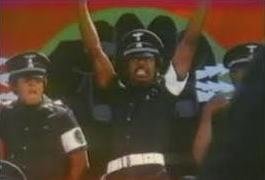
One of the many blaxploitation with the title prefix Black... (...Samurai, ...Caesar, ...Aphrodite), Gestapo also manages - rather uncomfortably - to incorporate the iconography of Nazism, bringing another of the popular sub-genre's of the exploitation market, that together make nazi-blaxploitation. "The People's Army", a vigilante group headed by General Ahmed (Rod Perry), are set up in Watts to protect black citizens in the inner city. After they run a white criminal organisation from the community, second in command Colonel Kojah (Charles Robinson), breaks the group in the middle to form his own, more fascistic group, indulging in money-making activities such as drug dealing, and orates for more direct, violent action.
Writer-director Lee frost (along with co-writer-producer Wes Bishop), has obviously, and incredibly insensitively, misinterpreted the black power movement in the late 1960's/'70's - particularly the Black Panthers - and presented it with Nazi iconography. It's an uncomfortable juxtaposition to see a group of black men congregated on a ghetto basketball pitch, dressed fully in the garments of the most vilified, ultra-racist political movement of the twentieth century. Why exactly would anyone (but particularly an ethnic minority), take on this most instantly recognisable of images?
There does seem to be an attempt to perhaps represent the opposing views of the two major iconic black figures of the 1960's. In Ahmed we have the message of non-violent protest from Dr. Martin Luther King Jr., whilst Kojah's view of violent actions mirrors the philosophy of Malcolm X, and his pronouncement of using violence in self-defence. But maybe I'm just reading into something that's not actually there. When the film isn't insulting its audience, it displays nothing new to an already lagging genre, and simply presents generic tropes: Blaxploitation was always criticised for perpetuating racial stereotypes, but this film could indeed be guilty of far more. With a series of scenes-we've-seen-before, such as the castration of a white man, after he raped a sister, the film also uses the contemporary necessities such as soft female nudity. Action scenes are played out with little excitement or even much vigorous movement, which along with the amateurish film making makes this film a totally dull squib. So... Hardly the "New Master Race," instead simply insulting to anyone who watches.

 Based on the short story, published in 1929, by H. P. Lovecraft, the story is grounded in two of his most famous creations. One being the Necronomicon (a creation that has been used several times in popular culture - including Sam Raimi's Evil Dead Trilogy (1981 - 1992)), and the tentacled beasts of the other world, epitomised by Cthulhu (yeah, no one knows how exactly it is pronounced). Whilst much of his writings have now been adapted into films (most famously Re-Animator (1985) and From Beyond (1986)), his adjective-heavy prose is regarded less than the work of that other American horror writer, Edgar Allen Poe; perhaps symptomatic of his anti-Semitic attitudes in life.