Showing posts with label Brad Pitt. Show all posts

Friday, 5 October 2018

Review #1,401: 'True Romance' (1993)

It's been many years since I last saw Tony Scott's True Romance, huddled up in my bedroom as a young teenager in fear of being caught with my older brother's VHS. I loved it then and I still like it very much, but it never struck me before just how much of a boy's fantasy the film is. This is a story in which a comic-book store worker forms a relationship with a gorgeous hooker-with-a-heart and successfully avenges her mistreatment at the hands of a despicable pimp, all before riding off to Hollywood with a case full of cocaine and dreams of an early retirement in mind. This is no surprise when you see who was behind the script - a young Quentin Tarantino - who at the time of writing was working in a video store dreaming of bigger and better things. But the fact that this is a fantasy isn't a bad thing. True Romance sweeps you up into its universe of outlaw love, mean-spirited gangsters and the ghost of Elvis Presley and doesn't allow you to pause for breath.

The hero at the centre of the story is Clarence Worley (Christian Slater). We meet him in a bar trying to chat up a woman by expressing his love for Elvis and inviting her to join him in a Sonny Chiba triple bill playing at the local theatre. You can almost imagine Tarantino speaking these words and being hit with a rejection, but Clarence is Tarantino's creation, so he has popcorn spilled over him by an attractive blonde named Alabama (Patricia Arquette) as he sits watching one of The Streefighter films alone. The two hit it off and spend the night together, before she reveals she is actually a call girl hired by his friends (the name should have been a hint). But she actually falls in love with Clarence, and him with her, and the two are quickly married before Clarence's attention turns to the pimp who is still holding her belongings, the milky-eyed and dreadlocked Drexl (Gary Oldman). Their confrontation leaves Clarence in possession of a suitcase chocked full of cocaine, so the newly weds head to Los Angeles to find a buyer, with the help of their clueless contact and aspiring actor Dick (Michael Rapaport).

Their road trip allows the opportunity for some familiar faces to flex their acting chops with the assistance of Tarantino's impeccable screenplay, including the likes of Dennis Hopper as Clarence's estranged father, Christopher Walken as fearsome gangster Don Vincenzo, Brad Pitt as Dick's useless stoner roommate Floyd, and a noticeably thinner James Gandolfini as one of Vincenzo's more sadistic thugs. It's a fast and furious two hours, with so much going on that you're barely given time to stop and realise that nothing much really adds up. The film sweeps you up into its silliness, forcing you to bow down to its own particular brand of cool. If you've seen Tarantino's directorial debut Reservoir Dogs, then many of True Romance's story beats will feel familiar (the story carefully moves its characters into place so they will eventually be in the same room at the same time with loaded guns pointed at each other), but Scott's style and energy make the ride exhilarating. The two leads are charming, with Slater convincing as a geek-turned-loose cannon and Arquette portraying just the right blend of cute and sexy, but the real star is Tarantino, who somehow manages to turn an adolescent fantasy into an exciting thrill ride.


Directed by: Tony Scott
Starring: Christian Slater, Patricia Arquette, Dennis Hopper, Val Kilmer, Gary Oldman, Brad Pitt, Christopher Walken, Michael Rapaport, James Gandolfini
Country: USA/France

Rating: ****

Tom Gillespie


True Romance (1993) on IMDb

Thursday, 24 March 2016

Review #1,000: 'The Big Short' (2015)

With a career built around Will Ferrell vehicles such as Anchorman (2004), Step Brothers (2008) and The Other Guys (2010), writer/director Adam McKay has made an astonishing leap into the big-leagues with The Big Short, clearly a passion project that discusses the inner workings of the housing market and subprime loans and manages to make it entertaining, funny and infuriating all at the same time. It tells the story of the financial crisis that hit the U.S. and eventually the rest of the world in 2007, and the men who foresaw it and profited hugely from the disaster while nobody paid attention.

Adapted from Michael Lewis's novel of the same name, The Big Short tells three non-intertwining stories. One-eyed hedge-fund manager Michael Burry (Christian Bale) suffers from Asperger's, but what he lacks in social skills he makes up for in sheer ability to read numbers. He is the only person to take a look at the housing market in detail and sees its collapse as a certainty. Visiting several banks, he bets against the market while the staff laugh behind his back. Spray-tanned trader Jared Vennett (Ryan Gosling), who also serves as our fourth-wall-breaking narrator, catches wind of this and, realising that Burry's predictions are likely correct, decides to bring his credit-swap dealings to the attention of other potential investors.

One person who is convinced by Vennett's proposal is Mark Baum (Steve Carell), a hedge fund manager with anger issues and a hatred of The Man, who, along with his team, starts to investigate these distressing claims for himself and learns that the banks have been selling collateralised debt obligations - loans made up of worthless bonds given fraudulent AAA ratings. Small-time investors Charlie Geller (John Magaro) and Jamie Shipley (Finn Wittrock) also want their piece of the action but are below the capital threshold to make a worthwhile profit and so employ Ben Rickert (Brad Pitt), a former Wall Street trader turned reclusive organic-obsessive, to assist them with their trades.

If it all sounds a touch confusing, it's because it is. The entire housing market was wrapped up in so many layers of bull-shit that it took a weird genius such as Burry to actually see it for what it was. McKay is aware of this too, and to ensure that attention doesn't wander during those important moments of exposition, he employs celebrities such as Margot Robbie, Anthony Bourdain and Selena Gomez to explain it to the audience in simple terms. The film doesn't think that the audience is stupid, but simply acknowledges just how dull the subject matter is. The fact that the banks ultimately escaped punishment and were bailed out by the government reinforces the importance of the general public's understanding of how they operated to ensure it doesn't happen again (although the sobering revelations at the climax reveal that they're at it again already).

The cast is uniformly flawless. Carell is the stand-out. with his Baum serves as the film's simmering champion of the little people. While he works in stocks, he holds nothing but disdain for the way his country operates. Bale is terrific too, careful not to paint Burry as a cartoon character as he slumps around his office in shorts and bare feet and pounds air-drums to heavy metal (Bale also has the uncanny ability to move each of his eyes independently, removing the need for a fake glass eye). While Gosling's Vennett is your typical grease-ball suit, he revels in the characters arrogance and projects enough charisma to even convince Baum to trust him. Despite the ensemble, the real hero is McKay who resists laying on the style too thickly and delivers a film bursting with energy, maturity and humour. Of the Academy's 2015 Best Picture line-up, The Big Short is my pick for film of the year.


Directed by: Adam McKay
Starring: Christian Bale, Steve Carell, Ryan Gosling, Jeremy Strong, Rafe Spall, John Magaro, Finn Wittrock, Brad Pitt, Marisa Tomei
Country: USA

Rating: *****

Tom Gillespie


The Big Short (2015) on IMDb

Friday, 13 March 2015

Review #844: 'Fury' (2014)

It's highly likely that David Ayer's Fury will conjure memories of Saving Private Ryan (1998). It will also bring to mind The Wild Geese (1978), The Dirty Dozen (1967), and just about every World War II movie ever made. It's also hard to shake off the idea that Brad Pitt is not playing Aldo Raine, his drawling, neck-scarred leader of a band of Nazi hunters in Quentin Tarantino's excellent Inglourious Basterds (2009). Although Fury is certainly not lacking in spectacle and decent performances, it just doesn't come up with any ideas of its own, stumbling along a wafer-thin narrative and getting lost on its way to try and figure out what type of film it wants to be.

We are in the climatic days of the war, with the U.S. deep into Germany territory, and the crew of 'Fury', an M4A3E8 Sherman tank, long battle-worn. Don 'Wardaddy' Collier (Pitt) is a hard man (we first meet him knocking a German soldier from his horse and stabbing him to death), but he struggles dealing with the horrors he has witnessed. With a crew member dead in their latest fight, rookie Norman (Logan Lerman), a kid who has never fired a gun or experienced combat, is plucked from his typing duties and thrown into Fury. The crew, consisting of bible-bashing gunner, er, Bible (Shia LaBeouf), token Hispanic driver Gordo Garcia (Michael Pena), and scumbag mechanic Coon-Ass (Jon Bernthal), don't take too kindly to the new arrival.

Perhaps the most frustrating thing about Fury is that it hints at potential brilliance. The underlying theme seems to be that war turns men into animals, and in one stand-out scene in which Wardaddy takes Norman into the home of two German women so he can lose his virginity, only to be interrupted by his crew and a drunken, vulgar Coon-Ass, manages to create an atmosphere of tension and discomfort. The battle scenes look very impressive too. Bullets fly across the screen like lasers, and one set-piece involving a squad of Sherman facing a superior German Tiger tank is exciting, but the film is often too eager to revel in gore and flying body parts.

Fury spends so much time giving us blood, guts and loud noises that it forgets to give us any resemblance of a plot to hang onto. It also gets so lost in trying to hammer home how damaged these men have become than it doesn't allow us to get to know the characters on any deeper level than their primary personality trait, ticking off a check-list of war movie cliches on its way. It all builds up to a ridiculous climax that pitches Fury against a 300-strong company of SS panzergrenadiers, who all proceed to jog gleefully into a hail of machine-gun fire like many a faceless video game baddie. It manages to insult both the German army and the audience's intelligence. We are given little to make us sympathise with the Americans apart from the fact that they aren't Nazi's, so come the emotions at the end, it's difficult to care at all.


Directed by: David Ayer
Starring: Brad Pitt, Logan Lerman, Shia LaBeouf, Michael Peña, Jon Bernthal
Country: USA/China/UK

Rating: **

Tom Gillespie


Fury (2014) on IMDb

Saturday, 1 March 2014

Review #717: 'Se7en' (1995)

After his calamitous experience working on his début film Alien 3 (1992), David Fincher took on a small genre picture that, little did he know, would revitalise his career and become one of the greatest films of the 1990's. Se7en appears to begin as your typical detective neo-noir, with the cynical veteran and the naive rookie taking on an elusive serial killer seemed hell-bent on turning the sin against the sinner. But, set in an unnamed and permanently drizzly American city, Se7en is a meditation on evil and a pessimist's depiction on the modern world, climaxing in one of the bravest and most memorable endings in Hollywood history.

Detective Somerset (Morgan Freeman) is on the verge of retirement, where he plans to leave his inner-city life behind him after years of fighting on the side of good. His replacement is the brash Detective Mills (Brad Pitt), an optimistic young recruit eager to learn, who Somerset takes under his wing. Their first homicide investigation involves an obese man who has been fed at gunpoint to the point of causing his stomach to rupture. With Somerset ready to leave the force, Mills takes on his first solo case in the murder of a rich attorney, a man forced to cut a pound of flesh from his own body. The murder scene has the words 'greed' written in blood. Somerset eventually finds the word 'gluttony' etched in grease in the apartment of the first victim, and he becomes convinced the murders are connected, and that the killer is murdering under the guidance of the seven deadly sins.

The genius of Se7en is rooted in the way the movie keeps the audience as clueless as the detectives. Normally in genre pictures such as this, we either know who the killer is and eagerly wait for the investigators to put the pieces together, or we have a line-up of suspects and red herrings to decide from. Here, apart from brief glimpses during a thrilling chase scene, we are devoid of clues. The killer is always one step ahead of Somerset and Mills, alluding to the idea that the mysterious 'John Doe' is indeed having his work guided by a higher power. Of course, he is not, he is merely a man, but this helps gives Se7en dramatic weight, rather than it becoming a nihilistic exercise in cruelty.

When, three-quarters of the movie in, the killer hands himself in, the movie becomes a masterclass in writing, slowly building into one of the greatest climaxes in film. Somerset, a decent man who has devoted his life to the side of good but has had the fight slowly drained out of him, meets his nemesis in John Doe (Kevin Spacey). But as they talk, Doe's reasoning becomes clear and, shockingly, almost sympathetic. "Wanting people to listen, you can't just tap them on the shoulder anymore, you have to hit them with a sledgehammer," he says. It's about a world gone to shit, a view shared by Mills' wife Tracy (Gwyneth Paltrow), who talks to Somerset in a diner about allowing a baby to be born into the world after discovering she is pregnant. Cerebral and gothic, Se7en transcends the genre on so many levels thanks to some bleak yet stylish direction by Fincher, and it still manages to astound after almost 20 years of repeat viewings.


Directed by: David Fincher
Starring: Morgan Freeman, Brad Pitt, Gwyneth Paltrow, Kevin Spacey, R. Lee Ermey
Country: USA

Rating: *****

Tom Gillespie


Se7en (1995) on IMDb

Thursday, 16 January 2014

Review #702: '12 Years a Slave' (2013)

Practically neglected entirely by cinema, it seems that America is finally holding its hands up in the air; ready to face its utterly barbaric history surrounding the kidnapping of black Africans and the introduction of slavery. Last year saw Quentin Tarantino deliver a sporadically entertaining yet hardly historically accurate depiction of slavery and plantation owners in Django Unchained, but British director Steve McQueen has delivered an unflinching, heartbreaking true story in 12 Years a Slave, an account of the experiences of Solomon Northup (Chiwetel Ejiofor), a freeman living in American who is kidnapped, taken from his wife and children, and sold into slavery.

After a conflict with a sadistic overseer (Paul Dano), Northup is passed on by gentle plantation owner Ford (Benedict Cumberbatch), into the hands of the cruel Edwin Epps (Michael Fassbender). There he finds himself caught up in a conflict between Epps' wife (Sarah Paulson) and fellow slave Patsey (Lupita Nyong'o). Patsey is treated cruelly by Mistress Epps simply because her husband desires her sexually, and Patsey pleads with Northup to end her life. Although coming from an educated background, and being especially skilled with a violin, Northup keeps his past a freeman quiet. But when chance leads to an encounter with Canadian abolitionist Bass (Brad Pitt), Northup sees a chance to communicate with his family back in New York.

For anyone familiar with the work of Steve McQueen, there is no doubting that 12 Years a Slave is distinctly his. His previous films Hunger (2008) and Shame (2011) can be described as works of high art, and while 12 Years a Slave features the long, haunting takes and moments of stillness that McQueen is known for, it is more recognisable as a mainstream film. I certainly don't mean that as a negative, as, given the subject matter, McQueen has to be extremely delicate with not allowing his own artistic preferences to overshadow the gravity of the story. But the film is surprisingly, yet thankfully, unsentimental. There's no big chest-beating moment of defiance or Oscar-grabbing monologues, and in fact we don't really get to know Northup as much as we really should. 

Northup plays the role of protagonist (the film is based on his written account), but this is just one man. His story was one of a precious few to come out of slavery with a 'happy' ending, and 12 Years A Slave extends its focus to the experiences of the majority of slaves, giving the audience a first-hand experience of what it was like to live in this time. In a key scene, Northup stands silent as the other workers sing, and as the realisation of his situation hits home, he defiantly joins in. Patsey's story, if anything, is the more heartbreaking, caught between a drunken, lusty maniac and his contemptuous, jealous wife. In the film's most powerful scene, Epps catches her on the way back from another plantation. When he asks where she has been, she holds up a bar of soap. Mistress Epps won't let her wash. So with his wife encouraging him, he whips Patsey until her back is near unrecognisable. It's one of the most horrendous moments I've ever seen on screen, and it's all caught in one unflinching take.

The performances are universally excellent. Fassbender gets the easier role as the scowling sadist, but it is his character's Christian justification for slavery that most disturbs. Ejiofor is quietly effective in an unshowy role, but it is Nyong'o and Paulson that stand out as two women on completely opposite sides of the social spectrum. When the movie ends, although it climaxes with Northup uniting with his family, I had a strange feeling of dissatisfaction. I realised that this is why 12 Years a Slave is so powerful, as although it offers a kind resolution to a character that suffers an awful amount throughout, there's still the knowledge that this is one man amongst millions, that there has been no real justice for the perpetrators of this barbarism. As the footnotes inform us, Northup's capturers were never punished either, as it wasn't law for Northup to testify against them. It's a lot to stomach, but this is devastating, important cinema.


Directed by: Steve McQueen
Starring: Chiwetel Ejiofor, Michael Fassbender, Sarah Paulson, Lupita Nyong'o, Benedict Cumberbatch, Paul Dano, Paul Giamatti, Brad Pitt
Country: USA/UK

Rating: ****

Tom Gillespie


12 Years a Slave (2013) on IMDb

Monday, 21 October 2013

Review #664: 'World War Z' (2013)

They use to stumble around aimlessly, flailing rotting limbs at you pathetically as you casually jogged by, or swung a baseball bat at their heads. But no more. Yes, it seems that in the 45 years of existence that zombies have had on the big screen, they've evolved from shuffling corpses to monsters who pose a real threat. Danny Boyle taught them how to run, and made them more of a virus that we can recognise than cadavers craving brains. So now, zombies have gone global. Not just in popularity, although in that regard they certainly have with the help of AMC's The Walking Dead (amongst others), but they have swept across the globe. And only Brad Pitt can save us.

After about three years in development hell, where there were more script re-writes and cast and crew shuffling about than you could keep up with, World War Z is finally here. Based on Max Brooks' multi-layered and heavily satirical novel that is told from the points of view of many different characters that reside throughout the globe, World War Z was always going to be a hard sell. Zombies are all the rage so naturally Hollywood wants to get their fat fingers on their piece of the pie, meaning World War Z was going to be a blockbuster. So, is it the giant pile of rotting brains that most fans were expecting, proving incoherent due to the many changes made throughout production? Surprisingly, no, and in fact it proves to be almost relentlessly entertaining.

After an array of obligatory news-reel footage foreshadowing the upcoming apocalypse, Gerry Lane (Pitt), a former UN employee, with his wife Karin (Mireille Enos) and two daughters are stuck in Philadelphia traffic when the zombie attacks explode on the streets. They are saved when a helicopter ordered by an old friend of Gerry's, Deputy Secretary-General Umutoni (Fana Mokoena), flies them to a U.S. Navy vessel in the Atlantic. Gerry is then persuaded to search for the source of the cure when it is made clear that he and his family will be booted off the vessel if he refuses. His journey will span the globe from South Korea to Jerusalem to, most oddly, Wales.

It's a flimsy plot to say the least. Most zombie computer games have more depth in the story, so we simply follow Gerry as he trots the globe. But where the film fails in story and character development, it makes up for in some outstanding action scenes. We are no longer in one man versus a horde of zombies mode, this is on a global scale, and when they attack, they attack in a ferocious swarm, piling on top of each other to reach massive heights and when they engage, they fling everything they can at their victim. Director Marc Forster, who proved himself inept at action in the Bond dud Quantum of Solace (2008), redeems himself somewhat with some fine set-pieces. The attack in Israel shows off some stunning CGI, but makes sure Gerry doesn't get lost in the mayhem.

Another overwhelming positive is the performance of Brad Pitt, who proves that he can carry a franchise-seeking blockbuster with ease. Even at 50, well past the age you would expect of an action star, he injects his criminally unrecognised acting talents into what is ultimately a thinly-written role, and again shows that there is more to him that simply being really really ridiculously good-looking (to quote Derek Zoolander). The supporting cast either don't get a look in or don't last long enough to make an impact, so Enos, James Badge Dale, Elyes Gabel and Matthew Fox barely register. Fox especially, after having his entire sub-plot cut down to the point that I didn't realise he was in it until the credits rolled.

The ending, which was re-wrote by Drew Goddard, reeks of indecision. The original ending, that saw a huge zombie battle in Moscow's Red Square, was canned, probably due to the political undertones of the setting, and the new, more low-key ending, was introduced to give the movie a more satisfying and coherent climax. While by no means a bad ending, for the film to start out global only to shrink to a sneaky one-on-one final note, it's somewhat of an anti-climax. It adds actors Peter Capaldi and Moritz Bleibtreu and offers some hope with a potential cure, but it just feels like everyone on board had no hope for the film. Given World War Z's commercial success, a sequel has now been greenlit (Pitt saw this as a first of a trilogy), so ultimately, the film did what it came to do. The many relatively minor quibbles aside, this is a success. But a film can surely only survive one troubled production shoot, so the people involved with the sequel will need to clear their heads and step up their game.


Directed by: Marc Forster
Starring: Brad Pitt, Mireille Enos, Daniella Kertesz, James Badge Dale, Fana Mokoena, David Morse
Country: USA/Malta

Rating: ***

Tom Gillespie


World War Z (2013) on IMDb

Sunday, 16 June 2013

Review #626: 'Killing Them Softly' (2012)

Teaming up for the second time after 2007's masterpiece The Assassination of Jessie James by the Coward Robert Ford, director Andrew Dominik and star/co-producer Brad Pitt bring us another beautifully bleak piece of cinema with Killing Me Softly. Like Jessie James, Softly is very much a mood piece, full of astonishing imagery that speaks as much about its characters as the actors themselves. But where Jessie James was gripping and wholly absorbing over its 160+ minute running-time, Softly is ultimately quite dull at just 97 minutes, playing with an interesting economic subtext alongside a rather straight-forward crime story, full of characters seen many times before and even played by the same actors.

Two small-time crooks, Frankie (Scoot McNairy) and Russell (Ben Mendelsohn), are drafted in by a gangster known as the Squirrel (Vincent Curatola - The Sopranos' Johnny Sack) to rob a mob card game ran by Markie (Ray Liotta). Markie had robbed his own game in the past and later admitted to it, but was given a pass due to his likeability, and the Squirrel feels he will inevitably get the blame this time. The robbery is a success and Frankie and Russell go to ground, so the mob ask the mysterious Driver (Richard Jenkins) to bring in hired killer Jackie Cogan (Pitt) to find and kill the culprits, only Jackie likes to 'kill them softly' from afar, and realising he knows one of the targets, brings in over-the-hill trigger-man Mickey (James Gandolfini) to help.

With only one female character of note appearing in the film for the duration of about a minute, Killing Me Softly is very male-orientated, featuring a lot of hard men talking in rooms smoking cigarettes and getting down to business. This would be all well and good if the plot threw in any elements of surprise, but the film moves on with an almost resigned inevitability towards a rather straight-forward climax. But this is a film that strives for more than a bunch of criminals whacking each other - that is clear from the repetitive news coverage of the Obama-McCain presidential campaign (the film is set in post-Katrina New Orleans in 2008) - but it tries to hammer the point home. The big joke is that economic hardships even effect those who steal for a living (the robbery causes an imbalance within the criminal economy), but the point is not made with any subtlety - surprising given the care Dominik gave to Jessie James.

All that said, the film still has plenty going for it. The cast are superb, with Gandolfini stealing the film with a relatively small role yet again, as the boozy, sex-obsessed hitman who may have been something in his day, but has become a sad man full of self-loathing due to an unhappy marriage. Mendelsohn impresses as well as a junkie who makes his money from stealing dogs and selling them for profit. But the plaudits must go to cinematographer Greig Fraser, who injects a steely 70's feel to a film set mostly at night, and throws in a moment of ultra slo-mo when an unfortunate character gets riddled with bullets in his car, that is as beautiful as it is ugly. However, these plus-points do not manage to save the film from being a huge disappointment given the talent involved, and with a more interesting plot and less spoon-feeding of its social message, could have been outstanding.


Directed by: Andrew Dominik
Starring: Brad Pitt, Scoot McNairy, Ben Mendelsohn, Richard Jenkins, James Gandolfini, Ray Liotta
Country: USA

Rating: ***

Tom Gillespie


Killing Them Softly (2012) on IMDb

Saturday, 7 April 2012

Review #377: 'Moneyball' (2011)

Being a football fan (that's 'soccer' to any Americans reading), it has been an increasingly frustrating past decade or so seeing the sport turn into a greedy, money-orientated business. The gap between the rich super-clubs, and the smaller teams that have been forced into becoming 'feeder clubs', is becoming larger and larger with every progressing season. The takeover of Manchester City a few seasons ago by Arab oil tycoon and politician Sheikh Mansour bin Zayed Al Nayhan saw the club spend over £150 million in one transfer window, and now sit second in the league as a result, with a host of superstar playboys littering their team-sheet. This transformation from sport of the working classes to a capitalist business is the focus of Moneyball, but the sport is baseball, America's equivalent to football.

It tells the true story of failed baseball player Billy Beane (Brad Pitt), who is now General Manager of Oakland Athletics, a team who are struggling to keep up with the pace of the New York Mets, a rich club who have just nabbed three of Oakland's key players. Disillusioned with the financial distance between the clubs, he approaches Peter Brand (Jonah Hill), a Yale-graduated economics analyst who seems to have made a breakthrough studying statistics rather than player valuation. Brand suggests three out-of-favour has-beens and rejects to replace one of the superstars they lost, to which Beane obliges. Oakland become the laughing stock of the sport, until they go on a winning run which will soon break all baseball records.

Like I said, I am a football fan, and I love to watch the game. But my love of the game is hampered by feelings of self-loathing as I watch these over-paid primadonnas whine and dive their way around the pitch, while earning more in a week than I will in twenty years for kicking a piece of leather around a pitch for 90 minutes. Billy Beans shares this view. He says 'it's impossible not to be romantic about baseball', but he has watched the sport he loves become merely dollar signs in the eyes of suit-wearing tycoons who treat it as something to play with in their spare time. Beane does not want to simply win a trophy, a ring, or a record, he wants to change the way the game is run.

Pitt became involved in the production way back in 2007, and became almost a labour-of-love for the actor. He also produces as well as giving an impressive performance. It's alarming how he has transformed himself from a mere pretty boy of the 1990's, into a passionate actor and producer, starring in excellent films such as Babel (2006), The Assassination of Jesse James by the Coward Robert Ford (2007) and Inglourious Basterds (2009). He received an Oscar nomination for this film, as it's fully deserved, portraying Beane as a mixture of determination, eagerness and concern, as well short-tempered rage. Jonah Hill is also excellent, following his creepy performance in Cyrus (2010) as the dutiful, super-intelligent Brand (he also received an Oscar nomination).

Moneyball is a welcome passion project that goes as far as translating the love of a sport that escapes us Brits. Although there is very little focus on the playing of the sport itself, it makes it clear why the sport is loved so much and is seen in such a romantic light. It does for baseball what the underrated Friday Night Lights (2004) does for American football. The script by superscribes Steven Zaillian and Aaron Sorkin is suitably fast-paced and complex, giving the film a weight and a darkness that made The Social Network (2010) so good (in Sorkin's case). Informative, insightful, and occasionally gripping, UK audiences should not shy away from this film due to the sport, and instead embrace a film that tackles larger issues of greed and class division.


Directed by: Bennett Miller
Starring: Brad Pitt, Jonah Hill, Philip Seymour Hoffman, Robin Wright
Country: USA

Rating: ****

Tom Gillespie


Moneyball (2011) on IMDb

Tuesday, 27 September 2011

Review #229: 'The Tree of Life' (2011)

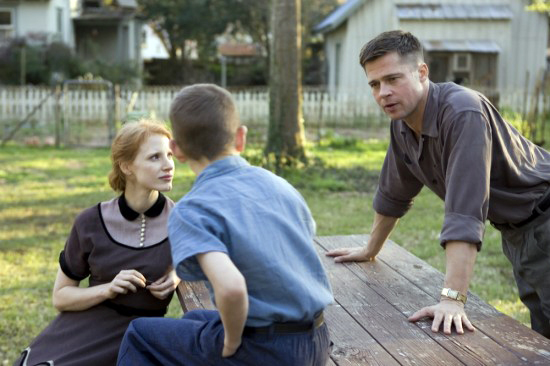
Terrence Malick's 5th film since his brilliant debut, Badlands (1973), The Tree of Life is seemingly a semi-autobiographical familial story of the O'Brien flock. The film begins with a brief look at the family in 1950's Texas. Headed by Brad Pitt's authoritarian Mr O'Brien, his wife Jessica Chastain, and their three boys, Jack (Hunter McCraken), R. L. (Laramie Eppler) and Steve (Tye Sheridan). This is often juxtaposed with an adult Jack (Sean Penn), who seems to be struggling with the memories of his childhood. The end of these first sequences are occupied by the death of one of the boys.

This is followed by a grandiose, visually stunning opus of the creation of worlds and life. A heavily orchestrated sequence with a scientific outlook for the big bang and what follows. We even see some CGI dinosaurs, occupying the beautiful, serene landscape. A tree, like life has wild branches, vein-like, splitting off on tangents, moving into different directions. Humbled by the complexity of this, we are back with the O'Brien clan, as we see birth in all it's joy. A family drama ensues, with Pitt's father, authoritarian, sometimes coldly tender to his boys. He does love his boys, but is stern, particularly with the eldest, Jack. Jack's feelings of hate towards his father becomes increasingly apparent. As Jack progresses, he begins to see the world, the relationships, in a more mature manner. In one sequence he states to his father, "This is your home, you can make me leave any time you want." His thoughts are whispered, as he thinks after "You want to kill me". Jack is also seen praying for God to kill his father.

The films major theme is reflective of both religion and hard science. Philosophy is fundamental to the process involved in the nature of life. Mrs O'Brien tells her sons in voice-over "There are two ways through life: the way of nature and the way of grace". This perfectly encapsulates the meaning behind the film. All actors involved are wonderful. Pitt's Mr O'Brien is stern, and effective, we feel almost threatened by his coldness. And all three boys are seemingly natural in their performances.

For the visual effects, Malick had Douglas Trumball pulled out of retirement, and (except for the dinosaurs), began experimental with natural substances to create the beautifully realised creation sequences. The use of Trumball seems to be reflective of the nature of the films themes. The Tree of Life often feels like a religious reworking of Stanley Kubricks 2001: A Space Odyssey (1968) - that Trumball also worked on - and Malick, like Kubrick, uses music wonderfully, evoking creations beauty. It is simply the elliptical nature of the film that gives it a fantastical, grandiose quality. Creation of life is juxtaposed with it's inevitable partner, death, and in turn how this effects life.

Winner of the Palme D'Or at 2011's Cannes film festival, The Tree of Life has been met with polar-opposite reactions. In its first showing at Cannes it was booed. Pretentious has been bandied round a lot in reaction to the film. Yeah, it has pretensions (of course it does - it's a huge subject to tackle). I watched the film with awe, its beauty utterly beguiling and surprising me. Many of the shots in the film are so stunning, I would be very happy to frame them to adorn my walls. And, due to its complexities, it is certainly one of those films that requires more viewings.


Directed by: Terrence Malick
Starring: Brad Pitt, Sean Penn, Jessica Chastain, Hunter McCracken
Country: USA

Rating: *****

Marc Ivamy


The Tree of Life (2011) on IMDb

LinkWithin

Related Posts Plugin for WordPress, Blogger...