When I was kid and the Super Nintendo was most people's console of choice, I played Street Fighter II a hell of a lot, often venting my frustration whenever I lost a fight (my blood boils at the very mention of Sagat). My grandmother took the controller to a computer shop in order to buy a replacement and, seeing my teeth marks etched into the control pad, the guy behind the counter asked if we had a dog. It was at this point I realised that I didn't quite have the temperament for gaming, and pretty much stayed away ever since. For this reason, I went into Steven Spielberg's Ready Player One thinking that I wasn't the target audience, but I enjoyed Scott Pilgrim vs. the World, so approached the film with an open mind. It struck me early on that this in fact isn't a movie for gamers, but for fans of pop culture. Barely thirty seconds go by without a recognisable character, vehicle or weapon gracing the screen. You could watch Ready Player One a hundred times and still miss something.
It's 2044 and many of the planet's great cities have turned into slums, with much of the population crammed into small apartments stacked on top of one another. To relieve themselves of this miserable reality, most regularly escape into a virtual reality world called OASIS - created by genius and innovator James Halliday (Mark Rylance) - which allows the player to do pretty much whatever they want, be it climb a mountain with Batman or participate in huge battles without the fear of being hurt or killed. The recent death of Halliday was followed by the announcement that three hidden keys have been hidden somewhere in the game that will lead to an 'Easter Egg'. The one to find it will be handed full ownership of OASIS, and with it unimaginable power and wealth. One participant is Wade Watts (Tye Sheridan), an orphaned 17 year-old who lives with his aunt and her bully of a boyfriend in a slum known as The Stacks. Every day he escapes the real world to take part in a seemingly unwinnable race to find the first key.
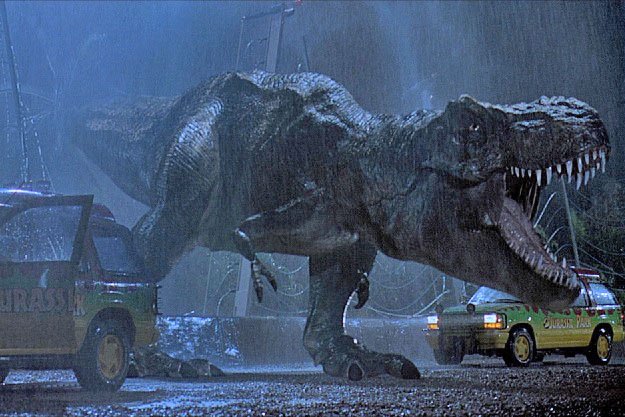
The sheer volume of pop culture references would normally distract from the story being told, but Spielberg maintains a grip on the action and lays out this new world and its many rules in a coherent manner. The novel by Ernest Cline (which I haven't read) was actually heavily inspired by Spielberg's movies, but aside from the appearance of Jurassic Park's T-Rex, Spielberg mostly avoids referencing himself. He is probably the best man for the job, especially when you consider how Spielberg's fantasy-based movies were so memorable because they kept at least one foot on the ground. Ironically, if there is a big criticism to be thrown at Ready Player One, it's that it struggles to engage when the action is outside of the OASIS, and only really comes to life when within the virtual world. Perhaps this is the point, but when the hero's ultimate quest is to save the real world from falling under the control of an evil corporation named Innovative Online Industries and its slimy CEO Nolan Sorrento (Ben Mendelsohn), it becomes difficult to truly grasp the stakes.
It's irresistible fun to be inside a world without limits, and the special effects department do an exceptional job of envisioning it. Each character can create their own avatar (Wade turns himself into a dashing hipster named Parzival), and purchase weapons and gadgets famous from pop culture. One character is even building an Iron Giant. Wade falls for a manga-eyed rebel named Art3mis (Olivia Cooke) who, as his best friend is keen to point out, could be a fat guy in his mother's basement for all he knows. He frets over what outfit to wear for their date, changing from Michael Jackson to Duran Duran before settling on Buckaroo Banzai. Spielberg has fun playing around with these elements, and it's all scarily believable. But Ready Player One isn't concerned with exploring the psychological and social consequences of such a widespread and immersive gaming experience, and asks that you simply enjoy the ride. And this is perfectly fine, since the ride is thoroughly entertaining. You will likely find yourself urging the movie to go deeper, but by the time Mechagodzilla arrives to battle an army that includes the likes of Bowser, Duke Nukem and Superman, you'll be too busy swimming in Nerd-vana to care.
Steven Spielberg's The Post is the great director's most handsome film in years. Shot quickly and clinically while he waited for the effects to be finished for Ready Player One, the film, if anything, is a sign of just how masterful he is at his craft. Starring A-list heavies Meryl Streep and Tom Hanks, The Post tells the story of the Pentagon Papers, leaked by disgruntled military analyst Daniel Ellsberg, which revealed that the President knew the war in Vietnam could not be won early on in the conflict. Many young men were drafted anyway, and sent to their deaths half a world away from home. The New York Times had the story first, but were threatened with a court injunction in an attempt to halt the publication of a series of planned articles which would damage the reputation of many high-ranking officials, including the President himself.
It's a story Spielberg felt needed to be told now, and for good reason. There are many parallels to the modern day, only nobody here is forced to live out their days hiding in an Ecuadorian embassy or assassinated with poison. When The Washington Post is handed the story themselves (by a hippy girl who dumps a package on the first desk she sees), editor-in-chief Ben Bradlee (Hanks) immediately decides that the revelations must be released to the public. Being the intelligent man he is, Bradlee had long suspected that the Times had their hands on something huge, and refuses to be silenced by the government of a country whose right to free speech is written in its very constitution. The Post depicts the newspapers search to locate the source of the leak, and Bradlee's relationship with publisher Kay Graham (Streep). The heiress and socialite has her own reservations about the newspaper's upcoming stock market launch, and how the Papers will affect the reputation of her close friend Robert McNamara (Bruce Greenwood).
There's an earthy, smoky quality to the 1970's-set The Post. Spielberg manages to capture the sweaty urgency of some of the great movies to emerge from Hollywood in its greatest decade, with All the President's Men being the most obvious comparison. In a world now filled with information at the swipe of a thumb, it's exciting and invigorating to see Ben Bagdikian (Bob Odenkirk) spills his pay-phone quarters onto the floor as he desperately searches for a pen, or the sight of Ellsberg (Matthew Rhys) holed up in a motel with thousands upon thousands of printed pages stacked all around the place. The large ensemble, which also includes Sarah Paulson, Tracy Letts, Carrie Coon, Jesse Plemons, Bradley Whitford, Alison Brie, Michael Stuhlbarg and David Cross, is impressive across the board, and although its hardly a stretch for such seasoned screen giants, Streep and Hanks - the former a fumbling yet oblivious feminist icon and the latter a cranky but good-hearted fighter - help the film to be incredibly watchable. It doesn't offer any further insights into a story many will already know, and Ellsberg is somewhat sidelined, but The Post is a timely stance against anyone looking to threaten the right to free speech and the freedom of the press.
It's been a whopping 25 years since Steve Spielberg's last real children's film, when he disappointed children and adults alike with his Peter Pan re-imagining Hook. After a long period of going back and forth between monochromatic, Oscar-wary history lessons and crowd-pleasing blockbuster fare, Hollywood's most famous director is back trying to win the hearts of both children and parents as he did with one of his most celebrated movies, E.T.: The Extra-Terrestrial (1982), with a passion project he's been considering for some time. He also reunites with E.T. screenwriter Melissa Mathison (who sadly died last year) to bring the notoriously tricky world of Roald Dahl to the big screen.
Insomniac orphan Sophie (Ruby Barnhill) spends her nights either beneath her blanket pouring over books or roaming the halls of the orphanage looking for anything that may spark her interest. While up late one night, she shushes some drunks staggering home from the pub, only to glimpse the shadow of what looks like a giant hooded man. The figure gets closer and closer, until a giant hand reaches in through her window and whisks her and blanket both across the country. The mysterious monstrosity turns out to be a giant indeed, but a big, friendly one, played in motion capture by a wonderful Mark Rylance. The BFG is the runt of his litter in Giant Country, and is routinely bullied by the much bigger fellow giants that lurk on the land outside of his cave. The two outcasts will form a bond that will see their two worlds unite.
Brian Cosgrove's beloved animated film from 1989 was incredibly close to the book, and was said to be a personal favourite of Dahl's. Yet a faithful page-to-screen adaptation of a terrific piece of literature doesn't necessarily result in a good movie, and having watched the cartoon relatively recently, I didn't find it very entertaining. Spielberg's update also stays quite close to Dahl's text, and it suffers from the same saggy narrative as the much shorter movie that came before did. Anyone hoping to keep their children entertained for a couple of hours may find them getting restless, as Spielberg is happy to take his time exploring this strange land. It's a decision I applaud, but it doesn't excuse an incredibly slow middle-section, as the BFG introduces the world of dream-catching, snozzcumbers and the joys of farting to the precocious Sophie, complete with rambling monologues and existential pondering.
There's also a noticeable reluctance to explore the darker areas of the book, with the giants (played like Cockney bouncers by the likes of Jemaine Clement and Bill Hader) failing to live up their names (Fleslumpeater, Bloodbottler, Bonecruncher). They instead come across as bullying buffoons and not the child-munching monsters they are meant to be. If there is one thing the film gets totally right, it is with the casting of Rylance, fresh off his Oscar win for Bridge of Spies (2015). The wonderful effects by Weta perfectly capture the warmth and innocence of his performance, and his line delivery is pitch-perfect. Spielberg also goes all-out with Dahl's bizarre finale, which sees Sophie recruit the Queen herself (Penelope Wilton) and her trusted butler Mr. Tibbs (Rafe Spall) in her fight against the evil giants of Giant Country. It's a truly weird climax, but it's the only consistently funny part of the movie. Not a total failure by any stretch of the imagination, but a somewhat rambling, timid effort to bring a difficult book to the screen.
Steven Spielberg's latest exercise in good ol' fashioned American wholesomeness, integrity and diplomacy transports us back to 1957, where undercover KGB agent Rudolf Abel (Mark Rylance) is about to be busted by the FBI under suspicion of passing secrets onto the Soviets. The idealistic man at the centre of the story is James B. Donovan, an insurance lawyer working in Brooklyn who joins the likes of John Quincy Adams, Oskar Schindler and Abraham Lincoln on the list of great, conflicted men caught up in a difficult period of upheaval and portrayed by Spielberg in an admiring light. And who better to play a man of such a clear sense of morality than Hollywood's favourite nice-guy Tom Hanks?
Working with frequent collaborator Janusz Kaminski, Bridge of Spies is about a good-looking as a film gets. Infused with the same eye for detail and greyed-down solemnity of Lincoln (2012), the backdrops on show provide the perfect location for serious men talking serious business. The main crux of the film rests in the blossoming friendship between Donovan and Abel, who are captured on an equal par in a bleak interrogation room as the sun blazes through the blinds. These are two men from opposing sides, but share the share the same determination, stubbornness, and loyalty to the ideals of their country. Abel accepts his increasingly-likely execution as one of the requirements of his job, but Donovan wants to exercise his rights as a PoW, making himself public enemy number one in the process as his face splashes across the newspapers.
Donovan also hopes to keep him as a tool should the need for a prisoner exchange rear its head in the future, which was incredible foresight for anyone who knows the true-life story. As Donovan fights for Abel in the courtroom, the United States are prepping their own mission - to send a spy plane over the Soviet Union to take photographs. Francis Gary Powers (Austin Stowell) is shot down and, after failing to swallow the cyanide given to him by his commanding officer in case he finds himself in such a perilous position, is taken prisoner by the Soviets and routinely tortured for information. The U.S. government again turn to Donovan in the hope of setting up an exchange just as American student Frederic Pryor (Will Rogers) is also arrested.
For a story so littered with intrigue and espionage, Bridge of Spies is oddly lacking in thrills and tension. When Donovan arrives for the exchange in Berlin as the Wall is being put in place, the city is hostile and seemingly lawless in areas, but instead the film focuses on the various bizarre characters, including a Petter Lorre-alike KGB man, who flock around Donovan, a man they simply do not know. Perhaps the unevenness in tone is down to a script-polishing by Joel and Ethan Coen, who never shy away from taking a genre and stamping their own particular brand of humour on it. Spielberg also cannot resist resorting to sentiment at the film's climax on the eponymous 'bridge of spies' (Glienicke Bridge). Still, this is Spielberg at his most professional, harking back to classic Hollywood while maintaining the relevance of the films themes.
My main memory of seeing Steven Spielberg's sequel to his 1993 mega-hit Jurassic Park is leaving the cinema with one of the worst migraines I've ever suffered. My head pounded so hard that I couldn't even eat my caramel sundae purchased from the drive-thru McDonalds on the route home. Seeing it again all these years later I approached the film with a clear head and a box of painkillers on hand as a precaution. But as the credits rolled after an exhausting 129 minutes, I found myself in pain yet again. Not pain of the physical kind, but the dull emotional pain of sitting through a pretty bad movie. The Lost World's aim is to make everything bigger and better, and while the dinosaurs are certainly more technically impressive this time, there is little of the original's magic here.
A few years after the incident on Isla Nublar, the InGen corporation are being hit with lawsuit after lawsuit, and former CEO John Hammond (Richard Attenborough) is now a naturalist who has seen the error of his ways. When Hammond's slimy nephew (Arliss Howard) takes over the business, he plans to bring the dinosaurs back to the mainland and make them a sideshow attraction. Dr. Ian Malcolm (Jeff Goldblum) is asked by Hammond to visit Isla Sorna, or "site B" - a breeding island where the dinosaurs roamed free - to document the dinosaurs in order to gather support for the island to be left to its own devices by humans. He initially declines, but then has a change of heart when he learns that his palaeontologist girlfriend Sarah Harding (Julianne Moore) is already there.
Everything is certainly on a larger scale here than its predecessor. Instead of one tyrannosaurus rex we get two and a baby, and there's a whole pack of velociraptors for the group to contend with. Shortly after Malcolm arrives, he and his crew are joined by the Hammond nephew, who brings along a small army and bad-ass hunter Roland Tembo (Pete Postlethwaite), the latter of whom simply wants a shot at taking down a T-Rex as payment for his services. Unfortunately, Malcolm's estranged daughter Kelly (Vanessa Lee Chester) - a character taken straight out of Cinema's Guide to Annoying Children - also sneaks along for the ride, so we get to suffer through sentimental moments of learning the importance of family. The stand-out scene, which sees the characters attacked by the angry T-Rex's near the edge of a cliff, happens because Sarah takes their baby to bandage a wound. It turns out the dinosaurs value family too.
The fact that Sarah, an expert in her field, would even try to take care of a baby T-Rex demonstrates how stupid these characters are required to be in order for the film to deliver a set-piece. When you know there are huge, angry monsters out there, why would you park your trailer next to a cliff-edge anyway? So concerned is the film with entertaining its audience, Spielberg and writer David Koepp seem to have forgotten that a scene also requires a degree of logic to truly work. Most of the action falls flat, which is surprising given the talent for the genre previously demonstrated by its director, and it culminates in an unnecessary T-Rex rampage around San Diego. It isn't all bad - the dinosaurs are as wonderful and terrifying as ever and the late Postlethwaite is a fantastically conflicted antagonist - but there's a noticeable lack of heart and effort here.
Jurassic Park was one of the first movies I remember watching at the cinema as a youngster, and I was so blown away I quickly acquired a pirate video of it, which I routinely watched to death. The special effects, the music, the set-pieces, that familiar park logo - it all had me riveted. It's one of the game-changing blockbuster movies, and watching it again an astonishing 22 years later, it's remarkable just how well the movie has aged. It's not quite the perfect experience I remember - those Spielberg-isms are now clear as day - but Jurassic Park's mixture of robotics and CGI blows most modern films away in terms of tension and pure spectacle.
Eccentric millionaire John Hammond (Richard Attenborough) approaches palaeontologist Dr. Alan Grant (Sam Neill) and his palaeobotanist partner Dr. Ellie Satler (Laura Dern) to join him on a journey to his newly built theme park. With the promise of a life-changing experience, the young-ish doctors cannot resist, so they journey to Isla Nublar, an island off the coast of Costa Rica, along with mathematician Dr. Ian Malcolm (Jeff Goldblum) and lawyer Donald Gennaro (Martin Ferrero). Upon arrival, they are greeted with the sight of a living, breathing brachiosaurus. Using the preserved dinosaur DNA extracted from mosquitoes preserved in tree sap, Hammond and his company have used cloning technology to birth a wide range of dinosaurs, including the terrifying tyrannosaurus rex and a group of velociraptors.
With this revelation comes the debate of whether man creating life is ethical, or in this scenario, safe. The dangers quickly become apparent to the group of doctors, but they cannot restrain their curiosity and are whisked off on a tour of the park. So confident is Hammond in the safety of his park, he invites his grandchildren Tim (Joseph Mazzello) and Lex (Ariana Richards) to participate. However, disgruntled employee Dennis Nedry (Wayne Knight) has cut a deal to sell dinosaur embryos to a corporate rival, and when a storm hits the park, he shuts down all the power in order gain access to the eggs. With the electric fences keeping the dinosaurs in temporarily down, it isn't long before the dinosaurs are fleeing their pens.
At first, this is the patient Spielberg who gave us Jaws (1975), opting for a slow build-up to the big reveal rather than giving the audience instant gratification. The introduction of the T-Rex is now an iconic moment in cinema, a thrilling combination of tension and pure terror, with a jump shock thrown in for good measure. But once Spielberg finally unleashes his monsters, the film simply doesn't stop. Delivering set-piece after set-piece, Jurassic Park abandons all restraint and packs it's second hour when it should be preparing us for the next big scene. Jaws gave us that wonderful moment when the crew compared battle scars, but there is no such scene here, just another problem for our relatively bland archetypal heroes to solve.
One of the most interesting aspects of the film is the character of John Hammond, Essentially the main antagonist, Hammond is a good-natured capitalist, a visionary who wants to bring wonder to the masses and make a tidy profit at the same time. Without a second thought for the consequences of his actions or the ethics of playing God, Hammond comes across as misguided, and too likeable to be labelled a villain. Hammond aside, Jurassic Park makes no apologies for its thinly-written characters, as this is a film of visual spectacle after all. When John Williams' famous score kicks in, it's easy to forget about the movie's many niggling problems and, for me at least, be reminded of that kid who would watch it on repeat with his nose a few inches from the screen.
Steven Spielberg's Munich questions the value of compromising your own ideals in the name of retaliation, whether 'doing what your enemies do' is a necessary stance or the beginning of a downwards spiral towards violence and bloodshed of which there is no end, and ultimately, no point. There are ancient political and religious rivalries in Ireland, South Africa and, especially, Israel; countries that have been torn apart by civil unrest. There seems no reasonable solution apart from forgiving and forgetting, but this doesn't seem to be an option. In the wake of the terrorist attack at the 1972 Munch Olympics, Israeli prime minister Golda Meir (Lynn Cohen) decides that lawful justice will not suffice for the murder of 11 Israeli athletes and team members.
A crack team is put together to carry out a series of carefully planned assassinations of alleged members of the Black September group. The group's leader is Avner (Eric Bana), a Mossad agent and soon-to-be father who is briefed of his task by the shadowy go-between Ephraim (Geoffrey Rush). The rest of the team is Carl (Ciaran Hinds), a clean-up man, Robert (Mathieu Kassovitz), an expert bomb-maker, Steve (Daniel Craig), a South African weapons handler, and Hans (Hanns Zischler), a professional document forger. Their first hit takes them to Rome, where they are sold information on the whereabouts of target Wael Zwaiter (Makram Khoury) by a Frenchman named Louis (Mathieu Amalric), who claims to work for an organisation unaffiliated with any government.
Highly controversial upon its release, some extreme views questioned director Spielberg's sympathies and ultimate goal. For most people not directly linked to the various religious groups and organisations seen in the film, it should be clear that Spielberg makes a point in showing both sides as equally sympathetic and morally ambiguous. Every attack and execution is a result of one action or another, bringing into question the whole idea of revenge (the movie is based on the book Vengeance by Yuval Aviv, who Bana's character is a fictional substitution for). Israel itself plays a key role. Although we spend little time there. Munich takes us to Italy, Greece, England, Spain, Lebanon and America, but Israel's disputed lands are never far from the characters minds.
Avner is an especially haunted soul, questioning the ethics of his operation and plagued by visions of the events at the Munich Olympics, the latter of which are portrayed with a chilling authenticity at various point throughout the film. He later meets Louis' 'Papa' (Michael Lonsdale), who argues that family, over any government or religious organisation, is the only unit worth fighting for, casting Avner's mind back to his recently-born child. The ensemble cast do a very good job at carrying the weighty tones of the film on their shoulders, but it is Spielberg himself who is the most deserving of acclaim here. It is the director at his most mature and unsentimental, and as the industry's most famous Jew he has taken a huge risk by tackling an extremely sensitive issue. It upset the people on both sides, but that is precisely the point. How can anyone come out of such a bloodied conflict, of which there is no clear end in sight, with a clear conscience?
Schindler's List is a film that will no doubt forever grace the endless 'Best Movies' lists trumped up by various organisations and movie magazines. It's serious subject matter, black-and-white photography, rousing score and 'directed by Steven Spielberg' tag has cemented it's status as one of the best American movies of all time. But the more hardened movie-goer will more than likely pick holes in it, and tell you that this in fact not even Spielberg's greatest achievement. Which is why, 21 years after it's release, I decided to revisit Schindler's List, and although I would agree that Spielberg has made better (he did make Jaws (1975) after all), this is still a masterful work, a wonderfully mature step-up for the film-maker who had, up to 1993, leaned towards the visual spectacle of David Lean and Howard Hawks.
The Holocaust is now very much a roll-your-eyes focus for a film-maker, easily passed off as a desperate plea for awards and serious recognition, and the Oscar are routinely stacked with movies portraying this appalling historical event. But Spielberg's movie was the first one brave enough to show it for what it was - a sickening, bloody event that humiliated its victims and where the life of a Jew was worth less than the work the Nazi's could squeeze out of them before they were routinely disposed of. Documentaries such as Night and Fog (1955) and Shoah (1985) hit hard, much more so than in this movie, but Schindler's List feels like a documentary come to life, with Janusz Kaminski's cinematography giving the movie a sense of timelessness.
Liam Neeson is Oskar Schindler, a Czechoslovakian opportunist looking to use cheap Jewish labour during World War II to make him enough money to help him retire a very wealthy man. He employs Jewish accountant Itzhak Stern (Ben Kinsley) to hire his workers and run his factory for him, at first making kitchen utensils to be used in the war. After witnessing the liquidation of the Krakow ghetto under the direction of SS-Untersturmfuhrer Amon Goeth (Ralph Fiennes), in which many Jews are massacred, Schindler is profoundly affected. He begins to lavish gifts and bribes upon Goeth in order to protect his workers from being murdered, but as the Germans begin to lose the war, Goeth receives the orders to move the Jews from his camp onto Auschwitz.
Made the same year as his CGI blockbuster Jurassic Park, Schindler's List showed an unseen maturity in Spielberg's work. He had made 'serious' films before, but they were always in the style of classic Hollywood; grand, sweeping epics that were generally homages to better directors. Here, Spielberg is invisible, his hand nowhere to be seen until one of the final scenes. This was film-making closer to Italian neo-realism, with hand-held cameras, bleak cinematography, and a glorious lack of sentimentality. Rather than make you weep into a tissue, he has you looking away from the screen in utter shock. Hundreds of naked Jews are humiliated as decisions are made on their ability to work and Goeth coldly shoots workers with a rifle from his balcony before breakfast. In one of its most famous scenes, a group of women are led into a shower room that may just be a gas chamber. It's one of the most terrifying sequences in recent memory.
Spielberg wisely chose relatively unknown actors to fill the roles. Neeson, now inexplicably an action star, brings a complexity to Schindler as he changes between smug womaniser and Nazi suck-up to a man capable of great kindness and selflessness, and the film isn't afraid to show the darker side of his character. Kingsley, who was known for his Oscar-winning role in Gandhi (1982), is Schindler's consciousness, a constant reminder of the atrocities that were being committed outside of Schindler's comfortable bubble. As Amon Goeth, one of cinema's most memorable villains, Ralph Fiennes steals the film. He is a hypocritical, loathsome psychopath, embodying the sense of self-righteousness of the Nazi power trip. He despises the Jews, and preaches about their extermination, yet falls in love with his servant Helen Hirsch (Embeth Davidtz), only to beat her in his disgust.
Although there are better films out there that focus on World War II or the Holocaust, it is of no surprise that this is still one of Spielberg's most revered films. It is a brave, accomplished film that gives you a sense that this was the film the director was always meant to make. However, he seems unable to resist stamping his recognisable dose of sentimentality at the climax, as Schindler breaks down in front of his workers wishing he did that little bit more. It's an unnecessarily slushy scene, a piece of director self-indulgence in what is damn near a perfect film, that, if anything, lessens the brutal impact of what came before. But this is a staunch reminder of the atrocities that humanity is capable of, and, as all great movies do, feels incredibly short at over three hours.
Film-makers frequently find themselves going back to basics or back to their roots in order to find inspiration, rather than seeking innovation. Two of Hollywood's arguably most powerful men - Steven Spielberg and Tom Hanks - did precisely this back in 2004 with the release of The Terminal, apparently based on the 18-year stay at Charles de Gaulle airport experienced by Iranian refugee Mehran Karimi Nasseri (although the film-makers and producers have failed to acknowledge it). Spielberg had been striving for bid-budget, CGI-laden blockbusters such as A.I.: Artificial Intelligence (2001) and Minority Report (2002), and historical epics like Amistad (1997) and Saving Private Ryan (1998), before he made The Terminal. Although those films were generally good to very good, Spielberg returned to something more simple and heartfelt; something in the vein of Frank Capra or Billy Wilder, who combined sentiment and romanticism to such a glorious effect. Well, to be frank, he shouldn't have bothered.
Victor Navorski (Hanks) arrives at JFK International Airport from his (fictional) home country of Krakozhia, with the intention of getting the autograph of a famous jazz musician who was loved by his late father in New York. Though what he doesn't know is that Krakozhia's government has been overthrown, leading do a devastating civil war. This puts Head of CPB Frank Dixon (Stanley Tucci) in a difficult situation, as America no longer recognises Krakozhia as a country, voiding Victor's passport and cancelling his right to leave the airport doors. So Victor sets up home in the terminal, making money by returning baggage carts back to their holders for 25 cents a cart, and befriending the various oddballs and desperado's in the airport. He also meets flight attendant Amelia (Catherine Zeta-Jones), an emotionally unstable woman who is in a relationship with a married man. Despite Dixon's frequent attempts to thwart Victor's activities, Victor becomes extremely popular with the airport's inhabitants by performing various good deeds.
If there is one thing that Spielberg's movies are frequently lambasted for, it is for their cloying sentimentality. Even his darkest output, such as Minority Report and Munich (2005) had their moments of emotional embraces to the sound of a string score that felt shoe-horned in. With The Terminal, Spielberg has gone all-out with the rom-com aesthetic. The result is a manipulating and almost fraudulent throw-back to the great Cary Grant films of the 1930's, capturing none of the magic of Spielberg's idols. Hanks is good value as always, but the character of Victor is almost offensive in it's stereotyping of the simple, almost idiotic foreigner.
The collection of supporting characters don't fair much better either, with Dixon's Hitler-esque CPB man raising questions as to the reasons behind his hatred for Victor. Everyone else seems to like him, even his own men, so is he doing it for career progression? His own soon-to-be-retiring boss informs him that empathy and humanity are key to the job, and if Dixon needs to be told this, then how has he gotten as far as he has up to now? Zeta-Jones's Andrea at least puts a different spin on the familiar rom-com heroine, with her erratic behaviour and questionable decision-making at least adding a bit of dimension. The most impressive aspect of the film is actually the set, built from scratch after no airport agreed to allow Spielberg to film for such an extended amount of time, and this, if anything, adds a flow to the way the film is captured. But when the set is the best thing about a film, you know you're in trouble, and this is undoubtedly one of Spielberg's worst efforts.
The focus of screenwriter Tony Kushner and director Steven Spielberg's Lincoln biopic is very specific, following the presidents administration for a short period of around two months in early 1865. It is a significant moment in Lincoln's term as president, not just for the passing of the 13th amendment to the United States constitution, that would free the thousands of black slaves, but for a change in Lincoln's opinion of the black population. It is also a significant period for American culture as a whole. Lincoln's image and reputation are wholly constructed from this short time. In the opening scene, Daniel Day-Lewis' Abraham Lincoln, discusses the black experience, and a previous speech he conducted, with two black soldiers on the front line in the civil war, still raging five years since it began. This opening is critical to the change that he experienced when he saw young black men fighting for the Union against the Confederate army. Before this face-to-face encounter, Lincoln had been involved in the Emancipation Proclamation (passed in 1863), but actually had plans to deport the blacks out of the United States, if slavery were abolished, as he felt that blacks and whites could not co-exist.
It is typical of all adaptations of Lincoln, "The Great Emancipator," is that the 16th president has been mythologised even by many history scholars since his death in April 1865. Spielberg is no stranger to revisionist historical cinema, of course (Schindler's List (1993) and Saving Private Ryan (1998) instantly come to mind), as the director tends to hold onto an idealised sense of sentimentality, a heightened range of emotions. It's often a cheap trick in Spielberg's cinema, but in Lincoln, the screenplay does hint at a man who is a little ambiguous on the subject of race. Day-Lewis, in a scene on a porch with his wife's ex-slave confidante, Elizabeth Keckley (Gloria Reuben), he plays Lincoln with an awkwardness. He asks her what he thinks will happen to the black population if slavery was abolished. Is he uncomfortable because of his views on deportation, or is he exploring the idea of absolute freedom? This is another scene that leads me to believe that Kushner and Spielberg were aware of the more dubious history concerning Lincoln's possible racism before 1865. That is not to say he wasn't against slavery, he was, but as a lawyer, it appears he approached it totally pragmatically.
Lincoln focuses it's attentions on the debates both in congress and behind the scenes within the seemingly cavernous rooms of the White House. The arguments and anecdotes about the meaning of freedom, and the race differences. The film attempts to show the bureaucratic and labyrinthine nature of policy change, let alone the grievances of changing the constitution written out in 1776. Tommy Lee Jones plays Thaddeus Stevens, a staunch opponent of slavery, and advocate of total freedom for blacks. As his story unfolds in congress, his secret personal life reveals itself almost revelatory in its conclusion. Small moments of comic vignette are provided by James Spader's Lobbyist W. N. Bilbo, and his crew, as they attempt to persuade democrats and republicans to vote for the passing of the 13th Amendment. Bilbo is seen in congress, sitting in the public seat mezzanine, providing character exposition, commentary and funny observations with his cohorts, like the two old men, Statler and Waldorf, in The Muppet Show. However, these escapades offer nothing more tangible than a little relief from the seriousness of the politics. Of course, with Spielberg attached to this project, the politics is also backed up with the emotional core of the Lincoln family. Sally Field plays the grief stricken wife, Mary, who is struggling after the death of a son.
Lincoln shows an ambiguous family, whose inner conflict juxtaposes the husband and the politician. In scenes with Mary, Lincoln is defensive, conflicting with the emotional stability of his wife. He has emotional detachments from his youngest son, whilst the visiting Robert Lincoln (Joseph Gordon-Levitt), battles with his father to join the civil war, a path that the president does not want for him. The American civil war was a brutal war, mechanised by the rise of the industrial revolution, leading to hundreds of thousands of dead and wounded. Whilst the scenes between son and wife are well scripted and acted, their presence seems secondary to what will, in part, contribute to awards heavy adulation of the Day-Lewis performance. Not only does he portray a president adored throughout history, but the script gives the actor a series of hyperbolic and anecdotal monologues. In practically all of Day-Lewis's performances, he has a moment in which he orates a lengthy, passionate speech, bringing stories to their emotional peek. In Lincoln, he almost explicitly has one of these fervent, impassioned moments, in every scene in which he is sitting. They are often humorous, but after a while, the obvious pleas for Oscar recognition, and fundamentally, to over emphasis the man as a great orator, and a man of complete honour and tolerance.
Undeniably, the film is sumptuously beautiful to look at. Cinematographer Janusz Kaminski conjures up a dark, candle-lit and fire-lit image when photographing inside. The minimal light, and contemporary decor, produces a palate of ochre's and earthy colours. When shooting outside, the grey of January winter bleeds from the sky into the skin of the characters, and the spacious clutter of buildings. The film juxtaposes these primitive images of the mid-ninetieth century surroundings with the very modern debates of morality and enslavement. There is a clear reason why Lincoln has been made in 2012. Lincoln's status as the emancipator of the black population, his image (still exploited for financial gain today in America), and his outstanding myth, were used during current president, Barack Obama's, presidential campaign in 2008. His myth is enduring (his Washington D.C. monument being the sight in which Dr. Martin Luther King Jr. spoke publicly about the failure of the Emancipation Proclamation to truly free black people in America), but his (and Day-Lewis's) performance as a saviour and saint, would always win over a nation of people whose emotional attachment to their history can be easily manipulated and perpetuated through mass communication (newspaper, film, television, Internet), and fact and fiction merge to create an acceptable narrative.
Lincoln is an interesting film. The machinations of politics are a subject that should be relevant to most people in this period where nefarious politics are happening in plain sight, but whose unknown activities are most likely darker and fundamentally scarier than is possible to imagine. This Lincoln has very slight moments of enigma, his character is at times inscrutable, but the film doesn't offer insight into these confusions of intention or social outlook. However, when these ambiguities present themselves, they are soon reversed by ever-present adoration of the historical figure, this is perfectly illustrated in the closing moments. The film uncomfortably and unnecessarily attaches Lincoln's death scene at the end (which occurred two or three months after the time period the film is set). A tactic that opens the film into stomach churning celebration and lionising, where his famous speech lingers over the ghost on Lincoln, the generic emotional music of John Williams echoing into the credits. It's a shame the filmmakers perpetuated the myth instead of penetrating a character whose true identity is clouded in over a century of storytelling, and pseudo-religious worship. A missed opportunity perhaps, but Lincoln seems to have been made at this time to simply highlight to the world the social and political progress that has been made in America, from the passing of the 13th amendment, to the inaugaration of Barack Obama in 2008: Well done America, you're so enlightened (sic)!
Young and confident investigative journalist Tintin (Jamie Bell) purchases a model boat of the Unicorn, a three-masted sailing ship, from a market, only to be approached by the sinister looking Ivanovich Sakharine (Daniel Craig) who offers him triple the amount he paid for it. He refuses and, along with his trusty dog Snowy, takes the ship home, only to unwittingly coming across a cryptic note that was preserved with the model that mentions a secret involving the mysterious ship and a family line called the Haddocks. Tintin is kidnapped and taken aboard the ship of Sakharine where he finds the drunken Captain Haddock (Andy Serkis), locked in a room with only whisky for company. The two must combine their wits and unravel the mystery of the messages which may lead to them to secret treasure.
The original comic books by Belgian artist Herge, and eventual cartoon series that came from it, have a huge dedicated and passionate fan base that were both eagerly awaiting and dreading Steven Spielberg's re-imagining. Not being a fan myself, I would imagine the fans would be happy with this effort, as although the look of Tintin is certainly very different, the old-school feel of the original works is certainly there. The film combines three old Tintin stories - The Crab with the Golden Claws, The Secret of the Unicorn and Red Rackham's Treasure. This is possibly the film's biggest flaw, as although it certainly looks amazing, and the film has a definite nostalgia-tainted, labour-of-love feel, the story just isn't up to scratch.
The performance-capture animation is without doubt the most close-to-life I've ever come across. It captures every facial movement and the subtle expressions that allow the actors performance to come through the CGI. Jamie Bell injects a likeability into a hero that might have come across as an annoying know-it-all. But the film really belongs to Serkis. Now a veteran of the whole motion-capture malarkey, his Captain Haddock allows him to show what he can do as an actor. He gets all the best lines and is involved in the more memorable scenes, notably when he's had a drink or two.
Thank God for the performances then as the plot has a lot to answer for. Combining the blockbuster minds of Spielberg, Peter Jackson, and long-time Spielberg collaborator Kathleen Kennedy, it's quite shocking that this is the best they can come up with. These are the people responsible for some of the best works in the mega-bucks department - E.T.: The Extra Terrestrial (1982), Jurassic Park (1993), the Lord of the Rings trilogy (2001-2003), Raiders of the Lost Ark (1981) - which all combined great storytelling, genuine passion, film-making know-how, and some old fashioned cinematic magic. Where Tintin certainly has the passion, the story just seems wafer-thin and very un-movie like, so to speak.
Understandably, they wanted to keep the adaptation close to Herge's original vision, but I just felt like I was watching an extended episode of the cartoon series that happened to have some very expensive animation. There is one notable set-piece, which involves Tintin, Haddock and Snowy fighting Sakharine at high speed for the last clue that may lead them to the Unicorn treasure, that would have been near-impossible if filmed in live-action. This scene, if anything, promotes the use of motion capture to take film-making to new levels, but it also happens to be amazingly choreographed and executed. But apart from that scene, the film never give me the shiver down the spine or got my pulse racing like the aforementioned films certainly did.
There is a lot to like about the film, however. The most annoying thing about the original cartoons were the Thompson and Thomson twins (here played by newly-appointed Spielberg bum-chums Simon Pegg and Nick Frost), and here they are given little more than extended cameo roles, and it's clear that they're best enjoyed in small doses. Craig is fun as the villain, although his character is rather one-dimensional and thinly-written. It's also fun to spot the little winks and homages to the originals, that includes a truly brilliant introduction to Tintin. Hopefully when the inevitable sequel comes along, Spielberg can take the passion from this and put it into a better story. But this is satisfying enough for the time being.
This made-for-TV movie about a man having a bad day, is a very well executed, wonderfully shot story of an angry truck driver, hell-bent on antagonising David Mann (Dennis Weaver), after he overtook him on a dusty, lonely stretch of road. This was the first feature of future uber-director Steven Spielberg. It is telling in the construction of the shots, and has a similar atmosphere to his mega-hit Jaws (1975).
More importantly is the screenwriter, Richard Matheson - who adapted it from one of his own stories. There is a sequence where David stops at a diner after his initial shock of the terrorism. In here, he sits at a table; an internal monologue plays. His pure thoughts of paranoia as he watches a bunch of truckers at the bar, scrutinising their boots (after he had only seen this part of the truck driver when stopped at a gas station. This is pure Matheson, straight out of his work on the TV show The Twilight Zone.
We never actually see the driver of the truck. This demonstrates the intention that the monster is not human, but is in fact the machine itself. An idea perpetuated at the end of the film when the monster truck careens off the edge of a cliff, the sound of a monster (much like the ones seen in '50's monster movies) is heard screaming. Maybe this was an intentional idea from Spielberg, who would later get to executive produce a bunch of trucks/cars etcetera, who can all transform into more recognisable monsters (i.e. have eyes and all that). Aside from the later travesty of Spielberg's inflated ego, I do still have affection for some of his earlier work, and Duel is another example of his knowing cinematic style.

 It's 2044 and many of the planet's great cities have turned into slums, with much of the population crammed into small apartments stacked on top of one another. To relieve themselves of this miserable reality, most regularly escape into a virtual reality world called OASIS - created by genius and innovator James Halliday (Mark Rylance) - which allows the player to do pretty much whatever they want, be it climb a mountain with Batman or participate in huge battles without the fear of being hurt or killed. The recent death of Halliday was followed by the announcement that three hidden keys have been hidden somewhere in the game that will lead to an 'Easter Egg'. The one to find it will be handed full ownership of OASIS, and with it unimaginable power and wealth. One participant is Wade Watts (Tye Sheridan), an orphaned 17 year-old who lives with his aunt and her bully of a boyfriend in a slum known as The Stacks. Every day he escapes the real world to take part in a seemingly unwinnable race to find the first key.