After spending most of his career larking around with Will Ferrell in the likes of Talladega Nights: The Ballad of Ricky Bobby, Step Brothers and The Other Guys, writer/director Adam McKay took a huge leap towards 'serious' film-making in 2015 when he released The Big Short, a funny, intelligent and unexpectedly engrossing account of the 2007-2008 financial crisis. The Big Short may not sound like much fun on paper, but McKay latched onto this idea, making the tedious subject of subprime loans and triple-A ratings interesting by entwining it with pop culture, employing the likes of Margot Robbie and Selena Gomez to dumb it down for the audience in a manner that was too wickedly clever to ever be patronising. With Academy recognition now under his belt, McKay strides into his next project - a biopic of one of the most fearsome yet enigmatic political figures in U.S. history - with confidence, and dare I say it, a touch of arrogance.
McKay is eager to perform the same trick again with Vice, a sporadically inspired but frustratingly blunt quasi-biography that feels to penetrate the skin of its subject or answer the big question of just what was the driving force behind the man who turned the symbolic position of Vice President into one of great power and influence. Rather than dig deeper, McKay prefers to allow Dick Cheney's actions to speak for themselves, occasionally cutting away to a visual metaphor, such as, in the case of Cheney's key meeting with Sam Rockwell's George W. Bush, a cheetah bringing down its prey. Cheney is a man McKay clearly views as a highly functioning psychopath, tracking his journey from working under Steve Carell's Donald Rumsfeld in the Nixon Administration, to his opportunistic lunge for control in the immediate aftermath of the 9/11 attacks. He fought to grant more power to a President he easily manipulated, praying on his short attention span and lack of political know-how, and to legalise torture, finding a massive legal loophole in the shape of Guantanamo Bay.
Vice is structured like a classic coming-of-age movie, with its 'hero' rising and falling, before dusting himself off and getting to his feet to rise again. After President Ford (Bill Camp) is voted out of office, seemingly closing all political doors for Cheney, McKay rolls the credits and pans away from the Cheney household, before an abrupt phone call reminds us that this story has barely begun. Like many of the jokes in Vice, the credit-roll-fake-out is funnier in theory than execution, and the film often takes the trickery so far that it threatens to undermine the seriousness of the subject matter. Satire must be funny, but it must also carry an emotional wallop that McKay struggles to find. At the centre of it all is Christian Bale's powerhouse performance, which explores a man whose obsessiveness could be compared to that of the actor's own extreme approach to his craft. Once again Bale takes his own body to the limit, piling on the pounds to resemble a man who suffered multiple heart attacks throughout his life (it becomes a running gag in the film), and adopting a deep growl capable of subtle intimidation. The performances of Bale, Carrel and Rockwell are all worth the entry fee alone, but Vice stutters to engage on a deeper level, failing to explain just how an oil company CEO can seize control of one of the most powerful countries in the world, and execute his plans with such cold indifference.
So here it is. After four years and four movies of universe-building and origin stories, the heroes of Warner Bros.' DC Universe are finally brought together to face down a common foe and unite under the Justice League banner for the very first time on the big screen. Such an impressive roster of supers in a time when superhero mania is at its highest should have been a safe bet at the box-office, especially since Marvel's B-list characters like Ant-Man and Doctor Strange have been pulling in $500-600 million worldwide. How Justice League limped to just $700 million worldwide on the back of little to no fan anticipation speaks volumes about audience investment in this DC Universe. Patty Jenkins' Wonder Woman won back some faith, but returning director Zack Snyder has learned nothing from the criticism and backlash Batman v Superman: Dawn of Justice received.
This is the same turgid, ugly and CGI-infested world started by Man of Steel, complete with one-note characters, headache-inducing fight scenes and plain bad storytelling. Yet, due to Snyder leaving the project in post-production as a result of tragic family circumstances, this makes up roughly half of the movie. The rest is purely Joss Whedon's input, after The Avengers' helmer was brought in to tighten up the film, re-write certain scenes, and take charge of the necessary re-shoots. Reports have surfaced recently that Snyder's rough cut was simply unwatchable, and sensing another critical panning, Warner Bros. simply cut their losses. Even the re-shoots were news worthy, as Henry Cavill, sporting an impressive moustache for his role in the upcoming Mission: Impossible - Fallout, was under contract to keep the facial hair, and so his upper lip would need to be altered with special effects. Naturally, the final film - which had a reported $300 million sunk into it - is a catastrophic mess.
Superman is dead, and the world has sunk into a state of despair. After taking down an alien scout during one of his crime-busting jaunts, the ageing Bruce Wayne, aka Batman (Ben Affleck), senses that a bigger threat is coming to Earth. A rich man in a stealthy suit won't be enough to tackle such an enemy, so he proceeds to round up his new friend Diana Prince, aka Wonder Woman (Gal Gadot), and hunt down those meta-humans glimpsed on Lex Luthor's laptop in Batman v Superman. There's Arthur Currie, aka Aquaman (Jason Momoa), the long-haired, tattooed Prince of Atlantis, Barry Allen aka The Flash (Ezra Miller), a motor-mouthed, incredibly annoying young man whose superpower is to run really, really fast, and finally Victor Stone, aka Cyborg (Ray Fisher), a half-human, half-machine hybrid who was created by his father with the help of a mysterious artefact called a Mother Box. There's two more boxes, and a giant alien warlord named Steppenwolf (voiced by Ciaran Hinds) hopes to snatch up all three.
You can work out almost on a moment-by-moment basis which segments were filmed by Snyder and which by Whedon. One second, were in the dour, unattractive world of Snyder's mind, where every character broods and walks in slow-motion. The next, we get quippy Batman and bright colours. Justice League became such a farce in post-production that I get the feeling the heads at Warner Bros. simply wanted rid of it, as this simply isn't the finished version of 300 million dollars worth of input. Steppenwolf's appearance changes from one scene to the next, and Cavill's moustache-removal is one of the most unnerving things I've seen on film. "We're not enough," claims Batman, and so Superman is dug up and brought back to life for the final act. Despite his weird CGI face, Cavill is actually one of the few pleasures of Justice League, as we finally get to see the hopeful, unstoppable Superman we have been waiting three movies to see. Sadly, his comeback is far too late to save the movie. For all its plot-holes, poorly-constructed action scenes and many other flaws, Justice League's biggest crime is that it is, inexplicably, just plain boring.
Seven year after fashion designer Tom Ford surprised everyone by delivering a tender, stylish romance with A Single Man, the writer/director returns for another tale of romantic exploration tinged with danger and sadness. Adapted from Austin Wright's 1993 novel Tony and Susan and renamed Nocturnal Animals for the screen, Ford expertly weaves three narratives, each with their unique look, tone and mood, into a brooding character study. One of the few criticisms thrown at A Single Man was its tendency to place style above substance, but I disagreed at the time, and offer Nocturnal Animals as proof that Ford is a skilled director who balances aesthetic and narrative seamlessly, and often to devastating effect.
The film opens with shocking images of obese women dancing provocatively, and naked, in front of the camera. It's the opening of artist Susan Morrow's (Amy Adams) latest work, and it's a hit amongst the champagne-guzzlers who occupy the room. Susan seems to have everything: a lavish, modern mansion; a wardrobe full of expensive clothes; and a dashing (and rich) husband in Hutton (Armie Hammer). Everything, that is, other than happiness. At a dinner with her pompous artists friends (including a scene-stealing Michael Sheen), she voices her concerns about her husband's suspected affairs and her struggle to take herself seriously in her line of work. As Hutton jets off on a business trip, Susan is home alone when she receives a package from her ex-husband Tony (Jake Gyllenhaal). It's a draft of his finished novel, called Nocturnal Animals.
There a multiple stories within the film, and we are transported into the novel as Susan reads it. It begins with a family driving down a deserted highway at night when they are suddenly run off the road by a group of rednecks. The father (also Gyllenhaal) attempts to diffuse the situation by offering to pay for the damages, but the hooligans, headed by the psychopathic Ray Marcus (Aaron Taylor-Johnson) wind up kidnapping the wife and daughter. The further this dark, violent tale takes us, the clearer it becomes that it is mirroring Susan's reality, and that there may be a hidden message in there somewhere. Is Tony fucking with his ex-wife for a prior incident, or could it be his bizarre way of trying to win back her affections? Either way, this fictional narrative clearly holds the key to unravelling the couple's part turmoil, and the mindset of both Tony and Susan after their marriage fell apart.
The performances are impressive throughout. Adams demands your attention whenever she graces the screen, expressing the most powerful of emotions with the subtlest of facial movements. Michael Shannon, who was shockingly the only one of the four leads to receive an Oscar nod, is particularly memorable as a long-past-giving-a-fuck Texan lawman riddled with cancer. Yet it's Ford who emerges as the star, delivering an expertly crafted crime psychodrama that is both a curious study of the grotesque bourgeois and a lean, mean Texas revenge thriller. While it's certainly true that the male characters are much more layered than the females, the film received unfair accusations of misogyny upon its release, which may explain its absence from the major categories during awards season. It's a shame, as Nocturnal Animals deserves some recognition for its intoxicating cocktail of Hitchcockian tension, gritty human drama, and decadent visuals.
Anyone who may be somewhat hesitant to let themselves get too hyped-up about the upcoming sequel to Ridley Scott's sci-fi masterpiece Blade Runner (1982) can now at least be assured that the movie is in the safest hands possible after viewing director Denis Villeneuve's Arrival, one of the most intelligent and thoughtful first contact pictures in recent memory. Arrival's November release date goes some way to indicate the kind of audience the film is going for: just in time for awards season and about as far removed from the CGI-laden destruction-athons that litter the summer as you can get. No monuments are blown to smithereens here, nor does the American President deliver a stirring speech to a chest-thumping crowd. Villeneuve's concerns lie with the necessity to communicate and the strength to be had in unity.
Adapted from Ted Chiang's short story Story of Your Life, Arrival begins by establishing the mindset of its heroine Louise Banks (Amy Adams), a linguist who is in mourning over the loss of her daughter to cancer. During one of her lectures, she is asked to turn on the news, where it is being reported that twelve alien spacecrafts have touched down at seemingly random locations around the world. One of the giant, egg-shaped ships touches down close by in Montana, while others hover mysteriously in the likes of Australia, China and Russia. They don't emit any gas or toxins, and their purpose and intent are frustratingly unclear. Naturally, all hell breaks loose across the globe with looting, violence and plummeting stocks leading the media to dub this an 'alien crisis', and Russia and China becoming increasingly nervous.
Having participated in a Farsi translation a couple of years earlier, Louise is brought in by U.S. Army Colonel Weber (Forest Whitaker) to help communicate with the alien beings, along with theoretical physicist Ian Donnelly (Jeremy Renner). A base has been set up at the Montana location, and Louise quickly establishes contact with the two giant creatures, who Ian dubs Abbott and Costello. They communicate by ejecting a substance from their tentacles, which manifest in circular symbols, each slightly differing from one another. With Weber and CGI Agent Halpern (Michael Stuhlbarg) insisting that time it of the utmost importance, Louise must decipher the alien language and establish the reason for their arrival as other countries do the same, and before an over-eager China strike first without knowing the extra-terrestrials true intentions.
Time and non-linearity are central to the film's themes, and Arrival's careful pace and fractured narrative will certainly frustrate anyone hoping to see a traditional alien invasion picture. Screenwriter Eric Heisserer and Villeneuve have much bigger ideas than to have both sides simply blow each other up. The film shares more in common with Contact (1997) and Interstellar (2014); more philosophical and contemplative works of science-fiction that raise the big questions. But this is not two hours of chin-stroking, as Villeneuve repeats his Sicario trick of building a tense atmosphere full of dread and trepidation. The first glimpse of the alien ship is an otherwordly experience, as Johann Johannsson's score blares out horns and deep rumbles, like the song of a whale from another planet. It's all anchored by Adams' terrific, restrained performance, as she channels pain and frustration through her tough, closed-off exterior. One of the finest sci-fi pictures of the past decade, and one that cuts to the very fabric of what it means to be human. The Replicants are surely in safe hands.
With the phenomenal success of Marvel's 8-year (and still going strong) moulding of their cinematic universe, the fashionable goal for studios now seems to be to create a vast world for their ensemble of characters to co-exist and occasionally cross paths. Marvel's output now includes some of the highest-grossest films of all time, so it was never going to take other studios too long to realise the potential in their comic-book property. Fox's X-Men franchise expanded itself this year with Deadpool, and the box-office success of Man of Steel in 2013 now have publishing behemoth DC flexing their muscles.
Subtlety isn't something Zack Snyder, director of 300 (2006), Watchmen (2009) and Sucker Punch (2011), is known for. Like Joss Whedon at Marvel before his departure, Snyder has been employed as head honcho for DC's expanded universe. Rather than taking the time to build the world from the ground up and teasing fans with what's to come, Snyder throws everything (including the kitchen sink in one scene) at Man of Steel's follow-up, which introduces a seriously pissed-off Batman into the mix, as well as a hoard of famous and not-so-famous fellow superheroes who are all due their own stand-alone movies in the future. To summarise, Batman V Superman: Dawn of Justice is a colossal mess.
Picking up during the climax of Man of Steel that saw Superman (Henry Cavill) cause mega-destruction and the deaths of thousands of people during his fisticuffs with General Zod (Michael Shannon), Bruce Wayne (Ben Affleck) arrives at Metropolis to witness the carnage first hand. This older, more damaged Batman holes up in his mansion and discusses Superman's alien threat with his trusted butler Alfred (Jeremy Irons). An unsupervised being of almost unlimited power, Wayne sees Superman as a threat to humanity and hopes to turn the public against him using his influence at the Daily Planet newspaper.
Meanwhile, billionaire eccentric Lex Luthor (Jesse Eisenberg) takes a special interest in Superman, and convinces Senator Finch (Holly Hunter) to allow him access to Zod's fallen spacecraft as well as the General's body. Wayne learns of Luthor's activities and attends one of his gatherings in the hope of stealing encrypted files, and learns that a mysterious woman by the name of Diane Prince (Gal Gadot) is also seeking the same thing. Knowing that Superman and Batman will always stand in his way, Luthor imports Kryptonite from the Indian Ocean and begins to set in motion a great battle between the two, from which surely only one will walk away.
The plot seems to only concern itself with the bigger picture, with its eyes firmly on the Justice League movie due next year, Without any sense of immediate threat and with such an emotional detachment from its characters, it's extremely difficult to care about much that happens during Batman v Superman. It's all too much, too soon. On top of the muddled plot, Snyder throws in glimpses of future members of the superhero team - The Flash (Ezra Miller), Aquaman (Jason Momoa) and Cyborg (Ray Fisher) - that act like mini-trailers jammed into the middle of the movie without much thought, and a seemingly random, yet beautifully captured, dream sequence that foreshadows the big bad Darkseid.
Most of the characters motivations are left unexplained too. While Superman's actions with Zod left catastrophic damage, the public are pretty clear that they view him as a hero fighting an alien threat, even concocting a monument in his honour. So why is Batman so utterly pissed at him, especially when Superman doesn't even harm him during their first encounter when he could have snapped him like a twig? Luthor, played by an Eisenberg who seems to believe he is on the set of Adam West's 1960's TV show, is hell-bent of neutralising Superman's threat. Does he have daddy issues? A fear of God? Luthor rants like a teenager hyped-up from sugar and video-games and hints at these and many others, but no real explanation is given. And just what was he hoping to achieve by unleashing the part cave-troll, part what you couldn't flush down the toilet this morning, at the end?
The movie's main positive is Affleck. The groans echoed throughout social media when his casting was announced, but he nails both Bruce Wayne and Batman. He is the Darkest Knight there has ever been, with a brute physicality that could flick Christian Bale's incarnation across the screen. Snyder has the skill to bring a comic book panel to life better than anybody, and Batman v Superman is frequently astonishing to look at. Gadot also excels during her small amount of screen-time, and is the only one appearing to be having any fun. Of the smack-down itself, it's an exciting and brutal affair, brought to a close by one of the most ridiculous moments of mutual enlightenment in cinema, ever. Like Man of Steel, Batman v Superman has defied mixed (and some utterly unforgiving) reviews and stormed the box-office, so I think it's safe to say that the DC train will plough on.
Not content with toying with our pre-quirky/ironic film-making preconceptions of how a movie should play out with the mind-blowing Being John Malkovich (1999), or going all-out self-reflexive with a blocked writer in Adaptation (2002), former music video director and Jackass co-creator Spike Jonze spins the traditional movie romance on it's head with Her. Set in a very believable near-future, it's the story of a lonely man who falls in love with a computer voice. It is the stuff of sci-fi and clever-clever satire. Or so you would think. Her, even with the absence of a physical female lead, may just be one of the most honest and heart-warming romances in recent memory.
Theodore Twombly (Joaquin Phoenix) writes love letters to husbands, wives, sons, daughters and any others loved ones that require his services. He spends his life in front of a computer verbally dictating his achingly romantic letters for BeautifulHandwrittenLetters.com, a service for people who want to vocalise their love but have no way to express it. Theodore is the best at his job, yet in the real world, he finds himself pining for his soon-to-be ex-wife (Rooney Mara), and chatting with strangers late at night on sex lines. He goes on a disastrous date with a beautiful woman (Olivia Wilde), but seems unable to connect with anyone in the real world.
When he hears about an innovation in technology, called OS, which activates an artificial voice that can organise your life, answer your questions, or simply be your best friend, Theodore gets Samantha (voiced by Scarlett Johansson), who quickly evolves to develop an adorable personality of her own. Soon enough, Theodore finds himself falling for her, and she for him, as they connect solely through an earpiece in Theodore's ear. It's a fad that quickly catches on, and people are soon falling for OS's throughout the country.
It sounds like the stuff of Orwellian satire, but there's no post-apocalyptic landscapes, no government agents watching through holes in the wall, and certainly no flying machines. The future of Her is nigh on utopian; the streets are spotless, the people happy, and no signs of class divide or social disorder of any kind. The film could easily have become another analysis of the dangers of technology and how we would rather send a text message than look someone in the face. The whole thing sounds gimmicky, a horror film about the rise of the iEverything, but this is as human a love story can be, even if the other half is the husky, wonderful voice of Scarlett Johansson. Her shows the joys of technology as much as the darker side.
It's Johansson's vocal performance that really allows the film to work, meaning that it's not just about a weird guy who gets off by talking to a computer. She does the incredible trick of making her a three dimensional character. It seems natural that a lonely guy like Theodore would fall for her, and Phoenix, sporting an unflattering moustache, capitalises on his staggering beast-in-a-cage performance in The Master (2012) - a film he should have beaten Day-Lewis to the Best Actor Oscar for - with another knockout performance. He's incredibly subtle, capturing more in a mumbled line than any Oscar-baiting monologue could. He's a heart-breakingly lonely soul, and when things inevitably get a bit difficult for the human/cyber couple, you really ache for him.
Her doesn't go down the route of Theodore craving human contact - the film is more complex than that. Samantha, with her infinite capacity to evolve, struggles to understand her own existence. It doesn't get bogged down with existential waffle, so we get to witness Samantha's child-like confusion and instinct to see and learn everything. Along with work friend Paul (Chris Pratt) and his recently separated best friend Amy (Amy Adams) (who both have love stories of their own), Theodore learns what it's like to love, and all the soul-breaking pain that comes with it. Her is wonderful and sad: a love story that even the most heart-hearted singletons living in this touch-screen world would find hard not to relate to.
American Hustle is all about large characters, outlandish fashion and awful hair. It may tease you into thinking it's some kind of smart con-artist movie with it's (very loosely) based-on-real-events premise ("some of this actually happened", the opening credits inform us) and snappy trailer. But for all visual pizazz, this is in fact a very small movie, focusing on a small set of unique and frequently bizarre characters that just happen to cross paths amidst the ABSCAM operation in the late 70's and early 80's. Imagine if the characters from I Heart Huckabees (2004) were in fact the people who took part in the operation covered in Argo (2012), and you'll have something akin to American Hustle.
Paunchy con-artist and loan-shark Irving Rosenfeld (Christian Bale) hooks up with the beautiful Sydney (Amy Adams), an intelligent and ambitious American girl who improves Irving's scams by pretending to be an English aristocrat. When they are busted by creepy FBI agent Richie DiMaso (Bradley Cooper), they are promised leniency if they assist the Bureau in making four additional arrests. The plan is to entrap popular Mayor Carmine Polito (Jeremy Renner), who is looking to inject funds into gambling in Atlantic City, by having a friend pose as an Arab sheik looking for potential investments in America. As Irving, Richie and Sydney delve further into the sting, things start to spiral wildly out of control, as Irving's loud-mouth wife Rosalyn (Jennifer Lawrence) can't seem to keep her mouth shut, and Richie develops feelings for Sydney.
As said before, the plot plays second-fiddle to director David O. Russell's obvious fascination with this ensemble of weirdo's. Surprisingly, it's the slimy swindler at the centre of it all, Irving, that comes out of it the most recognisably human. In the opening scene, we see a shockingly bloated Bale, slapping his awful toupee across his head to cover up an embarrassing hairline. Is this the American Dream at work, a petty criminal posing as a sophisticated, honest guy? Well, no, American Hustle doesn't need to try and touch those metaphorical heights, but this is the type of person we're to spend the next two-plus hours with. An apparently successful sort of guy, covered in gold and eyes covered by tinted sunglasses, but hiding something fragile or dangerous that may soon reveal itself.
The performances are spectacular, as one would expect. Bale manages to make you actually root for his slimeball character, and Jennifer Lawrence shows that she seems able to tackle any role or character with aplomb. Cooper does a job similar to his previous work with Russell, Silver Linings Playbook (2012), but even betters that. He seems to have the uncanny ability to make you instantly know there's just something wrong with his character, and when we see him at dinner with the fiancee he clearly doesn't love or respect, his hair bunched up in tiny little rollers, there's something simply tragic about him. And Amy Adams, let loose here to reveal an unseen feistiness, wins the award for Side-Boob of the Year.
The whole thing is a rather strange experience, never really falling into a recognisable genre or taking a conventional approach to storytelling. It could only really come from the mind of David O. Russell, the only director that seems able to combine a mixture of mainstream commercial success, nominations and awards a-plenty, and independent sensibilities, never really moving away from his own vision. It's not a total success of course - Irving's admiration from the 'moral' Mayor Polito, who just wants to rejuvenate Atlantic City, seems a bit of a sympathy quick-fix, and no-one can out-Scorsese Martin Scorsese. Well, maybe Paul Thomas Anderson can. But American Hustle is a big dose of strangely endearing entertainment, that even when it outstays it's welcome towards the end still made me want to spend more time with the characters.
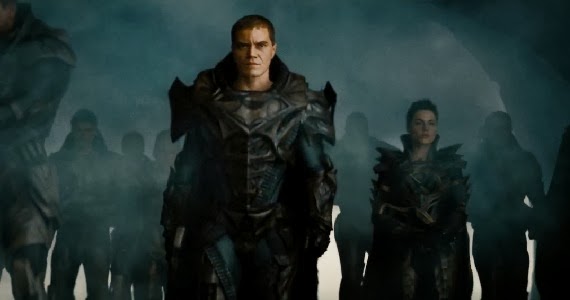
Dumping the light tone of the original Richard Donner Superman films (1978/1980) and their ridiculous sequels, as well as Bryan Singer's failed reboot, Zack Snyder's Man of Steel adopts the Christopher Nolan approach. With Nolan as producer and co-writer, this is Clark Kent seen through the eyes of a steely, saturated lens, with Henry Cavill's somewhat stoic and monotone Superman battling inner demons as well as General Zod (Michael Shannon). It's a typically long, convoluted modern blockbuster, but Man of Steel prevails thanks to some surprisingly dedicated focus by Snyder, who abandons the slo-then-fast-mo stylings of 300 (2006) and Sucker Punch (2011) for something much more grown-up.
The movie begins on Krypton, where Jar-El (Russell Crowe), delighted with the planet's first natural birth in centuries in his son Kal-El, pleads with the leaders to help save the planet from inevitable destruction. Enter the usurping Zod, who is leading a coup to overthrow the leaders and re-establish Krypton as a real power. Zod is furious at the birth of Kal-El aka Clark Kent, but Jar-El manages to blast his son off into space towards Earth before Zod overpowers him. Cut forward some years and Kent is working on a fishing vessel, at ease with his powers. When the military discover an alien craft in the Arctic, Kent infiltrates the mission and discovers his origins from the preserved conscience of his father. Meanwhile, Zod is approaching Earth with plans to use the planet to re-create Krypton.
It's clear from the off that this is no regular superhero origin film. Snyder manages to somehow bring a grounded realism to Krypton - giant human-carrying dragonflies and all. We then skip Kent's entire upbringing to witness his natural inclinations for good as he saves some oil rig workers from certain death, displaying the powers he is now at ease with. Through some beautifully realised and melancholy flashback scenes that evoke the style of Terence Malick, Kent's parents (played by Kevin Costner and Diane Lane), gradually teach him that he is different and has a much greater purpose than he could imagine. Costner is superb in these moments, bringing an old-hand, gravel-voiced weight that I have never seen from him before. Similar to Snyder's Watchmen (2009), these flashbacks are peppered throughout the film, yet don't damage the flow of the central story.
Where the film fails is in the action-heavy climax that lasts for pretty much the entire final hour. Zod and his cronies battle Superman and smash each other to a pulp. It's very similar to the climax of Thor (2011), that also had impossibly strong super-beings battle ten tons of shit out of each other because, well, what else can they do? Buildings collapse, explosions litter the screen, but there's very little tension. It switches the action between Superman and the Daily Planet, where Laurence Fishburne's Perry White serves no purpose other than to save some people from falling rubble. Perhaps it's setting the scene for future instalments, but they seem rather intrusive here.
The same could also be said about Amy Adams' Lois Lane, who is a spunky, determined character diminished to a simple love interest for Kent without any real chemistry. Of course she's important to the Superman universe, but there is no real dimension to her persona. Michael Shannon, however, is reliably excellent in his role, and his Zod incarnation is by far the most interesting thing about the film. He's a sympathetic bad guy akin to Tom Hiddleston's Loki, to the point where you can fully understand his reasoning. The man plans on genocide, but this was the role he was raised to play, and his determination to re-establish his race is certainly understandable. You can even see that Superman knows this, but he always knows that he must destroy him, whatever the odds.
Overall I was extremely impressed by Man of Steel, and its flaws can certainly be forgiven. This is a mature movie with underlying themes. Superman is God, an indestructible force (to us mere humans) that possesses too much power to be at ease with, even when he assures them that they are on the same side. The religious metaphors are embarrassingly obvious at times, but it's a thought-provoking sub-theme and a nice alternative to the crash-bang-wallop of the action scenes. Although it's not up to the ridiculously high standards set by Christopher Nolan, this can sit nicely alongside his Dark Knight trilogy (2005-2012) in the re-imagining of DC's universe.
Paul Thomas Anderson's The Master, his first film since 2007's spectacular There Will Be Blood, explores many of the themes of alienation, dysfunction within family and individual, that he has engaged with throughout his filmography. But where his previous film focused on the desperation for power in an increasingly Capitalistic, but almost primitively savage landscape, his latest probes and juxtaposes ideas of control and chaos within a substitute family. The surrogate family that drunk, chaotic Freddie Quell (Joaquin Phoenix) enters serendipitously, headed by "writer" Lancaster Dodd (Philip Seymour Hoffman), is a representation of a cult, incredibly loosely based on science fiction writer, L. Ron Hubbard's religious invention, Scientology. No doubt the allusions within the screenplay to this increasingly clandestine and insidious organisation (with powerful Hollywood membership from Tom Cruise and John Travolta), have been eradicated to avoid any problems - Scientologists are secretive, and appear aggressive and paranoid (I'm just goading, but it's true!).
The Master opens in the closing moments of World War Two, the drunken and isolated Freddie, winging his way on a Navy ship. He seems awkward in the presence of these men, iconographically like the muscular, homoerotic imagery of Kenneth Anger or Jean-Paul Gaultier. On a sun kissed beach, the sailors watch in bemusement as Freddie mock-fucks a woman made of sand, leg akimbo, the audience full of laughter, until the misogynist display goes on, becoming increasingly uncomfortable. In subsequent scenes Freddie shows his infantile, possessive obsession with sex and female genitalia, and the drunken fantasy that drifts in and out of his consciousness. He's a drifter with no place to go, a fractured family life, with no skills but a dangerous ability to make alcohol. In the chaos of his intoxicated mind, he wants a father figure, and after an accidental poisoning with his alcoholic concoctions, of a man he told looked like his father, Freddie stumbles upon a ship sailing sailing from San Francisco to New York through the Panama canal, and meets leader of The Cause, Dodd.
Like Hubbard, Hoffman's Dodd is a publisher of a book who's ideas create a loyal, devoted following in 1950's America, where religious movements separated from traditional ones were beginning to surface in greater numbers. The ideas within this quasi-religion, The Cause, are differing in many ways to Scientology (it does however include the idea that humans have existed for trillions of years), and Dodd confidently states that our spirits live for millennia, living through different physical vessels - not unlike the concepts in what is now called past life regression. But here, Dodd claims that through confronting past demons the subject can return to an emotional state of "perfect". It's a flimsy concept, and one which Dodd even has difficulty in defending or explaining when confronted with challengers to his philosophies. His son, Val (Jesse Plemens), tells Freddie that his father makes this stuff up as he goes along; this is not a stable functioning family, let alone a legitimate, or cohesive cult, where all followers agree with every alteration, or frivolous concept that The Master orates.
The film is not clear about the full nature of Lancaster and Freddie's relationship; at times it is like a father/son dynamic, then a homoerotic tinge is suggested, but they almost always seem at odds, battling even when calm and collected. But the real chaos that Freddie brings is juxtaposing the more secretive chaos behind the doors of the cult. On the surface Lancaster is jovial and accommodating, but as with Freddie, his demons, his complications, and his occasional inability to explain his wild theories, at times highlights his own chaotic psychology. In the time that Freddie stays with The Cause, Dodd is preparing his second book, 'The Split Sabre', and it seems that cracks are perhaps appearing in the "congregation", and Dodd is desperately attempting to cling to his followers, and with it continue leading with false ideas, and often ludicrous practises. The Master is about the destructive nature of these two characters, who often provoke each other into obscure and dangerous behaviour.
It would be impossible to write about this film without mentioning the two central roles. Hoffman plays Lancaster with a cool charisma, and he must have been intended for the role (he has worked with Anderson before). With simple motions he captures the belief of power in the character, he approaches other men, dramatically swinging his hand to slap against their hand. Dodd is in control of these people, he holds the power, but he is playful, a possessor of humour used as psychological warfare. In a scene at the end of his daughters wedding reception, he leaves, grabbing the audiences attention, announcing to not rise for his departure, whilst laughing but waving his hands up, in a motion to stand. Phoenix is also quite exceptional as the tortured cheat, his eyes saying more about anxiety and pain than any words could achieve, so an Oscar nomination was inevitable. He probably won't win due to another nominee having portrayed an American icon. Hoffman also received a nomination for Best Supporting Actor.
Anderson again displays his incredible mastery of cinematic form. The images are astounding, Mihai Malamare Jr's cinematography and Jack Fisk's (along with David Crank's) production design, complement beautifully Anderson's almost constantly moving camera, with small moments of dark, Film Noir lighting, contrasted with the sun drenched, saturated images outside. In a second collaboration with Radiohead guitarist, Jonny Greenwood, the soundtrack almost counters some of the scenes, lending the film a jarring, uncomfortable feeling. It could be seen as a total musical score of the psyche. The scatological nature of these two unhinged men, fit the more abstract and psychologically oppressive soundtrack to insanity - after all, it is easy to argue that Dodd and Freddie are insane to the eyes of government and society.
The post-war rise of psycho-analysis, particularly in the United States, could be seen as another tool of control. Civilisation determines what sanity and insanity are, or what it looks like. In The Master, these two men are both sane and insane simultaneously, and they may represent that change in culture and society after such a monumental war, with realities that even now are difficult to comprehend (yet they still happen today). Something that struck me whilst watching this film was the central idea of past lives. I was overwhelmed with the profound nature of death, and this somehow explains why people attach themselves to religion, and other ideas of the continuation of existence. It is difficult to comprehend death as the end. It may simply be easier to cling onto a seemingly ridiculous idea than confront the possibility of an absolute end to life. Whilst Anderson's film is not perfect in fully committing to the many, often erratic, ideas that permeate the film, the combination of the performances, the beauty of the image and the music, create an experience that is incredibly rewarding.
I have previously written about the Muppet 'franchise' when discussing the last great Muppet movie (The Great Muppet Caper (1981)). I had stated the brilliance of the late Jim Henson who began this visual plethora of beautiful characters. At a later stage I will be writing something more personal and fundamentally reflexive of his career, but at this point I will simply comment on this particular film that attempts to combine the love of a new audience with the more ferrel likes of it's original fans.
Since 1984's The Muppets Take Manhattan, the film career of the Muppet's has taken a very slow decline. OK, so the Christmas Carol adaptation was genuinely brilliant (adequately emphasised by repeat Christmas broadcasting), but subsequent films have been incredibly questionable. So after about 12 years in obscurity, the Muppets seem to make a comeback? Well, possibly. It was an absolute joy when I discovered that Nicholas Stoller and Bret McKenzie (of Flight of the Conchords fame) were advertised as being involved. This film, it would seem, would be a film fundamentally aimed at the people that were originally influenced by the band of felt characters.
The story of an oil tycoon, Tex Richman (Chris Cooper), who wants to overtake the Muppet studios, due to an apparent oil flow under said ground, is a very obvious choice of story arc in the cannon of Muppet movies. This was unfortunately an apparently contentious issue with the always level-headed Fox News (sic). (As a side-line they stated that this film was communist in it's ideological stance - cause it didn't show an evil Obama administration - check the webosphere if you think I'm making this shit up!)
The story of the rebranding of the Muppets is fundamental to the full concept of this film. We see motifs taken from the more interesting films of the cannon. Muppet movies are always self-reflexive, and almost always comment on the fact that what is happening is in fact film making! The crux of this particular film hinges on Walter. He is essentially a Muppet, but has been brought up as the brother of Jason Segal's Gary. Walter, essentially represents the generation that this film represents. What the Muppet franchise holds, is something that was not represented through the 1990's (certainly after the death of Jim Henson).
Every element of this film is entirely made for the audience that firstly succumbed to the wonder back in 1976 (as well as previously through Sesame Street). All good Muppet movies are self-reflexive. They are able to transport the viewer to place that transcends their adult life, bringing them back to a place of absolute comfort. Not only does the presence of a character like Animal bring you back to a child-like state, but it also rekindles your concept of values.
With all The Muppets propensity to good, the fact that the film seems to have a cross-over of independent and mainstream ideas makes the film far more interesting than the usual "kiddie" fodder. I'm guessing that only time will tell if the non-computerised Muppets will endure any further beyond their felt restrictions. For my money, I would rather watch 460 minutes of Kermit, rather than 230 minutes of some computer generated frog-monster!
Long in the development pipeline, and long something of a labour of love for actor Mark Wahlberg, The Fighter arrives just before Awards season, depicting a often-told story about overcoming obstacles to reach your dream. Wahlberg, who takes centre stage as Irish-American welterweight boxer Mickey Ward, spent four years bulking himself up for the part and learning to fight like a professional fighter. You have to admire his dedication, as his performance and the film itself is surprisingly excellent. After all, this story has already been told in the form of Rocky (1976), although that was told with a more fairytale edge. The Fighter is grounded in a very miserable reality, where poverty and crack-addiction is rife.
Trained by his former-professional boxer half-brother Dickie (Christian Bale), Mickey is going from fight to fight making little money and usually getting his arse handed to him. He is what is known in the boxing world as a 'stepping stone' - someone to knock out the way just before your big shot. Things aren't helped by the fact that Dickie is an unreliable crack-head, and his manager mother, is selfish and only sees what would be beneficial to her family, rather than Mickey's career. Mickey O'Keefe, a policeman and Mickey's co-trainer, believes him to be a formidable fighter, trying to do the right thing while his family keep messing things up. When Dickie is arrested and is jailed for a long stint, Mickey quits boxing and shacks up with feisty bartender Charlene (Amy Adams), much to his mother's and his seven sister's dismay. When an opportunity presents itself, Mickey must decide what is right and consider stepping back into the ring and fulfil his potential.
So far, so cliche, you may think. And you would be right to think that too, as the film does tick all the boxes. Yet it has never been done with so much dedication and heart, and this pours onto the screen for us to see. It's a film of (excuse the pun) knockout (sorry!) performances by a highly talented cast. The critics have raved about him, yet the Awards panels have failed to recognise Mark Wahlberg's restrained performance as the shy, quiet Mickey. He holds the film together as it's a film that needs a central character that you can truly root for, and Wahlberg nails it. Perhaps because it is a less showy performance than the other actors, but Wahlberg can stand tall after this, capturing the standard of acting that we have seen previously in Boogie Nights (1997) and The Yards (1999). It is Christian Bale, however, who is scooping up the awards, and has received an Oscar nomination for his painful depiction of drug-addled Dickie Eklund. It is a fine showcase for possibly the finest actor around at the moment, and you can only sit back in awe at his complete dedication to his craft. He apparently stayed in character throughout shooting, and he lost a lot of weight to portray the decimation of Dickie's addiction. Of course, he's done this before in The Machinist (2004), but here his acting overshadows the physical attributes.
The downside to the film is it's cliches, but I was so completely engrossed in the story and the characters that I just didn't care. It is difficult for the sports genre as a whole, as their is always something that has been done before. The better sports films of the last few years - Friday Night Lights (2004), Million Dollar Baby (2004), The Wrestler (2008) - also had to sacrifice originality for the sake of telling a good story, and it's the same here. Kudos, though, for director David O. Russell (who directed the fantastic Three Kings (1999)and I Heart Huckabees (2004)- both containing great Wahlberg performances) who takes an unfussy, no-nonsense approach. During the dramatic scenes, he simply points the camera and allows his actors to act, and the story to be told. He changes this, however, during the slightly disappointing boxing scenes, which are clearly influenced by Scorsese's Raging Bull, but lacking the magic and artistic flair of the 1980 classic.
Although it's never going to win the Best Picture Oscar, it is a worthy contender, much like it's protagonist. I hope Bale will received the award he so thoroughly deserves, and Wahlberg will realise he's not an action star, but a very good actor. A very pleasant surprise.

 McKay is eager to perform the same trick again with Vice, a sporadically inspired but frustratingly blunt quasi-biography that feels to penetrate the skin of its subject or answer the big question of just what was the driving force behind the man who turned the symbolic position of Vice President into one of great power and influence. Rather than dig deeper, McKay prefers to allow Dick Cheney's actions to speak for themselves, occasionally cutting away to a visual metaphor, such as, in the case of Cheney's key meeting with Sam Rockwell's George W. Bush, a cheetah bringing down its prey. Cheney is a man McKay clearly views as a highly functioning psychopath, tracking his journey from working under Steve Carell's Donald Rumsfeld in the Nixon Administration, to his opportunistic lunge for control in the immediate aftermath of the 9/11 attacks. He fought to grant more power to a President he easily manipulated, praying on his short attention span and lack of political know-how, and to legalise torture, finding a massive legal loophole in the shape of Guantanamo Bay.