French director Maurice Pialat mixes his usual approach of dialogue-heavy improvisation and his own slightly twisted sense of 'realism' with the police procedural genre. Anchoring Police is the formidable Gerard Depardieu playing Inspector Mangin, a chunky pitbull of a man who mixes charm, playfulness and violence together as he plays his way through the crime-fighting game with equal amounts of efficiency and carelessness. Pialat's camera, loose and restless, seems fascinated by him, and Depardieu's performance devours the film, overshadowing the director's themes of loneliness and criminality in France.
The first two-thirds of Police are it's best, as Mangin is caught up investigating a bunch of Tunisian drug-dealing criminals, and has his eye caught by the doe-eyed and beautiful Noria (Sophie Marceau), the girlfriend of one of the chief suspects. It's in these early scenes that Mangin is off the leash, slamming suspects heads into tables as a manner of interrogation, and, outside of work, joking with his friend Lambert (Richard Anconina), the criminal lawyer for most of the scumbags that Mangin puts away. Lambert is good at what he does, and most of his clients get off, yet he and Mangin laugh and joke about the system. It's all just a game to Mangin, something for him to do in order to satisfy his many appetites, as the line between the police and criminals is blurred.
Then Police settles down somewhat, as Noria turns from frightened innocent to fully-fledged femme fatale. She gets herself involved in a stolen wad of cash, and suddenly no-one is safe. Mangin is slowly revealed to be a lonely widower, and the film loses it's momentum. The fast dialogue and the murky world of pushers, pimps and prostitutes fades in favour of long takes in empty rooms, and Mangin suddenly isn't as interesting as he was. Sometimes it's better to prolong the mystery, to keep a character's motivations skewed. But Police is still a great ride, featuring one of Depardieu's best ever performances.
15-year old Suzanne (Sandrine Bonnaire) is a precocious child, living with her mother, her career-driven brother, and her sometimes overbearing father (played by Maurice Pialat). She has recently split from her boyfriend and is intent on moving from man to man in search of sexual pleasures and guardianship. When her father splits from her mother and moves out, home life becomes unbearable as her mother and brother disapprove of her lifestyle. She is most comfortable in the arms of a man, be it one of her seducers or her father. Men seems to flock to her, as she is pretty, charming and is happy to accommodate her admirers.
This is the second film that I've seen directed by French master Maurice Pialat, the other being the excellent L'Enfance Nue (1968). They are both similar films in terms of themes and execution, and tell the familiar coming-of-age story from an original perspective. Whereas the former was a sledgehammer portrayal of a young juvenile causing havoc amongst the various foster homes he was placed, where redemption never seems possible, A Nos Amours' Suzanne is a more sympathetic lead character, and her journey is portrayed in a more subtle manner. While it would be shocking to hear of a 15 year old girl bedding a number of men, Pialat is more focused on what drives her to act this way.
She is not a tease, and she doesn't flaunt her body to anyone who will look. Instead, she seems to simply enjoy the comfort of a man. When the father moves away, her home life falls apart and her bed-mates increase. Perhaps Pialat is trying to portray the impact an absent father can have on a child, or that all women need comforting every once in a while. Or maybe this is an individual character study, with no overriding message. What it most definitely is, though, is a wonderfully acted (especially from the young Bonnaire), intelligent, and intriguing film that has Pialat's usual cold detachment alongside a certain intimacy with the lead character.
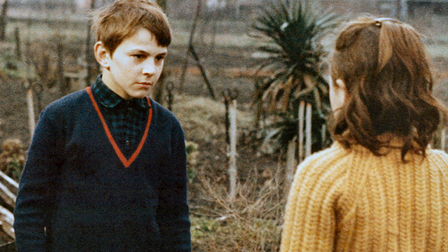
It is quite extraordinary that 1968's L'Enfance Nue (or Naked Childhood) was the debut feature of a 43 year-old Maurice Pialat. Pialat would go on to direct a small number of highly-admired films after this, up until 1995, but it remains this film that he will be most remembered for. Similar in spirit but not in style to Francois Truffaut's masterpiece The 400 Blows (1959), it follows the exploits of a troublemaking child who channels all of his rejection into ferocious anger that causes havoc with the people around him. Truffaut also has a co-producer credit for the film, although it would be the last time he would work with Pialat.
A young boy, Francois (Michel Terrazon), is placed in a home for bad children when his frequent outbursts and often psychopathic acts become too much for his mother. He is eventually re-homed and put into the care of an elderly couple, who also look after another older child, Raoul. When Francois warms to the elderly lady, his behaviour begins to become less hostile and he becomes familiar with his new surroundings. But a lifetime spent being unwanted has left it's mark on Francois, and he constantly remains unpredictable. Francois kills a cat, throws a knife at his new 'brother', and repeatedly steals from the other children. He is a horrific creation, and every parent's nightmare.
Pialat paints an interesting picture of France at the time. Without sledgehammering it home, he and the film depicts a time where a creeping poverty was lurking among the edges of suburbia. Perhaps this was one of the factors for Francois' parents being physically and mentally unable to keep the child, too distracted with their own situation that they don't have the time to get to the root of the problem. Or perhaps Francois is just a mischievous little bastard, and his inability to settle with one family before pushing them over the edge is his fault. L'Enfance Nue also has a surprisingly reserved depiction of the social services. They are seen simply doing their job, and repeatedly re-housing Francois every time he is rejected by a new foster family. This is where the genius lies in this film. Instead of using the film as a medium to send a social message (a la Ken Loach), Pialat sits back, points his camera, and tells a story. It is both complex and simple, but you would have to make your own mind up about that.
Much like Jean-Pierre Leaud in The 400 Blows, Michel Terrazon is fantastic in the lead role, brimming with menace and an unpredictability. Although the comparisons seem obvious, it would be wholly unfair to carry on comparing this to Truffaut's film, as L'Enfance Nue is a fantastic film in it's own right. Like most of his films, this is considered somewhat autobiographical to Pialat, but how much is unclear. His filmmaking techniques seem similar to the attitudes of the title character - this film is in your face and hard-hitting. You can almost hear the director yelling 'if you don't like it, then fuck you!'. A very, very good film, and I shall be seeking out more Pialat because of it. A remarkable debut.

 The first two-thirds of Police are it's best, as Mangin is caught up investigating a bunch of Tunisian drug-dealing criminals, and has his eye caught by the doe-eyed and beautiful Noria (Sophie Marceau), the girlfriend of one of the chief suspects. It's in these early scenes that Mangin is off the leash, slamming suspects heads into tables as a manner of interrogation, and, outside of work, joking with his friend Lambert (Richard Anconina), the criminal lawyer for most of the scumbags that Mangin puts away. Lambert is good at what he does, and most of his clients get off, yet he and Mangin laugh and joke about the system. It's all just a game to Mangin, something for him to do in order to satisfy his many appetites, as the line between the police and criminals is blurred.