The comedy pairing of writer and director Adam McKay and actor Will Ferrell turned their attention towards the buddy action movie for their fourth feature, The Other Guys. Their familiar see-what-sticks attitude and encouragement of improvisation often produces mixed to plain bad results (see Talladega Nights: The Story of Ricky Bobby), but every now and then gold can be struck, with the huge following that was generated in the wake of cult favourite Anchorman: The Legend of Ron Burgundy being the most obvious example. The Other Guys falls easily into the second category, with the sheer volume of belly laughs inspired by a fast-paced first hour going some way to gloss over the disappointment of the stretched-out, action-heavy final 50 minutes.
The NYPD prides itself on its two superstar cops, Highsmith (Samuel L. Jackson) and Danson (Dwayne Johnson), who regularly cause millions of dollars worth of damages on the city streets while chasing down low-level criminals, but doing so in style. When their own arrogance and plain stupidity puts them out of action, partners Gamble (Ferrell) and Hoitz (Mark Wahlberg), one a goofy desk jockey and the other a neurotic short-fuse (I'm sure you can guess which is which) must step up to keep the city safe. While investigating a scaffolding permit violation by billionaire businessman Sir David Ershon (Steve Coogan), the pair stumble upon a conspiracy involving mass fraud that goes all the way to the very top. They are met with resistance by a group of heavies led by Australian Roger Wesley (Ray Stevenson), and from their very own bosses and co-workers, but must get past their own personality clashes to bring the culprit to justice.
It's a shame that The Other Guys runs out of steam long before the closing credits, as there is real chemistry between the two leads. The film eventually falls back on a montage of shoot-outs and car chases to become the very thing it started out satirising, but Ferrell and Wahlberg have fun while it lasts. Wahlberg makes for a hilarious straight-man and the perfect foil for Ferrell to bounce his goofball ad-libs off, before the latter turns up the weirdness and decibel levels up to intolerable levels. The big joke is that Gamble is incredibly plain, but inexplicably attracts gorgeous women, including his 'bland' wife played by Eva Mendes. Hoitz's reaction to meeting the woman his partner describes as a 'big old gal' provides the film's funniest moment. There's great support from Michael Keaton, who gets to flex his comedy muscles after a long stint out of the game, but the meathead rival partners played by Damon Wayans Jr. and Rob Riggle are irritating from the get-go. A mixed bag for sure, but one of the better efforts from Ferrell and his posse.
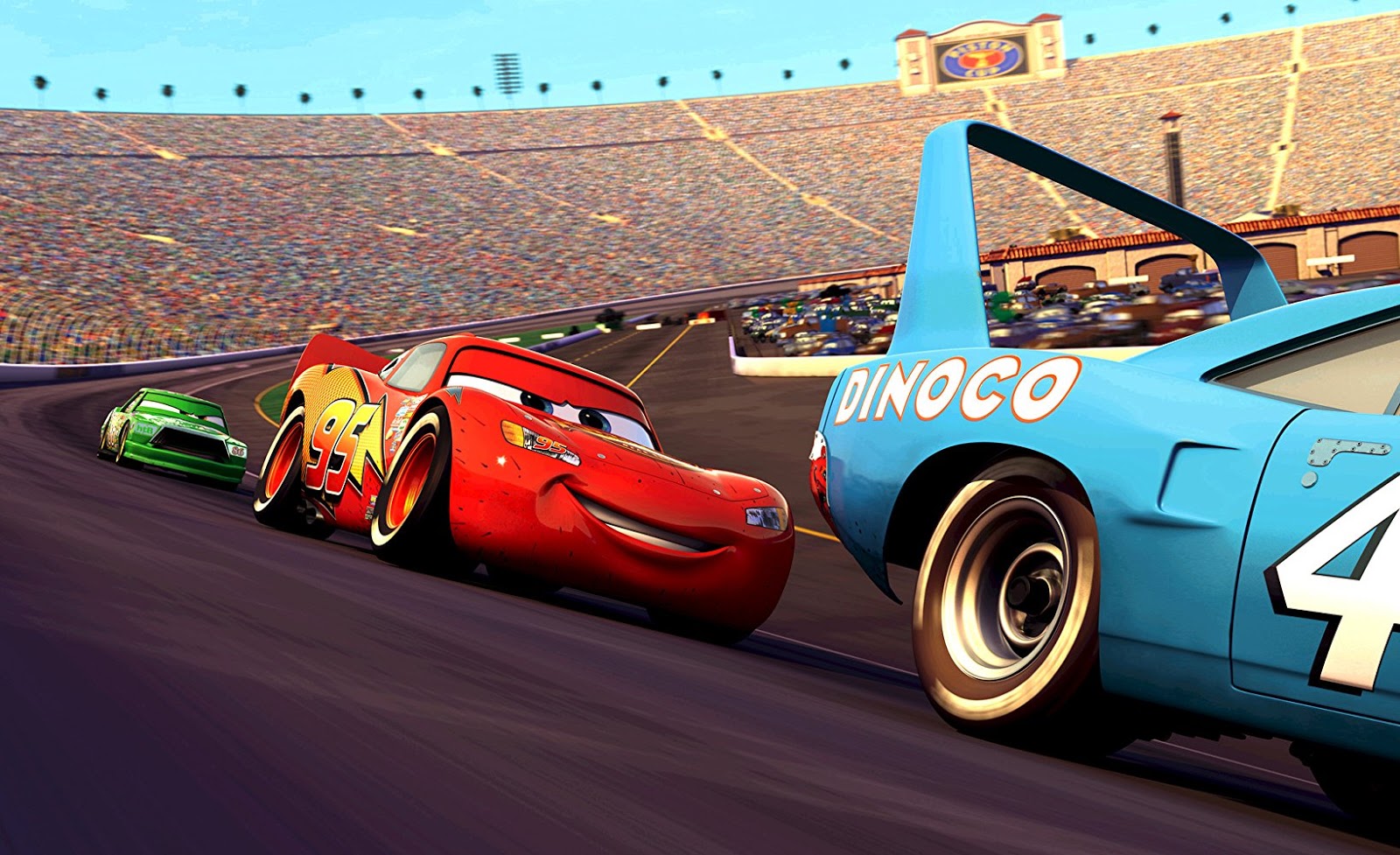
Ever since Pixar first wowed cinema-going audiences across the globe with their feature-length debut Toy Story, the company has become the standard for cinematic excellence. Not only for their constantly groundbreaking animation and ability to entertain both children and adults alike, but for the quality of their scripts and the amount of genuine heart that pours out of them. Yet for every WALL-E, The Incredibles or Inside Out there's always a Monsters University, A Bug's Life or Brave. These films still get a pass because, after all, "it's only a kid's movie," but the disappointment is all the more crushing with the knowledge of Pixar's capabilities. Cars is firmly in the latter category, falling into the traps of a familiar plot and a script that isn't quite up to scratch.
Cars' reputation has been damaged ever further in the decade since its release, and this is no doubt thanks to the lazy and bitter-tasting sequels and spin-offs, something the company has churned out at an increasing rate ever since Disney took over. I must admit that I didn't think much of Cars back in 2005. It lacked excitement and a character to really root for, and the story of a cocky upstart learning learning a valuable lesson to change their outlook on the world can be seen in countless other children's movies. However, on my second viewing I found moments of tenderness between the cracks, an old-fashioned romanticism to really warm the heart. The movie is about more than a young race car named Lightning McQueen (voiced by Owen Wilson) and his quest to escape the forgotten town of Radiator Spings to reach the Piston Cup. It's also about the changing face of America and the way its capitalist nature is leaving the little guys behind.
One aspect of Cars that was never criticised was its cutting-edge animation, and the way it brought the loud, dangerous world of racing and the country's glorious landscapes to beautiful life. It is still utterly glorious to look at, whether it be a wide shot of a darkening horizon or a close-up of buck-toothed tow truck Mater (Larry the Cable Guy). The small town off Route 66 is full of other colourful archetypes, voiced by the likes of Paul Newman, Bonnie Hunt, Tony Shalhoub, Cheech Marin and George Carlin. The problems I had with the film the first time around are still present - the climax should be a lump-in-the-throat moment but is oddly devoid of emotion, and the film offers no surprises at all - but they just didn't seem to bother me as much. The hefty running-time (just shy of 2 hours) also whizzed by, despite the lack of genuine laugh-out-loud moments. So forget Cars 2, Planes and those awful-looking straight-to-DVD spin-offs you ignore in Tesco, and give Cars another chance.
Marvel fans rejoiced when the announcement was made that Cinematic Universe overseer Kevin Feige had managed to reclaim the movie rights to one of their most beloved and iconic characters, Spider-Man. Along with Bryan Singer's X-Men, Sam Raimi's Tobey Maguire-starring Spider-Man trilogy laid the foundations for the modern superhero movie and proved that comic-books aren't just for nerds. After constant meddling by Sony, Spider-Man 3 was a convoluted mess, and although it raked in the cash at the box-office, plans for a fourth instalment were put on ice. The plan was later scrapped entirely in favour of a reboot with Andrew Garfield, which was also cancelled after its sequel made the same mistakes that saw Raimi's Spider-Man 3 receive a critical mauling.
Marvel cast British actor Tom Holland in the role, and he was quickly heralded as the best Peter Parker yet when he debuted in last year's Captain America: Civil War, and Feige revealed that a standalone reboot was coming soon. The thought of a second reboot just 5 years after the last one naturally had people sceptical, but Holland's exciting cameo also raised hopes. While it certainly doesn't reach the lofty humanist heights of Raimi's Spider-Man 2 (still one of the best comic-book movies ever made), Homecoming - a title that works on two levels - is bloody good fun. Taking Parker all the way back to high school as an overeager 15 year old, with detention, hormones and the homecoming dance as much of a concern to our hero as the villain flying around with alien technology, the film shares just as much in common with the classic John Hughes movies of the 1980s than it does with anything starring Iron Man, Thor or the Hulk.
Having proved himself to Tony Stark (Robert Downey Jr.) by stealing Captain America's shield and helping topple Paul Rudd's Giant-Man during the events of Civil War, Peter Parker now waits eagerly by the phone for a call from Jon Favreau's Happy Hogan to announce his next mission. Only Stark would prefer that he remains a friendly, neighbourhood Spider-Man for the time being, but Parker's eagerness to prove himself and struggle to truly control his powers see him taking on hardened thugs and barely making it out alive. On top of juggling his new responsibilities (thankfully we are spared the Uncle Ben speech this time around), he awkwardly courts the pretty Liz (Laura Harrier), receives abuse from rich douchebag Flash Thompson (Tony Revolori), and must prevent chubby best friend Ned (Jacob Batalon) from revealing his superhero alter-ego to the rest of the school. Ned quite rightly believes that the revelation is their ticket to climb the high school cool hierarchy, and Liz naturally has a crush on her local masked vigilante.
A world away from Marvel's previous supervillain Ego the Living Planet (no pun intended), whose masterplan spanned the entire universe, Homecoming's big bad is in the form of working man Adrian Toomes (Michael Keaton). Talking in a thick New York accent and favouring a baseball cap and a hoodie, Toomes is introduced cleaning up the mess left by Loki and his Chitauri army during the climax of 2012's The Avengers, only to watch as his contract is snatched away by Stark and his billions. He doesn't leave empty-handed though, as he manages to smuggle some alien technology away and form a lucrative, and highly illegal, arms business. He also has a formidable suit made for him, allowing him to soar through the sky on razor-sharp wings, dubbing him the Vulture. After a number of forgettable Marvel villains, Toomes brings to mind Alfred Molina's three-dimensional and incredibly sympathetic Doc Ock, and Keaton has fun with the role, proving a menacing presence during a particularly tense car journey on the way to the homecoming dance, in what is undoubtedly the film's standout moment.
The likes of Thor would be able to take out Toomes with the blink of an eye, but his family-first motivation and distrust of the rich and powerful ground the movie, and helps make Homecoming Marvel's smallest and most intimate entry since Ant-Man. While the climax does deliver a routine smash-em-up CGI fest that director Jon Watts doesn't seem experienced enough to handle, the film mainly avoids the usual superhero tropes and rarely shifts its focus away from Parker, who is played with irresistible charm and athleticism by Holland. There's an endearing playfulness in the smaller moments, particularly in the dynamic between Holland and scene-stealer Batalon. Having watched Watts's previous film Cop Car recently, it now seems obvious why Marvel placed so much trust in a director so clearly adept in handling young relationships. Homecoming continues the recent trend of proving that superhero movies don't necessarily need to be superhero movies: They can also be a high school comedy, or a violent western. Was a second reboot for a character only introduced to the big screen 15 years ago justified? Somehow, yes.
This years Academy Award Best Picture line-up was one of the most underwhelming in recent memory, but there was a little cheer when director Tom McCarthy's underdog Spotlight took home the top prize. My personal favourite of the nominees, The Big Short, lost out, and the stand-out film of the year, Inside Out, wasn't even on the list (although it took home the Best Animated Feature), but the lack of truly great films this year doesn't take anything away from Spotlight, which is a riveting little procedural hampered by a surprising emotional distance from the disturbing subject matter.
Like most films set amongst the huddled office meetings, desk-thumping and pen-chewing of the newspaper room, Spotlight takes its inspiration from Alan J. Pakula's seminal All the President's Men (1976), and concerns itself solely on the noble efforts of the staff trying to piece together that big story that will change everything. Here, we're at the Boston Globe in 2001, and the newspapers new editor Marty Baron (Liev Schreiber) and almost instantly notices the importance of delving deeper into eccentric lawyer Mitchel Garabedian's (Stanley Tucci) accusation that Cardinal Law (Len Cariou) has covered up the molestation of various children by a priest in their very city.
Baron hands the task to Spotlight, a team consisting of 'Robby' Robinson (Michael Keaton), Mike Rezendes (Mark Ruffalo), Sacha Pfeiffer (Rachel McAdams) and Matt Carroll (Brian D'Arcy James), who takes months exhaustively researching their subject matter before publishing their findings. What they uncovered were hundreds of cases in Boston alone of child molestation by priests, and the fact that this was ignored by people in a position to do much more. In fact, some of the most powerful moments come from the revelations that some of the Boston Globe staff sat on the story for years without taking notice of the extent of the abuse. With Operation Yewtree still hitting the headlines here in the UK, the subject of sweeping these kinds of cases under the rug couldn't be more relevant.
Spotlight depicts, in breathtaking detail, the work carried out by Robinson and his team to uncover the truth and to obtain the required evidence. Keaton, after last years Birdman, gives another assured performance, and Ruffalo is routinely terrific as the pit-bull Rezendes. Aesthetically, the film cannot be faulted, and McCarthy sticks strictly to the facts. However, the lack of an emotional connection means the film does not induce the kind of anger it really should. Without doubt the movies stand-out scene is Pfeiffer's reaction to a priests blunt response to her equally blunt questioning, and the film should maintain the sort of power and shock this moment inspires, but keeps itself frustratingly distant. Spotlight is still an accomplished piece of work with some sparkling dialogue, and McCarthy hints that he may have found the same form he had with his terrific debut The Station Agent (2003).
Director Alejandro Gonzalez Inarritu seems to have cheered up a bit since his reach-for-the-noose-depressing trilogy of 21 Grams (2003), Babel (2006) and Biutiful (2010). The first two are excellent films (I haven't seen the third), telling honest and brutal human stories powerfully played by expert, distinguished actors, but show no signs of the kind of energy, wit and satire of his latest, Birdman, this year's Best Picture Oscar winner. We spend two hours inside the world of washed-up actor Riggan Thomson (Michael Keaton), who is having a later-than-midlife crisis trying to escape from his superstar days of being a costumed hero and trying to re-invent himself by writing, directing and starring in his own play.
For a film that spends so much time poking fun at the self-contained world of thespians and the empty yet highly-craved escapism of blockbuster cinema, Birdman manages to be, in it's own strange, unique way, a bit of both. When we first meet Riggan, he is meditating mid-air. He moves objects telekinetically, and his actions and decisions are criticised and mocked by his former alter-ego, Birdman himself. We are in and out of our protagonist's head, which is made even more delirious by the magnificent camerawork by Emmanuel Lubezki, one of the finest in the business. With the odd exception, for the most part Birdman appears edit-free. Day turns to night in the same shot and vice versa. But this is no mere gimmick.
We're on the cusp of the opening of What We Talk About When We Talk About Love, Riggan's stage adaptation of Raymond Carver's (very) short story. One of his actors is injured by a falling piece of equipment and is replaced last-minute by primadonna dick-head Mike Shiner (Edward Norton) whose girlfriend Lesley (Naomi Watts) is already working on the play; his daughter Sam (Emma Stone) is fresh out of rehab and is resentful of her father's late-in-life attempts at reconnection; his female lead Laura (Andrea Riseborough) is pregnant and tells Riggan it's his; and pompous art critic Tabitha (Lindsay Duncan) is determined to destroy the play before it's even played. It's a stressful time for Riggan to say the least, and with the illusion of watching one continuous shot, we feel right there with him. With the near-constant jazz score, we also feel every beat.
But the technical aspects of the movie do not overshadow the story, and it is played out by a gifted ensemble. With the loose, free-spiritedness of it all, Keaton breaks free and shines, excelling at the moments of comedy (Riggan's semi-naked dash through Times Square is a highlight), and moving us in the more tender moments involving his sympathetic ex-wife Sylvia (Amy Ryan). He's also as precious as his fellow actors, disgruntled that Woody Harrelson, Michael Fassbender and Jeremy Renner are unavailable due to working on their highly successful franchises, resentful at he fact that he wore a cape before capes were cool. It could have been a disorientating experience, instead it's exhilarating. It could have also trodden ground covered before, but it's so on-the-nose that it feels fresh. And it may not be the best film of the year as Oscar may have you believe (my heart lies firmly with The Grand Budapest Hotel), but Birdman is everything and nothing, just like Riggan himself.

 The NYPD prides itself on its two superstar cops, Highsmith (Samuel L. Jackson) and Danson (Dwayne Johnson), who regularly cause millions of dollars worth of damages on the city streets while chasing down low-level criminals, but doing so in style. When their own arrogance and plain stupidity puts them out of action, partners Gamble (Ferrell) and Hoitz (Mark Wahlberg), one a goofy desk jockey and the other a neurotic short-fuse (I'm sure you can guess which is which) must step up to keep the city safe. While investigating a scaffolding permit violation by billionaire businessman Sir David Ershon (Steve Coogan), the pair stumble upon a conspiracy involving mass fraud that goes all the way to the very top. They are met with resistance by a group of heavies led by Australian Roger Wesley (Ray Stevenson), and from their very own bosses and co-workers, but must get past their own personality clashes to bring the culprit to justice.