Showing posts with label Sam Neill. Show all posts

Monday, 20 August 2018

Review #1,381: 'Sleeping Dogs' (1977)

With Sleeping Dogs, director Roger Donaldson near enough single-handedly cemented New Zealand's place on the cinematic map. It was, at the time, the biggest box-office hit the country had seen, and also boasted what is only the second big-screen appearance by Sam Neill. With Ozplotation in full swing just across the water, Sleeping Dogs kicked off a New Wave in New Zealand, with the likes of Donaldson's Smash Palace and Vincent Ward's Vigil following in the subsequent years. The film is odd and off-kilter, but never less than fascinating. Donaldson clearly looked at Adolf Hitler's own rise to power in post-World War I Germany for inspiration, as he depicts a New Zealand of the near future falling foul of a rising dictatorship who are eager to hunt down anybody they believe could belong to a growing band of freedom fighters. It all starts with television reports of fuel strikes across the country, and quickly spirals out of control from there.

The report is being watched by Smith (Neill) as his children write him goodbye letters and his wife sobs in the kitchen. He is the victim of infidelity, so decides to pack up and live off the grid for a while, but not before his wife's new lover Bullen (Ian Mune) arrives before he has even left the house. He spots an island on the Coromandel peninsula, arranging with the Maori owners to live out there untroubled, even exchanging his expensive car for their rusty old boat. He fishes, listens to the radio, and befriends the locals nearby, but his idyllic existence is soon interrupted when the government goes into full crackdown mode, arresting anybody on suspicion of assisting the revolution. He is taken in by the police to be interrogated and tortured, and likely sentenced to death. Seeing no other alternative, Smith takes his chance and escapes his captors, fleeing to a quiet camping ground where he meets a nice local girl. Smith is no guerilla revolutionary and is quite happy to live in ignorant bliss, but when US Army Colonel Willoughby (Warren Oates) arrives with more on his mind than policing the country, it becomes clear that Smith's destiny lies with the uprising, whether he likes it or not.

Donaldson deliberately holds back certain pieces of information to keep the goings-on away from Smith a mystery, making Sleeping Dogs a rather frustrating experience. But frustrating isn't always bad, and here the loose, drifting storyline gives the film a unique style and atmosphere. You're never quite sure where the story will go next, and when Warren Oates arrives with a smile and willingness to party, there's a disorientating sense of unease as the beads of sweat drip off his quivering moustache. Cinematographer Michael Seresin, who would go on to work on the likes of Midnight Express, Angel Heart and the third Harry Potter, captures the country beautifully, imbuing the scenery with a sense of beauty and peace one minute, and a sense of terror the next. It all sounds a bit George Orwell, but it really isn't. It's actually much stranger than that, and has a rich vein of humour throughout, usually stemming from Smith's frustration as he unwillingly grows into a revolutionary leader. In many ways, it mirrors Gary Bond's experience trapped in the small, violent town of Ted Kotcheff's masterpiece Wake in Fright, only with less booze, more humour, and some bizarre turns along the way.


Directed by: Roger Donaldson
Starring: Sam Neill, Nevan Rowe, Ian Mune, Warren Oates, Clyde Scott
Country: New Zealand

Rating: ****

Tom Gillespie


Sleeping Dogs (1977) on IMDb

Sunday, 2 October 2016

Review #1,093: 'Hunt for the Wilderpeople' (2016)

Before Hunt for the Wilderpeople was even released, director Taika Waititi had been headhunted by Marvel Studios to helm what will be one of their biggest releases in 2017, Thor: Ragnarok. The talented writer, director and actor duly obliged, and will no doubt bring his unique brand of charm and laugh-out-loud humour to what has been tantalisingly described as an intergalactic road movie. His relocation to Hollywood helps bring a sense of bittersweet gravitas to Wilderpeople, almost as if he is waving goodbye to his beautiful New Zealand, smashing the opening weekend box-office in his native country in the process.

The film tells the story of Ricky Baker (Julian Dennison), an overweight orphan who dresses like the gangster rappers he frequently quotes who is placed in the care of foster parent 'Aunt' Bella (Rima Te Wiata). Bella lives in a remote cottage and welcomes the troubled child with open arms, switched on to exactly how to deal with Ricky's unique brand of rebellion. The same cannot be said for her husband Hec (Sam Neill), a grizzled frontiersman who we first meet emerging from the hills with a huge boar on his back. Hec has no time for Ricky, but when tragedy strikes, the child heads out into the wilderness to survive on his own. It doesn't take long for Hec to catch up to him, but when the huntsman is injured, the two are forced into spending a huge amount of time together, becoming wanted outlaws and local celebrities in the process.

Waititi's previous film, the cult vampire mockumentary What We Do in the Shadows, was complimented by its cast of talented comedic actors and surprisingly gory set-pieces. While Shadows was certainly a riot, it could be argued that it lacked heart. Wilderpeople certainly doesn't, and Waititi seems to have an uncanny ability to know just when to inject sentiment into a mix of memorable one-liners, bizarre supporting characters and pop culture references. A lot of this is down to the two central performances. Dennison proves to be one held of a find and the ever-reliable Neill is perfect as the grumpy foil who slowly and convincingly forms a bond with the child. Many of the laughs come from Ricky's childish naivety - when he sees the military and their sniffer dogs hunting them through the trees, he exclaims, "Ninjas! Direwolves! Child Services!"

There is also a fine performance from Rachel House as head of child services Paula, a grotesque woman who seems to have stepped out of the pages of a Roald Dahl book. Her motto is "no child left behind," but doesn't seem to grasp the meaning of the words as she takes her job far too seriously and leading the manhunt herself. While the film seems to slightly lose focus towards the Thelma and Louise-inspired climax, it never loses its heart. Adapted from Barry Crump's book Wild Pork and Watercress, Waititi's is clearly in love with the film's characters, as well as the beauty of the New Zealand wilderness. It's a near perfect combination of comedy and drama, knowing exactly the right time to switch gears. If Waititi can bring the same levels of charm and offbeat humour to his Thor movie next year, it will be one of the most intriguing movies of the year and a standout in Marvel's already-impressive track record.


Directed by: Taika Waititi
Starring: Sam Neill, Julian Dennison, Rima Te Wiata, Rachel House, Rhys Darby
Country: New Zealand

Rating: *****

Tom Gillespie


Hunt for the Wilderpeople (2016) on IMDb

Thursday, 29 October 2015

Review #938: 'Jurassic Park III' (2001)

It became apparent rather quickly during my first viewing of The Lost World: Jurassic Park in 1997 that even an old master like Steven Spielberg was lacking ideas for the follow-up to his 1993 smash. So it comes as no surprise that director Joe Johnston, whose most popular work back in 2001 consisted of mediocre fare like Honey, I Shrunk The Kids (1989) and Jumanji (1995), failed to squeeze any life out of the extinct prehistoric monsters on show. Even the writing talents of Oscar-winners Alexander Payne and Jim Taylor - who co-scripted with Peter Buchman - struggle to bring any dimension to the film's ensemble of disposable characters.

When their son Eric (Trevor Morgan) goes missing while para-sailing near to the dino-infested island of Isla Sorna, his wealthy parents Paul (William H. Macy) and Amanda (Tea Leoni) look to launching their own rescue mission. As their guide, they approach Dr. Alan Grant (Sam Neill), one of the survivors from the events of Jurassic Park, to whom they offer a big pay-cheque and the promise that their plane will not touch ground. Paul and Amanda have some explaining to do when they inevitably land on the island and are soon running for their lives from a hungry spinosaurus. The velociraptors have also become more intelligent, learning to vocally communicate with each other, and do not respond nicely when Grant's assistant Billy (Alessandro Nivola) steals one of their eggs.

It's no surprise that the franchise stagnated for 14 years following this third instalment. Little more than a re-hash of the first two movies - characters scream, run, get eaten, and make stupid decisions, while the true stars, the dinosaurs themselves, still impress. There's little pity to be had for the characters as we are urged to accept that Paul and Amanda would let their young son adventure near to an island now famously inhabited by ravenous monsters, and then ignore every piece of advice offered to them by the expert they employed. Even Sam Neill sleepwalks his lines and fails to bring any life to Dr. Grant. It all just seems like a pointless exercise, like everyone involved were simply seeking a nice pay day, and any ethical questions raised in the first two films are ignored in favour of somehow squeezing in yet another dinosaur attack.


Directed by: Joe Johnston
Starring: Sam Neill, William H. Macy, Téa Leoni, Alessandro Nivola, Trevor Morgan
Country: USA

Rating: **

Tom Gillespie


Jurassic Park III (2001) on IMDb

Wednesday, 21 October 2015

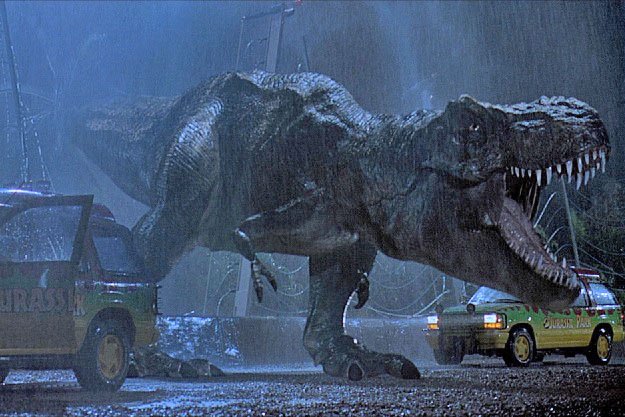
Review #934: 'Jurassic Park' (1993)

Jurassic Park was one of the first movies I remember watching at the cinema as a youngster, and I was so blown away I quickly acquired a pirate video of it, which I routinely watched to death. The special effects, the music, the set-pieces, that familiar park logo - it all had me riveted. It's one of the game-changing blockbuster movies, and watching it again an astonishing 22 years later, it's remarkable just how well the movie has aged. It's not quite the perfect experience I remember - those Spielberg-isms are now clear as day - but Jurassic Park's mixture of robotics and CGI blows most modern films away in terms of tension and pure spectacle.

Eccentric millionaire John Hammond (Richard Attenborough) approaches palaeontologist Dr. Alan Grant (Sam Neill) and his palaeobotanist partner Dr. Ellie Satler (Laura Dern) to join him on a journey to his newly built theme park. With the promise of a life-changing experience, the young-ish doctors cannot resist, so they journey to Isla Nublar, an island off the coast of Costa Rica, along with mathematician Dr. Ian Malcolm (Jeff Goldblum) and lawyer Donald Gennaro (Martin Ferrero). Upon arrival, they are greeted with the sight of a living, breathing brachiosaurus. Using the preserved dinosaur DNA extracted from mosquitoes preserved in tree sap, Hammond and his company have used cloning technology to birth a wide range of dinosaurs, including the terrifying tyrannosaurus rex and a group of velociraptors.

With this revelation comes the debate of whether man creating life is ethical, or in this scenario, safe. The dangers quickly become apparent to the group of doctors, but they cannot restrain their curiosity and are whisked off on a tour of the park. So confident is Hammond in the safety of his park, he invites his grandchildren Tim (Joseph Mazzello) and Lex (Ariana Richards) to participate. However, disgruntled employee Dennis Nedry (Wayne Knight) has cut a deal to sell dinosaur embryos to a corporate rival, and when a storm hits the park, he shuts down all the power in order gain access to the eggs. With the electric fences keeping the dinosaurs in temporarily down, it isn't long before the dinosaurs are fleeing their pens.

At first, this is the patient Spielberg who gave us Jaws (1975), opting for a slow build-up to the big reveal rather than giving the audience instant gratification. The introduction of the T-Rex is now an iconic moment in cinema, a thrilling combination of tension and pure terror, with a jump shock thrown in for good measure. But once Spielberg finally unleashes his monsters, the film simply doesn't stop. Delivering set-piece after set-piece, Jurassic Park abandons all restraint and packs it's second hour when it should be preparing us for the next big scene. Jaws gave us that wonderful moment when the crew compared battle scars, but there is no such scene here, just another problem for our relatively bland archetypal heroes to solve.

One of the most interesting aspects of the film is the character of John Hammond, Essentially the main antagonist, Hammond is a good-natured capitalist, a visionary who wants to bring wonder to the masses and make a tidy profit at the same time. Without a second thought for the consequences of his actions or the ethics of playing God, Hammond comes across as misguided, and too likeable to be labelled a villain. Hammond aside, Jurassic Park makes no apologies for its thinly-written characters, as this is a film of visual spectacle after all. When John Williams' famous score kicks in, it's easy to forget about the movie's many niggling problems and, for me at least, be reminded of that kid who would watch it on repeat with his nose a few inches from the screen.


Directed by: Steven Spielberg
Starring: Sam Neill, Laura Dern, Jeff Goldblum, Richard Attenborough, Bob Peck, Martin Ferrero, Joseph Mazzello, Ariana Richards, Samuel L. Jackson, Wayne Knight
Country: USA

Rating: ****

Tom Gillespie


Jurassic Park (1993) on IMDb

Thursday, 10 January 2013

Review #561: 'The Piano' (1993)

Ada (Holly Hunter) arrives at a rainy New Zealand coast to meet her new husband - the gently-spoken frontiersman Stewart (Sam Neill) - along with her precious grand piano and her illegitimate daughter Flora (Anna Paquin). Ada has been a mute since she was 6 years old, and as she explains in her narration, no-one knows why. Stewart's friend Baines (Harvey Keitel) takes an interest in the piano and offers Stewart land in exchange for it, as well as lessons from Ada, to which Stewart agrees. Offering the chance to earn her piano back, Baines wants one visit per black key on the piano from Ada, who he is seemingly infatuated with.

Australian director Jane Campion's erotically-charged gothic love story was a huge success back in 1993, winning the Best Actress Academy Award for Holly Hunter and Best Supporting Actress for Paquin, who became the second youngest recipient ever. Hunter's shadowy Ada is the backbone of The Piano, and while it may appear that it is her piano that fuels her passion, it is very much her own mind and experiences that dictate her actions. She is quite a fascinating character - not merely the put-upon mute who longs for love and her piano - she is actually rather subtly manipulative and sexually powerful, weighing up the two love interests in her life, and playing a dangerous power game with her increasingly jealous husband.

The contrast between the two men in Ada's life couldn't be any obvious - Stewart playing dutiful, business-minded and quite inept in courtship, while Baines is hulking, living out in the forest, his face spotted with native Maori tattoos - but it is quite clear as to where Campion's preferences life. Ada's scenes with Baines, in which he listens to her play, become the centrepiece for some highly erotic moments, playing out more like animal foreplay than anything human. Ada seems not to bat an eyelid when Baines lies on the floor by her feet, fingering a hole in her stocking, or simply walks around the room completely naked. While these unconventional actions are there to channel Ada's sexual repression/release and Baines' animalistic nature, these scenes often appear forced, filled with lazy or nonsensical metaphors passed of as spiritual film-making.

As with many Australian period films, The Piano looks stunning. The exotic location is not filmed through a sun-tinted lens, and nor does it capture any of the colourful wildlife (something you would expect if Terence Malick had directed it), but is grey, wet and muddy. Like Peter Weir's Picnic at Hanging Rock (1975) and Gallipoli (1981), it has that lived-in feel, with Hunter's beautiful, ghostly face evoking a 19th-century photograph, where everyone looks grim and pale, and Campion's occasionally snapshot approach captures the mundane, everyday actions of the period. The performances are a revelation, with Hunter and Paquin deserving their accolades, and Keitel proving a formidable presence (I'll not mention the accent). The Piano is personal film-making, but too often the film seems to be striving for that mystical atmosphere rather than actually capturing it, occasionally getting lost amongst Campion's obvious adoration for her protagonist.


Directed by: Jane Campion
Starring: Holly Hunter, Harvey Keitel, Sam Neill, Anna Paquin
Country: Australia/New Zealand/France

Rating: ***

Tom Gillespie


The Piano (1993) on IMDb

Tuesday, 5 July 2011

Review #157: 'Possession' (1981)

Ukrainian director Andrzej Zulawski's first and only English language film, is a strange mixture of horror and drama. The film begins as Mark (Sam Neill) and Anna's (Isabelle Adjani) marriage is deteriorating. What proceeds is a series of increasingly brutal arguments, as Mark unravels Anna's infidelities that she has been embroiled in over the past year. Their son, Bob (Michael Hogben) is caught in between the feuding couple. As Mark breaks down in almost infantile ways to begin with, he employs a detective to follow Anna to find out who she has been having an affair with. Here he meets Heinrich (Heinz Bennent - giving a fantastically deranged performance as "zen" superior; stumbling around in a strangely amusingly contorted way), who has been at least one of the persons Anna has been sleeping with.

The first half of the film sees Mark's paranoia escalate, as he attempts to discover Anna's secrets. Each of their meetings are fraught with anguish and violence. As the secrets unravel, it becomes apparent that Anna has a clandestine apartment, where she has been seemingly having sexual relations with a tentacled "monster". What transpires is a vicious hatred of men, as Anna murders and dismembers men, perhaps to feed the bed-ridden monster.

The ambiguities within the text of the film are great. As the protagonist in the film is male, are we to consider that his instability after the breakup creates these base images of his wives "monster" lover? Has she simply become a monster herself within his broken mind, so that he projects these images of male slaughter onto her? It has been stated by the director that at the time of the creation of the film, he too was going through a marriage break-up. Perhaps these are his fantasised thoughts on the realities of this very real trauma.

Isabelle Adjani gives an incredibly powerful performance, moving from serene, to a very animalistic frenzy of outbursts. She won the best actress award at the Cannes Film Festival for this film. The film also became embroiled in the British video nasties debacle, as it was placed upon the Director of Public Prosecutions (DPP) list of banned films. A strange inclusion amongst the "hard-core" gore films. The film plays mostly as a dark drama, a fantasised male projection of women's infidelity. It has been compared to celebrated relationship break-down films such as Ingmar Bergman's Scenes from a Marriage (1973). In it's depiction of body horror, it has been likened to David Cronenberg's The Brood (1979). I wondered, within the moments of horror within Anna's secret apartment, whether Clive Barker may have been influenced by the film to create the fundamental idea of Hellraiser (1987).

Anna's tenticular "lover" may feed upon her victims to create a whole new being. In the finale of the film, she presents the dying Mark with a doppelganger, stating, "It is finished now". We could read this as the total end of the relationship. Or, we could see this as her way (within his own mind) of creating a superior yet visually similar man. A man devastated by the break-up may not be able to deal with the idea of his former wife living with a totally different man, so therefore he wants to create a man that is his mirror image.

A shockingly forgotten film, portrays the destruction of a relationship in all of its debilitating reality. For a period after such an upheaval, nothing really seems real. Perhaps the film has largely been forgotten within the UK because of its inclusion into the video nasties list. A bunch of films that most people would have no interest in viewing. And those interested in the gore-filled nasties, would probably be disappointed with the beauty of the film. It is almost a perfect portrayal of devastation, and the implications, and horrors projected onto the fall-out of long term relationships. Beautiful, disturbing, but essential cinema.


Directed by: Andrzej Zulawski
Starring: Isabelle Adjani, Sam Neill, Margit Carstensen
Country: France/West Germany

Rating: ****

Marc Ivamy


Possession (1981) on IMDb


LinkWithin

Related Posts Plugin for WordPress, Blogger...