Showing posts with label Ted Kotcheff. Show all posts

Sunday, 7 September 2014

Review #782: 'Wake in Fright' (1971)

One of the pioneering films of the Australian New Wave, Ted Kotcheff's Wake in Fright was released in 1971 to widespread critical acclaim after a number of successful festival screenings. It was then lost for nearly 40 years, found by the film's editor Anthony Buckley in a bin marked 'for destruction'. The New Wave, which eventually gave birth to Ozploitation, showed polar opposite views of Australia. The likes of Peter Weir and Nicholas Roeg portrayed the country's mystical, spiritual beauty, while movies like Mad Dog Morgan (1976) and Mad Max (1979) exploited the country's rough-and-tumble reputation.

Wake in Fright is somewhere in between - a nightmarish journey into the heart of man's primitive instincts, and into a country in which the inhabitants of back-road towns welcome you with aggressive hospitality. Yet there's something oddly alluring about the sweaty, dusty streets of Bundanyabba ('The Yabba') and it's collection of disturbingly eccentric gamblers and alcoholics. Gary Bond's mild-mannered schoolteacher, John Grant, finds himself in The Yabba on route to Sydney to see his girlfriend, but circumstance and insistence means he can't get out. It's simple-minded townsfolk and excessive beer-swilling attitudes repulse him, but the animal inside of him becomes addicted, and he ends up losing all of his money on a simple game of heads-and-tails.

God bless the persistence of Anthony Buckley, as Wake in Fright is a terrifying masterpiece. At times, it's incredibly difficult to watch. It's a relentless barrage of warm beer, unbearable heat and extreme masculinity, where the only cure to a head-pounding hangover is to gulp more warm beer. Grant meets Doc Tydon (Donald Pleasence - never better), an alcoholic doctor who left his home and job to take residence in the Yabba, a place where his drunken, often violent behaviour is not only accepted, but gives him a social standing, and his idiosyncrasies are celebrated. Doc is Grant's mirror-image, or at least an image of who he could become if he doesn't manage to leave the hell-hole. Doc doesn't need money to survive, he lives on kangaroo stew and favours.

Most of the film's controversy stems from the infamous kangaroo hunt, in which many of the creatures are blasted apart by Doc, Grant, and two other men. This scene is less stomach-churning than the scenes in Cannibal Holocaust (1980), but is a hundred times more unnerving. But there's an odd beauty to the scene, especially when one of the group decides to take one on with a knife in a thrilling encounter. And that sums Wake in Fright up, its utterly repellent, yet you can't take your eyes away. The Yabba's inhabitants celebrate everything with a drink, gulp it down like there's no tomorrow, and are completely perplexed if you refuse. It's ugly, brutal stuff about man's potential for ugliness and brutality, but also a commentary on man's natural primal urges. I now have three reasons never to visit Australia - spider, snakes, and The Yabba.


Directed by: Ted Kotcheff
Starring: Gary Bond, Donald Pleasence, Chips Rafferty, Sylvia Kay, Jack Thompson
Country: Australia/USA

Rating: *****

Tom Gillespie


Wake in Fright (1971) on IMDb

Tuesday, 3 December 2013

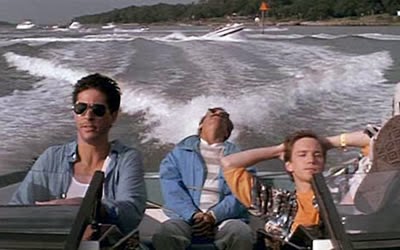
Review #682: 'Weekend at Bernie's' (1989)

Time has the knack of breathing fresh new life into a former piece of crap. Nostalgia sets in with the fashions and the music of its era, and familiar faces re-appear after we have seen their careers gradually collapse. Unfortunately for Ted Kotcheff's Weekend at Bernie's, it is the same cringe-inducing, one-joke farce it was 24 years ago. There was a real chance for some dark comedy here, given that the set up isn't a bad idea if you have the correct writers behind it. However, Norman Mailer did not write Weekend at Bernie's, Robert Klane did, and he was responsible for such classics as National Lampoon's European Vacation (1985), Folks! (1992), and, most unforgivably, Weekend at Bernie's II (1993).

Larry (Andrew McCarthy) and Richard (Jonathan Silverman) are two young, eager lower-level employees at a New York insurance firm. When Richard discovers that an employee has stolen 2 million dollars from the company, he and Larry think they're on their way to a promotion and take the findings to their boss, Bernie (Terry Kiser). As a reward, Bernie invites them to stay at his island beach-house, but secretly, Bernie is behind the theft and has hired a mob hitman to take them both out. However, Bernie himself is assassinated for sleeping with the mob boss' wife, and with party-seeking friends quickly turning up at the beach-house, Larry and Richard must maintain the illusion that Bernie is still alive and well if they want to party.

It seems strange that their has never been (to my mind) a decent comedy involving a dead body. Perhaps the presence of a cadaver is too macabre a subject to raise any laughs, or, as with Weekend at Bernie's, there's not much you can do with it apart from move its limbs and head in an attempt to squeeze out some laughs. And that pretty much sums up this film, raising the question of how moronic can these people be to not realise Bernie is dead? Perhaps it's because, inexplicably, rigor mortis fails to set in at any point and his bowels do not drop. This may even be forgiven if we had anyone to root for, but, as hard as McCarthy and Silverman try, their characters are nothing more than incompetent goofballs chasing that ever-so-80's dream of climbing the corporate ladder. 100 minutes of pure pain.


Directed by: Ted Kotcheff
Starring: Andrew McCarthy, Jonathan Silverman, Catherine Mary Stewart, Terry Kiser
Country: USA

Rating: *

Tom Gillespie


Weekend at Bernie's (1989) on IMDb

Tuesday, 20 November 2012

Review #537: 'First Blood' (1982)

Giving the decades action hero his (or hers) raison d'etre, John Rambo became the ultimate right-wing icon, and, through the First Blood sequels, exacerbated the one-man-army excesses that became so pervasive in action cinema. But before the hyperbole of Republican jingoism, - where the scars of the Vietnam war were refreshed and revised when Reagan, quoting from Rambo: First Blood Part II (1985), stated that; "This Time We're Gonna Win" - Rambo, or more specifically, the Vietnam veteran, was persecuted in American society.

Sylvester Stallone's "John J." drifts through the American landscape searching for the remnants of his Green Beret troop, but finds despair in their absence. The veteran often came back to from the war unable to adjust to civilian life, left with the trauma of warfare, they were subjected to dehumanising abuses by the hippie generation, the middle-class students of the anti-war protesters (as Rambo says "They call us baby killers"). Rambo represents the American working class, the bottom of society, who were abused by foreign policy, trained into machines of death, and forgotten about. Unable to hold a job in the negative climate, Rambo wanders, like the Western outlaw, attempting to find his retirement. Much like the conventions of the classic American Western, the lone outsider enters a small town (not the sun blistered West, but the cold, isolated North-East), finding the antagonistic Sheriff Teasle (Brian Dennehy), who's only concern is containing the status quo.

In Rambo and Teasle there are two souls damaged by late 1960's American politics. Rambo has been reduced to an angry outsider, whilst Teasle, who clearly continued as Sheriff during the war, would have seen the United States reduced to civil disobedience. Rambo enters town with long hair, he is unwashed, and displays the stars and strips on his jacket, a flag that had lost its meaning in the hearts of men like Teasle. So when this nomadic person, a post-war hippie, drifts into his territory, he is myopic in his attempts to get rid of him. In creating this vacuity of an idealised America, the sheriff protects from the transient generation. The two characters are the different generations, and the divide between these different ideologies. They have both been trained by US authorities, and each, like the country itself, only foresees victory and survival.

The structure of First Blood is very simplistic. After being arrested and taken to the local police station, Rambo makes a spectacular escape, making his way on a motorcycle to the rocky, and heavily wooded mountains. After which Rambo is pursued as the authorities, and the audience, begin to discover his exceptional survival techniques, and he wages his own personal war against American small-town hypocrisy, including the inept national guard, made up of local hicks, too young to have any knowledge of war. Unlike the similarly themed action films that proceeded First Blood, Rambo does not actually kill anyone intentionally (Galt (Jack Starrett) falls from a helicopter after a rock hits it, only because he unfastens his seat belt), which actually adds corners to an otherwise one-dimensional character.

Rambo's final outburst of violence is directed at the buildings of the small town. The symbols of progress, and the inscrutable institution, the machine of society, of which he is a small, expendable component, a government trained killing machine. Originally to be played by Kurt Russell, Col. Trautman (Richard Crenna) is the military, the superior and trainer of this broken machine. As Rambo's only exterior relationship, he acts as his father figure. The two characters become human when sharing the screen. An often lampooned scene in First Blood is the emotional outpouring by Stallone, which is at times incomprehensible, as his character finally has a voice, but this scene is pivotal to his redemption.

Based on a 1972 novel by David Morrell, the film makers thoughtfully toned down the more extreme book. It is a competently made action film, the more ridiculous elements of the one-man-army aspects of the narrative have since been diminished by the more over-the-top action that followed. First Blood sits comfortably within the transition from '70's anti-heroes to the machine-bodies of the '80's. It looks back at Clint Eastwood and Travis Bickle, whilst moving towards a Schwarzenegger. It has muscle and explosive action, some thrilling stunts, and a squeamish scene of Rambo sewing his own gashed arm with a needle and thread. But with this comes an interesting (if slightly over the top) observation of the post-Vietnam American consciousness, the barren psychological landscape, and the harsh effects of war on the individual, what we would call Post Traumatic Stress Syndrome.


Directed by: Ted Kotcheff
Starring: Sylvester Stallone, Richard Crenna, Brian Dennehy
Country: USA

Rating: ****

Marc Ivamy


First Blood (1982) on IMDb

LinkWithin

Related Posts Plugin for WordPress, Blogger...