After being shipwrecked, ocean traveller Edward Parker (Richard Arlen) is picked up by a drunken captain, whose next stop is a mysterious island owned by Dr. Moreau (Charles Laughton). Parker gets into a fight with the captain after seeing him beat a strange, hair-covered servant. Upon arrival at the island, he unloads his cargo of various animals and fellow passenger Mr. Montgomery (Arthur Hohl), only to throw Parker overboard and abandoning him there. Unable to escape the island, Parker takes up residence with Moreau, only discover that his strange experiments have caused him to be seen as a God-like figure to the increasingly bizarre island natives, including the Panther Woman (Kathleen Burke), and the 'Sayer of the Law' (Bela Lugosi).
Refused a certificate three times between 1933 and 1957, Island of Lost Souls' blasphemous themes and scenes of vivisection caused wide controversy upon its initial release, and even author H.G. Welles voiced his dislike of it. It's not hard to see why, as although the film is extremely tame compared to the movies released these days, it is way ahead of its time in terms of underlying sexual and religious themes. Moreau's dream is to mate one of his creations, the Panther Woman, with Parker, and then he will truly be a creator. Moreau is obsessed to a psychopathic level of becoming God, and treats the island natives with disdain, cracking his whip and making them recite the laws that he has set for them.
When Parker's fiance Ruth (Leila Hyams) arrives at the island in a hope to save him, the focus on the sexual increases. The natives are stirred, as there is only one other woman on the island, the aforementioned Panther Woman, who Moreau keeps locked in his residence. One of the natives tears one of the bars from her window and sneaks in as Ruth lies in bed. The blend of horror and the threat of rape is used to startling effect, and is a bravely mature and controversial theme for a film produced in the 1930's. So, thankfully, the film is now widely available and ripe for a re-discovery, as it is a brilliant piece of B-movie horror. And the ever-great Charles Laughton, is wonderfully creepy in his role, even though he does look like Peter Kay.
Not specifically emblematic of the "nunsploitation" subgenre signifiers, which were so prevalent in the 1970's after Ken Russell's The Devils (1971), Guilio Berruti's Killer Nun is less exploitative. It doesn't offer a wildly extravagant, gun-toting nun. Nor does it have a convent of sexually repressed nuns, using crucifix's to subvert Christianity in any way. Sister Gertrude (Anita Ekberg, who's image of Sylvia in Fellini's La Dolce Vita (1960) became iconic of European cinema), complains of severe headaches after undergoing neurosurgery, and appears to be suffering from hallucinations. These progressively become exacerbated by an habitual use of opiates, and Gertrude's behaviour on the ward of the geriatrics hospital, and her work is disturbed. In one outburst, she is annoyed by a patient, Josephine (Nerina Montagnani), who has left her false teeth in a glass of water, Sister takes then out and stamps until they break.
A series of strange deaths occur in and around the hospital, and the suspicion begins to focus upon sister Gertrude. Her personal confusion is spiralling out of control, and she is not even aware if she is the culprit. Killer Nun is not exactly what I was expecting. As I stated, there are none of the obvious imagery associated with the nun subgenre. So whilst it was not the fun, exciting and possibly humorous experience I expected, it wasn't exactly a bad place to spend 90 minutes. It had some over-the-top but good performances from Ekberg, and also from Andy Warhol regular Joe Dallesandro, who plays Dr Patrick Roland, who eventually becomes seduced by a subversive woman in a habit.
The film tries to have a more psychological aspect to the narrative, but I can't help but miss the rampant nuns, writhing around in their own sexual debauchery, attempting to obliterate and subvert every religious image possible. A nun with a gun is also something of a pleasurable juxtaposition. Killer Nun is also purported to be based on a real life incident, but I have not verified this.
When his village is attacked by a giant boar demon, Ashitaka (voiced by Billy Crudup) kills it, and receives a cursed arm in return. Upon learning that the curse will torture and ultimately kill him, he sets out West in search of a cure from the forest spirit, only to get caught up in an ongoing battle between Lady Eboshi (Minnie Driver) of Iron Town who is slowly destroying the forest with her iron mining, and San (Claire Danes), a human who has been raised by wolves. Ashitaka sees no way of their being a clear victor, and sets out to arrange some kind of truce, but wandering monk Jigo (Billy Bob Thornton) is employing Eboshi to help him get the head of the forest spirit.
Studio Ghibli was long established in its native Japan when this film was released in 1997, with critical hits such as the deeply upsetting masterpiece Grave of the Fireflies (1988), and commercially successful action and children's films like My Neighbor Totoro (1988 - in my opinion, one of the best children's films ever made) and Kiki's Delivery Service (1989). But Princess Mononoke was the film that was meant to break the global, and more importantly, the U.S. market. It was a critical smash, but was only released in selected theatres and Ghibli only remained a favourite with Japanophiles and art-lovers. It wasn't until Spirited Away (2001) won the Academy Award for Best Animated Feature four years later that people started to sit up and take notice.
As brilliant as Spirited Away is, Mononoke is just as good, if not better. Director Hayao Miyazaki had been planning the project for years, and had a multi-layered epic complete with fantasy, history and war in mind. What came out of it is indeed epic both in scale and in ambition, with a deep and detailed mythology to boot. The film is also surprisingly violent for it's PG rating - heads are lopped off with arrows, and a samurai's arms are both ripped off and pinned to a tree. But it needs to be, as Miyazaki is showing us the brutality of nature and the darkness of mankind, highlighting a wider message about man's terrible treatment of all things natural.
But the film is not just a poem to tree-huggers, it's also a quite exceptional action film, with some exquisite animation (a blend of hand-drawings and computer effects). The attack by the wolves on the workers of Iron Town is as good as anything I've seen in live-action fantasy, as men tumble off the cliff to their deaths and Eboshi lets loose with her rifle. And, going back to the animation, there's some inspired moments here, namely in the strange tree-spirits that are both cute and quite unnerving, and the night-walker, a kind of giant jellyfish in the shape of a man. Ghibli have made outstanding films with a mixture of genres, but Mononoke remains my personal favourite of Miyazaki's efforts, and can be enjoyed by children, a mainstream audience, art-house lovers, and stoners, and there's not many films out there capable of that.
There were two films released in 1986 whose youthful protagonists confronted death in the form of a dead body. The first, Rob Reiner's coming-of-age drama, Stand By Me, was set in 1959 and followed three friends on a journey simply to witness a dead body, what they find (as the narrator advises) is themselves and each other. But what this film also highlights in the closing moments, is that these three kids, are the generation that will almost certainly be confronted with death in a more profound way, in Vietnam. Following shortly after Stand By Me, River's Edge was released, which tackled, not the nostalgic journey of three kids, who spend an encapsulated moment of perfection before innocence is lost, but portrayed a very contemporary place where the teenagers (the kids of the men who went to Vietnam) seem completely detached from death: desensitised perhaps. Vietnam was, after all the first televised war in world history.
This is a generation completely alienated from, and of course (as teenagers do) suspicious of the adult world, like no other generation before. These kids are from broken homes. 'John', a tall, bulking, detached guy nonchalantly tells his group of friends that he has killed a peer, Jamie (Danyi Deats), and left her naked by a river. Of course the friends do not believe him at first, but as they are all gradually taken to the site where the body lies, the event is proven. However, with such a fundamentally deep and seemingly unbreakable barrier between the adult world and the young, the murder is kept within the circle. Crispin Glover's Lanye (with his usual jittery, yet brimming style), takes the lead in covering up the conspiracy, but the group inevitably fractures and that adult wall is opened. Once this opens the adult world is confronted with a teenaged generation that is numb; that is, these 'young adults' have shown no emotion to the death of one of their fellow students.
It's a damning indictment of the MTV (or Gen X) generation, whose diet of consumption in all of its capacities, had seemingly completely detached from society. It had seen it's parents generation fail in revolution, only to be eaten up be 'the system', becoming the executives of the money hungry 1980's. The only adult character that the group has any genuine contact with is a recluse, who's girlfriend is of the blow-up variety, selling weed to them, perhaps still living that '60's dream? Dennis Hopper's Feck provides this anchor between the generations - but his clearly boarder line mentality simply highlights that the dream has gone.
With some decent performances from the likes of Keanu Reeves, Joshua Miller (whose precocious performance probably lead to him being cast as a 50 year old vampire in Katheryn Bigalow's Near Dark (1987), and particularly the killer, 'John', played with distance, and genuinely hauntingly detached looks, by Daniel Roebuck. Along with some beautifully stark cinematography by Frederick Elmes (who had collaborated with David Lynch on Eraserhead (1977) and Blue Velvet (1986)), the project also seems aesthetically and thematically linked to the later Twin Peaks televisions series (for which Tim Hunter directed some episodes). The film leaves you with a sour taste, perhaps the start of societal detachment that might later lead to events such as the Columbine shootings: Writer Neal Jimenez did loosely base River's Edge on a real life incident involving 16 year old Anthony Jacques Broussard in Milpitas, California on November 3 1981.
When Isabella (Francesca Ungaro), a model, is brutally killed on the grounds of a fashion house by a masked killer, investigator Sylvester (Thomas Reiner) is called in. He discovers a nervous misfit group of employees and models, all seemingly nervous about the pending investigation. When Countess Cristina Como (Eva Bartok) finds Isabella's diary amongst her belongings, tensions run high, and a wave of corruption, drug abuse and blackmail is slowly uncovered as the body count piles up and the killer searches for the diary.
Generally considered as one of the most influential giallos ever made, Mario Bava's Blood and Black Lace oozes style and blood. Opening with a quite stunning credits sequence, the cast are framed in beautifully lit shots alongside the mannequins of the fashion house. It's a great introduction to one of the most gorgeous horrors I've ever seen. I've long admired the style of Dario Argento (his Inferno (1980) and Opera (1987) are up there with the most stylistic) but this film blows him out the water in terms of sheer beauty. The early set piece which sees the killer stalk a model through the underbelly of the fashion house employs bright reds and blues, and it's a hugely effective way to juxtapose the beautiful with the ugly (the inevitable murder).
Yet Black Lace seems to be a work of style over substance, and while there is a bucket load of style, there's precious little substance.Sylvestor's investigation is a prime focus early on, but seems to disappear when the revelation comes. The revelation itself is easily guessable, as the many red herrings are far too obvious, and the reasons behind the murders is a simply written story about blackmail. It was a flop on its release after Bava's two commercially successful films, Black Sunday (1960) and Black Sabbath (1963), and it's not too difficult to see why. I feel I'm yet to see the best of Bava (apart from the excellent Danger: Diabolik (1968) I have only seen the relatively flat A Bay of Blood (1971)), but I'm confident his reputation is there for a reason, and I'll look forward to discovering his better works.
Another film in the horror genre that takes part of it's influence from both Ed Gein and Hitchcock's Psycho (1960), Don't Go in the House, originally titled - more appropriately - The Burning (this was altered due to the release of a slasher-camp film), it focuses on a troubled man who has been perpetually abused by his dominating mother. After a burning incident in an incinerator that Donny Kohler (Dan Grimaldi) witnesses at work, he returns home to find that his mother has passed away. Immediately, Donny hears disembodied voices telling him that he is now free to do whatever he likes. Donny shows a fear of fire, even when using matches. His memories flash back to his mother holding his arms over a burning hob, "punishing" the young boy, presumably due to the fact that he reminds her of his father.
After finding pleasure in burning his mothers body (he keeps his mother in the chair that she died in), he constructs a steel-lined room, purpose built to burn any woman he can get back to the house. He seems throughout to be tortured by these women, even seeming to believe that they have all done wrong with him. We only really see the first victim, Kathy Jordan (Johanna Brushay), being torched in the room, as she stands tied and naked, Donny enters the room with an all over fire resistant suit, before "opening fire" with the blow torch.
It's not a bad film, considering it is essentially a slasher film (without the slashing of course), which were so prevalent at the time. It is quite different also to this sub-genre, and it often feels more grimy, even dirty than the average fare (The Prowler or Final Exam (both 1981), for example). Of course some of the acting is appalling, but strangely, Donny's descent into madness seems quite palpable. Donny is that disenfranchised man, completely cut off from the world, and only due to his mother. As with many (even real) males who have had an abusive matriarch, this can often translate into an overbearing, all-encompassing misogyny. This madness crescendos in a now cliched, but still quite chilling, disturbing end.
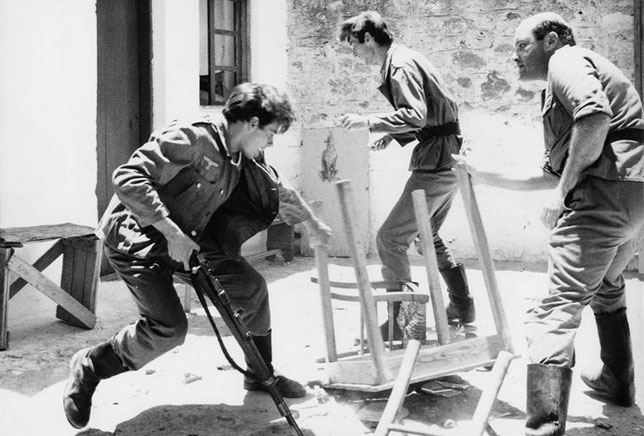
Werner Herzog's debut feature tells the story of a wounded German paratrooper Stroszek (Peter Brogle) who is transported to the Greek island of Kos to recover physically and mentally. Already there are fellow soldiers Meinhard (Wolfgang Reichmann) and Becker (Wolfgang Von Ungern-Sterngberg), who are taking life easy in the sun with little to nothing to do. Stroszek sets them to work, but soon, as the work begins to dry up, he becomes more and more unstable in the isolation and loneliness.
Nobody really knows what goes through Herzog's head, but it is clear he is a film-making genius and has one of the finest eyes for visuals in cinema. Signs of Life explores themes that Herzog would later become engrossed and almost obsessed with - isolation, obsession and madness. While he would later employ Klaus Kinski as the face of wide-eyed insanity, here the tone is quiet, contemplative and often very funny. The opening half of the film concentrates mainly on the three soldiers trying to find things to do. Meinhard becomes frustrated with the presence of cockroaches in their apartment and builds a trap to catch them. The feeling of being trapped appears throughout the film, usually using animals - the soldiers are given a strange toy that seems to move on its own, until they open it and find out that it's full of trapped flies; and we are shown how a hen is hypnotised.
But the comedy is soon put aside as Stroszek begins his descent into madness, holding himself up in the 14th century fortress where the soldiers are stationed with a horde of ammunition. It's in the second half that Herzog shows us the images he can conjure. It's breathtaking what he achieves with a stolen 35mm camera and a micro-budget. Amongst other things, we see a seemingly endless field of windmills, and fireworks set off into the night sky. The grainy black-and-white imagery gives the whole thing a fresh beauty. This is far from the greatest debut in cinema, but a very clear indication of a director's raw skill, and of course, Herzog would go on to make many fine films.
There must be something unifying in our globes collective consciousness, as 2011 saw two films that looked back at the cinematic past. Strangely, it took a French film maker, Michel Hazanavicius, to release a movie that pays homage to early, silent American cinema (The Artist). Conversely, Martin Scorsese, a well-known cinephile, delights with his love of early European silent cinema, in his often beautiful 'children's' film, Hugo.
Set in 1930's Paris, the main focus of this cinematic love is the work of the first movie magician, Georges Melies. We are introduced to Hugo (Asa Butterfield), a young man whose father left him a automaton after his death. It was a project that they worked on together, but never finished it. Hugo's main mission is to get the object working. As an orphan, Hugo hides in the rafters of a train station, maintaining the clocks that his drunken uncle used to do. After befriending a young girl, Isabelle (Chloe Moretz), he finally gets the automaton working, and it opens up a mystery that leads to the forgotten cinema of Melies (Ben Kingsley), now working on a store in the station.
The film shows love for silent cinema, and particularly the magic of Melies. Sacha Baron Cohen's station inspector is occasionally funny, and his character seems to be filtered through both Peter Sellers' Inspector Clouseau, and Jacques Tati's Monsieur Hulot, but he just doesn't seem to really progress at all, and feels almost like a filler character. Scorsese, like Robert Zemekis and Bob Gale before, reference that iconic Harold Lloyd moment in Safety Last! (1923), as Hugo hangs from a clock face.
Like so many others who speculate about the choices of Oscar nominations, Hugo, I feel, is not a contender for the best picture Oscar. There were some far better films produced in 2011. That said, the film is beautiful, accomplished , and often fun. Also, the resurgence of interest in a forgotten father of cinema, is completely touching, and leaves a warm feeling in the heart. Unfortunately, I did not see this in 3D; as far as I am aware, Scorsese uses it to brilliant degrees, so perhaps this would have made the experience perfect (despite the fact that I care not for the dimensions of 3.
An extraordinary account of the doomed expedition on the Terra Nova by Captain Robert Falcon Scott to the south pole between 1910 and 1913, by cinematographer, Herbert Ponting. This document follows the ship from New Zealand as it lands on the antarctic coastline where the team set up a camp. Here, Ponting films both the people and their actions, along with the wildlife that inhabits the area.
Much of the middle section of the film focuses on the wildlife, documenting the habits of seals, penguins and gulls. Throughout these animal parts, the "narrator" (obviously being a silent film , these narrations are provided within inter titles) almost seems to place human characteristics to them (such as stating that a male penguin searches for his "bride"), his observations at times entertaining and occasionally amusing. Unfortunately, some of the practices for capturing footage seems very archaic to modern viewers, as Ponting often interrupts nature to capture certain footage; a practice that I'm sure David Attenborough would be astounded with.
Obviously, Ponting did not follow the five men who set off from camp to reach the south pole. As history is now aware, those men never returned alive. With some incredibly stunning images of polar caps, icebergs etc, the film is a beauty to behold. Unfortunately, the film was not really successful at the time, and Ponting died in poverty 10 years after its release. However, the British Film Institute has released the film in a beautiful digital transfer that means that this film of historical importance may live on for future generations to enjoy.
During the 1980's the world of advertising and general marketing took on an all invasive, sinister tone. After the success of the Star Wars toy line from Kenner, the industry began a series of fantasy toy lines that used the 30 minute Saturday morning cartoon as an advertising tool. This led to famous toy's/cartoons such as Tranformers, Thundercats et al (there are way too many to list in this review). I believe the first of these was the He-Man and the Masters of the Universe, which hawked a band of sword-and-sandal-like fantasy characters, in a world called Eternia.
The cartoon and toy line were incredibly successful, and whilst as an adult, my cynical side sees the enormity of this exploitative marketing, as a child I was totally sucked in. With the unbridled achievement of cynical marketing, it was only a matter of time before the Hollywood machine would take the buff character of He-man and immortalise the cunt on screen.
The 1980's also saw an increase of over sized muscle-men on the big screen. This was of course reflective of Reagan's politics of big-is-good etcetera. So with such a low-rent project, the film needed a pretty low-rent, muscular "actor". I'm guessing that even Schwarzenegger and Stallone were too good for this film, as the actor chosen to play the homo-erotic, buff-dunce He-man was Dolph Lundgren, another of the increasingly large action stars of the decade.
The story involves a set of keys that can open a portal to other worlds/dimensions, and He-man's evil foe, Skeletor (Frank Langela) obviously wants the set. During a battle in Snake mountain, the hero's are forced to go through a portal where they find themselves in contemporary America, and take on the help of a native, Julie (Courtney Cox).
This derivative, insipid film is just awful. The action is more than likely placed in a Earth-bound setting for budgetary reasons. And to be fair, even if this was not the case, it would probably be just as shit. I did see this at the cinema at the time, and probably liked it. But seeing this as an adult just makes me realise that there was an abundance of genuinely awful movies in the decade of greed.
Classic Russian literature is a wealth of psychological intentions, brimming with historical depravity and conversely elegance. Poverty and degradation was rife during the 18th and 19th centuries. This depth of psychological characterisation can most certainly be found in one of Russia's greatest writers, Fyodor Dostoevsky, and particularly in (in my opinion) his greatest work, Crime and Punishment which was published in instalments in 1866. (This publication is also one of my favourite books of all time).
The book (and of course this 1935 film) follows Raskolnikov (Peter Lorre), a lauded graduate of criminology, who is witness to the depravity and selfishness of the culture around him. After seeing a young woman, Sonya (Marion Marsh), being ripped off by an old female pawnbroker (Mrs Patrick Campbell), he sees it as his duty to remedy the problem by murdering her. With his credentials as a master criminologist, Raskolikov believes he can commit the perfect crime. Unfortunately his actions do not go as he had planned, and the time spent after the murder he is overcome with paranoia.
It seems appropriate that this film was produced in the 1930's, during the Great Depression. The poverty and hypocrisy redolent in that decade were found in the Russia of the novel. Peter Lorre plays a fantastically paranoiac, and sweaty character, his facial contortions perfect instruments of doubt, scared awkwardness, and justified anguish. Raskolikov's path leads him to the chief of police, Porfiry (Edward Arnold), and his guilt begins to unravel.
This film was an incredibly low-budget affair, which hampers the director, Josef von Sternberg's, usual visual flares (in films such as The Blue Angel (1930) and Shanghai Express (1932)). This film was produced under Columbia Pictures, as Sternberg's previous employers, Paramount, had ended his contract with them. However, whilst it is technically flawed, and is largely unimaginative in the art department, it is still a beautiful film to watch. Certainly not the greatest adaptation of Dostoevsky, it does carry a great performance from Lorre, and packs in some of the psychological tension produced from the narrative.
After narrowly escaping death in the first film, Alice (Adrienne King) is in recovery when she is murdered by an unknown killer. After dreaming about being dragged into the water by Jason Voorhees at the end of the original, the apparently dead son of mass-murderer Mrs. Voorhees, rumours spread that Jason is out for revenge after seeing his mother decapitated. Five years later, a fresh bunch a naive horny teenagers arrive at the rebuilt Camp Crystal Lake for some relaxation time. Soon enough, murders start occurring and it becomes clear that a masked Jason is indeed out for revenge.
The main problem with the Friday the 13th franchise is that every film seems to be a re-hash of the previous, and this is no exception. The basic premise of an unknown killer stalking clueless teenagers is exactly what happened in the first film, except this time it has a bit of a trump card in Jason (played by Warrington Gillette). Mrs. Voorhees was a rather lame and unrealistic reveal in the climax of the first, and although he is yet to don his iconic hockey mask (here he wears a flour bag with an eye hole), he makes for a much more effective and physically intimidating killer.
But the film doesn't really have any effective or memorable murders, which, let's face it, is why you watch a Friday the 13th film. The only scene worth any mention is the killing of the boy in the wheelchair, which provides an unintentionally hilarious moment that sees him rolling down the stairs backwards after being stabbed. It also has possibly the most annoying horror character in history who not only has the nerve to survive the film after disappearing half way through, but is also ginger. Certainly an improvement of the original, but it's still a rather uninspiring and pedestrian slasher film.
When young Danny Madigan (Austin O'Brien) is given a magic movie ticket by friendly cinema owner Nick (Robert Prosky) at an advance screening of new action movie Jack Slater IV, he is magically transported into the movie and into the car of supercop Jack Slater (Arnold Schwarzenegger). Danny starts to inform Slater about who the bad guys are after seeing them on screen, and the two are paired up as a mismatched investigative duo by Slater's screaming boss. Glass-eyed bad guy Mr. Benedict (Charles Dance) manages to get his hands on the magic ticket, and escapes into the real world, where he finds things are much easier for the bad guys. Slater must leave his action movie cliche of a world where he is nigh on invincible behind, and enter one where things are slightly more difficult.
Last Action Hero had one of the most expensive and turbulent page-to-screen stories in recent cinema history. Originally written as a self-mocking action movie that embraced the cliches of the genre, that was also a proper action movie in its own right. After an unexpected bidding war, the young scribes Zak Penn and Adam Leff were shocked to find that Arnold Schwarzenegger had taken a personal interest in it (the original hero name was Arno Slater). This was to be the turning point. Arnie saw the potential for a franchise as a kid's film and immediately wanted to tone down the violence, so Penn and Leff were fired, and genre legend Shane Black was hired to spruce up the script. Things changed yet again when director John McTiernan was brought in, and, due to the success of his previous films, was given full control.
A few script re-writes, firings, and storm-outs later, the film was shot and ready to hit the market. A toy franchise and a ridiculously expensive and calamitous advertising campaign (they paid half a million dollars to have the film's name on a NASA rocket, only to have the launched delayed till long after the film's release) were put into motion, and the film's release date was announced for the week after Jurassic Park's. Last Action Hero had disastrous test screenings, but the release date was not changed, and naturally, Jurassic Park stormed the box-office and merchandising range, and Last Action Hero was revealed to be an over-ambitious, confused dud of a movie. However, the legend is rather cruel on Schwarzenegger's biggest flop, as although it is a gigantic mess, it has plenty of interesting ideas than are unfortunately spewed out onto the film in ungraceful belches.
The biggest problem is that it doesn't know what kind of film it is. At its heart, its a kid's film, complete with annoying mop-haired child, a kindly old man, magic tickets and, um, a cartoon cat. Yet on its surface, its a rather uninspired action film that is actually rather violent and, once in the real world, is quite grim. The film never seems to know whether it wants to homage, spoof or simply in-joke. The movie world it creates is itself confused - while it has some funny touches such as the police line pairing together various mismatched partners - it also has women walking around in sexy, futuristic costumes, and the aforementioned cartoon cat called Whiskers (voiced by Danny DeVito). Seriously, whose idea was that? I've never seen a cartoon cat in a live-action action movie!
However, the sheer mess that is the complete film does prove Last Action Hero to be a curious little oddity. There have been much finer examples of action-movie send-ups, namely in Shane Black's own excellent Kiss Kiss Bang Bang (2005), so perhaps the producers weren't ready back in 1993 to take on such an ambitious project. Arnie is pleasantly game for sending himself up, and Charles Dance chews the screen with his gloriously hammy British bad guy. But Last Action Hero will ultimately always be a reminder of how the Hollywood system to suck up an interesting maverick project, fuck it over a few times, and bundle it over the finishing line with such unbelievable inefficiency. I did love it as a kid, however.
In 1973, a left-wing militant group calling themselves the Symbionese Liberation Army shot and murdered black school superintendent Marcus Foster and wounded his deputy. Led by prison escapee and black political activist Donald DeFreeze, Foster's murder was a confused statement about fascism, apparently revealing Foster to be a pawn in what was essentially an ethically corrupt school system. The following year, they kidnapped newspaper heiress Patty Hearst from her home and caused a media sensation. The SLA made demands that her father Randolph Hearst pay to feed the starving, while the media storm gathered even more momentum. It reached its peak when recordings of Patty were released to the media declaring her sympathy towards the SLA, and her wish to join them.
The 1970's was a time of revolution and a new political awareness. Like the Red Army Faction (or the Baader-Meinhof Group) in Germany, the children of the 1970's were children of Nazi's and, in America, of blatant political corruption (the Watergate scandal, for example). The SLA were inspired by Marxism, anti-Capitalism, and Che Guevara's revolution in Cuba, believing that America would benefit from an equal society, and from the eradication of corruption and racism. "Death to the fascist insect that prays upon the life of the people!" was one of their motto's, and although it is easy to sympathise with their relatively naive hopes and views, the SLA certainly went about their business in a strange way. They committed murder, bank robberies and kidnapping - acts that certainly aren't beneficial to the people.
Sadly, the former SLA members that are interviewed in the film are not those that experienced the Patty Hearst scenario first hand (those people are either dead or in jail), so the interviewees don't draw from personal experiences and are quick to distance themselves from the darker aspects of the SLA. Hearst herself is sadly absent from the film, which is a shame, because as a result, she gets off relatively lightly. She is now a part-time actress and media darling, which is quite sickening given what she did. As to whether she was brain-washed or she was acting on her own accord is left unexplored. Robert Stone's documentary, is, however, well-constructed and contains plenty of fascinating archive footage. Plus, this is one of the most fascinating stories in America's recent history, and a poignant commentary on the role of the media in creating national treasures out of scandal and sensationalism.
The first half of the 20th century was an incredibly corrupt and conspiratorial period, particularly in American politics. A figure within this rich history was John Edgar Hoover, founder and head of the FBI from it's inception in 1935. He did much for the modernisation of police procedure, but he was also a very contentious character. He kept secret files on public figures, using them to blackmail. This also kept each new president in check, creating a position in the country who was above the law, unaccountable, and practically untouchable. His FBI was corrupt, and Hoover himself publicly stated that organised crime did not exist on the level that was claimed about The Mafia. It's interesting that it was not until Hoover's death in 1972, that the US supreme court et al began investigating and eventually prosecuting organised gangs.
Obviously this first paragraph is unable to summarise the full complexity of a man, - speculated as being homosexual (something that has never been proven) - I was expecting good things for a project directed by Clint Eastwood (who has been active over the last decade or so, producing some incredibly accomplished films), and starring Leonardo DiCaprio (who has himself been involved in great films, and performing spectacularly - despite still having the "heart-throb" label attached to him due to one film, Titanic (1997).
J. Edgar's main focus is not necessarily the full complexities of the real man. It's attention is focused upon the man as a public figure, a character that he plays himself in life. The image is important to him; he is shown as being a great PR man. In the early stages of the FBI, he influenced the content of radio shows, comic books and movies (such as 'G' Men (1935)) that were depicting the courageous activities of the bureau. Hoover's public image is portrayed as being practically identical to his private persona, keeping only three people close to him: His mother Anna Marie (Judi Dench), his secretary (Naomi Watts), and Clyde Tolson (Armie Hammer), his close associate at the FBI. Tolson and Hoover were close their entire careers, leading to the speculation that they were lovers - something that seems plausible on the evidence, but has no concrete conclusion. Therefore, the film only really briefly suggest this, leaving the viewer to ponder personal conclusions.
Whilst the screenplay (written by Dustin Lance Black, who had previously won an Oscar for the fantastic Milk (2008)) fails to really explore the ambiguities, or even much of the psychological complexities of Hoover, the production is exceptional. The film's span brings it through the 1920's into the 1970's and costume, sets and cinematography is dazzlingly beautiful, and exacting of their periods. DiCaprio's performance is good, but the screen is quite often filled with prosthetically 'enhanced' pensioner's, which at times actually aggravated me. This is not to say that the make-up is bad, it is very good. This could have been less distracting had there only been one character, however, with three or more, is too much. With some great talent attached to this project, I would have expected a more interesting film. As it is, it's not the worst biopic that I have ever seen. However, for my money, if you want a film about this interesting historical figure, I would advise you watch Larry Cohen's excellent low budget The Private Files of J. Edgar Hoover (1977).

 Refused a certificate three times between 1933 and 1957, Island of Lost Souls' blasphemous themes and scenes of vivisection caused wide controversy upon its initial release, and even author H.G. Welles voiced his dislike of it. It's not hard to see why, as although the film is extremely tame compared to the movies released these days, it is way ahead of its time in terms of underlying sexual and religious themes. Moreau's dream is to mate one of his creations, the Panther Woman, with Parker, and then he will truly be a creator. Moreau is obsessed to a psychopathic level of becoming God, and treats the island natives with disdain, cracking his whip and making them recite the laws that he has set for them.