Showing posts with label Jude Law. Show all posts

Monday, 18 March 2019

Review #1,460: 'Captain Marvel' (2019)

It says a lot about the mammoth universe built by Kevin Feige and the folks at Marvel over the past 11 years that merely the glimpse of a modified pager displaying the colours of their costume is enough to generate a huge amount of buzz around the arrival of a new superhero. Captain Marvel's introduction was teased during the traditional post-credits stinger of last year's Avengers: Infinity War, and now, just under a year later, Brie Larson's Carol Danvers finally makes her bow. Black Panther became a cultural phenomenon, and Infinity War delivered and then some on its promise to bring this breathtaking (first) saga closer to an end, so the small-scale and light-hearted Ant-Man and the Wasp was a welcome, if underwhelming palette cleanser. Captain Marvel is the studio's first female-led superhero film, so there's a weight of expectation behind Marvel once again.

There has been a wave of ugliness online in protest against the idea of female empowerment and Brie Larson's pro-feminist comments before the film even premiered, but an opening weekend of north of $500 million has silenced the haters and, with any hope, brought us closer to a future when a hero's gender or sexuality is irrelevant to a film's success. Captain Marvel is far from perfect. In fact, it relies heavily on Marvel's tried-and-tested origin story formula we saw a lot of when this universe was still in its first phase, although directors Anna Boden and Ryan Fleck toy around with the structure enough to keep things slightly less familiar. Anyone who was keen to write Captain Marvel off as an example of forced diversity should take the time to actually watch it. Don't get me wrong, the film takes a strong pro-feminist stance and tackles issues plaguing our modern world, but it does so with subtlety. Carol Danvers aka Captain Marvel is strong, confident, even arrogant at times, but just like Tony Stark or Dr. Strange, she is also flawed, troubled and - despite the mystery surrounding her ancestry - recognisably human.

The warrior known as Vers (Larson) is a member of Starforce, an elite band of soldiers operating within the Kree Empire tasked with infiltrating the Skrulls, a race of shape-shifting aliens they have been at war with since before they can remember. Vers is troubled by dreams that feel like memories she does not remember, but her commander Yon-Rogg (Jude Law) trains her to put aside her emotion to focus on the enemy. During a mission to rescue one Starforce's own, Vera is captured by Skrull leader Talos (Ben Mendelsohn), who proceeds to dissect her memories before they all crash down on a strange, primitive planet. That planet is Earth, and the year is 1995. It isn't long before an eager, two-eyed agent of S.H.I.E.L.D. called Nick Fury (Samuel L. Jackson) is drawn to this mysterious stranger and is caught up in her desire to uncover the secrets of her past, along with learning of an intergalactic war that may one day threaten his home. With the help of old friend Maria Rambeau (Lashana Lynch) and a cat named Goose, Vers discovers that she was born Carol Danvers, and that everything she has been taught about who she is and what she's fighting for may actually be a lie.

Although Marvel have done period before with Captain America: The First Avenger back in 2011, Boden and Fleck were clearly having fun revelling in some 90's nostalgia. Although some of the music choices are a little on-the-nose, the appearance of a Blockbuster store and the sound of a dial-up internet connection will delight those, like me, who grew up in the decade. The big joke is that while Carol embarks on galaxy-hopping adventures with the Kree, down here on Earth everything takes an age to load. Captain Marvel switches seamlessly between these two extremes with good humour, and for a character that is destined to become the franchise's next cosmic powerhouse, the low-key approach to her origin actually works in the film's favour. It also allows time for Larson to develop the character, whether it be bouncing off Jackson's one-liners or discovering her old self with her best friend. Larson is great: strong but not over-powered, cocky but endearing. Despite Mendelsohn's scene-stealing, Larson ensures that it'll be Captain Marvel's appearance you'll be eagerly awaiting in the upcoming Avengers: Endgame. Formulaic? Certainly, but Marvel knows how to entertain, and they can't exactly re-define the genre with every film.


Directed by: Anna Boden, Ryan Fleck
Starring: Brie Larson, Samuel L. Jackson, Ben Mendelsohn, Jude Law, Annette Bening, Lashana Lynch, Clark Gregg, Gemma Chan, Rune Temte, Djimon Hounsou
Country: USA

Rating: ****

Tom Gillespie


Captain Marvel (2019) on IMDb

Monday, 25 February 2019

Review #1,454: 'Fantastic Beasts: The Crimes of Grindelwald' (2018)

Aside from Peter Jackson's epic Lord of the Rings trilogy (the less said about his more recent adaptation of The Hobbit, the better), no cinematic journey into the realms of the fantastical has captured the imagination of audiences in recent years quite as much as J.K. Rowling's Harry Potter, a cash-making juggernaut for both Warner Bros. and the author herself. When the franchise came to a conclusion in 2011, it was never going to be away from our screens for very long, and the 'Wizarding World' universe was expanded in 2016 with the surprisingly charming Fantastic Beasts and Where to Find Them. Like Harry Potter, Beasts managed to find a nice balance between wand-swishing set-pieces, enduring us to a new set of compelling characters, and building a tangible new world for it all to take place in. And with Eddie Redmayne's Newt Scamander - a shy and awkward David Attenborough type - at the centre of it all, the pieces were in place for an engrossing - and different - saga to get out teeth into.

The delicate balance found by Rowling and director David Yates the first time around is sadly nowhere to be found in this follow-up, The Crimes of Grindelwald. This is part two of a five-part story, so introductions are brushed aside in favour of plot, plot and some more plot. The first hour is taken up by bringing this new group of characters back into the fold, finding Newt grounded by the Ministry of Magic following his shenanigans last time around, just as a new threat rears its ugly face in the form of Johnny Depp's muggle-hating Grindelwald. The bad wizard is searching for the troubled Credence (Ezra Miller), who has emerged in Paris with a circus performer called Nagini (Clauia Kim), but Auror Tina Goldstein (Katherine Waterston) is already on the case. It seems as though everybody is searching for Credence. Even the young Albus Dumbledore (Jude Law), who is mysteriously reluctant to face his old friend-gone-bad himself, tries to convince Newt to go to Paris in his stead. Muggle Kowalski (Dan Fogler) is also back with his memory mainly in tact, as is his girlfriend Queenie (Alison Sudol), who is struggling to deal with a Ministry ban on Wizard-Muggle relationships.

The Crimes of Grindelwald throws everything it can into the mix: a rain-soaked battle in the air, Newt caught up in no less than three romantic entanglements, a detour to Hogwarts, and more name-drops and Easter eggs than you can shake a stick at. It's an unfathomable wall of information, punctured by an occasional set-piece that only truly come to life when the titular (and frustratingly sidelined) beasts are involved. The Harry Potter films dodged this bullet by allowing the audience to grow into this world, and often grow up with the characters, but Fantastic Beasts goes all out without really justifying its flagrant disregard for coherency, or earning the right to take such an approach. Although he is often pushed out of the spotlight by the many side-plots occurring, Redmayne just about holds it all together with another endearingly twitchy performance, and Law, who combines some of Michael Gambon mannerisms with a more youthful swagger, proves to be a shrewd bit of casting. Ultimately, this follow-up is too busy moving the chess pieces into place to focus on character, and many are pushed into the background as a result. There are great revelations, but after two hours of trying to keep up with who's who and what's what, they don't have much impact. It isn't enough to derail the series completely, but I'll have a hard time remembering where the hell we are by the time the third entry rolls around.


Directed by: David Yates
Starring: Eddie Redmayne, Katherine Waterston, Dan Fogler, Alison Sudol, Johnny Depp, Ezra Miller, Zoë Kravitz, Jude Law, Callum Turner, Claudia Kim
Country: UK/USA

Rating: ***

Tom Gillespie


Fantastic Beasts: The Crimes of Grindelwald (2018) on IMDb

Thursday, 13 December 2018

Review #1,429: 'The Imaginarium of Doctor Parnassus' (2009)

There are few filmmakers working today with a vision quite as singular as Terry Gilliam, and even less possess the sheer force of will to bring it to the big screen. His battles with producers are now the stuff of legend and, as seen in the wonderful documentary Lost in La Mancha, it literally takes a force of nature to bring one his productions down. While he remains an endearing figure in cinema and will always be a director to watch, he hasn't really made a great film since Twelve Monkeys, and that was over twenty years ago. His more recent films, most notably The Brothers Grimm and Tideland, have underwhelmed and somewhat flown under the radar, and this may have also been the case for his 2009 effort The Imaginarium of Doctor Parnassus if it hadn't been for the tragic death of star Heath Ledger during production.

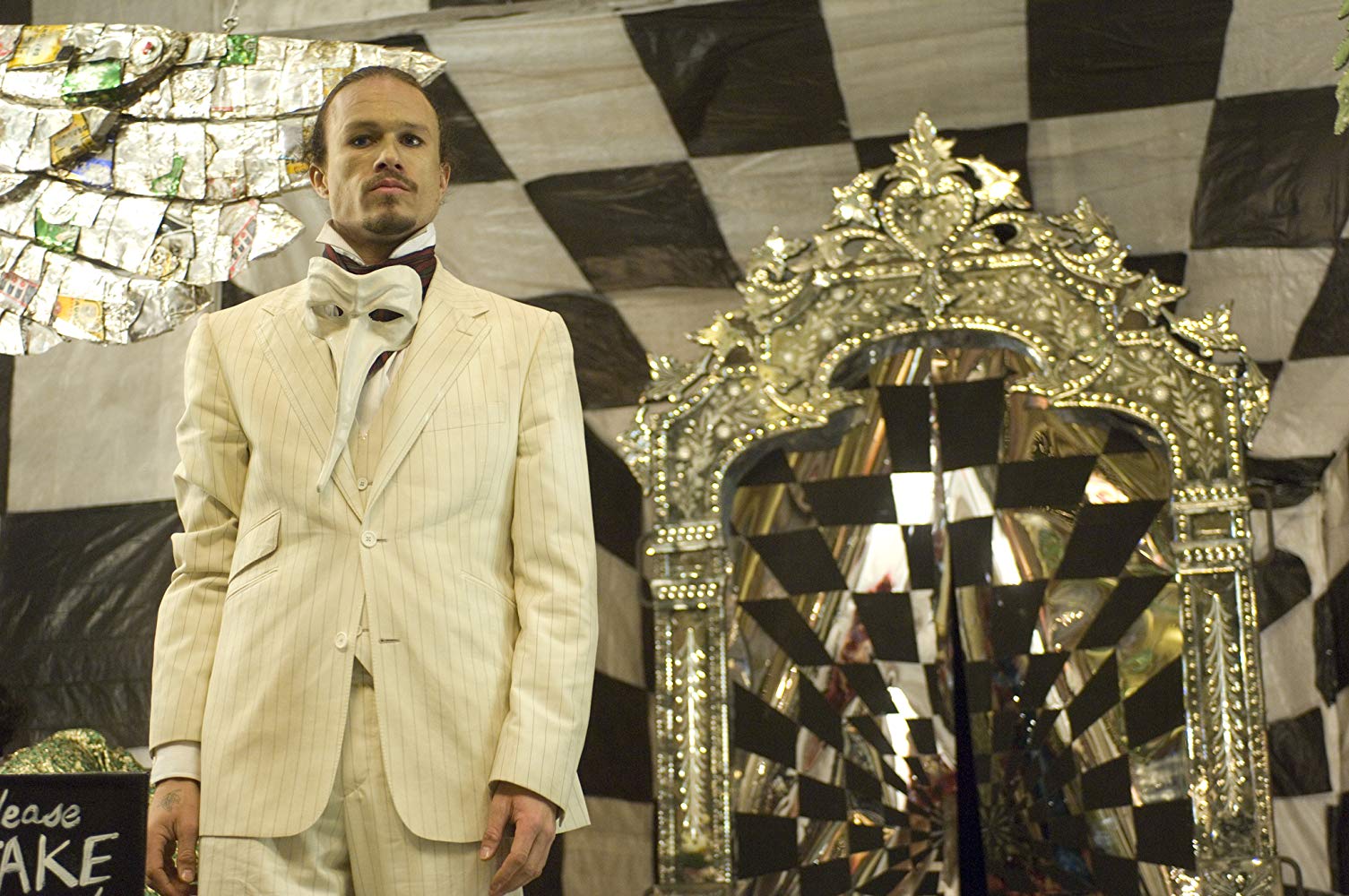
Ledger plays the mysterious Tony, a man found hanging from a bridge by a travelling theatre troupe headlined by the titular Doctor Parnassus (Christopher Plummer). The group also consists of the Parnassus' old friend, the wise Percy (Verne Troyer), the old man's daughter Valentina (a charming Lily Cole), and former beggar Anton (Andrew Garfield), who is head over heels in love with Valentina. Tony has a mysterious and shady past, so he is happy to work for the Imaginarium in an effort to disappear from a very public life, and soon sets about transforming the show's old-timer decor and feeble efforts to attract an audience. Usually setting up the stage in dingy car parks or other undesirable locations, Parnassus' only boast is that of a magical mirror that can transport anybody who enters it into their own imagination. Anton is unhappy at the sudden appearance of this handsome stranger, who naturally attracts the attentions of Valentina, but the troupe may face a larger threat thanks to Parnassus' ancient wager with the Devil (Tom Waits).

There's a great idea in there somewhere, but the script by Gilliam and co-writer Charles McKeown (who also worked together on Brazil and The Adventures of Baron Munchausen) is so haphazard and unsure of itself that it often feels like three films crammed into one. This is no doubt down to the in-production re-writes that were necessary following Ledger's death (Johnny Depp, Jude Law and Colin Farrell were brought in to play alternate versions of Tony when he ventures behind the mirror), so sections of the film feel awkwardly patched together. But there is also much to like. The design of the Imaginarium itself is wonderful in its own tatty, weather-beaten way, and Waits, complete with pencil moustache, cigarette-holder, and that signature raspy voice, is irresistible as Satan himself. The moments set within the imagination are often silly and plagued with questionable special effects, but they also occasionally sparkle with the same kind of magic of Gilliam's Monty Python animation. While it may not be the ideal film to finish his short career on, the film plays a lovely tribute to Ledger and will always be a reminder of the talent we lost far too soon. Sadly, this is likely all Imaginarium will be remembered for, but its a sporadically entertaining ride while it lasts.


Directed by: Terry Gilliam
Starring: Heath Ledger, Christopher Plummer, Andrew Garfield, Verne Troyer, Lily Cole, Tom Waits, Johnny Depp, Jude Law, Colin Farrell
Country: UK/Canada/France/USA

Rating: ***

Tom Gillespie


The Imaginarium of Doctor Parnassus (2009) on IMDb

Thursday, 7 September 2017

Review #1,243: 'King Arthur: Legend of the Sword' (2017)

Guy Ritchie may just one of the luckiest film directors in history. After making his name with Cockney gangster movies Lock, Stock and Two Smoking Barrels and Snatch, he released a double-bill of stinkers so bad that even the utterance of their titles provokes sniggers. Swept Away and Revolver almost killed the career of the Brit before it truly took off, with his highly publicised relationship to Madonna proving far more interesting to the tabloids than any of his desperate output. He returned to his roots with RocknRolla, a motor-mouthed crime comedy which, although sitting well within his comfort zone, was good enough to remind us of why we liked him in the first place. Since then, he's found big-budget success with the Sherlock Holmes films and The Man from U.N.C.L.E. (although the latter tanked at the box-office, it was generally warmly received by those who saw it), and has been handed the keys to his very own franchise, the eternally rebootable story of King Arthur and his Knights of the Round Table.

It's unclear just how much more input Ritchie will have on this new take on Arthurian legend, as he has just started production on Disney's live-action remake of Aladdin, starring Will Smith as the genie. That, combined with the box-office failure of King Arthur: Legend of the Sword, would surely suggest that this series was dead on arrival, or at least will see it taken in a new direction by Warner Bros., who had been trying to get something off the ground ever since the more grounded 2004 version starring Clive Owen. If this is true, then thank the cinema gods, as this annoying, sickly and exposition-heavy turkey was never going to interest a new generation of cinema-goers in a legend that has fascinated many for years. It trips up during its very first moments, as giant, CGI elephants knock down CGI buildings and send CGI people to their death, removing all the elements that make this old-fashioned myth so endearing by employing a contemporary attitude. Haircuts, fashion and dialogue all fit Ritchie's lad's mag aesthetic.

Everything needs to be big and shiny, and King Arthur opens with a set-piece most movies would choose to climax with. King Uther Pendragon (Eric Bana) is locked in a war with warlock Mordred and an army of mages, with the kingdom of Camelot under threat from their magic. Assisted by his magical sword Excalibur, the King triumphs, only to be betrayed by his evil, pampered brother Vortigern (Jude Law), who arranges a coup to usurp the throne. Only Uther's son Arthur escapes with his life, pushed down a river to be raised by prostitutes in, as you would guess from a Ritchie film, Londinium. He grows up to look like Charlie Hunnam and practises hand-to-hand combat. He also dabbles in petty theft with a small gang of cheeky chappies while unaware of his true heritage. When Uther's sword reappears stuck in a rock near the castle's ground, Vortigern rounds up all the men in the nearby areas to attempt to pull it free. He who succeeds is the true heir to the throne, and therefore destined for the chopping block.

This all sounds like a classic hero's journey set within the medieval fantasy genre, but Ritchie is so intent of shoving modern-day sensibilities down your throat that it's easy to quickly forget the true essence of the story. There are endless visual gags involving a story narrated in the present while we flash back to the actual event, a gimmick employed by Ritchie many times before (but was done far better in Ant-Man), and an abundance of camera-swirling action scenes that resemble a video game cutaway scene. At times, it is the cinematic equivalent of that G-force ride at the fairground, in that you cling to whatever you can and hope it ends before you vomit. At the centre of it all is Hunnam, who follows his turn in Pacific Rim with another charisma-free performance. He is drawn as a tough- working-class hero who would be more comfortable in a pub brawl than ruling a country, but comes across as the kind of meat head seen on a night out starting fights while others insist he's a good guy really. A dick head with a magical sword and royal blood is still a dick head. Many of its flaws could be forgiven were it not such a massive bore. Instead, this will likely induce a headache more than any sense of wonder.


Directed by: Guy Ritchie
Starring: Charlie Hunnam, Astrid Bergès-Frisbey, Jude Law, Djimon Hounsou, Eric Bana, Aidan Gillen, Neil Maskell, Annabelle Wallis
Country: USA

Rating: **

Tom Gillespie


King Arthur: Legend of the Sword (2017) on IMDb

Wednesday, 17 February 2016

Review #980: 'Sherlock Holmes: A Game of Shadows' (2011)

In 2009 Sherlock Holmes was re-imagined by Guy Ritchie as an ass-kicking and mentally unstable private investigator with a weakness for a variety of mind-altering substances. Played by Robert Downey Jr., Holmes was Iron Man without the vast fortune, super-suit and fashionable beard, but with the same genius-level intellect, capable of predicting the exact outcome of a fight with a foe before the first punch is thrown. Though heavily compromised by Ritchie's sledgehammer subtlety and love for annoying Cockney geezers, it was still an entertaining take on an extremely familiar character, with Downey Jr. at his twitchy best and demonstrating a convincing English accent.

A Game of Shadows, the bloated sequel rushed into production after the international success of its predecessor, turns the doctor from idiosyncratic eccentric to a babbling pantomime. When we meet Holmes, he is rescuing his flame Irene Adler (Rachel McAdams) from a bomb intended for somebody else. The package was given to her by the scheming Professor Moriarty (Jared Harris), and after her next meeting with him, she disappears. On the eve of his wedding, Dr. Watson (Jude Law) arrives at Baker Street to find Holmes deep into investigating a splurge of seemingly unrelated murders and business acquisitions linked to Moriarty, and at Watson's bachelor party, the two encounter a gypsy woman named Simza (Noomi Rapace), the intended recipient of the letter that accompanied the bomb.

Without any sign of the storytelling flair of the books, A Game of Shadows becomes little more than a series of punch-ups, shoot-outs and inane exchanges between Holmes and his trusted Watson. At one point, the heroes are fired at by an increasingly ridiculous arsenal of machine guns as trees shatter and fireballs explode around them in ultra slo-mo. Any resemblance to one of literatures most beloved characters is lost, and it feels instead like you're watching a movie about The Transporter's British granddad, albeit with a touch more style. Mad Men's Harris is impressive as Holmes's most challenging foe, but Rapace's character is so redundant that she is reduced to just a pretty face for the poster. Shockingly, the main problem is Downey Jr., whose hyperactive shtick is as tiresome as the plot he is caught up in.


Directed by: Guy Ritchie
Starring: Robert Downey Jr., Jude Law, Noomi Rapace, Jared Harris, Rachel McAdams, Stephen Fry
Country: USA

Rating: **
Tom Gillespie


Sherlock Holmes: A Game of Shadows (2011) on IMDb

Friday, 11 July 2014

Review #763: 'The Grand Budapest Hotel' (2014)

Those who turn their nose up at the thought of another fussily-filmed, wildly colourful journey into the world and mind of Wes Anderson, will no doubt detest his latest, and arguably most perfect work, The Grand Budapest Hotel. His work is criticised by his haters for being too meticulously structured, his camera limited to sideways and occasionally upwards movements, festooned with bold colours, always leading to that dreaded, overused word - 'quirky'. Yet this is a world a sly wit, of characters so ridiculous and charming that you could wish they would replace the monotonous bores that litter our reality, and one in which Bill Murray is omnipresent.

In the pink, mountainous haven of the picturesque, fictitious European country of Zubrowka, sits the Grand Budapest Hotel. In it's heyday, the hotel was meticulously managed by Monsieur Gustave H. (Ralph Fiennes), a charismatic, perfume-wearing horndog, who knew all about what his guests wanted before they even knew they wanted it. On the day that one of his elderly conquests, Madame D. (Tilda Swinton), leaves the hotel, he meets new lobby boy Zero Moustafa (Tony Revolori), and immediately begins to groom him as his possible successor. When he hears of Madame D's death, Gustave and Zero travel to her mansion to hear the reading of her will.

She leaves Gustave a piece of priceless art, something heavily resented by Madame's two evil, leather-jacketed sons, Dmitri (Adrien Brody) and Jopling (Willem Dafoe), who don't wish to see this lecherous lothario receive a dime. Sensing trouble, Gustave and Zero steal the painting, replace it with some kind of grotesque lesbian erotica, and flee. This sets in motion a series of farcical events involving a prison escape, an apologetic police officer named Henckels (Edward Norton), a missing butler, and the rise of fascism. All of this is told by an ageing Zero (F. Murray Abraham) to a curious writer credited only as 'The Author' (Jude Law).

What it all about, you ask? Possibly nothing. This could all be just a splurge of the director's imagination, or a hark back to the grand eccentrics of the olden days. It could be about the state of Europe between the two World Wars, with the Grand Budapest Hotel a multi-national asylum for all of the continent's misfits. But the setting simply seems too fitting for it's comedic approach for it to be labelled with any kind of 'war' or 'period' label, with bursts of slapstick and comedy-of-manners worthy of Lubitsch, punctured by ridiculous exclamations from it's hyperactive concierge. When he hears about an enemy's dastardly plan, he responds "the fuckers!".

So, I don't quite know what it's all about. What I do know is that I loved every second of watching it's ludicrous story play out, anchored by an outstanding performance by Fiennes. He may seem an odd choice for an Anderson film, whose films are usually littered with the likes of Jason Schwartzman, Owen Wilson, and Bill Murray (all of whom appear here), but his Gustave is Anderson's greatest creation, brought fearlessly and completely to life by Fiennes. He's certainly no spring chicken, but he's a strange delight to spend 100 minutes with. And that's really how I felt about the entire experience, it was certainly strange, but utterly delightful.


Directed by: Wes Anderson
Starring: Ralph Fiennes, Tony Revolori, F. Murray Abraham, Adrien Brody, Willem Dafoe, Edward Norton, Saoirse Ronan, Jude Law, Jeff Goldblum, Mathieu Amalric, Harvey Keitel
Country: USA/Germany

Rating: *****

Tom Gillespie


The Grand Budapest Hotel (2014) on IMDb

Sunday, 31 March 2013

Review #600: 'Sherlock Holmes' (2009)

Said to have been portrayed by over 70 actors in over 200 adaptations, it was only a matter of time before Sherlock Holmes received a modern-day revision. The BBC cast Benedict Cumberbatch as the titular loose-cannon, with Martin Freeman as his sidekick Dr. Watson in the series Sherlock, but director Guy Ritchie wanted to revert back to the source novels for his Holmes, and who better than Robert Downey, Jr. to star as the bohemian detective-for-hire with a penchant for self-starvation and cocaine. Only this being rated 12A, the cocaine and needle abuse is somewhat glossed over in favour of a more 'teenage-friendly' preference to alcohol, though the unpredictable and near-schizophrenic personality is maintained, and his famous and iconic deerstalker hat (though never mentioned in the books) ridden of altogether.

After foiling the ritualistic sacrifice of a young girl at the hands of the aristocratic Lord Blackwood (Mark Strong), Sherlock Holmes retreats into a state of isolation while he awaits his next case. His good friend and colleague Dr. Watson (Jude Law) is getting married, and his invitation to Holmes to meet his bride-to-be finally brings Holmes back into the world. With Blackwood awaiting execution, his last wish is to talk with Holmes, who is warned of three more deaths to come. Blackwood is hanged and assumed dead, until his body goes missing and is replaced by a man reported missing by Irene Adler (Rachel McAdams), an American thief who has managed to escape Holmes in the past. Holmes' investigations leads them to the Temple of the Four Orders, a secretive magical organisation who seem terrified by Blackwood's apparent resurrection and eventual resurfacing.

I've never really been a fan of Guy Ritchie. Since his breakthrough début way back in 1998 with Lock, Stock & Two Smoking Barrels, he has done little of note, or at least nothing to develop on the promise of his début. Lock, Stock was an amusing and quite clever little throwback to the Cockney gangster films of the 1980's, featuring memorable dialogue and a funky score. He then made Snatch (2000), which is still lauded by its fanbase but offered nothing different apart from a new and annoying self-awareness, and Alan Ford calling himself "an 'orrible cant!". He then was almost forced to pack it in for good after making the embarrassing double-whammy that was Swept Away (2002), a love-letter to his then-wife Madonna, and Revolver (2005), a pretentious, insulting piece of shit starring Jason Statham and Ray Liotta. Seeing his dreams fading, Ritchie went back into his comfort zone - the criminal underbelly of London - and made RocknRolla (2008), which although being over-familiar, wasn't half bad and featured some nice cinematography.

With Holmes, Ritchie has gone mega-budget and handles it well. Though for all its CGI backdrops and grand set-pieces, Ritchie has stuck with the Cockney wide-boy dialogue and slow-motion fight scenes. From the very first scenes, his intentions are clear, as Holmes envisions his opponents weak-spots and we are narrated through the damage that each blow will inflict, all caught in that time-altering way he championed way back in '98. This is Holmes at his most action-heavy. I don't recall ever seeing Basil Rathbone taking out someone's knee-cap or getting involved in bare-knuckle boxing fights. But isn't that was revisions are all about - taking a beloved character and taking them to places never seen before? Well of course, but in this case, it's to take their character to the top of the box-office by attracting a less-demanding audience, and make a lot of money.

The Ritchie-isms aside, Sherlock Holmes is still entertaining, which is its primary goal. Although the story is weak, everything looks fake and like a computer effect, and the aspect that made Holmes such a popular read - the investigation and his almost supernatural ability to unravel the smallest of clues - isn't particularly clever, and is brushed aside in favour of Downey, Jr's admittedly excellent comedic performance. He is perfect for this Holmes, showing a lot of the cocky charm and general strangeness he injected into Tony Stark in the Iron Man films (2008-2013). After all, Downey, Jr. practically is (or was) Holmes, almost spurning his talent in favour of drug abuse. It's enough to make me watch the sequel someday, but not enough to make me warm to Ritchie. But it's 128 minutes of breezy, easy-watching entertainment.


Directed by: Guy Ritchie
Starring: Robert Downey Jr., Jude Law, Rachel McAdams, Mark Strong, Eddie Marsan
Country: USA/Germany

Rating: ***

Tom Gillespie


Sherlock Holmes (2009) on IMDb

Sunday, 25 March 2012

Review #359: 'Wilde' (1997)

Every now and then in cinema, a performance comes along that seems so right and so fitting, that it is almost as if  the actor was born to play the role. Robert DeNiro as Travis Bickle in Taxi Driver (1976), Max Schreck in Nosferatu (1922) or Ray Milland in The Lost Weekend (1945) are examples of career-defining performances, where you couldn't imagine any other actor filling the role. Okay, so Stephen Fry's performance here as the tragic poet, author and social rebel Oscar Wilde is hardly the greatest performance ever, but it seems that no other actor could capture the authenticity of his performance. Fry is a well-known author, intellectual and mostly comedic actor, with a deep-rooted love for literature and history. He is also homosexual with a history of depression and feelings of social misplacement, much like Wilde himself.

Brian Gilbert's film follows Wilde from his early marriage to Constance Wilde (Jennifer Ehle), which produced two children, until his sexual awakening with lifelong friend Robbie Ross (Michael Sheen). He describes his awakening as "being like a city under siege for years, and then the floodgates are opened". He has massive success with his only novel The Picture of Dorian Gray, and his social comedy The Importance of Being Earnest, when he meets his true love Lord Alfred 'Bosie' Douglas (Jude Law), a spoiled youth living under the tyrannical reign of his father, the Marquess of Queensbury (Tom Wilkinson). The Marquess' disapproval of the 'friendship' between his son and the well-known provocateur leads to a libel court case, which sees Wilde imprisoned for social indecency.

Unlike many biopics, Gilbert wisely chooses to stay away from detailing his work, and instead keeps the focus on the man himself. This allows the film to explore the mind of the subject, and a complex and vastly intelligent mind it is. The main focus though is of the social attitudes towards homosexuality (especially the relationship between an older and a younger man) and the prudishness towards the idea of following pleasure rather than duty. Wilde states in the court case that he is championing the ancients, the Greeks, and this now-taboo relationship was the focus of many a celebrated academic, namely Plato, who used it as a focal point of one of his key philosophy works. Society, it would seem, had gone back in time.

There are many great performances here from a hugely talented British cast (which also includes Vanessa Redgrave, Ioan Gruffudd and Zoe Wanamaker), namely from the always-excellent Sheen. He is now established as a great impressionist (his performances as Kenneth Williams and David Frost are near-perfection), but here he is stripped-down and gives his best performance as the dedicated Robbie Ross, a man who is in love with Wilde but remains loyal despite the love not being returned. But ultimately, this is Fry's film. Years of seeing him as quizmaster in panel show QI has made me forget what a talented performer he is. If ever there was an argument made of re-incarnation, then there is no finer example than here. Apart from an uncanny resemblance, he seems to embody the very soul of Wilde.


Directed by: Brian Gilbert
Starring: Stephen Fry, Jude Law, Michael Sheen, Jennifer Ehle, Vanessa Redgrave, Tom Wilkinson
Country: UK/Germany/Japan

Rating: ****

Tom Gillespie


Wilde (1997) on IMDb

Friday, 3 February 2012

Review #325: 'Contagion' (2011)

Beth Emhoff (Gwyneth Paltrow) arrives back in America after a trip to Hong Kong displaying symptoms of a serious illness. Her husband Mitch (Matt Damon) rushes her to hospital after she suffers a violent fit, only for her to die there. Puzzled about the virus, doctors quarantine Mitch and alert Dr. Cheever (Laurence Fishburne) of the CDC. Cheever sets about growing the virus to find a potential cure, and sends Dr. Mears (Kate Winslet), an Epidemic Intelligence Officer, to begin the investigation. Internet blogger Alan Krumwiede (Jude Law) runs with the virus and apparently cures himself from the disease by taking forsythia, an alternative medicine, and therefore causes a mad panic for the drug. While Dr. Orantes (Marion Cotillard), an epidemiologist, travels to Hong Kong to discover the root of the virus.

Similar to director Steven Soderbergh's film career, Contagion is a mixed bag. The first two thirds of this film are quite exceptional - exciting, intelligent, and often fascinating. Yet it burns itself out towards the end, as the distribution of the vaccine becomes the central focus, and the film loses its edge. But at the same time, the film's dedication to realism is admirable, even though it does affect the films quality. The ultra-talented and multi-Academy Award nominated/winning cast are exceptional, with Jude Law's slimy, dentally-challenged journalist, and Winslet exhausted yet dedicated investigator proving the stand-outs. I usually hate Jude Law, but he is at his best when he plays arseholes - Closer (2004), The Talented Mr. Ripley (1999), I Heart Huckabees (2004) - and he is at his most despicable here.

Law's character is at the centre of one of the film's themes about mass hysteria and panic, as he uses the power of the Internet to send the country into a spiral of looting and violence. It's an interesting commentary on how small the world has become with the introduction of blogging and social networking, and how this can be abused for personal gain. Krumwiede has no scientific fact or support behind him, just a webcam and a computer, and the results are quite terrifying.

Soderbergh wanted to make this as realistic as possible, and Contagion received praise from scientific institutions for its accuracy. Similar to his excellent 2000 film Traffic, Soderbergh explores the subject from the ground floor upwards. From Damon's struggling father trying desperately to shield his daughter from the virus, way up to Fishburne's CDC agent fighting against it on a global level. Watching it unfold, and seeing the political and social implications that stems from it is quite fascinating. But when that final third arrives, story threads become stale, and Soderbergh seems to lose interest in certain characters (Cotillard suffers the most), and the film fizzles out. Disappointing, but the film's thrilling beginning and middle certainly make the film worth a watch.


Directed by: Steven Soderbergh
Starring: Laurence Fishburne, Matt Damon, Jude Law, Kate Winslet, Marion Cotillard, Gwyneth Paltrow
Country: USA/United Arab Emirates

Rating: ***

Tom Gillespie


Contagion (2011) on IMDb

LinkWithin

Related Posts Plugin for WordPress, Blogger...