Showing posts with label Tom Waits. Show all posts

Thursday, 13 December 2018

Review #1,429: 'The Imaginarium of Doctor Parnassus' (2009)

There are few filmmakers working today with a vision quite as singular as Terry Gilliam, and even less possess the sheer force of will to bring it to the big screen. His battles with producers are now the stuff of legend and, as seen in the wonderful documentary Lost in La Mancha, it literally takes a force of nature to bring one his productions down. While he remains an endearing figure in cinema and will always be a director to watch, he hasn't really made a great film since Twelve Monkeys, and that was over twenty years ago. His more recent films, most notably The Brothers Grimm and Tideland, have underwhelmed and somewhat flown under the radar, and this may have also been the case for his 2009 effort The Imaginarium of Doctor Parnassus if it hadn't been for the tragic death of star Heath Ledger during production.

Ledger plays the mysterious Tony, a man found hanging from a bridge by a travelling theatre troupe headlined by the titular Doctor Parnassus (Christopher Plummer). The group also consists of the Parnassus' old friend, the wise Percy (Verne Troyer), the old man's daughter Valentina (a charming Lily Cole), and former beggar Anton (Andrew Garfield), who is head over heels in love with Valentina. Tony has a mysterious and shady past, so he is happy to work for the Imaginarium in an effort to disappear from a very public life, and soon sets about transforming the show's old-timer decor and feeble efforts to attract an audience. Usually setting up the stage in dingy car parks or other undesirable locations, Parnassus' only boast is that of a magical mirror that can transport anybody who enters it into their own imagination. Anton is unhappy at the sudden appearance of this handsome stranger, who naturally attracts the attentions of Valentina, but the troupe may face a larger threat thanks to Parnassus' ancient wager with the Devil (Tom Waits).

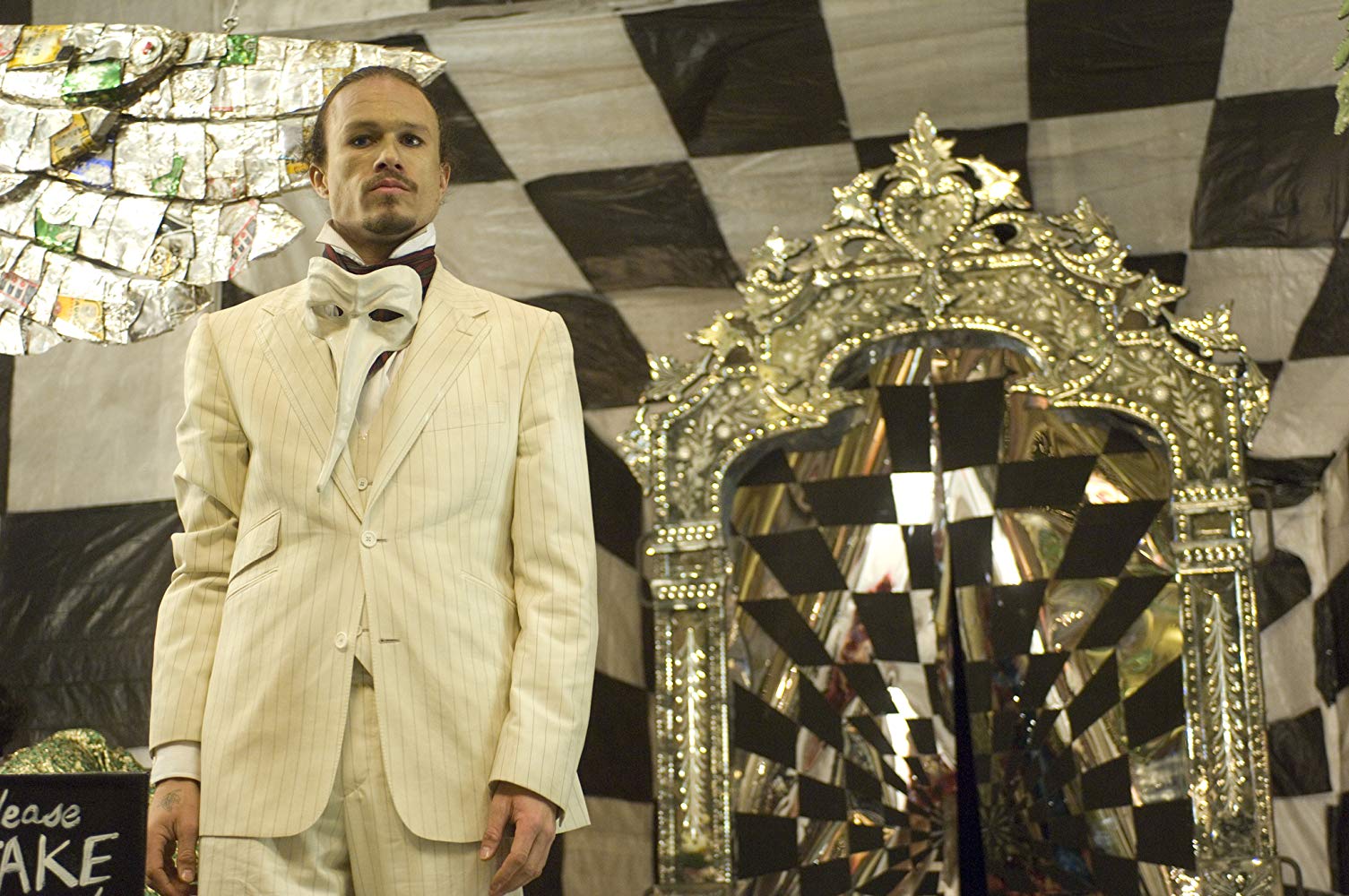
There's a great idea in there somewhere, but the script by Gilliam and co-writer Charles McKeown (who also worked together on Brazil and The Adventures of Baron Munchausen) is so haphazard and unsure of itself that it often feels like three films crammed into one. This is no doubt down to the in-production re-writes that were necessary following Ledger's death (Johnny Depp, Jude Law and Colin Farrell were brought in to play alternate versions of Tony when he ventures behind the mirror), so sections of the film feel awkwardly patched together. But there is also much to like. The design of the Imaginarium itself is wonderful in its own tatty, weather-beaten way, and Waits, complete with pencil moustache, cigarette-holder, and that signature raspy voice, is irresistible as Satan himself. The moments set within the imagination are often silly and plagued with questionable special effects, but they also occasionally sparkle with the same kind of magic of Gilliam's Monty Python animation. While it may not be the ideal film to finish his short career on, the film plays a lovely tribute to Ledger and will always be a reminder of the talent we lost far too soon. Sadly, this is likely all Imaginarium will be remembered for, but its a sporadically entertaining ride while it lasts.


Directed by: Terry Gilliam
Starring: Heath Ledger, Christopher Plummer, Andrew Garfield, Verne Troyer, Lily Cole, Tom Waits, Johnny Depp, Jude Law, Colin Farrell
Country: UK/Canada/France/USA

Rating: ***

Tom Gillespie


The Imaginarium of Doctor Parnassus (2009) on IMDb

Tuesday, 4 December 2018

Review #1,424: 'The Ballad of Buster Scruggs' (2018)

The Coen brothers have long weaved their love of the western genre into their movies, whether it be capturing its core essence with the likes of Blood Simple and Raising Arizona, or tackling the genre head-on with No Country for Old Men and True Grit. Their latest, The Ballad of Buster Scruggs, which makes its way onto Netflix after a limited theatrical release, sees the siblings hark back to the horse operas of old. Initially marked as an anthology series, it soon evolved into a feature of six unrelated stories, bound together only by the imaginary pages of the short-story book we as the viewer are supposed to be reading. The final product suffers from the same problems faced by any film attempting the portmanteau format - a couple are great, some are either frustratingly short or unnecessarily drawn-out, and at least one you'll be struggling to remember after the credits have rolled.

There's also the feeling that Buster Scruggs blows its load far too early, as the titular Ballad, featuring one of Tim Blake Nelson's best performances, struts into town on the back of a horse carrying the smoothest country singer and deadliest gunslinger in the West, and knocks it out of the park. It's a bizarre little tale that mixes the yodell-y crooning of those white hat vs. black hat genre pictures of old with bursts of the ironic, darkly humorous violence the Coens are so well known for. The tunes are wonderful, the cinematography (by Bruno Delbonnel) is ingeniously inventive (watch out for that shot from inside the guitar), and Nelson is a lively narrator. It ends too soon, and you can't help but think that a standalone feature for the sharply-dressed Buster Scruggs may have been warranted instead. The next story, Near Algodones, sees James Franco's roaming thief hold up the wrong bank and come under fire from the gun-toting teller, played by Stephen Root. It's supposed to be a funny tale of irony and karma, but ultimately feels like an afterthought in the wake of Scruggs' more well-rounded story.

Meal Ticket is more sombre in tone, following opportunistic impresario Harrison (Liam Neeson) and his performer, the legless and armless Artist, who is played with great poise by Harry Melling (Dudley Dursley from the Harry Potter films). There is a great idea here, one fraught with tragedy and sorrow, but it simply doesn't have enough time to fully develop its ideas. Slotting nicely alongside Buster Scruggs as a stand-out piece is All Gold Canyon, in which Tom Waits' grizzled prospector digs for gold in an untouched valley. It's like the opening scene of There Will Be Blood, only this also has a nice surprise in store as the weather-beaten old man searches for 'Mr. Pocket', the place in the ground holding his grand prize. The remaining two stories, The Gal Who Got Rattled and The Mortal Remains, touch on romance and horror elements, as the characters are transported by wagon train and stagecoach, respectively, to the destination that may or may not await them. They round off a mish-mash of tones and themes, and although they each have individual merits, they simply don't gel together or flow naturally. Fans will no doubt find some wonderful stuff here, as I did, but recommended only for Nelson and Waits, whose stories are up there with some of the Coens' very best.


Directed by: Ethan Coen, Joel Coen
Starring: Tim Blake Nelson, James Franco, Liam Neeson, Harry Melling, Tom Waits, Zoe Kazan, Bill Heck, Tyne Daly, Brendan Gleeson, Jonjo O'Neill
Country: USA

Rating: ***

Tom Gillespie


The Ballad of Buster Scruggs (2018) on IMDb

Wednesday, 23 September 2015

Review #922: 'Seven Psychopaths' (2012)

Even though I wasn't blown away by Irish playwright Martin McDonagh's directorial debut, In Bruges (2008), the film contained enough memorable one-liners and great performances to have me anticipating his next feature. In the four years that elapsed between In Bruges and his follow-up Seven Psychopaths, Martin's brother John Michael wrote and directed the offensively hilarious The Guard (2011), and in 2014 gave us Calvary, one of the truly great films of that year. Martin's limelight has been stolen somewhat, and Seven Psychopaths is a slight let-down. It's a movie about movies, or rather a movie within a movie, or even a movie without a movie - either way, it's a bit of a mess.

Script-writer Marty (Colin Farrell) has writer's block. He knows what his next movie is going to be called - Seven Psychopaths - but the title is all he has. Struggling with alcoholism, he tries to keep his girlfriend Kaya (Abbie Cornish) happy while his unhinged best friend Billy (Sam Rockwell) tries to worm his way into a writing credit. Looking to avoid creating yet another movie glamorising violence, he wants his psychopaths to retain some humanity and have the message of his movie be about peace and love. Billy suggests he takes inspiration from the 'Jack of Diamonds' killer, who only kills high-ranking mobsters and is currently on a killing spree in Los Angeles, and they take an ad out in the local paper asking for real-life psychopaths to come and tell their story.

Billy also kidnaps dogs from rich folk for a living along with his partner-in-crime Hans (Christopher Walken), but they have just stolen a Shih Tzu from the wrong man - gangster and madman Charlie (Woody Harrelson) - a man we first meet trying to fix his gun so he can shoot the young girl who had the dog in her care in the face. Marty has the vaguest of ideas about his other psychopaths - one being a Vietnamese war veteran (Long Nguyen) dressed as a priest looking to avenge his family's murder during the war, and another a quaker (Harry Dean Stanton) who stalks his daughter's killer for decades - but no way of connecting them and one story possibly accidentally stolen. With Charlie on their tail, Marty, Billy and Hans flee to the desert to contemplate their fate and finish the script once and for all.

This is an odd film from start to finish. The opening scene depicts two gangster (Michael Stuhlbarg and Michael Pitt) discussing famous murders of people being shot through the eyeball, before being blown away themselves by the masked Jack of Diamonds killer, It's reminiscent of the Tarantino-inspired wave of self-aware crime flicks of the 1990's, where pop-culture references and quirky humour trumped anything dark and serious. The use of freeze-frames to introduce it's collection of psychopaths also reminded me of the 1990's, when Danny Boyle's Trainspotting (1996) opened the floodgates for countless inferior imitators in Britain to do the very same. Are these the kinds of movies McDonagh was offered in the wake of a successful debut and is now satirising them? Or did he just run out of ideas and resort to emulating a now-dated era?

I found this the main problem with Seven Psychopaths, and I felt like I could never be sure if McDonagh was being smart, lazy, or both in an ironic clever-clever way. At the half-way point, the film begins to drag and meander as if McDonagh had genuine writer's block (there's a reason the main character is Irish and called Marty) but kept writing in the hope that it would eventually work itself out. But Seven Psychopaths does have moments of inspiration. As Hans, Christopher Walken makes the welcome return to the large roles that seem to have evaded him of late, and delivers a performance of real humanity. The dialogue too, is as quotable and vicious as you would expect from the man who penned In Bruges, with the humour providing a welcome distraction from the barrage of exhaustive violence - and maybe that's the point. But whatever the point, this will more likely leave you scratching your head trying to figure it out.


Directed by: Martin McDonagh
Starring: Colin Farrell, Sam Rockwell, Christopher Walken, Woody Harrelson, Tom Waits, Olga Kurylenko, Abbie Cornish, Harry Dean Stanton
Country: UK

Rating: ***

Tom Gillespie


Seven Psychopaths (2012) on IMDb

Thursday, 30 June 2011

Review #148: 'The Book of Eli' (2010)

It's 31 years since the sky opened up, sending apocalyptic sun-rays to the earth. A familiar landscape of burnt out cars, empty homes and dilapidated plant-life. Eli (Denzel Washington), is a wanderer with an obscure "mission". He carries with him a book of great power and importance; he heads west on a journey that has been told to him by a voice in his heart. The road is a dangerous place; filled with violence, in a world that has lost it's rules and devoid of meaning. Eli wanders into a town ruled by Carnegie (Gary Oldman), who dictates from a desk in an abandoned cinema. Henchmen work for him, his myopic focus on claiming a book; the book (whilst the subject of which is skirted around for the first hour) is quite obviously the Holy Bible.

A collection of genre tropes inform this film. Firstly, the most obvious post-apocalypse setting gives is it's sci-fi credentials; this theme is ever-present at this moment in cinema, and has provided varying quality (The Road (2009), 2012 (2009)), the latter being an awful example). Eli wonders into the town controlled by Carnegie, with the same western iconography of Clint Eastwood's Man With No Name in Sergio Leone's Dollars trilogy. Carnegie controls a blind woman, Claudia (Jennifer Beals - her character name quite possibly a reference to Claudia Cardinale), and her daughter Solara (Mila Kunis). After discovering that Eli carries the book that he has been searching for, he begins a hunt for him.

I will admit that I came to this film very sceptical. A work colleague (Alice Mills), after hearing that I write reviews for this blog, suggested that I see this. The film is beautifully shot (well, it certainly has some wonderful back projections anyway). It's an interesting idea also, although not greatly realised, the concept of religiosity is carried through rather well. The film flirts with the concept that the bible has always been interpreted for use of both good and bad. Washington's character (obviously) carries and protects the book so that he may preserve its goodness, and pass it on so that it can continue to do it's supposed duty. Oldman's character however represents that darker element of representation. He sees the book as a weapon; a means to control the masses. A view that is very prevalent in attackers of the bible proper.

Whilst the film is admittedly enjoyable, it is simply a throw away piece of cinema. It possibly has some interesting ideas within it, but falters many times. In other words, it has many flaws. Whilst it represents the readings of the book, that throughout history has created such awful conflict, it also fully presents it's blind 'faith'. A line Eli states (when he is joined on his 'quest' by Solara) after being asked how he knows which way he is going - after all I'm pretty sure it does not take 30 years to walk from the east to west coast of America - he simply says 'I'm guided by faith, not by sight'. This statement does become more relevant in the closing moments of the film.

Whilst much gets in his way, Eli does make it to his destination. Alcatraz to be exact. There he finds a utopia of popular culture (literature etc) being cultivated. The head of this cultural museum is Malcom McDowell. Whilst perhaps I shouldn't say too much about the ending, it does remind me of Fahrenheit 451 (1968), in it's concept of the preservation of books in a world where they have become obsolete - and in the case of the bible, burnt after a war, presumably as it may have been the cause/blame for that war? The Book of Eli, is a flawed yet interesting film. It has the almost tired iconography of a modern CGI post-Apocalypse, yet it does attempt to manufacture something a little different from some of the other crop of the same story structure. It's not just a story of survival from vicious hoards of wanderers, scavengers etc. It does weave into this the preservation of ideas; the concept that the written word has something more powerful in it's presence in human consciousness.

I've not looked into it, but it would be interesting to hear the reaction of the Christian church (in all of its many manifestations). Whilst not explicitly, the film highlights the fact that the written form (and particularly the bible through history) has been mis-interpreted - or even purposefully re-read - to fit whichever form of control and repression that particular society feels it needs to provide.


Directed by: Albert Hughes, Allen Hughes
Starring: Denzel Washington, Gary Oldman, Mila Kunis, Ray Stevenson, Jennifer Beals, Michael Gambon, Tom Waits
Country: USA

Rating: ***

Marc Ivamy


The Book of Eli (2010) on IMDb

LinkWithin

Related Posts Plugin for WordPress, Blogger...