Showing posts with label Chishu Ryu. Show all posts

Saturday, 15 October 2011

Review #247: 'Equinox Flower' (1958)

Businessman Wataru (Shin Saburi) is continually approached by his friends and co-workers for advice and help, especially when it concerns potential marriages for their daughters. He is approached by Mikami (Ozu regular Chisu Ryu) who is concerned that his daughter has gone off with a man from a lesser family with a low-paid job. He agrees to meet her and try to talk some sense into her. One day at work, he is approached by a man named Maniguchi (Keiji Sada) who asks for his daughter's hand in marriage. Wataru is horrified that his daughter Setsuko (Ineko Arima) has been seeing this man without his knowledge, and insists that marrying him is not the right decision.

Japanese master Ozu is again on familiar ground with this gentle drama. Again, he explores themes of family, and change in a post-war Japanese society. Wataru is not a traditionalist by nature - he is generally quite open-minded, but only when it comes to his friend's families. When he has tea with one of Setsuko's friends, she explains how her mother is obsessed with finding her a match with a man with a decent job and background. Wataru is agreed that her mother is stuck in her ways. It becomes clear that Wataru is simply a father who cannot let go of his daughter. It's a sentiment that anyone, even those without children, can relate to.

Ozu does make a point of showing the increasing differences in attitudes between the generations. The parents are children of war. Wataru and his wife Kiyoko (Kinuyo Tanaka) discuss memories of being in the bomb shelters. Ozu doesn't want us to see the elders as narrow-minded and old-fashioned, but instead as people who grew up with danger and death all around them, and clearly hold protection and security in high regard, and for good reason. However, Ozu does show the women of Equinox Flower as the stronger sex, and the biggest advocates for change. Kiyoko tries to change Wataru's mind, but realises that this is a decision he will make on his own.

The film is full of Ozu's usual traits, including the usual gorgeous cinematography - and this is his first to be shot in colour. His camera is ever-still, watching from low angles, usually through doorways. He is offering his audience a window into these people's lives, and allows them to give their naturalistic courtesies as they would if no-one was watching. It is a delight watching a true master at work, and it's amazing how he finds fresh and fascinating ways to explore similar themes. I've never seen any of his films that have been anything less than brilliant, and I'm still to see his widely celebrated Tokyo Story (1953). An absolute delight.


Directed by: Yasujirô Ozu
Starring: Shin Saburi, Kinuyo Tanaka, Ineko Arima, Yoshiko Kuga, Chishû Ryû
Country: Japan

Rating: *****

Tom Gillespie


Equinox Flower (1958) on IMDb

Tuesday, 21 June 2011

Review #134: 'Good Morning' (1959)

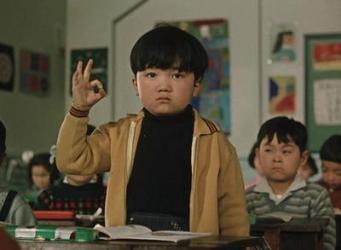
Japanese master Yasijuro Ozu repeated many themes in his movies. One of the key things running throughout  his films is the idea of communication, or the lack of it. Good Morning, or Ohayo (to give the film its native title) centres around two young brothers, Minoru (Koji Shitara) and Isamu (Masahiko Shimazu), who long to own a television set. Their parents refuse, citing the fact that it will kill the art of conversation as the reason why. The boys rebel after accusing grown ups of talking a lot but never saying anything worthwhile, and go on a vow of silence, much to their parents gratitude. In a key sub-plot, the town gossips accuse the neighbourhood treasurer Mrs. Haraguchi (Haruko Sugimura) of embezzling their funds in order to buy herself a new washing machine, when in fact one of the gossips' mothers had forgot to pass the money on.

Ozu's reputation as one of cinema's all-time greats and a director of elegance and sophistication is given a bit of a kick up the arse in this film. This is Ozu at his most hilarious. The mischievous brothers' increasingly desperate antics unwittingly causes mayhem amongst the townsfolk and inevitably has them bickering amongst themselves. It also contains lots of fart jokes. Yes, fart jokes, from Ozu. The brothers and their friends have a strange obsession with forcing out little farts as they push each others foreheads, which causes one unfortunate to repeatedly soil himself as he tries to take part.

The kids' accusations that grown-ups have nothing useful to say is as amusing as it is poignant. The communities breakdown in communication leads to all sorts of rumours flying around about where the treasuries money is, when a simple forgetful act is all that has taken place. Even when this is discovered and the matter appears to be cleared up, they still find ways to stir up trouble. And the scene where two singletons who are obviously attracted to each other talk about the weather to fill the awkward silences, is as heartbreaking as it is oddly magical. Only a true master such as Ozu can conjure two conflicting emotions from one scene. But beneath all the bittersweet comedy and social observations is a sobering message about the decline of community and the looming death of cinema. Stunning filmmaking from a true great.


Directed by: Yasujirô Ozu
Starring: Kôji Shitara, Masahiko Shimazu, Keiji Sada, Chisû Ryû
Country: Japan

Rating: *****

Tom Gillespie


Good Morning (1959) on IMDb

LinkWithin

Related Posts Plugin for WordPress, Blogger...