It's pretty difficult to judge this film fully. The first half is erratic, and filled with jolting edits, characters that appear and disappear without any introduction. It's a damn shame. The scatological nature of this epic project, adapted from the Russian classic by Fyodor Dostoyevsky, was due to it being horrendously cut down by the studio that funded it. Originally, Akira Kurosawa had created a 266 minute cut of the - incredibly faithful to the source novel - was shortened by 100 minutes. Unfortunately, it would seem that the world may never see the original version, as even when Kurosawa hunted for the missing scenes in the vaults several decades later, he was unable to locate them.
As it is in its now 166 minute format (the longest version available), it is still an incredibly important piece of melodrama. After the devastation of the war, Kinji Kameda (Masayuki Mori) and Denkichi Akama (Toshiro Mifune), travel back to a remote island. Kameda claims that he suffers from an illness, cause by the suffering of war, and simply referred to as idiocy - when expressed on film, this idiocy seems simply to be an innocent, and fundamentally naive view of people. He simply only sees good in people, even if this is not the case. On arriving they both seem to fall for a disgraced woman, Taeko Nasu (Setsuko Hara), who was someones concubine since the age of fourteen, and is being offered for marriage at a price.
What ensues is a strange love triangle that divides not only the two male protagonists, but the community. The film is beautifully shot in black and white by Toshio Ubukata, who had worked with Kurosawa on his previous film, Scandal (1950). It is unfortunate that the films first half suffers so evidently due to extensive cutting. However, it is the relationship between Kameda and Akama that provides the climax (which is seemingly more intact) that provides the films central theme, and its most poignant elements.
Businessman Wataru (Shin Saburi) is continually approached by his friends and co-workers for advice and help, especially when it concerns potential marriages for their daughters. He is approached by Mikami (Ozu regular Chisu Ryu) who is concerned that his daughter has gone off with a man from a lesser family with a low-paid job. He agrees to meet her and try to talk some sense into her. One day at work, he is approached by a man named Maniguchi (Keiji Sada) who asks for his daughter's hand in marriage. Wataru is horrified that his daughter Setsuko (Ineko Arima) has been seeing this man without his knowledge, and insists that marrying him is not the right decision.
Japanese master Ozu is again on familiar ground with this gentle drama. Again, he explores themes of family, and change in a post-war Japanese society. Wataru is not a traditionalist by nature - he is generally quite open-minded, but only when it comes to his friend's families. When he has tea with one of Setsuko's friends, she explains how her mother is obsessed with finding her a match with a man with a decent job and background. Wataru is agreed that her mother is stuck in her ways. It becomes clear that Wataru is simply a father who cannot let go of his daughter. It's a sentiment that anyone, even those without children, can relate to.
Ozu does make a point of showing the increasing differences in attitudes between the generations. The parents are children of war. Wataru and his wife Kiyoko (Kinuyo Tanaka) discuss memories of being in the bomb shelters. Ozu doesn't want us to see the elders as narrow-minded and old-fashioned, but instead as people who grew up with danger and death all around them, and clearly hold protection and security in high regard, and for good reason. However, Ozu does show the women of Equinox Flower as the stronger sex, and the biggest advocates for change. Kiyoko tries to change Wataru's mind, but realises that this is a decision he will make on his own.
The film is full of Ozu's usual traits, including the usual gorgeous cinematography - and this is his first to be shot in colour. His camera is ever-still, watching from low angles, usually through doorways. He is offering his audience a window into these people's lives, and allows them to give their naturalistic courtesies as they would if no-one was watching. It is a delight watching a true master at work, and it's amazing how he finds fresh and fascinating ways to explore similar themes. I've never seen any of his films that have been anything less than brilliant, and I'm still to see his widely celebrated Tokyo Story (1953). An absolute delight.

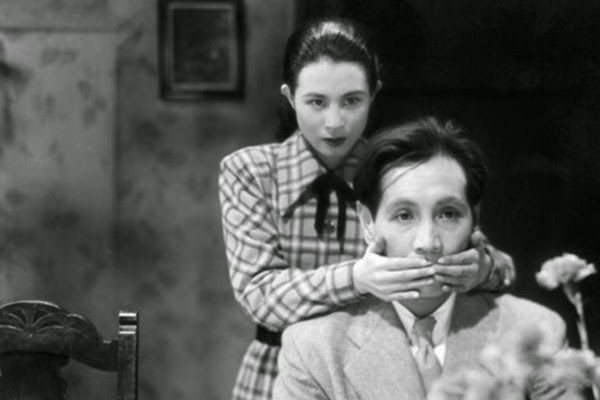 As it is in its now 166 minute format (the longest version available), it is still an incredibly important piece of melodrama. After the devastation of the war, Kinji Kameda (Masayuki Mori) and Denkichi Akama (Toshiro Mifune), travel back to a remote island. Kameda claims that he suffers from an illness, cause by the suffering of war, and simply referred to as idiocy - when expressed on film, this idiocy seems simply to be an innocent, and fundamentally naive view of people. He simply only sees good in people, even if this is not the case. On arriving they both seem to fall for a disgraced woman, Taeko Nasu (Setsuko Hara), who was someones concubine since the age of fourteen, and is being offered for marriage at a price.


