Aside from Peter Jackson's epic Lord of the Rings trilogy (the less said about his more recent adaptation of The Hobbit, the better), no cinematic journey into the realms of the fantastical has captured the imagination of audiences in recent years quite as much as J.K. Rowling's Harry Potter, a cash-making juggernaut for both Warner Bros. and the author herself. When the franchise came to a conclusion in 2011, it was never going to be away from our screens for very long, and the 'Wizarding World' universe was expanded in 2016 with the surprisingly charming Fantastic Beasts and Where to Find Them. Like Harry Potter, Beasts managed to find a nice balance between wand-swishing set-pieces, enduring us to a new set of compelling characters, and building a tangible new world for it all to take place in. And with Eddie Redmayne's Newt Scamander - a shy and awkward David Attenborough type - at the centre of it all, the pieces were in place for an engrossing - and different - saga to get out teeth into.
The delicate balance found by Rowling and director David Yates the first time around is sadly nowhere to be found in this follow-up, The Crimes of Grindelwald. This is part two of a five-part story, so introductions are brushed aside in favour of plot, plot and some more plot. The first hour is taken up by bringing this new group of characters back into the fold, finding Newt grounded by the Ministry of Magic following his shenanigans last time around, just as a new threat rears its ugly face in the form of Johnny Depp's muggle-hating Grindelwald. The bad wizard is searching for the troubled Credence (Ezra Miller), who has emerged in Paris with a circus performer called Nagini (Clauia Kim), but Auror Tina Goldstein (Katherine Waterston) is already on the case. It seems as though everybody is searching for Credence. Even the young Albus Dumbledore (Jude Law), who is mysteriously reluctant to face his old friend-gone-bad himself, tries to convince Newt to go to Paris in his stead. Muggle Kowalski (Dan Fogler) is also back with his memory mainly in tact, as is his girlfriend Queenie (Alison Sudol), who is struggling to deal with a Ministry ban on Wizard-Muggle relationships.
The Crimes of Grindelwald throws everything it can into the mix: a rain-soaked battle in the air, Newt caught up in no less than three romantic entanglements, a detour to Hogwarts, and more name-drops and Easter eggs than you can shake a stick at. It's an unfathomable wall of information, punctured by an occasional set-piece that only truly come to life when the titular (and frustratingly sidelined) beasts are involved. The Harry Potter films dodged this bullet by allowing the audience to grow into this world, and often grow up with the characters, but Fantastic Beasts goes all out without really justifying its flagrant disregard for coherency, or earning the right to take such an approach. Although he is often pushed out of the spotlight by the many side-plots occurring, Redmayne just about holds it all together with another endearingly twitchy performance, and Law, who combines some of Michael Gambon mannerisms with a more youthful swagger, proves to be a shrewd bit of casting. Ultimately, this follow-up is too busy moving the chess pieces into place to focus on character, and many are pushed into the background as a result. There are great revelations, but after two hours of trying to keep up with who's who and what's what, they don't have much impact. It isn't enough to derail the series completely, but I'll have a hard time remembering where the hell we are by the time the third entry rolls around.
There are few filmmakers working today with a vision quite as singular as Terry Gilliam, and even less possess the sheer force of will to bring it to the big screen. His battles with producers are now the stuff of legend and, as seen in the wonderful documentary Lost in La Mancha, it literally takes a force of nature to bring one his productions down. While he remains an endearing figure in cinema and will always be a director to watch, he hasn't really made a great film since Twelve Monkeys, and that was over twenty years ago. His more recent films, most notably The Brothers Grimm and Tideland, have underwhelmed and somewhat flown under the radar, and this may have also been the case for his 2009 effort The Imaginarium of Doctor Parnassus if it hadn't been for the tragic death of star Heath Ledger during production.
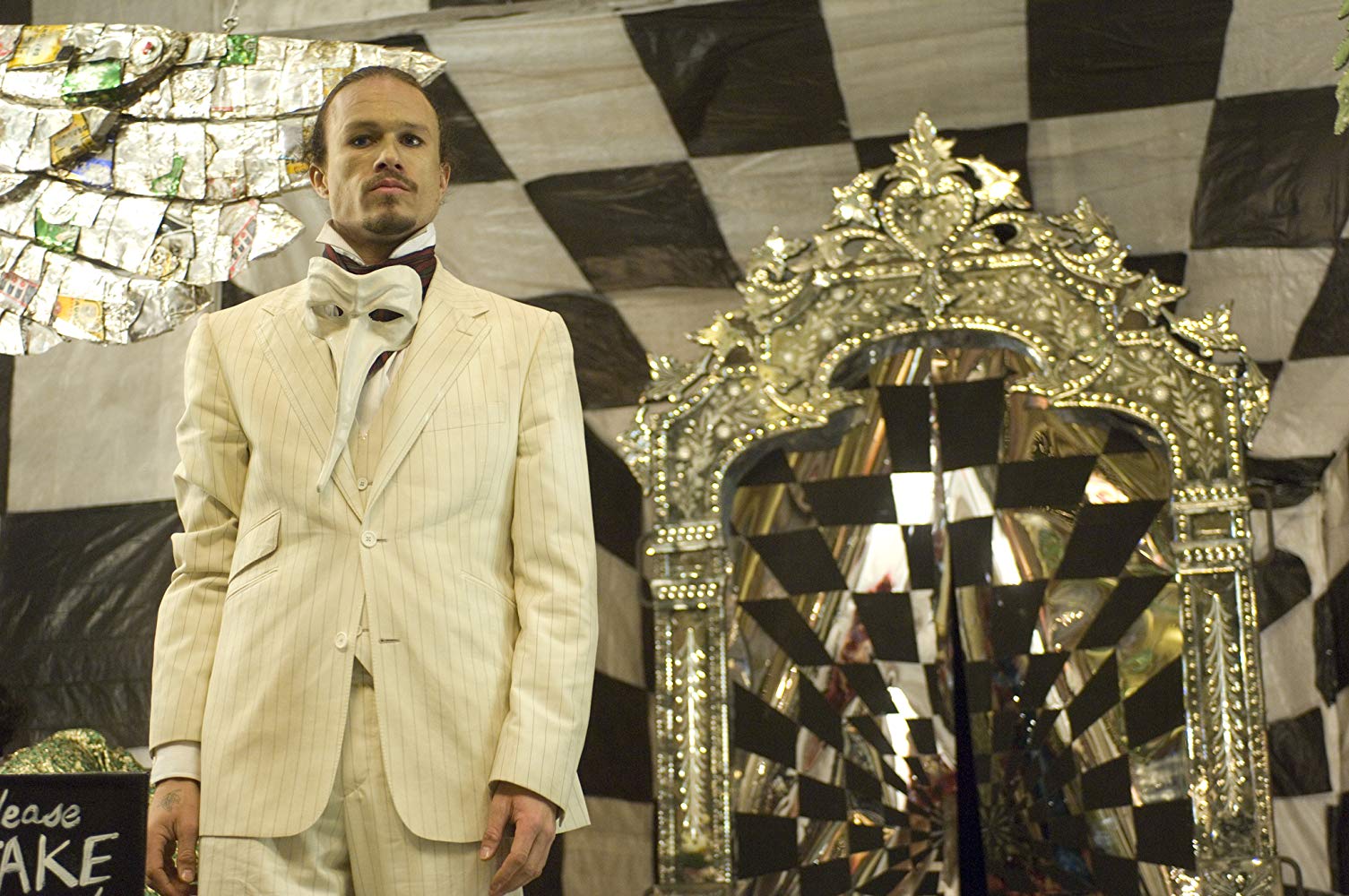
Ledger plays the mysterious Tony, a man found hanging from a bridge by a travelling theatre troupe headlined by the titular Doctor Parnassus (Christopher Plummer). The group also consists of the Parnassus' old friend, the wise Percy (Verne Troyer), the old man's daughter Valentina (a charming Lily Cole), and former beggar Anton (Andrew Garfield), who is head over heels in love with Valentina. Tony has a mysterious and shady past, so he is happy to work for the Imaginarium in an effort to disappear from a very public life, and soon sets about transforming the show's old-timer decor and feeble efforts to attract an audience. Usually setting up the stage in dingy car parks or other undesirable locations, Parnassus' only boast is that of a magical mirror that can transport anybody who enters it into their own imagination. Anton is unhappy at the sudden appearance of this handsome stranger, who naturally attracts the attentions of Valentina, but the troupe may face a larger threat thanks to Parnassus' ancient wager with the Devil (Tom Waits).
There's a great idea in there somewhere, but the script by Gilliam and co-writer Charles McKeown (who also worked together on Brazil and The Adventures of Baron Munchausen) is so haphazard and unsure of itself that it often feels like three films crammed into one. This is no doubt down to the in-production re-writes that were necessary following Ledger's death (Johnny Depp, Jude Law and Colin Farrell were brought in to play alternate versions of Tony when he ventures behind the mirror), so sections of the film feel awkwardly patched together. But there is also much to like. The design of the Imaginarium itself is wonderful in its own tatty, weather-beaten way, and Waits, complete with pencil moustache, cigarette-holder, and that signature raspy voice, is irresistible as Satan himself. The moments set within the imagination are often silly and plagued with questionable special effects, but they also occasionally sparkle with the same kind of magic of Gilliam's Monty Python animation. While it may not be the ideal film to finish his short career on, the film plays a lovely tribute to Ledger and will always be a reminder of the talent we lost far too soon. Sadly, this is likely all Imaginarium will be remembered for, but its a sporadically entertaining ride while it lasts.
Over his impressively long career, Johnny Depp has adorned make-up and a variety of wigs, contact lenses and outlandish costumes to deliver a plethora of memorable (and not-so-memorable) characters, performed with a trademark flamboyance now simpatico with the actor. The success of these films, which are often seen through the gothic lens of Tim Burton, makes it easy to forget that there is a good-looking actor capable of a fantastic 'normal' performance in there somewhere. Black Mass shows a bit of both sides. He has once again donned a rather distracting appearance - a set of pale blue eyes, a receding hairline and bulbous nose - to portray James "Whitey" Bulger, but there is also a terrific and unseen intensity to Depp here, convincingly scaring the shit out of anyone he comes across.
Clearly channelling Scorsese visually, director Scott Cooper of Crazy Heart (2009) and Out of the Furnace (2013) fame skips his main character's rise to criminal overlord in favour of showing us just how much of a bastard Bulger was (and probably still is). His otherworldly appearance, with blotchy skin and a mouth full of wonky brown teeth, is not how the real man looked but instead serves to highlight his monstrous nature. Bulger's activities are recollected by his former gang members Stephen Flemmi (Rory Cochrane), Kevin Weeks (Jesse Plemons) and John Martorano (W. Earl Brown), who all have their own bone to pick with him by the end of their story. His willingness to murder and threaten whether it be for business, pleasure, or to simply stay out of jail led to Bulger becoming one of the most notorious criminals in Boston history.
In the beginning, Bulger is approached by FBI agent John Connolly (Joel Edgerton), a local boy, who offers him a free ticket to the top of the criminal underworld. It's not snitching, but a deal that benefits both sides as Connolly is served rival gang members on a plate, and Bulger gets to carry on with his illegal activities without the prying eyes of federal agents. Only Connolly seems to be enjoying peeking into the criminal high life a bit too much while Bulger gives him diddly squat. Bulger plays him like a fiddle, managing to silence a dinner table with murderous threats thinly disguised as jest in one stand-out scene. And Black Mass is at its best when the film moves into darker territory, cruelly teasing the inevitable brutality to come whenever a disposable minor character shuffles onto the scene.
Narratively, it's all over the place and tends to neglect detail in favour of more conventional biopic storytelling. In the few scenes he has, Benedict Cumberbatch oozes a subtle sliminess as Whitey's Massachusetts State Senate President brother Billy. The vastly different paths these two brothers took could have made for engaging drama and given the film more balance, but strangely Cooper chooses to almost ignore the relationship completely to concentrate on Bulger's dealing with the FBI, so Cumberbatch is criminally under-served. However, as silly as he looks, Depp is genuinely unsettling and, like the film as a whole, gets under your skin. Black Mass sounds like it should be a horror, and as the creepy real-life security footage plays out over the credits, its hard to deny that in many way it is.
By 1983 the horror sub-genre of slasher films were dwindling, offering largely imitations of the hugely successful Friday the 13th series (in 1984 Friday had it's 'Final Chapter' that proved to be eventually false), with films such as Curtains, The Forest or Sleepaway Camp. Whilst the majority of these films expressed the vapid nature of teenagers as throwaway avatars for murder, they continued with the conventions set out by John Carpenter's Halloween (1978), but added very little in originality or invention. Of course, Wes Craven's A Nightmare on Elm Street was not the first slasher to involve a supernatural villain - Uli Lommel's ridiculous The Boogeyman (1980) - along with Halloween's Michael Myers - had utilised these elements before, but Craven's nightmare hook turned what could have been a standard early-'80's horror film into something quite original and filled with socio-political ideas.
Wes Craven at this point in his career had made the notorious (and still quite shocking) debut, The Last House on the Left (1972), the mediocre, yet well known The Hills Have Eyes (1977) and the failed mystery, Deadly Blessing (1981) - amongst other inferior projects. He had yet to display his intelligent subversion of horror conventions that are now well known though the Scream franchise (1996 - 2011), but within the foundation of his slasher screenplay, was a concept inspired by a real-life mystery that he embellished, creating what is now an icon of the genre. Craven read in the newspapers about a young Asian boy who was fearful of sleep, telling his parents that someone was after him in his dreams. One night his physician father gave him sleeping pills, and the boy violently died in his sleep. So, what if there was someone attempting to kill a group of teenagers in their sleep? Well, it would surely make for an interesting narrative, and one that would equally be frightening, smart and original.
On the surface, Nightmare is a straight forward story about revenge. Krueger hunts the teenage children of the parents who had burned him alive. A child molester and killer (the molestation angle was diluted for the film due to the McMartin pre-school trial that was breaking in the media at the time), Krueger had escaped imprisonment due to a technicality, so the parents of Springwood created a vigilante mob to track him down and deal out justice on their own terms. As Nancy (Heather Langenkamp) and her friends begin to describe the razor-fingered, red-and-green-sweater-wearing figure invading their dreams, the conspiracy surrounding him, and the secrecy kept by the parents begins to unravel. Elm Street is a place where the parents (or the forefathers of the United States) hide the sins of the "father" from the younger generation. Like the omni-present rise of a new conservatism in Reagan-era politics, America desperately felt the need to hide the fundamental violence that created the nation.
In this context, Krueger represents America's violent past, from the decimation of native Indians, through the depravity of civil war, to the embarrassment of the failed war in Vietnam. Reagan wanted to present the nation as a clean-cut, progressive society, and with the religious right now on his side (before 1980, state and religion were separated by the constitution, until Republicans realised the number of voters that could be gained by "preaching" god and country into their policies). In the first real introduction of Krueger proper in the film, the young Tina (Amanda Wyss) stands in an alleyway, and he enters at the other side, his Fedora hat in silhouette, he stands like a figure from the old western frontier, the music suggests the genre conventions of a John Ford film. But this is an outlaw figure twisted to reveal to the youth of the '80's that they are no longer able to believe the lies and deceits of parent and government. But Krueger is also a spectre of the past, who will correct the wrongs by eliminating the future, tearing apart the fabric of the fallacy created to whitewash any infractions of history.
Aside from subtextual concepts that run through the film, there is ample room for inventive, bloody deaths. The supernatural infuses the script and lets fantasy become overindulged. From the horrific death of Tina, whose body, slashed with the finger knives, is dragged onto the ceiling where she screams for life, to Johnny Depp's screen debut, where his body is pulled into his bed, gushing out blood at an impossible rate, the bloodletting is both horrifying and informatively original. In Nancy we have the standard final girl of the sub-genre, but she is far more intelligent than previous girls. Langenkamp portrays the strong-willed female with confidence. But fundamentally, unlike films such as Friday the 13th or Halloween, the "monster" seems to have purpose, his vengeance almost justified by the legality of his murder; legitimised by a troubled past. In a way, Krueger looks over the teenagers, like the incredibly effective scene where his claws and face push through the wall above the sleeping Nancy, he peeks into the wrong bedroom, but he wants to expose the fabrication of history.
I first saw A Nightmare on Elm Street on video in 1985 (a friends brother rented it for us - I was 9), and it was one of the first modern horror films I was introduced to. To be honest it was a bit of a revelation, and I can easily state that it probably changed my life, in the sense that I saw a film that played with film form, and presented the concept and atmosphere of a dream/nightmare in such a primal and effective way. It is certainly a film that has stayed in my sub-conscious ever since. The impact of the film, and its central, monstrous conceit (Krueger), has been watered down with seven inferior sequels (which will be reviewed on The Wrath of Blog over the next few months), and has therefore lost the thing that made it work on so many levels. But, watching this film as a stand alone narrative, it still has a powerful, deeply disturbing idea - we all sleep, we all dream. What if that activity that we all need to survive could kill you? The only real failure of this first movie is the multiple, farcical endings that time has been unkind to. It seems that director and producer, Robert Shaye, were unable to agree on a suitable end, but resolved to use them all. But it is still a film of interesting beauty and mood, and a film that I will no doubt return to in the future.
After the debacle of the Pirates of the Caribbean sequels, Gore Verbinski needed a project that would possibly rejuvenate his reputation (he did some interesting work on films such as The Ring (2002) remake, and the little-known, but very effective comedy, Mousehunt (1997). So we come to Rango. another collaboration with Johnny Depp, and written by John Logan (Gladiator (2000), The Aviator (2004)). This delightfully animated film, tells the story of a chameleon (Rango, voiced by Depp), who is a wanna-be thespian, who wants to escape the confines of his glassed habitat. This dream comes true as he is knocked out of the back of a travelling car, onto a desert road.
Rango wanders into the small "wild west" town of Dirt. a town that needs a sheriff. Here Rango decides to perform a character (as he realises there is no need to be himself). His stories of bravery infect the population and they take him on as sheriff. He then becomes involved in a conspiracy that endangers the lives of all the locals, as the water supply is dwindling, and Rango has to investigate to get to the bottom of the situation, with many ideas "lifted" from Chinatown (1974).
The film is a western, and certainly the writer knows his films, as there are many references to the Hollywood classics, as well as the more well-known Spaghetti westerns (there is even a scene with Spirit of the West - a character that is quite obviously Clint Eastwood's Man With No Name from Sergio Leone's Dollars Trilogy. In the opening sequence, Rango attempts to cross a very busy road (clearly in this story the animals are somewhat behind than the humans - there are roads and cars in this universe, but the animals live in a rickety town of the post-civil war era), and when he is flung into the air, he lands on the windscreen of Hunter S. Thompson: "It's another one of those damn things!". Thompson is on his voyage of gonzo-discovery, fearing and loathing on the way to Vegas.
Like Thompson's journalistic travels, Rango is looking for the American dream. Whether he finds it or not is irrelevant. This film is utterly delightful. A fantastic cinematic experience, beautiful animation, a collection of interesting (some obviously cliched) characters, and a simple, yet strong story. All delivered in a package that works incredibly well for both adults and children.

 The delicate balance found by Rowling and director David Yates the first time around is sadly nowhere to be found in this follow-up, The Crimes of Grindelwald. This is part two of a five-part story, so introductions are brushed aside in favour of plot, plot and some more plot. The first hour is taken up by bringing this new group of characters back into the fold, finding Newt grounded by the Ministry of Magic following his shenanigans last time around, just as a new threat rears its ugly face in the form of Johnny Depp's muggle-hating Grindelwald. The bad wizard is searching for the troubled Credence (Ezra Miller), who has emerged in Paris with a circus performer called Nagini (Clauia Kim), but Auror Tina Goldstein (Katherine Waterston) is already on the case. It seems as though everybody is searching for Credence. Even the young Albus Dumbledore (Jude Law), who is mysteriously reluctant to face his old friend-gone-bad himself, tries to convince Newt to go to Paris in his stead. Muggle Kowalski (Dan Fogler) is also back with his memory mainly in tact, as is his girlfriend Queenie (Alison Sudol), who is struggling to deal with a Ministry ban on Wizard-Muggle relationships.