Friday, 24 June 2011

Review #137: 'Repulsion' (1965)

It's easy to forget that beneath all the controversy and hullabaloo that has surrounded the majority of Roman Polanski's post-The Tenant (1976) career, Polanski was once one of the most exciting and formidable film-makers in the world. He could once stand up amongst the true greats of World Cinema, and even directed one of the greatest American films ever made in Chinatown (1974). It could be argued that his career remained strong after he was charged for underage sexual abuse, and he did even win an Oscar for 2002's The Pianist, but to me, he was never quite the same. He was once truly exceptional, and 1965's Repulsion is one of the best examples of his work.

Carole Ledoux (Catherine Deneuve) is a Belgian manicurist living in London with her sister. Although she is beautiful, she is extremely timid and quiet, and seems to have an unhealthy fear of men. She is being wooed by Colin (John Fraser) but she repeatedly stands him up. When her sister Helen (Yvonne Furneaux) and her boyfriend Michael (Ian Hendry) leave for Italy, Carole is left alone in her apartment. She begins to hallucinate about cracks appearing in the wall, and that a faceless man waits in her bed to rape her every night. As her mental state declines, she is paid a visit by Colin who is worried about her reclusiveness.

I put on this film without knowing at all what it was about, and after the first 45 minutes, it was still unclear. It felt like I was being teased and slowly drawn in by the atmosphere and beautiful black-and-white photography, only to be suddenly yanked into to this nightmarish world. Polanski and his director of cinematography Gilbert Taylor make the most out of the ordinary looking apartment. They turn it into the mind of Carole - cracks shockingly appear in the walls, arms grope her from the walls, and a skinned rabbit lays rotting and rancid in her living room.

Deneuve is a revelation here. She barely utters a word in the whole two hours, and instead lets her face do the acting. But the real star here is Polanski, who manages to keep a tight grip of the proceedings for the entire two hours and never lets up, and doesn't make it easy for you. Is Carole's mind tortured by her fear of what men are capable of? Or is she driven mad by suppressing her psycho-sexual fantasties? Either way, Repulsion is beautiful, horrifying, gripping and thrilling.


Directed by: Roman Polanski
Starring: Catherine Deneuve, Ian Hendry, John Fraser, Yvonne Furneaux
Country: UK

Rating: *****

Tom Gillespie


Repulsion (1965) on IMDb

Thursday, 23 June 2011

Review #136: 'Senna' (2010)

The documentary genre, in my opinion, is capable of reaching heights that is impossible for regular features. It has the advantage of being true, and a fascinating story told well that happens to be true is always going to be that little bit more special. True, it can be used as a propaganda tool, but after the documentary boom that started near to that start of the millennium (and it still going strong), the genre has been taken to new heights. And with Senna, a profoundly moving and thoroughly exciting film, it has blended documentary film-making with drama, action and a genuinely touching rags-to-riches tale that goes way beyond the sport of car racing.

Ayrton Senna was a Brazilian Formula One racing driver, who took the sport by storm in the mid-eighties with his no-holds barred attitude to driving, fierce competitiveness, and patriotism for his native country. Senna was simply untouchable. Tensions rose when his McLaren-Honda partner Alain Prost accused him of being reckless and dangerous in his driving, and the two fought for dominance until Prost eventually left. Yet Senna was always at the forefront at campaigning for safer conditions for him and his fellow professionals in the face of the politics of the sport, and it seemed inevitable that the sport would tragically kill him in 1994.

Being a person that usually falls asleep whenever Formula One appears on my television, I was more interested to see a documentary about the man himself. But kudos must go to director Asif Kapadia, as I was completely caught up in the archival footage of the races themselves. Added to the fact I didn't have a clue who won what, it was made all the more exciting. The film starts at a running pace and never lets up, much like Senna himself. It is never sidetracked and the pace is never held up by the use of talking heads - Kapadia instead has small soundbites playing over the footage, and therefore we never leave Senna.

The man himself, who I knew next to nothing about before seeing the film, seems as enigmatic and as captivating as his reputation precedes. He is portrayed here as spiritual, intelligent and warm. His rivalry with Alain Prost is often shown a little one-sided, with Prost being initially a bit demonised, but it makes the sight of Senna stood with him on the champions podium with their arms around each other years later, and eventually Prost carrying Senna's coffin, all the more profoundly moving.

As the tragic ends approaches, Kapadia shows how the drivers were getting increasingly concerned about safety, and Senna is always at the forefront of it. Here the film takes on an almost apocalyptic tone, as Senna's tragic death approaches. As the camera focuses on and studies Senna's face as he prepares for the race, it's almost as if he knows. He looks unsure, concerned, and yet somehow resigned to his fate. As if this is something he must do for the greater good. Perhaps I'm almost romanticising his death, but I was captivated by the man, and when the end came, I was deeply touched. A powerful documentary about a fascinating sportsman, and although it's not going to get me into the sport,  I certainly have a new-found respect for it.


Directed by: Asif Kapadia
Starring: Ayrton Senna
Country: UK/France/USA

Rating: ****

Tom Gillespie


Senna (2010) on IMDb

Wednesday, 22 June 2011

"Nostalgia and Spectatorship"

Over the past month or so, we have been discussing the idea of creating a themed blog project. The first of these that we considered are the films of our childhood. The idea is that we would revisit films from our formative years, watch them with fresh, pseudo-adult eyes, and review them for The Wrath of Blog. This got me thinking about the films that I grew up with. This consequently led me to my change in attitude to the films from that time, and how the same cycle of genre films are dominating the cinemas of today - just now they are in the form of CGI "spectaculars". Because of this I decided that I should write an introduction to this themed, review based season (if you will).

'The Dark Crystal'
I became aware of film at a very early age. I was young, but remember vividly the early 1980's boom of video. We had a Betamax video cassette recorder. It was the size of a house. I remember that you could not only rent videos from very dubious shops, but you could easily also rent from videos lined up in some random houses porch. What this meant to me was simple. I had access to so many films. I could record films off the TV late at night, watching them in the early hours, before the parents woke. I even used to sneak to the newsagents to buy pre-certificate video trade magazines such as 'Video World'. This interest also informed me of the video nasty (a subject we will be returning to in a proposed project in the near future).

Whilst I had been exposed to the world of horror before in the form of (very early by my granddad who was also an avid film viewer and video cassette recording hoarder, as I later became) Universals 1930/40's horror cycle, modern horror had not been accessible for me. Then, when one day in 1982, my Granddad bounds into the house with a rented copy of John Landis's An American Werewolf in London (1982), and I was aloud to watch the transformation scene (you could see the delight on my granddads face as he was so amazed by the sequence). This made me hungry to see horror as much as possible. I was unable as a person of 7-9 years of age to find any of the video nasties until some time after this, so was happy to fit into the ones that I had access to, such as Wes Cravens A Nightmare on Elm Street (1984), Friday the 13th (1980) and their many sequels. I was however able to watch The Exorcist (1973) and The Texas Chain-Saw Massacre (1974), on incredible over-copied pirate video - I still believe this adds a certain grimy, more perverse viewing experience, making it an even greater thrill from the illicitness of the whole affair. After all these two particular films, whilst not of the official DPP 'nasties' list, were banned for distribution on home video by the BBFC. However this was not the dominant movie genre that I immersed myself in in my formative movie watching years.

'Dimensions Of Dialogue'
I was born in 1976. A year later George Lucas's Star Wars was released. I obviously wasn't aware of it at the time, but this became the dominant obsession for myself and my generation, and all that (at the time) followed in Hollywood cinema for the summer blockbuster as we pretty much know it now. So, the Fantasy film ran supreme in my video viewing and cinema going habits. After all, it was the age of kids cinema. My first cinema experiences are with films such as E.T. The Extra Terrestrial (1982), The Dark Crystal (1982), the obligatory Disney animated movies (Snow White and the Seven Dwarfs (1937), Dumbo (1940) and Pinocchio (1941)), Return of the Jedi (1983), Superman III (1983), and Ghostbusters (1984). Action-Adventure movies were a regular on the screens. Indiana Jones and the Temple of Doom (1984) and Romancing the Stone (1984), cast Han Solo and that prick with the stupid hair, Michael Douglas as swashbuckling forest twitchers. I'm not going list all the films I watched as a child - that would be ridiculous, not to mention tiresome.

The story of how Jaws (1975) and Star Wars completely changed, and in many ways destroyed, the Hollywood system, has been exhaustively re-told by many, so I'm not going to re-tell it here, and only state that I agree with it, as is reiterated by Peter Biskind in his popular book 'Easy Riders, Raging Bulls'. Extending this to 2011, and we see that the blockbuster, weekend money-maker is still the prevalent occupier of cinema screens around the world. Now, I'm not going to continue with a diatribe about how films aren't made like they used to be; that would be crass. But obviously my viewing habits have changed since my childhood. The films however have not changed. It's the same stories told over. With computer generated monsters etc. We have been in a massive sea of fantasy films since Peter Jackson's The Lord of the Rings trilogy (2001 - 2003). Also super heroes are dominant. Their presence quite welcoming in some cases (Spider-Man 2 (2004), The Dark Knight (2008)), but usually not. In my childhood there was of course Superman (1978 - 1987) and later Batman (1989). On TV, the cheesy-yet-watchable American shows The Incredible Hulk (1978 - 1982) and The Amazing Spider-Man (1977 - 1979). So, the films of today are seeming to be repeating the trends set after Star Wars. As in the '80's, we now have endless sequels. Hollywood is a perpetual motion machine. '80's film is now being regurgitated in remakes.

'Q: The Winged Serpent' 
That's enough about the cyclical trends of Hollywood cinema since the age of the F/X "event" movie: back to the nostalgia. Because of video I was not only exposed to endless fantasy/sci-fi Hollywood blockbusters. But I'm not one to watch just one type of film. I was, even at a very early age, interested in new cinematic experiences (something I still do to this day). The most challenging, and artistically daring films I was exposed to, were the many dark and interesting animation from around the world. This was due to the newly begun UK television "network", 'Channel 4'. This had late-at-night animated shorts. This, I later discovered, is where I was first introduced to the films of Jan Svankmejer (Alice (1988), Dimensions of Dialogue (1982), Virile Games (1988)), and The Quay Brothers (Street of Crocodiles (1986), The Unnameable Little Broom (1985)). Through my Granddad, I was shown the epic 'classics'. Lawrence of Arabia (1962), Ben-Hur (1959), The Wizard of Oz (1939). The mini-epics starring Ray Harryhausen (Jason and the Argonauts (1966), The Golden Voyage of Sinbad (1977) et al). My childhood also includes many other types: Exploitation cinema, mainly through Kung-Fu movies, and of course horror and action z-grade movies. The works of Larry Cohen produced two of my favourite films in the 1980's; Q: The Winged Serpent (1982) and The Stuff (1985).

Whilst my film spectatorship has changed since my youth, I seem to have illustrated here that much of what I encountered has influenced what I watch today. My exploration for new cinema has obviously expanded since those early days. Access to film has certainly become easier since then. I do have many gripes with the Hollywood film industry and is continuation of the same cyclical path it has been tread milling since the 1970's. But because of this access to almost limitless films, I can do what we all should do when we view something that's personally offensive. Ignore it, leave the cinema, turn the video/DVD/Blu-Ray off, switch the TV channel over. Problem solved.

Marc Ivamy


Stay tuned!

Review #135: 'Boss Nigger' (1975)

Made at the height of the Black Power movement, Boss Nigger (or The Black Bounty Killer) is a blaxploitation western that was written and co-produced by genre legend Fred Williamson. Boss (Williamson) and his friend Amos (D'Urville Martin) are bounty hunters who are looking for wanted man Jed Clayton (William Smith), in order to claim a big reward. When they arrive at a small town where they suspect he may be, they discover it has no sheriff, and is instead being run by corrupt Mayor Griffin (R.G. Armstrong). Tired of being controlled by those damn 'whities', they instate themselves as sheriff and deputy, and stamp their own brand of law enforcement on the community.

Whether this is a genuinely angry film, made in the midst of racial tension and the rise of Black Power, or a satirical play on a familiar scenario with the roles reversed, I'm not sure. It certainly made me feel uncomfortable every now and then. There is only one white character in the whole town that treats the Boss as an equal, and he is quick to stamp his superiority over her as he seduces her. I know, this is a blaxploitation film and the theme is practically always sticking it to the whities, but this is the kind of stereotyping that the black community were experiencing themselves at the time, which leads me to believe that it may in fact be a play on this.

However, racial themes aside, this is actually a pretty enjoyable western. It doesn't break any boundaries, but it's a delightfully old-fashioned new-sheriff-in-town story, that is suitably both amusing and action-packed when it needs to be. As the Boss, Williamson employs his impressive screen presence the same way he did in Larry Cohen's Black Caesar (1973), taking no shit from the townsfolk, and charming the ladies. It also benefits from the fact that is had a bit of a budget, as opposed to most blaxploitation films which often looked cheap and amateurish. Good, bloodless fun, that drops more 'N' bombs than a BNP rally.


Directed by: Jack Arnold
Starring: Fred Williamson, D'Urville Martin, William Smith, R.G. Armstrong
Country: USA

Rating: ***

Tom Gillespie


Boss Nigger (1975) on IMDb

Tuesday, 21 June 2011

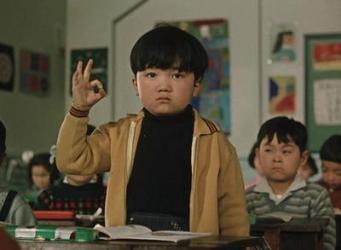
Review #134: 'Good Morning' (1959)

Japanese master Yasijuro Ozu repeated many themes in his movies. One of the key things running throughout  his films is the idea of communication, or the lack of it. Good Morning, or Ohayo (to give the film its native title) centres around two young brothers, Minoru (Koji Shitara) and Isamu (Masahiko Shimazu), who long to own a television set. Their parents refuse, citing the fact that it will kill the art of conversation as the reason why. The boys rebel after accusing grown ups of talking a lot but never saying anything worthwhile, and go on a vow of silence, much to their parents gratitude. In a key sub-plot, the town gossips accuse the neighbourhood treasurer Mrs. Haraguchi (Haruko Sugimura) of embezzling their funds in order to buy herself a new washing machine, when in fact one of the gossips' mothers had forgot to pass the money on.

Ozu's reputation as one of cinema's all-time greats and a director of elegance and sophistication is given a bit of a kick up the arse in this film. This is Ozu at his most hilarious. The mischievous brothers' increasingly desperate antics unwittingly causes mayhem amongst the townsfolk and inevitably has them bickering amongst themselves. It also contains lots of fart jokes. Yes, fart jokes, from Ozu. The brothers and their friends have a strange obsession with forcing out little farts as they push each others foreheads, which causes one unfortunate to repeatedly soil himself as he tries to take part.

The kids' accusations that grown-ups have nothing useful to say is as amusing as it is poignant. The communities breakdown in communication leads to all sorts of rumours flying around about where the treasuries money is, when a simple forgetful act is all that has taken place. Even when this is discovered and the matter appears to be cleared up, they still find ways to stir up trouble. And the scene where two singletons who are obviously attracted to each other talk about the weather to fill the awkward silences, is as heartbreaking as it is oddly magical. Only a true master such as Ozu can conjure two conflicting emotions from one scene. But beneath all the bittersweet comedy and social observations is a sobering message about the decline of community and the looming death of cinema. Stunning filmmaking from a true great.


Directed by: Yasujirô Ozu
Starring: Kôji Shitara, Masahiko Shimazu, Keiji Sada, Chisû Ryû
Country: Japan

Rating: *****

Tom Gillespie


Good Morning (1959) on IMDb

Monday, 20 June 2011

Review #133: 'Faces' (1968)

John Cassavetes' drama shows the breaking point of a long-disintegrating marriage between Richard and Maria Forst (John Marley and Lynn Carlin). At the start of the film, Richard joins his lifelong friend in the home of prostitute Jeannie (Gena Rowlands), where the two sing and dance, and drunkenly make fools of themselves as they try to impress her. He goes home to his wife and the two joke, only for Richard to suddenly announce his desire for a divorce. He goes back to Jeannie, who is now entertaining two businessmen. Maria goes out with her friends and they pick up optimistic dancer Chet (Seymour Cassel). He charms her friends and the two end up alone, where their desire for intimacy brings them together.

Cassavetes, known as the pioneer of American independent film-making, is at his most cold here. We are forced to watch these often repulsive characters laugh and interact without ever really connecting. Most of the men in the film are unhappily married and try to fill the void by committing adultery. All they seem to be doing is distancing themselves more from their wives, and increasing the loathing they truly have for themselves. It's a stroke of genius how over the course of two hours, we get to fully understand the mechanics of Robert's and Maria's marriage, even though they only spend about 15 minutes of screentime together. We get to experience it through a facial expression, or a certain glance, or a line of dialogue.

Filmed in the style of cinema verite, a device used most successfully by documentary film-makers The Maysles Brothers, Cassavates deploys it to truly get underneath the skin of the characters. We get to see the characters mainly in close-up, and although we are forced to swallow their meandering and dull conversations, the film never feels intimate. And this is the point. These people seem to exist for themselves, and although they communicate, they only really talk to themselves. The title Faces seems like a clever joke. All these people are, are faces. The director's true intentions come out in one of the final scenes, as Chet talks about how mechanical society is, and how everyone longs for, but is terrified, of intimacy. A truly great American drama featuring expert performances, namely from the Oscar-nominated Lynn Carlin and Seymour Cassel.


Directed by: John Cassavetes
Starring: John Marley, Lynn Carlin, Gena Rowlands, Seymour Cassel
Country: USA

Rating: ****

Tom Gilespie


Faces (1968) on IMDb

Review #132: 'Night of the Bloody Apes' (1969)

Part of the short film wave in Mexico that combined extreme gore with wrestling (or 'lucha'), this low-budget horror was part of the 'video nasty' list in the UK. It tells the story of a brilliant surgeon, who when finding out his son will die from leukaemia, has the brilliant idea of giving him the heart of an ape. He thinks that by replacing his heart, his body will be able to sustain the chimp blood being pumped around his body. As a result, his son grows a big hairy face, terrorises the city and murders lots of people in particularly brutal fashion. Hot on the doctor's tale is Lt. Martinez (Armando Silvestre) and his wrestler girlfriend. Will they be able to stop the manic ape-man? Will the doctor be able to save his son from his affliction? Will the Mexican to English language translation ever manage to string an actual sentence together?

As you would expect, this film is bad. First of all, the title is a lie. There are no apes involved, it involves a beast with a wrestler's body and a big hairy face. And there's only one of it. But I don't think that director Rene Cordona was striving for the next Citizen Kane (1941) (which is clear from the film's wildly imaginative alternative title, Horror And Sex). The film has plenty of enjoyable gore, and I mean plenty. But Tom Savini did not work on this film - instead I think a blind film student did. The bad effects are most evident when the beast is tearing open the throat of an one unfortunate, only for the close-up to reveal that he's clearly peeling of a large plaster, with the gore beneath.

It is all rather enjoyable though, so I must give the film credit for that. The film's slender running time breezes by, and there's plenty of laughs to had in the stodgy dialogue, bullshit scientific discussions, and watching the beast butcher a seemingly endless amount of people. The main reason for the film's UK ban must be for the scenes of real open-heart surgery, which was spliced into the film upon it's US release by director Jerald Intrator (responsible for such classics as Satan In High Heels (1962) and The Curious Case Of Dr. Humpp (1969)). I refuse to believe that it's because of the extremely unrealistic and silly gore scenes. Not really a guilty pleasure, but certainly something to watch while refilling the glass of brandy and thinking of what film to put on next (in my case).


Directed by: René Cordona
Starring: José Elías Moreno, Carlos López Moctezuma, Armando Silvestre
Country: Mexico

Rating: **

Tom Gillespie


Night of the Bloody Apes (1969) on IMDb


Saturday, 18 June 2011

Review #131: 'This Island Earth' (1955)

This 1955 cult sci-fi 'favourite' first came to my attention whilst I was watching Mystery Science Theatre 3000: The Movie (1996) back in my University days. The clips accompanied by the sarcastic comments of the MST robots was hilarious, and I had to see the film. So, five or so years later, I did. And I realised without added hilarity of Mystery Science Theatre, the film isn't so much funny, as jaw-droppingly awful and frustratingly timid. 

Square-jawed, opera-voiced, vanity-ridden cheeseball Dr. Cal Meacham (Rex Reason) is one of the best in his field, and when he starts receiving machine parts that he didn't order, he begins to build the 'interociter' along with the arse-sniffing colleague Joe (Robert Nichols). When it's built, a strange being appears on the monitor and invites Cal to join his academy that boasts a collection of top-rated scientists. Upon arrival, Cal suspects that things aren't as they seem, as the reason they are there is kept top secret. Or perhaps it's because the head the academy, Exeter (Jeff Morrow), has the forehead the size of an airport runway, and the skin tone of a used teabag. 

Apparently the special effects were ground-breaking in their day, and perhaps they were. But I felt it actually lacked bad special effects, which at least would have given the film a bit of charm. Don't get me wrong, I usually love these kind of awful films, but the film was played so straight-faced that I just found it a bore. My lack of interest also led to me getting confused about the plot. But there are funny moments, mainly involving the obnoxious alpha-male Cal and his assistant, who follows him around like a dog, and a scene where an embarrassingly crap alien insect attacks Cal and his love interest Ruth (Faith Domergue). For some quality cheesy sci-fi, I would recommend Robinson Crusoe On Mars (1964) instead, and give this one a miss. 


Directed by: Joseph M. Newman
Country: USA

Rating: **

Tom Gillespie


This Island Earth (1955) on IMDb

Review #130: 'Kung Fu Panda 2' (2011)

And so the battle between Pixar and Dreamworks rages on. Dreamworks have been somewhat in the shadow of it's rival in the recent years, only managing average output such as Shark Tale (2004), Over The Hedge (2006) and Madagascar (2005), while Pixar have been formidable with the likes of The Incredibles (2004), the Toy Story trilogy (1995-2010), and WALL-E (2008), all of which could easily be called masterpieces. But Dreamworks had something up it's own sleeve back in 2008 with the extremely funny and enjoyable Kung Fu Panda, which was a huge success for the studio. And three years on, the more-than-welcome sequel arrives, and it's really rather good.

After establishing himself as the Dragon Warrior in the first film, Po (Jack Black) heads the Furious Five, consisting of Tigress (Angelina Jolie), Monkey (Jackie Chan), Mantis (Seth Rogen), Viper (Lucy Liu) and Crane (David Cross). All is well, as the powerful group easily dispose of any potential threat to the relm, under the watchful eye of Shifu (Dustin Hoffman). Po is seeking out answers to his birth, when he realises that his father Mr. Ping (James Hong) couldn't possibly be his biological parent, what with being a goose and all. But there is a new threat in town, and he is in the form of peacock Shen (Gary Oldman), who is stealing all the scrap metal he can to aid his new powerful weapon, which could see the end of Po and kung-fu.

The thing that appealed most about the first film was it's genuine affection for kung-fu and China. It used Chinese-style animation in one sequence, and some traditional drawing in the end credits. Plus the action scenes were better than the majority of real-life action films, combining thrilling action with slapstick comedy to good effect. Here, they've changed into second gear, and the action is twice as ambitious, and twice as impressive. The epic climax sees many kung-fu warriors, including our heroes battle Shen's army, and I've not been as excited while watching an action scene since the hotel corridor scene in Inception (2010). And in showing Po's childhood, they've created another beautifully drawn sequence that uses China's traditional paintings as its influence.

Thankfully, the sequel is not a mere re-tread of the original. The fat jokes are kept to a minimum, the scope is expanded, and they've developed Po's story in revealing his childhood. One of the main things that concerned me was that it may miss Ian McShane, who for me stole the first film as the menacing Tai Lung. But in Gary Oldman, they've created a different sort of villain. Just as menacing as Tai Lung, he is not half the warrior, but he possesses something that Po and the Furious Five may be helpless against - a big gun.

Not quite as good as the original - it lacks the freshness and under-uses Dustin Hoffman's kung-fu master - but a more than worthy follow-up. It even manages to make Jack Black likeable, who after years of playing the same character in shit films (not including The School of Rock (2003)), wears me down. And the sheer number of talented actors that have been brought in (apart from the already mentioned, there's also Jean-Claude Van Damme, Dennis Haysbert, Danny McBride and Michelle Yeoh) shows that the film is puffing it's chest out at Pixar. I'll be looking forward to the inevitable third instalment, and hoping it can carry on impressing.


Directed by: Jennifer Yuh
Voices: Jack Black, Angelina Jolie, Dustin Hoffman, Gary Oldman, James Hong, Seth Rogen, Jackie Chan, Lucy Liu, David Cross, Michelle Yeoh
Country: USA

Rating: ****

Tom Gillespie


Kung Fu Panda 2 (2011) on IMDb

Review #129: 'Zoolander' (2001)

Derek Zoolander (Ben Stiller) is a slow-witted fashion model who is known for his 'Blue Steel' look, and has dominated the industry for years. When the new kid on the block, Hansel (Owen Wilson), starts taking the attention away from Zoolander, and journalist Matilda (Stiller's wife Christine Taylor) writes a mocking piece on him, Zoolander considers retirement. He travels back home to work in the coal pits with his father (Jon Voight) and brothers (Vince Vaughn and Judah Friedlander) but they reject him due to his fashion antics and general uselessness in the pits. Meanwhile, fashion giant Jacobim Mugatu (Will Ferrell) is coming up with a plan to assassinate the Prime Minister of Malaysia, and feels that Zoolander is just stupid enough to be the hit-man.

I've never really been a fan of the work of Stiller and his usual troupe. While his films are generally entertaining, I just don't find them that funny. Zoolander, though not exactly a classic, is possibly his best, being frequently funny, silly, and most important of all, fun. For all it's prat-falls and ridiculous costumes, it is actually a pretty damn accurate send-up of the fashion industry. Many a time I've been forced to sit through the likes of America's Next Top Model and whatever new shit Gok Wan has come up with (I detest that man with every fabric of my being), and it is really this ridiculous.

The cleverist moment of the film is when Mugatu announces his new fashion show, called Derelicte, spinning fashion out of the bums and hobo's that roam the streets. It's just the type of pretentious and shallow thing that happens in fashion all the time, taking its influences from the unfortunate and putting it's own naive and clueless fingers all over it. Anyway, that's enough about my hatred for the fashion industry, now for the actual film.

Zoolander has the thing that seems to missing from Stiller's usual films, which is sweetness. As gay as that sounds, it helps elevate the likes of Judd Apatow's films above others, and helps you actually care about the film rather than it being played just for laughs. Tropic Thunder (2008) and Dogeball: A True Underdog Story (2004) certainly tried, and ultimately failed. Although Zoolander is a shallow idiot, he is certainly loveable. And as Hansel, the always-watchable Owen Wilson is just a dim-witted. When the two settle their rivalry and team up, there is plenty of chemistry. Watching them both giggle like children when talking about bulimia is a scene where if handled badly, could have been uncomfortable, but the scene is possibly the funniest in the film.

Yes, it follows the same path as many other a comedy, and some of the jokes fail to hit the mark. But it's fun, entertaining, and features a handful of solid comedy performances. And, as ever, Will Ferrell steals the show as a manically over-the-top designer.


Directed by: Ben Stiller
Starring: Ben Stiller, Owen Wilson, Christine Taylor, Will Ferrell, Milla Jovovich, Jerry Stiller, Jon Voight, David Duchovny
Country: USA/Australia/Germany

Rating: ***

Tom Gillespie


Zoolander (2001) on IMDb

Thursday, 16 June 2011

Review #128: 'The Human Centipede (First Sequence)' (2009)

I can only imagine the pitch. Young, eager director Tom Six walks in, anxious to impress potential producers. "So what's it about?" asks one of the financers. Six looks awkward, shuffling his feet. "Er.. it's about this mad scientist who specialises in Siamese twin separation, who abducts these girls. He kinda has this obsession and dream about stitching people together. He wants to join three people together, connected by their mouth and arsehole, and treat them like a dog." The producers look at each confused, and the one drops a bag on the table full of money. "Here's two million dollars," he says, "go make a fucking movie!"

And yes, that is what the film is about. This is probably the maddest idea I've ever heard, which got me extremely intrigued. That, along with the minor media storm that was caused upon it's UK release, meant it was a film I had to see. Not since the glory days of Grindhouse has such a crazy idea been released to mainstream audiences. Yet for all its 'potential' it falls rather flat on it's face.

First of all, there are things to enjoy about the film. The crazy surgeon at the centre of it all, Dr. Heiter (Dieter Laser), has one of the most unusual faces I've ever seen, and therefore makes a great horror villain. His stoic and Nazi-like behaviour is hilarious, sometimes unnerving, and often very camp. There's definitely a little Udo Kier about him. The surgery scenes, and the inevitable "oh no, I need to shit!" moment are delightfully cringe-inducing, and watching Heiter gaze longingly at a picture of his dead three-dog (work it out) is just plain weird.

Yet at the heart of it all, it's nothing more than a run-of-the-mill horror, with dragged-out set pieces, an overlong stalk-around-the-house scene, and a rather poor climax. The eventual unveiling of his creation is also rather tame, with the key gruesome areas covered up (the fact that I would want to see a mouth stitched to an arsehole worries me). I'd like to say it's a missed opportunity, but I don't if an opportunity was ever there. I mean, how good can a film be where the victims are joined through the gastric system and are forced to shit in each others mouths? Saying all that, I will be watching the sequel.


Directed by: Tom Six
Starring: Dieter Laser, Ashley C. Williams, Ashlynn Yennie
Country: Netherlands

Rating: **

Tom Gillespie


The Human Centipede (First Sequence) (2009) on IMDb

Wednesday, 15 June 2011

Review #127: 'The Devil and Daniel Johnston' (2005)

The struggle of an artist battling against his own demons has long been played out in both the movies and reality. Musicians such as Ray Charles, Johnny Cash and Jim Morrison fought against drug and alcohol addiction that led to their lives being played out on screen. They suffered for choices they made. Daniel Johnston, a cult figure and genius songwriter, battled with mental illness for most of his life. His art both benefited and suffered because of his affliction. But Johnston was helpless of his fate. His mental instability deepened as his fame grew, and it's all captured in detail in this wonderful documentary.

Daniel Johnston was always a strange child, growing up with a seemingly obsessive compulsion for art, and later for music. He was vastly creative, inspired and individual in his output. When he decided that he wanted to be a musician and be famous, he produced an album on tape, advertised his work to producers and writers, and blew everyone away. Always influenced by his muse - a girl he fell in love with at college and never saw again - his songs were tortured and heart-rendering, yet joyous and upbeat. But his increasingly unstable mental state put his career on hold. After indulging in marijuana and LSD, he was submitted to a mental hospital after attacking his friend with a lead pipe. And so began Daniel Johnston's tragic public decline, as he alienated himself from his family and friends, and intensified his obsession with God, and ultimately, the Devil.

I had never heard of Daniel Johnston's music before this film. His music is not for everyone's taste - his voice is high-pitched and unbalanced, and his techniques non-conformal and almost old-school - but no-one could deny the tortured genius behind it. Seeing him go on stage for the first time, all skinny and uncomfortable, glancing nervously at the camera every now and then, there was something awe-inspiring about him. It makes it all the heart-breaking to see him now, bloated and old, physically damaged by his mental illness. And yet his thirst for art remains.

There are plenty of bio-documentaries and music documentaries out there that are capable of blowing you away (Gimme Shelter (1970) and The Last Waltz (1978) come immediately to mind), but although this is a great music documentary, it just as brilliant as a serious portrayal of the devastating effects of mental illness. As Johnston had the nack of recording practically everything he did on tape, we get to witness almost first hand his life and breakdown. There are early tapes of him arguing with his mother, and phone calls asking him to wash the graffiti he did on the Statue of Liberty. We also hear troubled calls from his loved ones and friends, and hear the effect it was having on them. One friend states that the troubled genius's of the past, like Van Gogh, are fascinating to read about and amplifies their God-like status. But no-one living has ever had to live with them, and witness it unfold before their eyes. An excellent documentary that really gets to the heart of it's subject. And I'll definitely be hunting down Daniel Johnston's work.


Directed by: Jeff Feuerzeig
Starring: Daniel Johnston
Country: USA

Rating: *****

Tom Gillespie


The Devil and Daniel Johnston (2005) on IMDb

Tuesday, 14 June 2011

Review #126: 'The London Nobody Knows' (1969)

In stark contrast to the colourful, "swinging" imagery of 1960's London we are all too familiar with, The London Nobody Knows, displays the dying, decaying underbelly of old Victorian values, practices and architecture. We are shown proto-delboy's hawking goods in now-dead street markets. Bizarre buskers and street performers act out their defunct acts to grey, bewildered onlookers. Old forgotten men pay 6 shillings a week for bed and breakfast in Salvation Army hostels, the memories of the war lingering in their haggard faces.

Written by Bolton-born artist and art critic, Geoffrey Fletcher, based on his own book of the same name, he illustrates a world that is fundamentally changing. A mournful tome to the decrepit, and disappearing 19th century city. James Mason narrates; he informs of historical anecdotes, and guides us through the multitude of eccentrics, losers, and hopeless characters cluttering the streets, and displays their almost archaic interests and habits.

The London Nobody Knows is a perfect artifact of a Britain before the almost complete Americanisation of its streets, industries and culture, that was to come in the late 1980's and throughout the 1990's. Like the Free Cinema movement of the '50's (headed by the likes of Lindsay Anderson), and the British transport film, and GPO documentaries, this represents a view of a very different, almost alien Britain to the one we live in now. Beautiful, horrifying, insightful, strange, and even emotional. A film that should be seen by anyone interested in the Britain of the past.


Directed by: Norman Cohen
Narrator: James Mason
Country: UK

Rating: ***

Marc Ivamy


The London Nobody Knows (1969) on IMDb

Monday, 13 June 2011

Review #125: 'The Witches' (1966)

After a terrifying experience in Africa, involving native voodoo witch doctors, Gwen Mayfield (Joan Fontaine) has a nervous breakdown and returns to home. Once recovered she takes a job as head mistress in Heddaby, a small quaint English village. She is introduced to brother and sister Alan and Stephanie Bax, who had given her the job. Alan is a distant character. He'd always wanted to be a Reverend, but 'could never do this'. His evidently tortured soul wonders through the film, zombie-like, impotent to the happenings in his village.

Gwen begins to suspect there is something strange going on in Haddaby, when two of the school children she is teaching, - Linda and Ronnie (Ingrid Brett & Martin Stephens) - are kept apart from one another. A sinister plot to make sure Linda keeps her virginity. Gwen delves deeper into the escalating events in the village, and is slowly driven to a relapse of her breakdown, as the idea of witchcraft, and human sacrifice circle in her mind. She is constantly reminded of the imagery that had brought her first nervous disposition in Africa. The film cleverly draws parallels with the ancient 'arts' of the folkloric black arts of witchcraft and voodoo.

Based on the book 'The Devil's Own' by Norah Lofts, the always excellent Nigel Kneale (writer of such British classics as The Quatermass Experiment et al), weaves a tale of increasing anguish, and conspiratorial plotting. Amongst this is a line of dialogue completely out of place, but an absolute joy. After Gwen relapse and memory loss, she is placed in a nursing home. She is sat in the 'TV' room, where an old, knitting lady states, "You're the lady that's lost her memory. I've got veins". Well, it made me chuckle.

A Hammer film, co-produced with Seven Arts, this is not one of their greatest films. It is relatively pedestrian. But very enjoyable. The ritualistic climax does move far too close to camp farce, as the townsfolk writhe ridiculously around the floors, dressed in rags for inexplicable reasons. Joan Fontaine (who owned the rights to the book), suitably over acts, using her contorted face to emote pain, confusion, and a little bit of horror. It's one of those films that fits perfectly with a wet, lazy, Sunday afternoon. Well, that's how I like to spend those types of days.


Directed by: Cyril Frankel
Starring: Joan Fontaine, Kay Walsh, Alec McCowan
Country: UK

Rating: ***

Marc Ivamy


The Witches (1966) on IMDb

Review #124: 'Anti-Clock' (1979)

Thought-reader Joseph (Sebastian Saville) is undergoing a new procedure which mixes computer analysis, brain monitoring, and psychotherapy. It takes him deep within into his soul and causes him to reflect on his past, present and future. These thoughts are seen as snippets of footage on grainy surveillance-type video, newsreels that reveal Joseph's inner psyche and memories, and some seemingly normal scenes played out in various scenarios. These are all accompanied by Joseph's poetic voice-over, Jane Arden's score, and the occasional question or reflections noted by the analyst Professor Zanof (also played by Saville).

This film will be hard to review as I just couldn't come to any clear conclusions on the film's point or themes. It is clear to see that Joseph is in fact not a very nice man, peddling drugs when he's not reading people's thoughts at card games. This is pretty much the only thing that made logical sense. It is, however, not a film to be watched and enjoyed, but a film to experience. After a while, I just rested my brain and simply watched what was happening in front of me. The film is dazzling, confusing, eerie, atmospheric, and occasionally actually gripping. Co-director Jane Arden is something of a cult national treasure, who dabbled in theatre and feminism in her somewhat diverse body of work, and she brings intelligence and artistic flair in which what could have been a pretty dull art project. Thankfully the film stays just on the right side of pretentious.


Directed by: Jane Arden, Jack Bond
Starring: Sebastian Saville, Suzan Cameron, Liz Saville
Country: UK

Rating: ****

Tom Gillespie


Anti-Clock (1979) on IMDb

LinkWithin

Related Posts Plugin for WordPress, Blogger...