Walter Ruttmann's documentary love letter to the German capital, shows the city from the morning proletariat on their way to work, to the decadent bourgeois night of Wiemar Republic, 1920's high living opulence. It shows the shops and market stalls opening, the streets filling, industry moving. The almost constantly static camera captures both the poverty and the affluence. Along with the single shots of the surroundings, there are the occasional flourish of the avant-garde; kaleidoscopic, spinning images similar in experimental joy as Al Bricks Looney Lens series (Split Skyscrapers, Tenth Avenue, NYC (both 1924)), often using split screens and other such optical effects to create hall-of-mirror comparisons.
The films style also often reflects the influence of Sergei Eisenstein and Dziga Vertov's Soviet montage, a style that suggested sub-textual meaning using a series of juxtaposing images. At the start of Berlin... the working classes, walking to their factories, moving uniformly, then images of cattle, and soldiers are sliced, creating the metaphor. Whilst not as politically motivated as the Soviet's, this is still an interesting document of a city living in stark contrasts, in a country still ravaged by the failures of WWI. But watching it now, you become reflective of the changes to this important city. It's history since the making of this film (events that the director would never see, due to his death in 1941), which is devastated by war, and divided by a wall. It's always fascinating to see visual "objects" of the past. Whilst this doesn't have the interesting longevity of the more political Soviet films, this is an important piece of silent-era documentary, and would go on to influence the British documentary movements of the 1930's and 40's.
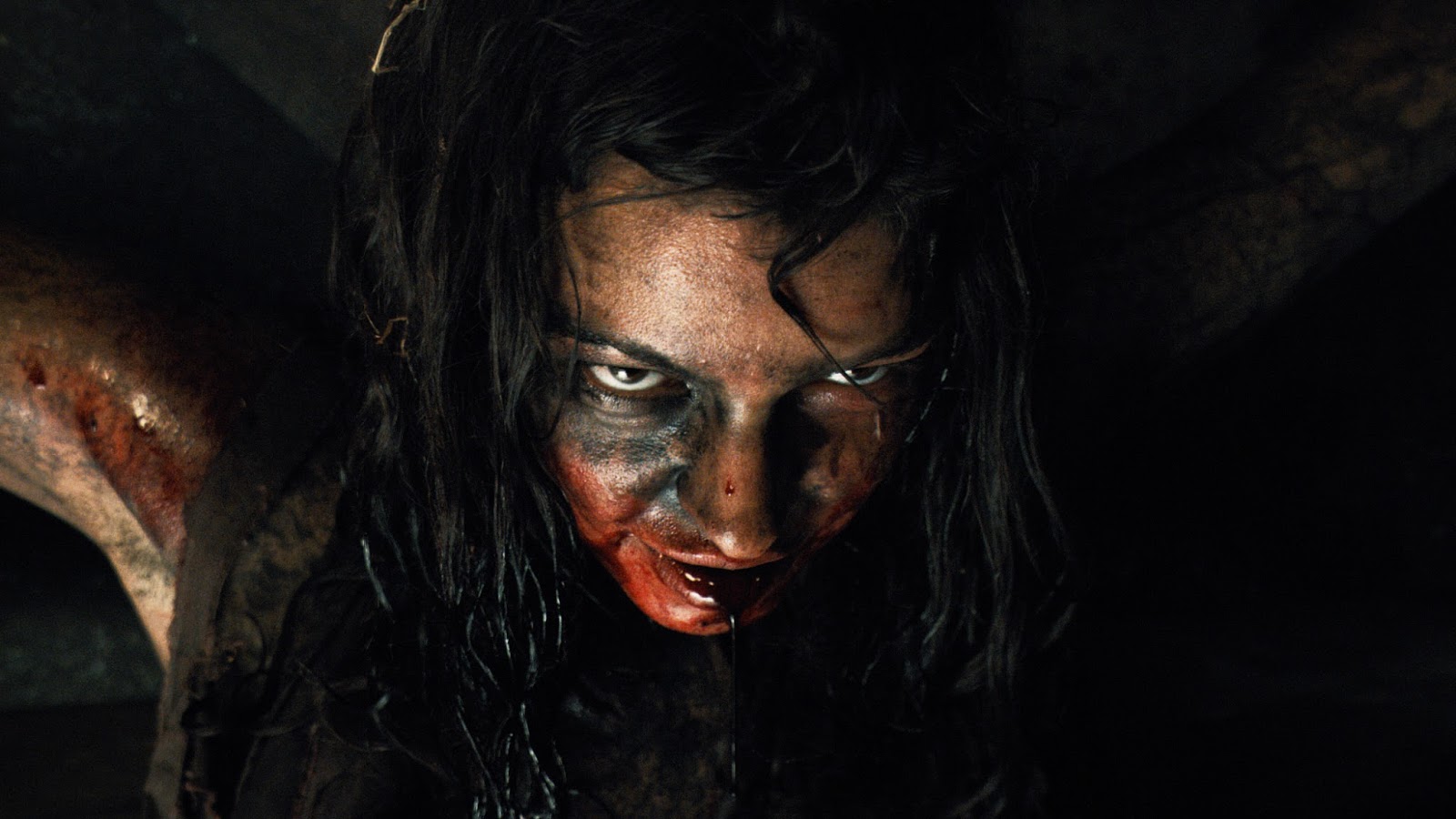
The Wild Child's (1969) premise of an animalistic human being found in the forests and brought into the "civilised" world, is given a slight twist in this sometimes troubling tale of a violently misogynist patriarch. Having discovered a feral female roaming through the woods, Chris Cleek (Sean Bridgers) makes a plan to capture her and bring her into the cellar of the family home, his justification being centred on the premise of civilising the woman (Pollyanna McIntosh). Lucky McKee and Jack Ketchum's screenplay use the uncivilised woman, bound to the will of a man, to increasingly reveal the inherently psychotic hatred this central character has for woman in general. Cleek's meek wife, Belle (Angela Bettis), and teenage daughter Peggy (Lauren Ashley Carter), begin to unravel, Peggy with a hidden pregnancy of dubious inception (her concerned teacher turns up to speak with the Cleeks as she suspects she is pregnant, and the patriarch replies that Peggy does not have any boyfriends, "I'd know if she did").
Whilst the male head of this family is deeply misogynistic, and the inevitable rape of the captured woman leads to influence his teenage son, Brian (Zach Rand), and the dominating thought about it's subject during the watching, was that the film was intrinsically hateful towards women. But as I was in the kitchen, doing the dishes, you know, women's work (sic), I considered a it feminist reading, after all, this is fundamentally about the entrapment and abuse of women. The feral woman, chained and sexually abused, juxtaposed with the "civilised", family unit, locked in a clandestine world, a secret insular house of family oppression, the truth behind the societal veneer of communities. But, contrary to this initial thought, a feminist treatise this is not - it simply falls apart, when the violence towards women turns to the rape of the shackled woman, and then the sons attack with pliers which alters the films effects, and panders to the horror cinema fans, and uses torture-porn tactics, and gruesome gore.
Apart from these moments, the film often plays, laconically, as self-consciously "indie". It is a very well made film, and some of the performances are very good. But I wonder about the intentions of the films central premise. It's a little ambiguous, and is sometimes difficult to truly decipher if the film is celebrating the misogyny in the father and son; or is this a tract about the gender divisions that still prevails in 21st century society? But ambiguous gender politics aside, it does state the theme that generally, the civilised are not far removed from the primitive, animal tendencies, and the barrier of property changes not some of these instincts.
Two drag-racers, named The Driver (James Taylor), and The Mechanic (Beach Boys drummer Dennis Wilson), travel across America looking for quick money racing their souped-up '55 Chevy. They pick up a hitch-hiker, The Girl (Laurie Bird), who they both form a strange attraction to. Meanwhile, a lonely and quite desperate man drives his Pontiac GTO (played by Warren Oates) and comes across the two, and they agree a race to Washington, D.C. for pink slips. While this is the overlying focus of the film, Two-Lane Blacktop is more of an existential odyssey across 1970's America following a group of misfit characters drifting through an increasingly alien landscape.
Very much a mood piece, Two-Lane Blacktop can now be viewed as a key film of 1970's American film-making, encompassing the feelings of both the young and the ageing. This is pure Americana - we see the beautiful desolation of Route 66, road-side diners, dusty gas stations, and empty, one-horse towns. There is minimal dialogue, but with frames and characters so beautifully empty, there is no need. The landscape tells the story. The open road was the focus of many films of the late 1960's and early 70's, many of them misconstrued as simply car-porn. Films such as Easy Rider (1969) and Vanishing Point (1971) channelled feelings of anger and the longing for freedom that were brought on by events such as the Kent State massacre in 1970, causing a generation gap and the isolation of youth.
Not to say there isn't car-porn on show here - the '55 Chevy is rusty and ugly, but the growl it gives out when revved is invigorating. The majority of the races and driving scenes are shot from the interior, allowing us to hear every mechanical clank and gear-change. But the main focus is on the characters. The Driver and Mechanic say little but tell their story with their eyes. They live for their car and care for little else. Although the Driver clearly has feelings for the Girl, he does little to truly act upon it, and therefore causes her to experience loneliness and the feeling of being used. But the most fascinating is GTO, played to perfection by the ever-reliable Oates. We see him at the start of the film telling the same story twice to one of the many hitch-hikers he picks up. He acts out of desperation, reaching out to anyone who will listen. It's a painful portrayal of a very human character.
Not a second is wasted in the film. Director Monte Hellman captures every single sound and feeling out of the most mundane situations, and we are therefore transported back to 1971 America. It is almost as if the film is about absolutely nothing, and maybe that's the point. These characters seem to be speeding to an unknown goal that will always be out of reach. Maybe they know it and maybe they don't, but as long as they get to drive, they're happy. An outstanding piece of 70's cinema.
Perhaps a comment on celebrity culture, and particularly the intangible gloss as presented by celebrity gossip magazines and television shows, Sofia Coppola has produced a sombre, sparse and vapid portrait of a movie star, Johnny Marco (Stephen Dorff), focusing initially on his vacuous life of parties, women and strange and sycophantic encounters with the media and empty women who probably make a career out of shagging celebrities. The only problem with the character initially is that he is blissfully unaware at how empty his life truly is. That is until his ex-wife informs him that she has to go away, and has to leave their daughter, Clio (Elle Fanning), in the responsibility of him.
The films early scenes function is to present Marco in almost exclusive isolation. He is visited by women, including twins who seem to visit him for a pole-dancing act. He is constantly framed alone, in regular protracted shots: in one he is left seated upright with Plaster-of-Paris covering his head (he is having a cast made for a movie role), the camera slowly pans in, his breathing (through nose only) becoming the only audio, as it increases in intensity.
The time spent with his daughter becomes a clearly revolutionary event in the mans life, and he becomes increasingly dependant on the company. This is not in any way the best that Coppola has produced in her (so far) good directing career. The fact that she grew up with a famous father more than likely gives this film some realism. However, it seems to me to be a bit pretentious. Are we really supposed to care about this guy? Perhaps the Coppola woman should try living a regular life, and perhaps produce a film that doesn't centre on privilege.
Long before the likes of the Daily Mail newspaper incensed the British parental population, and indelibly creating an irrational fear, and the idea that there are paedophiles on every street corner, this subject was rarely tackled. Previously, Fritz Lang's excellent M (1931) gave Peter Lorre's child murderer a sinister screen presence, but in terms of directly commenting upon this sexual perversion, it wasn't until Cyril Frankel directed this little known gem of the Hammer studios. With none of the scaremongering tactics that would probably infect a film of this subject these days, this project - whilst observing a credible story of a young girl confronting a local "lover" of children - it's main purpose seems to be to highlight the power of money and social position.
The Carter family, new to a small insular town in Canada, are told by their daughter Jean (Janina Faye) of the events of her afternoon, which involved visiting an old man, Clarence Olderberry (Felix Aylmer), who gave her and her friend, Lucile, some sweets (referred to in the film in the American terms of candy - which also lead to the change in the title for the US release). Jean also advises that Mr Olderberry got the two girls to take off their clothes. Against all the advise from the townspeople, the Carters decide that this needs to be heard in a court of law. Unfortunately for the Carter family, Mr Olderberry is the head of the most powerful family in the town. They soon discover that the transgressions of the old man are well known within the town, and due to his social standing, the concept is forgotten - brushed under the carpet so to speak.
Beautifully shot by Hammer regular Freddie Francis, the film is absolutely stunning to look at. The tensions forming within the insular town - the gossip, which essentially accuses the "outsiders" of deliberately stirring the gentle balance of the community - is palpable. This is subtle, and sometimes sinister storytelling, which highlights the corruption within communities built upon commerce and familial business - as well as an indictment of the small-town small-mindedness. Never Take Sweets from a Stranger could be one of the finest examples of the Hammer studios output, demonstrating that they were not all about the traditional Gothic settings. A true and tragically forgotten piece of British cinema.
This post-war British film from the great Ealing studios, is a charming tale of innocence lost, and particularly the idea of childhood guilt, brought on by a small incident and exacerbated by fear and misconstrued information. Johnny Brent (a young James Fox - billed as William Fox), a 10 year old wanderer, cons a younger boy into giving him his magnet. After feeling guilt (and particularly the fear of being caught out) he hands the powerful magnet to a charity organiser, feeling that he would be rid of his culpability. His imagination - coupled with his stricken conscience - takes over, as the boy with the magnet becomes of interest to the local authorities. He overhears and misinterprets some information he believes is connected with the boy he stole from. Fearing that he has caused the death of the boy, Johnny runs away.
The Magnet is full of genuine charm. It almost perfectly captures those moments of childhood where we believe we have done great wrong - a usual emotion of guilt, but particularly it is the acquisition of information in these situations that are fundamentally ingrained on our conscience. Johnny's father, Dr Brent (Stephen Murray), is a Jungian Psychoanalyst who attempts to interpret the unusual behaviour of his son, which leads to some interesting asides - this could possibly even be a criticism of this form of psychology, and it's intrinsic hypotheses that all strange behaviours are connected to the parents.
This is by no means the greatest of Ealing Studios output, but it is a delightful story of youth, with a good lead performance from Fox. It is always irresistible to watch old British films, and see an autonomous country that looks individual, before the signs and signifiers of American consumerism invaded and changed the landscape forever.
After the Watergate scandal had been uncovered by two Washington Post journalists, Bob Woodward and Carl Bernstein, and was published as All the President's Men (which itself was adapted into the award winning film, excellently directed by Alan J. Pakula), investigative journalism, and particularly in the reporting of institutionalised conspiracy, became incredibly "hip" - the new rock and roll stars. This character trait was even evident in 1978's Superman, with the tempestuous (actually incredibly annoying) Lois Lane. This level of journalism and conspiracy are the basis for the "environmental" machinations of a nuclear power plant, recently installed in California.
After a visit to the plant, television news anchor, Kimberley Walsh (Jane Fonda), begins to unravel a cover-up concerning the construction and safety. Along with camera man Richard Adams (Michael Douglas - who also produced), and eventually a concerned employee of the plant, Jack Godell (Jack Lemmon), they begin to come closer to the truth, with the standard conspiracy movie "villains" attempting to stop the damning information being made public.
The China Syndrome's title refers to a nuclear process, which proposes that if the reactor were to be opened (in the plants construction, there were many corners cut to save in expenses), and a pipe fails, the nuclear reaction could potentially pass through the earth to China. It's not a bad movie at all, not the best of these '70's conspiracy films, but there are some solid performances, particularly from Jack Lemmon. There are multiple scenes within the control desk of the nuclear base, which at times become rather tedious, due to a lot of exposition concerning the working of the reactor. Still, worth a watch.
Carrying on the Friday the 13th tradition, Part III is yet another re-run of the events of the first film, only using different actors and character names. The action picks up just a day after Part 2, with Jason surviving the attack and fleeing to a nearby lakeside resort called Higgins Haven. Amongst the group of naive machete-bait is heroine Chris (Dana Kimmell), obligatory horny couple Debbie (Tracie Savage) and Andy (Jeffrey Rogers), annoying and self-loathing prankster Shelley (Larry Zerner), and hippy stoner couple Chuck (David Katims) and Chili (Rachel Howard). Some little one-dimensional character building later, Jason Voorhees (Richard Brooker) is soon hacking them up in various entertaining ways.
After the blandness of the first two Friday the 13th movies, I was expecting more of the same here, which I indeed got (it even replaces Crazy Ralph with a demented religious fanatic they meet on the road). There's precious little in ways of scares, originality or surprises, but it does have a couple of decent deaths that don't seem to suffer given Tom Savini's absence. The most memorable being someone being hacked clean in half whilst hand-standing. The third entry into the long franchise is better remembered for being the film that introduced Jason's hockey mask, which is now a well-recognised piece of pop culture. I was never expecting anything great here, and while it is formulaic, predictable, and often very dull, it's still an easy 90 minutes of slasher entertainment.
Not one to miss on an opportunity, Larry Cohen's second feature film utilised the explosion of blaxploitation cinema after the successes of Sweet Sweetback's Baadasssss Song (1971) and Shaft (1971), and crafted his own "black" action film, modelled on the 1931 film Little Caesar. Fred Williamson plays the titular role, a boy from the streets, witnessing and being victim of brutality from the white community, and particularly a local police officer, McKinney (Art Lund). As an adult, Caesar's goal is to become kingpin of Harlem, and he won't let anything stand in his way.
The narrative is a story told over, which focuses on a person who looses everything in the pursuit of power, including childhood friends, wives, and particularly looses sight of the person that they are. It's always great to watch a Cohen movie from this period. When filming in the streets (in this case New York - of which is his usual setting), his guerilla-style is self evident: clearly in the making of these films, Cohen does not get any kind of permission to film, he simply turns up and does it. In one scene, Williamson has been shot, the camera follows him down the busy street from a roof top, and passers by seem to want to help him. It's these elements of exploitation cinema that I embrace.
Whilst this is certainly not one of Cohen's greatest (check out his horror output for some terrifically socio-political subtexts), the film oozes charm. Not only do we have the easy-cool of Fred Williamson, the film also has the ubiquitous Gloria Hendry , although not in her usual kung-fu-influenced fighting mode. Even though this film is less well known than Shaft or Superfly (1972), who's soundtracks were composed by soul giants Isaac Hayes and Curtis Mayfield respectively, Black Caesar's soundtrack is provided by the godfather of soul himself, James Brown: Break it down! Heeyyyyaa!!
A staple of the exploitation circuit, the martial arts movie played a fundamental role in the 1970's as a prime form of action cinema. It not only had its own stand-alone sub-genre, but was also essential to even the blaxploitation market. In the west the Kung-Fu movie was enlivened by Bruce Lee, and particularly Enter the Dragon (1973), and despite his early death, left a legacy that turned this obscure form of action cinema into a western phenomenon that is still highly evident today. Unlike Bruce Lee's usually modern-set movies, the tradition of period films found their way onto the exploitation market, and Master of the Flying Guillotine sits within this context. Set in the 18th century, this film follows on from Yu Wang's 1971 The One-Armed Boxer, and centres on a mission to avenge the killings that the one-armed boxer (Yu Wang) committed in the previous film by Fung Sheng Wu Chi (Kang Chin), the blind master of the titular weapon (an infamous tool that has the ability to severe a human head with very little effort).
There is very little in the way of narrative in the film, and focuses its attentions of the fight choreography, which is at times spectacular. A particular favourite is the Yoga expert, who has the ability to extend his arms in battle, leading to some hilarious sequences. It's a testament to Chinese cinema, that the film makers were able to use humour even within fight sequences (something that Hollywood action cinema rarely does (and really didn't do until the 1980's), something that Jackie Chan took to new levels in the late 1970's and 1980's. There are a few times where the fighting becomes a bit repetitive, but I guess that will happen, considering that about 95% of the screen time is spent of fight sequences.
Whilst there are many funny sequences, and the fighting looks amazing, there was something that just didn't feel right about it as I viewed, and couldn't immediately put my finger on it. Growing up in the 1980's, the Kung-Fu genre was an important part of growing. Not only were there great action sequences, but they're incredibly fun to watch, but seeing this in my adult life highlighted a function that was missing with this film: The English dub! I saw Guillotine in its original language (Mandarin), but was struck at how much funnier they are when over-dubbed into English. But besides this rather trivial complaint, Master of the Flying Guillotine is a hoot.
There have been precious few true innovators of Gay Cinema (if you can really call it that). Sure, great directors such as Rainer Werner Fassbinder and Pedro Almodovar were/are openly gay and can boast an impressive back catalogue of films, but few have tackled the portrayal and attitudes towards homosexuality with such an eagerness than Britain's own Derek Jarman. Derek is a loving recollection of Jarman's life and work, spoken by Jarman himself, intertwined with visuals and poetry by Jarman's muse, Tilda Swinton.
I have only seen one of his films - his most popular, 1986's excellent Caravaggio - which puts me in a slightly awkward position in reviewing this documentary, having relatively little experience of his art. But after viewing it, although it runs at a slight 75 minutes, I feel prepared to tackle his films with more insight into his thinking. He discusses his childhood growing up with a military father and a free-spirited mother in Middlesex, and then his artistic awakening at the Slade School of Art, where he fell in with many radical artists that help mould his own output. His first film, Sebastiane (1976) caused a massive stir in its open depiction of homosexual desire, featuring highly erotic, slow-motion of scenes of love-making (and an erection!).
Jarman would fall in love with the punk movement, and directed many 8mm shorts and low-budget, sometimes avant-garde features, as well as music videos for the likes of The Smiths and Pet Shop Boys. But it would be his activity in Gay Rights activism that many of his friends and colleagues appreciate and love him for, which is clear from the words of Swinton. She remembers him in melancholy voice-over tinged with sadness and longing, as Jarman died of AIDS-related illness in 1994. During his final years, he was losing his sight and health, which led to him making Blue (1993), a film consisting solely of blue imagery as Jarman narrates. Derek is an insightful and constantly informative documentary, which can be enjoyed by Jarman fans and newcomers alike, showing Jarman as an extremely likeable yet truly under-appreciated film-maker.
In the height of the run-in for the Democratic Presidential candidate, young campaign manager Stephen Meyers (Ryan Gosling), who is working for Governer of Pennsylvania Mike Morris (George Clooney), is called for a meeting by rival campaigner Tom Duffy (Paul Giamatti) who attempts to convince him to jump ship. Meyers refuses, but fails to tell his boss Paul Zara (Philip Seymour Hoffman), only to admit it to him later. Furious at the lack of trust now between the two, Zara fires Meyers, who furiously tries to join the rival team. During this time, Meyers has been romancing intern Molly Stearns (Evan Rachel Wood), who may just harbour a secret of his own. Over the course of the film, Meyers learns the true nature of politics, and just what it takes to survive in the business.
There are three things that cannot be faulted with this film - that is the stellar acting by a multi-talented cast, the sharp script, and Clooney's direction. Gosling is quickly becoming Hollywood's favourite A-lister (even though I've been championing him for years!), combining good looks, charm, and a huge acting talent. 2011 was good to him, with this film, and the year's sleeper hit, Drive, catapulting him to stardom. The reliable supporting cast - Giamatti, Hoffman, Clooney, Wood, Jeffrey Wright and Marisa Tomei - all prove effective in their roles. The script, by Grant Heslov, Beau Willimon, and Clooney himself, packs a lot into its feature running time, but it keeps things rather tense and suitably fierce. And Clooney, who is quickly becoming a hugely confident director, keeps the style of the film very much that of the political thrillers of the 1970's. Not to say he is a homage director, but he clearly takes his styles from his peers. Given that America's finest cinematic era was the 70's, there's certainly nothing wrong with taking its influences from it.
Yet, given all the style and fine acting on display, The Ides of March seems rather pointless. It is clearly depicting the corruption of the self through politics as Gosling evolves from naive and passionate wunderkid, to morally dubious game-player, though it's nothing that has been seen before. So politics corrupts? No shit. A shame then, as I wanted to really like this film, and I suppose I did, but ultimately it left me yearning for more, and I felt the film would have been more effective as a mini-series, giving time to breathe life into its characters between the moments of back-stabbing and shady meetings. It's undoubtedly extremely well made and well-intentioned, but rather hollow. Clooney, however, still remains a director of promise, and I will still be eager to watch whatever he directs next.
After the massive success of the hugely over-rated debut feature, The Sixth Sense (1999), M. Night Shyamalan could only really go one way. The series of films that he produced over the years have always been absolutely reliant on a twist, or put simply, one single idea, that the film's entire narrative is hinged upon. In his first the lead character was dead, in Unbreakable (2000), the lead was an unwitting superhero, in The Village (2004), it was the media signifiers of the war on terror. In essence the films were quite interesting. However, as films they were largely dull, pretentious drivel. I never actually saw Lady in the Water (2006), so I am unable to comment on the film he directed before this atrociously titled, The Happening.
The film begins with a series of vignettes showing various New Yorker's stopping their movements, and randomly committing suicide. One scene has workmen jumping from the room of a tall building - the director sorely missing out on the opportunity to have The Weather Girls' It's Raining Men playing on a radio, or even with non-diegesis. So, what about that old Shyamalan twist that has become so ubiquitous to 21st cinema thus far? The plants did it! The plants are attacking the entire eastern seaboard of North America, and a struggling couple, Elliot (Mark Wahlberg) and Alma (Zooey Deschanel) have been given a friends child Jess (Ashlyn Sanchez) to take to safety after her father, John Leguizamo, - who willingly manages to slit his wrists, successfully ejecting himself from this awful film - goes off in search of the mother.
Shyamanlan proudly highlights his involvement in his films, with his credits for writing, producing and directing, and his career path would seem to indicate that he combats outside forces in their making. If this is the case, I would state that for his careers sake, he should absolutely make other peoples scripts. For me, I don't really care, having never really liked any of his films. It would appear that the gravitas of the attention he received after The Sixth Sense, (being hailed as the new Spielberg; the wunderkind status in the media) clearly have hindered his films. And as I watched Wahlberg and Deschanel, zombie-like in their delivery of some very poor "relationship" dialogue, and the pathetic narrative of plant spores evolving to drive humans to suicide as a defence, I wondered to myself: Why on earth is this man still making movies? We should relegate him to television reality shows: When Botany Goes Mad!
The Doll Squad pre-dates the hugely successful television series Charlie's Angels (1976 - 1981), and it's intentions are similar. After a catastrophic space shuttle launch, the clandestine group of government agents, must form to conquer this criminal conspiracy. Sabrina Kincaid (Francine York) is called to gather the scattered doll squad, a group of female agents. Practically all American films and television in the 1970's that involved crime were embroiled in conspiracy, from Starsky and Hutch (1975 - 1979), Police Woman (1974 - 1978) to The Amazing Spider-Man (1977 - 1979), and this film seems to have paved the way. It's certainly true that the producer of Charlie's Angels (Aaron Spelling) did go to the premier of The Doll Squad.
The films production is obviously incredibly low budget. Ted V. Mikels was previously known for the grindhouse cheapie's The Corpse Grinders (1971) and Blood Orgy of the She-Devils (1972), but this film's production values certainly rise above the limitations, and also look a lot better than the horror films. Where the film really fails is in the pace. It struggles through several clunky dialogue scenes, and often uses a piece of funky, disco-esque soundtrack (which is used far too much throughout the film) seemingly to attempt to give a dull scene a bit of pep - such as what appears to be either a fast walk down a long corridor, or a slow walk in a short one.
However, when the action does heighten, and that same piece of music is used appropriately, the film does have its moments of fun. It's always good to see the heavily made-up, statuesque '70's women beating up the weak men, from the women in prison movies, to proto-punk Switchblade Sisters (1975) - and of course their raison-d'etre, seduction. The film also boasts an appearance by Tura Satana, who was electric in Russ Meyer's Faster Pussycat. Kill! Kill! (1965). Whilst the film has it's lagging moments, and tedious dialogue, it doesn't ever really become boring. All the limitations actually function well within the context of the ludicrous scenes, and gives the film humour. A lasting example would be, of course, the technical effects for explosions. Mikels's solution? Superimpose a flare of red over the exploded object, then cutting object out: ridiculous, cheap-as-chips, fucking hilarious!
From 1903's Passion play, to Mel Gibson's anti-Semitic gore festival, The Passion of the Christ (2004), the story of Jesus as written in the new testament has been a cinematic staple since the start, and whilst there are many variations and interpretations, they have largely been produced by absolute believers. However, after a visit to Pope John XXII, who in the early 1960's was reaching out to non-Catholic artists, and a reading of the gospels, the Italian film maker, Pier Paolo Pasolini - vocal atheist, homosexual, and Marxist, - undertook a quite direct, and literal interpretation of the story of Christ. But unlike the usual productions of this narrative, Pasolini's film has none of the dramatic inventions of a more "mystical" interpretation such as The Greatest Story Ever Told (1965), which was produced a year after this with a huge budget, starring Charlton Heston, and made under the machinations of the Hollywood system.
At this stage in Pasolini's career, he was still working within the neo-realist trend that had perpetuated in Italy in the post-war years. He brings this more loose style of film making to this "great" story. What he also brings is another trend of this movement, which was the use of non-actors. But fundamental to the directors work, and particularly this film, is his political views. His depiction of Jesus is that of a political thinker, and an advocate of social justice. The choice to watch this film at this time was purely coincidental, but it dawned upon me the significance of the message. In a week in politics in the United Kingdom where our current government's budget revealed heavy cuts to the taxes of the very rich, whilst the poor of the country are told to live in austerity, there is a very simple line spoken by Jesus (Enrique Irazoqui) - which should have been utilised by the occupy camp that was moved away from St Paul's Cathedral in central London, he states: "It would be easier for a camel to get in the kingdom of heaven, than it would be for a rich man."
Whilst I consider myself an Atheist, the message of these gospels are very clear, and yet we still live in a world where the rich get richer, and the catholic church gets sickeningly richer. To use a very tired, and over used statement in popular culture: What would Jesus do? If there were to be a second coming, surely he would not be pleased. Anyway, I digress. I believe that some of this may be Pasolini's point. If the story of Jesus were true, then his message was clear, and even if he never even lived, the fact of the matter is that his message is clear, and yet the people who follow his teachings largely simply ignore this and interpret to whatever means they feel is right.
As previously stated the film is shot in the cinema verite style and this helps give the story not only realism, but a gravitas that is lost in the more lavish productions. The film looks absolutely beautiful, and this is helped by the incredible southern Italian setting, which adds a seeming reality. Without question, this is the greatest film of the story of Christ, and clearly influenced the later Martin Scorsese film The Last Temptation of Christ (1988). Even if you (as I am) are not a believer, this film is more about the crimes of social injustice, and the division caused by wealth. Essential film making.