"Crime is the disease. Meet the cure." So reads the tag-line for Sylvester Stallone's now cult favourite Cobra, a quote that really sums up the whole action genre of the 1980's. While America was still suffering from the demoralising and embarrassing defeat in Vietnam, audiences were calling out for all-American heroes that could kick ass again, and prove that they would stand up to any potential threats. Therefore, violent criminals were the target (as well as the Viet Cong in frequent vets-return-to-Vietnam-for-one-last-mission movies), shown as mindless thugs that needed stamping out. Enter Marion 'Cobra' Cobretti (Stallone) - tight jeans, reflective sunglasses, leather gloves, and match-in-mouth.
After a shooting spree in a shopping mall, police negotiations fail, so Cobretti steps in to take down the mad man. Before he dies, the gunman informs Cobretti that there is a new order in town, a neo-fascist group that is wiping out the weak in order for the strong and powerful to prevail. A series of gruesome murders occur, and after witnessing the group commit a murder, led by a hulking man listed simply as the Night Slasher (Brian Thompson), model Ingrid (Brigitte Nielsen) finds her life in danger. Faced with opposition from the suit upstairs Detective Monte (Andrew Robinson), Cobretti takes Ingrid into his protection, but with the suspicion of a police insider, Cobretti and his partner Gonzales (Reni Santoni) find themselves relentlessly pursued by the axe-wielding maniacs.
In the modern-day world of liberalism and grass-roots problem-solving, it's quite difficult to empathise with Cobretti's shoot first, ask questions later approach. He is really nothing more than a vigilante with a badge, without a care for the lives of others as he blows up and shoots his way through busy streets. I know this is Hollywood Action Cinema, and not to be taken as anything but mindless entertainment, but this is a direct reflection of America's right-wing attitudes of the time. Therefore the bad guys are given no character depth whatsoever, and is unclear as to what they're exactly trying to achieve (apart from standing in what looks like a warehouse banging axes together above their head).
This was popular at the Razzie Awards, picking up nominations for Worst Film and Worst Actor for Stallone, but an extremely successful box-office showed that audiences didn't care, as long as shit was getting blown up. The critical hammering it received is unfair, however, as it really isn't that bad at all. The questionable morals aside, it has some half-decent action scenes, and the film is rather nicely shot by cinematographer Ric Waite, who captures the carnage in crisp blue neon. A mainstream movie would never get away with such a ham-fisted (anti)hero in the modern age - our leads tend to be much more complex nowadays - so Cobra is an amusing reminder of the days when the answer to crime was to simply shoot at it.
There were two main prevailing themes in 1980's Hollywood action cinema. One was the still prominent cold war, and secondly was the repositioning of the Vietnam war, where the domination of American warfare was scarred by its defeat. Missing in Action takes the latter theme, with Chuck Norris's Col. James Braddock, only a year out of a POW camp. Taken to Vietnam to either apologise for his war crimes during the war, or to get an apology for being held prisoner (it's not ultimately clear - unless I had already lost interest within the first reel), Braddock leaves his guarded hotel to get information from General Trau (James Hong) about other soldiers missing-in-action. Their presence is inevitably denied as unfounded.
Action cinema certainly took liberties with the Vietnam defeat, giving the war an almost revisionist interpretation. By stating within the context of the film (the basic plot would be retraced a year later in Rambo: First Blood Part 2 (1985)), that Vietnam still hold many Vietnam vets imprisoned, Hollywood cinema is essentially stating that their defeat is justified as this race is barbaric and inhumane. Braddock eventually teams up with ex-soldier friend - and comic sidekick - Jack Tucker (M. Emmet Walsh) in Singapore. They somehow have thousands of dollars to spend on high-end military equipment, designed specifically for the needs of their eventual plan.
Without humour, and with no tongue in any way near the cheek, the one-man army of Norris saves a bunch of POW's, bringing the inhumanity of the Vietnam government into disrepute. Missing in Action is a generic piece of action cinema, with a low-rent action hero. This prisoner-of-war rescue was so ubiquitous to the "war" film elements, and a way in which to recover America's damaged collective consciousness. Gung-ho had to return. As with all the action stars of the decade, the hard body was an important component to their raison-d'etre, and Norris can be horrifically spotted aimlessly walking around bland rooms, his shirt either open or completely off, revealing his gorilla-like torso.
It dawned on me whilst watching this trash-action, that Chuck Norris was an action hero out-of-place. He appeared to me to be more of a 1970's television hero, such as Lee Majors or Gil Gerard. Then I remembered that he ending his career in the world of television, with the long running series, Walker: Texas Ranger (1993 - 2001). Fundamentally Chuck Norris has become a bigger cult than his "acting" output, but aside from the gratuitous chest-baring, I found his presence in this throw away action film quite endearing. Norris seems to take these cinematic films of explosions very seriously, a relic of the '70's next to the wisecracking, tongue-in-check machismo of the bigger (both in box-office and girth) '80's stars of the genre.
Snowtown occupies the space at the underbelly of society, where the forgotten and destitute merge with mental illness and marginalised families, in a notoriously violent and broken suburb of Adelaide in Australia. It's within this demoralised, dehumanising community that provides the backdrop for a real life tragedy involving Australia's most notorious serial killer, John Bunting. Bunting (Daniel Henshall) arrives unannounced to the breakfast table of Jamie Vlassakis (Lucas Pittaway), a quiet, doomed-looking sixteen year old, and his charismatic charm, and obvious domination are illuminated as he prepares a fry-up for the fatherless family, presuming the mantle over the four Vlassakis boys.
Bunting begins a torrent of child-like abuse towards Elizabeth Vlassakis's (Louise Harris) ex-boyfriend and neighbour, who had photographed the boys naked in the opening scenes. The presumption is that he had raped the boys, but this is never explicitly revealed. Bunting's torments include chopping up a kangaroo and throwing the remains at the house of the accused paedophile, but it the way in which he "recruits" the young Jamie into these almost adolescent revenge activities, and eventually chase the man from town. Snowtown focuses it's attentions on the relationship between the dominating character of Bunting, who has assumed the role of father figure, and Jamie, who rarely says anything, and seems so beyond the fringe, that when he is sexually abused by his step-brother, he seems to simply accept it as part of life.
Snowtown is also a comment on the nature, and dysfunction of community gossip. Bunting holds neighbourhood watch-like meetings, where speculation of paedophiles and homosexuals, and their alleged abhorrent activities. It becomes increasingly apparent that Bunting uses this community heresay to select his victims, but also as a way to gauge insights into the depravity of the community. He begins to derive a sadistic pleasure by twisting the concerned people to tell the group what they would do to these people if they had them. Inevitably these "confessions" provoke violent tendencies within the group. Bunting is a true manipulator of people.
First time feature director Justin Kurzel used only two professional actors (Pittaway and Henshall), and the rest were made up of non-actors from the community that this event actually occurred. He films in the same community, which lends the film a totality of authenticity. The real events, known as either 'The Snowtown Murders' or "The Bodies-in-the-Barrel Murders' - due to the way in which the bodies were disposed of, - were perpetrated between 1992 and 1999, and Kurzel has managed to reject any of the usual trappings of the true crime film, lending it a grim realism. The spaces are empty, dull, and without character. Aside from the haunting charm of Bunting, the characters are devoid of humanity, broken to the point of catatonia. Because of these long, laconic scenes make the moments of violence all the more shocking.
With two incredible central performances, particularly from Henshall, whose Bunting balances the polar oppositions in his psychology, Snowtown is a tough film, which does not flinch from gruesome reality, facing death and torture, not in the sensational ways that the torture-porn films often revel in. This is Henry: Portrait of a Serial Killer (1986) through the lens of Ken Loach. In other words Snowtown is fundamentally more real than Henry... Uncomfortably rewarding, this is devastatingly powerful film making, and it will stay with you, and haunt you, but will also leave you with a layer of grime over you, that you will need to wash off.
Since 2006's Rocky Balboa, Sylvester Stallone has been on a nostalgia trip, re-visiting the characters and genres that catapulted him to the A-list in the 1980's and early 90's. After his rather average yet commercially successful homage to cheesy action - 2010's The Expendables - Stallone and his crew are back, with some extra recruits and some familiar (and aged) faces from the genre. Thankfully, Stallone has passed the director's chair to Simon West, a director who has plenty of experience in blowing shit up with the ridiculous yet irresistibly enjoyable Con Air (1997). If there was a main problem with the first film, it was that Stallone's action scenes were messy and confusing, hardly akin the kung-fu-inspired action of the 1980's.
After returning from a successful mission in Nepal, new recruit Bill (Liam Hemsworth) announces his retirement at the end of the month. Shady CIA operative Mr. Church (Bruce Willis) forces group leader Barney (Stallone) into taking a mission to recover a mysterious item in a crashed plane located in Albania. The group, including Lee Christmas (Jason Statham), Hale Caesar (Terry Crews), Toll Road (Randy Couture), Gunnar Jensen (Dolph Lundgren), and newly appointed technical expert Maggie Chan (Yu Nan), are ambushed by international criminal Claude Vilain (Jean-Claude Van Damme) who kills Bill and flees with the retrieved item. Gradually the team uncover a plot to find a storage of plutonium left over from the Cold War, and the enslavement of a nearby town by Vilain.
Early rumours that Stallone was going for a milder tone to allow a younger audience to see and enjoy the film are quickly dashed with an opening scene full of exploding heads and CGI blood. Stallone loves his blood and explosions - that was clear from 2008's almost pornographically gory Rambo. His goal was to aim higher and bigger with the sequel, and while on a whole it is pretty much on par with the first, the scope is certainly larger and the giddy in-jokes are more outlandish and obvious. The film is certainly full of love for the genre that was so good to Stallone, and what person that grew up in the 1980's and 90's would not smile at the sight of Planet Hollywood's Stallone, Willis and Arnold Schwarzenegger mowing down bad guys side-by-side?
Yet it is at times so ridiculous and self-consciously cheesy that it comes across as a parody of itself. Schwarzenegger and Willis steal each other's catch phrases ("I'll be back!"/"Yippee-kay-ya") and Stallone even cracks a Chuck Norris Facts joke, and while these are funny, it takes the edge off the action and creates a feeling that none of these characters are really going to be in any real trouble. While Mickey Rourke sadly departed the project and Jet Li only briefly appearing, the addition of Chuck Norris and an actually very impressive Van Damme certainly compensate (the latter adding to his surprisingly moving performance in JCVD (2008)). But the film is crammed with far too many characters that pushes the whole Expendables crew minus Stallone well into the background. It won't stop me watching the upcoming third instalment, but this is no more than an amusing way to kill 90 minutes - much like the films it's playing homage to.
L.A. cop Chris Kenner (Dolph Lundgren) styles himself as a modern-day samurai. He was raised in Japan, making him an expert in their culture, and as a child he witnessed the murder of his parents by a sword-wielding man with a tattoo on his chest. He is partnered with Johnny Murata (Brandon Lee), an American of Japanese descent who is ignorant of his own roots. The two only seem to have one thing in common - martial arts of course! After an incident in a restaurant, Kenner notices that the criminal shares the same tattoo as the person who murdered his parents, a symbol of the Iron Claw, a yakuza gang. The trail leads him to Yoshida (Cary-Hiroyuki Tagawa), a psychopathic gang leader who is using a local factory to manufacture his drugs.
Of all the muscle men that came out of the 80's and prevailed throughout the 90's - Schwarzenegger, Stallone, Seagal, Van Damme, and even Norris - retrospectively, poor old Dolph seems to have come out the worst, leaving no memorable or even so-bad-they're-good films in his wake. With the exception of his minor role in Rocky IV (1985), this forgettable, but ultra-violent 72-minute bullet-a-thon, seems to be his most significant - even if it is a ludicrous, logic-defying, cheddar-stained, homoerotic journey that quite beggars belief in its inept execution. It did, however, make me smile throughout, as its racial stereotyping and quite abominable acting from Brandon Lee raises it slightly above the usual straight-to-video tripe.
In a decade that perceived itself at the time as very manly and right-wing (a reflection of Reagan-era America no doubt), it is easy to look back on it and see it as being ever so slightly gay. After all, the stars of the era were shaved muscle-men Adonis's in tight vests and soaked in oil, and the massive guns the era so dearly loved were really just an extension of the wielder's cock. Never has action been so homoerotic as in Showdown, with Murata's strange quips at Kenner frequently elevating the right eyebrow. The greatest scene takes place after Lundgren has just boned Minako (Tia Carrere) after lying naked in an outside bath, when Yoshida's men surround the house. Guns a-cocked, Murata turns to Kenner and says "I just wanna say, you got the biggest dick I've ever seen!". His response? "Thanks!" Hmm...
But the bromance aside, the film is relentless. As Kenner seems to never been taught how to for call back-up, it is basically one action scene after next, as the idiotic partners seem to be intent on taking on an army of yakuza's single-handedly, with Yoshida naturally managing to escape every time. It would be harsh to call the action dull (the film manages to squeeze in a decapitation and a close-up underwater stabbing), it's nothing you can't get from any of Seagal or Van Damme's straight-to-video crap. Tagawa does prove to be quite memorable though, as his outlandishly sadistic evil is almost funny, his face like an angry prune spawned from Satan. It's a steaming pile of turd, but I've seen worse (there is a compliment in there somewhere).
After the success of The Karate Kid (1984), the martial arts film became a staple of Western mainstream cinema. Of course, the West was first properly introduced to this Eastern form of action cinema in 1973 through Bruce Lee, but the trend in American action cinema really kicked off (pun intended) after 1984. (It was of course exacerbated by the 1980's visual and political fad for hard, large bodies in action films - Stallone, Schwarzenegger, Lundgren et al.) Hong Kong actor and director, Corey Yuen, takes elements from The Karate Kid, throws in (and hugely insults) Bruce Lee ideologies and techniques - through the spectre of the master, - and produces an incompetent film that fails in both of it's sub-genre tagging of an action film with drama.
The film opens in a karate dojo in Los Angeles, where a "crime syndicate" intrude on a lesson which is held by Tom Stillwell (Timothy D. Baker). Who knows why this crime organisation would antagonise a karate establishment, but they drive the family, not only from their training space, but entire city: The Stillwell's move to Seattle - conveniently the resting place of Bruce Lee, as the young Jason Stillwell (Kurt McKinney) is a devoted fan. With the gift of a broken leg, procured from the syndicates henchman, Ivan (an obvious reference to the previous years Drago in Rocky IV (1985), both Russian hardbodies, and played here by "newcomer" Jean-Claude Van Damme), Tom's son, Jason, is free to train in the garage, and quickly makes friends with the neighbourhood black stereotype, R. J. (J. W. Fails) - introduced carrying a ghetto-blaster (very 1986 - and "black"). The both of them become the target for the local angry fat guy, who is again stereotypically introduced with a cake in his mouth - like his fatness didn't act as its own visual signifier.
After being humiliated in a Seattle dojo, Jason faces his martial arts incompetence by imploring rather loudly at the grave of Bruce Lee. Not only does the film think it has the right to get a tenth rate actor to spew garbage dialogue at the concept of Lee, but the film makers film these scenes in front of his actual gravestone. Having cried in front of Lee's grave, his training with the spirit (the ghost) of Lee. This is insulting on so many levels, but Tai Chung Kim who plays Sensei Lee tries quasi-admirably under the circumstances. Nothing much really happens between the bookended crime syndicate scenes (they only appear in the first and last scenes of the film). There's the ubiquitous training montage; a disco involving break dancing; a pathetic and infantile love interest, and a minute amount of fighting - a really small amount.
Jean-Claude Van Damme's Russian fighter and his criminal gang's leaders reappear at the end of the film to challenge the Seattle-based karate dojo to a fight in the ring. Van Damme's Ivan against all three. Of course he beats them easily. Luckily, Jason, newly trained by the ghost of Bruce Lee, is in the audience, and ready to fight him. No Retreat, No Surrender manages to insult and bore its viewers in a multitude of ways. Everything about the film is incompetent. The acting is appalling, there is little to no dramatic tension or narrative complexity, and the characters are simplistic stereotypes of action/martial arts cinema. The big threat of the film, that crime gang that I guess is supposed to offer the characters tension and cohesion, only appear at each end of the film. Even the one thing that this type of film is supposed to offer, fighting, only really occurs at the end (with a few rubbish bits from beginning to end), but this doesn't really present anything interesting choreographically, and is easily outdone in thrill and action, even by mediocre fight films such as Bloodsport (1988).
Beginning with a truly disturbing scene that depicts God (Brian Salzberg) slicing himself open with a straight razor, Begotten tells the story of Genesis through a series of strange, methodical scenes involving various, unnamed characters in a barren landscape. While God lies dead, his blood sprayed across the walls and pooled on the floor, Mother Earth (Donna Dempsey) is born through his semen and sets off into the wilderness, where the Son of Earth (Stephen Charles Barry) is created. His body writhes pathetically in the dirt, and is found and captured by a group of hooded nomads. They drag him through the wilderness, collecting objects that the Son of Earth vomits, and when they cross paths with Mother Earth, they proceed to rape and destroy her.
Begotten is one of those rare films that manages to frustrate you as much as it will fascinate. The imagery, which took ten hours per second to render, is truly unnerving. It's like watching a lost silent film only to realise it contains some of the most fucked-up imagery ever committed to film. Often the film is so scratched and the blacks and whites so grainy, it's difficult to make out exactly what is happening. But maybe that's the point, perhaps the violent acts committed by the hooded beings are best seen through squinted eyes or merely glimpsed. Not much happens - most of the film spends watching the Son of Earth being dragged and abused, and the only soundtrack consists of crickets and birds, that become so repetitive it actually adds to the psychological torment of the film. But Begotten wasn't meant to be enjoyed, but simply experienced, and if you can look past its art-house pretensions, this is one of the most original horror films of the last 25 years.
In Turin, Italy, beautiful young model Celine (Elsa Pataky) is kidnapped by a taxi driver, who takes her to his torture chamber where a previous victim still lies half-dead. Celine was on her way to meet her sister Linda (Emmanuelle Seigner), who eventually suspects foul play. With the police unwilling to help, she turns to Italian-American detective Enzo (Adrien Brody), who is deep into an investigation that stretches way back, involving many missing girls who turn up tortured and murdered at seemingly random spots.
Former master of horror Dario Argento has been in deep decline since his 1970's heyday. Even his own fanboys admit that the visionary has lost his touch, and his films no longer have the gliding beauty he injected into the likes of Deep Red (1975), Suspiria (1977) and Inferno (1980). Thankfully (or should I say hopefully?), it would seem that Argento must be on the ascension, as Giallo, his homage to the sub-genre that prevailed in the 60's and 70's, must surely signal rock-bottom. He surely cannot produce anything so confusingly dire, or he should simply pack his bags and stop making movies. It beggars belief how the man that created some of the most elegant horror movies ever made can fail to raise even a moment of inspiration, and at times seems to parody the genre rather than showing any real love for it.
After being promoted as being something of a return to form for the auteur and a return to director's roots, Giallo was given a very limited release (I believe it went straight-to-DVD here in the UK) after a verbal slamming from audiences and critics alike. The most famous thing to come out of it was Adrien Brody's law-suit against the producers, claiming he had yet to be paid, and tried to halt any releases of the film until he was given what he was owed. Well, judging from his performance here, the Oscar-winner doesn't deserve a dime, sleep-walking through his role and bringing no life to his thinly-written, cliché-ridden character. Any attempts to blur the lines between his miserable detective and the sadistic killer comes across as laughable, and the 'big reveal' that explains his back-story is just plain silly.
For a film marketing itself as a giallo, the film lacks anything resembling the visual class or the sleazy atmosphere of the best of the genre, with Argento's camera glides feeling more like the director's futile attempts to polish a turd. It instead has more in common with that popular, ugly sub-genre of the modern age - torture porn. We see a girl's lips cut off with scissors, and a particularly nasty hammer-to-the-skull moment, cheap tricks that are more akin to the likes of Eli Roth's Hostel (2005) and its countless imitators. The killer looks like he's wandered in from the set of Joe D'Amato's Anthropophagus (1980), and is one of many plot devices that confuse and defy logic. Depressing then, seeing a once-great director stoop so low, but maybe his ambitious Dracula 3D (2012) will see a return to form.
When a young writer (William Dieterle) sees an advert in the paper requesting somebody with a big imagination, he takes the job and finds himself in a wax museum, where the owner asks him to write stories about his three finest works. His models are of Harun al-Rashid, Ivan the Terrible, and Spring-Heeled Jack, and when Harun's arm accidentally drops off, the writer's imagination starts to wander, and he sets about telling his fantastical tales.
Although in essence a horror film, Waxworks is more of an anthology film, juggling genres and tones to fit the mood of the individual piece. While this can be an inventive and successful approach (Creepshow (1982), for example), it can also damage a film's flow if not carefully constructed, risking leaving one story in another's shadow if they also vary in quality. Waxworks suffers for this unfortunately, mainly due to the unevenness in the stories' running times, and the sudden shifts in tone. The stories increase in quality as the film goes on, which is a good thing, but in the case of Waxworks, it leaves a disappointing taste in the mouth given the running time of the final piece is within the blink of an eye.
The first story has German silent screen legend Emil Jannings playing Harun al-Rashid, who is informed by his advisor that the most beautiful woman he has ever seen (played by Olga Belajeff) is married to a baker in the city. Rashid goes to win the love of the beauty, but she has set her husband (Dieterle) off to prove himself as a man by stealing the wishing ring from Rashid. Taking a fantasy approach, this story also has a sprinkling of comedy. Jannings if a colossal beast, as you would expect, and brings his dramatic chops to a rarely-seen comedic role. Yet this section drags, and the beautiful expressionist sets don't manage to save it from becoming a silly pantomime.
Another German silent icon, Conrad Veidt, plays Ivan the Terrible in the second section, which focuses on Ivan's insane obsession with his potion maker, who can seemingly strike death upon anyone he chooses. It has all the wide-eye operatic tones of Sergei Eisenstein's own Ivan adaptations, with Veidt proving the perfect candidate for Ivan's descent into complete madness. And the final story sees the writer fall asleep at his desk and begin a creepy dream about being stalked by a killer (Werner Krauss) in the streets. It is the final story that remains the most impressive, but sadly only lasts about four minutes.
Weimar Germany brought some of the greatest screen icons and most innovative directors in cinema history to the fore during the free-spirited expressionist movement, and although by 1924 the movement was fading away, Waxworks has some fine examples. The winding, claustrophobic staircases of the city streets in the first story evoke the most popular film of the movement, The Cabinet of Dr. Caligari (1920), and in a way, Waxworks almost feels like a homage to Robert Wiene's masterpiece, employing Krauss (who played the titular character) and Veidt who both starred. There is certainly a lot to admire here from a visual standpoint, but even three silent screen giants can't save it from being a slight disappointment, given the promise shown in the final story.
Now known as the beginning of the 'Coffin Joe Trilogy', Jose Mojica Marins' supernatural horror has garnered a loyal cult following through it's camp sets, it's grainy, low-budget photography, and the wildly sadistic acts of violence by it's anti-hero, Ze do Caixao (or Coffin Joe - to translate - played by Marins). Dressed all in black, with a long cape, top hat and full beard, Coffin Joe has become an iconic figure amongst die-hard horror fans, and his (outlandish) presence is undeniable. Joe is an undertaker, and rejects all ideas of Christianity or faith (he literally laughs in the face of it), so his dark demeanour is the embodiment of evil, and ultimately, Satan.
At Midnight... kick-starts Joe ultimate quest to find a suitable wife who will bore him a son, therefore cementing his precious blood-line for years to come. His current wife Lenita (Valeria Vasquez) loves him, though she cannot give him a son. Infatuated by Terezinha (Magda Mei), the fiancée of his best friend Antonio (Nivaldo Lima), he tries to seduce her, but she rejects his advances, leaving Joe infuriated. Convinced that Lenita is the thing standing between him and Terezinha, he ties Lenita to the bed and lets her get bitten by a venomous spider. But Joe learns that the things he wants in life must be taken rather than earned, and he begins a killing spree in the face of a prophecy that deems him to die on the night of the Day of the Dead.
Beginning with huge lashings of style, Marins introduces his actors in the opening credits by showing them dying later in the film. It's an interesting approach, and almost as if Marins wishes us to view the characters as the walking dead, as we already know their fate. There are freeze-frames, trippy texts, and an almost industrial soundtrack layered with shrills and screams. It's all very theatrical, akin to a pantomime at times, with the clichéd gypsy fortune teller talking directly to camera and warning the audience that they should not watch the movie. But it was this old-fashioned approach, and the almost ineptness of its execution, that made this such an enjoyable experience.
We have fake cobwebs, spiders, and a gypsy witch with a shrieking laugh combined with moments of utter surreality, and a surprisingly gruesome streak given its age (Joe removes a doctor's eyeballs, mashes the fingers of a rival poker player with a broken bottle, and flogs a man half to death). It's no surprise Marins is a national treasure in his native Brazil, as he single-handedly brought the horror genre to his country after starting his career with westerns and dramas. The final instalment to the trilogy was just made in 2008, so its quite impressive given that his character is memorable enough to stretch over four decades. Next up will be the deliciously-titled This Night I'll Possess Your Corpse (1967).
A group of alien creatures known as the 'Krites' escape from a meteor prison station and head towards Earth, so the leaders of the station instantly sets two shape-shifting bounty hunters out to retrieve them. On Earth, the rural Brown family, Helen (Dee Wallace), Jay (Billy "Green" Bush), their daughter April (Nadine Van Der Velde) and son Brad (Scott Grimes), live peacefully on their farm in Kansas. The Krites (or 'Critters') arrive on Earth and wreak havoc, attacking police cars and encroaching on the Brown family's farm. The bounty hunters arrive too, witnessed by Jay and Brad, and aggressively seek out the critters, as the tiny terrors descend on the Brown's.
Seemingly both pro and anti-Spielberg in nature, Critters benefits from - like so many horror films of its era and ilk - the puppet design. While the whole concept is a thinly-disguised rip-off of the vastly superior Gremlins (1984), the critters are certainly enjoyable to watch, as, unlike the gremlins, they dispose of people in variously gruesome ways with their razor-sharp teeth and their spikes (which they project like darts from their back). It's just a shame that the makers decided to crowbar in the alien bounty hunter sub-plot that not only takes the action away from the critters, but gives the film a very silly, slapstick edge that reminded me of Suburban Commando (1991).
While Spielberg had set the family blockbuster groundwork with Close Encounters of the Third Kind (1977) and the massively successful E.T.: The Extra Terrestrial (1982), depicting the wonder of alien invasion from the view of the family unit, Critters seems to be happy enough following this familiar path, but giving the film of a more violent edge (in one scene, a critter bites the head of Brad's E.T. teddy). It is these aspects that work for and against the film, giving it a warm familiarity of the line of 'kid-friendly' 80's horror/sci-fi movies, but reminded you that Spielberg did it far, far better. But at only 82 minutes, it doesn't demand much attention, but manages to be entertaining enough when it grabs it.
When a group of photographers and models sneak into an apparently abandoned castle to do a photo-shoot, they are immediately asked to leave by the castle's inhabitant, Travis Anderson (Mickey Hargitay). But when he recognises his ex-fiancé Edith (Luisa Baratto) amongst the group, he changes his mind and gives them the freedom of the castle. Lurking in the castle's dungeons, where the group have set up, is the preserved body of an executed serial-killer named The Crimson Executioner, and when his coffin is disturbed, his spirit is released and enters the body of Travis. Soon enough, bodies are dropping like flies while the 'hero' Rick (Walter Brandi), desperately attempts to save them.
Former Mr. Universe Mickey Hargitay made a moderately successful career for himself after appearing in the excellently madcap Will Success Spoil Rock Hunter? (1957) with his wife Jayne Mansfield. He was mainly employed in B-grade Italian horror movies such as the twisted Delirium (1972), and he is just about the only good thing is Bloody Pit of Horror, also known as The Red Hangman, A Tale of Torture, and most hilariously, Some Virgins for the Hangman. Although his role is completely ridiculous, he has a hulking presence that brings a likeability to Travis, even when he is wide-eyed, tightening the hold of a rack. Plus I couldn't imagine anyone else being able to pull off those red, spandex pants.
The sets have a bright, technicholour warmth about them, reminiscent of some of the classic Hammer horrors and Roger Corman's Poe adaptations, that give the film a nicely gothic, if slightly camp, feel. But ultimately it is as effective as wrapping a ribbon around a turd, failing to cover up the sheer atrocity of its direction. It is so over-the-top and silly that the film ends up feeling like a cartoon, containing torture scenes that include a woman stuck in a giant web with a spider so badly constructed, I don't know if it was meant to be real or not. That said, I still found this quite fun, but I don't feel good about it.
Perhaps more famous now because of its 'sequel' Troll 2 (1990) - an unrelated cash-in that is frequented with the 'worst movie ever' tag - Troll continued the popular trend in the 1980's of giving a darker edge to children's movies and fantastical stories. After moving in to an apartment complex full of colourful, eccentric characters, the Potter families' daughter Wendy (Jenny Beck) is attacked in their basement by a troll, who possesses her. Soon enough, the troll is breeding many other fairytale monsters. Wendy's brother Harry (Noah Hathaway) notices her strange behaviour and alerts resident Eunice St. Clair (June Lockhart), who just so happens to be a powerful witch.
The story is ludicrous and the execution is generally confused in terms of tone and target audience, but Troll does manage to muster a certain charm through its puppet design, designed by director John Carl Buechler. There is a bizarre moment at around the half way mark where the troll and his creatures burst into a macabre sing-a-long, and single-handedly manages to rescue the film from complete disaster. Add to that the intense watchability of the great Michael Moriarty, whose hangdog face and impeccable comic timing always raises a laugh, and you have a shit film, rather than a very shit one.
It's confusing as to what it is trying to be, whether a twisted take on familiar fairytale conventions, a creepy kids film, or a horror-comedy. It manages to be all of these, but they are thrown together to create a huge mess of a film. The plot is far too incoherent to make any real sense of, and the film babbles its way to a silly, yet colourful climax. It's one of those films that would be a laugh if watched with friends and many beers, but watched alone stone cold sober, it's a drag. Possibly the only interesting fact that comes from Troll is its involvement in a legal battle with J.K. Rowling, due to similarities with the character names (Moriarty and Hathaway are name Harry Potter Sr. and Jr.) and magical aspects, but it seems a bit far-fetched to me. Worth a watch for fans of 80's puppet horror, and for a young and very beautiful Julia Louis-Dreyfus, but otherwise this is destined for bargain-bin obscurity.
Dementia is a relatively short (originally running at 61 minutes, but cut to 56) noirish mood piece that begins and ends with the camera slowing zooming into the hotel room window of a damaged woman, the Gamin (meaning street urchin - played by director John Parker's secretary Adrienne Barrett). She is stirred to awakening from unsettled, possibly nightmarish dreams, and begins a late-night descent into the more lubricious elements of modern city life. Through the hidden dirt alleyways and the jazz dens of '50's America, her night intertwines with a drunk hobo, a lascivious pimp, and a rich man (played by producer Bruno VeSota) whom she travels round with as he consumes the fruits of his wealth. The Gamin's mental state, and implied madness are signified by flashback's of a traumatic event with her parents; she kills her father in retaliation of his murder of her mother.
Shot largely with static, black and white shots by cinematographer, William C. Thompson (who worked extensively with legendary Edward D. Wood), each frame is imbued with a strange tension, and are incredible compositions of beauty and expressionist horror. An effective musical score by George Antheil is significant within the context of the film, which uses no dialogue, and minimal sound (we occasionally hear laughter, cries, and sound effects such as breaking glass). These elements, including some very expressionistic acting styles, has led to the film being often compared to Robert Weine's silent masterpiece, Das Cabinet Des Dr Caligari (1920), and whilst Dementia is certainly a competent little shocker, and has some visual flares of insanity, it doesn't really hold up against the German predecessor.
It is easy to compare the stilted visual style of the film to the film noir cycle that was prevalent in the '40's and '50's, which shows the underbelly of the city in all of its muddied repulsion. An antidote to the predominant film style of the time, which falsely portrays the Eisenhower-era complete with the technicolor façade With a cyclical narrative, the Gamin finds herself in the same hotel room, waking from a possible nightmare at the end of the film, leaving the mystery of her true identity and a questioning of her level of insanity: Are these visions and city excursions simply a trip through her almost-linear nightmare? Whilst the film has been largely forgotten, it is most famous for being the film shown in the cinema in The Blob (1958), it is still a very interesting "dream-narrative", and one which undoubtedly had influence on later film makers.
By the start of the 21st century, horror cinema had exhausted the post-modernist referencing of films such as the Scream trilogy (1996 - 2000), or simply settled on a variety of remakes of the ghostly, modernist narratives from Japan (Ringu (1998) for example). After the last decade of the 20th century, which was signified with largely bland cinema, and a political climate focused on the perpetration of sexual deviance, the financial boom of the '90's was still to be revealed as a fallacy, but this extension of capital greed would create an event that would change everything. The attack on the twin towers in New York in 2001, led to a political and media climate of fear. From this fear, the machinations of our political elite were exposed (it was also the first significant decade that unregulated Internet discussion became widespread), with the manufacture of torture on the island prison of Guantanamo Bay. The climate of fear, and the perpetration of US foreign policy on suspected terrorists would inevitably be reflected in cinema - specifically the horror genre.
This trend, set by films such as Saw (2004) and particularly Eli Roth's Hostel (2005) and their sequels, the sub-genre was defined by the journalistic term "torture porn" (or gorenography), and was focused on physical mutilation, torment and bodily endurance. French filmmaker and screenwriter Pascal Laugier took this very conceited concept and managed to create a disturbing, and potentially politically motivated, and gender specific narrative of institutional abuse. After a prologue involving a young girl being manipulated and abused by an unidentified institution, the film portrays an appealing family breakfast, which is quickly intruded upon. A young woman, Lucie (Mylene Jampanoi), bursts into the family property gunning down the 2 point 4 unit. Once she is joined by Anna (Morjana Alaoui), the significance of the murders becomes apparent. This seemingly idyllic family unit hides a dark secret, and these two young women had escaped from their tortuous captors 15 years previously.
Whilst the first part of the film focuses on the revenge of the abused girls, the film alters both thematically and changes the protagonist/spectator relationship. A trick used by Hitchcock in Psycho (1960) when the leading lady, Janet Leigh, is killed off, the audience's identity is with the unstable Lucie. Anna's apparent devotion to Lucie extends to the clean up in the slaughter house. If the first half of the film could be read as a simplistic revenge narrative, with hints of almost delusional character hysteria, then the second part, focused on Anna, forms an incredibly moving and disturbing descent into human suffering and endurance. The secrets that the house hold is tantamount to serious, institutional experimentation.
Before Lucie leaves the film, she is haunted by a twisted and deformed person, the apparition of a girl who attacked her when she was young. But as the house is explored further, the extent of the experiment is revealed. Whilst the perpetrators have moved from their original location, their activities as torturers have moved with them. A basement is set up for the purposes of systematic violence. What becomes apparent is that the experiments perpetrated on young girls is formed by an elite society, looking for answers to fundamental philosophical questions about existence. It is this secretive elite that is reflective of the elitist society that rules the global masses. This society (or global institutions) pursue these transcendental answers with disregard of the masses that they torture. Anna's endurance and levels of abuse, can be transcended if strong enough, but why would we sacrifice our personal narrative to offer information to our institutions? Like the suspected terrorist held at Guantanamo, can any extracted information be effectively useful.
As Hostel portrayed the "other" (that is the foreigner of America) as twisted, and not civilised like the predominant culture, Martyrs portrays the dominant politics of American foreign policy (and the axis of evil simplification of terrorism), as damaging and personally tragic. It is certainly the most interesting of the "torture porn" films that I have seen, but could easily be interpreted as incredibly misogynist. The elitist "society" group within the film focuses its attentions on women only - the gender whose susceptibility to the experiment is historically "easier", but then, the middle-eastern terrorist would be portrayed in the media as women haters. The male interpretation of their religion places the female as second class, and many of the well publicised "suicide bombers" were women.
A damning indictment of the 21st century's fearsome political climate, but also a thrilling, scary, and often disturbing film. It offers interesting twists, and some gory asides of violence and mutilation, with breathless verisimilitude. The last twenty minutes or so shift in tone, and the audience is witness the full extent of the torture experiment. With the climactic allusions towards Stanley Kubrick's 2001: A Space Odyssey (1968), and references to Hellraiser (1987), it is more rewarding than the average gore film of its ilk. As of November 2010, an American "remake" was announced, but here's hoping that by the time the undoubtedly false starts in production of an English language project, will be completely abandoned. Basically, here's hoping that this torture trend will dissipate, and completely disappear. But than again, will the political and social extremities of our current political milieu be changed before the horror genre trend?

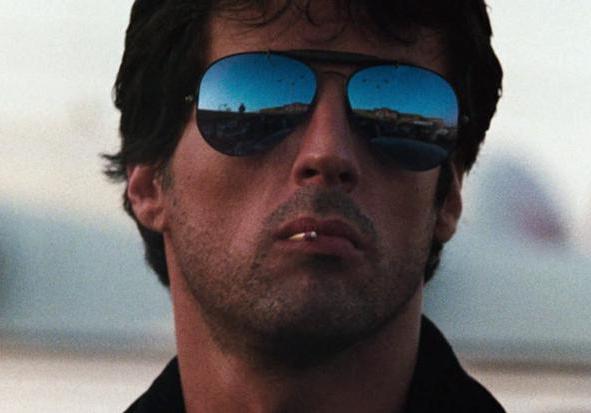 After a shooting spree in a shopping mall, police negotiations fail, so Cobretti steps in to take down the mad man. Before he dies, the gunman informs Cobretti that there is a new order in town, a neo-fascist group that is wiping out the weak in order for the strong and powerful to prevail. A series of gruesome murders occur, and after witnessing the group commit a murder, led by a hulking man listed simply as the Night Slasher (Brian Thompson), model Ingrid (Brigitte Nielsen) finds her life in danger. Faced with opposition from the suit upstairs Detective Monte (Andrew Robinson), Cobretti takes Ingrid into his protection, but with the suspicion of a police insider, Cobretti and his partner Gonzales (Reni Santoni) find themselves relentlessly pursued by the axe-wielding maniacs.


