Tuesday, 22 October 2013

Review #665: 'The 40 Year-Old Virgin' (2005)

After decades of being dragged to the cinema by our better halves to watch the latest Meg Ryan or Hugh Grant pap, it was only a matter of time until men fought back in the rom-com genre. Director Judd Apatow, along with co-writer and lead star Steve Carell, went the extra mile and actually created a rom-com that is both genuinely romantic and laugh-out-loud hilarious, but one that members of both sex can actually enjoy. But amongst all the sweetness there are four guys talking like genuine guys. So, this includes lines like "you need to put the pussy on a pedestal!" and "you know how I know you're gay? You listen to Coldplay." The language is filthy, but the script is heartfelt.

Andy Stitzer (Carell) lives a simple life alone with his collection of valuable (and still boxed) action figures and his gaming chair, working in the stockroom of an electronic store. He also rides a bike to work and never socialises, leading his co-workers to naturally assume he's a serial killer. When they find themselves a man down for a poker game, David (Paul Rudd), Jay (Romany Malco) and Cal (Seth Rogen) invite Andy. After swapping freaky sex stories, it becomes clear that Andy is in fact a 40 year-old virgin, and so they make a vow to get him laid. Amongst his options are the girl from the bookshop Beth (Elizabeth Banks), who takes a liking to Andy after he takes Cal's advice, his horny boss Paula (Jane Lynch), and the spunky Trish (Catherine Keener), a woman who's just opened a store across the street.

The thing that The 40 Year-Old Virgin achieves most is how accurately it portrays its men. Sure, these are extreme versions of people we have come across before in our lives, but men generally talk crap and half-truths to each other about women, movies and computer games. The advice that David, Jay and Cal give is hardly helpful, and is based on their own half-remembered experiences that lead to the assumption that they are the ones that truly understands women. But they are all screwed up in their own way that their advice just leads to some amusing scenes, including the most famous scene of Andy having his chest waxed (which Carell really did, and he's the hairiest comedian since Robin Williams).

The film also succeeds in its honesty and its attention to detail. Andy isn't the badly-dressed, bespectacled nerd that has been seen in the likes of She's All That (1999), that once he's given a makeover, he's a hunk. He signals when he's turning his bike on an empty street and his Monday-morning what-I-did-at-the-weekend stories involve making an egg salad sandwich. He's relatable because he's real, so his quest to get his leg over becomes something ultimately more important. The supporting cast are all excellent, especially Malco, who I'm surprised hasn't gone on to bigger things, and Keener, who is surprisingly adorable after years of playing the bitch. Like many movies churned out by the Apatow machine, it's goes on for far too long, but that's easy to forgive when the film is this funny.


Directed by: Judd Apatow
Starring: Steve Carell, Catherine Keener, Paul Rudd, Romany Malco, Seth Rogen, Elizabeth Banks, Leslie Mann, Jane Lynch
Country: USA

Rating: ****

Tom Gillespie


The 40-Year-Old Virgin (2005) on IMDb

Monday, 21 October 2013

Review #664: 'World War Z' (2013)

They use to stumble around aimlessly, flailing rotting limbs at you pathetically as you casually jogged by, or swung a baseball bat at their heads. But no more. Yes, it seems that in the 45 years of existence that zombies have had on the big screen, they've evolved from shuffling corpses to monsters who pose a real threat. Danny Boyle taught them how to run, and made them more of a virus that we can recognise than cadavers craving brains. So now, zombies have gone global. Not just in popularity, although in that regard they certainly have with the help of AMC's The Walking Dead (amongst others), but they have swept across the globe. And only Brad Pitt can save us.

After about three years in development hell, where there were more script re-writes and cast and crew shuffling about than you could keep up with, World War Z is finally here. Based on Max Brooks' multi-layered and heavily satirical novel that is told from the points of view of many different characters that reside throughout the globe, World War Z was always going to be a hard sell. Zombies are all the rage so naturally Hollywood wants to get their fat fingers on their piece of the pie, meaning World War Z was going to be a blockbuster. So, is it the giant pile of rotting brains that most fans were expecting, proving incoherent due to the many changes made throughout production? Surprisingly, no, and in fact it proves to be almost relentlessly entertaining.

After an array of obligatory news-reel footage foreshadowing the upcoming apocalypse, Gerry Lane (Pitt), a former UN employee, with his wife Karin (Mireille Enos) and two daughters are stuck in Philadelphia traffic when the zombie attacks explode on the streets. They are saved when a helicopter ordered by an old friend of Gerry's, Deputy Secretary-General Umutoni (Fana Mokoena), flies them to a U.S. Navy vessel in the Atlantic. Gerry is then persuaded to search for the source of the cure when it is made clear that he and his family will be booted off the vessel if he refuses. His journey will span the globe from South Korea to Jerusalem to, most oddly, Wales.

It's a flimsy plot to say the least. Most zombie computer games have more depth in the story, so we simply follow Gerry as he trots the globe. But where the film fails in story and character development, it makes up for in some outstanding action scenes. We are no longer in one man versus a horde of zombies mode, this is on a global scale, and when they attack, they attack in a ferocious swarm, piling on top of each other to reach massive heights and when they engage, they fling everything they can at their victim. Director Marc Forster, who proved himself inept at action in the Bond dud Quantum of Solace (2008), redeems himself somewhat with some fine set-pieces. The attack in Israel shows off some stunning CGI, but makes sure Gerry doesn't get lost in the mayhem.

Another overwhelming positive is the performance of Brad Pitt, who proves that he can carry a franchise-seeking blockbuster with ease. Even at 50, well past the age you would expect of an action star, he injects his criminally unrecognised acting talents into what is ultimately a thinly-written role, and again shows that there is more to him that simply being really really ridiculously good-looking (to quote Derek Zoolander). The supporting cast either don't get a look in or don't last long enough to make an impact, so Enos, James Badge Dale, Elyes Gabel and Matthew Fox barely register. Fox especially, after having his entire sub-plot cut down to the point that I didn't realise he was in it until the credits rolled.

The ending, which was re-wrote by Drew Goddard, reeks of indecision. The original ending, that saw a huge zombie battle in Moscow's Red Square, was canned, probably due to the political undertones of the setting, and the new, more low-key ending, was introduced to give the movie a more satisfying and coherent climax. While by no means a bad ending, for the film to start out global only to shrink to a sneaky one-on-one final note, it's somewhat of an anti-climax. It adds actors Peter Capaldi and Moritz Bleibtreu and offers some hope with a potential cure, but it just feels like everyone on board had no hope for the film. Given World War Z's commercial success, a sequel has now been greenlit (Pitt saw this as a first of a trilogy), so ultimately, the film did what it came to do. The many relatively minor quibbles aside, this is a success. But a film can surely only survive one troubled production shoot, so the people involved with the sequel will need to clear their heads and step up their game.


Directed by: Marc Forster
Starring: Brad Pitt, Mireille Enos, Daniella Kertesz, James Badge Dale, Fana Mokoena, David Morse
Country: USA/Malta

Rating: ***

Tom Gillespie


World War Z (2013) on IMDb

Tuesday, 15 October 2013

Review #663: 'Blackfish' (2013)

Anyone who has seen 2009's heartbreaking Oscar-winner The Cove will know just how ugly the reality is behind being able to enjoy marine mammals at zoo's or sealife parks. Blackfish could work almost as a sequel, as where The Cove left us with a sea of blood amidst the entrapment and capture of a group of dolphins, Blackfish shows us the life of a group of killer whales in captivity at Sea World, more than likely where most of The Cove's dolphins would have ended up. What the film has in abundance is an archive of disturbing video footage showing unprovoked attacks by orca's on experienced trainers, which is something that Sea World executives have brushed off as trainer errors.

Director Gabriela Cowperthwaite went into the film intending of making a documentary on Dawn Brancheau, the former Sea World trainer who was killed in 2010 by Sea World's most notorious orca, Tilikum. Yet what she uncovered with the help of interviews from former Sea World trainers was obviously too difficult to simply ignore. Brancheau's unfortunate death wasn't a one-off, nor was it the first time Tilikum had been responsible for the death of a trainer (it was the third), but it was the latest in a long line of deaths, mutilations and lucky escapes by orca's on both the trainers and on each other. The most unnerving of them all is the attack on Kenneth Peters, where the killer whale Kasatka drags him under water for long periods of time as if issuing a threat.

But it's not in the video footage that Blackfish retains it's power, but in the testimonies given by those who experienced it first hand. Each interviewee seems riddled with guilt that they didn't do more for the orca's, and they give tearful recollections of the signs they failed to see. Sea World declined to be interviewed for the film, and it's of no surprise. The images are so damning that there is simply nothing they can say. Trainers would naively sign up being told tales of trainer misconduct being responsible for the near-fatalities or simply hushed up to avoid bad press. It's not an easy watch, especially those with a weak-stomach for real-life moments of horror, but this is a powerful film, exposing cruelty and corporate cover-ups on an appalling scale. It seems money is worth more than basic compassion for a fellow intelligent creature.


Directed by: Gabriela Cowperthwaite
Country: USA

Rating: ****

Tom Gillespie


Blackfish (2013) on IMDb

Saturday, 12 October 2013

Review #662: 'The Departed' (2006)

I saw Hong Kong crime thriller Infernal Affairs (2002) a couple of years before Martin Scorsese's Hollywood remake The Departed. I remember little of it now, but I do remember finding it to be an ingenious idea and a gripping little movie, albeit a little overrated. Scorsese obviously saw potential in the idea, as The Departed is admittedly bloated, but packed-to-the-gills with eccentric criminals, sweary 'cwops', and CGI blood, expanding the story and characters and executed in that uber-stylish way that the director is so well known for. I'll avoid comparisons to Infernal Affairs as the two share very little in common apart from basic story, and Scorsese makes this film very much his own.

Colin Sullivan (Matt Damon) is enlisted into mob boss Frank Costello's (Jack Nicholson) crime-ring at a young age, and is raised to be an informant in the Massachusetts State Police. New police academy graduate William Costigan (Leonardo DiCaprio), a rough-and-ready type from a colourful family, is forced into going undercover in Costello's gang by Captain Queenan (Martin Sheen) and Sergeant Dignam (Mark Wahlberg). When a rat is exposed on both sides, the two must search desperately for the other before they are unwillingly revealed. Unbeknownst to the both of them, they also share a girl in psychiatrist Madolyn (Vera Farmiga). 

If you go into this film expecting a gritty and realistic urban crime thriller, you will be disappointed. Although the subject matter is grim and it certainly doesn't pull its punches when it comes to violence, this is a shiny movie with explosions of bloodshed akin to the comic-book aesthetic of manga, and asks you to suspend your beliefs for the duration. I mean, Costello is a known maniac with no fear of dispatching his own, yet Costigan becomes his right-hand man within months even though he is known to be ex-police? There are plenty of plot-holes that I could mention but won't bother, as they are there for the purpose of telling an entertaining story.

This is Scorsese as unhinged as he's been in years, letting the story just unravel regardless of just how mental it becomes. Nicholson, an actor I cannot believe had never worked with Scorsese before, gets frequently mentioned as stealing the show. He certainly steals his scenes, and grabs the opportunity to improvise with both hands, waving a severed hand in a bag around in one scene, and inexplicably covered with blood in another. Costello wouldn't last a minute in real-life, he's just too obvious and psychopathic, but in this world he thrives, and is a memorable Nicholson creation. But it's actually Wahlberg that steals the show, getting lines such as "if you had an idea of what we do, we would not be good at what we do now would we? We would be cunts. Are you calling us cunts?". It's a testament to his performance that he has probably 10 minutes of screen time and received an Oscar nomination.

DiCaprio and Damon fill their roles admirably, the former being the incarnation of anxiety and the latter proving surprisingly slimy given his history of generally wholesome characters. But its the ensemble that really shines in this array of ridiculous and cartoon characters. By the end, questions of identity and who is really important to the story get blurred with a climax of endless bloodshed. The prize of Best Picture and Best Director now seem somewhat silly, and surely a sympathy vote for Martin Scorsese who has made at least ten other movies more deserving of rewarding his talent. But this is a crazy ride, and one that remains gripping and surprising throughout, bolstered by a smart script and a hell of a cast.


Directed by: Martin Scorsese
Country: USA/Hong Kong

Rating: ****

Tom Gillespie


The Departed (2006) on IMDb

Tuesday, 8 October 2013

Review #661: 'Mud' (2012)

Similar to his excellent 2011 feature Take Shelter, writer/director Jeff Nichols delivers another exceptional slice of small-town Americana. Mud's story is small, and its characters hail from some backwood town in rural Arkansas, living on makeshift boathouses on the Mississippi River. Yet although the focus is on these small people and their ordinary existence, there seems to be something larger and grander in its execution. Take Shelter showed a man's (possible) mental deterioration as he envisioned the apocalypse. In Mud, a very grown-up tale is seen through the eyes of two 14 year old boys, and theme that runs throughout is love. Yet there's always the feeling that the fate of the eponymous Mud (Matthew McConaughey) and Juniper (Reese Witherspoon) could somehow have global consequences, and that if they are doomed then so are we all.

After hearing about a boat that lies at the top of a tree as the result of a flood, two teenage boys, Ellis (Tye Sheridan) and Neckbone (Jacob Lofland), travel to an island on the Mississippi River in a speed boat. They find the boat, but they also find Mud, a rugged drifter with a gun, who asks the boys to get him food in exchange for the boat. It becomes evident that Mud is an outlaw, but the boys stay true to their word and deliver the food. Mud tells them the story of Juniper, the woman he loves, and hands them a note to deliver to her. As the boys seek her out in her motel room, they find her being abused by a man who is the brother of a man that Mud murdered. Despite the dangers, Ellis stays loyal to Mud and carries out the tasks he is asked to do.

There is more than just a hint of Mark Twain to the story, but Mud is successful in combining a number of genres - Southern gothic, coming-of-age drama, and sometimes even your standard man-on-the-run thriller. Cinematographer Adam Stone, who worked with Nichols on Take Shelter and his debut Shotgun Stories (2007), captures the Mississippi River immaculately, portraying its mythic qualities so lyrically that you may think it was capable of washing Mud up on the shore of its empty island. The world seems both peaceful and violent, two themes so contrasting that we can only be seeing this world from the viewpoint of Ellis' naive and innocent mind.

The cast is stellar. McConaughey seems well on his way to redeeming himself for his years of service to terrible rom-coms with an impressive performance, harking back to his early appearance in the magnificent Lone Star (1996). Small roles for Sam Shepard and Michael Shannon round off an impressive cast, and Ray McKinnon and Sarah Paulson (both former Deadwood actors) inject raw emotion into their roles as Ellis' separating parents. But it was Tye Sheridan that stole the show for me, giving a performance way beyond his years as the honest and headstrong Ellis. The scene in which he is humiliated by the girl he thought was his girlfriend, the expression etched across Sheridan's face becomes something more profound than simple confusion. Although it dips into a slightly disappointing and generic shoot-out climax, Mud is a fine film, and one that reminds us what it is like to love, as ugly and unpredictable as it can be.


Directed by: Jeff Nichols
Starring: Matthew McConaughey, Tye Sheridan, Reese Witherspoon, Jacob Lofland, Sam Shepard, Ray McKinnon, Sarah Paulson, Michael Shannon
Country: USA

Rating: ****

Tom Gillespie


Mud (2012) on IMDb

Sunday, 6 October 2013

Review #660: 'Bloody Mama' (1970)

"Blood's thicker than water," explains Shelley Winters' pious and psychotic Ma Barker. Based extremely loosely on the exploits of Ma Barker and her sons, who went on a crime spree during the 1920's and was chased by J. Edgar Hoover's newly formed F.B.I., director Roger Corman reverses the familiar pre-credits text by stating 'any similarity to Kate Barker and her sons is intentional." The truth is that the real Ma Barker had very little to do with the organisation of her family's criminal activities, but Corman gives her to Shelley Winters who grabs the role and runs away with it. This is a loud, crude, violent film, about a bunch of despicable characters. But Corman does something that is rarely done and delves into the psychology of these gangsters, and, although it's hardly Freud, comes up with some interesting and uncomfortable answers.

Leaving her home and husband in Arkansas, Ma Barker and her four sons - the towering brute Herman (Don Stroud), the practical Arthur (Clint Kimbrough), the submissive, bisexual Fred (Robert Walden), and the quiet, drug-addled Lloyd (Robert De Niro) - embark on a petty crime spree on the command of Ma. Herman and Fred find themselves locked away for petty theft, and inside, Fred is dominated by the violent Kevin (Bruce Dern), who joins Ma and her boys when they are released from prison. As their notoriety grows, the family kidnap wealthy businessman Sam (Pat Hingle) and hold him for ransom. When the boys start bonding with the father figure, cracks begin to appear in the gang.

On the surface this is just a cheap exploitation film made the master of the quickie, but it has recently received some acclaim for its unorthodox portrayal of its ugly characters. There's more than a hint of incest that runs throughout the film, conveyed in Ma's hyper-sexual activity and Herman's hesitation to leave his mother's breast. It is also often quite disturbing, as the lengths that Ma will go to in order to protect her sons becomes evident as she drowns an innocent young woman who Lloyd rapes. The performances are noticeably excellent too, especially Winters, who gives Ma a vulnerability in her need to have strong men around her, and Dern, who is creepy as the alpha-male whose sexual preferences is somewhat questionable. This is one of the finest examples of Corman's skill as a director, using limited resources to create a genre film that still stands out in a crowded marketplace, never ashamed to embrace it's exploitation roots, but bold enough to dig that little bit deeper.


Directed by: Roger Corman
Starring: Shelley Winters, Don Stroud, Bruce Dern, Clint Kimbrough, Robert De Niro, Robert Walden, Pat Hingle
Country: USA

Rating: ****

Tom Gillespie


Bloody Mama (1970) on IMDb

Saturday, 5 October 2013

Review #659: 'This Is the End' (2013)

We all know the comedy formula by now - obnoxious man-child goes about his business until a life-changing event (i.e. a girl) teaches him the way of the world so that we gradually learn that he's really quite sweet after all. It's a cliché fully embraced by silver screen comedy megastars like Ben Stiller, Will Ferrell and Jack Black. Audiences, clearly comfortable with predictability, flock to see their hugely profitable films, because, as bad as their movies tend to be, they are still loveable actors. Judd Apatow and his entourage of actors - although they have made their fair share of bad movies too - seem unsatisfied with simply offering the same thing over and over again. First-time directors Evan Goldberg and Seth Rogen here give us a strange and dangerously self-indulgent end-of-the-world comedy with some of Hollywood's most famous offering themselves up for lampooning, resulting in a Marmite movie that I believe is the funniest of the year so far.

L.A.-loathing Jay Baruchel arrives at the airport to be greeted by his lifelong buddy Seth Rogen. The two go home and smoke some weed, and eventually head over to James Franco's new Hollywood mansion for an A-list party. Baruchel doesn't want to go because Jonah Hill will be there, and Jonah is apparently an arsehole. While Rogen mixes with his new Hollywood buddies, Baruchel mopes on his own and watches Craig Robinson sing 'take yo' panties off!' with Rihanna. But as Baruchel and Rogen go to the store for some munchies, beams of light suddenly start sucking people up into heaven, and the ground below them starts to open. It seems the Rapture has passed them by and the apocalypse is upon them. Holed up in Franco's mansion as demonic monsters prowl outside, they must survive starvation, Emma Watson wielding an axe, an exorcism, and most of all, an uninvited Danny McBride.

With disaster movies opening every other week these days, the vision of the apocalypse brought by Goldberg and Rogen is actually rather well done. A coked-up Michael Cera, who is previously seen receiving some oral assistance in a bathroom, is given a particularly gruesome death, while the likes of Christopher Mintz-Plasse, Jason Segel and Paul Rudd are sucked into wormholes in the ground. It would seem obvious to most normal people as to what these idiots need to do to escape their predicament, but they are far too self-absorbed to realise. It's funny how aware these actors are of their public perception, and they fully embrace it. So Rogen is ribbed for playing the same guy in every movie and is practically always seen with a joint in his mouth; Franco is the robe-wearing, art-collecting 'pretentious nerd' (as McBride labels him); Hill is subtly creepy; Robinson is just an extremely nice guy; and McBride is psychotic and selfish. Baruchel, it seems, is the only 'normal' one, completely untainted by Hollywood.

But the point here is not that Hollywood is evil or that Hollywood corrupts the soul. I don't really know what it's about, but at it's centre there is the relatable story of lifelong friends that have grown apart, but are still desperately clinging onto that special bond they share. And it is this that makes the film so engrossing. The humour is as bad taste as you would expect (at one point, Franco and McBride threaten each other with ejaculation), but it's the emotional core that dilutes all the cock jokes and gives the movie such much-needed humanity. It won't be for everybody, and some of the general strangeness will go over a lot of audience's heads. Goldberg and Rogen have clearly seen far too many movies and therefore throw everything but the kitchen sink at the film, but I found this a completely unexpected joy, and an original one at that. Although it gets a bit too ridiculous at the climax, the end note will have a big part of the audience screaming with pleasure with a cameo or five by some unexpected guests.


Directed by: Evan Goldberg, Seth Rogen
Starring: Seth Rogen, Jay Baruchel, James Franco, Jonah Hill, Craig Robinson, Danny McBride, Emma Watson, Michael Cera
Country: USA

Rating: ****

Tom Gillespie


This Is the End (2013) on IMDb

Sunday, 29 September 2013

Review #658: 'Paradise Lost 3: Purgatory' (2011)

And so, after 18 years, the story of the West Memphis Three finally reaches its conclusion. As does Joe Berlinger and Bruce Sinofsky's epic documentary trilogy. These films, as Echols confesses, were so important to their lives that without them, the judicial system would have forgotten about them and left them to rot for the rest of their lives (and until Echols' death by lethal injection). Purgatory picks the case up ten years after the second entry, Revelations, to find the case in a never-ending loop of denied appeals by original Judge David Burnett. With more evidence surfacing, the case is taken to the Arkansas Supreme Court, to argue that enough has been unearthed to warrant a new trial for Damien Echols, Jason Baldwin and Jessie Misskelley.

After spending way too much time going over what occurred in the first two documentaries (about 45 minutes - which is a massive drag if you've just watched them back-to-back), we finally get to new ground as new interviewees give statements and leading experts in their respective fields give lectures uncovering new revelations about misinterpretations and misconduct given by the original trial 'experts'. Much of the trial focused on these murders being the work of ritualistic sacrifice due to the sexual mutilations of the victims and scratches left on their persons. It turns out that these are clearly the work of animals, most probably turtles (the area where the bodies were found is nicknamed 'Turtle Hill'). It reveals poor research by the original lawyers working for the defendants, and general ineptitude by basically everyone involved back in 1993/94.

Purgatory commits the same sin as Revelations, as suspicion moves from a noticeably more subdued John Mark Byers - who is now a supporter of the West Memphis Three and pen-pal to Echols - to Terry Hobbs, stepfather of Stevie Branch. Although, accusations don't come from character alone, but instead stem from a hair found within the knot of the shoelace with which the boys were hog-tied with and some alarming inconsistencies in Hobbs' story. But (ironically), this is something for the court to pursue and not documentary film-makers. The ending, which sees the West Memphis Three released from prison but not with their innocence intact, comes out of nowhere, as filming had already wrapped when the court called the plea appeal. For a more satisfying closure to the story, I would recommend West of Memphis (2012), which gives a more detailed account of their release, and also a more focused and detailed investigation of Hobbs. Still, it's a relief to finally watch these three walk free, even though it leaves a bitter taste in the mouth.


Directed by: Joe Berlinger, Bruce Sinofsky
Starring: Damien Wayne Echols, Jason Baldwin, Jessie Misskelley
Country: USA

Rating: ***

Tom Gillespie


Paradise Lost 3: Purgatory (2011) on IMDb

Saturday, 28 September 2013

Review #657: 'Paradise Lost 2: Revelations' (2000)

After the storm kicked up by the first film, film-makers Joe Berlinger and Bruce Sinofsky returned to West Memphis four years later. Whereas the first film seemed to simply document the case in as much detail as possible and allowed you to make your own mind up, with Revelations, they seem to have their own agenda. New 'evidence' has been discovered, and perhaps the real killer still walks the streets, and it's clear who Berlinger and Sinofsky believes it to be. That crazy bastard John Mark Byers, who took so much pleasure in giving Biblical rants to camera, hardly covers himself in glory, and he's back here to build fake graves for Damien Echols, Jason Baldwin and Jessie Misskelley at the crime scene, only to set them on fire amidst his demented monologues.

It's sad that Berlinger and Sinofsky decided to take such a manipulative approach to the sequel, as although Byers is clearly an unhinged and simple-minded hick, there is no evidence against him killing the three boys (Michael Moore, Stevie Branch, and his stepson Christopher Byers) aside from the fact that he comes across as scary and strange. The first film was an intense study of mob mentality and the dangers of pre-judgement by appearance, and how the West Memphis Three managed to get themselves convicted simply for being black-wearing outcasts. So Revelations comes across is hypocritical.

When new evidence is presented, suggesting teeth marks on the head of one of the victims, tests prove that none of the WM3's teeth match. When Byers is confronted, he reveals that he had his teeth removed but keeps changing his story as to when this took place. He is repeatedly confronted by a support group that help fund and promote the case against the WM3, but they come across as equally strange as Byers, following Echols like groupies as if he was some kind of prophet, and they berate Byers into handing in his dental records voluntarily to prove himself innocent. Byers refuses, stating that there is no case against him, and this is shown in the film as if an admittance of guilt. The film-makers never take any time to explain the reasoning behind Byers' behaviour, clearly convinced of his guilt.

In the end, it's a case of there being too little here to warrant a two hour-plus movie. The new evidence is flimsy to say the least, and as revealed in West of Memphis (2012), is probably completely wrong. Yet when the film gets back down to cold facts, it becomes as riveting as the first film, unveiling a justice system that seems unwilling to open the doors to the possibility that they simply got it wrong. It's just a shame that too much time is spent on a personal witch-hunt, and even when Byers passes a voluntary lie-detector test, the film suggests that Byers was on so much prescription medication that the results of this cannot really stand up, yet fails to ask to conductor of the test of his views regarding this. It's certainly a confused film, and one that works best when it stays on topic and documents the facts rather than revelling in propagandistic speculation.


Directed by: Joe Berlinger, Bruce Sinofsky
Starring: Damien Wayne Echols, Jason Baldwin, Jessie Misskelley, John Mark Byers
Country: USA

Rating: ***

Tom Gillespie


Paradise Lost 2: Revelations (2000) on IMDb

Wednesday, 25 September 2013

Review #656: 'Paradise Lost: The Child Murders at Robin Hood Hills' (1996)

With the recent release of the closing chapter to the trilogy, Paradise Lost: Purgatory (2011), and the Peter Jackson-funded West of Memphis (2012), it seemed a perfect time to re-visit the original HBO documentary that focused on the original trial of the accused now known as the West Memphis Three. Knowing now that they have only recently been released in 2011, the first thing that shocked me about the first film was realising it was made way back in 1996, and the trial was back in 1993. I was 8 in 1993, and I cannot imagine the torment that Damien Echols, Jason Baldwin and Jessie Misskelley, Jr. went through, spending almost twenty years in prison for a crime they did not commit. Paradise Lost is still as utterly sickening as it was when I first viewed it over five years ago.

The question here is not if these three were innocent of this hideous crime - you can make your own mind up about that - but it is how can three teenage boys be sentenced to life in prison (and the death penalty for Echols) with not a shred of evidence against them? The irony is that these murders were believed to be the work of satanic sacrifice, but the West Memphis Three were condemned to a modern day witch-hunt by ignorant townsfolk terrified of them because they wore black and refused to blend in with the dungaree-wearing hicks in their dirt-poor neighbourhood. It seemed like everyone was against them, eager to lay the blame on something they simply did not understand. Judge David Burnett highlighted the need for evidence of a motive, so the answer was to get 'expert' testimony from a man with a mail-order PhD in the occult. When his lack of qualifications is highlighted by the attorney representing Echols, this is dismissed without a second thought.

Film-makers Joe Berlinger and Bruce Sinofsky were granted unlimited access to the entire trial, so as a documentary, it is incredibly detailed. After the uproar this film caused, this access was quickly denied for the sequel, no doubt they were terrified that more shameful misconduct would be unearthed. Interviewers are given by the parents of the accused and of the three murdered boys (Christopher Byers, Michael Moore and Stevie Branch), and their emotion is laid out raw. Special attention is given to John Mark Byers, stepfather to Christopher, who handed the film-makers a hunting knife stained with blood as a present, which was quickly handed over to the authorities. Byers is a strange and often terrifying character, pumping bullets into a target and stating his wishes that he could do the same to the three boys on trial. It is easy to find yourself thinking that he must be the real killer, but as the trilogy of films progress, I learned that appearances can be deceiving, and that I was guilty of the exact same thing that led to the imprisonment of the West Memphis Three.

This is powerful stuff, provoking more emotion than probably any other film I have ever seen. The atmosphere is extremely gloomy, right from the get-go when we see crime scene footage of the young boys hardened corpses lying naked in the woods. It certainly doesn't pull its punches, and Metallica's magnificent soundtrack, the first time they have ever allowed their music to be used in film, only adds to this. But ultimately, it's the story itself that proves to be the most powerful aspect. They were guilty from the moment they came to court - these sullen kids with their black clothes and long hair. Individuality doesn't go down well in the Bible Belt, it would seem. As each heavily flawed accusation flies at Echols, Baldwin and Misskelley, you must simply watch and grit your teeth. This is a truly terrifying story and also one full of tragedy, both for the young boys who were murdered and for the three that were the fall guys swept up by an almost neo-Nazi institution.


Directed by: Joe Berlinger, Bruce Sinofsky
Starring: Damien Wayne Echols, Jason Baldwin, Jessie Misskelley, John Mark Byers
Country: USA

Rating: *****

Tom Gillespie


Paradise Lost: The Child Murders at Robin Hood Hills (1996) on IMDb

Wednesday, 18 September 2013

Review #655: 'Time Bandits' (1981)

If you were once a young boy (or girl) who enjoyed riding their bike at breakneck speed or got their thrills from wandering off to places you were forbidden to go to, then you will totally get Terry Gilliam's Time Bandits. If adventure and danger were what spurred you on as a child, then you no doubt fantasised about travelling through time and meeting the famous historical figures you learned about whilst falling asleep in history class. Time Bandits is pure Boys Own adventure, making idiots out of the likes of Robin Hood and Napoleon, and even bringing six dwarves along for the ride. The plot is muddled and nonsensical, but the plot is beside the point - arguably just a McGuffin for some childish fun.

It tells the story of eleven year old Kevin (Craig Warnock), who, when not being ignored by his lazy absent-minded parents, spends his time doting on history, particularly Ancient Greece. One night, six dwarves come crashing out of his wardrobe holding a map that they claim show the world's time portals, that they appear to have stolen from the Supreme Being (i.e. God, played at the climax by the wonderful Ralph Richardson). Kevin goes along for the ride, and finds himself meeting Napoleon (Ian Holm) during the Napoleonic Wars, Robin Hood (John Cleese) in the Middle Ages, and King Agamenmon (Sean Connery) in Ancient Greece (amongst others). Meanwhile, in the Fortress of Ultimate Darkness, the technologically obsessed Evil (David Warner) is planning to steal the map and take over the world.

The set design is fantastic in this film, and the main credit should go to that department. The sets look as if constructed from the mind of a child, paying no real attention to historical detail or a 'lived-in' feel - this is all pure fantasy. The film rushes at such a breakneck speed that we don't get to spend enough time with these characters in their times, and this was my main (and only) problem with Time Bandits. Thankfully, these scenes are packed with so much wit by writers Gilliam and Michael Palin (who also appears as the dim-witted romantic Vincent), that it is hard to care too much. This is not Monty Python though, there is humour here for children and adults both, but it's just as funny. John Cleese's over-enthusiastic Robin Hood was a particular stand-out for me.

Gilliam also uses the film to take some sly satirical digs at the emergence of technology, juxtaposing Evil's plan to use computers to carry out his evil deeds alongside Kevin's active imagination and sense of wonder. His parents are bone-idle idiots that get excited at the idea of a microwave cooking their dinner in quick time, and technology is clearly viewed by Gilliam as something that will rot the imagination. This isn't entirely true of course - technology can inspire innovation - but I often see young children staring open mouthed and expressionless at their mobile phones when they should be annoying their parents or getting up to something they shouldn't be, so I can certainly sympathise with Gilliam's concerns. But Time Bandits is mainly about adventure and the wonder of a child's imagination. Funny, manic, and occasionally moving, this is one of the definitive movies about childhood, and how we occasionally long for it.


Directed by: Terry Gilliam
Starring: Craig Warnock, John Cleese, Sean Connery, Shelley Duvall, Katherine Helmond, Ian Holm, Michael Palin, Ralph Richardson, Peter Vaughan, David Warner
Country: UK

Rating: ****

Tom Gillespie


Time Bandits (1981) on IMDb

Saturday, 14 September 2013

Review #654: 'The Astro-Zombies' (1968)

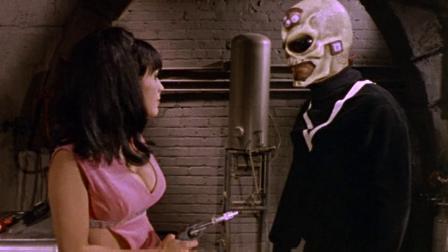
The Astro-Zombies is one of those Z-grade efforts where you can tell the producers had a bunch of props and sets left over from previous productions and wrote a script based around them. Therefore, the film makes absolutely no sense, and ends up throwing everything but the kitchen sink at the audience. We are left with a story involving mad scientist Dr. DeMarco (John Carradine) and his hunchback lab assistant who are attempting to create an army of 'astro zombies', superhuman beings whose actual purpose is sketchy. After one is loosed and goes on a killing spree, the CIA (led by a clearly sozzled Wendell Corey, who died due to his alcoholism shortly after filming) and a spy ring led by the great Tura Satana become interested.

It's easy to label a film 'the worst film ever!', but The Astro Zombies, directed by schlock favourite Ted V. Mikels, truly lives up to its reputation. Carradine, bless him, makes a valiant attempt to make some kind of sense of the plot with some muffled monologues, but I got completely lost in all the drivel. There is the odd moment of camp weirdness such as the wounded astro zombie fleeing with a torch pressed against his head to keep itself alive or a naked exotic dance that serves absolutely no purpose, but it constantly lingers on endless laboratory scenes where literally nothing happens. The zombies themselves are nothing more than a man in a kind of insect/skull/mutant mask, and there's only really one of them. It's a truly painful experience that lacks the amusing moments of Mikels' other 'works' such as The Corpse Grinders (1971) and The Doll Squad (1973), that at least made those films bearable. Truly painful stuff that could benefit from a good thirty minutes shaved off the running time.


Directed by: Ted V. Mikels
Starring: Wendell Corey, John Carradine, Tom Pace, Tura Satana
Country: USA

Rating: *

Tom Gillespie


The Astro-Zombies (1968) on IMDb

Monday, 9 September 2013

Review #653: 'Star Trek Into Darkness' (2013)

After having to wait a surprising amount of time for the sequel - given the success of its predecessor - Star Trek Into Darkness has a lot to live up to. The 'original' did the remarkable job of bringing a fresh audience to what was thought of (by non-Trekkies) as cheesy sci-fi with bad sets and dodgy haircuts. The franchise had been brought back from the dead, opting for less philosophising and more wallop for your money, which although pissing a few Trekkies off, kept most viewers at least relatively satisfied. So after finding a way to be able to re-tell the story of the Starship Enterprise without having to re-write 'history', returning director J.J. Abrams found himself with an entire universe to explore. Which makes it very strange that Abrams and his frequent collaborators have chosen not to give us something entirely new, and instead chosen to touch the untouchable - "KHAAAAAAANNNNNNNN!".

Having made his natural progression from the academy to the captain's chair, Jim Kirk (Chris Pine) and his conflicted friend Spock (Zachary Quinto) begin the film by saving a planet from destruction. Though this is seen as a valiant act in his own eyes, Kirk is reprimanded by Captain Pike (Bruce Greenwood) for knowingly disobeying Starfleet orders. Kirk agrees to a demotion and to become Pike's second-in-command, and they are briefed about a terrorist named John Harrison (Benedict Cumberbatch), who has just blown up a Starfleet installation in London. But after the meeting of the Starfleet commanders is also attacked, Kirk is reinstated by Admiral Marcus (Peter Weller), who gives Kirk the Enterprise back and a mission to take out Harrison.

Many of the problems that lay with the first film are back again. Abrams often heaps on too much comedy in a bid to keep the audience entertained, sometimes much to the suffering of some of the film's supporting characters. Much of the supporting crew are reduced to a set-piece here or a funny line there, with Uhura (Zoe Saldana) and Sulu (John Cho) suffering most this time. The story is still focused on the growing relationship between Kirk and Spock, who after many misunderstandings last time around, seem well on their path to the great friendship that will be. Newcomer Carol (Alice Eve) does little more that get her kit off in one pointless and much criticised scene, but, unless you're a die-hard Trekkie, you should be too enthralled to care much about it, as Abrams delivers one breathless set-piece after another, backed by some excellent CGI work.

The plot often gets unnecessarily convoluted given the relatively basic plot, and there are plot holes a-plenty if you enjoy picking at them. Yet Cumberbatch's excellent performance as the refreshingly multi-dimensional bad guy is the much-needed 'darkness' from the title, and Abrams really pushes the boundaries of the 12A certificate (if you're from the UK). It's been called the worst Star Trek movie ever made by Trekkies, which seems utterly ridiculous to me. It treads much of the same ground as the beloved Star Trek II: The Wrath of Khan (1982), but I believe this was an attempt to bond with the hardcore fans, although I feel The Wrath of Khan is grossly overrated. The re-boot doesn't subvert Star Trek, it simply takes it in another direction, which was the whole point of the exercise. Personally, I'll still be tracking this franchise with wide-eyed curiosity, as Abrams boldly takes us where... well, you get the point.


Directed by: J.J. Abrams
Starring: Chris Pine, Zachary Quinto, Benedict Cumberbatch, Zoe Saldana, Karl Urban, Simon Pegg, Peter Weller, John Cho, Anton Yelchin, Bruce Greenwood
Country: USA

Rating: ****

Tom Gillespie


Star Trek Into Darkness (2013) on IMDb

Tuesday, 3 September 2013

Review #652: 'The Killer Inside Me' (2010)

The Killer Inside Me, a brutally violent neo-noir from British director Michael Winterbottom, raised hell at Sundance, sending audiences into frenzies of disbelief and light-headedness. Of course, as usual with premature festival outrage, the film is really not as appalling as the uproar would have led you to believe. There is one truly sickening scene - as gut-wrenching as any burst of violence I've seen on screen - but, the real tragedy is that this insistence on portraying it so graphically actually takes the focus away from what is a very stylish, if tonally uneven, pulp thriller. Although Winterbottom has juggled genres and styles with relative ease in his previous work, mainly to positive results, perhaps his inexperience with tackling a project so deeply rooted in Americana leads to the film's downfall.

Small-town deputy sheriff Lou Ford (Casey Affleck) is sent to warn off prostitute Joyce (Jessica Alba), who is having a dangerous affair with the son of construction tycoon Chester Conway (Ned Beatty). After realising they have the same violent sexual tastes, they begin a love affair and devise a plan to extort $10,000 from Conway, as Lou believes Conway to be responsible for the death of his brother. Unbeknownst to Joyce, Lou, despite his pleasant demeanour, is a violent sociopath, and after Lou beats Joyce to death with his bare hands and runs with the money, county attorney Howard Hendricks (Simon Baker) is called in to investigate. So Lou is forced to cover his tracks while he dotes on his fiancee Amy (Kate Hudson).

Pulp writer Jim Thompson was possibly the grimmest writer of his ilk, and The Killer Inside Me is widely thought of as his best work. I have not read the novel, so I am unaware as to how Lou Ford is written, but here he is a blank but undeniably fascinating character. He is a character that always seems in control, even when he seems surprised at just what he is capable of. Yet for someone seemingly so clinical at killing, he's not very good at it. His extortion plan is full of holes that could lead back to him, and it doesn't take long for Hendricks to figure him out. Often a glance or a word will make you wonder if he even understands himself or anything he is doing. Casey Affleck is a fine actor, and his Lou Ford is intimidating. Even though he's slightly built and his voice is a high-pitched drawl, he is a scary character to spend 90 minutes with, and he even surpasses his performance in The Assassination of Jessie James By the Coward Robert Ford (2007), of which I felt he was robbed of an Oscar.

Winterbottom wisely steers away from any psychological analysing of Ford, only hinting at childhood abuse (but not the way you would think), and glimpses of his intellect. Instead it makes you ponder this hideous character, and stay with him (but not necessarily root for) throughout the duration of the film. But it's Winterbottom's approach that is the problem here, blending a mixture of styles that causes the film to seem contrasting and haphazard. There are moments of pure noir - headlights approaching in the dust, characters sat in empty diners, cynical narration - and these scenes are at ease with the sleaze of the film's focus, but often it will kick in with some banjos at inappropriate moments that caused me to wonder whether I should be taking the film seriously. When it does take itself seriously, it's often inspired, but the final scene is so badly handled that I did wonder if a different director with more experience in the field would have made a much better film.


Directed by: Michael Winterbottom
Starring: Casey Affleck, Kate Hudson, Jessica Alba, Ned Beatty, Elias Koteas, Tom Bower, Simon Baker, Bill Pullman
Country: USA/Sweden/UK/Canada

Rating: ***

Tom Gillespie


The Killer Inside Me (2010) on IMDb

Sunday, 1 September 2013

Review #651: 'The Right Stuff' (1983)

"Is that a man?" asks the pilot of a rescue plane headed towards the crash site of Chuck Yeager's attempt to reach the edge of space in a Lockheed NF-104A. An outline of a man appears on the horizon, blurred by heat and mirage, his face bloody and burned, walking at pace with his helmet in his hand. Yeager's good friend Jack Ridley sits in the passenger seat, having seen Yeager conquer several near-suicidal flight records, including the first to break the sound barrier. Ridley smiles. "You're damn right it is!". The Right Stuff, adapted from Tom Wolfe's best-selling account of the test-pilots in the Mercury Space Program, shows what it takes to be a man; to have the 'right stuff' inhabited by these fearless men, who were the only ones crazy enough to risk everything, on live TV, to beat the Russians in the space race.

Besides the many fascinating and frequently hilarious vignettes involving the test pilots - played by a stellar cast of Dennis Quaid, Ed Harris, Fred Ward, Charles Frank, Lance Henriksen, Scott Glenn and Scott Paulin - the movie's real ace-in-the-hole is the juxtaposition of this story with that of Chuck Yeager (Sam Shepard), a man thought of by his peers to be the finest pilot in the world. Played stoically by an Oscar-nominated Sam Shepard, he is brooding, dusty, a true man's man, but without the college degree needed to join the space program. He is the polar opposite of the 'hot dog's' of the Mercury Program, and when he is not off chasing his wild wife Glennis (Barbara Hershey), he is making sure he is still the fastest man in the world.

Even at over 3 hours, the movie is packed with great and memorable scenes. Director Philip Kaufman managed to retain Wolfe's skill for absurd humour, so we get to see the President crawling on the floor to plug in a projector, two astronauts' slow walk to the bathroom following an enema, and a hilarious moment involving humming and sperm samples. It has an observational aesthetic that America conquered in the 1970's, made even better by some amazing aviation and space travel scenes, easily more exciting than the CGI-laden movies we get nowadays. It's often called the second-best movie of the 1980's behind Raging Bull (1980), and, although I don't necessarily agree with that statement (Blue Velvet (1986), anyone?), it's one of the finest movies to come out of it's era, feeling almost classical despite being modern. Like Shepard's Chuck Yeager, The Right Stuff seems old before its time, encompassing wisdom and poignancy with ease.


Directed by: Philip Kaufman
Starring: Sam Shepard, Scott Glenn, Ed Harris, Dennis Quaid, Fred Ward, Barbara Hershey, Kim Stanley, Veronica Cartwright, Scott Paulin, Lance Henriksen
Country: USA

Rating: *****

Tom Gillespie


The Right Stuff (1983) on IMDb

LinkWithin

Related Posts Plugin for WordPress, Blogger...