Of all the crazy films Cannon Films put out there between their emergence in 1967 to their demise in 1993, I doubt any are quite as out-there as Lifeforce, Tobe Hooper's half space-opera, half end-of-the-world thriller. Although it's far from his best film, Hooper clearly had big visions for Lifeforce and, with some confidant support from the film's producers, it looks visually impressive. Starting out as essentially an Alien (1979) rip-off (didn't they all around this era?), the film moves on to vampire movie, action movie, zombie movie and then disaster movie. It's an insane trip, but, if you can forgive its many, many flaws, this is actually a lot of fun.
The crew of space shuttle Churchill locate an alien craft inside the corona of Halley's Comet, and inside they find hundreds of dead alien bodies, as well as three humanoids, suspended and frozen inside glass pods. On their return journey, all contact is lost with mission control. The rescue mission find the entire crew dead from a fire, but the humanoids intact. The aliens are taken back to a research centre in London, watched over by Dr. Fallada (Frank Finlay). While there, the female alien awakens and sucks the 'life force' out of a guard, turning him into a shrivelled zombie. She escapes, and S.A.S. operative Col. Caine (Peter Firth) and Col. Carlsen (Steve Railsback) - whose escape pod from Churchill is found in Texas - start trying to track down the mysterious alien vampire.
If the movie has one trump card, it is in the form of Mathilda May, who plays the female vampire. She is a woman of such staggering beauty that you can understand Carlsen's relentless pursuit of her, and the storyline that she has placed a kind of a love spell on him seems that little bit less ridiculous. Special mention must also go to John Dykstra (winner of the Academy Award for Star Wars (1977)), whose special-effects are still impressive to this day. The problems are that the plot is too convoluted, the acting is awkward, and Tobe Hooper over-reaches himself. It seems like his vision was so big, that he forgot to make it small enough to fit into 116 minutes and make a coherent movie. Still, it's a million times better than most sci-fi B-pictures of its era, and if you let it simply wash over you, Lifeforce is a bonkers hoot.
Ginger Baker, that fire-haired, heroin-addicted, mentally unstable drummer of Cream and Blind Faith fame, is given a much deserved documentary here at the hands of Rolling Stone journalist Jay Bulger. For all his notorious genius - the guy single-handedly invented the drum solo and heavy metal owes a significant debt - the man is repulsively anti-social and, well, mad. We learn this from the opening scene, as Baker yells at Bulger, who is off-camera, that he doesn't want his friends and colleagues interviewed for the film, while Bulger protests. Cue a pause, then Baker stabs at Bulger with his cane, leaving the film-maker with a bloodied nose.
For the rest of the film, Baker is somewhat subdued, slumped in his reclining chair, never without a cigarette and his sunglasses, giving a reluctant commentary on his life and his career. It is Baker's discomfort at being an interviewee that slightly damages the film, as we never really get beneath those red locks and mad eyes of his to the soul (or lack of) beneath. So, Beware of Mr. Baker (the title comes from a warning sign outside Baker's South African ranch), becomes a mere birth-to-present biography of his career. It's still fascinating stuff, and Bulger has unearthed some excellent archive footage and photographs.
His colleague and family provide the more personal information on Baker, such as his estranged son, who recollects that he was briefly happy with his father, even drumming alongside him on-stage, before Baker verbally attacked him and sent him on his way. Baker, in simple terms, is a horrible man, but (as the annoying sell-out Johnny Rotten tells us), he is the type of man that true genius often produces. His affection for polo and heroin are not explored enough, and the real focus here is the music. The footage shown is outstanding, ranging from his superstar-creating time with Cream through to some mind-bending footage of drumming 'battles' with his peers and heroes. Yet Baker himself still remains a mystery, and perhaps it should stay that way.
There has always been a clear distinction between director Guillermo del Toro's art-house Mexican productions and his more audience-pandering Hollywood movies. Not just in quality, but also in tone. His native efforts have produced the haunting The Devil's Backbone (2001) and his masterpiece Pan's Labyrinth (2006), which both leaned towards the director's love of fantasy and folklore as well as meditations on war and childhood. Pacific Rim, his latest big-budget Hollywood production (following cancellations and delays on his work on The Hobbit and At the Mountains of Madness) is probably his most 'Hollywoody' to date. It's big, loud, stupid, but also quite fun, with del Toro harking back to his childhood days watching Japanese kaiju movies.
Earth is under attack from giant monsters dubbed as 'kaiju', who rise out of the Pacific Ocean from a portal to devastate anything in their path. Humanity fared well in their war against this new threat, building giant robots named 'Jaegers' to battle the kaiju's, until the attacks became more frequent, and the monsters larger and deadlier. The Jaeger's need to be powered by two pilots - one to represent the left side of the brain and the other the right. But the pilots are also required to be 'drift compatible', as once in the 'drift', they share each other memories, instincts and pain. We first meet ace pilot Raleigh (Charlie Hunnam) battling a kaiju with his brother. His brother is killed, and Raleigh is washed up on shore and helps in the construction of a giant wall to keep the creatures out.
Four years later, and the Jaeger programme is being shut down. Stacker Pentecost (Idris Elba), the commander of the Jaeger's, takes the programme underground. He persuades Raleigh to re-join the programme, and introduces him to Mako (Rinko Kikuchi), a beautiful woman who clearly shares a link to Stacker. Also working on the programme are comic relief characters Dr. Geiszler (Charlie Day) and Gottlieb (Burn Gorman), two bickering scientists who are studying the kaiju and their emergence in different ways. Raleigh demands to be teamed up with Mako, who he is clearly drift compatible with, and the two must learn to work together before the final assault.
It's a lot of plot to take in, but this has a hefty 131 minutes to explore it in. Del Toro manages to create a lot of back-story that is crammed in to the twenty minute prologue, but it's all a lot of twaddle to give the movie a reason to stage some gargantuan action scenes. With a movie like this, you come to see the action. We want to see giant robots smash the shit out of giant monsters, and del Toro certainly delivers on that front. There's no elegance in the fighting; they just pummel each other with giant fists and, every now and then, some acid and giant saws. Cities are devastated, thousands are (presumably) killed and tourist sites are made out of the results. The CGI is frankly astonishing, and watched in high definition especially, the film looks beautiful.
Yet as much genuine heart del Toro puts into the action scenes, he fails wholeheartedly in the moments in between. There is no character development and no original plot devices, just another messiah story with a heavy section in the middle dedicated to the preparation for the moment everyone is waiting for. This is as soulless as they come, and although its easy to say that the lack of plot and character is expected of a film like this, the movie doesn't have any star power to add any charisma to the proceedings. Independence Day (1996), as much as I detest the film, at least had Will Smith to keep us amused between the sickening lashings of cheddar, and Armageddon (1998) had Bruce Willis. Pacific Rim has Idris Elba, who certainly tries his best with his Henry V speeches and dashing suits, but he's second fiddle to Charlie Hunnam, who just doesn't cut the mustard.
There's also the distraction of Day and Gorman, who are undoubtedly the most annoying and unfunny comic-relief double-act since those twin racial stereotypes in Transformers: Revenge of the Fallen (2009). The reason for their existence points to giving del Toro's favourite actor Ron Perlman a reason to be in the film, and although Perlman's presence is always welcome, his sub-plot proves to be a distraction to the central storyline. Perhaps del Toro simply needed to make a movie after a few years of delayed and failed projects, so a little self-indulgence can certainly be forgiven, especially if the results are as entertaining as this. But it just begs the question of why del Toro doesn't put the same heart into his mainstream movies as he does his arthouse films.
Jonah Hex is a project that seemed doomed from the start. It has all the ingredients for a great movie - a too-cool-to-be-true premise, an extraordinary cast, a rarely seen (in the comic book universe) Wild West setting, and a cult following thanks to DC Comics' graphic novels. But if you look at other movies of its kind - Constantine (2005), Ghost Rider (2007) etc. - it was never going to work. The studio system or just plain bad writing always seems to get in the way. And Jonah Hex is quite possibly the most terrible of them all. Josh Brolin snarls and grunts his way through a solid performance, but he does not manage to save this absolute mess of a movie.
Jonah Hex served as a Confederate solider during the American Civil War. We learn through a fast-tracking prologue that shortly after the war, the evil Quentin Turnbull (John Malkovich) murdered Jonah's entire family, and branded his face with a terrible wound that leaves him disfigured. He is left for dead but nursed back to health by some native Americans, that somehow leave him with the ability to talk to the dead. Believing Turnbull burned to a crisp in a hotel fire, Jonah turns to bounty hunting to earn his living, proving highly efficient at the job. But when Turnbull re-emerges with his mad Irish cronie Burke (Michael Fassbender) and the threat of a terrorist attack, President Grant (Aidan Quinn) hires Jonah to take him out and save the day.
After the quick-fire introduction that zips through Jonah Hex's backstory so fast that you simply cannot care about him, we are introduced to the familiar hooker-with-a-heart Lilah (Megan Fox), who is inexplicably in love with Jonah. They share one scene together with no hint as to why these two characters even like each other (although I'm sure I know why Jonah enjoys visiting Lilah), and are not reunited until the climax when we are expected to give a damn about these two making it through the explosions and gunfire. Writers Brian Taylor and Mark Neveldine (who like to refer to themselves as simply Taylor/Neveldine - oh, please) don't seem to have heard of character-building or pacing, but when you look at their back catalogue then this can hardly be a surprise.
The most depressing thing is that the actors do their best and are largely successful with their cardboard characters, which makes it even more confusing as to how this was screwed up so badly. Nothing is explained properly - how did Turnbull escape the fire that apparently killed him/why do we only see Jonah revive the dead twice/why is Turnbull so pissed at the government? - and the fact that we are simply expected to accept this is offensive. I know, I know, this is a comic-book movie, but the action is so dull and ridiculous (dynamite guns!) that the aspect that we expect to be at least not bad is not there in order for us to forgive its many flaws. If there's one good thing to say about the film, it's that Jonah Hex's prosthetics are good, but the fact that I'm praising the make-up department shows how badly I'm clutching at straws.
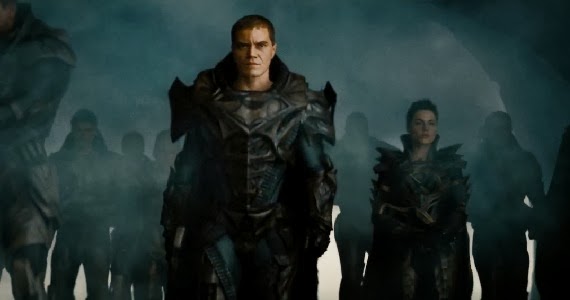
Dumping the light tone of the original Richard Donner Superman films (1978/1980) and their ridiculous sequels, as well as Bryan Singer's failed reboot, Zack Snyder's Man of Steel adopts the Christopher Nolan approach. With Nolan as producer and co-writer, this is Clark Kent seen through the eyes of a steely, saturated lens, with Henry Cavill's somewhat stoic and monotone Superman battling inner demons as well as General Zod (Michael Shannon). It's a typically long, convoluted modern blockbuster, but Man of Steel prevails thanks to some surprisingly dedicated focus by Snyder, who abandons the slo-then-fast-mo stylings of 300 (2006) and Sucker Punch (2011) for something much more grown-up.
The movie begins on Krypton, where Jar-El (Russell Crowe), delighted with the planet's first natural birth in centuries in his son Kal-El, pleads with the leaders to help save the planet from inevitable destruction. Enter the usurping Zod, who is leading a coup to overthrow the leaders and re-establish Krypton as a real power. Zod is furious at the birth of Kal-El aka Clark Kent, but Jar-El manages to blast his son off into space towards Earth before Zod overpowers him. Cut forward some years and Kent is working on a fishing vessel, at ease with his powers. When the military discover an alien craft in the Arctic, Kent infiltrates the mission and discovers his origins from the preserved conscience of his father. Meanwhile, Zod is approaching Earth with plans to use the planet to re-create Krypton.
It's clear from the off that this is no regular superhero origin film. Snyder manages to somehow bring a grounded realism to Krypton - giant human-carrying dragonflies and all. We then skip Kent's entire upbringing to witness his natural inclinations for good as he saves some oil rig workers from certain death, displaying the powers he is now at ease with. Through some beautifully realised and melancholy flashback scenes that evoke the style of Terence Malick, Kent's parents (played by Kevin Costner and Diane Lane), gradually teach him that he is different and has a much greater purpose than he could imagine. Costner is superb in these moments, bringing an old-hand, gravel-voiced weight that I have never seen from him before. Similar to Snyder's Watchmen (2009), these flashbacks are peppered throughout the film, yet don't damage the flow of the central story.
Where the film fails is in the action-heavy climax that lasts for pretty much the entire final hour. Zod and his cronies battle Superman and smash each other to a pulp. It's very similar to the climax of Thor (2011), that also had impossibly strong super-beings battle ten tons of shit out of each other because, well, what else can they do? Buildings collapse, explosions litter the screen, but there's very little tension. It switches the action between Superman and the Daily Planet, where Laurence Fishburne's Perry White serves no purpose other than to save some people from falling rubble. Perhaps it's setting the scene for future instalments, but they seem rather intrusive here.
The same could also be said about Amy Adams' Lois Lane, who is a spunky, determined character diminished to a simple love interest for Kent without any real chemistry. Of course she's important to the Superman universe, but there is no real dimension to her persona. Michael Shannon, however, is reliably excellent in his role, and his Zod incarnation is by far the most interesting thing about the film. He's a sympathetic bad guy akin to Tom Hiddleston's Loki, to the point where you can fully understand his reasoning. The man plans on genocide, but this was the role he was raised to play, and his determination to re-establish his race is certainly understandable. You can even see that Superman knows this, but he always knows that he must destroy him, whatever the odds.
Overall I was extremely impressed by Man of Steel, and its flaws can certainly be forgiven. This is a mature movie with underlying themes. Superman is God, an indestructible force (to us mere humans) that possesses too much power to be at ease with, even when he assures them that they are on the same side. The religious metaphors are embarrassingly obvious at times, but it's a thought-provoking sub-theme and a nice alternative to the crash-bang-wallop of the action scenes. Although it's not up to the ridiculously high standards set by Christopher Nolan, this can sit nicely alongside his Dark Knight trilogy (2005-2012) in the re-imagining of DC's universe.
It's hard to believe that just three years before Roger Corman would begin his Edgar Allen Poe cycle of films that would bring him international acclaim, he made this - a dirt-cheap black-and-white radiation movie about giant crabs who can communicate telepathically with humans (yes, you read that right). Charles B. Griffin (who also worked with Corman on B-movie classics It Conquered the World (1956), Not of This Earth (1957) and A Bucket of Blood (1959)) is on writing duties, and he delivers a humour-laden script that is well aware of just how ridiculous it is.
After the Bikini Atoll nuclear tests, a group of scientists are sent to a remote island to investigate the disappearance of a former party and further there research into the effects of nuclear testing on plants and wildlife. It soon becomes apparent that giant mutated crabs are responsible and have eaten the scientists that were there previously and have absorbed their minds. With the island collapsing before their eyes and with one of their group missing, they must destroy the crabs and escape.
Corman manages to make the film just about as entertaining as it can be, given the budget limitations and the bunch of cornball actors (apart from Russell Johnson of Gilligan's Island fame). It runs at just 62 minutes, and every scene is filled with 'suspense' or 'action', two aspects that Corman usually demanded ran constantly throughout his movies. The crabs themselves look ridiculous and actually move forward - oh the horror! - rather than sideways, but watching crap actors getting hit over the head with a giant paper mache claw never gets old. Certainly an amusing way to pass an hour.
The greatest thing about the Marx Brothers was the diversity of their comedy. Groucho was ultimately a master of the one-liners, Chico alluded to ethnic stereotypes that were popular during his days doing vaudeville, and Harpo was the clown, pulling sight gags from every pocket he had in that huge overcoat he wore. Animal Crackers, their second film as The Marx Brothers, allows them free reign to indulge in their manic brand of comedy due to an absence of plot. What is immediately apparent upon viewing the film is just how postmodern it is. Groucho laments his inner thoughts to camera and a statue shoots back at a startled Harpo, all combining to make one truly insane 95 minutes, made all the more risqué with this being before the introduction of the Hays Code.
Famour explorer Captain James T. Spaulding (Groucho) arrives at a house party hosted by the upper-class Mrs. Rittenhouse (Margaret Dumont). Whilst there, he manages to swindle, insult and charm the various guests who are in attendance, namely Roscoe Chandler (Louis Sorin), an art collector who has brought one his most prized paintings to display to the guests. Also there is musician Signor Ravelli (Chico) and his mad sidekick The Professor (Harpo), who are harbouring a plan to steal the painting and replace it with a forgery. Unfortunately for them, there are others who wish to pull off the same trick for different reasons.
While the songs are nice and catchy (Groucho's intro song "Hooray for Captain Spaulding" was used in TV quiz show You Bet Your Life, which Groucho hosted), the technical aspects suffer the same way as many films did with the sudden introduction of sound. The screen is crammed with characters, much like a play would be, and this sense of disorganisation takes a little away from the film.
But it is all about the comedy after all, and here all three of the brothers are on top form, with Groucho providing the killer lines "one day I shot an elephant in my pajamas. How he got in my pajamas, I don't know" and "we took some pictures of the native girls, but they weren't developed. But we're going back again in a couple of weeks!" (Zeppo also appears, but only briefly). When the plot becomes too ridiculous or the action moves away from the Marx Brothers, stick around for another 30 seconds and they'll be something else to laugh at - it's just that funny.
It's hard to believe that it's been 12 years since the original Monsters, Inc. graced the screens and introduced the world to a green, one-eyed motormouth named Mike Wazowski and a loveable furry giant called James P. 'Sully' Sullivan. Although it was far from Pixar's best effort, Inc was charming and a surprisingly moving little film that made a killing at the box office. So why the wait for a sequel? Cars 2 (2011) aside, Pixar have always prided themselves on putting story above all else, so perhaps the writers simply could not come up with something solid enough to warrant another outing for Mike and Sully. But now Disney are in charge, I guess that if there's money to be made, they'll make sure it's made.
Before the events of Monsters, Inc., Mike (Billy Crystal) is a young monster with only one goal in his life - to become a top scarer at Monsters, Inc. The only problem is that he's not scary. Inspired by an encounter on a school trip, Mike studies and studies until he is enlisted in Monsters University, the best place for any budding scarer to learn their craft. Sully (John Goodman) enlists too, with a legendary family name and a clearly formidable appearance. Sully's lethargic approach to study annoys Mike, and a fallout between the two leads them to be kicked out of the class by the terrifying Dean Harscrabble (Helen Mirren). With seemingly no hope, Mike sees the upcoming Scare Games as the chance to prove himself to Harscrabble, who agrees to let him back in if he triumphs, only he has to team up with Sully to make up the numbers.
The main problem with Pixar's output in the last few years is that they seem to be slowly moving away from making movies that please adults in equal amounts to children. Toy Story 3 was their last great movie and that was three years ago. Cars 2 and last year's Brave were mediocre efforts, certainly beautiful to behold but relatively hollow inside. Much of the same can be said for Monsters University, as although it's nice to see these characters again, it lacks that Pixar touch that led to so many of their films to now be considered classics of the genre. We are left with not much more than a collection of wonderfully constructed set-pieces based around a thin plot that we all know the result of anyway.
Of the new additions, Charlie Day's Art and Helen Mirren's Dean Harscrabble steal the film, the former a truly bonkers creation and the latter given some quality thespian backing. We also get the welcome return of Steve Buscemi's Randy, who's downturn we get to witness thanks to a very clever moment. But ultimately, Monsters University's biggest problem is that it's just not that funny. The best moments are seen in the trailer (such as the snail monster trying not to be late for class on his first day), and the best aspects of college life can't be played with as they involve alcohol, drugs or boobs, a no-no even for Pixar. So we are left with a very pretty film (possibly the finest animation-wise to date) full of breathtaking set-pieces, but one that lacks that special touch I came to love from Pixar and one I am becoming reluctantly resigned to never seeing again.
After decades of being dragged to the cinema by our better halves to watch the latest Meg Ryan or Hugh Grant pap, it was only a matter of time until men fought back in the rom-com genre. Director Judd Apatow, along with co-writer and lead star Steve Carell, went the extra mile and actually created a rom-com that is both genuinely romantic and laugh-out-loud hilarious, but one that members of both sex can actually enjoy. But amongst all the sweetness there are four guys talking like genuine guys. So, this includes lines like "you need to put the pussy on a pedestal!" and "you know how I know you're gay? You listen to Coldplay." The language is filthy, but the script is heartfelt.
Andy Stitzer (Carell) lives a simple life alone with his collection of valuable (and still boxed) action figures and his gaming chair, working in the stockroom of an electronic store. He also rides a bike to work and never socialises, leading his co-workers to naturally assume he's a serial killer. When they find themselves a man down for a poker game, David (Paul Rudd), Jay (Romany Malco) and Cal (Seth Rogen) invite Andy. After swapping freaky sex stories, it becomes clear that Andy is in fact a 40 year-old virgin, and so they make a vow to get him laid. Amongst his options are the girl from the bookshop Beth (Elizabeth Banks), who takes a liking to Andy after he takes Cal's advice, his horny boss Paula (Jane Lynch), and the spunky Trish (Catherine Keener), a woman who's just opened a store across the street.
The thing that The 40 Year-Old Virgin achieves most is how accurately it portrays its men. Sure, these are extreme versions of people we have come across before in our lives, but men generally talk crap and half-truths to each other about women, movies and computer games. The advice that David, Jay and Cal give is hardly helpful, and is based on their own half-remembered experiences that lead to the assumption that they are the ones that truly understands women. But they are all screwed up in their own way that their advice just leads to some amusing scenes, including the most famous scene of Andy having his chest waxed (which Carell really did, and he's the hairiest comedian since Robin Williams).
The film also succeeds in its honesty and its attention to detail. Andy isn't the badly-dressed, bespectacled nerd that has been seen in the likes of She's All That (1999), that once he's given a makeover, he's a hunk. He signals when he's turning his bike on an empty street and his Monday-morning what-I-did-at-the-weekend stories involve making an egg salad sandwich. He's relatable because he's real, so his quest to get his leg over becomes something ultimately more important. The supporting cast are all excellent, especially Malco, who I'm surprised hasn't gone on to bigger things, and Keener, who is surprisingly adorable after years of playing the bitch. Like many movies churned out by the Apatow machine, it's goes on for far too long, but that's easy to forgive when the film is this funny.
They use to stumble around aimlessly, flailing rotting limbs at you pathetically as you casually jogged by, or swung a baseball bat at their heads. But no more. Yes, it seems that in the 45 years of existence that zombies have had on the big screen, they've evolved from shuffling corpses to monsters who pose a real threat. Danny Boyle taught them how to run, and made them more of a virus that we can recognise than cadavers craving brains. So now, zombies have gone global. Not just in popularity, although in that regard they certainly have with the help of AMC's The Walking Dead (amongst others), but they have swept across the globe. And only Brad Pitt can save us.
After about three years in development hell, where there were more script re-writes and cast and crew shuffling about than you could keep up with, World War Z is finally here. Based on Max Brooks' multi-layered and heavily satirical novel that is told from the points of view of many different characters that reside throughout the globe, World War Z was always going to be a hard sell. Zombies are all the rage so naturally Hollywood wants to get their fat fingers on their piece of the pie, meaning World War Z was going to be a blockbuster. So, is it the giant pile of rotting brains that most fans were expecting, proving incoherent due to the many changes made throughout production? Surprisingly, no, and in fact it proves to be almost relentlessly entertaining.
After an array of obligatory news-reel footage foreshadowing the upcoming apocalypse, Gerry Lane (Pitt), a former UN employee, with his wife Karin (Mireille Enos) and two daughters are stuck in Philadelphia traffic when the zombie attacks explode on the streets. They are saved when a helicopter ordered by an old friend of Gerry's, Deputy Secretary-General Umutoni (Fana Mokoena), flies them to a U.S. Navy vessel in the Atlantic. Gerry is then persuaded to search for the source of the cure when it is made clear that he and his family will be booted off the vessel if he refuses. His journey will span the globe from South Korea to Jerusalem to, most oddly, Wales.
It's a flimsy plot to say the least. Most zombie computer games have more depth in the story, so we simply follow Gerry as he trots the globe. But where the film fails in story and character development, it makes up for in some outstanding action scenes. We are no longer in one man versus a horde of zombies mode, this is on a global scale, and when they attack, they attack in a ferocious swarm, piling on top of each other to reach massive heights and when they engage, they fling everything they can at their victim. Director Marc Forster, who proved himself inept at action in the Bond dud Quantum of Solace (2008), redeems himself somewhat with some fine set-pieces. The attack in Israel shows off some stunning CGI, but makes sure Gerry doesn't get lost in the mayhem.
Another overwhelming positive is the performance of Brad Pitt, who proves that he can carry a franchise-seeking blockbuster with ease. Even at 50, well past the age you would expect of an action star, he injects his criminally unrecognised acting talents into what is ultimately a thinly-written role, and again shows that there is more to him that simply being really really ridiculously good-looking (to quote Derek Zoolander). The supporting cast either don't get a look in or don't last long enough to make an impact, so Enos, James Badge Dale, Elyes Gabel and Matthew Fox barely register. Fox especially, after having his entire sub-plot cut down to the point that I didn't realise he was in it until the credits rolled.
The ending, which was re-wrote by Drew Goddard, reeks of indecision. The original ending, that saw a huge zombie battle in Moscow's Red Square, was canned, probably due to the political undertones of the setting, and the new, more low-key ending, was introduced to give the movie a more satisfying and coherent climax. While by no means a bad ending, for the film to start out global only to shrink to a sneaky one-on-one final note, it's somewhat of an anti-climax. It adds actors Peter Capaldi and Moritz Bleibtreu and offers some hope with a potential cure, but it just feels like everyone on board had no hope for the film. Given World War Z's commercial success, a sequel has now been greenlit (Pitt saw this as a first of a trilogy), so ultimately, the film did what it came to do. The many relatively minor quibbles aside, this is a success. But a film can surely only survive one troubled production shoot, so the people involved with the sequel will need to clear their heads and step up their game.
Anyone who has seen 2009's heartbreaking Oscar-winner The Cove will know just how ugly the reality is behind being able to enjoy marine mammals at zoo's or sealife parks. Blackfish could work almost as a sequel, as where The Cove left us with a sea of blood amidst the entrapment and capture of a group of dolphins, Blackfish shows us the life of a group of killer whales in captivity at Sea World, more than likely where most of The Cove's dolphins would have ended up. What the film has in abundance is an archive of disturbing video footage showing unprovoked attacks by orca's on experienced trainers, which is something that Sea World executives have brushed off as trainer errors.
Director Gabriela Cowperthwaite went into the film intending of making a documentary on Dawn Brancheau, the former Sea World trainer who was killed in 2010 by Sea World's most notorious orca, Tilikum. Yet what she uncovered with the help of interviews from former Sea World trainers was obviously too difficult to simply ignore. Brancheau's unfortunate death wasn't a one-off, nor was it the first time Tilikum had been responsible for the death of a trainer (it was the third), but it was the latest in a long line of deaths, mutilations and lucky escapes by orca's on both the trainers and on each other. The most unnerving of them all is the attack on Kenneth Peters, where the killer whale Kasatka drags him under water for long periods of time as if issuing a threat.
But it's not in the video footage that Blackfish retains it's power, but in the testimonies given by those who experienced it first hand. Each interviewee seems riddled with guilt that they didn't do more for the orca's, and they give tearful recollections of the signs they failed to see. Sea World declined to be interviewed for the film, and it's of no surprise. The images are so damning that there is simply nothing they can say. Trainers would naively sign up being told tales of trainer misconduct being responsible for the near-fatalities or simply hushed up to avoid bad press. It's not an easy watch, especially those with a weak-stomach for real-life moments of horror, but this is a powerful film, exposing cruelty and corporate cover-ups on an appalling scale. It seems money is worth more than basic compassion for a fellow intelligent creature.
I saw Hong Kong crime thriller Infernal Affairs (2002) a couple of years before Martin Scorsese's Hollywood remake The Departed. I remember little of it now, but I do remember finding it to be an ingenious idea and a gripping little movie, albeit a little overrated. Scorsese obviously saw potential in the idea, as The Departed is admittedly bloated, but packed-to-the-gills with eccentric criminals, sweary 'cwops', and CGI blood, expanding the story and characters and executed in that uber-stylish way that the director is so well known for. I'll avoid comparisons to Infernal Affairs as the two share very little in common apart from basic story, and Scorsese makes this film very much his own.
Colin Sullivan (Matt Damon) is enlisted into mob boss Frank Costello's (Jack Nicholson) crime-ring at a young age, and is raised to be an informant in the Massachusetts State Police. New police academy graduate William Costigan (Leonardo DiCaprio), a rough-and-ready type from a colourful family, is forced into going undercover in Costello's gang by Captain Queenan (Martin Sheen) and Sergeant Dignam (Mark Wahlberg). When a rat is exposed on both sides, the two must search desperately for the other before they are unwillingly revealed. Unbeknownst to the both of them, they also share a girl in psychiatrist Madolyn (Vera Farmiga).
If you go into this film expecting a gritty and realistic urban crime thriller, you will be disappointed. Although the subject matter is grim and it certainly doesn't pull its punches when it comes to violence, this is a shiny movie with explosions of bloodshed akin to the comic-book aesthetic of manga, and asks you to suspend your beliefs for the duration. I mean, Costello is a known maniac with no fear of dispatching his own, yet Costigan becomes his right-hand man within months even though he is known to be ex-police? There are plenty of plot-holes that I could mention but won't bother, as they are there for the purpose of telling an entertaining story.
This is Scorsese as unhinged as he's been in years, letting the story just unravel regardless of just how mental it becomes. Nicholson, an actor I cannot believe had never worked with Scorsese before, gets frequently mentioned as stealing the show. He certainly steals his scenes, and grabs the opportunity to improvise with both hands, waving a severed hand in a bag around in one scene, and inexplicably covered with blood in another. Costello wouldn't last a minute in real-life, he's just too obvious and psychopathic, but in this world he thrives, and is a memorable Nicholson creation. But it's actually Wahlberg that steals the show, getting lines such as "if you had an idea of what we do, we would not be good at what we do now would we? We would be cunts. Are you calling us cunts?". It's a testament to his performance that he has probably 10 minutes of screen time and received an Oscar nomination.
DiCaprio and Damon fill their roles admirably, the former being the incarnation of anxiety and the latter proving surprisingly slimy given his history of generally wholesome characters. But its the ensemble that really shines in this array of ridiculous and cartoon characters. By the end, questions of identity and who is really important to the story get blurred with a climax of endless bloodshed. The prize of Best Picture and Best Director now seem somewhat silly, and surely a sympathy vote for Martin Scorsese who has made at least ten other movies more deserving of rewarding his talent. But this is a crazy ride, and one that remains gripping and surprising throughout, bolstered by a smart script and a hell of a cast.
Similar to his excellent 2011 feature Take Shelter, writer/director Jeff Nichols delivers another exceptional slice of small-town Americana. Mud's story is small, and its characters hail from some backwood town in rural Arkansas, living on makeshift boathouses on the Mississippi River. Yet although the focus is on these small people and their ordinary existence, there seems to be something larger and grander in its execution. Take Shelter showed a man's (possible) mental deterioration as he envisioned the apocalypse. In Mud, a very grown-up tale is seen through the eyes of two 14 year old boys, and theme that runs throughout is love. Yet there's always the feeling that the fate of the eponymous Mud (Matthew McConaughey) and Juniper (Reese Witherspoon) could somehow have global consequences, and that if they are doomed then so are we all.
After hearing about a boat that lies at the top of a tree as the result of a flood, two teenage boys, Ellis (Tye Sheridan) and Neckbone (Jacob Lofland), travel to an island on the Mississippi River in a speed boat. They find the boat, but they also find Mud, a rugged drifter with a gun, who asks the boys to get him food in exchange for the boat. It becomes evident that Mud is an outlaw, but the boys stay true to their word and deliver the food. Mud tells them the story of Juniper, the woman he loves, and hands them a note to deliver to her. As the boys seek her out in her motel room, they find her being abused by a man who is the brother of a man that Mud murdered. Despite the dangers, Ellis stays loyal to Mud and carries out the tasks he is asked to do.
There is more than just a hint of Mark Twain to the story, but Mud is successful in combining a number of genres - Southern gothic, coming-of-age drama, and sometimes even your standard man-on-the-run thriller. Cinematographer Adam Stone, who worked with Nichols on Take Shelter and his debut Shotgun Stories (2007), captures the Mississippi River immaculately, portraying its mythic qualities so lyrically that you may think it was capable of washing Mud up on the shore of its empty island. The world seems both peaceful and violent, two themes so contrasting that we can only be seeing this world from the viewpoint of Ellis' naive and innocent mind.
The cast is stellar. McConaughey seems well on his way to redeeming himself for his years of service to terrible rom-coms with an impressive performance, harking back to his early appearance in the magnificent Lone Star (1996). Small roles for Sam Shepard and Michael Shannon round off an impressive cast, and Ray McKinnon and Sarah Paulson (both former Deadwood actors) inject raw emotion into their roles as Ellis' separating parents. But it was Tye Sheridan that stole the show for me, giving a performance way beyond his years as the honest and headstrong Ellis. The scene in which he is humiliated by the girl he thought was his girlfriend, the expression etched across Sheridan's face becomes something more profound than simple confusion. Although it dips into a slightly disappointing and generic shoot-out climax, Mud is a fine film, and one that reminds us what it is like to love, as ugly and unpredictable as it can be.
"Blood's thicker than water," explains Shelley Winters' pious and psychotic Ma Barker. Based extremely loosely on the exploits of Ma Barker and her sons, who went on a crime spree during the 1920's and was chased by J. Edgar Hoover's newly formed F.B.I., director Roger Corman reverses the familiar pre-credits text by stating 'any similarity to Kate Barker and her sons is intentional." The truth is that the real Ma Barker had very little to do with the organisation of her family's criminal activities, but Corman gives her to Shelley Winters who grabs the role and runs away with it. This is a loud, crude, violent film, about a bunch of despicable characters. But Corman does something that is rarely done and delves into the psychology of these gangsters, and, although it's hardly Freud, comes up with some interesting and uncomfortable answers.
Leaving her home and husband in Arkansas, Ma Barker and her four sons - the towering brute Herman (Don Stroud), the practical Arthur (Clint Kimbrough), the submissive, bisexual Fred (Robert Walden), and the quiet, drug-addled Lloyd (Robert De Niro) - embark on a petty crime spree on the command of Ma. Herman and Fred find themselves locked away for petty theft, and inside, Fred is dominated by the violent Kevin (Bruce Dern), who joins Ma and her boys when they are released from prison. As their notoriety grows, the family kidnap wealthy businessman Sam (Pat Hingle) and hold him for ransom. When the boys start bonding with the father figure, cracks begin to appear in the gang.
On the surface this is just a cheap exploitation film made the master of the quickie, but it has recently received some acclaim for its unorthodox portrayal of its ugly characters. There's more than a hint of incest that runs throughout the film, conveyed in Ma's hyper-sexual activity and Herman's hesitation to leave his mother's breast. It is also often quite disturbing, as the lengths that Ma will go to in order to protect her sons becomes evident as she drowns an innocent young woman who Lloyd rapes. The performances are noticeably excellent too, especially Winters, who gives Ma a vulnerability in her need to have strong men around her, and Dern, who is creepy as the alpha-male whose sexual preferences is somewhat questionable. This is one of the finest examples of Corman's skill as a director, using limited resources to create a genre film that still stands out in a crowded marketplace, never ashamed to embrace it's exploitation roots, but bold enough to dig that little bit deeper.
We all know the comedy formula by now - obnoxious man-child goes about his business until a life-changing event (i.e. a girl) teaches him the way of the world so that we gradually learn that he's really quite sweet after all. It's a cliché fully embraced by silver screen comedy megastars like Ben Stiller, Will Ferrell and Jack Black. Audiences, clearly comfortable with predictability, flock to see their hugely profitable films, because, as bad as their movies tend to be, they are still loveable actors. Judd Apatow and his entourage of actors - although they have made their fair share of bad movies too - seem unsatisfied with simply offering the same thing over and over again. First-time directors Evan Goldberg and Seth Rogen here give us a strange and dangerously self-indulgent end-of-the-world comedy with some of Hollywood's most famous offering themselves up for lampooning, resulting in a Marmite movie that I believe is the funniest of the year so far.
L.A.-loathing Jay Baruchel arrives at the airport to be greeted by his lifelong buddy Seth Rogen. The two go home and smoke some weed, and eventually head over to James Franco's new Hollywood mansion for an A-list party. Baruchel doesn't want to go because Jonah Hill will be there, and Jonah is apparently an arsehole. While Rogen mixes with his new Hollywood buddies, Baruchel mopes on his own and watches Craig Robinson sing 'take yo' panties off!' with Rihanna. But as Baruchel and Rogen go to the store for some munchies, beams of light suddenly start sucking people up into heaven, and the ground below them starts to open. It seems the Rapture has passed them by and the apocalypse is upon them. Holed up in Franco's mansion as demonic monsters prowl outside, they must survive starvation, Emma Watson wielding an axe, an exorcism, and most of all, an uninvited Danny McBride.
With disaster movies opening every other week these days, the vision of the apocalypse brought by Goldberg and Rogen is actually rather well done. A coked-up Michael Cera, who is previously seen receiving some oral assistance in a bathroom, is given a particularly gruesome death, while the likes of Christopher Mintz-Plasse, Jason Segel and Paul Rudd are sucked into wormholes in the ground. It would seem obvious to most normal people as to what these idiots need to do to escape their predicament, but they are far too self-absorbed to realise. It's funny how aware these actors are of their public perception, and they fully embrace it. So Rogen is ribbed for playing the same guy in every movie and is practically always seen with a joint in his mouth; Franco is the robe-wearing, art-collecting 'pretentious nerd' (as McBride labels him); Hill is subtly creepy; Robinson is just an extremely nice guy; and McBride is psychotic and selfish. Baruchel, it seems, is the only 'normal' one, completely untainted by Hollywood.
But the point here is not that Hollywood is evil or that Hollywood corrupts the soul. I don't really know what it's about, but at it's centre there is the relatable story of lifelong friends that have grown apart, but are still desperately clinging onto that special bond they share. And it is this that makes the film so engrossing. The humour is as bad taste as you would expect (at one point, Franco and McBride threaten each other with ejaculation), but it's the emotional core that dilutes all the cock jokes and gives the movie such much-needed humanity. It won't be for everybody, and some of the general strangeness will go over a lot of audience's heads. Goldberg and Rogen have clearly seen far too many movies and therefore throw everything but the kitchen sink at the film, but I found this a completely unexpected joy, and an original one at that. Although it gets a bit too ridiculous at the climax, the end note will have a big part of the audience screaming with pleasure with a cameo or five by some unexpected guests.

 The crew of space shuttle Churchill locate an alien craft inside the corona of Halley's Comet, and inside they find hundreds of dead alien bodies, as well as three humanoids, suspended and frozen inside glass pods. On their return journey, all contact is lost with mission control. The rescue mission find the entire crew dead from a fire, but the humanoids intact. The aliens are taken back to a research centre in London, watched over by Dr. Fallada (Frank Finlay). While there, the female alien awakens and sucks the 'life force' out of a guard, turning him into a shrivelled zombie. She escapes, and S.A.S. operative Col. Caine (Peter Firth) and Col. Carlsen (Steve Railsback) - whose escape pod from Churchill is found in Texas - start trying to track down the mysterious alien vampire.