The bourgeoisie have long been a target for many of the great European film-makers. They were an object of fascination and humour for Luis Bunuel and were often portrayed as outwardly repulsive by Rainer Werner Fassbinder and Jean-Luc Godard. In Theorem, Pier Paolo Pasolini ponders whether they are beyond hope and redemption, so far removed from our society that they are now of a different species altogether. The film begins outside of a factory, where the workers gather outside trying to understand why the owner has fled, leaving the entire company in the hands of its employees. They seem angry while a news reporter tries to comprehend the situation.
In an upper-class Milan suburb, a wealthy family are informed of the imminent arrival of a stranger by a enthusiastic postman. The man, known only as the Visitor (Terence Stamp), suddenly appears at their home seemingly without reason, and immediately begins to affect the family and their maid. He stops the maid (Laura Betti) from committing suicide, soothes the son (Andres Jose Cruz Soblette) of his anxieties, eases the fears of the opposite sex of the daughter (Anne Wiazemsky), seduces the sexually repressed mother (Silvana Mangano), and nurses the seriously ill father (Massimo Girotti) back to health. He vanishes as quickly as he appeared, leaving his subjects in various states of bewilderment and enlightenment.
Is the man God, the devil, or both? Ultimately, this question doesn't really matter. It's clear that the Stranger is a divine presence, but it's the effect he has on the unwitting family that is the most fascinating. The maid, a humble woman of low birth, returns to her village and is worshipped as a saint, and even appears to levitate at one point. The bourgeoisie family, however, start to slowly implode, climaxing with the father stripping himself naked and wandering into a desolate land. The Visitor seems to unlock their potential, only they - the maid aside - are unable to handle such divinity brought to them on a human level. The final scene includes a scream that may be ecstasy or pure terror, but Theorem doesn't make it that easy to unravel. This is a complex and fascinating work by one of the Italian masters, and one that will have you trying to pull apart its themes days after you have watched it.
The first Critters (1986) movie was one of the best in an abundance of Gremlins rip-off's to come out following the release of Joe Dante's classic in 1984. It was amusing, entertaining, satisfyingly bloody and whizzed by in a fast-paced 90 minute running time. The titular Critters or, to give them their proper name, Crites, were also a memorable creation - tiny balls of fur with nasty teeth and the ability to shoot poisoned darts from their back. They are cuddly enough to be oddly cute but with a face only a mother could love. The surprisingly modest box-office takings established Critters as a franchise, and the sequel arrived just two years later.
Unsurprisingly, Critters 2 is little more than a re-hash of the first movie, with the terrorising creatures attacking the same town again and coming up against their arch-nemesis Brad (Scott Grimes), who apparently had his ear pieced and grew a mullet between films. Brad's celebrity status in the town catches the eye of the slight-older Megan (Liane Curtis), but Brad just wants his friend Charlie (Don Keith Opper) back. Still teamed up with bounty hunter Ug (Terrence Mann) somewhere in space, Charlie's spaceship detects Crite activity back on Earth, and so they return to destroy them. Soon enough, the Crites have bred beyond count and are munching on everything in sight.
The biggest disappointment with Critters 2 is the sheer lack of imagination. The first movie had enough wit and self-awareness to create something bolder, the like of which was done in Gremlins 2: The New Batch (1990) and its bat-shit crazy, anything-goes climax. The creatures too, are easily propped behind a variety of counters so their puppeteers can operate them with ease, while the first movie at least demonstrated some creative puppet work. The humour is goofier and more obvious, and the climactic set-piece involving a giant ball of combined critters attacking a garage packed with fast-food, just fails to hit the mark. It's certainly an easy watch, but there's little here to excite.
Following the calamity of Joe Johnston's Jurassic Park III in 2001, the beloved Jurassic Park franchise was in danger of throwing away its massive potential. After 14 years of rewrites, recasts and director-swapping, the long-awaited fourth instalment arrives with anticipation and high-expectations, and the park is finally open to the public. Now sitting happily as the third highest grossing film of all time, it would seem that the world is still fascinated by dinosaurs, but Jurassic World knows its audience won't be content with the beasties that came before, and has gone for bigger and scarier. By creating its own dinosaur, the formidable (and ridiculously-named) Indominus rex, it certainly achieves this, and also serves as a commentary on corporate and consumer greed.
20 years after Dr. Alan Grant gazed upon the sights of Isla Nublar for the first time, Jurassic World is the planet's biggest theme park. Brothers Gray (Ty Simpkins) and Zach (Nick Robinson) head to the park to stay with their aunt Claire (Bryce Dallas Howard), who is the operations manager. With audience demand on the increase, Claire has overlooked the development of the next big attraction, the lab-created Indominus Rex, which possesses high intelligence along with a collection of attack and defence abilities wound into its DNA from other animals. Navy veteran and velociraptor handler Owen Grady (Chris Pratt) thinks its a bad idea, and upon his inspection of the indominus pen, he notices claw marks on the walls and the creature nowhere to be found.
Jurassic World still very much follows the formula of what came before - characters arrive, think they're safe, and are soon fleeing and screaming from a variety of giant lizards - but at least director Colin Trevorrow has moved the story on. While throwing in a few new elements, it covers a lot of themes covered in the first movie, with a corporate bigwig (Vincent D'Onofrio) hoping to play God for his own - albeit less innocent - means, and ignoring the warnings of an expert with a better understanding of nature, while children who may just be wiser than their elders find themselves in mortal peril. Yet there is a certain charm to the film's nostalgic elements, and the set-pieces - which range from the exhilarating to the ridiculous - finally feel deserving of John Williams' iconic score.
You could pull the film to pieces if you're looking for plot-holes (how would a dinosaur bred in captivity, regardless of its intelligence, know to rip a tracking device out of itself?), but the indominus, despite its McGuffin status, is a suitably nasty antagonist, casually committing genocide as it carves its bloody path towards the tourist centre. Anyone who loved Jurassic Park for its science may be disappointed, as all sense of reality goes out of the window - this is a movie where velociraptors team up with humans to fight a greater threat. But as a film of pure spectacle, it's massively entertaining. It's well aware that it is pandering to a young audience brought up on quick-fixes and everything at their fingertip, and makes a point of this by showing hordes of snot-nosed kids running around the park lacking any sense of wonder. Will humanity ever learn? Unless the plan is to set its recently-announced sequel in a world where man and dinosaur live together in harmony, I guess not.
It became apparent rather quickly during my first viewing of The Lost World: Jurassic Park in 1997 that even an old master like Steven Spielberg was lacking ideas for the follow-up to his 1993 smash. So it comes as no surprise that director Joe Johnston, whose most popular work back in 2001 consisted of mediocre fare like Honey, I Shrunk The Kids (1989) and Jumanji (1995), failed to squeeze any life out of the extinct prehistoric monsters on show. Even the writing talents of Oscar-winners Alexander Payne and Jim Taylor - who co-scripted with Peter Buchman - struggle to bring any dimension to the film's ensemble of disposable characters.
When their son Eric (Trevor Morgan) goes missing while para-sailing near to the dino-infested island of Isla Sorna, his wealthy parents Paul (William H. Macy) and Amanda (Tea Leoni) look to launching their own rescue mission. As their guide, they approach Dr. Alan Grant (Sam Neill), one of the survivors from the events of Jurassic Park, to whom they offer a big pay-cheque and the promise that their plane will not touch ground. Paul and Amanda have some explaining to do when they inevitably land on the island and are soon running for their lives from a hungry spinosaurus. The velociraptors have also become more intelligent, learning to vocally communicate with each other, and do not respond nicely when Grant's assistant Billy (Alessandro Nivola) steals one of their eggs.
It's no surprise that the franchise stagnated for 14 years following this third instalment. Little more than a re-hash of the first two movies - characters scream, run, get eaten, and make stupid decisions, while the true stars, the dinosaurs themselves, still impress. There's little pity to be had for the characters as we are urged to accept that Paul and Amanda would let their young son adventure near to an island now famously inhabited by ravenous monsters, and then ignore every piece of advice offered to them by the expert they employed. Even Sam Neill sleepwalks his lines and fails to bring any life to Dr. Grant. It all just seems like a pointless exercise, like everyone involved were simply seeking a nice pay day, and any ethical questions raised in the first two films are ignored in favour of somehow squeezing in yet another dinosaur attack.
Once the media circus died down following the emerging release of The Human Centipede (First Sequence) back in 2009, people actually sat down to watch it. Behind the reports of a macabre, utterly depraved film in which people were sown together ass-to-mouth and forced to shit through each other as one huge digestive system, the movie itself was actually pretty tame. This was the main gripe a lot of people had with it, and it became a victim of its own hype (although I'm sure the film benefited from it financially). Director Tom Six's reaction to this was to make First Sequence seem like 'My Little Pony' compared to it's follow-up.
And Part II does exactly that. Six has created an experience so utterly deplorable that even the most die-hard of gore-hounds will undoubtedly cringe at the horror on show. Every aspect of the film is designed to repulse it's viewers, causing critics of the first film to question whether this was the kind of debauchery they were hoping for in 2009. This approach may have been affective had Six demonstrated any hint of subtlety or artistic flair, but instead he delivers shock after shock like a cinematic endurance test and points and laughs at us like a giddy teenager showing someone 2 Girls 1 Cup for the first time. The idea came to him when he was asked if he thought a deranged fan could actually try and create their own human centipede, and his new antagonist was born.
Overweight car park attendant Martin (Laurence R. Harvey) spends his days watching The Human Centipede on his laptop in his toll booth, and is such a huge fan of the film that he keeps a scrapbook containing movie stills, photographs of its actors, and hastily drawn diagrams of the grisly, yet '100% medically accurate' surgical procedure. Asthmatic and mentally retarded, he lives with his abusive and overbearing mother and was sexually abused as a child by his father. Tired of his miserable, repetitive existence, Martin decides to turn his fantasies into reality and create his own centipede. Not content with the work of Dr. Heitler in the first film, Martin plans a 12-strong centipede and starts to mutilate and kidnap his victims, storing them in a warehouse while he awaits the arrival of actress Ashlynn Yennie, who he has conned into coming to London on the promise of an audition for the next Tarantino movie.
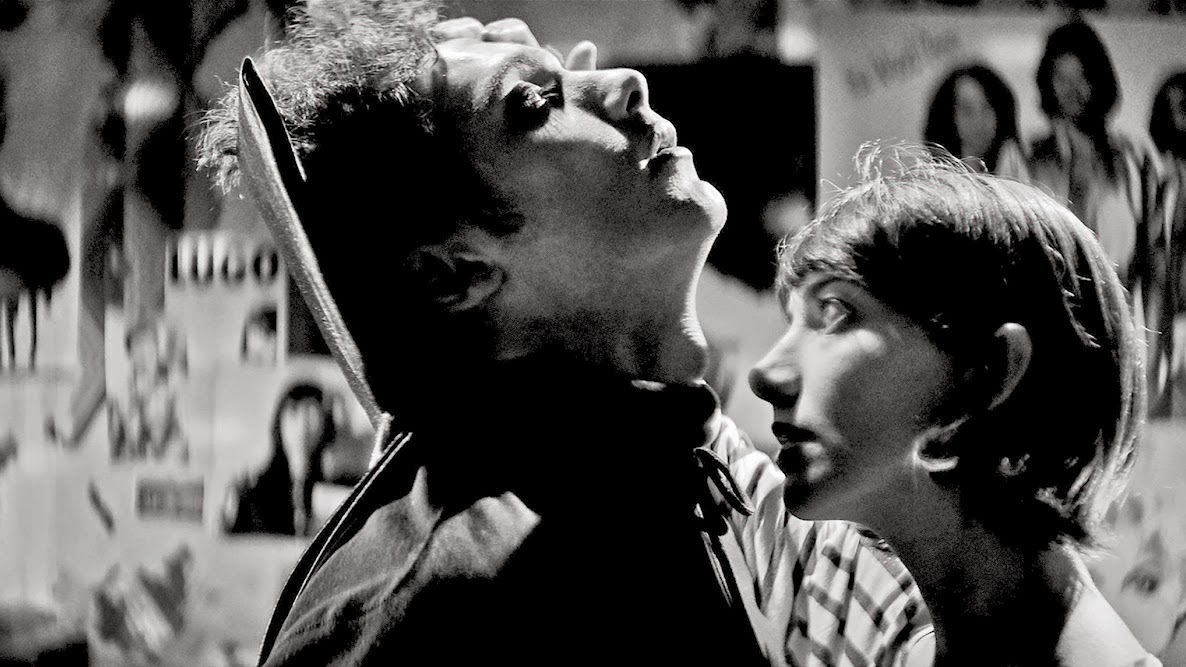
Six makes a point of showing Martin's lack of surgical skills. While First Sequence was crisp, clinical and in colour, Full Sequence is grimy, messy, and filmed in a depressing black-and-white. Rather than drugging his victims, Martin bashes them over his head with a crowbar, and unlike the surgical precision of Heitler, Martin duct tapes his victims and staples them together. It makes for a brutal experience, but its effects are dulled by some lazy writing - we are expected to believe the victims wouldn't struggle while their teeth are being knocked out one by one with a hammer or having the ligament in their knees removed. While I can certainly appreciate Six's desire to create something different to its predecessor, this is simply an unpleasant experience. I could appreciate disturbing, but Six opts for disgusting, and this exists simply to push your buttons.
As the never-ending vampire craze marches on, film-makers from around the globe continue to try and dissect our fascination with the seductive undead and their nocturnal habits. British-American-Iranian director Ana Lily Amirpour's unusual vampire flick tip its hat to 1950's Americana, and its setting, the Iranian town Bad City, is like something from a spaghetti western. Part love story, part gothic horror, and part exercise in style over substance, A Girl Walks Home Alone at Night is a beautiful work of art, but like its blood-sucking heroine, doesn't seem to know quite what it is.
Manual labourer Arash (Arash Marandi) spends his life either looking after his heroin-addled father Hossein (Marshall Manesh) or caring for his recently-purchased 1950's car. When Hossein fails to pay his debts to local drug dealer and pimp Saeed (Dominic Rains), Arash's car is taken as collateral. Saeed snorts and bullies his way through life, but soon catches the attention of a mysterious new arrival, a skateboarding vampire wearing a chador. The Girl (Sheila Vand) starts to stalk the streets at night, preying upon men committing evil acts, and even threatens a young boy when he shows early signs of becoming a bad person. As Arash stumbles home one night from a party dressed as Count Dracula, he catches the girl's eye, and they start a curious romance.
With gorgeous black-and-white cinematography and a haunting score, A Girl Walks Home Alone at Night is a treat for all of the senses. The Girl glides on her skateboard masked by her chador like a curious and vengeful spectre of the night, and her night-time haunts are captured beautifully by cinematographer Lyle Vincent. But with its relentless efforts to be cool and iconic - the film has a distinctive hipster vibe - the artfulness of the early scenes gives way to something akin to an extended music video. The soundtrack is certainly decent, but Amirpour often lingers too long on the two would-be lovers as they touch and gaze at each other like two members of different species. Still, on this evidence alone, Amirpour is a director to watch, and how often does an Iranian vampire western come along?
My main memory of seeing Steven Spielberg's sequel to his 1993 mega-hit Jurassic Park is leaving the cinema with one of the worst migraines I've ever suffered. My head pounded so hard that I couldn't even eat my caramel sundae purchased from the drive-thru McDonalds on the route home. Seeing it again all these years later I approached the film with a clear head and a box of painkillers on hand as a precaution. But as the credits rolled after an exhausting 129 minutes, I found myself in pain yet again. Not pain of the physical kind, but the dull emotional pain of sitting through a pretty bad movie. The Lost World's aim is to make everything bigger and better, and while the dinosaurs are certainly more technically impressive this time, there is little of the original's magic here.
A few years after the incident on Isla Nublar, the InGen corporation are being hit with lawsuit after lawsuit, and former CEO John Hammond (Richard Attenborough) is now a naturalist who has seen the error of his ways. When Hammond's slimy nephew (Arliss Howard) takes over the business, he plans to bring the dinosaurs back to the mainland and make them a sideshow attraction. Dr. Ian Malcolm (Jeff Goldblum) is asked by Hammond to visit Isla Sorna, or "site B" - a breeding island where the dinosaurs roamed free - to document the dinosaurs in order to gather support for the island to be left to its own devices by humans. He initially declines, but then has a change of heart when he learns that his palaeontologist girlfriend Sarah Harding (Julianne Moore) is already there.
Everything is certainly on a larger scale here than its predecessor. Instead of one tyrannosaurus rex we get two and a baby, and there's a whole pack of velociraptors for the group to contend with. Shortly after Malcolm arrives, he and his crew are joined by the Hammond nephew, who brings along a small army and bad-ass hunter Roland Tembo (Pete Postlethwaite), the latter of whom simply wants a shot at taking down a T-Rex as payment for his services. Unfortunately, Malcolm's estranged daughter Kelly (Vanessa Lee Chester) - a character taken straight out of Cinema's Guide to Annoying Children - also sneaks along for the ride, so we get to suffer through sentimental moments of learning the importance of family. The stand-out scene, which sees the characters attacked by the angry T-Rex's near the edge of a cliff, happens because Sarah takes their baby to bandage a wound. It turns out the dinosaurs value family too.
The fact that Sarah, an expert in her field, would even try to take care of a baby T-Rex demonstrates how stupid these characters are required to be in order for the film to deliver a set-piece. When you know there are huge, angry monsters out there, why would you park your trailer next to a cliff-edge anyway? So concerned is the film with entertaining its audience, Spielberg and writer David Koepp seem to have forgotten that a scene also requires a degree of logic to truly work. Most of the action falls flat, which is surprising given the talent for the genre previously demonstrated by its director, and it culminates in an unnecessary T-Rex rampage around San Diego. It isn't all bad - the dinosaurs are as wonderful and terrifying as ever and the late Postlethwaite is a fantastically conflicted antagonist - but there's a noticeable lack of heart and effort here.
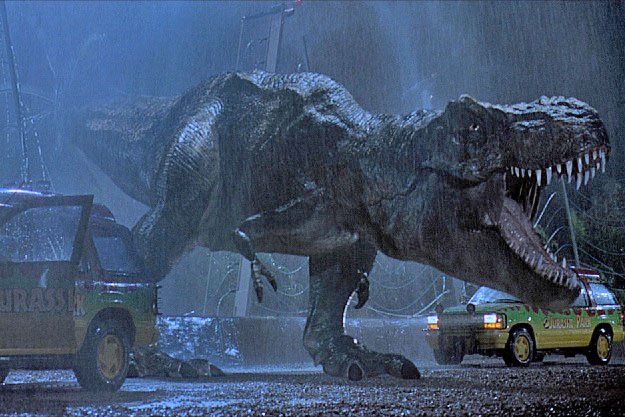
Jurassic Park was one of the first movies I remember watching at the cinema as a youngster, and I was so blown away I quickly acquired a pirate video of it, which I routinely watched to death. The special effects, the music, the set-pieces, that familiar park logo - it all had me riveted. It's one of the game-changing blockbuster movies, and watching it again an astonishing 22 years later, it's remarkable just how well the movie has aged. It's not quite the perfect experience I remember - those Spielberg-isms are now clear as day - but Jurassic Park's mixture of robotics and CGI blows most modern films away in terms of tension and pure spectacle.
Eccentric millionaire John Hammond (Richard Attenborough) approaches palaeontologist Dr. Alan Grant (Sam Neill) and his palaeobotanist partner Dr. Ellie Satler (Laura Dern) to join him on a journey to his newly built theme park. With the promise of a life-changing experience, the young-ish doctors cannot resist, so they journey to Isla Nublar, an island off the coast of Costa Rica, along with mathematician Dr. Ian Malcolm (Jeff Goldblum) and lawyer Donald Gennaro (Martin Ferrero). Upon arrival, they are greeted with the sight of a living, breathing brachiosaurus. Using the preserved dinosaur DNA extracted from mosquitoes preserved in tree sap, Hammond and his company have used cloning technology to birth a wide range of dinosaurs, including the terrifying tyrannosaurus rex and a group of velociraptors.
With this revelation comes the debate of whether man creating life is ethical, or in this scenario, safe. The dangers quickly become apparent to the group of doctors, but they cannot restrain their curiosity and are whisked off on a tour of the park. So confident is Hammond in the safety of his park, he invites his grandchildren Tim (Joseph Mazzello) and Lex (Ariana Richards) to participate. However, disgruntled employee Dennis Nedry (Wayne Knight) has cut a deal to sell dinosaur embryos to a corporate rival, and when a storm hits the park, he shuts down all the power in order gain access to the eggs. With the electric fences keeping the dinosaurs in temporarily down, it isn't long before the dinosaurs are fleeing their pens.
At first, this is the patient Spielberg who gave us Jaws (1975), opting for a slow build-up to the big reveal rather than giving the audience instant gratification. The introduction of the T-Rex is now an iconic moment in cinema, a thrilling combination of tension and pure terror, with a jump shock thrown in for good measure. But once Spielberg finally unleashes his monsters, the film simply doesn't stop. Delivering set-piece after set-piece, Jurassic Park abandons all restraint and packs it's second hour when it should be preparing us for the next big scene. Jaws gave us that wonderful moment when the crew compared battle scars, but there is no such scene here, just another problem for our relatively bland archetypal heroes to solve.
One of the most interesting aspects of the film is the character of John Hammond, Essentially the main antagonist, Hammond is a good-natured capitalist, a visionary who wants to bring wonder to the masses and make a tidy profit at the same time. Without a second thought for the consequences of his actions or the ethics of playing God, Hammond comes across as misguided, and too likeable to be labelled a villain. Hammond aside, Jurassic Park makes no apologies for its thinly-written characters, as this is a film of visual spectacle after all. When John Williams' famous score kicks in, it's easy to forget about the movie's many niggling problems and, for me at least, be reminded of that kid who would watch it on repeat with his nose a few inches from the screen.
Although the poliziotteschi sub-genre would not dominate the Italian box-office until the 1970's - a period which also saw crime movies in American cinema become distinctly grittier - it's roots can be traced back to the early work of director Carlo Lizzani. His early work, such as Wake Up and Kill (also known as Wake Up and Die) and The Violent Four (1968), laid the foundations for a rougher crime flick, movies that weren't afraid be socially aware or show Italy as the haven for crime and corruption it had become. For Wake Up and Kill, Lizzani took inspiration from one of the country's most popular Robin Hood figures - Luciano Lutring.
To be honest, I hadn't heard of Lutring before I was reading up about the film before watching it. I also doubt many people outside of Italy, or perhaps France (where Lutring served 12 years in prison), would have heard of him either, but his story is a familiar one. The likes of Ned Kelly and Jesse James come immediately to mind - criminals who are pardoned of their acts through folk-tales, becoming mythic heroes in the process. Lutring (played with a charismatic swagger by Robert Hoffman) robs jewels in broad daylight by smashing shop windows with a hammer and grabbing what he can. As his fame rises and his reputation hardens, he turns increasingly violent, carrying a sub-machine gun in a violin case which lends him the name "the machine-gun soloist,".
At first, Lizzani draws us into a sexy world of crime where every robbery lacks sophistication but sets the pulse racing, with sexy club singer Yvonne (Lisa Gastoni) soon on Lutring's arm before she realises what she's gotten herself into. Led by the determined Inspector Moroni (Gian Maria Volonte), the police are always one step behind Lutring's crime-spree. A few moments of casual domestic violence aside, Lizzani mainly portrays Lutring in a sympathetic light, being sexed-up by the media and blamed for crimes he didn't commit. For the crimes he does commit, Lizzani delivers a couple of well-handled and realistic set-pieces, usually in broad daylight. But at just shy of two hours (there are various versions of the movie out there - it appears I saw the longest) Wake Up and Kill feels dragged out, despite closing with a fantastic open-ended final scene.
On the morning of August 7th, 1972, in New York, something occurred that brought shock and exhilaration to the city's inhabitants. Eccentric French acrobat Philippe Petit wire-walked between the two towers of the World Trade Centre, as onlookers watched in awe and the police waited patiently at either side. Not only did he walk between the towers without safety precautions, but he also tip-toed gleefully back and forth, beckoned for the helpless police to come and catch him, and even found time to have a lie down in the process. With Robert Zemeckis's The Walk currently in cinemas, with Joseph Gordon-Levitt starring as Petit, it seemed a perfect time to re-visit James Marsh's miraculous documentary Man on Wire.
After encountering Petit on a radio show, what struck director Marsh so much about the story is how the meticulous planning that went into this highly illegal act and the round-up of Petit's assisting crew resembled that of a heist movie. With thrilling reconstructions, cleverly played out with silhouettes and shadows, we witness the intense research that went into making this extremely dangerous stunt feasible and safe, the various undercover operations done in plain sight to gather visual information on the building, and of course, the job itself. At one point, Petit and a colleague hide from wandering security officers under a plastic tarp for what feels like an eternity. Ever wondered how they got the wire over that tremendous drop? Well, now you'll know, and it's probably not how you thought.
The central spectacle aside, Man on Wire is very much about Petit himself. Narcissist, egotist, attention-seeker - he is of course all of these things (what great performers aren't?) - but he is also highly intelligent, charismatic, and uses beautiful language when he talks. From a young age, he dreamt of walking in the clouds, and his early life was neatly synchronised with the construction of the World Trade Centre, to which he kept close tabs on over the years. Dazzling crowds with a unicycle and slight of hand tricks, Petit trained for his ultimate goal by walking between towers at Notre Dame Cathedral and Sydney Harbour Bridge. But the World Trade Centre remained an almost mythical entity to Petit, something that was built for him and something he was born to conquer.
Anyone who suffers from a fear of heights may perhaps want to avoid the film. While his climactic walk in New York is shown only with still photographs (no video footage was taken from the top), his previous walks are caught in all their vertigo-inducing glory. Yet these stunts aren't designed to terrify, and although they certainly forced my heart into my mouth, they create an almost transcendent sense of wonder. When recollecting the World Trade Centre walk, many of Petit's accomplices break down in tears. This was a truly special thing - a man literally walking in the clouds - and it is something that can never be done again. It's also fitting that the 9/11 attacks are not mentioned in the movie, as this is as a much a love-letter to the memory of the twin towers as it is to the human spirit of Philippe Petit.
With Freddy Vs. Jason still stuck in development hell, Friday the 13th producer and creator Sean S. Cunningham wanted to ensure that audiences didn't forget about the monster in the hockey mask and gave us a tenth entry, coming 8 years after the previous film. With the last two instalments attempting to change the formula (getting him out of Camp Crystal Lake and then turning him into a body-jumping ghoul from Hell) and becoming two of the most hated entries into the franchise in the process, Jason X faced a battle to bring the well-worn slasher genre to a modern audience. Well, all gore-seeking teenagers love space, right?
When the title is a film's cleverest attribute, you know it's in trouble. In the near-future, Jason Voorhees (Kane Hodder) is imprisoned in Camp Crystal Lake's research facility, where a bunch of silly scientists (including David Cronenberg) look to transport him to another location in order to carry out further research. Naturally, Jason breaks free and kills everyone, just before being frozen along with the sexy doctor Rowan (Lexa Doig). They are discovered almost 500 years later by a group of explorers from Earth II, who take the two corpses aboard their ship, bringing Rowan back to life using advanced science. With Jason now established as a supernatural being who cannot be killed, he is soon alive and kicking and butchering the annoying crew one by one.
With the post-modern horror boom still in full swing thanks to Scream (1997), Jason X plays mainly for laughs. Clearly made with the series' fans in mind, it features various winks at the audience and just may have worked had the script, actors and production values been anything other than abominable. Bad special effects can have its charms, but Jason X looks like a mid-shelf TV show most of the time, with the only inspired effect coming from a poor female doctor who has her face frozen with liquid nitrogen and then smashed to pieces on a work surface (one of the best Jason killings in the entire franchise). Rather than being funny, it feels symbolic of what a parody of itself the series has become. The fans will surely disagree, but the Friday the 13th films have never been good, and Jason X is the poorest of them all. It may not tell us how to kill Jason once and for all, but it demonstrates how to kill a franchise.
Steven Spielberg's Munich questions the value of compromising your own ideals in the name of retaliation, whether 'doing what your enemies do' is a necessary stance or the beginning of a downwards spiral towards violence and bloodshed of which there is no end, and ultimately, no point. There are ancient political and religious rivalries in Ireland, South Africa and, especially, Israel; countries that have been torn apart by civil unrest. There seems no reasonable solution apart from forgiving and forgetting, but this doesn't seem to be an option. In the wake of the terrorist attack at the 1972 Munch Olympics, Israeli prime minister Golda Meir (Lynn Cohen) decides that lawful justice will not suffice for the murder of 11 Israeli athletes and team members.
A crack team is put together to carry out a series of carefully planned assassinations of alleged members of the Black September group. The group's leader is Avner (Eric Bana), a Mossad agent and soon-to-be father who is briefed of his task by the shadowy go-between Ephraim (Geoffrey Rush). The rest of the team is Carl (Ciaran Hinds), a clean-up man, Robert (Mathieu Kassovitz), an expert bomb-maker, Steve (Daniel Craig), a South African weapons handler, and Hans (Hanns Zischler), a professional document forger. Their first hit takes them to Rome, where they are sold information on the whereabouts of target Wael Zwaiter (Makram Khoury) by a Frenchman named Louis (Mathieu Amalric), who claims to work for an organisation unaffiliated with any government.
Highly controversial upon its release, some extreme views questioned director Spielberg's sympathies and ultimate goal. For most people not directly linked to the various religious groups and organisations seen in the film, it should be clear that Spielberg makes a point in showing both sides as equally sympathetic and morally ambiguous. Every attack and execution is a result of one action or another, bringing into question the whole idea of revenge (the movie is based on the book Vengeance by Yuval Aviv, who Bana's character is a fictional substitution for). Israel itself plays a key role. Although we spend little time there. Munich takes us to Italy, Greece, England, Spain, Lebanon and America, but Israel's disputed lands are never far from the characters minds.
Avner is an especially haunted soul, questioning the ethics of his operation and plagued by visions of the events at the Munich Olympics, the latter of which are portrayed with a chilling authenticity at various point throughout the film. He later meets Louis' 'Papa' (Michael Lonsdale), who argues that family, over any government or religious organisation, is the only unit worth fighting for, casting Avner's mind back to his recently-born child. The ensemble cast do a very good job at carrying the weighty tones of the film on their shoulders, but it is Spielberg himself who is the most deserving of acclaim here. It is the director at his most mature and unsentimental, and as the industry's most famous Jew he has taken a huge risk by tackling an extremely sensitive issue. It upset the people on both sides, but that is precisely the point. How can anyone come out of such a bloodied conflict, of which there is no clear end in sight, with a clear conscience?
For those unfamiliar with the shocking events that took place in Oakland, California on New Year's Day in 2009, black youth Oscar Grant was detained by police officers on his way back from celebrating the new year, handcuffed, and eventually shot in the back while face down on the floor by BART police officer Johannes Mehserle. In the opening scene of Fruitvale Station, we see one of the few grainy mobile phone videos taken of the incident. The camera is shaky, the audio is muffled, but the incident itself is as clear as day. What happened was undoubtedly a strange event, and writer/director Ryan Coogler doesn't try to make any sense of it. Instead, he is interested in showing us the human being behind the headlines.
Starting 24 hours before the shooting, Oscar (Michael B. Jordan) is in bed with his girlfriend Sophina (Melonie Diaz), and the two have a young daughter who naturally interrupts them moments before getting their freak on. It's a relatively uneventful day - Oscar visits a grocery store in an attempt to regain the job he lost a couple of weeks earlier due to being frequently late, sits down for dinner with his family, takes care of a stray dog, and ponders a potential drug deal. He's no saint, but he is a man trying to turn his life around and winds up tossing the bag of weed in his closet into the ocean. A former convict, Oscar hopes for a fresh start with his girlfriend and daughter and prepares to see the new year in with Sophina and his friends.
While it was a wise move to avoid any social commentary and attempt to unravel the mystery of just what happened on that day, this is undoubtedly a one-sided view and subtly whitewashes it's lead character. While a dark past is certainly hinted at, Oscar is portrayed as an extremely nice guy, and a dramatic narrative is forsaken in favour of a relentlessly positive depiction of a man we actually know very little about. Technically, the film is crisp-looking and has a naturalistic flow to it, with the scenes of family bonding never feeling forced or ham-fisted. Jordan is excellent, highly charismatic and proving rather imposing when called upon, and he will no doubt grow into a star despite the recent failure of Fantastic Four (2015). Mehserle was not charged for the murder - there's a strong argument that he actually meant to pull a taser - but we will probably never know what really happened on the platform of Fruitvale Station.
The opening scene of John Frankenheimer's massively overlooked thriller Seconds follows everyman Arthur Hamilton (John Randolph) as he ushers along a familiar railway station seemingly heading to another day at work. Through Frankenheimer and Oscar-nominated cinematographer James Wong Howe's eyes, this is our world but not quite as we know it, but how a lot of us will no doubt feel it. Obscure camera angles and extreme close-ups invoke a deep sense of paranoia, like someone is subtly observing from afar while the walls of our world feel like they're closing in. The man looks like the kind of pod-person Mad Men depicted so well, but who is he and where is he going? Eventually the man is handed a note from a stranger baring an address.
Seconds is the last and least well-known of John Frankenheimer's so-called 'paranoia trilogy', which began with The Manchurian Candidate (1962) and was followed by Seven Days in May (1964). Paranoid thrillers of the highest quality, Seconds is arguably the best. Dismissed by the majority of critics and unseen by audiences upon its release in 1966, it has been frequently re-evaluated over the years but has never achieved the level of recognition is surely deserves. It tries to answer the questions no doubt pondered by many middle-aged men caught up in the mundaneness of modern life, of what it would be like to be offered a clean slate - to change your appearance, be given the money to conquer your goals, and have your former self completely removed from the world. Will you achieve happiness and live the life you have always desired, free from the constraints of marriage and a 9 to 5 lifestyle? Or will you simply make the same mistakes as before?
Arthur Hamilton is contacted by an old friend he believed to be long dead, who tempts his old school buddy into a radical - and highly secretive - procedure that will transform him into a completely different person. Arthur cannot resist and visits the address he was handed by the stranger, and is soon transformed into a handsome and younger man, and is given a new name, Antiochus Wilson (played by a career-best Rock Hudson). Arthur's death is faked and he is whisked off to a warmer climate, where a swanky new pad and the tools to pursue his dream life as an artist await him. Is this life-changing reset merely covering up the underlying cracks deep within in his soul? Antiochus is soon indulging in trendy cocktail parties and the attentions of neighbour Nora (Salome Jens), but as the drinks are consumed his old self starts to bubble over.
Although he only appears around the hour mark, Hudson is nothing short of mesmerising here. Retained his handsome features but gaining a world-weariness, the man best known for his screwball comedies seems to perfect fit to play a man hiding his true self, given the double-life he was forced to lead to improve his public image and which eventually damaged his career. Wilson's drunken antics during a long party segment of the film are filled with pity and embarrassment, and it's here that Frankenheimer starts to lose his grip on the story. The narrative sags, but it only adds to the whole disorienting experience. Though technically a thriller, Seconds also works well as a horror, hiding the surgeons ready with their scalpels behind thick walls and shrouding the organisation offering the services in secrecy. Deserving of far more respect in the world of cinema, Seconds is a disturbing and depressing experience, but one that is drenched in irony, featuring one of the most unsettling closing lines I've ever heard.
After successfully re-stimulating cinema audience's thirst for classic horror with re-tellings of the Dracula and Frankenstein legends, Hammer Films turned their attention to another piece of classic British literature, Sir Arthur Conan Doyle's Sherlock Holmes. It seemed logical to adapt Doyle's arguably most popular story, The Hound of the Baskervilles, a tale translated to the screen countless times before and since 1959. This being Hammer however, the gothic atmosphere and supernatural elements took centre stage, and with Terence Fisher in the director's chair and Peter Cushing donning the famous deerstalker, this is not only one of the finest Holmes adaptations but one of Hammer's most memorable works.
Beginning centuries ago, the sadistic aristocrat Sir Hugo Baskerville (David Oxley) is enjoying a night of debauchery when a female prisoner escape and flees into the surrounding moors. Outraged, he pursues her with his pack of hounds, and eventually captures her and stabs her to death. Shortly after, Hugo is killed by an unseen entity that causes him to die with a look of terror on his face. Hundreds of years later, and Sir Charles Baskerville has been found dead under similar circumstances, leaving his only remaining heir Sir Henry (Christopher Lee) to take over Baskerville Hall. Now fearing that Sir Henry may become the next victim of the Baskerville curse, Dr. Richard Mortimer (Francis De Wolff) employs the talents of Sherlock Holmes and his trusted partner Dr. Watson (Andre Morell) to solve the mystery.
The film has its problems, mainly with Holmes going missing for a large chunk of the running time and leaving Dr. Watson in charge of the investigation, but thankfully Morell proves to be suitably refined in the role and capable of carrying the movie for this period. The hound at the final reveal is also anti-climatic and rather silly, although this is understandable given that there are no true supernatural powers at work here. These quibbles are overshadowed by some sumptuous cinematography by Hammer stalwart Jack Asher, whose smoky moors really drum up a genuinely spooky atmosphere at times, especially during the surprisingly violent opening scene and the tense climax. This being Hammer, liberties are taken with the source material, but it's all for the sake of good old-fashioned entertainment. It's a shame that Cushing and Hammer didn't adapt more Holmes stories following this.

 In an upper-class Milan suburb, a wealthy family are informed of the imminent arrival of a stranger by a enthusiastic postman. The man, known only as the Visitor (Terence Stamp), suddenly appears at their home seemingly without reason, and immediately begins to affect the family and their maid. He stops the maid (Laura Betti) from committing suicide, soothes the son (Andres Jose Cruz Soblette) of his anxieties, eases the fears of the opposite sex of the daughter (Anne Wiazemsky), seduces the sexually repressed mother (Silvana Mangano), and nurses the seriously ill father (Massimo Girotti) back to health. He vanishes as quickly as he appeared, leaving his subjects in various states of bewilderment and enlightenment.