And so, after 18 years, the story of the West Memphis Three finally reaches its conclusion. As does Joe Berlinger and Bruce Sinofsky's epic documentary trilogy. These films, as Echols confesses, were so important to their lives that without them, the judicial system would have forgotten about them and left them to rot for the rest of their lives (and until Echols' death by lethal injection). Purgatory picks the case up ten years after the second entry, Revelations, to find the case in a never-ending loop of denied appeals by original Judge David Burnett. With more evidence surfacing, the case is taken to the Arkansas Supreme Court, to argue that enough has been unearthed to warrant a new trial for Damien Echols, Jason Baldwin and Jessie Misskelley.
After spending way too much time going over what occurred in the first two documentaries (about 45 minutes - which is a massive drag if you've just watched them back-to-back), we finally get to new ground as new interviewees give statements and leading experts in their respective fields give lectures uncovering new revelations about misinterpretations and misconduct given by the original trial 'experts'. Much of the trial focused on these murders being the work of ritualistic sacrifice due to the sexual mutilations of the victims and scratches left on their persons. It turns out that these are clearly the work of animals, most probably turtles (the area where the bodies were found is nicknamed 'Turtle Hill'). It reveals poor research by the original lawyers working for the defendants, and general ineptitude by basically everyone involved back in 1993/94.
Purgatory commits the same sin as Revelations, as suspicion moves from a noticeably more subdued John Mark Byers - who is now a supporter of the West Memphis Three and pen-pal to Echols - to Terry Hobbs, stepfather of Stevie Branch. Although, accusations don't come from character alone, but instead stem from a hair found within the knot of the shoelace with which the boys were hog-tied with and some alarming inconsistencies in Hobbs' story. But (ironically), this is something for the court to pursue and not documentary film-makers. The ending, which sees the West Memphis Three released from prison but not with their innocence intact, comes out of nowhere, as filming had already wrapped when the court called the plea appeal. For a more satisfying closure to the story, I would recommend West of Memphis (2012), which gives a more detailed account of their release, and also a more focused and detailed investigation of Hobbs. Still, it's a relief to finally watch these three walk free, even though it leaves a bitter taste in the mouth.
After the storm kicked up by the first film, film-makers Joe Berlinger and Bruce Sinofsky returned to West Memphis four years later. Whereas the first film seemed to simply document the case in as much detail as possible and allowed you to make your own mind up, with Revelations, they seem to have their own agenda. New 'evidence' has been discovered, and perhaps the real killer still walks the streets, and it's clear who Berlinger and Sinofsky believes it to be. That crazy bastard John Mark Byers, who took so much pleasure in giving Biblical rants to camera, hardly covers himself in glory, and he's back here to build fake graves for Damien Echols, Jason Baldwin and Jessie Misskelley at the crime scene, only to set them on fire amidst his demented monologues.
It's sad that Berlinger and Sinofsky decided to take such a manipulative approach to the sequel, as although Byers is clearly an unhinged and simple-minded hick, there is no evidence against him killing the three boys (Michael Moore, Stevie Branch, and his stepson Christopher Byers) aside from the fact that he comes across as scary and strange. The first film was an intense study of mob mentality and the dangers of pre-judgement by appearance, and how the West Memphis Three managed to get themselves convicted simply for being black-wearing outcasts. So Revelations comes across is hypocritical.
When new evidence is presented, suggesting teeth marks on the head of one of the victims, tests prove that none of the WM3's teeth match. When Byers is confronted, he reveals that he had his teeth removed but keeps changing his story as to when this took place. He is repeatedly confronted by a support group that help fund and promote the case against the WM3, but they come across as equally strange as Byers, following Echols like groupies as if he was some kind of prophet, and they berate Byers into handing in his dental records voluntarily to prove himself innocent. Byers refuses, stating that there is no case against him, and this is shown in the film as if an admittance of guilt. The film-makers never take any time to explain the reasoning behind Byers' behaviour, clearly convinced of his guilt.
In the end, it's a case of there being too little here to warrant a two hour-plus movie. The new evidence is flimsy to say the least, and as revealed in West of Memphis (2012), is probably completely wrong. Yet when the film gets back down to cold facts, it becomes as riveting as the first film, unveiling a justice system that seems unwilling to open the doors to the possibility that they simply got it wrong. It's just a shame that too much time is spent on a personal witch-hunt, and even when Byers passes a voluntary lie-detector test, the film suggests that Byers was on so much prescription medication that the results of this cannot really stand up, yet fails to ask to conductor of the test of his views regarding this. It's certainly a confused film, and one that works best when it stays on topic and documents the facts rather than revelling in propagandistic speculation.
With the recent release of theclosing chapter to the trilogy, Paradise Lost: Purgatory (2011), and the Peter Jackson-funded West of Memphis (2012), it seemed a perfect time to re-visit the original HBO documentary that focused on the original trial of the accused now known as the West Memphis Three. Knowing now that they have only recently been released in 2011, the first thing that shocked me about the first film was realising it was made way back in 1996, and the trial was back in 1993. I was 8 in 1993, and I cannot imagine the torment that Damien Echols, Jason Baldwin and Jessie Misskelley, Jr. went through, spending almost twenty years in prison for a crime they did not commit. Paradise Lost is still as utterly sickening as it was when I first viewed it over five years ago.
The question here is not if these three were innocent of this hideous crime - you can make your own mind up about that - but it is how can three teenage boys be sentenced to life in prison (and the death penalty for Echols) with not a shred of evidence against them? The irony is that these murders were believed to be the work of satanic sacrifice, but the West Memphis Three were condemned to a modern day witch-hunt by ignorant townsfolk terrified of them because they wore black and refused to blend in with the dungaree-wearing hicks in their dirt-poor neighbourhood. It seemed like everyone was against them, eager to lay the blame on something they simply did not understand. Judge David Burnett highlighted the need for evidence of a motive, so the answer was to get 'expert' testimony from a man with a mail-order PhD in the occult. When his lack of qualifications is highlighted by the attorney representing Echols, this is dismissed without a second thought.
Film-makers Joe Berlinger and Bruce Sinofsky were granted unlimited access to the entire trial, so as a documentary, it is incredibly detailed. After the uproar this film caused, this access was quickly denied for the sequel, no doubt they were terrified that more shameful misconduct would be unearthed. Interviewers are given by the parents of the accused and of the three murdered boys (Christopher Byers, Michael Moore and Stevie Branch), and their emotion is laid out raw. Special attention is given to John Mark Byers, stepfather to Christopher, who handed the film-makers a hunting knife stained with blood as a present, which was quickly handed over to the authorities. Byers is a strange and often terrifying character, pumping bullets into a target and stating his wishes that he could do the same to the three boys on trial. It is easy to find yourself thinking that he must be the real killer, but as the trilogy of films progress, I learned that appearances can be deceiving, and that I was guilty of the exact same thing that led to the imprisonment of the West Memphis Three.
This is powerful stuff, provoking more emotion than probably any other film I have ever seen. The atmosphere is extremely gloomy, right from the get-go when we see crime scene footage of the young boys hardened corpses lying naked in the woods. It certainly doesn't pull its punches, and Metallica's magnificent soundtrack, the first time they have ever allowed their music to be used in film, only adds to this. But ultimately, it's the story itself that proves to be the most powerful aspect. They were guilty from the moment they came to court - these sullen kids with their black clothes and long hair. Individuality doesn't go down well in the Bible Belt, it would seem. As each heavily flawed accusation flies at Echols, Baldwin and Misskelley, you must simply watch and grit your teeth. This is a truly terrifying story and also one full of tragedy, both for the young boys who were murdered and for the three that were the fall guys swept up by an almost neo-Nazi institution.
If you were once a young boy (or girl) who enjoyed riding their bike at breakneck speed or got their thrills from wandering off to places you were forbidden to go to, then you will totally get Terry Gilliam's Time Bandits. If adventure and danger were what spurred you on as a child, then you no doubt fantasised about travelling through time and meeting the famous historical figures you learned about whilst falling asleep in history class. Time Bandits is pure Boys Own adventure, making idiots out of the likes of Robin Hood and Napoleon, and even bringing six dwarves along for the ride. The plot is muddled and nonsensical, but the plot is beside the point - arguably just a McGuffin for some childish fun.
It tells the story of eleven year old Kevin (Craig Warnock), who, when not being ignored by his lazy absent-minded parents, spends his time doting on history, particularly Ancient Greece. One night, six dwarves come crashing out of his wardrobe holding a map that they claim show the world's time portals, that they appear to have stolen from the Supreme Being (i.e. God, played at the climax by the wonderful Ralph Richardson). Kevin goes along for the ride, and finds himself meeting Napoleon (Ian Holm) during the Napoleonic Wars, Robin Hood (John Cleese) in the Middle Ages, and King Agamenmon (Sean Connery) in Ancient Greece (amongst others). Meanwhile, in the Fortress of Ultimate Darkness, the technologically obsessed Evil (David Warner) is planning to steal the map and take over the world.
The set design is fantastic in this film, and the main credit should go to that department. The sets look as if constructed from the mind of a child, paying no real attention to historical detail or a 'lived-in' feel - this is all pure fantasy. The film rushes at such a breakneck speed that we don't get to spend enough time with these characters in their times, and this was my main (and only) problem with Time Bandits. Thankfully, these scenes are packed with so much wit by writers Gilliam and Michael Palin (who also appears as the dim-witted romantic Vincent), that it is hard to care too much. This is not Monty Python though, there is humour here for children and adults both, but it's just as funny. John Cleese's over-enthusiastic Robin Hood was a particular stand-out for me.
Gilliam also uses the film to take some sly satirical digs at the emergence of technology, juxtaposing Evil's plan to use computers to carry out his evil deeds alongside Kevin's active imagination and sense of wonder. His parents are bone-idle idiots that get excited at the idea of a microwave cooking their dinner in quick time, and technology is clearly viewed by Gilliam as something that will rot the imagination. This isn't entirely true of course - technology can inspire innovation - but I often see young children staring open mouthed and expressionless at their mobile phones when they should be annoying their parents or getting up to something they shouldn't be, so I can certainly sympathise with Gilliam's concerns. But Time Bandits is mainly about adventure and the wonder of a child's imagination. Funny, manic, and occasionally moving, this is one of the definitive movies about childhood, and how we occasionally long for it.
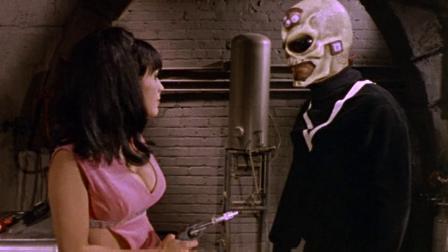
The Astro-Zombies is one of those Z-grade efforts where you can tell the producers had a bunch of props and sets left over from previous productions and wrote a script based around them. Therefore, the film makes absolutely no sense, and ends up throwing everything but the kitchen sink at the audience. We are left with a story involving mad scientist Dr. DeMarco (John Carradine) and his hunchback lab assistant who are attempting to create an army of 'astro zombies', superhuman beings whose actual purpose is sketchy. After one is loosed and goes on a killing spree, the CIA (led by a clearly sozzled Wendell Corey, who died due to his alcoholism shortly after filming) and a spy ring led by the great Tura Satana become interested.
It's easy to label a film 'the worst film ever!', but The Astro Zombies, directed by schlock favourite Ted V. Mikels, truly lives up to its reputation. Carradine, bless him, makes a valiant attempt to make some kind of sense of the plot with some muffled monologues, but I got completely lost in all the drivel. There is the odd moment of camp weirdness such as the wounded astro zombie fleeing with a torch pressed against his head to keep itself alive or a naked exotic dance that serves absolutely no purpose, but it constantly lingers on endless laboratory scenes where literally nothing happens. The zombies themselves are nothing more than a man in a kind of insect/skull/mutant mask, and there's only really one of them. It's a truly painful experience that lacks the amusing moments of Mikels' other 'works' such as The Corpse Grinders (1971) and The Doll Squad (1973), that at least made those films bearable. Truly painful stuff that could benefit from a good thirty minutes shaved off the running time.
After having to wait a surprising amount of time for the sequel - given the success of its predecessor - Star Trek Into Darkness has a lot to live up to. The 'original' did the remarkable job of bringing a fresh audience to what was thought of (by non-Trekkies) as cheesy sci-fi with bad sets and dodgy haircuts. The franchise had been brought back from the dead, opting for less philosophising and more wallop for your money, which although pissing a few Trekkies off, kept most viewers at least relatively satisfied. So after finding a way to be able to re-tell the story of the Starship Enterprise without having to re-write 'history', returning director J.J. Abrams found himself with an entire universe to explore. Which makes it very strange that Abrams and his frequent collaborators have chosen not to give us something entirely new, and instead chosen to touch the untouchable - "KHAAAAAAANNNNNNNN!".
Having made his natural progression from the academy to the captain's chair, Jim Kirk (Chris Pine) and his conflicted friend Spock (Zachary Quinto) begin the film by saving a planet from destruction. Though this is seen as a valiant act in his own eyes, Kirk is reprimanded by Captain Pike (Bruce Greenwood) for knowingly disobeying Starfleet orders. Kirk agrees to a demotion and to become Pike's second-in-command, and they are briefed about a terrorist named John Harrison (Benedict Cumberbatch), who has just blown up a Starfleet installation in London. But after the meeting of the Starfleet commanders is also attacked, Kirk is reinstated by Admiral Marcus (Peter Weller), who gives Kirk the Enterprise back and a mission to take out Harrison.
Many of the problems that lay with the first film are back again. Abrams often heaps on too much comedy in a bid to keep the audience entertained, sometimes much to the suffering of some of the film's supporting characters. Much of the supporting crew are reduced to a set-piece here or a funny line there, with Uhura (Zoe Saldana) and Sulu (John Cho) suffering most this time. The story is still focused on the growing relationship between Kirk and Spock, who after many misunderstandings last time around, seem well on their path to the great friendship that will be. Newcomer Carol (Alice Eve) does little more that get her kit off in one pointless and much criticised scene, but, unless you're a die-hard Trekkie, you should be too enthralled to care much about it, as Abrams delivers one breathless set-piece after another, backed by some excellent CGI work.
The plot often gets unnecessarily convoluted given the relatively basic plot, and there are plot holes a-plenty if you enjoy picking at them. Yet Cumberbatch's excellent performance as the refreshingly multi-dimensional bad guy is the much-needed 'darkness' from the title, and Abrams really pushes the boundaries of the 12A certificate (if you're from the UK). It's been called the worst Star Trek movie ever made by Trekkies, which seems utterly ridiculous to me. It treads much of the same ground as the beloved Star Trek II: The Wrath of Khan (1982), but I believe this was an attempt to bond with the hardcore fans, although I feel The Wrath of Khan is grossly overrated. The re-boot doesn't subvert Star Trek, it simply takes it in another direction, which was the whole point of the exercise. Personally, I'll still be tracking this franchise with wide-eyed curiosity, as Abrams boldly takes us where... well, you get the point.
The Killer Inside Me, a brutally violent neo-noir from British director Michael Winterbottom, raised hell at Sundance, sending audiences into frenzies of disbelief and light-headedness. Of course, as usual with premature festival outrage, the film is really not as appalling as the uproar would have led you to believe. There is one truly sickening scene - as gut-wrenching as any burst of violence I've seen on screen - but, the real tragedy is that this insistence on portraying it so graphically actually takes the focus away from what is a very stylish, if tonally uneven, pulp thriller. Although Winterbottom has juggled genres and styles with relative ease in his previous work, mainly to positive results, perhaps his inexperience with tackling a project so deeply rooted in Americana leads to the film's downfall.
Small-town deputy sheriff Lou Ford (Casey Affleck) is sent to warn off prostitute Joyce (Jessica Alba), who is having a dangerous affair with the son of construction tycoon Chester Conway (Ned Beatty). After realising they have the same violent sexual tastes, they begin a love affair and devise a plan to extort $10,000 from Conway, as Lou believes Conway to be responsible for the death of his brother. Unbeknownst to Joyce, Lou, despite his pleasant demeanour, is a violent sociopath, and after Lou beats Joyce to death with his bare hands and runs with the money, county attorney Howard Hendricks (Simon Baker) is called in to investigate. So Lou is forced to cover his tracks while he dotes on his fiancee Amy (Kate Hudson).
Pulp writer Jim Thompson was possibly the grimmest writer of his ilk, and The Killer Inside Me is widely thought of as his best work. I have not read the novel, so I am unaware as to how Lou Ford is written, but here he is a blank but undeniably fascinating character. He is a character that always seems in control, even when he seems surprised at just what he is capable of. Yet for someone seemingly so clinical at killing, he's not very good at it. His extortion plan is full of holes that could lead back to him, and it doesn't take long for Hendricks to figure him out. Often a glance or a word will make you wonder if he even understands himself or anything he is doing. Casey Affleck is a fine actor, and his Lou Ford is intimidating. Even though he's slightly built and his voice is a high-pitched drawl, he is a scary character to spend 90 minutes with, and he even surpasses his performance in The Assassination of Jessie James By the Coward Robert Ford (2007), of which I felt he was robbed of an Oscar.
Winterbottom wisely steers away from any psychological analysing of Ford, only hinting at childhood abuse (but not the way you would think), and glimpses of his intellect. Instead it makes you ponder this hideous character, and stay with him (but not necessarily root for) throughout the duration of the film. But it's Winterbottom's approach that is the problem here, blending a mixture of styles that causes the film to seem contrasting and haphazard. There are moments of pure noir - headlights approaching in the dust, characters sat in empty diners, cynical narration - and these scenes are at ease with the sleaze of the film's focus, but often it will kick in with some banjos at inappropriate moments that caused me to wonder whether I should be taking the film seriously. When it does take itself seriously, it's often inspired, but the final scene is so badly handled that I did wonder if a different director with more experience in the field would have made a much better film.
"Is that a man?" asks the pilot of a rescue plane headed towards the crash site of Chuck Yeager's attempt to reach the edge of space in a Lockheed NF-104A. An outline of a man appears on the horizon, blurred by heat and mirage, his face bloody and burned, walking at pace with his helmet in his hand. Yeager's good friend Jack Ridley sits in the passenger seat, having seen Yeager conquer several near-suicidal flight records, including the first to break the sound barrier. Ridley smiles. "You're damn right it is!". The Right Stuff, adapted from Tom Wolfe's best-selling account of the test-pilots in the Mercury Space Program, shows what it takes to be a man; to have the 'right stuff' inhabited by these fearless men, who were the only ones crazy enough to risk everything, on live TV, to beat the Russians in the space race.
Besides the many fascinating and frequently hilarious vignettes involving the test pilots - played by a stellar cast of Dennis Quaid, Ed Harris, Fred Ward, Charles Frank, Lance Henriksen, Scott Glenn and Scott Paulin - the movie's real ace-in-the-hole is the juxtaposition of this story with that of Chuck Yeager (Sam Shepard), a man thought of by his peers to be the finest pilot in the world. Played stoically by an Oscar-nominated Sam Shepard, he is brooding, dusty, a true man's man, but without the college degree needed to join the space program. He is the polar opposite of the 'hot dog's' of the Mercury Program, and when he is not off chasing his wild wife Glennis (Barbara Hershey), he is making sure he is still the fastest man in the world.
Even at over 3 hours, the movie is packed with great and memorable scenes. Director Philip Kaufman managed to retain Wolfe's skill for absurd humour, so we get to see the President crawling on the floor to plug in a projector, two astronauts' slow walk to the bathroom following an enema, and a hilarious moment involving humming and sperm samples. It has an observational aesthetic that America conquered in the 1970's, made even better by some amazing aviation and space travel scenes, easily more exciting than the CGI-laden movies we get nowadays. It's often called the second-best movie of the 1980's behind Raging Bull (1980), and, although I don't necessarily agree with that statement (Blue Velvet (1986), anyone?), it's one of the finest movies to come out of it's era, feeling almost classical despite being modern. Like Shepard's Chuck Yeager, The Right Stuff seems old before its time, encompassing wisdom and poignancy with ease.
After five movies and one giant superhero mash-up, the Marvel superhero formula is getting as stale as old bread. With the only Marvel stand-alone superhero film to have a sequel (so far - Thor: The Dark World and Captain American: The Winter Soldier are imminent) being Iron Man, did the world really need a third entry into this franchise? More importantly, did we want it? Well, with over $1 billion in the bank and the label of fifth highest grossing film of all time, the answer is an overwhelming yes. The franchise certainly needed a fresh injection of life - Jon Favreau's massively disappointing follow up to his impressive Iron Man (2008) perhaps showed his inexperience as director, though he has stayed on to reprise his role as bodyguard Happy Hogan (looking worryingly bloated). Changes have been made, and although the critics seemed to lap up Iron Man 3, audiences opinions seem strangely polar opposite.
Following the events of The Avengers (2012), Tony Stark (Robert Downey Jr.) is suffering from anxiety attacks, and in his restlessness, spends his nights in his basement building a small army of Iron Man suits. America is under attack from a string of bombings by a terrorist known as the Mandarin (Ben Kingsley), and after his bodyguard Happy is seriously injured in an attack, Tony makes a personal come-and-get-me message to the shady terrorist. After his home is obliterated by Mandarin's helicopters, Tony finds himself in Tennessee to investigate some potentially linked attacks. All paths seem to lead to AIM, a treatment facility run by Aldrich Killian (Guy Pearce), a formerly crippled scientist that Tony shunned back in 1999.
Interesting choices for director have always been Marvel's thing, to allow a respected or rookie director a chance to inject their own sensibilities into the familiar superhero film. Sometimes it pays off - Kenneth Branagh's Shakesperian background gave Thor (2011) a certain gravitas when it could have been plain silly. But sometimes it doesn't, such as the choice of Joe Johnston - whose career is a very mixed bag anyway - for Captain America: The First Avenger (2011), which I found rather dull. So for Iron Man 3, in steps Shane Black, 80's buddy-comedy extraordinaire, whose filmography was somewhat re-discovered in fits of nostalgia of late, especially after the excellent Kiss Kiss Bang Bang (2005). And deservedly so, as Black's obvious talent for writing led to movies such as Lethal Weapon (1987) setting the benchmark for countless buddy movies to follow (and ultimately damage the sub-genre). So Iron Man 3 would bring Tony Stark back down to Earth, allowing a more intimate side to be seen and a chance for the supporting characters to finally make their mark.
It's certainly more down to Earth, with less of Tony Stark's quick-humour and arrogant prancing (which is what we love him for, especially with Downey Jr.). His new foe would finally be a match for him - not just a man in a different sort of Iron Man suit, but a true criminal mastermind that would meet him physically and mentally, in the same way that Bane smashed Batman in The Dark Knight Rises (2012). And after the opening third, Tony Stark is simply Tony Stark. His suits have been all but destroyed, his friends are far away, and the prototype escape suit he is left with is damaged almost beyond repair, so even the trusty JARVIS (voiced by Paul Bettany) isn't there to help. He must now use his wits, but without his suit, he is physically and mentally vulnerable, not helped by the pursuing super soldier Savin (James Badge Dale).
This is where I find that superhero movies get interesting, when the central character is stripped of all his powers and we see the true man (or woman!) underneath. Yet Stark's task is a rather tedious one, trying to put the pieces together of a relatively simplistic yet clumsily executed central plot with the help of a precocious child (played by Ty Simpkins), who just so happens to have an obsession with engineering. Didn't child sidekicks die out in the early 1990's when film-makers realised that no-one likes them? If it is in fact Shane Black's way to give a nod-and-wink to the audience, then there's not really any call for it. This is not a throwback to buddy movies so in-jokes of the like have no place here.
If there's one thing to be said about Black after seeing this, is that he must have balls made of diamonds. Alec Baldwin's character in Glengarry Glen Ross (1992) certainly would have employed him in real estate. The decision he made regarding the main villain of the story is one that had the comic-book nerds shaking the foundations of their parents' basements, and one that had me appalled. I cannot say much without revealing the twist, but it's a baffling decision, one that would have been rather clever under different circumstances. It leads to Stark's nemesis being just as dull as previous instalments, which have been the main problem with the franchise. Finally we could have had a bad guy up to Christopher Nolan's standards, but it is side-stepped in favour of something all the more familiar.
Iron Man 3 is a mixed bag. Action-wise, this is the best so far, with excellent CGI work leading to a thrilling climax which includes an army of iron men suits. But the humour - Black's forte and something that has been spot-on in the first two movies - seems forced and, at times, awkward. James Rhodes (Don Cheadle), Tony's best friend and frequenter of War Machine, has a larger role, but the chemistry and banter between the two lifelong friends is just not there. They are certainly no Riggs and Murtaugh. It also outstays its welcome, stretching credibility as far as it will go to the point of the ridiculous (since when has Tony Stark been Jason Bourne?), but it is a definite improvement of Iron Man 2 (2010), employing a more interesting internal struggle for Stark than mere daddy issues, and a more satisfying climax. As a whole, Iron Man 3 was undoubtedly a let-down for me, quite shocking given the talent involved, but my eagerness to see the film and my unquenched thirst for superhero movies proves that Marvel's formula still works even if some of their output just isn't up to scratch.
Shortly after leaving Los Angeles on a trip, the family Baldwin - Harry (Ray Milland), Ann (Jean Hagen), Rick (Frankie Avalon) and Karen (Mary Mitchel) - witness a large mushroom cloud over their home city. Radio reports conclude the start of a thermonuclear war, and Harry's survival instincts click immediately into gear. After abandoning the rescue of Ann's mother due to the fleeing Los Angeles residents, Harry takes the family off-road and into a small town to gather supplies. The news has yet to spread to this small town, so they are instantly met with suspicion. They leave to settle some place safe and away from civilization, but are met with more hostility in the form of three young punks.
This cheap end-of-the-world quickie effort from American International Pictures is now seemingly all but forgotten, but this is a surprisingly effective little movie that benefits from a strong central performance and direction by Hollywood Golden Era legend Ray Milland. This is obviously low budget, with the camera never focusing on anything but the immediate action, allowing the audience to use their imagination to experience the wider picture. But more than anything, this is a character study of an all-American family trying to hold any remnants of civilisation together in the midst of social decay and lawlessness.
Like Val Guest's excellent The Day The Earth Caught Fire just a year before, the outlook here is very gloomy. But Panic in Year Zero! is the reserve side of The Day The Earth Caught Fire's coin, offering a right-wing alternative, embodied in Harry's instant tooling up and viewing every outside the family as an enemy. It is here that the films fails, where some more character building and intimate moments (especially between Harry and Ann) could have provided more insight into Harry's narrow view. But this is a cold look at humanity in crisis, where robbery and rape are just around the corner and every man is out for themselves. Ultimately, an exciting and often shocking little film that does wonders with what little it was given.
Having developed a morbid fascination with serial killers over the past few years, I was delighted to hear that Richard Kuklinski, one of the most prolific and emotionless mass murderers in history, was to be given the cinematic treatment. Not only was his story ripe for a juicy adaptation, but Michael Shannon, the most consistently mesmerising actor working in film today, was cast as the titular Iceman. Sadly, inexperienced director Ariel Vromen, who up to this point had only made two films I've never heard of, has delivered a by-the-numbers biopic; one that follows familiar genre conventions and whitewashes Kuklinski's story completely in favour of a formula that a mainstream audience can comfortably follow.
After being impressed by his towering frame and generally intimidating nature, mob boss Roy DeMeo (Ray Liotta), who is in the employ of the Gambino crime family, takes the young Richard Kuklinski under his wing. To get a feel for him, DeMeo tells Kuklinski to kill at tramp in broad daylight, to which Kuklinski coldly obeys . Soon enough, Kuklinski is carrying out mob hits for DeMeo, while telling his clueless wife Deborah (Winona Ryder) that he is in finance. He meets fellow contract killer Robert 'Mr. Freezy' Prongay (Chris Evans), who teaches Kuklinski the benefits of using cyanide to carry out the murders, and then freezing the bodies to rule out a time of death. But with DeMeo coming under pressure from his boss Leonard Marks (Robert Davi) for a drug deal gone wrong, Kuklinki finds himself and his family under threat.
What might have been a fascinating insight into the inner workings of a sociopath, The Iceman is nothing more than your standard straight-to-DVD mobster movie. Completely ignoring Kuklinski's natural instinct for murder (he was a serial killer long before the mob approached him) and his reputation as a merciless and cruel man, beating and killing men for the slightest of reasons, Vromen even adds a family angle that is completely untrue. To give the lead character a bit of recognisable humanity, here he is portrayed as a loving family man, dedicated to his wife and kids as the mob close around him. In fact, in real life Kuklinski was an aggressive wife-beater; a tyrannical king of the household who regularly committed acts of physical and mental abuse on his family.
Artistic license is a right that every film-maker has when conducting a biopic, but when there's a complex and fascinating story to tell, however dubious some of Kuklinski's claims are (he claims to be responsible for the murder of Jimmy Hoffa), then why make such drastic changes if all you're doing is making your subject the same character seen a thousand times before? Shannon deserves better than that, and his unnerving performance is one of the few saving graces here, but his character is reduced to nothing more than a standard mobster, seduced by the lifestyle and cutting himself off from regular life. He was a cruel, savage monster, who disposed of some of his victims by having them eaten alive by rats (or so he claims), or in one incident, he allowed his victim time to pray to God to see if he would answer his prayers, before killing him (this scene is played out in the film with James Franco as the victim).
Plot strands veer off path and are offered no resolution, making them completely redundant. Some are intriguing, such as Stephen Dorff's appearance as Kuklinski's imprisoned paedophile brother, who hints at Kuklinski's dark childhood and abuse. Others are not, such as DeMeo's right-hand man Josh Rosenthal (David Schwimmer) who is given more screentime than necessary, only for the story to fizzle out into absolutely nothing, as does DeMeo himself. Given a longer running time, a more experienced director, and ultimately more commitment to the source material (various books and recordings exist of Kukinski, the most popular being Philip Carlo's book The Iceman: Confessions of a Mafia Contratc Killer and the TV movie The Iceman Tapes), this could have been highly engrossing cinema, instead it's a crushing disappointment, saved only by Shannon's imposing performance.
Following in the genre-setting footsteps of Jack Hill's The Big Doll House (1971), Sweet Sugar is a formulaic Women in Prison movie from Werewolves on Wheels (1971) director Michel Levesque. Busty prostitute Sugar (Phyllis Davis) is set up for marijuana possession by a corrupt politician, and is thrown into a Costa Rican prison. She is given the opportunity to be moved to the sugar plantation in exchange for a confession, where she meets the various feisty inmates, including Simone (Ella Edwards). Amongst the male guards, there is hustler Max (Albert Cole) who is trying to get his young friend Ric (James Houghton) laid, and the tyrannical and sadistic Burgos (Cliff Osmond), all overlooked by the creepy Dr. John (Angus Duncan). The girls' hopes are raised upon the arrival of voodoo priest Mojo (Timothy Brown), who uses his powers in black magic to help set them free.
If you're a fan of WiP movies, then Sweet Sugar, if anything, ticks all the boxes. We have shower scenes, boobs (naturally), topless flogging, ketchup-red blood, rapey guards, a filming location where filming is cheap, torture, a sassy black chick, and explosions. Where it stands out is in the sheer insanity of certain scenes, namely Angus Duncan's ridiculously over-the-top Dr. John, who performs orgasm torture experiments on his subjects, and some drugged angry cats. Duncan camps it up so ludicrously that the mundanity of the rest of the film becomes redundant enough to get some enjoyment out of it. Davis has the chesty charm of a Russ Meyer lead (and also starred in Beyond the Valley of the Dolls (1970)), but she's no Pam Grier, and the film's quirkiness soon wears thin, as it plods from one familiar scene to the next. It's not quite as dull as most WiP movies, but it's still a pretty bad film that offers nothing new to the genre.
Never a director to focus on anything but the utterly fascinating, Errol Morris' documentaries over the past few years lay a foundation for a consistently excellent body of work. His love of the eccentric and the condemned prove fascinating viewing, but what makes his films so utterly gripping is his objectivity. Don't get me wrong, it's more often than not very clear as to where Morris' opinions lie, but he allows his subject a fair crack, a chance to give their side of the story, no matter how outrageous it happens to be. Here, with Mr. Death, about the highs and lows of Fred Leuchter, expert manufacturer of execution devices and Holocaust denier, Morris lets his subject seal his own fate with his own words.
With his father a prison warden, Fred Leuchter spent a lot of his youth around criminals, many of whom were facing imminent execution. Having heard about the flaws in the execution facilities - many of which were built by non-professionals with only a photograph to work from - Leuchter took it upon himself to design an electric chair that was not only more reliable, but more 'humane', both for the prisoner and the wardens. Soon enough, without any engineering qualifications, Leuchter was being employed by other states to design gallows and machines to administer lethal injection. Meanwhile in Canada, renowned neo-Nazi Ernst Zundel published a paper that denied the existence of the Holocaust. Leuchter was brought in as an 'expert' to investigate the gas chambers of Auschwitz, only to discover no trace of cyanide. This led to Leuchter's paper The Leuchter Report, and the downfall of the man's life and reputation.
Similar to Morris' The Fog of War (2003), which allowed former Secretary of Defence Robert S. McNamara to be viewed as a human being and not the monster it was so easy to label him as, Leuchter does not come across as an anti-Semite, or even someone that believes half the things he says. This mouse of a man - short, ugly, addicted to coffee and cigarettes - is entirely non-threatening. But as we witness him getting swept up in the neo-Nazi rallies he's invited to speak at, he comes across as a man that simply has a need to feel a purpose and place in the world. What he did is unspeakable - illegally gathering samples by chipping off stone from the walls of a place many hold sacred, to use his self-labelled expertise to deny the most shocking genocide in history - but it is nevertheless hard not to feel some sort of pity for him.
Being a former detective, Morris doesn't need to try very hard to disprove Leuchter's findings, and rubbishes with them with a few swift strokes. But those of us with working brains in our heads don't need to be told the Holocaust was real, so Morris doesn't spend too much time on it. This is very much about the man behind the uproar, using archive footage of his time at Auschwitz to portray a man that doesn't seem to grasp the true gravity of the situation. Why did he do it? Can he comprehend the possible repercussions of the words that come out of his mouth? Whatever the answers, this is a fantastic documentary - gripping, shocking, informative and objective, everything you would expect from Errol Morris.
After Captain Picard and his crew crash-landed at the box office with Star Trek: Nemesis (2002) and the TV series Star Trek: Enterprise was canned, the Star Trek franchise was at a dead-end and in desperate need of fresh eyes. After TV success with the likes of Alias and Lost, and a decent franchise entry in Mission: Impossible III (2006) - which brought the series back on course after John Woo's horrible first sequel - in stepped J.J. Abrams, along with writers Roberto Orci and Alex Kurtzman. This would be a complete re-boot, going back to the very beginning of the careers of the characters from the original series - Kirk, Spock, Scotty et al, who are now some of the most recognisable faces in popular culture.
Born amidst the heroic death of his father, James T. Kirk (Chris Pine) is a rash, headstrong, yet intelligent adrenaline junkie, who, after a bar fight with some Starfleet cadets, is convinced by Captain Pike (Bruce Greenwood) to enlist in Starfleet academy. On Vulcan, Spock (Zachary Quinto) faces the decision whether to give himself over completely to the logic-based Vulcan way of life of his father, or embrace the emotions brought on by his human mother. After being invited to join the Vulcan Science Acacemy, but taking offence at a suggestion that his humanity is a 'disadvantage', Spock declines and enlists in Starfleet. Three years later, the cadets find themselves on the Enterprise commanded by Pike, where they answer a distress signal from Vulcan, who are facing destruction from Romulan Nero (Eric Bana).
While admittedly not a fan himself, Abrams clearly doesn't want to upset the huge fanbase that this franchise attracts, going as far as using a clever plot device that allows the rookie characters to pursue their own path, and therefore not eradicating everything that happened back when William Shatner was hamming it up. Occasionally, you'll see Shatner in Chris Pine, but Pine makes Kirk very much his own. Kirk is the humanity of the story - cocky and arrogant to the point of dangerous, but capable and confident like every leader needs to be, and here we see him discover where to draw the line. He is the polar opposite to Quinto's Spock, who, at this point of the story, is a cold, angry presence, but inwardly fighting his natural instinct to balance logic with emotion, seeing weakness in his humanity.
It is the interactions between these two characters that form the emotional core of the film, with the characters naturally learning from each other and starting on the path that would lead to their great friendship. This being an origin story, the focus should naturally be on character development, so Bana's Nero, although nailing the short time he has on screen, doesn't get much of a look in, becoming not much more than a plot device that allows the crew of the Enterprise to pull together. However, Nero's ruthlessness does allow for some fine action scenes, and one genuinely shocking moment. There's less 'set phasers to stun' and more hand-to-hand combat in the vein of the Bourne trilogy, with Spock displaying some chopsocky skills and Sulu (John Cho) revealing some unknown kung-fu abilities (he is Asian, after all!).
It won't please all the fans, certainly not the hardcore Trekkies. Original creator Gene Roddenberry fused philosophy and science and gave the world a series that, on the surface, could be misconstrued as just another cheesy sci-fi series from the 1960's, but was rooted in something far deeper and more intelligent. Abrams take on Star Trek all but throws away these ideas, and focuses more on action and comedy, aspects of the traditional blockbuster. Myself, I've seen very little of the TV series, so this didn't bother me in the slightest. Although I think the original Star Trek: The Motion Picture (1979) has an unfair bad rep, I generally find the original movie series quite tedious and very hit-and-miss (something the fans will admit), so I welcome the new take. It's Star Trek for the modern age, but shows enough respect for what came before that a fine balance is created, and, some lazy plot devices aside, is one of the most shamelessly entertaining films of the past few years.
While the 'film noir' genre was still in its earlier stages (back then they were generally referred to simply as melodramas), This Gun For Hire, an exciting, violent thriller from Frank Tuttle, probably shares more thematically with the Pre-Code gangster thrillers. There is no femme fatale to manipulate the film's anti-hero, nor is the lead a hard-bitten private dick or a dead-beat trying to make some cash. In fact, there isn't really a lead at all. It's arguably three inter-linking stories that intertwine and finally come to a head at the climax. Such is the curiosity of This Gun For Hire, one of the finest examples of the B-movie noirs.
Stoic hitman Philip Raven (Alan Ladd) guns down chemist Albert Baker (Frank Ferguson) and his innocent secretary, and takes what he came for - a chemical formula. His employer, the effeminate and cowardly Willard Gates (Laird Cregar), pays Raven in marked bills and then reports the bills stolen from his company. Nightclub entertainer Ellen Graham (Veronica Lake) is in town to audition for a nightclub spot owned by Gates, but is pulled aside by a senator hoping to gain information on Gates, who is under investigation for treason. Graham's boyfriend, LAPD detective Michael Crane (Robert Preston) is assigned to the case of Raven and the stolen money, but Raven has plans for revenge.
Although only fourth-billed, this made a star of Alan Ladd. His dead-eyed, cold-blooded gun for hire is what you take away from the film. Like Richard Widmark as Tommy Udo in Kiss of Death (1947), his character displays such a shocking lack of ethics, quite alarming for its day. His brief moment of humanity comes when he chooses to spare an child who sees his face after a murder. Yet Ladd makes him undeniably compelling, even when he's smacking his girlfriend around for messing with his cat. Veronica Lake, an actress who has yet to completely win me over, does a decent job with a rather unexciting character, performing a couple of nice musical numbers (even though she is lip-synching) while performing magic.
Made during WWII, the overseas menace plays a definite part in the film. While by no means a political thriller, the chemical formula that Raven unwittingly steals is for poison gas, intended to be sold overseas to the highest bidder by Gates' mysterious, wheelchair-bound boss Alvin Brewster (Tully Marshall). America's need for corny patriotism damages the film in the end, used as a tool to allow its mean anti-hero some one-dimensional sympathy. It's my only real problem with the film, which without the ending, could have been up there with the greats of film noir. It's still a damn fine film, as hard-edged as you would want your noirs to be, with a truly enigmatic character (and actor) at its centre.

 After spending way too much time going over what occurred in the first two documentaries (about 45 minutes - which is a massive drag if you've just watched them back-to-back), we finally get to new ground as new interviewees give statements and leading experts in their respective fields give lectures uncovering new revelations about misinterpretations and misconduct given by the original trial 'experts'. Much of the trial focused on these murders being the work of ritualistic sacrifice due to the sexual mutilations of the victims and scratches left on their persons. It turns out that these are clearly the work of animals, most probably turtles (the area where the bodies were found is nicknamed 'Turtle Hill'). It reveals poor research by the original lawyers working for the defendants, and general ineptitude by basically everyone involved back in 1993/94.