Showing posts with label 1927. Show all posts

Sunday, 26 August 2012

Review #464: 'It' (1927)

Based upon Elinor Glyn's novel of the same name (she also adapted the screen story, and has a cameo as herself), this rags-to-riches tale begins with a camp (silent-era homosexual coding) department store executive, Monty (played with relish by William Austin, whose look insure John Waters has been influenced by) reading Glyyn's article in 'Cosmopolitan' magazine, about the concept of "IT": Someone who possesses "IT" oozes sex appeal, and draws others towards them, like a moth to flame. Looking around the shop floor, he observes that one shop girl, Betty Lou (Clara Bow), is the only girl in the building that possesses "IT".

Betty dreams of breaking away from poverty (a common theme in '20's Hollywood cinema), and sees the dashing department store owner, Cyrus Waltham (Antonio Moreno), and attempts to get noticed by him. They embark on a love affair, with the characteristic up-and-downs, but with one remarkable service done the pair fall apart. There is an incredible scene of selflessness by Betty, her room-mate, Molly (Priscilla Bonner), has two local busybodies (played by Jacqueline Gadsden and Julia Swayne Gordon) threatening to take her baby to a home, but Betty steps in and tells them that the baby is hers. This, of course, leads to a misconstrued situation in her love life, and consequently a comedy of errors.

Elinor Glyn's impact on early 20th century popular culture is evident right here. It could be argued that she created the romantic comedy, and certainly popularised women's romantic fiction. But from this book in particular, she created an enduring concept that still infects our popular culture: "IT". And with the incredible "ITness" of Clara Bow, she can truly be titled "The Original IT Girl". Sadly, after being the roaring twenties' most famous sex symbol, she left the limelight shortly after the coming of sound cinema, and moved to Nevada with her actor husband, Rex Bell. Most unfortunately, she suffered for many years with psychiatric issues, and spent some time in institutions - but her sassy, beautiful image is immortal.


Directed by: Clarence G. Badger
Starring: Clara Bow, Antonio Moreno, William Austin, Priscilla Bonner
Country: USA

Rating: ***

Marc Ivamy


It (1927) on IMDb

Friday, 6 April 2012

Review #374: 'Berlin: Symphony of a Great City' (1927)

Walter Ruttmann's documentary love letter to the German capital, shows the city from the morning proletariat on their way to work, to the decadent bourgeois night of Wiemar Republic, 1920's high living opulence. It shows the shops and market stalls opening, the streets filling, industry moving. The almost constantly static camera captures both the poverty and the affluence. Along with the single shots of the surroundings, there are the occasional flourish of the avant-garde; kaleidoscopic, spinning images similar in experimental joy as Al Bricks Looney Lens series (Split Skyscrapers, Tenth Avenue, NYC (both 1924)), often using split screens and other such optical effects to create hall-of-mirror comparisons.

The films style also often reflects the influence of Sergei Eisenstein and Dziga Vertov's Soviet montage, a style that suggested sub-textual meaning using a series of juxtaposing images. At the start of Berlin... the working classes, walking to their factories, moving uniformly, then images of cattle, and soldiers are sliced, creating the metaphor. Whilst not as politically motivated as the Soviet's, this is still an interesting document of a city living in stark contrasts, in a country still ravaged by the failures of WWI. But watching it now, you become reflective of the changes to this important city. It's history since the making of this film (events that the director would never see, due to his death in 1941), which is devastated by war, and divided by a wall. It's always fascinating to see visual "objects" of the past. Whilst this doesn't have the interesting longevity of the more political Soviet films, this is an important piece of silent-era documentary, and would go on to influence the British documentary movements of the 1930's and 40's.


Directed by: Walter Ruttmann
Country: Germany

Rating: ***

Marc Ivamy


Berlin: Symphony of a Great City (1927) on IMDb

Sunday, 22 May 2011

Review #91: 'The Ring' (1927)

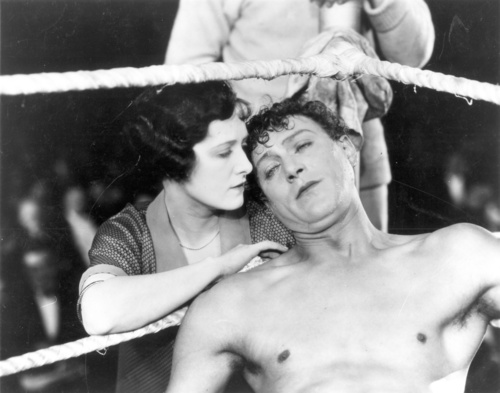
Alfred Hitchcock's only screen writing credit follows the story of two aspiring boxers as they slowly work their way to the top of their game. 'One-Round' Jack (Carl Brisson) works in a carnival show, using the gimmick of being able to knock any challengers out in one round to draw the crowds. When onlooker Bob Corby is reluctantly talked into going a round with Jack, he knocks him out, much to Jack's dismay and surprise. Caught between the two fighters is Jack's girlfriend Mabel (Lilian Hall Davis) who takes a liking to Bob, especially as he begins his rise up the boxing ranks. As Jack's frustration and jealousy grows, so does his success. As the two fight their way to the top, the likelihood of a climatic bout between the two protagonists increases with every fight. Ultimately it becomes a mental and physical battle for the love of Mabel.

The meaning of the title is multi-layered - of course referring the boxing ring, but also the arm bracelet that Mabel receives from Bob that comes to represent the everlasting loop that the three lead characters are caught up in. Although relatively little-seen compared to some of the popular boxing movies, Hitchcock's silent has undoubtedly had a great impact of the sport genre, especially on Scorsese's Raging Bull (1980). Hitchcock was fascinated with boxing - the idea of a physical and mental duel between two gladiators, and also with the dirty feel of the arena. Halls would be filled by both smartly-dressed socialites, and the working-class looking for a bit of escapism. The place would be filled with cigarette smoke, sweat and dirt trampled in by the masses. Although this doesn't quite have the cinematic flair of Scorsese's masterpiece, the photography is clearly comparable, and is extremely impressive given its era. This is Hitchcock's early experiment, where he would develop techniques he would come to perfect in his long-list of truly great films. A fascinating film from the man that would become one of the giants of cinema.


Directed by: Alfred Hitchcock
Country: UK

Rating: ****

Tom Gillespie


The Ring (1927) on IMDb

LinkWithin

Related Posts Plugin for WordPress, Blogger...