Showing posts with label Fantasy. Show all posts

Monday, 6 May 2019

Review #1,476: 'Avengers: Endgame' (2019)

It feels like an eternity since the bald, purple alien madman Thanos (Josh Brolin) assembled his impressive gauntlet with all of the infinity stones and snapped half of our universe out of existence. It was a bold move by writers Christopher Markus and Stephen McFeely and directors Anthony and Joe Russo, and although there were many fanboys in the crowd who knew beforehand that what they were seeing was essentially the first part of two-act structure, the sight of many beloved superheroes dissolving into nothingness was a shock for those who had never read a comic-book in their life.

It's actually only been a year since Avengers: Infinity War, but the secrecy surrounding the plot of Avengers: Endgame (the title was only revealed a few months ago) has kept audiences desperate to see how the remaining heroes will react to their failure. The main question hanging over Endgame's head is how they will handle the devastation left over by Infinity War, and whether certain characters who met their demise last time around will in fact stay dead, or, as is the case in the comic-books, find their way back into the story via one of various means (cloning, parallel universes, time travel, etc.).

Without spoiling anything, Endgame establishes quite early on that there are indeed irreversible consequences to Thanos' victory, and no amount of magic or technological advancement can set things back to how they were. The decimation happened, and those lucky, or unlucky, enough to be left behind are forced to deal with it. Those that didn't fall victim to the snap consist of the original Avengers crew - Captain America (Chris Evans), Black Widow (Scarlett Johansson), Thor (Chris Hemsworth), Hulk (Mark Ruffalo), and Iron Man (Robert Downey Jr), who we find drifting hopelessly in space with only Karen Gillan's Nebula for company.

There's also Jeremy Renner's Hawkeye, an integral member of the crew and surprise no-show in Infinity War, who perhaps has more reason than anybody to avenge the loss of half of all life. The sight of Black Panther (Chadwick Boseman), Scarlet Witch (Elizabeth Olsen) and Spider-Man (Tom Holland) disappearing before our eyes may have been shocking, but Endgame's opening scene pulls the snap right back to a personal level. With his family gone, Hawkeye adopts a new persona and has taken it upon himself to take out criminal organisations Punisher-style.

As the trailer pointed out, people find a way to move on, but our heroes don't. Bolstered by the arrival of uber-powerful hero Captain Marvel (Brie Larson), the gang - along with Don Cheadle's War Machine and Bradley Cooper's Rocket - head into space to make Thanos pay for what he has done. Naturally, things don't go quite according to plan, but when Ant-Man (Paul Rudd) - previously believed to have been a victim when in fact he was trapped in the Quantum Realm - re-emerges with Pym technology and an ambitious plan, the Avengers are handed a glimmer of hope.

I'm deliberately leaving out specific plot points for fear of spoilers. This is a three-hour film, but every second counts in some way to moving the complex plot forward or explaining the mind-bending mechanics at work. While Infinity War barely paused for breath, Endgame begins on a sombre note, before launching us into a breathlessly exciting second act that serves as both as inventive way for our heroes to stand a fighting chance, and a celebration of Marvel's ground-breaking 22-film, 11-year spanning arc.

The third act, a colossal battle between the forces of good and evil that is almost too overwhelming to comprehend, throws lots of fancy effects and punch-ups at the screen. In most other big-budget epics, these climactic smack-downs are when my attention start to wander, but here they are involve characters I have watched evolve over the course of a decade and have grown to love, and when that Alan Silverstri score kicks in at just the right moment, the heart-flutters are inescapable. I'd also be lying if I said I didn't well up on multiple occasions. After all, we knew contracts were up and we'd be forced to say goodbye to at least one of the original heroes, but the future also looks bright for Marvel. For the moment, until Spider-Man: Far from Home arrives in a couple of months at least, Endgame is a near-perfect way to wrap up 11 years of storytelling and character-building, and a warm thank you to the fans who have been there since 2008.


Directed by: Anthony Russo, Joe Russo
Starring: Robert Downey Jr., Chris Evans, Mark Ruffalo, Chris Hemsworth, Scarlett Johansson, Jeremy Renner, Don Cheadle, Paul Rudd, Karen Gillan
Country: USA

Rating: ****

Tom Gillespie


Avengers: Endgame (2019) on IMDb

Saturday, 4 May 2019

Review #1,475: 'The Lego Movie 2: The Second Part' (2019)

Before Phil Lord and Christopher Miller surprised everybody with one of the best films of 2014, the idea of a movie based on a toy line seemed like a rather hopeless idea. Yes, the building blocks and miniature figures of Lego have been adored by both children and adults alike for decades, but they are still produced by a company whose main focus is naturally on your wallets. It felt inevitable that The Lego Movie would be a soulless feature-length advertisement, but not only did it feature some of the most eye-popping CG animation in recent memory (which also felt hand-crafted), it also melted our hearts by taking the action into the real world, where we discover that events are being conjured by the imagination of a young boy. His father, an avid collector played by Will Ferrell, had forgotten the true meaning of playtime. Lego, after all, is about whatever you want it to be.

The Lego Movie wasn't just great, it was awesome. It was also unfairly snubbed by the Academy, but with a worldwide box-office gross of just shy of $500 million, Lord and Miller's film was a huge hit and seemingly the beginning of a lucrative new big-screen franchise. The Lego Batman Movie was next, successfully capitalising on the appeal of Will Arnett's supporting character and opening up Lego's own DC universe. The juggernaut started to creak and show signs of fatigue with The Lego Ninjago Movie however, which arrived the same year as Batman, so the brand was allowed a bit of time to breathe before its next instalment. The big question is does The Lego Movie 2: The Second Part steer this yellow-tinged universe back on course, or has it burnt itself out? The good news is that this sequel is far more the former than the latter, but despite the skills of Lord and Miller on the screenplay (Mike Mitchell has moved in to direct), it does suffer slightly from sequelitis.

The end of The Lego Movie saw the arrival of the real-world family's young girl on the playing field, and with her comes unicorns and Duplo, both unwelcome arrivals in the world built up by the young boy. As a result, Bricksburg has become Apocalypseburg, a Mad Max-esque wasteland turned to dust by the invading Duplo aliens. While Wyldstyle/Lucy (Elizabeth Banks) finds the wastelands a perfect place in which to brood and gaze seriously into the distance, Emmet (Chris Pratt) maintains an upbeat attitude, enthusiastically purchasing his morning coffees and listening to remixes of his favourite song, Everything Is Awesome. Despite being plagued by visions of Armageddon, Emmet builds Lucy their dream home, but their attempts to live a normal life are scuppered by the arrival of intergalactic traveller Sweet Mayhem (Stephanie Beatriz), a mini-doll from the 'Systar System' who has come to take the strongest leader away to marry Queen Watevra Wa'Nabi (Tiffany Haddish). Naturally, that leader is Batman, and he along with Lucy, Benny (Charlie Day), MetalBeard (Nick Offerman) and Unikitty (Alison Brie), find themselves kidnapped and taken to another galaxy.

The premise sounds fun and that's precisely what it is. It maintains the madcap energy of the first film and brings back memorable characters, throwing in more meta-jokes and visual gags than you can shake a stick at. But The Lego Movie was fun and so much more, and Lord and Miller really set the bar high for any future sequels. The Second Part keeps the family thread going, this time with Mom (Maya Rudolph) trying to keep the peace between older son and younger daughter, but doesn't bring anything new to the table. One of the funnest aspects of the original was tying to keep up the amount of characters from both pop culture and real life showing their faces, but the supporting cast seems much thinner this time around. There's a joke about Marvel not returning the calls, and in fact no characters from the world of Disney show their faces. More focus could have been given to other DC figures who show up, particularly Channing Tatum's Superman and Jonah Hill's Green Lantern, who both seem to be having a great time behind the microphone. It's still a rollicking ride, and it only seems like a slight let-down because, somehow, we have come to expect something special from these Lego romps. The film boasts a new catchy song called, um, Catchy Song, which warns 'This song's gonna get stuck inside your head." And in your head it will certainly remain, but the rest of the movie sadly won't.


Directed by: Mike Mitchell
Voices: Chris Pratt, Elizabeth Banks, Will ArnettTiffany Haddish, Stephanie Beatriz, Maya Rudolph
Country: Denmark/Norway/Australia/USA

Rating: ***

Tom Gillespie


The Lego Movie 2: The Second Part (2019) on IMDb

Monday, 15 April 2019

Review #1,469: 'How to Train Your Dragon: The Hidden World' (2019)

Loosely based on the series of books by Cressida Cowell, the How to Train Your Dragon series has grown to become the jewel in the somewhat small and dusty crown of Dreamworks Animation. With Pixar killing it near enough year in, year out, the adventures of reluctant Viking leader Hiccup (Jay Baruchel) and his trusted Night Fury pal are the closest thing that Dreamworks have ever come to the quality and visual splendour of its most fearsome rivals. If you've kept up with the series since its debut in 2010, you'll have watched Hiccup grow out of his father's shadow into a battle-scarred warrior and forward-thinking frontiersman, who brought a close to his tribe's never-ending war with the dragons to discover the fire-breathing beasts actually make for useful and loving friends. The second instalment veered into incredibly dark territory, signalling a maturing tone that matched the protagonist's transformation from nervous kid to an innovator destined to change the lives of his people forever.

The third and presumably final entry into the series, The Hidden World, doesn't darken the tone further - it is still a kids' film after all - but you get the sense from very early on that we are heading inevitably towards an emotional parting of ways. Hiccup and his friends continue their quest to rescue captive dragons and bring them back to the village of Berk to live in harmony with humans. The problem is that they've become so good at their search-and-rescue missions that their home is now overcrowded with the lumbering beasts. Hiccup believes their only hope lies in 'the hidden world, a mysterious and possibly make-believe haven at the edge of the world spoken of by his late father Stoick (Gerard Butler). But cracks start to appear in the young chieftan's plans when his dragon and best friend Toothless happens across a Light Fury, the female of his species. Wild and distrusting of humans, the female bolts from Toothless' advances any time Hiccup shows his face to help, and it becomes clear that if he is ever to see his best bud happy, he must also let his dragon run free.

As ever, there's a dragon-hating antagonist to jeopardise Hiccup's plans in the form of renowned hunter Grimmel the Grisly (F. Murray Abraham), whose own mind-controlled dragons have the ability to vomit acid and melt pretty much anything in their wake. He certainly looks and sounds cool, but Grimmel shares much of the same motivation as the bad guys that come before him, and the character really symbolises the film's overall reluctance to dig that little bit deeper. For me, How to Train Your Dragon 2 really stepped up the game for this franchise, but it feels like returning director Dean DeBlois is happy to ease off the accelerator and ride this trilogy-closer out. If this were practically any other series, The Hidden World would be a delightful surprise, offering up great moments like the opening night-time raid and the sight of Toothless clumsily attempting win over his potential mate, the latter proving to be one of the most charming and heart-warming scenes of the entire trilogy. But with the knowledge of how great this could have been, The Hidden World is a disappointment, fizzling out with an ending that undoubtedly satisfies, but when compared to the emotional wallop of, say, Toy Story 3, plays it rather safe.


Directed by: Dean DeBlois
Voices: Jay Baruchel, America Ferrera, F. Murray Abraham, Cate Blanchett, Gerard Butler, Craig Ferguson, Jonah Hill, Christopher Mintz-Plasse
Country: USA

Rating: ***

Tom Gillespie


How to Train Your Dragon: The Hidden World (2019) on IMDb

Wednesday, 3 April 2019

Review #1,466: 'Mary Poppins Returns' (2018)

With many studios these days greenlighting reboots, spin-offs and remakes, it's actually quite refreshing to get a good old-fashioned sequel to a beloved classic. It worked for Blade Runner, and - somewhat surprisingly - it also works for Mary Poppins. A sequel to Robert Stevenson's 1964 family classic has been stuck in development hell for decades, with original author P. L. Travers proving notoriously difficult to work with. She despised what Walt Disney had done to her work, although she admired certain aspects, so while she was still alive, a follow-up would only see the light of the day on her own very strict terms. We almost saw the return of the nanny who is practically perfect in every way in the 1980s, with a screenplay by Travers and her friend Brian Sibley, but Julie Andrews' reluctance to return meant the film quickly fell apart. Some 55 years later, Poppins finally returns in the form of Emily Blunt, and there is plenty to enjoy for both adults who adored the original growing up and children new to this unique world.

It's 1930, and siblings Michael (Ben Whishaw) and Jane Banks (Emily Mortimer) are all grown up. They remember the nanny who raised them but believe the magic she displayed was all part of their youthful imaginations. Michael is now a widowed banker and takes after his father, while Jane mirrors her mother in that she is ever the optimist. Still living at Cherry Tree Lane and forced to raise his three children - Annabel (Pixie Davies), John (Nathanael Saleh) and Georgie (Joel Dawson) - on his own, things aren't going well for Michael. With grief consuming him, the bills have gone unpaid, and the bank, headed by new chairman William Wilkins (Colin Firth), have served a notice threatening to repossess the house if the loan isn't paid back in full. Spirits are lifted by the re-appearance of Mary Poppins, who offers to look after the children while the adults get their affairs in order. With the help of cheery Cockney lamplighter Jack (Lin-Manuel Miranda), Annabel, John and Georgie are whisked off into a world of musical numbers and talking cartoon animals, and learn that when you think you've reached the bottom, the only way is up.

There's not much going on in terms of plot in Mary Poppins Returns, but things weren't much different last time around. Director Rob Marshall and writer David Magee are far more concerned with pulling you into a fantastical world of catchy songs, breathtaking dance numbers, and lovingly rendered hand-drawn animation. Tunes like 'Tip a Little Light Fantastic' and '(Underneath the) London Sky' are clearly trying to copy iconic moments from the original (with Miranda playing the Dick Van Dyke supporting role), but composer Marc Shaiman and lyricist Scott Wittman have found a way to wonderfully capture the essence of the original while adding a modern twist. Blunt, who seems to be fan-cast for just about every upcoming role, proves to be the perfect choice for Poppins. Stern but playful, strict yet mischievous, she embraces Andrews' iconic performance and adds much sparkle of her own, displaying a knack for comedy timing that went unjustly unrecognised by the Academy. She wouldn't be complete without an enthusiastic sidekick, and Miranda is on great form, speaking with an accent that fares only slightly better than Van Dyke's, but that was all part of what made the original so memorable. Mary Poppins Returns isn't quite practically perfect in every way, but as far as sequels to childhood staples go, it rarely fails to charm or tug the heartstrings.


Directed by: Rob Marshall
Starring: Emily Blunt, Lin-Manuel Miranda, Ben Whishaw, Emily Mortimer, Pixie Davies, Nathanael Saleh, Joel Dawson, Julie Walters, Meryl Streep, Colin Firth
Country: USA

Rating: ****

Tom Gillespie


Mary Poppins Returns (2018) on IMDb

Tuesday, 12 March 2019

Review #1,458: 'Aquaman' (2018)

After a cameo in Zack Snyder's 2016 car crash Batman v Superman: Dawn of Justice and a team-up appearance in 2017's equally disastrous Justice League, the time feels right for one of comic-book lore's goofiest superheroes, Aquaman, to receive his own standalone origin story. After all, Jason Momoa's hulking, tattooed fish-whisperer was one of the surprising standouts of DC's flop team-up event, and with the campy orange-and-green costume replaced by a long-hared and shirtless Kiwi Adonis, the character can now be played straight-faced. Wonder Woman proved that DC could produce quality with the right director pulling the strings, and they pulled off a coup with James Wan, a filmmaker whose talents I have long admired despite many of his films missing the mark for me. So it pains me to say that Aquaman is yet another tonally uneven and bloated effort from Warner Bros. that never quite knows if it wants to make you laugh or feel, with a marathon running time which, by the time is gets round to its umpteenth climax, is about as welcome as a fart in a wetsuit.

In 1985, lighthouse keeper Tom Curry (Temuera Morrison) comes across a beautiful woman washed up on the shores of Maine. The woman is Atlanna (Nicole Kidman), a princess from the underwater nation of Atlantis who has escaped an arranged marriage and a gang of Atalantian stormtroopers. Tom takes her in and the two naturally fall in love, resulting in the birth of the half-Atlantian, half-human Arthur. When her enemies come calling, Atlanna must return to the ocean, leaving Tom to bring up young Arthur on his own. The baby grows up to be the beer-swilling gym-devotee we saw in Justice League, but there is trouble a-brewin' down in the depths. Arthur's half-brother Orm (Patrick Wilson) wants to unite the kingdoms of Atlantis and wage war on the surface, who have been polluting their home for decades. But Orm knows that he will never be accepted as the true leader while Arthur, who has no desire to take the throne, is still alive. Mera (Amber Heard), the daughter of King Nereus (Dolph Lundgren), comes to warn Arthur, but they don't stand a chance against the might of Atlantis without the Trident of Atlan, a magical weapon buried somewhere in the Sahara desert.

Aquaman certainly isn't short of ideas; the problem is that Wan doesn't quite know how to cram them all in. We are taken across continents on land and to multiple kingdoms under the water. With a desire to capture the adventurous magic of Romancing the Stone and Indiana Jones, the film actually trips over its own ambition, squeezing in side characters such as Atlantean Mr. Miyagi Vulko (Willem Dafoe) and the fearsome pirate Black Manta (Yahya Abdul-Mateen II), as well as a variety of underwater races we are expected to remember and littering the story with clunky CGI smackdowns. Wan crafts a colourful, vivid world, full of giant sea-horses and advanced technology, but it shares more in common with the weightless. computer-generated locations of The Phantom Menace than the tangible flamboyance of Black Panther's Wakanda. Yet all of this could be considered a mere niggle had the leads been up to the task, but Momoa and Heard have all the chemistry of two strangers making awkward small-talk in a lift. Momoa is an impressive specimen and possesses the charisma to bring this character to life (see Justice League), but here he is denied a moment to have that quiet moment of reflection or to reveal the flaws to his character that would help make him interesting. A wheezing, confused and sickly bore.


Directed by: James Wan
Starring: Jason Momoa, Amber Heard, Willem Dafoe, Patrick Wilson, Nicole Kidman, Dolph Lundgren, Yahya Abdul-Mateen II, Temuera Morrison
Country: Australia/USA

Rating: **

Tom Gillespie


Aquaman (2018) on IMDb

Monday, 25 February 2019

Review #1,454: 'Fantastic Beasts: The Crimes of Grindelwald' (2018)

Aside from Peter Jackson's epic Lord of the Rings trilogy (the less said about his more recent adaptation of The Hobbit, the better), no cinematic journey into the realms of the fantastical has captured the imagination of audiences in recent years quite as much as J.K. Rowling's Harry Potter, a cash-making juggernaut for both Warner Bros. and the author herself. When the franchise came to a conclusion in 2011, it was never going to be away from our screens for very long, and the 'Wizarding World' universe was expanded in 2016 with the surprisingly charming Fantastic Beasts and Where to Find Them. Like Harry Potter, Beasts managed to find a nice balance between wand-swishing set-pieces, enduring us to a new set of compelling characters, and building a tangible new world for it all to take place in. And with Eddie Redmayne's Newt Scamander - a shy and awkward David Attenborough type - at the centre of it all, the pieces were in place for an engrossing - and different - saga to get out teeth into.

The delicate balance found by Rowling and director David Yates the first time around is sadly nowhere to be found in this follow-up, The Crimes of Grindelwald. This is part two of a five-part story, so introductions are brushed aside in favour of plot, plot and some more plot. The first hour is taken up by bringing this new group of characters back into the fold, finding Newt grounded by the Ministry of Magic following his shenanigans last time around, just as a new threat rears its ugly face in the form of Johnny Depp's muggle-hating Grindelwald. The bad wizard is searching for the troubled Credence (Ezra Miller), who has emerged in Paris with a circus performer called Nagini (Clauia Kim), but Auror Tina Goldstein (Katherine Waterston) is already on the case. It seems as though everybody is searching for Credence. Even the young Albus Dumbledore (Jude Law), who is mysteriously reluctant to face his old friend-gone-bad himself, tries to convince Newt to go to Paris in his stead. Muggle Kowalski (Dan Fogler) is also back with his memory mainly in tact, as is his girlfriend Queenie (Alison Sudol), who is struggling to deal with a Ministry ban on Wizard-Muggle relationships.

The Crimes of Grindelwald throws everything it can into the mix: a rain-soaked battle in the air, Newt caught up in no less than three romantic entanglements, a detour to Hogwarts, and more name-drops and Easter eggs than you can shake a stick at. It's an unfathomable wall of information, punctured by an occasional set-piece that only truly come to life when the titular (and frustratingly sidelined) beasts are involved. The Harry Potter films dodged this bullet by allowing the audience to grow into this world, and often grow up with the characters, but Fantastic Beasts goes all out without really justifying its flagrant disregard for coherency, or earning the right to take such an approach. Although he is often pushed out of the spotlight by the many side-plots occurring, Redmayne just about holds it all together with another endearingly twitchy performance, and Law, who combines some of Michael Gambon mannerisms with a more youthful swagger, proves to be a shrewd bit of casting. Ultimately, this follow-up is too busy moving the chess pieces into place to focus on character, and many are pushed into the background as a result. There are great revelations, but after two hours of trying to keep up with who's who and what's what, they don't have much impact. It isn't enough to derail the series completely, but I'll have a hard time remembering where the hell we are by the time the third entry rolls around.


Directed by: David Yates
Starring: Eddie Redmayne, Katherine Waterston, Dan Fogler, Alison Sudol, Johnny Depp, Ezra Miller, Zoë Kravitz, Jude Law, Callum Turner, Claudia Kim
Country: UK/USA

Rating: ***

Tom Gillespie


Fantastic Beasts: The Crimes of Grindelwald (2018) on IMDb

Sunday, 24 February 2019

Review #1,453: 'Ralph Breaks the Internet' (2018)

While 2012's Wreck-It Ralph is far from Pixar's most accomplished achievement, it was a fun tale of friendship and nostalgia as our two lovable heroes romped their way through a variety of games, both modern and retro. Despite the appeal of its characters, the ending hardly cried out for a sequel, but the world created by Rich Moore and his team of animators offered endless possibilities with which the story could be taken. With demand for 80's and 90's nostalgia at an all-time high, you have to wonder why a sequel took a whole six years to arrive. While one of the main appeals of Wreck-It Ralph was seeing a bunch of familiar characters from your childhood weaved into the story and placed into everyday situations, this follow-up takes Ralph and best pal Vanellope out of their pixelated comfort-zone and into a brave new world of pop-up ads and nightmarish comment sections.

Six years have also passed for arcade-game villain Ralph (John C. Reilly) and glitchy Sugar Rush racer Vanellope (Sarah Silverman), who both enjoy a routine-based life of doing their video game duty by day and knocking back root beers together at night. But while Ralph finds comfort in familiarity, Vanellope longs for something different. In an attempt to cheer up his best friend, Ralph creates a special new track in Sugar Rush, but the stunt backfires when the steering-wheel breaks in the real world and Vanellope is left without a game. However, the shiny new arrival at Litwak's Family Fun Centre and Arcade - the internet - may offer a glimmer of hope in the form of eBay, where one user has a replacement steering-wheel up for auction. So, the two friends venture into this digital metropolis of corporate logos and dead-eyed avatars to buy the part, only they don't have any money to back up their winning bid.

Of course, there's always money to be made on the internet if you know how, and with the help of Yesss (Taraji P. Henson), the algorithm at video site BuzzzTube, Ralph racks up the likes and hearts by becoming a viral sensation. Vanellope's friendship with Ralph is tested when she discovers dangerous open-world racing game Slaughter Race and finds a like-minded friend in bad-ass racer Shank (Gal Gadot). There's a message about the dangers of toxic friendships in there somewhere, but the sweet relationship developed more carefully the first time around is often drowned out by the sheer noise of this online world. There are many great ideas here, such as Alan Tudyk's KnowsMore, an search engine who is always over-eager to predict what you're going to say, and Bill Hader's J.P. Spamley, a click-bait pop-up ad who acts like a desperate, down-on-his-luck salesman. A detour into a Disney fan-site initially reeks of self-promotion, but the company sends itself up rather well, conjuring up an inspired moment involving the entire roster of Disney princesses. Ralph Breaks the Internet is fun and packed with creativity, but struggles to find its heart amidst all the eye-catching chaos.


Directed by: Phil Johnston, Rich Moore
Voices: John C. Reilly, Sarah Silverman, Gal Gadot, Taraji P. Henson, Bill Hader, Jack McBrayer, Jane Lynch, Alan Tudyk, Alfred Molina
Country: USA

Rating: ***

Tom Gillespie


Ralph Breaks the Internet (2018) on IMDb

Friday, 15 February 2019

Review #1,450: 'Mowgli: Legend of the Jungle' (2018)

Whenever a director needs to lend a computer-generated character a much-needed dramatic weight and dimension, Andy Serkis is all but guaranteed to be at the top of anybody's list. The actor took the breath away as Gollum in The Lord of the Rings and again as the magnetic Caesar in the rebooted Planet of the Apes trilogy. So it makes perfect sense that his directorial debut would be motion-capture heavy, with the master himself playing one of the CGI characters. Adapting Rudyard Kipling's novel The Jungle Book has long been a passion project for Serkis, and the film, which was originally entitled Jungle Book: Origins, was scheduled for a 2016 release and set to compete against Disney's own remake of their 1967 classic. To allow more time to work on the special effects, the release date was pushed back to 2017, and then to 2018. As Warner Bros. seemingly became concerned at the idea of a potential box-office bomb, the distribution rights were eventually sold to Netflix. 

This transition to the small screen works both for and against Mowgli: Legend of the Jungle. Although he has voiced his delight at Netflix acquiring his film, it's difficult to believe that Serkis wasn't disappointed that such a personal project wouldn't be seen on the big screen. On the other hand, this has allowed for a much darker tone, and thus bringing it closer to Kipling's original text, without any concern for classification. It's a 12A on Netflix, but I feel the censors may have requested some cuts for a cinema release, and probably rightfully so. This doesn't feature any song-and-dance numbers or King Louie, and the once-cuddly Baloo the sloth bear is now a scarred brute with a Cockney accent. The story is familiar enough, with an orphan boy being left to die in the jungle before being carried to safety by the wise black panther Bageera (voiced by Christian Bale). A wolf pack takes him in, and the boy grows up to be Mowgli (Rohan Chand), only the wolves are never quite convinced of his importance and the man-cub struggles to find his place. 

All is relatively happy until the fearsome, man-killing Bengal tiger Shere Khan (Benedict Cumberbatch) arrives to kill Mowgli, who he feels threatens the very jungle itself. Cumberbatch is far more terrifying than Idris Elba's incarnation, and the effects work is rather astonishing. This level of quality is not maintained however, as for every jaw-dropping close-up of Bageera's face, there is a wolf that looks bizarrely unfinished. And this unevenness runs throughout the film, not only with the special effects, but also with the tone. Serkis' attempt to deliver a different take on the story is admirable and warranted, but the darkness occasionally veers into outright horror. The climax of the film is shockingly brutal when compared to the lighter moments before, and the fate of one of Mowgli's close friends is one of the most disturbing things I've seen for a very a long time. It's undeniably jarring, and will likely scar any unsuspecting children watching for life. While Serkis may struggle to find the perfect balance, it's a bold piece of work by a thoroughly underappreciated actor that at least strives to grasp the deeper themes within the story.


Directed by: Andy Serkis
Starring: Rohan Chand, Christian Bale, Cate Blanchett, Benedict Cumberbatch, Naomie Harris, Andy Serkis, Peter Mullan, Matthew Rhys, Freida Pinto
Country: UK/USA

Rating: ***

Tom Gillespie


Mowgli: Legend of the Jungle (2018) on IMDb

Sunday, 13 January 2019

Review #1,439: 'Alice in Wonderland' (1951)

Long before animation pioneer Walt Disney wowed the cinema-going world with Snow White and the Seven Dwarfs - one of the first feature-length animated films ever made - in 1937, the innovator was long dreaming of adapting Lewis Carroll's books Alice's Adventures in Wonderland and its follow-up Through the Looking Glass. He made a short adaptation called Alice's Wonderland, which mixed live-action and animation, for the Laugh-O-Gram Studio in 1923, but never let go of the idea after the studio went bankrupt and he left for Hollywood. Disney's dream wouldn't be fully realised until 14 years after Snow White, when Alice in Wonderland was finally unveiled in 1951. The film flopped upon release, with audiences failing to be seduced by the many colourful yet incredibly weird characters on show, but through television screenings and subsequent revivals, Alice is now an established classic amongst Disney's animated classics.

As her sister reads under a tree, the young Alice (Kathryn Beaumont) dreams of adventure, choosing to explore her own imagination rather than the tales told in books. As she sings by a riverbank, she spots a white rabbit (Bill Thompson) carrying a huge pocket watch. The White Rabbit is late for an important meeting and dashes off into a large rabbit hole. Ever curious, Alice follows him, eventually entering a world in which logic has no place, everything is backward, and everybody is ever so slightly mad. Her adventure into this strange new world leads her to the rather frightening identical twins Tweedledum and Tweedledee (both voiced by J. Pat O'Malley), a garden of singing flowers who soon reveal their weirdly fascist outlook, a hookah-smoking caterpillar (Richard Haydn), the mischievous Cheshire Cat (Sterling Holloway), and, of course, a truly mad tea party hosted by the Mad Hatter (Ed Wynn) and March Hare (Jerry Colonna). This bizarre world known as Wonderland seems to offer no way out, so Alice seeks help from the tyrannical and homicidal Queen of Hearts (Verna Felton), who has a fondness for removing heads.

There is really no meaning or hidden depths to be found in Carroll's books, and Disney's adaptation is no different. It seems to exist simply as a celebration of the wonders of childish imagination and an opportunity for creative abandon. The result is a nonsensical story with little time for structure or purpose, but one that has stood the test of time through the wonderful characters it imagines. It's an often frustrating experience that offers little sense of direction, and I wouldn't be surprised if some younger viewers were put off by the narrative's excessive randomness or utterly terrified by some of the more sinister characters on show. Yet Disney knew exactly how he wanted to portray these characters, and backed by some stellar talent behind the microphone, Alice in Wonderland prevails as a series of memorable vignettes. The Mad Hatter and Cheshire Cat are now embedded into the fabric of pop culture, and that is mainly thanks to Disney and his team of animators. These are truly insane, even malevolent, characters, but Disney knows how to make them lovable, even when they are toying with our protagonist or leading her further into the madness. It's more a nightmare you can't wake up from than a children's adventure story, and while it won't top many people's lists of favourite Disney movies, there is a unique sense of wonder here that could not be found in Tim Burton's over-stylised 2010 remake.


Directed by: Clyde Geronimi, Wilfred Jackson, Hamilton Luske
Voices: Kathryn Beaumont, Ed Wynn, Richard Haydn, Sterling Holloway, Jerry Colonna, Verna Felton, J. Pat O'Malley
Country: USA

Rating: ***

Tom Gillespie


Alice in Wonderland (1951) on IMDb

Wednesday, 19 December 2018

Review #1,432: 'The Grinch' (2000)

Although his popularity is unrivalled in the US, children's author and illustrator Dr. Seuss is considerably less popular in the UK, where instead Roald Dahl occupies this role as creator of wonderful stories to inspire and influence the imaginations of children across the country. However, this hasn't prevented Ron Howard's The Grinch, or How the Grinch Stole Christmas, from becoming a beloved Christmas movie and establishing itself as a regular feature across the channels over the holidays. Having read the joyful story by Dr. Seuss, which manages to pack in a welcome message about the true importance of Christmas alongside The Grinch's journey from the feared monster at the top of the mountain to humbled hero with a heart two sizes bigger, I fail to understand how anybody can find any magic in this overwrought, ugly and sickly vehicle for Jim Carrey's camera-mugging shtick.

The population of Whoville are eagerly awaiting the arrival of Christmas, frantically hoarding presents and preparing for the yearly 'Holiday Cheermeister' overlooked by the town's narcissistic mayor Augustus Maywho (Jeffrey Tambor). At the top of the mountain casting a shadow over Whoville is the Grinch (Carrey), a joyless and selfish green creature who loathes the Whos and their constant celebrations. Pushed to breaking point by the eternal singing blowing up the mountainside, the Grinch heads into town dressed as Santa to pray a prank on the townsfolk. Precocious 6 year-old Cindy Lou Who (Taylor Momsen) takes pity on the creature and tries talking to him, only to be shoved into a postal machine for her efforts. He ends up reluctantly saving her life however, so Cindy Lou starts to explore his past, learning that he was once an ugly child who ran away after being bullied. She wants to teach him about the true meaning of Christmas and show her fellow Whos that they have nothing to fear by nominating him as the Cheermeister, but the Grinch, armed with a sleigh, his trusted dog Max and a giant vacuum, heads into town with other ideas.

The immediate problem faced by screenwriters Jeffrey Price and Peter S. Seaman when adapting such a short tale is how to fill in the blanks with enough story and character development to stretch into a 90-minute feature, without losing the core message in the process. Apparently their plan was to hope Howard could create a colourful enough world to hold the kiddies' attention to cover up the glaring holes, and to throw in a number of meaningless sub-plots to add unwanted layers to characters who are charming for their simplicity. We get a backstory for the Grinch, along with a love triangle that will surely warm nobody's hearts, and enough time is saved so Jim Carrey can exhaustively flick his fingers and wrinkle his nose when he's not rolling around on the floor or eating glass. The film misses Seuss' point completely by making the Whos a bunch of intolerable consumers with pig-noses, who have long forgotten the more important things to savour during this time of year. It leaves just Cindy-Lou and her father as the only non-soulless, plastic robots with petty problems, so why would we care about them? Of course, it all heads towards the Grinch understanding that there is more to Christmas than material gain and gorging on food, but that doesn't stop the climax from being centred around saving everybody's presents. It's about spending time with your family and loved-ones you see, as long as there's plenty of crap to open come Christmas morning.


Directed by: Ron Howard
Starring: Jim Carrey, Taylor Momsen, Jeffrey Tambor, Christine Baranski, Bill Irwin, Molly Shannon
Country: USA/Germany

Rating: **

Tom Gillespie


How the Grinch Stole Christmas (2000) on IMDb

Thursday, 13 December 2018

Review #1,429: 'The Imaginarium of Doctor Parnassus' (2009)

There are few filmmakers working today with a vision quite as singular as Terry Gilliam, and even less possess the sheer force of will to bring it to the big screen. His battles with producers are now the stuff of legend and, as seen in the wonderful documentary Lost in La Mancha, it literally takes a force of nature to bring one his productions down. While he remains an endearing figure in cinema and will always be a director to watch, he hasn't really made a great film since Twelve Monkeys, and that was over twenty years ago. His more recent films, most notably The Brothers Grimm and Tideland, have underwhelmed and somewhat flown under the radar, and this may have also been the case for his 2009 effort The Imaginarium of Doctor Parnassus if it hadn't been for the tragic death of star Heath Ledger during production.

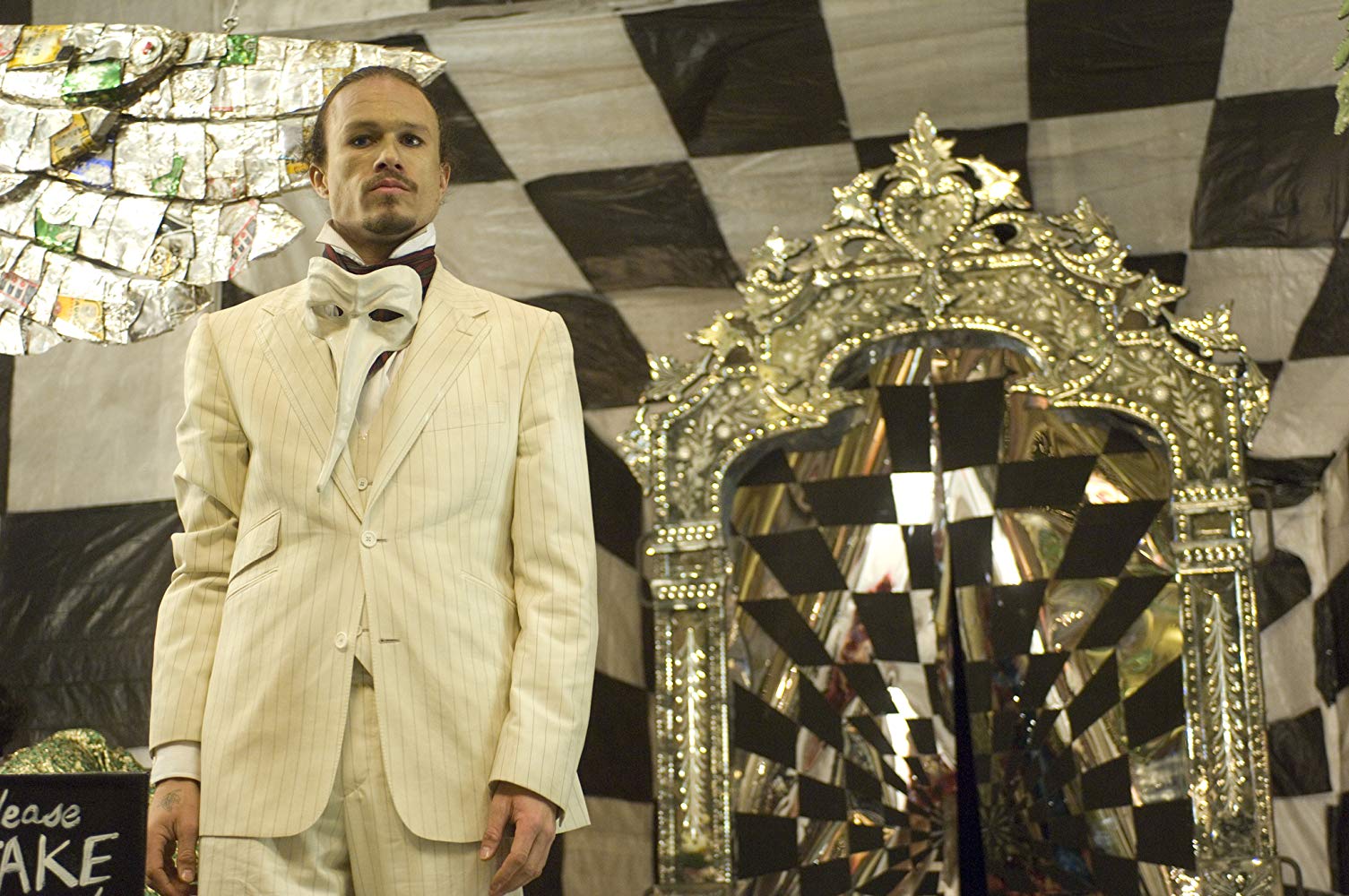
Ledger plays the mysterious Tony, a man found hanging from a bridge by a travelling theatre troupe headlined by the titular Doctor Parnassus (Christopher Plummer). The group also consists of the Parnassus' old friend, the wise Percy (Verne Troyer), the old man's daughter Valentina (a charming Lily Cole), and former beggar Anton (Andrew Garfield), who is head over heels in love with Valentina. Tony has a mysterious and shady past, so he is happy to work for the Imaginarium in an effort to disappear from a very public life, and soon sets about transforming the show's old-timer decor and feeble efforts to attract an audience. Usually setting up the stage in dingy car parks or other undesirable locations, Parnassus' only boast is that of a magical mirror that can transport anybody who enters it into their own imagination. Anton is unhappy at the sudden appearance of this handsome stranger, who naturally attracts the attentions of Valentina, but the troupe may face a larger threat thanks to Parnassus' ancient wager with the Devil (Tom Waits).

There's a great idea in there somewhere, but the script by Gilliam and co-writer Charles McKeown (who also worked together on Brazil and The Adventures of Baron Munchausen) is so haphazard and unsure of itself that it often feels like three films crammed into one. This is no doubt down to the in-production re-writes that were necessary following Ledger's death (Johnny Depp, Jude Law and Colin Farrell were brought in to play alternate versions of Tony when he ventures behind the mirror), so sections of the film feel awkwardly patched together. But there is also much to like. The design of the Imaginarium itself is wonderful in its own tatty, weather-beaten way, and Waits, complete with pencil moustache, cigarette-holder, and that signature raspy voice, is irresistible as Satan himself. The moments set within the imagination are often silly and plagued with questionable special effects, but they also occasionally sparkle with the same kind of magic of Gilliam's Monty Python animation. While it may not be the ideal film to finish his short career on, the film plays a lovely tribute to Ledger and will always be a reminder of the talent we lost far too soon. Sadly, this is likely all Imaginarium will be remembered for, but its a sporadically entertaining ride while it lasts.


Directed by: Terry Gilliam
Starring: Heath Ledger, Christopher Plummer, Andrew Garfield, Verne Troyer, Lily Cole, Tom Waits, Johnny Depp, Jude Law, Colin Farrell
Country: UK/Canada/France/USA

Rating: ***

Tom Gillespie


The Imaginarium of Doctor Parnassus (2009) on IMDb

Monday, 19 November 2018

Review #1,421: 'Mulan' (1998)

Based on the Chinese folktale of a woman who disguised herself as a man in order to battle against the Hun and help protect her homeland, Disney's Mulan came at a strange time for the juggernaut studio. While still riding the wave of its own 90's renaissance in the wake of smash-hits Beauty and the Beast and The Lion King, it was also watching another studio, Pixar, emerge as its greatest competition, and Pixar's use of computer animation was in danger of rendering Disney's traditional hand-drawn pictures obsolete. Of course, Disney would go on to gobble up its rival and take the studio under its sizeable wing, but back in 1998, Mulan, although a box-office hit, didn't leave the same mark as Pixar's effort that year, A Bug's Life. As a result, Mulan was remembered as one of Disney's lesser 90's efforts, but time has aged the film incredibly well. It doesn't feel like one of the last of a dying breed to be pushed out before computer animation took over completely, but a joyous reminder of how timeless and splendid hand-drawn animation can be.

The Huns, led by the fearsome Shan Yu (Miguel Ferrer) have breached the Great Wall and invaded China, causing the Emperor to hand out conscription notices that demand one man from every household. The elderly Fa Zhou (Soon-Tek Oh) has fought his country's wars before, but he nevertheless tosses aside his cane and dusts off his old sword and amour. His daughter, Fa Mulan (Ming-Na Wen), doesn't want to see her withered father march off to his death and so steals the armour and heads off to the join the army in his place. Her country doesn't allow for women to fight, so Mulan ties up her hair, deepens her voice, and puts on her most manly stance for her new commander, the handsome and formidable Li Shang (BD Wong). The spirits of her ancestors summon a tiny dragon named Mushu (Eddie Murphy) who they hope will convince her to return, but the gong-ringer decides instead to help Mulan battle against the Huns. With Li Shang's training and guidance, Mulan and her unit are transformed into warriors, but are they ready to face off against the mighty Shan Yu?

Mulan distinguishes itself from the rest of the Disney back catalogue with its wartime setting and location in a foreign, ancient land. While it may still carry familiar themes of finding your inner strength and being true to yourself, there's no doubting that a darker and more serious tone runs through the story's centre. The violence is kept to a minimum so it's all still family-friendly, but the stakes feel higher, and there's a real sense of dread when Mulan and Li Shang first lay their eyes on the charging Hun. This weightier atmosphere is also helped by Mulan herself, who is less a traditional princess longing to meet her true love than a fully-formed, believable character who is learning to adapt at all costs in a world that will do everything it can to try and stop her. Disney still couldn't resist a tacked-on ending that seems to go against everything that was said and suggested before, which is a shame, as Mulan is evidence that Disney was tackling issues of diversity and gender equality long before it became a social media revolution. This doesn't have the catchy tunes of Beauty and the Beast or the adorable characters of The Lion King, but Mulan has its fair share of moments, packed with elegant animation and compelling action.


Directed by: Tony Bancroft, Barry Cook
Voices: Ming-Na Wen, Eddie Murphy, BD Wong, Miguel Ferrer, Harvey Fierstein, Gedde Watanabe
Country: USA

Rating: ****

Tom Gillespie


Mulan (1998) on IMDb

Sunday, 4 November 2018

Review #1,415: 'Crimson Peak' (2015)

If you were to task both critics and general audiences with naming their favourite active directors, I would place a bet on Guillermo del Toro being the first name on the lips of many. The Mexican monster-lover has the unique ability to juggle both passion projects that clearly mean a lot to the filmmaker, and large-scale blockbusters to appease the studios, and this one-for-me, one-for-you approach has allowed to him to bring to the screen some incredibly personal stories which would have otherwise been left to linger in the director's imagination. So for every The Devil's Backbone, we got a Hellboy, and for every Pan's Labyrinth, we got a Pacific Rim. 2015's Crimson Peak was del Toro's first attempt at blending these two styles. Movie lovers could admire the breathtaking visuals and attention to detail, while the general audience could enjoy a juicy gothic mystery featuring some of the industry's most attractive stars. The result is a very mixed bag.

In turn-of-the-century New York, heiress Edith Cushing (Mia Wasikowska) dreams of becoming an author, but finds herself dissuaded at every turn by the men holding the power. Her father, wealthy businessman Carter (Jim Beaver), is visited by English travelling salesman Thomas Sharpe (Tom Hiddleston), who is seeking investment for his clay-mining machinery. The dashing bachelor is shut down by Carter, but catches the eye of Edith, and two begin a romantic affair. When Carter dies, Edith marries Thomas and travels to his home Allerdale Hall in Cumberland, a decaying mansion dubbed 'Crimson Peak' due to the red clay oozing up from the ground. Joining them will be Thomas' ice-cold sister Lucille (Jessica Chastain), who seems to harbour a resentment for her brother's new wife. But Crimson Peak has stories to tell, and Edith's unexplained connection to the spirit world means that she is frequently visited by hideous tormented ghosts carrying warnings. Back in the U.S., former suitor Dr. McMichael (Charlie Hunnam) is conducting his own research into the Sharpes and their shady history.

Del Toro has always excelled at building tangible worlds which seem to live and breath alongside the characters, and the rotting interiors of Allerdale Hall is one of the director's greatest achievements. Lush with exquisite detail, the house pulses with menace, tormenting Edith with locked doors and taps that spurt red before running clear. There's even a hole in the ceiling that allows snow to gather at the bottom of the main staircase, and the splashes of bold colour evoke the likes of Mario Bava, Dario Argento and Hammer. It's a feast for the senses, and it's just enough to distract from the mediocrity of the main story and the inclusion of CGI spectres. The mystery unravels quite beautifully, but the problem is that you'll already be two or three steps ahead. Nothing that happens in Crimson Peak will come as a surprise, especially after you've quickly realised that anyone with an English accent can't be trusted. The film loses its physicality somewhat when attempting to deliver the scares, as twisted ghosts crawl and squeal their way towards Edith. Computer-generated apparitions will never be scary, and Crimson Peak packs way more impact when catching you off guard with moments of extreme violence that will make you wince and cry out without averting your gaze. Rank this somewhere above Pacific Rim and below Hellboy II.


Directed by: Guillermo del Toro
Starring: Mia Wasikowska, Tom Hiddleston, Jessica Chastain, Charlie Hunnam, Jim Beaver, Burn Gorman
Country: Canada/USA

Rating: ***

Tom Gillespie


Crimson Peak (2015) on IMDb

Monday, 22 October 2018

Review #1,409: 'R.I.P.D.' (2013)

Ryan Reynolds may have gone out of his way to try and obliterate the memories of some of the terrible movie choices he's made over the years during the post-credit scenes of Deadpool 2, but the sheer scale of the misfires he's been caught up in never ceases to amaze. One of the standouts in his filmography of horrors is R.I.P.D., an adaptation of Peter M. Lemkov's comic book of the same name which comes across as a misguided mash-up of Men in Black and Ghostbusters and whose biggest boast is that it's probably just a tiny notch better than how terrible you've no doubt heard it is. The Men in Black comparisons are unavoidable from the get-go, and while the comic was released just as the love for Barry Sonnenfeld's smash-hit was at its highest, Robert Schwentke's adaptation has no excuse for such lazy regurgitation. Seriously, if you replace Will Smith with Ryan Reynolds, Tommy Lee Jones with Jeff Bridges, and aliens for monsters, you have the same movie. Only this isn't good.

Crooked Boston detective Nick Walker (Reynolds) buries gold stolen during active duty in his back garden, hoping the loot will provide a nice rest egg for him and his wife Julia (Stephanie Szotak) in the future. After deciding he doesn't need the money or the guilt on his back, Nick decides to turn it over into evidence, but not before revealing his intentions to partner Bobby Hayes (Kevin Bacon). During a police raid, Bobby informs Nick that he cannot allow the gold to be handed in, and shoots his partner dead. But death is not the end, Nick learns, and on his journey into the afterlife he is hauled into the office of the Rest in Peace Department, a force designed to capture any souls who refuse to pass over and instead remain on Earth, known as 'deados'. His humourless boss Mildred Proctor (Mary-Louise Parker) partners Nick with rugged former United States Marshal and Civil War veteran Roychepus 'Roy' Pulsipher (Jeff Bridges), a gruff figure from the days of the Wild West who speaks like a cowboy with a mouth full of cotton balls.

As R.I.P.D. was the beginning of what the producers hoped would lead on to a fully-fledged franchise, there's a lot of explaining to do. Before the plot involving the Staff of Jericho, the end of the universe as we know it, and the obligatory sky beam even kicks in, there are characters to introduce, rules to set in place and a mythology to establish. When the film isn't busy reeling off exposition, it's a chaotic mish-mash of jarring tones and woefully-realised action, as Nick and Roy bicker their way through the city searching for their targets, employing seemingly random questions and, for some reason, curry, to expose the undead's true, monstrous form. Bouncing aimlessly between slapstick comedy, tedious drama, endless chase scenes, and some hideously rendered CGI action, R.I.P.D. is a cesspit of half-baked ideas. Such hideousness could even be forgiven if the film raised the odd chuckle, or threw in a surprise every now and then, or it's lead star wasn't sleepwalking through the entire thing. Bridges, who actually seems to be relishing the chance to flex his goofy chops, certainly tries his best to liven things up, but even a seasoned Oscar winner isn't enough to save this from the cinematic rubbish pile.


Directed by: Robert Schwentke
Starring: Ryan Reynolds, Jeff Bridges, Kevin Bacon, Mary-Louise Parker, Stephanie Szostak
Country: USA

Rating: *

Tom Gillespie


R.I.P.D. (2013) on IMDb

Sunday, 23 September 2018

Review #1,394: 'Solo: A Star Wars Story' (2018)

During the countless times I watched George Lucas' original Star Wars trilogy as a child, teenager and adult, I don't recall ever wondering how Han Solo became the sarcastic, smirking smuggler that definitely shot first. Ever since Disney acquired Lucasfilm and announced that not only would they be continuing the story that began back in 1977 but would also be giving some of the fan-favourite supporting characters their very own spin-offs, there's been a split in the fandom between those gagging for anything Star Wars related on the big screen again and those opposed to a project that would both render the many beloved novels set in the Star Wars universe as un-canon, and undermine the story already told. Rian Johnson's The Last Jedi is either loved or hated (I loved it), but the one announcement that brought all the fans together in united opposition was Han Solo's very own spin-off, which would be set in the past and not feature the man who helped make the character so iconic, Harrison Ford.

You may not care just how Han won the Millennium Falcon from Lando Calrissian, or how he met Chewbacca, or how he got his hands on that cool blaster, or how he made the Kessel Run in under 12 parsecs - but Solo: A Star Wars Story is going to tell you anyway. While this isn't necessarily a bad thing, it does give Solo a sense of weightlessness and the feeling of a filler episode in the middle of television series with too many episodes. With such little stakes at play, the success of Solo comes down to the charm of its actors, and the casting of Alden Ehrenreich was a very shrewd move indeed. He isn't a famous name, or even a pronounceable one, but his scene-stealing performance in 2016's Hail, Caesar!, where he managed to overshadow the likes of George Clooney, Tilda Swinton, John Brolin and Ralph Fiennes, bristled with star quality. Harrison Ford could never be replaced and Ehrenreich seems to know that, so while every now and then you get a glimmer of Ford's smile and his iconic one-handed shooting stance, Ehrenreich makes the role his own, replicating the charisma and infusing it with a youthful innocence.

We first meet Han hot-wiring cars on Corellia, an awful planet where orphaned children are forced to steal for slug-like gang-boss Lady Proxima (voiced by Linda Hunt). With their lives in danger from the local gangs, Han and his lady friend Qi'ra (Emilia Clarke) decide to make a break for it, but at the airport they are separated, with Han fleeing to join the Imperial Navy and Qi'ra taken away by her pursuers. Three years later, Han is serving in the Military after being kicked out of the Flight Academy, fighting as an infantryman on a planet called Mimban. There he encounters a gang of criminals posing as Imperial soldiers led by the enigmatic Tobias Beckett (Woody Harrelson) and attempts to blackmail them into letting him join them. Instead, he is thrown into a pit for desertion, where he meets the formidable Chewbacca (Joonas Suotamo). They escape and manage to convince Beckett to enlist them for a job to steal a shipment of coaxium. Now officially an outlaw, Han is brought into a dangerous world controlled by a criminal syndicate called Crimson Dawn. Beckett answers directly to crime boss Dryden Vos (Paul Bettany), whose favourite advisor is a young lieutenant named Qi'ra.

Solo likely won't convince those soured by The Last Jedi or especially those who failed to see any potential in Han Solo origin movie in the first place, but it may be a nice, if forgettable, surprise for some. Like the other 'Star Wars Story', Rogue One, Solo was hit with numerous problems during production, the most notable being the firing of Phil Lord and Christopher Miller and the subsequent hiring of Ron Howard. Star Wars has always been a rule-bound universe, and Lord and Miller's loose, improvised style was perhaps too much for studio executives looking for a guaranteed hit. Howard was a reliable, safe choice, but one has to wonder how much fun Solo could have been in the hands of those responsible for 21 Jump Street and The LEGO Movie. What we have is a perfectly entertaining adventure movie that is surprisingly coherent given the patchwork built into it, but nothing worthy of the Star Wars banner. History will remember the film as the first Star Wars flop, and will cause historians to wonder why they didn't choose to given Donald Glover's Lando his own movie instead. On a positive note that will no doubt unite the fan-base, a box-office return of south of $400 million seem to have woken Disney executives up to the idea that there is such a thing as too much, too soon.


Directed by: Ron Howard
Starring: Alden Ehrenreich, Joonas Suotamo, Woody Harrelson, Emilia Clarke, Donald Glover, Thandie Newton, Phoebe Waller-Bridge, Paul Bettany
Country: USA

Rating: ***

Tom Gillespie


Solo: A Star Wars Story (2018) on IMDb

LinkWithin

Related Posts Plugin for WordPress, Blogger...