Showing posts with label Blaxploitation. Show all posts

Saturday, 7 January 2017

Review #1,135: 'Willie Dynamite' (1974)

As all fans of exploitation cinema will know, there were many, many blaxploitation movies released during the 1970s after Melvin van Peebles left an incredibly impression on black audiences with Sweet Sweetback's Baadasssss Song in 1971. While many are rather enjoyable in a comical way, few works of blaxploitation were actually any good. Tony Award-nominated Broadway director Gilbert Moses' Willie Dynamite is incredibly under-seen, but is one of the genre's most impressive works, shunning the usual hyper-stylised, lightly comic beats in favour of something more serious and dramatic, while also touching on themes such as black identity, racism and police corruption.

New York pimp Willie Dynamite (Roscoe Orman) has built himself a mini-empire, training his girls to work like a production line to maximise profits and keep his many customers happy. While his clothes are utterly outlandish (there are some of most ridiculous outfits ever seen in the genre here), Willie ain't no lovable scamp like Super Fly (1972), but a real piece of shit; he regularly threatens his girls with violence, underpays them, and fails to offer any help when they get themselves arrested. When he's late to turn up to court for his most recent arrival Pashen (Joyce Walker), prostitute-turned-social worker Cora (Diana Sands) takes a particular interest, and becomes intent on rescuing Willie's girls and ending his reign of terror.

For a genre normally so rich in exploitative traits, Willie Dynamite contains no nudity and little violence, earning its adult rating instead for language and drug use. The lack of sex and action scenes leaves plenty of room for drama and character building, and Willie's journey to discovering his place in society and ultimately redeeming himself is all the more engrossing for it. Anyone familiar with Sesame Street will be left shocked at the sight of Orman wearing some of the most garish costumes ever committed to celluloid and trying to keep his bitches in check, and it's a very convincing performance. But it is in fact Diana Sands, who sadly died shortly after filming, who steals the film as the force of nature with a gentle side. Ripe for re-discovery, there's much more to Willie Dynamite than I would have ever expected. Now, bring me some scratch.


Directed by: Gilbert Moses
Starring: Roscoe Orman, Diana Sands, Thalmus Rasulala, Joyce Walker, Albert Hall
Country: USA

Rating: ****

Tom Gillespie


Willie Dynamite (1974) on IMDb

Wednesday, 7 August 2013

Review #643: 'Foxy Brown' (1974)

After the huge success of Coffy (1973), American International Pictures wanted more blaxploitation, namely in the form of Pam Grier's sexy, female empowered ass-kicker. Coffy made Grier an overnight star, but not wanting to make a sequel after seeing a few sequels of other franchises fail at the box-office, they hastily re-wrote the script for Burn, Coffy, Burn!, and created Foxy Brown. They kept writer and director Jack Hill, and made a film about basically the same character. Yet Coffy and Foxy Brown are arguably as popular and as iconic as each other - Foxy maybe even more so - and this is mainly due to Foxy Brown being a pretty decent film, despite familiar plotting and genre tropes.

When her boyfriend is gunned down by a bunch of gangsters, Foxy Brown goes undercover to infiltrate a prostitute ring posing as a modelling agency. Her dead-beat brother Link (the amazing Antonio Fargas) tells Foxy that the group - led by strange and kinky couple Steve (Peter Brown) and Miss Katherine (Kathryn Loder) - are the people responsible. Violence, drugs and explosions soon follow as Foxy pursues her thirst for vengeance, and helps fellow black woman Claudia (Juanita Brown) to escape a life on the game,

It's a revenge premise seen a thousand times before, but Foxy Brown is often a blast. Grindhouse trailers often dazzle and confuse us with endless action scenes and violence promising a wonderful experience, only to submit us to 90 torturous minutes of amatuerish crap. Yet Foxy Brown certainly delivers on its promises. It's noticeably more violent than other blaxploitation films, with Jack Hill's wit surprisingly shining through moments of forced heroin addiction and pickled cock. But it's Pam Grier that steals the movie, pulling guns out of her 'afro and simply being 'a whooooole lotta woman!' (as recognised by her own brother) throughout, displaying the charisma that would make her a 70's icon. It doesn't break any boundaries, even by action standards, and there are certain plot holes you have to try and ignore (what does Foxy Brown actually do?), but it's 95 minutes of solid exploitation fare.


Directed by: Jack Hill
Starring: Pam Grier, Antonio Fargas, Peter Brown, Kathryn Loder, Sid Haig
Country: USA

Rating: ****

Tom Gillespie


Foxy Brown (1974) on IMDb


Tuesday, 28 August 2012

Review #474: 'The Human Tornado' (1976)

Rudy Ray Moore reprises his comic character creation, Dolemite, the hyperbolic, Mohammed Ali-jive-talking, rhythmic discoursing, man of the people. The sequel to 1975's Dolemite, the film offers nothing new to the series, or to blaxploitation cinema, but simply adheres to the generic signifiers, such as female nudity, car chases, and the ubiquitous kung-fu cross-over. But significantly for the stylistic variations of the sub-genre, the subject of racism is the most evident theme - despite the fact that blaxploitation is readily accused of reverse racism (a term I have never understood, as this would suggest that racism is a purely white condition - it's all xenophobia).

Dolemite is caught in bed with the local red-neck sheriff Beaty (J. B. Baron)'s wife, who is then shot dead by his deputy. Escaping this situation, Dolemite flees to California, and the sheriff's crew follow, pinning the crime upon Dolemite. Lady Reed also reprises her role as Queen Bee, and she along with "her girls" have their club shut down by the mob, and it is up to Dolemite to settle the score.

Undoubtedly taking into account the failings of Dolemite, the sequel increases much of what makes exploitation cinema exciting. The violence is more nuanced, there is a lot more naked flesh on display, but more significantly, the comedy is far more indulgently silly, over the top ridiculousness. It's those rhythmic one-liners that Moore produces that increase the enjoyability of the film. And of course (as previously stated), no blaxploitation film would be complete without that other ethnic sub-genre, kung-fu, and here we are enthralled by the ferocious work of the Central American Nunchuck Champion, plus an early role for future Ghostbuster, Ernie Hudson. Marginally better than its predecessor, it has a strange ability to be both dull and exciting.


Directed by: Cliff Roquemore
Starring: Rudy Ray Moore, Lady Reed, Jimmy Lynch
Country: USA

Rating: **

Marc Ivamy


The Human Tornado (1976) on IMDb


Review #471: 'The Black Gestapo' (1975)

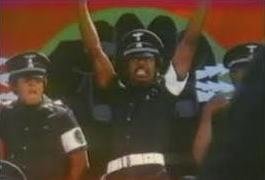
One of the many blaxploitation with the title prefix Black... (...Samurai, ...Caesar, ...Aphrodite), Gestapo also manages - rather uncomfortably - to incorporate the iconography of Nazism, bringing another of the popular sub-genre's of the exploitation market, that together make nazi-blaxploitation. "The People's Army", a vigilante group headed by General Ahmed (Rod Perry), are set up in Watts to protect black citizens in the inner city. After they run a white criminal organisation from the community, second in command Colonel Kojah (Charles Robinson), breaks the group in the middle to form his own, more fascistic group, indulging in money-making activities such as drug dealing, and orates for more direct, violent action.

Writer-director Lee frost (along with co-writer-producer Wes Bishop), has obviously, and incredibly insensitively, misinterpreted the black power movement in the late 1960's/'70's - particularly the Black Panthers - and presented it with Nazi iconography. It's an uncomfortable juxtaposition to see a group of black men congregated on a ghetto basketball pitch, dressed fully in the garments of the most vilified, ultra-racist political movement of the twentieth century. Why exactly would anyone (but particularly an ethnic minority), take on this most instantly recognisable of images?

There does seem to be an attempt to perhaps represent the opposing views of the two major iconic black figures of the 1960's. In Ahmed we have the message of non-violent protest from Dr. Martin Luther King Jr., whilst Kojah's view of violent actions mirrors the philosophy of Malcolm X, and his pronouncement of using violence in self-defence. But maybe I'm just reading into something that's not actually there. When the film isn't insulting its audience, it displays nothing new to an already lagging genre, and simply presents generic tropes: Blaxploitation was always criticised for perpetuating racial stereotypes, but this film could indeed be guilty of far more. With a series of scenes-we've-seen-before, such as the castration of a white man, after he raped a sister, the film also uses the contemporary necessities such as soft female nudity. Action scenes are played out with little excitement or even much vigorous movement, which along with the amateurish film making makes this film a totally dull squib. So... Hardly the "New Master Race," instead simply insulting to anyone who watches.


Directed by: Lee Frost
Starring: Rod Perry, Charles Robinson, Phil Hoover
Country: USA

Rating: *

Marc Ivamy


The Black Gestapo (1975) on IMDb


Sunday, 26 August 2012

Review #466: 'Truck Turner' (1974)

Blaxploitation films are so frequently ridiculed and parodied (much of it with reason) these days, that it's easy to forget that some of them were actually pretty good. Shaft (1971) paved the way for the sub-genre with its strutting bad-ass lead who's a sex-machine to all the chicks, and Isaac Hayes' Oscar-winning score (for what he will forever be best remembered for). Hayes himself steps into the lead role here as ex-American football star and bail bondsman Mac 'Truck' Turner, who according to Yaphet Kotto's bad-guy pimp Blue, is "like a bulldog with eyes up his ass!", and displays some surprisingly charismatic qualities that makes it quite a shame he didn't appear in more.

Greasy lawyer Fogarty (the great Dick Miller) employs bounty-hunters 'Truck' Turner and his partner Jerry (Alan Weeks - with the best grin in cinema) to track down a low-down pusher and pimp named Gator (Paul Harris). After an extended chase scene, Turner and Jerry manage to kill Gator, much to the dismay of Gator's lady Dorinda (Nichelle Nichols - Uhura!). Dorinda rounds up the big pimps and offers her valuable collection of whores in exchange for Turner's head, a deal in which Blue accepts. Wanting to settle down with his girlfriend Annie (Annazette Chase), Turner finds his life turned upside when Blue employs a gang of hired killers.

Beginning almost as a buddy-comedy, the witty script and some genuine chemistry serve up some amusing early scenes, showing off Hayes' natural screen presence. But this turns into pure police procedural blaxploitation as the main plot kicks in, with jive-talk, pimps in some of the most delightfully ludicrous dress I've ever seen, car-chases, slow-motion shoot-outs, cocaine, hookers, and of course a tragically neglected soundtrack from Hayes himself. The action scenes are surprisingly good, and Corman protege Jonathan Kaplan (director of fellow Grindhouse Project feature Night Call Nurses (1972) - review #443) makes sure he includes as much slow-motion men falling off rooftops and gushing fake blood as possible. Bloody good fun, and probably better than Shaft.


Directed by: Jonathan Kaplan
Starring: Isaac Hayes, Yaphet Kotto, Alan Weeks, Annazette Chase, Nichelle Nichols, Dick Miller
Country: USA

Rating: ***

Tom Gillespie


Truck Turner (1974) on IMDb


Monday, 2 April 2012

Review #366: 'Black Caesar' (1973)

Not one to miss on an opportunity, Larry Cohen's second feature film utilised the explosion of blaxploitation cinema after the successes of Sweet Sweetback's Baadasssss Song (1971) and Shaft (1971), and crafted his own "black" action film, modelled on the 1931 film Little Caesar. Fred Williamson plays the titular role, a boy from the streets, witnessing and being victim of brutality from the white community, and particularly a local police officer, McKinney (Art Lund). As an adult, Caesar's goal is to become kingpin of Harlem, and he won't let anything stand in his way.

The narrative is a story told over, which focuses on a person who looses everything in the pursuit of power, including childhood friends, wives, and particularly looses sight of the person that they are. It's always great to watch a Cohen movie from this period. When filming in the streets (in this case New York - of which is his usual setting), his guerilla-style is self evident: clearly in the making of these films, Cohen does not get any kind of permission to film, he simply turns up and does it. In one scene, Williamson has been shot, the camera follows him down the busy street from a roof top, and passers by seem to want to help him. It's these elements of exploitation cinema that I embrace.

Whilst this is certainly not one of Cohen's greatest (check out his horror output for some terrifically socio-political subtexts), the film oozes charm. Not only do we have the easy-cool of Fred Williamson, the film also has the ubiquitous Gloria Hendry , although not in her usual kung-fu-influenced fighting mode. Even though this film is less well known than Shaft or Superfly (1972), who's soundtracks were composed by soul giants Isaac Hayes and Curtis Mayfield respectively, Black Caesar's soundtrack is provided by the godfather of soul himself, James Brown: Break it down! Heeyyyyaa!!


Directed by: Larry Cohen
Starring: Fred Williamson, Gloria Hendry, Art Lund, D'Urville Martin
Country: USA

Rating: ***

Marc Ivamy


Black Caesar (1973) on IMDb

Tuesday, 20 March 2012

Review #355: 'Dolemite' (1975)

"Dolemite's the name, and fucking motherfuckers is my game." This line is symptomatic of the dialogue in most of the many blaxploitation films of the 1970's, a brand of exploitation cinema that revels in the violence and fashion of the black ghettos: It is in fact the first instance in cinema history that black actors were able to be the star. Dolemite (played by blaxploitation king/"godfather of rap"/disco godfather, Rudy Ray Moore) has been set up by corrupt cops, city mayor and the local king-pin, Willie Green (D'Urville Martin - also director), and sent to prison for 20 years. However, Queen Bee (Lady Reed) and a prison officer set him free so that he may get revenge on those who cheated him of his freedom, and clean the streets of these corrupt figures in society.

It is a pretty standard blaxploitation flick, with the requisite iconography: the ultimate '70's pimp look; a hareem of sexy girls (credited here as simply Dolemite girls); the obvious influence of Bruce Lee with a healthy dose of kung-fu; and, of course an almost perpetual presence of the boom-mic in-shot. It's unfortunate that through the majority of the list on our Grindhouse Project, we are offered pretty dull movies, which look incredibly action-packed and fun in a 2 minute trailer, but fails to be either when expanded to it's full 90 minutes.

This sub-genre was incredibly short-lived, and became pretty generic, and the acting throughout is appalling. However, despite the disappointment of the pace compared to the trailer, and the obvious stereo types, the film still has elements of fun, and a preacher who hoards a massive cache of weapons in his church. So I'm guessing that I should at some point watch the sequel, The Human Tornado (1976).


Directed by: D'Urville Martin
Starring: Rudy Ray Moore, D'Urville Martin, Lady Reed
Country: USA

Rating: **

Marc Ivamy


Dolemite (1975) on IMDb


Wednesday, 12 October 2011

Review #244: 'Sweet Sweetback's Baadasssss Song' (1971)

A young black orphan is picked up by a group of women who feed him and give him a job as a towel boy in their brothel. One of the women seduces him and the two have sex. Due to his apparently large member, the woman, in a fit of ecstasy, nicknames him 'Sweetback'. When Sweetback is grown, he is employed as a male prostitute who performs for rich folk. When he witnesses police brutality on a black man, he beats up two police officers and goes on the run. The film follows his plight in a picaresque fashion, and he makes his way across a corrupt and discriminative America.

Generally regarded as the first blaxploitation film (although whether it is in fact exploitation is questionable), Sweet Sweetback influenced a whole generation of film-makers, and gave a new voice to a social minority with a lot more to say than the majority. Director Melvin van Peebles (father to Mario), who also plays the eponymous hero, funded the project himself (with a little help from Bill Cosby), and the film went onto gross $4.1 million. The film became required viewing for members of the Black Panthers, and Sweetback himself can be seen giving the Panther first sign.

As socially and historically important as this film is, it's still not very good. Apart from van Peebles' use of some innovative jump-cuts and camerawork, I found the film hard work. The terrible editing often renders scenes unwatchable, and I had trouble even following what was happening during some of the fight scenes. Often characters just babble seemingly meaningless rubbish at the camera. I must also mention the very uncomfortable first sex scene which borders on child porn, which depicts a boy (played by Mario) of around 12 having sex with a woman, the both of them being completely naked. Very weird.

Van Peebles himself appears in a few sex scenes, that are apparently unsimulated. He actually contracted gonorrhea during the shoot, and claimed workers compensation. This is a film all about black domination - Sweetback's large penis and sexual prowess standing for black superiority. As well as sexually, the black community are seen as superior mentally (the community pull together to outwit the police and protect Sweetback) and physically (Sweetback overpowers two policemen in a bar brawl). You can feel the anger and the desire to fight back in every scene.

Still, as interesting as the film is in a social context, this is extremely amateurish stuff. The last half an hour sees Sweetback running endlessly while the camera jumps around showing various landmarks to the sound of an extremely repetitive soundtrack. It goes on and on and on. But I suppose that any film that is indirectly responsible for Disco Godfather (1979) can't be all bad.


Directed by: Melvin Van Peebles
Starring: Melvin Van Peebles, Simon Chuckster, Hubert Scales
Country: USA

Rating: **

Tom Gillespie


Sweet Sweetback's Baadasssss Song (1971) on IMDb

Wednesday, 22 June 2011

Review #135: 'Boss Nigger' (1975)

Made at the height of the Black Power movement, Boss Nigger (or The Black Bounty Killer) is a blaxploitation western that was written and co-produced by genre legend Fred Williamson. Boss (Williamson) and his friend Amos (D'Urville Martin) are bounty hunters who are looking for wanted man Jed Clayton (William Smith), in order to claim a big reward. When they arrive at a small town where they suspect he may be, they discover it has no sheriff, and is instead being run by corrupt Mayor Griffin (R.G. Armstrong). Tired of being controlled by those damn 'whities', they instate themselves as sheriff and deputy, and stamp their own brand of law enforcement on the community.

Whether this is a genuinely angry film, made in the midst of racial tension and the rise of Black Power, or a satirical play on a familiar scenario with the roles reversed, I'm not sure. It certainly made me feel uncomfortable every now and then. There is only one white character in the whole town that treats the Boss as an equal, and he is quick to stamp his superiority over her as he seduces her. I know, this is a blaxploitation film and the theme is practically always sticking it to the whities, but this is the kind of stereotyping that the black community were experiencing themselves at the time, which leads me to believe that it may in fact be a play on this.

However, racial themes aside, this is actually a pretty enjoyable western. It doesn't break any boundaries, but it's a delightfully old-fashioned new-sheriff-in-town story, that is suitably both amusing and action-packed when it needs to be. As the Boss, Williamson employs his impressive screen presence the same way he did in Larry Cohen's Black Caesar (1973), taking no shit from the townsfolk, and charming the ladies. It also benefits from the fact that is had a bit of a budget, as opposed to most blaxploitation films which often looked cheap and amateurish. Good, bloodless fun, that drops more 'N' bombs than a BNP rally.


Directed by: Jack Arnold
Starring: Fred Williamson, D'Urville Martin, William Smith, R.G. Armstrong
Country: USA

Rating: ***

Tom Gillespie


Boss Nigger (1975) on IMDb

Thursday, 24 March 2011

Review #38: 'Disco Godfather' (1979)

It's rare that a film can be simultaneously the greatest and worst film ever made. Herschell Gordon Lewis regularly almost achieves this, notably with his disease-inducing classic The Gore Gore Girls (1972), a film that is so balls-out awful, offending every possible sense in every conceivable way, yet making you laugh so hard that the negatives threaten to almost become redundant. The Grindhouse and blaxploitation genres are 99% awful films. You watch the trailer and wonder how it can fail to be anything but a masterpiece. But then you watch the film and wonder how the director can stretch it out to a 90-minute movie, and also how you can possibly stay awake amongst all the visual crud on display. Yet Disco Godfather is somehow different. Yes, it's fucking awful. It really is. But it's also very, very special.

Tucker Williams is a retired cop who now spends his days wearing crappy, Salvation Army-esque sparkly spandex suits and has re-invented himself as the Disco Godfather. When he's not DJ-ing and demanding that the crowd 'put their weight on it!', he also indulges in a bit of dancing - that is moving his hips in uncomfortable looking motions while brandishing his disturbingly wide and sparkly white grin. But when a new drug hits the street, the Godfather must put aside his disco days and use his street experience to tackle to scum that is putting the 'whack' on the streets, killing the youth and sending one of his family members crazy.

The first half an hour genuinely tested my patience with endless shots of people dancing in a disco while the Disco Godfather shouts an endless of array of quotable lines over the microphone. And the same disco song playing over and over and over again. And then a bit more. But then the 'plot' kicks in and it becomes a riot. From the moment Disco Godfather is paid a visit and is told about his nephew Bucky, lying in a hospital bed, going out of his mind from 'whack' intake, and he stares her in the face and says 'where is Bucky, and what has he ha-yad?', I knew this was an instant classic. Rudy Ray Moore, who plays the eponymous Godfather, was primarily a stand-up comedian in the same vein of Richard Pryor. Thank God the man was good at comedy (I hear) because he would have been laughed out of the audition room if he hadn't. The man is awful at acting. And thank God for it.

The film has so many classic moments it's impossible to comment on them all. An early scene has an ambulance driver, on the scene to rescue another victim of the whack, refer to Tucker as 'Disco Godfather', regardless of the fact that they have never met and the man looks like he wouldn't be seen dead in a disco. Another great scene has the Godfather kung-fu kicking the ass of a gang of henchmen, only to call on a passer-by for help, who coincidentally also possesses the ability to kung-fu kick the ass of henchmen, and proceeds to do so. A film of many delights, and I urge anyone who breathes to track this down and watch it. I feel aggrieved that I have to give this film one star. But I have to, it's phenomenally awful, and the laughs are unintentional. But they are there, and I loved it. You'll be shouting 'put yo' weight on it!' for days.


Directed by: J. Robert Wagoner
Starring: Rudy Ray Moore, Carol Speed, Jimmy Lynch
Country: USA

Rating: **

Tom Gillespie


Disco Godfather (1979) on IMDb


LinkWithin

Related Posts Plugin for WordPress, Blogger...