Showing posts with label 1986. Show all posts

Monday, 31 December 2018

Review #1,435: 'Night of the Creeps' (1986)

Fred Dekker's Night of the Creeps is only of many 80's horror movies that failed to find much of an audience upon its initial release, but has gathered a cult following over the subsequent years through scuzzy VHS tapes passed between fans and late-night showings on cable TV. It's now available on near enough every format, so you have no excuse not to check out this endearing little gem, especially if you're a fan of genre film-making and movies of the 80s in general. Dekker, who made his debut here and would go on to direct The Monster Squad and Robocop 3, is clearly a fan of horror movies and blends many of his favourite influences into the increasingly gory events. The result is a blast for fans, who'll enjoy spotting the name-drops amongst the various characters and the way it sticks closely to the rules of the genre. Yet Night of the Creeps can also feel like a bunch of your favourite movies re-arranged and plastered together to form an admittedly fun 90 minutes.

In the 1950s, an alien craft carrying slug-like creatures crashes down to Earth. At a nearby lover's lane, a boy heads out into the woods to investigate and comes across a canister, which naturally explodes in his face and unleashes the squirmy extra-terrestrials, one of which makes its way inside the unsuspecting boy orally. The girl, who is left behind in the car, meets an unfortunate demise at the hands of an escaped serial killer before a rookie cop blows the mad man away. Fast-forward to 1986, and teenager Chris Romero (Jason Lively) wants desperately to hook up with sorority girl Cynthia Cronenberg (Jill Whitlow). Backed by his best friend J.C. (Steve Marshall), the clueless twosome figure that the only way to impress Cynthia is to join a fraternity. To enter the Beta Epsilon fraternity - which is headed by Cynthia's douchebag of a boyfriend - Chris and J.C. are tasked with stealing a corpse from the nearby medical centre and placing it front of a sorority house. They break in easily enough, but what awaits them is the cryogenically frozen body of the unfortunate boy from the opening scene. Naturally, the cadaver escapes, and soon enough the town is overrun with zombies and giant slugs looking for a host.

There's a real energy and spirit to Dekker's film that is lacking from many low-budget horror movies from the same era, but what drags the movie down is a lack of any original ideas of its own. While there's fun to be had with spotting references to other (and better) films (Dick Miller even shows up for an obligatory cameo), this can often feel like a lazy way to patch up the lack of anything fresh. They also missed a trick by relegating beaten-down detective Cameron (Tom Atkins) to a supporting character. He has all the best lines and Atkins is clearly enjoying himself in the role, so you can only wonder how better the film would have been if our guide was an emotionally-scarred and wise-cracking old dog rather than a couple of sad-sack horny teenagers looking to impress a girl. That said, Night of the Creeps delivers exactly what its target audience - those still awake in the early hours - requires, and manages to round-up practically everything that is charming about low-budget 80's B-movies, even touching on the teen sex comedies made popular by the likes of Porky's. It perfectly sets itself up for a sequel before its box-office returns put a quick end to that idea, but it's never too late.


Directed by: Fred Dekker
Starring: Jason Lively, Tom Atkins, Steve Marshall, Jill Whitlow, Wally Taylor
Country: USA

Rating: ***

Tom Gillespie


Night of the Creeps (1986) on IMDb

Thursday, 27 December 2018

Review #1,433: 'Dead End Drive-In' (1986)

After the global success of low-budget exploitation flick Mad Max, the Australian film industry underwent a revolution, built mainly around fast cars, a rebellious attitude, and a satirical look at the 'dangerous' youth of the day, all within a post-apocalyptic, near-future setting. One of the directors at the forefront of the Ozploitation movement was Brian Trenchard-Smith, the man behind such cult classics as Turkey ShootBMX Bandits and The Man from Hong Kong. The director referred to his best work, Dead End Drive-In, as a mixture of Mad Max and Luis Bunuel's The Exterminating Angel, and although he was clearly over-reaching by comparing his film to two established classics, there's much more going on here than punk teenagers, souped-up classic cars and boobs. Yes, Dead End Drive-In is just as concerned with social and economic commentary as it is with loud music, B-movies and vehicles smashing into each other.

In the near-future, society has crumbled amidst economic collapse, and small gangs of mohawked ne'er-do-wells scour the cities for car parts. With manufacturing at an all-time low, cars are now a commodity so criminals cruise the streets looking for accidents in the hope of swiping rare parts for profit or to pimp out their own method of transportation, while rival salvage companies battle it out for scraps. Workout junkie Crabs (Ned Manning) has little trouble getting his hands on an impressive ride - his burly older brother possesses a 1956 Chevy - and he manages to persuade his sibling to loan him the chick-magnet for a date with his girlfriend Carmen (Natalie McCurry). A night at the flea-pit local cinema followed by a night of steamy passion is clearly on Crabs' mind, but this particular drive-in has a little secret. Surrounded by high fences and S-roads that don't permit walking, the drive-in is actually a concentration camp that keeps its inhabitants - horny, trouble-making teenagers - prisoner. While the residents of the graffiti-laden hellhole appear content with their responsibility-free existence of booze, drugs and sex, Crabs does everything he can to persuade the creepy owner (Peter Whitford) to help him escape.

Described as a sort-of offbeat Mad Max clone upon its release, the comparisons to George Miller's grindhouse favourite seem a little lazy. While both films share a fetish for automobiles and a concern for the economic climate, the only other similarities are the accents and a grungy aesthetic. Dead End Drive-In doesn't litter the story with action scenes, and although it is book-ended by some impressive stunt-work, the film takes it down a gear during the middle section to explore the madness of Crabs' situation. The idea of a makeshift concentration camp for the apparently disenchanted youth is interesting enough, but the crazy idea that the prisoners within the walls are in fact happy to stay lend the film a unique and rather pleasantly maddening tone. If you've ever been stuck within a dream where nobody can understand you, you'll empathise with Crabs' plight, despite his unfortunate nickname. While the dip in pacing may infuriate exploitation fans hoping to see leather-clad warriors of the apocalypse battling it out on jacked-up vehicles, it only increased my curiosity, and while Trenchard-Smith doesn't explore its themes with enough care to make the film truly resonate, Dead End Drive-In is one of the more thought-provoking and off-kilter efforts from the age of Ozploitation.


Directed by: Brian Trenchard-Smith
Starring: Ned Manning, Natalie McCurry, Peter Whitford, Wilbur Wilde
Country: Australia

Rating: ****

Tom Gillespie


Dead End Drive-In (1986) on IMDb

Wednesday, 14 November 2018

Review #1,419: 'Gothic' (1986)

The story goes that during the summer of 1816, renowned British poet and philanderer Lord Byron invited fellow poet Percy Bysshe Shelley and his wife Mary Godwin to stay at his grand Villa Diodati in Switzerland. As the weather took a nasty turn and a storm raged outside, the threesome, along with Byron's physician Dr. John Polidori and Mary's stepsister Claire Clairmont, gathered around the fire to share ghost stories. This event allegedly spawned two incredibly influential works of literature, although they didn't come from the poets. Mary Godwin, who would become Mary Shelley, released Frankenstein, or the Modern Prometheus in 1818, and Polidori would go on to pen The Vampyre, the first published vampire story and obvious inspiration for Bram Stoker's Dracula. It's the kind of myth rooted in fact that has filmmakers licking their lips. James Whale used this gathering as a framing device for The Bride of Frankenstein, but Ken Russell took his own idea and ran with it, and the result is a strange, psychosexual horror that fails to really fit into any discernible genre.

We begin with a group of socialites gossiping amongst themselves as they spy on Lord Byron's mansion through a telescope. I supposed this is meant to be us, the viewer, as we giddily peak behind the doors of a known rascal as he awaits the arrival of some of the most soon-to-be-revered writers in Britain. Percy (Julian Sands) and Mary (Natasha Richardson) arrive, and Byron, played by Gabriel Byrne, watches them with indifference. His mistress Claire (Myriam Cyr) and physician Polidori (Timothy Spall) are already there, enjoying the freedom of Byron's home. As the drinks start to flow, Byron start to read excerpts from Phatasmagoria, a book containing many horror stories, and the group decide to have a seance around a human skull. Immediately after, Claire has a seizure and strange events start to take place. Paintings come alive, odd noises can be heard around the house, and Polidori attempts suicide after experiencing paranoid episodes. Is Byron behind it all? Are supernatural forces really at work? Or are the literary darlings simply seeing their unpublished work come to life?

I'm a huge fan of Ken Russell and his unique, easily-distracted style of film-making, but Gothic is the first film I've seen of his that didn't quite work. He seems to have a million different directions he would like to take Gothic but heads towards all of them at same time. There are dark sexual undercurrents at play, particularly with Byron and Claire's apparently violent and toxic relationship, but they are never fully developed. It seems to have aspirations to be a horror, but Russell simply isn't disciplined enough to follow the genre rule-book. This refusal to conform can often achieve greatness, but Gothic ends up as little more than a collection of slightly camp vignettes involving characters running and screaming down corridors or making spooky statements as the thunder rumbles outside. It also isn't helped by Julian Sands' uniformly terrible performance, whose interpretation of a Romantic poet is to prance around shirtless and blubber like a child. Byrne is perfect casting as the bored poet yearning for new experiences, as is Spall as the creepy, reptilian Polidori. It also looks beautiful, from the sets to the costumes, but it isn't enough to save this from being a rare miss from Russell.


Directed by: Ken Russell
Starring: Gabriel Byrne, Julian Sands, Natasha Richardson, Myriam Cyr, Timothy Spall
Country: UK

Rating: **

Tom Gillespie


Gothic (1986) on IMDb

Saturday, 1 September 2018

Review #1,387: 'Poltergeist II: The Other Side' (1986)

Back in 1982, Tobe Hooper's Poltergeist terrified audiences with state-of-the-art special effects and a story of unseen supernatural forces at work in suburban USA. It's rather tame if watched back today, but the popular chiller is still a lot of fun, and producer Steven Spielberg's magic can be felt throughout (some would say a bit too much, considering Hooper received the director credit). Poltergeist's success meant that a sequel was always on the cards, and when it came in 1986, Poltergeist II: The Other Side had no qualms about going down the familiar follow-up route of taking everything good about the first and doubling down on it. The result is an over-stuffed extravaganza of flying chainsaws, monster tequila worms and possessed braces, complete with dated computer effects that may have been charming if the story unfolding before us wasn't so utterly preposterous.

It's been a year since the Freeling family's house was sucked into another dimension, and with the insurance company refusing to pay out on a property that simply disappeared, the gang have moved to Phoenix, Arizona to live with 'Gramma' Jess (Geraldine Fitzgerald). While the insurance company isn't interested in investigating the paranormal goings-on, physic Tangina Barrons (Zelda Rubinstein) has discovered a secret tunnel beneath where the house once stood, alerting Native American shaman Taylor (Will Sampson) to her findings. It turns out that a maniacal preacher named Henry Kane (Julian Beck) had perished there along with many of his followers, who had all huddled together in preparation for an apocalypse incorrectly foreseen by the reverend. Having failed last time around, Kane wants to take young Carol Anne (Heather O'Rourke) back to 'the other side', but mother Diane (JoBeth Williams) and father Steve (Craig T. Nelson) enlist the powerful and knowledgeable Taylor as their ally.

Poltergeist II has its fans and I can certainly understand why, although I found it a silly and rather tedious experience. Director Brian Gibson is keen to deliver a shock or set-piece in every other scene, and while this certainly moves the action along at a brisk pace, the attempted scares are far too soft to have any impact, and there seems to be no rhyme or reason to the events playing out. By the time Steve has downed a bottle of tequila and swallowed a Kane-possessed worm, you'll be wondering what the writers were smoking when they were brainstorming. The film's one true bright spark is the performance of Beck - who was battling stomach cancer at the time - as the creepy Southern preacher with a high-pitched voice and a set of yellow gnashers. He slithers his way into the Freeling's lives looking like a predatory sex offender from the Old West, but the character's compelling back story is only glimpsed in a couple of brief flashback scenes, and is left frustratingly unexplored. Beck's death before the film's release fits into 'theory' of a curse surrounding the Poltergeist films (O'Rourke tragically died aged 12 and Dominique Dunne, who played Freeling daughter Dana, was murdered in 1982), but when the trivia is more intriguing than the film itself, you know you're in trouble.


Directed by: Brian Gibson
Starring: JoBeth Williams, Craig T. Nelson, Heather O'Rourke, Oliver Robins, Zelda Rubinstein, Will Sampson, Julian Beck, Geraldine Fitzgerald
Country: USA

Rating: **

Tom Gillespie


Poltergeist II: The Other Side (1986) on IMDb

Monday, 26 March 2018

Review #1,318: 'Rawhead Rex' (1986)

As well as delivering some of the shoddiest straight-to-video horror efforts ever made, the 1980s were also notorious for making stars of the real brains behind most projects - the writers. Popular authors such as Stephen King and Dean Koontz saw their names frequently advertised above the movie's title, used as the main selling point over any actors attached or the director in charge of the adaptation. One of the biggest names to emerge in the decade was Clive Barker, whose pull-no-punches approach and love of the stomach-churning side of sexuality provided a racier alternative to the milder King and Koontz. He would really make his mark in 1987 with his directorial debut Hellraiser, but before that came Rawhead Rex, adapted from a short story from Volume 3 of his Books of Blood series.

Just why Barker seemed so intent on bringing Hellraiser to the big screen himself is made perfectly clear after watching Rawhead Rex, a cheap, schlocky monster movie which Barker himself wrote the screenplay for, but quickly disowned after seeing the final product. Set in Ireland, Rawhead follows American Howard Hallenback (David Dukes), who drags his whole family to the cold, wet countryside in a bid to discover his roots and research sites that may be of religious and historical significance. But little does he know that nearby, a farmer has moved a sacred stone and unleashed the snarling demon Rawhead Rex upon the world. The peculiar priest Declan O'Brien (Ronan Wilmot) starts to act even more bizarrely when he encounters a strange vision after laying his hand on the church altar. Soon enough, mutilated bodies are being unearthed and citizens are vanishing, and with the police seemingly clueless, it's left to Howard to uncover the truth and send the monster back where it came from.

Directed by George Pavlou, Rawhead Rex is a terrible movie, losing points on everything from the camerawork to the acting (although Dukes actually isn't bad). The monster itself looks like hastily clumped-together paper mache school project, with a permanent open-mouthed expression unable to disguise the clear signs that the actor inside is struggling to see where they're going. It's offensive to the Irish, and just about anybody else with reasonable taste in cinema. Still, like many horror movies from the 1980s that receiving a pounding from the critics before gathering dust in the local video store, this is tons of fun for anybody with a weakness for tongue-in-cheek trash. It has a sense of humour, and certainly isn't afraid to have the most helpless of victims be dragged away by the rabid beast when you really expect them to turn up alive. Barker was understandably embarrassed but this certainly doesn't damage his reputation, and is enough to tide us over until Barker hopefully gets around to his long-planned remake.


Directed by: George Pavlou
Starring: David Dukes, Kelly Piper, Hugh O'Conor, Ronan Wilmot, Niall Toibin
Country: UK/Ireland/USA

Rating: ***

Tom Gillespie


Rawhead Rex (1986) on IMDb

Tuesday, 29 August 2017

Review #1,239: 'Aliens' (1986)

The biggest obstacle faced by a studio looking to cash-in on a surprise success that resonated well with both audiences and critics is the direction in which to take it. The seemingly obvious call would be to study the original and pick apart the ingredients which helped form, in the case of Alien, an instant science-fiction classic. While the sequel faced trouble getting the greenlight as Fox procrastinated over a project they felt was a costly risk, this delay in production was only leading to the sequel rights falling into the hands of the perfect guy for the job. Production on The Terminator was facing a lengthy delay due to scheduling conflicts, so director James Cameron found himself some spare time to pen a script. Only this wasn't to be called Alien 2, but Aliens, as Cameron sought to embrace the scope and ambition he would later become famous for.

While Alien features gruff space truckers, Aliens is led by a band of buzz-cut space marines, and Cameron's idea was not to continue with the slow-burn, show-little approach of the original, but a relentless assault on the senses. It's certainly isn't that Cameron doesn't know how to generate tension (the slow beeping of the motion tracker and the moment trapped inside a room with a face-hugger is clear evidence that he does), but he has a different method of pay-off. A long build-up following by a genuinely terrifying jump-scare made you hold your breath in Alien, but when the indecipherable blobs turn into a huge hoard of the remorseless, slimy killing machine, it's difficult to catch it. It's incredibly long, with a climax that seems to go on forever. But Aliens truly puts you through the wringer, to the point that, by the end, you loathe the xenomorph just as much as Ripley (Sigourney Weaver).

After spending 57 years in stasis, Ripley is picked up and rescued by her employers the Weyland-Yutani Corporation, the very company that sent the crew of the Nostromo to their doom. Her wild claims of a perfect alien hunter are dismissed, mainly because the planet it was originally discovered on was colonised years ago, and her flight officer license is revoked. When communication with the colony is inevitably lost, shifty company representative Carter Burke (Paul Reiser) convinces Ripley to join an expedition back to the alien planet to investigate and exterminate any alien lifeforms discovered. She reluctantly agrees, and finds herself on a mission accompanied by a rag-tag squad of marines, who all seem trigger-happy but incredibly naive about the dangers they will face. When they arrive, the only survivor is a little girl named Newt (Carrie Henn), who speaks of monsters who mostly come out at night... mostly.

Sigourney Weaver is so terrific in this film that she received Academy Award nomination for Best Actress, something almost unheard of in the sci-fi/horror genre. Having learned that her daughter had died of old age just two years before she was rescued, her relationship with Newt and her eventual showdown with the alien queen is given a whole new layer. She is backed up by a supporting cast who help distinguish themselves in the platoon of grunts, with special mention going to Michael Biehn, Jenette Goldstein and, of course, the late Bill Paxton. They help elevate the film from an exciting sea of bullets and spattered alien carcasses to an engrossing thriller featuring characters you genuinely hope will make it out alive. Of course, they all don't, but Cameron makes almost every death memorable and occasionally oddly powerful. I still prefer the quiet horror of Alien, but I can completely understand why many prefer the deafening terror of Cameron's vision, but it can quite rightly take its place among cinema's greatest ever sequels.


Directed by: James Cameron
Starring: Sigourney Weaver, Michael Biehn, Carrie Henn, Paul Reiser, Lance Henriksen, Bill Paxton, William Hope, Jenette Goldstein
Country: USA/UK

Rating: *****

Tom Gillespie


Aliens (1986) on IMDb

Wednesday, 24 May 2017

Review #1,201: 'From Beyond' (1986)

In 1986, some of the gang behind Re-Animator (1985) reassembled to adapt another of H.P. Lovecraft's stories, From Beyond. While not on the same level of exquisite trashiness as Re-Animator, From Beyond has developed a similarly loyal cult fanbase, especially since previously cut scenes of gore and debauchery have been reinserted seamlessly back into the film. Director Stuart Gordon was back to helm the film, and does a very good job of once again extending Lovecraft's slender text into a feature length picture. Stars Jeffrey Combs and Barbara Crampton will also be familiar, as will the presence of Brian Yuzna as producer.

Dr. Edward Pretorius (Ted Soreal) and his assistant Crawford Tillinghast (Combs) have created the 'Resonator': A machine with the ability to significantly extend the pineal gland of anyone within range. The down side is that it also allows you to see into other dimensions inhabited by strange and deadly worm and jellyfish creatures. When turning it on for the first time, Pretorius gets his head bitten off and Tillinghast gets himself locked away in an asylum. Enter the sexy and shrewd psychiatrist Dr. Katherine McMichaels (Crampton), who is intrigued by Tillinghast's wild claims and persuades the head nurse to release him into her care. Returning to the Resonator, backed by detective Bubba Brownlee (Ken Foree), the three reactivate the device and are confronted by a mangled, sinister Dr. Pretorius.

In uniting a group of horror icons, both in front of and behind the camera, this is a film that demands to be seen by any fan of the genre. It's also deliriously entertaining. I find that even some of my favourite trash movies send my attention wandering occasionally, but From Beyond had my full immersion for the duration. Both repulsive and hilarious in equal measure, it's a hoot from the off. The physical effects, all disgusting goo and blood, are wonderful, and even when some of monster effects prove laughably bad, it is fitting to the film's preposterous tone. The script is also witty and clever, and some of the best scenes are when the central trio simply bicker amongst themselves. The science is utter gibberish of course, but the film makes the wise choice of going with the momentum of its own nonsense. If that hasn't convinced you, then there's also a scene of a woman dressed in bondage gear fighting a giant worm.


Directed by: Stuart Gordon
Starring: Jeffrey Combs, Barbara Crampton, Ted Sorel, Ken Foree
Country: USA

Rating: ****

Tom Gillespie


From Beyond (1986) on IMDb

Thursday, 27 October 2016

Review #1,105: 'Platoon' (1986)

Ever since Steven Spielberg wowed the cinematic world and changed the aesthetic of the war movie forever with the exceptional opening 25 minutes of 1998's Saving Private Ryan - the film went downhill from there - audiences have come to expect the same grainy camerawork and ultra-realism of Spielberg's breathtaking vision whenever a battle is depicted. Anything else would be 'unrealistic', and many movies dated horribly almost overnight as a result. While Oliver Stone's Platoon, which was once considered difficult to watch due to its unflinching depiction of the insanity of war, may not seem quite as brutal as it used to, it possesses one thing that no war other movie can boast - the guiding hand of a veteran.

Stone did a tour in Vietnam which ended in 1968, changing the future writer/director forever. Starting out life as a screenplay focusing on a soldier's experiences both before and during the war which had Jim Morrison touted for the lead, it evolved into a movie focused solely on a young volunteer's time spent in the sweaty, eternally damp jungle. Charlie Sheen's Chris Taylor is an obvious stand-in for Stone, and he arrives fresh-faced and eager to fight for his country. By the end, he is dazed and confused, and angry at the country who would send such "bottom of the barrel" men - invisible in society - into a world of such horror and meaningless bloodshed. It's an experience that moulded Stone into the one of the most outspoken voices in cinema.

The casting of the two sergeants vying for Chris' soul is a stroke of genius. The platoon is made up of two main groups - the 'juicers', a collection of beer-swilling meat-heads seemingly intent on violence at every opportunity, and the 'heads', a more laid-back and weary bunch who are happiest when getting high and having a singalong. At the head of the juicers is Sgt. Barnes, played by Tom Berenger, an actor known for his heart-throb leading-man roles but here cast as a dead-eyed, heavily scarred brute. While Willem Dafoe, who was and still is known for his crazy-eyed villainous roles, plays the wiser, gentler leader of the heads, an all-round good guy battling his own demons. By toying with expectations, Stone adds layers to their characters, and they both received Best Actor nominations for their efforts.

Yet what makes Platoon truly stand out 30 years after its release is the way Stone manages to transport the audience to that terrible place. It's teeming with dangers at every turn, be it the ants, the snakes or the Viet Cong better equipped for the harsh surroundings, the most frightening moment is when they fall asleep. And even when they awake, there's something moving in the shadows. The film never allows you to ever be at ease, despite the fun to be had with spotting the many famous faces dotted throughout the supporting cast. There are flaws, especially with some overacting from some of the supporting cast - in particular John C. McGinley - and Chris' unnecessary, rambling narration, but the movie packs such a punch that it's easy to forget these quibbles. It's a true insight into the mind of a grunt and how combat can have a lasting, eye-opening effect on those on the ground, and undoubtedly one of the most important war pictures ever to come out of the US.


Directed by: Oliver Stone
Starring: Charlie Sheen, Tom Berenger, Willem Dafoe, Keith David, Forest Whitaker, John C. McGinley, Kevin Dillon, Francesco Quinn
Country: UK/USA

Rating: *****

Tom Gillespie


Platoon (1986) on IMDb

Saturday, 3 September 2016

Review #1,079: 'Demons 2' (1986)

The names Argento and Bava alone are enough to cause the average gore-hound to salivate, and fans of over-the-top splattery were treated to an exercise in excess with the Argento-produced, Bava-directed Demons in 1985. While I still felt the film sucked despite the talent behind the camera (although this is Lamberto Bava, not his legendary father Mario), there was still enough bone-gnawing and blood-spraying to enjoy amidst the terrible 80's fashions and soap opera-level dialogue. For the follow-up, the horror maestros inexplicably took out the bite and accentuated the goofiness, and the result is a clumsy, camp and somewhat annoying mess of atrocious acting and even worse film-making.

The film begins with what looks to be a documentary based on the events of the first movie, with a bunch of disposable teens trespassing into an quarantined city deserted following the demon outbreak. It turns out to be a film-within-a-film, with 'reality' taking place in an apartment block as loathsome teenage brat Sally Day (Coralina Cataldi-Tassoni) locks herself in a room during a birthday party tantrum to watch the movie on her television. Thankfully, a demon quickly bursts through the screen to turn her into a poster-girl for tooth decay and drip bile through the various floors, turning many of its residents into blue-skinned monsters. Amongst the many archetypes fighting for survival, douchebag George (David Edwin Knight) must get back to his apartment to rescue his pregnant wife and badass gym instructor Hank (Bobby Rhodes) leads his group of oiled-up bodybuilders into battle.

It all sounds like a lot of fun, and it really should be. An apartment building is the perfect setting to induce feelings of claustrophobia, with a vast labyrinth of corridors and narrow vents for our heroes to fight their way out of. Instead, Bava ignores the need for any resemblance of atmosphere or tension in favour of a never-ending stream of badly executed set-pieces, where grisly attacks tend to take place away from view. There's also the matter of the ending making little sense and a scene in which an unexplained demon monster thingy that looks like a discarded prop from Troll bursts out of the chest of an infected young boy, in a special effect so bad you wonder why on Earth the film-makers left it in. Only the antics of Hank (a winning combination of Fred Williamson and Mr. Motivator) and a terrific British new wave soundtrack gloss over the abominable acting and frankly unprofessional direction.


Directed by: Lamberto Bava
Starring: David Edwin Knight, Nancy Brilli, Coralina Cataldi-Tassoni, Bobby Rhodes
Country: Italy

Rating: *

Tom Gillespie


Demons 2 (1986) on IMDb

Tuesday, 16 June 2015

Review #881: 'Transformers: The Movie' (1986)

I was enticed into watching Transformers: The Movie after watching an episode of the surprisingly funny The Goldbergs, currently airing for the first time in the UK. In the episode, the physically underdeveloped nerd of the family watches in awe as the movie version of his favourite weekend cartoon plays out across the cinema screen. His face soon turns to sheer horror when his beloved heroes are routinely blown away by the evil Decepticons, and I was immediately transported back in time. Not only does the bespectacled Adam Goldberg (played by Sean Giambrone) remind me of my older brother, but I instantly recalled my own horror at seeing the likes of Ratchet, Ironhide and Prowl being casually blown to pieces.

Your enjoyment of Transformers: The Movie really depends on whether you roll your eyes or clap your hands like a child at the sound of un-ironic 80's cheese blaring over sketchy animation of giant robots. No will claim that this is a work of high art or even narratively consistent, but if you're even remotely invested in the ensemble of Autobots, the ensuing blood-bath (oil-bath?) will still no doubt be shocking. Characters are dismembered, decapitated and shot execution-style. Casual viewers or newcomers may have trouble distinguishing one Transformer from the next (something that the live-action Michael Bay movies struggle with), but the relentless carnage at least makes for a refreshing experience to the usual child-friendly fare.

It also has Unicron, the big bad guy who is so huge he transforms into a planet. Voiced by Orson Welles in one of his last feature films, his operatic, ham-fisted growl combined with that opening tune still has the ability to give me chills. While Unicron commits planetary genocide in the opening moments, Optimus Prime (Peter Cullen) plans an all-out assault on the Decepticons. Prime's opposite number Megatron (Frank Welker) hears of the plans and attacks first, leaving the Autobots scattered and on the defensive. Following an attack on Autobot City, the Autbots flee with Megatron wounded and blasted into outer space. But Unicron wants the Matrix, a talisman of great power currently in the hands of Autobot Ultra Magnus (Robert Stack), and so re-creates Megatron as Galvatron (Leonard Nimoy) to recover it.

The narrative consists of little more than one action scene after the next, full of explosions, gun-play, and fan-favourites the Dinobots cracking-wise. While these moments are generally entertaining and lovingly realised, they soon become quite tiresome. When good guy Hot Rod (Judd Nelson) lands on planet Junk and is attacked by the motorcycle-riding natives led by Wreck-Gar (Eric Idle), I just longed for some of them to sit down and have a conversation. This leads to a disappointingly underwhelming climax as Hot Rod, Galvatron and Unicron finally face-off. The animation is rather jittery but incredibly stylish, in a style seemingly lost with modern-day cartoons. I may be nit-picking, but it's only because I believe that Transformers: The Movie deserves to be taken seriously, and although it's far from perfect, it will always retain a place in the hearts of us children of the 80's.


Directed by: Nelson Shin
Voices: Judd Nelson, Peter Cullen, Frank Welker, Leonard Nimoy, Orson Welles, Eric Idle
Country: USA/Japan

Rating: ****

Tom Gillespie


The Transformers: The Movie (1986) on IMDb

Friday, 24 April 2015

Review #859: 'Mona Lisa' (1986)

Bob Hoskins' performance in Mona Lisa is usually highly praised and spoken in the same breath as his portrayal of hood boss Harold Shand in The Long Good Friday (1980). But apart from their shady dealings within the British criminal underworld, their characters couldn't be more different. Where Harold was an old-fashioned, respectable gangster who had excelled in his business now looking to go straight, Mona Lisa's George is a petty crook fresh out of a long stretch in prison. They are both fascinating, detailed portrayal's, but I feel George is the more complex performance, serving as a sad reminder of the fact that the world lost one of it's finest actors last year.

Thrust back into a world that seems to evolved without him, George manages to land a job driving call girls from client to client. His first customer is Simon (Cathy Tyson), a beautiful, upper-end call girl who clashes with George's bull-headed personality. She gives him money to buy some decent clothes, and he shows up in a Hawaiian shirt and leather jacket. With time, their differences become their bond, and Simone asks George to help her find her old friend, a young girl named Cathy (Kate Hardie), who is still in the hands of a sadistic pimp (played by The Wire's Clarke Peters). Meanwhile, George's old boss Denny Mortwell (Michael Caine) is suspicious of their activities and demands that George provide information on Simone.

The movie doesn't go over-the-top with its depiction of the capital's seedy underbelly, but is far more subtle in the way it plays on our expectations. We're all aware of the presence of prostitutes in practically every town in the country, but do we ever really consider what they spend their money on? How they are treated? Where do they sleep at night? We glimpse the true barbarism behind the red lights here, something that George finds difficult to deal with. However, the film is by no means grim, with an excellent script by director Neil Jordan and David Leland providing many amusing moments, particularly in the exchanges between George and his detective story-loving friend Thomas (Robbie Coltrane).

The performances are excellent all round. Hoskins is a rather loveable lunk, proving to be almost insistent at drawing unwanted attention to himself and Simone; at complete odds with this new world he stumbles across. He's the type of guy who asks for a cup of tea at a strip club. Tyson too (what happened to her?) projects real vulnerability under her mask of confidence and beauty. When the movie shifts from drama to thriller in the last third, Caine becomes a menacing presence with a unnerving lack of emotion. All the filth we witness is all just business to him. By the end, as what I initially thought was a character-driven relationship drama turned into something else entirely, the film had subverted my expectations so much that I had to just sit back and admire.


Directed by: Neil Jordan
Starring: Bob Hoskins, Cathy Tyson, Michael Caine, Robbie Coltrane, Clarke Peters
Country: UK

Rating: ****

Tom Gillespie


Mona Lisa (1986) on IMDb

Saturday, 31 January 2015

Review #827: 'Jason Lives: Friday the 13th Part VI' (1986)

Following the backlash from fans at the previous instalment's omission of Jason Voorhees as the killer and the general awfulness of the film as a whole, the series took a new direction thanks to the efforts of director and writer Tom McLoughlin. Jason Lives is the first time Jason has been recognised as a supernatural force (which would explain his refusal to die after being disposed of in a manner of gruesome ways previously) and one of the earliest examples (perhaps the first example?) of a horror movie being so humorously self-reflexive, long before the post-modern horror boom in the 1990's following the success of Scream (1996).

A year after A New Beginning (1985), Tommy Jarvis (Thom Mathews) and a friend drive to Jason's grave in the hope of burning the body to rid Tommy of his recurring nightmares. When Jason's rotting corpse is uncovered, Tommy loses it and repeatedly stabs and kicks the lifeless monster. Inexplicably, a lightning bolt hits Jason, reanimating him into an unstoppable killing machine. After his friend is killed, Tommy flees to Forest Green, re-named from Crystal Lake to try and rid the town of the stigma of Jason's previous killing spree's. Believing Tommy to be a psychopathic loon after he breaks into the sheriff's office making wild claims, Sheriff Garris (David Kagen) imprisons him. But his daughter Megan (Jennifer Cooke), believes him and decides to take matters into her own hands.

Despite treading very familiar ground to the movies that came before - the film is again little more than an endless series of disposable characters being cut to bloody pieces - Jason Lives is the best in the series thanks to McLoughlin's obvious talent for comedy. Even going as far as breaking the fourth wall, the characters talk as if they're aware they're in a horror film before being massacred, the best of which is three bickering corporate types on a paintball bonding activity having their heads lopped off in one swing. For once, we have a memorable hero thanks to Mathews' performance, repeating his loveable lug-head shtick from The Return of the Living Dead (1985). It's far from perfect, but it's the first time I've truly enjoyed a Friday the 13th movie.


Directed by: Tom McLoughlin
Starring: Thom Mathews, Jennifer Cooke, David Kagen, Renée Jones
Country: USA

Rating: ***

Tom Gillespie


Jason Lives: Friday the 13th Part VI (1986) on IMDb

Monday, 22 July 2013

Review #636: 'Class of Nuke 'Em High' (1986)

Following the surprising success of The Toxic Avenger (1984), cult, Z-movie proprietors Troma Entertainment stuck with the toxic-mutation-in-high-school theme and blended it with the zero-taste, smutty humour of the likes of Porky's (1982) to bring us Class of Nuke 'Em High. This is crass, low-brow entertainment, but entertainment it certainly is. Long a cult favourite, this is hopefully due a critical re-evaluation, because if you can look past the many burp and fart gags (although admittedly these probably got the biggest laugh from me), there is an energetic movie underneath, and certainly one of Troma's best works.

Tromaville High School has been overrun by formerly respectful honours students, who now dress like punks and sell weed in the school corridors, calling themselves 'The Cretins'. They sell weed to Eddie (James Nugent Vernon) for a party, where he gives a joint to his friends Warren (Gil Brenton) and Chrissy (Janelle Brady), who end up having some supercharged sex. Unbeknownst to them, the weed was grown next door at the nuclear power plant, giving the weed an extra 'potency'. That same night, Warren and Chrissy have strange dreams, and Chrissy gives birth to a deformed foetus which is flushed down the toilet, only to land in a drum of toxic waste underneath the school.

It's a ridiculous premise, and nothing more than an excuse to flash some boobs and show some gore. The blood-letting is kept a minimum, however, and doesn't really advance with the movie's opening, which has a nerd affected by nuclear waste jump out the window to his death, his body quickly rotting away. This is all about the comedy, and subtle this certainly ain't. The Cretins are ridiculous caricatures, one with a nose ring so big it drops well below his bottom lip, and he carries a bone for some reason. So while Warren gets super-strength, the Cretins have seemed to have just turned nihilistic from smoking too much of that 'Atomic High', as they call it. It's a major inconsistency to the plot, but not one that will have any Troma fans complaining, nor me neither. Some extremely dodgy special effects aside, the climax proves to be insane and amusing, even throwing in a foetus monster for good measure, and rounds off what is a pretty good movie.


Directed by: Richard W. Haines, Lloyd Kaufman
Starring: Gil Brenton, Janelle Brady, Robert Prichard
Country: USA

Rating: ***

Tom Gillespie


Class of Nuke 'Em High (1986) on IMDb

Tuesday, 18 December 2012

Review #552: 'Top Gun' (1986)

Following his shocking suicide earlier this year, director Tony Scott's legend was cemented, with actors and fellow directors flooding to pay tribute to the man that delivered the likes of The Last Boy Scout (1991) and Crimson Tide (1995). Personally, with the greatest respect, I feel his death has overshadowed what was a relatively average career, in which his finest achievement, the Tarantino-scripted True Romance (1993), was possibly his most low-octane film, given that he is most fondly remembered for his work in the action field. Therefore, it seemed the perfect time to re-visit his most popular film, Top Gun, the high-fiving homoerotica-fest that cemented the careers of both Scott and star Tom Cruise, a film that they are still, 26 years later, best remembered for.

With top fighter pilot Cougar (John Stockwell) losing his nerve during a dogfight and dropping out of the Air Force, hot-shot pilot Pete 'Maverick' Mitchell is offered the chance to join the Top Gun flight school. Fancying himself as the best of the best, Maverick, along with his RIO lieutenant Goose (Anthony Edwards), sets about establishing a name for himself with grand stunts and a cocky attitude, almost coming to blows with his fellow elite students, namely Iceman (Val Kilmer). He even finds time to romance instructor Charlie Blackwood (Kelly McGillis). But when a tragic accident occurs, Maverick must do a bit of soul-searching, and question his ability to live up to the legend of his father.

For a film that remains so immensely popular, Top Gun is shockingly bad. The almost unbearable swagger of the now slightly creepy Scientology dwarf Tom Cruise leads to many moments of teeth-grinding anger-inducement, with the much-imitated You've Got That Lovin' Feeling karaoke moment being simply embarrassing. But with most square-jawed, Reagan-era 1980's action films comes much hilarity, with the best-selling soundtrack proving to be the king of synthesised cheddar, and the near-constant homoeroticism questioning the era's view of a 'man's man'. The volleyball scene is especially jaw-dropping, with slow-motion arse-slapping and greased-up torso's aplenty, playing out like a pre-sex ritual by Cruise and Kilmer.

The film is real justification of Tony Scott's reputation as a great action director. The dogfight scenes are filmed beautifully, with rapid editing and spectacular framing generating real excitement between all the crud (especially impressive given the cost of flying these machines and the heavily-restricted time-frames in which the crew had to shoot within). Yet whenever the film is in danger of getting quite good, it delves into another cliche or shifts the focus back to the uninvolving romance between Maverick and Charlie, with scenes involving Maverick's inner-demon fighting especially causing the fists to clench. With a film having the ability to be so bad and rather good in equal measures, it's hard to really justify it's massive fan-base and endless imitations, yet it's also difficult to deny.


Directed by: Tony Scott
Starring: Tom Cruise, Kelly McGillis, Val Kilmer, Anthony Edwards, Tom Skerritt, Michael Ironside
Country: USA

Rating: ***

Tom Gillespie


Top Gun (1986) on IMDb

Saturday, 10 November 2012

Review #529: 'Cobra' (1986)

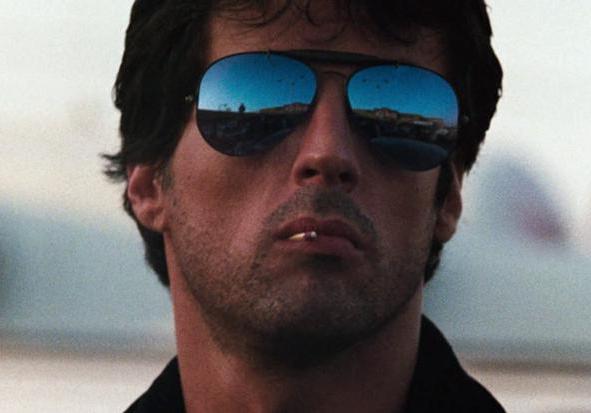
"Crime is the disease. Meet the cure." So reads the tag-line for Sylvester Stallone's now cult favourite Cobra, a quote that really sums up the whole action genre of the 1980's. While America was still suffering from the demoralising and embarrassing defeat in Vietnam, audiences were calling out for all-American heroes that could kick ass again, and prove that they would stand up to any potential threats. Therefore, violent criminals were the target (as well as the Viet Cong in frequent vets-return-to-Vietnam-for-one-last-mission movies), shown as mindless thugs that needed stamping out. Enter Marion 'Cobra' Cobretti (Stallone) - tight jeans, reflective sunglasses, leather gloves, and match-in-mouth.

After a shooting spree in a shopping mall, police negotiations fail, so Cobretti steps in to take down the mad man. Before he dies, the gunman informs Cobretti that there is a new order in town, a neo-fascist group that is wiping out the weak in order for the strong and powerful to prevail. A series of gruesome murders occur, and after witnessing the group commit a murder, led by a hulking man listed simply as the Night Slasher (Brian Thompson), model Ingrid (Brigitte Nielsen) finds her life in danger. Faced with opposition from the suit upstairs Detective Monte (Andrew Robinson), Cobretti takes Ingrid into his protection, but with the suspicion of a police insider, Cobretti and his partner Gonzales (Reni Santoni) find themselves relentlessly pursued by the axe-wielding maniacs.

In the modern-day world of liberalism and grass-roots problem-solving, it's quite difficult to empathise with Cobretti's shoot first, ask questions later approach. He is really nothing more than a vigilante with a badge, without a care for the lives of others as he blows up and shoots his way through busy streets. I know this is Hollywood Action Cinema, and not to be taken as anything but mindless entertainment, but this is a direct reflection of America's right-wing attitudes of the time. Therefore the bad guys are given no character depth whatsoever, and is unclear as to what they're exactly trying to achieve (apart from standing in what looks like a warehouse banging axes together above their head).

This was popular at the Razzie Awards, picking up nominations for Worst Film and Worst Actor for Stallone, but an extremely successful box-office showed that audiences didn't care, as long as shit was getting blown up. The critical hammering it received is unfair, however, as it really isn't that bad at all. The questionable morals aside, it has some half-decent action scenes, and the film is rather nicely shot by cinematographer Ric Waite, who captures the carnage in crisp blue neon. A mainstream movie would never get away with such a ham-fisted (anti)hero in the modern age - our leads tend to be much more complex nowadays - so Cobra is an amusing reminder of the days when the answer to crime was to simply shoot at it.


Directed by: George P. Cosmatos
Starring: Sylvester Stallone, Brigitte Nielsen, Reni Santoni, Brian Thompson
Country: USA

Rating: **

Tom Gillespie


Cobra (1986) on IMDb

Monday, 5 November 2012

Review #524: 'No Retreat, No Surrender' (1986)

After the success of The Karate Kid (1984), the martial arts film became a staple of Western mainstream cinema. Of course, the West was first properly introduced to this Eastern form of action cinema in 1973 through Bruce Lee, but the trend in American action cinema really kicked off (pun intended) after 1984. (It was of course exacerbated by the 1980's visual and political fad for hard, large bodies in action films - Stallone, Schwarzenegger, Lundgren et al.) Hong Kong actor and director, Corey Yuen, takes elements from The Karate Kid, throws in (and hugely insults) Bruce Lee ideologies and techniques - through the spectre of the master, - and produces an incompetent film that fails in both of it's sub-genre tagging of an action film with drama.

The film opens in a karate dojo in Los Angeles, where a "crime syndicate" intrude on a lesson which is held by Tom Stillwell (Timothy D. Baker). Who knows why this crime organisation would antagonise a karate establishment, but they drive the family, not only from their training space, but entire city: The Stillwell's move to Seattle - conveniently the resting place of Bruce Lee, as the young Jason Stillwell (Kurt McKinney) is a devoted fan. With the gift of a broken leg, procured from the syndicates henchman, Ivan (an obvious reference to the previous years Drago in Rocky IV (1985), both Russian hardbodies, and played here by "newcomer" Jean-Claude Van Damme), Tom's son, Jason, is free to train in the garage, and quickly makes friends with the neighbourhood black stereotype, R. J. (J. W. Fails) - introduced carrying a ghetto-blaster (very 1986 - and "black"). The both of them become the target for the local angry fat guy, who is again stereotypically introduced with a cake in his mouth - like his fatness didn't act as its own visual signifier.

After being humiliated in a Seattle dojo, Jason faces his martial arts incompetence by imploring rather loudly at the grave of Bruce Lee. Not only does the film think it has the right to get a tenth rate actor to spew garbage dialogue at the concept of Lee, but the film makers film these scenes in front of his actual gravestone. Having cried in front of Lee's grave, his training with the spirit (the ghost) of Lee. This is insulting on so many levels, but Tai Chung Kim who plays Sensei Lee tries quasi-admirably under the circumstances. Nothing much really happens between the bookended crime syndicate scenes (they only appear in the first and last scenes of the film). There's the ubiquitous training montage; a disco involving break dancing; a pathetic and infantile love interest, and a minute amount of fighting - a really small amount.

Jean-Claude Van Damme's Russian fighter and his criminal gang's leaders reappear at the end of the film to challenge the Seattle-based karate dojo to a fight in the ring. Van Damme's Ivan against all three. Of course he beats them easily. Luckily, Jason, newly trained by the ghost of Bruce Lee, is in the audience, and ready to fight him. No Retreat, No Surrender manages to insult and bore its viewers in a multitude of ways. Everything about the film is incompetent. The acting is appalling, there is little to no dramatic tension or narrative complexity, and the characters are simplistic stereotypes of action/martial arts cinema. The big threat of the film, that crime gang that I guess is supposed to offer the characters tension and cohesion, only appear at each end of the film. Even the one thing that this type of film is supposed to offer, fighting, only really occurs at the end (with a few rubbish bits from beginning to end), but this doesn't really present anything interesting choreographically, and is easily outdone in thrill and action, even by mediocre fight films such as Bloodsport (1988).


Directed by: Corey Yuen
Starring: Kurt McKinney, Jean-Claude Van Damme, J.W. Fails
Country: USA/Hong Kong

Rating: *

Marc Ivamy


No Retreat, No Surrender (1986) on IMDb

Friday, 19 October 2012

Review #519: 'Critters' (1986)

A group of alien creatures known as the 'Krites' escape from a meteor prison station and head towards Earth, so the leaders of the station instantly sets two shape-shifting bounty hunters out to retrieve them. On Earth, the rural Brown family, Helen (Dee Wallace), Jay (Billy "Green" Bush), their daughter April (Nadine Van Der Velde) and son Brad (Scott Grimes), live peacefully on their farm in Kansas. The Krites (or 'Critters') arrive on Earth and wreak havoc, attacking police cars and encroaching on the Brown family's farm. The bounty hunters arrive too, witnessed by Jay and Brad, and aggressively seek out the critters, as the tiny terrors descend on the Brown's.

Seemingly both pro and anti-Spielberg in nature, Critters benefits from - like so many horror films of its era and ilk - the puppet design. While the whole concept is a thinly-disguised rip-off of the vastly superior Gremlins (1984), the critters are certainly enjoyable to watch, as, unlike the gremlins, they dispose of people in variously gruesome ways with their razor-sharp teeth and their spikes (which they project like darts from their back). It's just a shame that the makers decided to crowbar in the alien bounty hunter sub-plot that not only takes the action away from the critters, but gives the film a very silly, slapstick edge that reminded me of Suburban Commando (1991).

While Spielberg had set the family blockbuster groundwork with Close Encounters of the Third Kind (1977) and the massively successful E.T.: The Extra Terrestrial (1982), depicting the wonder of alien invasion from the view of the family unit, Critters seems to be happy enough following this familiar path, but giving the film of a more violent edge (in one scene, a critter bites the head of Brad's E.T. teddy). It is these aspects that work for and against the film, giving it a warm familiarity of the line of 'kid-friendly' 80's horror/sci-fi movies, but reminded you that Spielberg did it far, far better. But at only 82 minutes, it doesn't demand much attention, but manages to be entertaining enough when it grabs it.


Directed by: Stephen Herek
Starring: Dee Wallace, M. Emmet Walsh, Billy Green Bush, Scott Grimes, Nadine Van Der Velde
Country: USA

Rating: ***

Tom Gillespie


Critters (1986) on IMDb

LinkWithin

Related Posts Plugin for WordPress, Blogger...