Showing posts with label 1990. Show all posts

Monday, 29 October 2018

Review #1,412: 'Predator 2' (1990)

John McTiernan's Predator introduced a new horror icon. With its flowing dreadlocks, formidable size, arsenal of deadly, otherworldly weapons, and a face that can only be described as "one ugly motherfucker," the Predator quickly garnered a legion of fans, who were all the more titillated by the idea that the creature could in fact exist in the same universe as the xenomorphs from the Alien franchise. It hardly had the critics salivating, but Predator quickly became a cult classic, and is now considered one of the finest action films of the 80's. The follow-up, released three years later, is considerably less impressive. Stephen Hopkins' Predator isn't a bad film by any stretch of the imagination, but is about as middle-of-the-road as sequels come. It's sufficiently action-packed and certainly violent enough to appease the horror crowd, but ultimately this is a re-hash of the first film with the action transported from the jungles of South America to the urban jungle of a near-future Los Angeles.

It's 1997, and L.A. has become a playground for violent gangs. Shoot-outs occur in the streets in broad daylight, and the warring Colombian and Jamaican gangs don't hesitate to take down as many cops as they can. Lieutenant Mike Harrigan (Danny Glover) is perhaps the city's best hope: a plays-by-his-own-rules type who will always lead the charge into the gunfire. When a group of Colombian thugs turn up massacred by something of considerable size and strength, Harrigan makes it his personal mission to take down this mysterious hostile. The Predator is back in town on safari, and it seems that both gang members and the police are on its hit list. Harrigan and his crew - Danny Archuleta (Ruben Blades), Leona Cantrell (Maria Conchita Alonso) and Jerry Lambert (Bill Paxton) - know that something is amiss when they discover an alien artefact hidden among the carnage, and especially when secretive F.B.I. agent Peter Keyes (Gary Busey) starts sniffing around. As the bodies of his friends and enemies start to pile up, Harrigan will stop at nothing to take the extraterrestrial down, but how can he outwit a foe that has him outgunned and outsmarted?

The lack of any kind of new story means that Predator 2 lives and dies by its action. Thankfully, there is plenty of it, and it's about as gory as they come. Spines are torn from their body, hearts are ripped out of chests, and in a particularly disturbing moment, the Predator buffs the skull of his latest victim to display in its trophy room. No matter how predictable the story becomes or how ridiculous the dialogue is, nobody could claim that Predator 2 is boring. But action doesn't equal tension, and this sequel misses the mystery of the first film, when the threat was always lurking out of sight, watching his clueless target stagger about in harsh terrain. Here, the Predator jumps straight into the mix, hacking, shooting and impaling anyone in its way. It also misses the presence of Arnold Schwarzenegger and his occasional tongue-in-cheek quips. The Governator was no Laurence Olivier, but his presence is undeniable. As watchable as Glover is, who here is more akin to Lethal Weapon's Riggs than his very own Murtaugh, he ain't no Arnie. It also doesn't help that he is one of the stupidest cops ever to grace the screen.  It's lazy and forgettable, but dumb and fun.


Directed by: Stephen Hopkins
Starring: Danny Glover, Gary Busey, Kevin Peter Hall, Maria Conchita Alonso, Rubén Blades, Bill Paxton, Robert Davi, Adam Baldwin
Country: USA

Rating: ***

Tom Gillespie


Predator 2 (1990) on IMDb

Wednesday, 23 May 2018

Review #1,341: 'The Godfather Part III' (1990)

The status of The Godfather and The Godfather Part II as two of the greatest movies ever made meant that Part III, made 16 years after the previous instalment, was always going to be in for a rough ride if it turned out to be anything other than perfection. Of course, it wasn't, and the film has since been considered as something of the deformed runt of the litter ever since. 28 years have now passed since director Francis Ford Coppola and writer Mario Puzo drew the curtains on the Corleone family legacy, which is ample time to set aside the anger and frustration generated after the original viewing and reevaluate it objectively. Is it anything near as bad as the film's reputation would suggest? No, not at all.

The story picks up in 1979, with Don Michael Corleone (Al Pacino) seeking legitimacy for his family business and moving out of the murky criminal underworld he has spent most of his adult life dwelling in. To do this, he strikes a deal with Archbishop Gilday (Donal Donnelly) to pay off his astronomic debt in exchange for shares in an international real estate company, making him the largest shareholder as a result. Meanwhile, the bastard son of Michael's brother Sonny, Vincent Mancini (Andy Garcia), has returned home to offer his services, and to justify his beef with the ambitious boss of the Corleone's New York operations, Joey Zasa (Joe Mantegna). Michael agrees to take the young hot-head under his wing, but Vincent starts to develop feelings for his cousin - and Michael's daughter - Mary (Sofia Coppola).

Many of the complaints aimed at the film usually involve the overly bleak tone, a confusing and slow-moving plot, and the performance of Sofia Coppola, and these are all completely justified. Coppola and Puzo's decision to move the main action away from the mob's dirty dealings and their individual attempts to grab power to rambling conversations and business speak with the Catholic Church understandably isolated a huge chunk of the core fan-base. An already-dull story isn't helped when it's difficult to grasp exactly what's going on. And Sofia Coppola really is terrible. Her decision to make the switch from actor to director was the best decision she could have made, and we've had the pleasures of The Virgin Suicides and Lost in Translation as a result. Her relationship with Vincent is key to the movie's themes, but their scenes play out in spectacularly bland fashion.

Yet there is still plenty to savour in The Godfather Part III.  Where it fails in the quieter moments to make its central story involving corruption within the Church remotely engaging, the set-pieces are still immaculately crafted, something of a Godfather staple. The climax gradually builds the tension to an unbearable level, and there's a nice moment during a crowded street festival involving Vincent and Joey. There's also the other performances, with Pacino delivering one of finest of his career, and Talia Shire and Diane Keaton injecting real emotion in their roles of sister and ex-wife, respectively. This is Michael at his most guilt-ridden and tortured, as he reflects on a life built on the blood of others during his savage quest for power, including of course, his own brother Fredo. Pacino really excels here, as he portrays a man distracted by melancholia and seeking any kind of redemption for his past actions. This will always be the unwanted stepchild of The Godfather trilogy, but go into it with an open mind and you may find that it's much better than you remembered.


Directed by: Francis Ford Coppola
Starring: Al Pacino, Diane Keaton, Talia Shire, Andy Garcia, Eli Wallach, Joe Mantegna, Sofia Coppola, George Hamilton, Bridget Fonda
Country: USA

Rating: ***

Tom Gillespie


The Godfather: Part III (1990) on IMDb

Tuesday, 26 September 2017

Review #1,252: 'Maniac Cop 2' (1990)

Picking up immediately where the events of the first film left us, Maniac Cop 2 is one of those rare examples of a sequel surpassing its predecessor in almost every way. Of course, this is hardly The Godfather Part II or Toy Story 2, but, with an increased budget and B-movie maestro Larry Cohen back on writing duties, director William Lustig pulls out all the stops to deliver a hugely entertaining, if formulaic, slasher follow-up. Jack (Bruce Campbell) and Teresa (Laurene Landon) are also back, although they don't last very long, as we are replayed the climax of Maniac Cop, where the seemingly bullet-proof psychopathic ex-cop Matt Cordell (Robert Z'Dar) was last seen in the driver's seat of a van heading straight into the sea.

Naturally, Cordell's body is nowhere to be found and he is soon spreading terror once again across New York City, gunning down an innocent convenience store clerk who was in the process of being robbed. Deputy Police Commissioner Edward Doyle (Michael Lerner) doesn't believe Jack and Teresa's wild claims of the disgraced and heavily-scarred former officer returning from the dead, until they are both brutally murdered and the body count starts to rise once again. Enter tough, chain-smoking detective Sean McKinney (Robert Davi), who is currently undergoing psychiatric evaluation by Susan Riley (Claudia Christian) following the suspicious death of a criminal he was hunting. Meanwhile, serial killer Steven Turkell (Leo Rossi) is murdering strippers. His path soon crosses with the vengeful Cordell, and the two become unlikely roommates.

Maniac Cop 2 offers little in the way of originality. If you've ever seen a slasher film, then you'll likely be able to guess most of what happens next in the story, although it does throw in the surprise of killing off its previous two main characters without batting an eyelid. What it does offer, however, is a number of memorable set-pieces, including a woman handcuffed to the wheel of a moving car whilst she is outside of it, and a pretty astonishing climax involving a prison rampage and a full body burn, which looks as though it must have been tricky to film. Larry Cohen also writes the characters with his trademark quirkiness, with Lerner in particular appearing to be having a blast, and Davi providing a more compelling leading man than Campbell. There is still no explanation to what exactly granted Cordell his superhuman powers, but we are given more insight into his background, despite his rather odd friendship with a scumbag you expect to see hacked apart within seconds of appearing on screen. Maniac Cop 2 offers way more than is expected of a sequel to an 80's slasher.


Directed by: William Lustig
Starring: Robert Davi, Claudia Christian, Michael Lerner, Bruce Campbell, Laurene Landon, Robert Z'Dar
Country: USA

Rating: ***

Tom Gillespie


Maniac Cop 2 (1990) on IMDb

Tuesday, 9 May 2017

Review #1,193: 'Troll 2' (1990)

If you are the type of sadomasochistic movie-goer who seeks out films so notoriously awful just to have a laugh or two, then chances are you are familiar with Troll 2, Claudio Fragasso's cult non-sequel classic. However, if you were to label Troll 2 as the worst movie ever made, then I would question whether or not you have actually seen it (although it was the subject of Best Worst Movie, a documentary made by the lead actor). Don't get me wrong, this is one of the most inept, poorly-constructed, and laughably performed films you could ever hope to see, but what separates it from the likes of The Beast of Yucca Flats, Santa Claus Conquers the Martians and Battlefield Earth is that it is enormous fun. I usually go into these types of films hoping for a few laughs but end up being subjected to 90 minutes of sheer tedium, but Troll 2 really is in a class of its own.

We open with kindly old man Seth (Robert Ormsby) reading his grandson Joshua (Michael Paul Stephenson) a fairytale involving goblins. The stunted creatures chase a man through the woods and force him to eat a green goo, which turns him into a plant. You see, goblins are vegetarians, so they can eat the man once he has completed the transformation. Goblins are everywhere, warns Grandpa Seth. The bedtime story is abruptly ended by the arrival of Joshua's mother Diana (Margo Prey), who causes Seth to suddenly vanish. The lovable old man has been dead for 6 months, but still appears to Joshua as a ghost. Fearing the boy is losing his marbles, the Waits family head off to the town of Nilbog as part of some kind of weird exchange program, which will see them tend crops and live off the land for a week while the Nilbogian family head into the big city in the opposite direction. On arrival, they are met with a feast covered in a strange weird goo similar to the one from the story. It seems Nilbog is the home of evil goblins posing as humans hoping to gobble them up at the earliest opportunity.

Before you think I've had a stroke, I can assure you that this is the plot of the movie. You will also see no mention of trolls, because there aren't any. Director Fragasso (under the pseudonym of Drake Floyd), who could speak little English, waltzed into town with a script written in Italian and seemingly cast the first people to audition who could string a sentence together. The dialogue was badly translated, nevertheless Fragasso insisted that the lines were spoken exactly as written on the page. Somewhat endearingly, the entire cast really give it their all, despite being lumbered with the lines such as "It's goblin spelled backwards!". Every single frame of Troll 2 lacks logic, and this is what makes the movie so charmingly hilarious and helps separate it from the horror lurking in the IMDb's Bottom 100 list, which may raise a smirk once or twice throughout their running time. Simply marvel at the complete disregard for common sense (Grandpa's Seth plan to escape the goblins is to Molotov cocktail the house while the whole family is still inside it) and stare open-mouthed at the moment when a young horndog is seduced by a corn-on-the-cob. There really is no way to describe Troll 2.


Directed by: Claudio Fragasso
Starring: Michael Paul Stephenson, George Hardy, Margo Prey, Robert Ormsby, Connie Young
Country: Italy

Rating: *

Tom Gillespie


Troll 2 (1990) on IMDb

Monday, 28 December 2015

Review #957: 'It' (1990)

Throughout the Stephen King adaptation boom of the 1980's and 90's, one aspect that kept writers and directors scratching their heads was how to stay faithful to the sprawling text, while condensing the story into one digestible sitting. While movies such as Carrie (1976) and The Shining (1990) were masterful, they had to stray away from the source in order to avoid becoming a rambling mess. With It, King's hugely successful novel about a shape-shifting entity who preys on young children, the story plays out over two made-for-TV 90 minute episodes. While this format allows the characters and dense plot to breathe, it also highlights a noticeable drop in quality come part two.

The first part takes place mainly in the cursed town of Derry, Maine, in 1960. The younger brother of Bill Denbrough (the late Jonathan Brandis) is approached by a clown named Pennywise (Tim Curry), who lures the little boy into a storm drain with promises of candy and balloons before attacking and killing him. Bill becomes the leader of the Losers Club, a small gang of sorts that consists of outcasts, most of whom have long been the target of a notorious bully. All the kids have problems of their own at school or at home, but they have all been approached by the sinister being who calls himself Pennywise, who terrifies them by feeding on their fears. As they learn the history of the monster who is terrorising their town, the Losers Club decide that it is down to them to end the horror once and for all.

The young cast portraying the Losers Club (along with Brandis, they consist of Brandon Crane, Adam Faraizl, Emily Perkins, Marlon Taylor, Seth Green and Ben Heller) surprisingly outshine their adult counterparts, forging a chemistry with each other strong enough to convince that these are real friends united by shared experience. The opening segment is expertly paced, juxtaposing the events in Derry 30 years ago with the group as adults, all leading their own lives apart from one another, who will find their fates intertwining once again as they learn of children going missing in their home town once again. As they prepare to return home to face an enemy they thought had been destroyed, they think back to their life as children and the bond they once shared.

While the first half brings to mind the heart-warming nostalgia of another King adaptation, Stand by Me (1986), and is genuinely terrifying at times, the second half sinks into strung-out melodrama. The adult cast, consisting of mainly of TV alumni (Richard Thomas, John Ritter, Dennis Christopher, Annette O'Toole, Tim Reid, Harry Anderson and Richard Masur), look like they're sleep-walking through their roles and, as well as sharing little in the way of physical resemblance to the kids playing them, they share little of their natural chemistry also. I haven't read the novel, but I cannot imagine the climax being quite as ridiculous and underwhelming as it is here. More than likely a victim of its TV budget, the three hour-plus running time ends on a whimper. If the quality had been maintained throughout, this could have been one of the most effective King adaptations to date. Instead, it lies somewhere in the middle. However, Curry deserves high praise of his portrayal of what is surely cinema's scariest clown.


Directed by: Tommy Lee Wallace
Starring: Tim Curry, Richard Thomas, John Ritter, Annette O'Toole, Tim Reid, Jonathan Brandis
Country: USA/Canada

Rating: ***

Tom Gillespie


It (1990) on IMDb

Wednesday, 2 December 2015

Review #949: 'Frankenhooker' (1990)

Cult director Frank Henenlotter's particularly offensive sense of humour is given free reign in Frankenhooker, his extremely loose adaptation of Mary Shelley's Frankenstein novel. Any hints of misogyny during the bulk of the film's build-up can be forgiven thanks to an enjoyably daft climax, during which a female creature made up of various prostitutes body parts and the head of its mad creators wife runs rampant around New York taking vengeance on the various scum-bags encountered earlier in the film and any sleazy perverts who fancy a bit of the stitched-together would-be centrefold model (she is played by Penthouse model Patty Mullen).

Medical school drop-out and whiny-voiced genius Jeffrey (James Lorinz) is about to marry the woman he loves, Elizabeth, when she is accidentally killed by a lawnmower he built. The grisly incident leaves he scattered around the garden, but Jeffrey manages to steal a few body parts and preserve them in a solution of his own making before the authorities arrive to clean up the mess. Distraught at losing his fiancée, he plans to re-build her using the body of a beautiful prostitute, gifting the plump Elizabeth the body she always desired. However, executing his plan proves harder than he realised thanks to a psychopathic pimp named Zorro (Joseph Gonzalez), and so develops a dangerously potent form of crack to lure his potential victims.

Despite being a loathsome and extremely disturbed central character, Jeffrey remains oddly likeable thanks to a lively performance by Lorinz, who delivers monologues to himself in a thick New Jersey twang and maintains an infectiously high energy level throughout. Jeffrey's acts represent the darkest of male fantasies, and the film may have come off as repugnant had Henenlotter not soaked every scene with a knowing absurdity. The scene in which a group of prostitutes explode into pieces one-by-one after smoking Jeffrey's powerful crack particularly treads a fine line between offensive and hilarious. Despite the few laughs to be had, Frankenhooker is still poorly acted (Lorinz aside) and some special effects, which mainly consist of stiff mannequin limbs, leave a lot to be desired. Depending on your exploitation experience, it may go too far or not far enough, but there's plenty of giddy fun to be had along the way.


Directed by: Frank Henenlotter
Starring: James Lorinz, Patty Mullen, Joseph Gonzalez
Country: USA

Rating: ***

Tom Gillespie


Frankenhooker (1990) on IMDb

Monday, 13 April 2015

Review #855: 'The Bonfire of the Vanities' (1990)

Tom Wolfe's sprawling novel about the aftershocks of a hit-and-run in 1980's New York set out to capture the corruption and self-promotion that seemed to dominate the decade, with every power player in the city, and every hanger-on trying to achieve personal triumph, latching on to the media and cultural frenzy to benefit their own personal agenda. It's a remarkable novel; bleakly hilarious but meticulously detailed. A movie adaptation was always going to be dangerous territory, and Brian De Palma's resulting film, that flopped both critically and commercially, is a confused mess. The complete failure of the film may be somewhat cruel and not wholly deserved, but De Palma goes for all-out comedy, failing to grasp Wolfe's subtle satire completely.

Tom Hanks plays self-styled 'master of the universe' Sherman McCoy, a Wall Street broker who enjoys every material comfort that life can offer, living in his huge apartment with his ditsy wife Judy (Kim Cattrall). During an eventful night with his mistress Maria Ruskin (Melanie Griffith), they take a wrong turn while heading back to her apartment and end up in South Bronx. Sherman gets out of the car to clear the road when he is approach by two black youths, and a misunderstanding leads to Ruskin accidentally running one of them over. They flee the scene, but once the story of a rich white man almost killing a poor black kid breaks, the likes of Reverend Bacon (John Hancock), a Harlem religious and political leader, Jewish district attorney Abe Weiss (F. Murray Abraham) and hard-drinking journalist Peter Fallow (Bruce Willis) rear their heads to twist the ongoing shit-storm to their own benefit.

Despite some nice tracking shots and sets that really do capture the tacky glamour of the 80's, the movie's biggest downfall is the casting. The two leads, Hanks and Willis, are woefully miscast. McCoy is a loathsome character, a WASP-ish high-roller in an increasingly capitalist country, but Hanks is one of the most likeable actors around. He looks visibly uncomfortable in a thinly-written role, and only takes control of his character in a scene in which he clears his apartment by unloading a shotgun played mainly for laughs, which at this stage of his career was Hanks's shtick. Fallow in the novel is a manipulative con-man, twisting the unravelling story through his newspaper in order to keep his job and make a nice paycheck along the way. But De Palma only seems to have picked up on his heavy drinking, meaning that Willis swings a bottle around and narrates the story, playing the role of spoon-feeder without playing an active role in story or convincing as someone who could get to his position.

But then again, De Palma's movie doesn't exist in the real world. Arguably, the ensemble of characters in Wolfe's novel were caricatures, but they were well-rounded characters, and being inside their heads meant that we could understand their motives, something the movie entirely ignores. So we get the likes of Bacon, Weiss, lawyer Tom Killian (Kevin Dunn) and Assistant District Attorney Kramer (Saul Rubinek), all key players in the novel, reduced to scowling or bumbling onlookers, while McCoy squirms for our amusement and Fallow tells us what we're supposed to be thinking. Occasionally its an all-out pantomime, which would be forgiveable it was funny or insightful. Yet when Wolfe calls for pantomime at the climax, the movie delivers a ridiculous speech spoken by Judge White (Morgan Freeman), informing us that decency is what your grandmother taught you.


Directed by: Brian De Palma
Starring: Tom Hanks, Bruce Willis, Melanie Griffith, Kim Cattrall, Saul Rubinek, Morgan Freeman, John Hancock, F. Murray Abraham
Country: USA

Rating: **

Tom Gillespie


The Bonfire of the Vanities (1990) on IMDb

Sunday, 12 January 2014

Review #699: 'Goodfellas' (1990)

During one of the many thrilling montage sequences littered throughout one of Martin Scorsese's most revered films, gangster Henry Hill arrives home at Christmas time with a giant white and tacky Christmas tree and announces "I got the most expensive tree they had!". This sums up the colourful characters that inhabit Goodfellas, cheap, trashy thugs who hold more value to material possessions with hefty price-tags than human life. It has been criticised for glamorising these criminal types, all sharp, shiny suits, slick hair and big cars, and it's easy to get lost amongst the glitz and lifestyle. But although Scorsese alludes to the appeal of this live-fast way of life, he doesn't have much sympathy for its characters, and rightly so. Henry Hill may be the protagonist, our window into this world of high-rolling mafioso, but when he's stripped of his 'friends' and cash, he's not much more than a coke-addled rat.

Ever since he was a little kid, Henry Hill (Ray Liotta) always wanted to be a gangster. In his blue-collar, Irish Brooklyn neighbourhood, he begins by parking cadillacs for local gangsters, and eventually starts to work for Jimmy 'The Gent' Conway (Robert De Niro). As the years go by, Henry, Jimmy and Italian-American loose-canon Tommy DeVito (Joe Pesci) form a small crew hijacking trucks and carrying out heists. Henry marries a wild and beautiful Jewish girl named Karen (Lorraine Bracco), and things seem peachy under the watch of boss Paulie (Paul Sorvino). But when Henry starts selling cocaine under the disapproving Paulie's nose, his world begins to crumble and he can no longer trust his friend, and the ugly side of the gangster business rears its head.

Looking back at his early works such as Mean Streets (1973) and his documentary short Italianamerican (1974), there was always a sense of authenticity in Scorsese's Italian-American-focused work. All the talk now so clearly associated with Italian-Americans was practically invented by the director, and became so influential it now seems cliché and stereotyping. But Scorsese came from these types of neighbourhoods, and this rubs off on Goodfellas. This world seems so unreal - a world where a character can be beating money out of someone one minute, and then being sent champagne by a famous crooner the next - yet it comes alive in Scorsese's hands. The much-celebrated Steadicam sequence has been much imitated, but it still retains its crown. You get washed away amongst it all just like Karen.

The film simply catapults you through it's story, showing snippets of gangster life through some breathtaking montages with voiceover narration. One minute Henry is enjoying new found love, sipping champagne while the glorious soundtrack plays in the background, the next he's on a paranoid and ill-fated drug deal. At the end I felt exhausted, like I'd just lived an entire life within 2 hours, and I've seen this film many times. But still, 24 years after it was made, it still feels fresh, energetic and innovative. Perhaps The Sopranos took its mantle when it took the gangster genre and made it a metaphor for American consumption, but it owes Goodfellas an overwhelming dose of gratitude. It also make it all the more tragic that Joe Pesci has retired from film, as his Oscar-winning performance and the final shot of him shooting at the camera a la The Great Train Robbery (1903) will linger long after the credits have rolled.


Directed by: Martin Scorsese
Starring: Ray Liotta, Robert De Niro, Joe Pesci, Lorraine Bracco, Paul Sorvino
Country: USA

Rating: *****

Tom Gillespie


Goodfellas (1990) on IMDb

Sunday, 25 November 2012

Review #541: 'Hard to Kill' (1990)

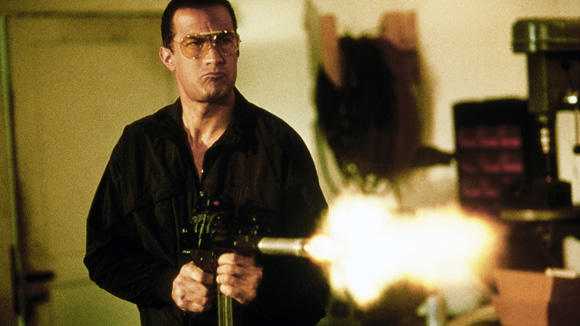
Looking back on Hard to Kill - a film if released nowadays it would surely be lying in the straight-to-DVD bargain bin at Tesco - it is actually quite sad to see the once tall and lean Steven Seagal showing off his bone-breaking Aikido skills, given the flabby has-been that now graces the covers of movies such as Belly of the Beast (2003) and Maximum Conviction (2012). These movies tend to appear in the supermarket every other week and then seemingly disappear into obscurity, but the flappy-handed, pony-tailed beast that runs like a girl was once able to draw a cinema crowd. Yet watching Hard to Kill, one of his most popular titles from his early 90's heyday, it certainly poses the question of how?

Go it alone cop Mason Storm (Seagal) records a meeting between a gang of mobsters and Vernon Trant (William Sadler), and flees when they spot him. He divulges this information to one of his policemen friends, unaware that a couple of crooked cops are listening into the conversation. Arriving home to his wife and kids, he is greeted by a group of masked gunmen who kill his wife, and shoot Mason to within an inch of his life, while his young son escapes. Falling into a coma, Mason's death is faked by his best friend Lt. O'Malley (Frederick Coffin) to keep him out of reach of the mobsters. Seven years later, he awakens to a police force now overcome with corruption, and Trant now Senator. Along with nurse Stewart (Kelly LeBrock), who has been looking after him during his coma, Mason escapes the hospital to recuperate his strength and exact revenge on the people who murdered his family.

The action movies of the early to mid-90's were generally quite dull affairs, with television-quality attitudes to film-making, and the sound of machine-gun fire seen as an easy substitute to anything resembling genuine tension, and Hard to Kill is no exception. Apart from the delight taken in seeing Seagal being shot to shit, very little happens for a good fifty minutes. The silly and quite diabolically unrealistic plot is nowhere near engrossing enough to justify this, and Seagal's quite repulsive protagonist failing to provide a lead to care about. There is, however, one of the best one-liners in action history, when Mason overhears a television commercial for Senator Trant in which he uses the line "and you can take that to the bank!", Mason replies "I'm gonna take you to the bank. The blood bank!". Genius.


Directed by: Bruce Malmuth
Starring: Steven Seagal, Kelly LeBrock, Frederick Coffin, William Sadler
Country: USA

Rating: **

Tom Gillespie


Hard to Kill (1990) on IMDb

Tuesday, 30 October 2012

Review #523: 'Begotten' (1990)

Beginning with a truly disturbing scene that depicts God (Brian Salzberg) slicing himself open with a straight razor, Begotten tells the story of Genesis through a series of strange, methodical scenes involving various, unnamed characters in a barren landscape. While God lies dead, his blood sprayed across the walls and pooled on the floor, Mother Earth (Donna Dempsey) is born through his semen and sets off into the wilderness, where the Son of Earth (Stephen Charles Barry) is created. His body writhes pathetically in the dirt, and is found and captured by a group of hooded nomads. They drag him through the wilderness, collecting objects that the Son of Earth vomits, and when they cross paths with Mother Earth, they proceed to rape and destroy her.

Begotten is one of those rare films that manages to frustrate you as much as it will fascinate. The imagery, which took ten hours per second to render, is truly unnerving. It's like watching a lost silent film only to realise it contains some of the most fucked-up imagery ever committed to film. Often the film is so scratched and the blacks and whites so grainy, it's difficult to make out exactly what is happening. But maybe that's the point, perhaps the violent acts committed by the hooded beings are best seen through squinted eyes or merely glimpsed. Not much happens - most of the film spends watching the Son of Earth being dragged and abused, and the only soundtrack consists of crickets and birds, that become so repetitive it actually adds to the psychological torment of the film. But Begotten wasn't meant to be enjoyed, but simply experienced, and if you can look past its art-house pretensions, this is one of the most original horror films of the last 25 years.


Directed by: E. Elias Merhige
Country: USA

Rating: ****

Tom Gillespie


Begotten (1990) on IMDb

Monday, 8 October 2012

Review #506: 'Two Evil Eyes' (1990)

Originally conceived as a quartet of Edgar Allen Poe adaptations, by George A. Romero, Dario Argento, John Carpenter and Wes Craven, the previous due were to be the only contributors to the double bill film Two Evil Eyes. Modernising (and in Argento's case merging a variety of Poe's themes) two stories, 'The Facts in the Case of M. Valdemar' and 'The Black Cat', Romero and Argento tackle similar themes about guilt and morality. In the first story, Romero's, Jessica (Adrienne Barbeau) is the wife of an older, rich, dying man, as she attempts to gain all of his wealth before his demise. Using her doctor/lover, Dr Hoffman (Ramy Zada), they hypnotise him, so they are able to embezzle the cash. However, when Valdemar dies, and they put him into a freezer, his disembodied voice can still be heard, a spirit trapped between two worlds.

In Argento's piece, Harvey Keitel plays a crime scene photographer, Rod Usher, who has also published a book of questionable ethics, involving (along with photos of mutilations of women from real-life crime scenes) some apparent shots of a black cat being tortured, a cat owned by his live-in girlfriend, Annabel (Madeleine Potter). After an argument, he kills her and conceals her body behind a dry wall fronted with a bookshelf. In dreams and in life, Rod is tortured by the presence of the black cat, who may possess spiritual powers. Fundamental to both of these narratives is that element of overwhelming guilt. Both characters are tormented, whether psychologically or supernaturally. This is a theme that permeates a lot of Poe's horror writing, for example in one of his most famous short stories, 'The Tell-tale Heart', the protagonist receives a visit from the police, and the trap door where a dead body is concealed, pulsates as the narrator's anguish and paranoia envelops him.

'The Black Cat' is the better of the two short films. Romero's feels at times like a macabre daytime soap opera. The Dallas iconography of dazzlingly bright-coloured decor, and immense shoulder pads, the garish face paint of the ruling classes. That said, as with many of Romero's films, he infuses the film with social commentary, coming out of the 1980's processing of our consumerist indulgence: The ethic of greed. Argento makes a more stylish attempt, which has heightened paranoia, one which is elevated largely due to a series of suspicious characters. Tom Savini's by now obligatory horror effects are also superior in the latter tale of terror. But, as with all horror films of the early 1990's, this (and they) loses something as they are consumed by television aesthetics, perhaps a project that would have benefited from being made ten years previously. The overall film experience is dampened by these production values, and the atmosphere is stilted, with little, or no sense of terror or impending horror. The definitive film adaptations of Edgar Allen Poe are still those beautiful Roger Corman productions of the early 1960's, and Two Evil Eyes is best suited to Poe/Romero/Argento purists.


Directed by: Dario Argento, George A. Romero
Starring: Adrienne Barbeau, E.G. Marshall, Harvey Keitel, Madeleine Potter
Country: Italy/USA

Rating: **

Marc Ivamy


Two Evil Eyes (1990) on IMDb

Sunday, 9 September 2012

Review #482: 'King of New York' (1990)

Crime lord Frank White (Christopher Walken) is released from prison, and on his long drive back to New York City, witnesses the filth his city has descended into since his incarceration. His old friend Jimmy Jump (Laurence Fishburne) has just wiped out a Colombian drug operation and welcomes Frank back with a suitcase full of money and cocaine. Eager to win his city back, and also help fund the saving of an inner city hospital through his drug operation, he sets the wheels to his crowning in motion. But cops Roy Bishop (Victor Argo), Gilley (David Caruso) and Flanigan (Wesley Snipes) are on his case, but after struggling to bring Frank in under regulations, resort to more illegal methods of getting him off the streets.

King of New York was booed upon its initial screenings, with mass walk-outs and cult director Abel Ferrara being bombarded with uncomfortable questions. Audiences were apparently appalled by the films seemingly glamorous depiction of man who was essentially a homicidal maniac, encouraging violence and sleaze wherever he went. The film is certainly guilty of that, but the character of Frank is a little different to the likes of Tony Montana or Henry Hill. He seems to style himself as a champion of the lower-classes, using his influence and vast wealth to push a councilman to put forth the money to save a hospital in a poverty-stricken area, and then fund it himself when that fails. He and his girlfriend Jennifer (Janet Julian) are robbed on the subway by inner-city youths. Frank shown them his gun, and they back off, but Frank throws them a wad of money and tells them there is work for them if they want it. A crime-lord he may be, but is he any worse than the fat politicians that soak up the city's money, or the bent cops that are on his back?

In Walken's hands, White is a charismatic, unconventional crime boss, and is in turns charming, strange, and deranged. It's a fabulous performance, but for me it was Laurence (here still credited as Larry) Fishburne that steals the show, as the swaggering, loud-mouthed gun-man Jimmy ("yo, where the chicken at?" he says after killing a cop), a man of such ridiculous posturing that he almost becomes a cartoon character. And this is one of the main reasons I loved this film. It is, at times, so outlandishly over-the-top that it should betray its gritty roots, but its so steeped in atmosphere and that key element, grime, that it becomes a fantasy-laden, insane ride amongst a decaying city and one its most colourful characters.

For anyone who has seen the work of Abel Ferrara, especially two of his most popular films, The Driller Killer (1979) and Bad Lieutenant (1992), will know what they are in for. His New York is not the one you see in the earlier works of Woody Allen, but one of whacked-out prostitutes, cocaine-sniffing criminals, inner-city poverty, and angry, sweaty, middle-aged detectives. We do glimpse the glitzier side of the city in King of New York, as Frank often mingles with the politicians and power-players, but it is a world of black suits and orange lighting, and a world that shares the same depravity and sleaze as the lower-classes. It's a grim thing to see through Abel Ferrara's gaze, but boy is it brimming with atmosphere. This will always play second or third fiddle to the likes of Scarface (1983), but King of New York is the film the former could never be, and in its own depressing way, is a much better film. Undoubtedly Ferrara's finest, and most 'polished' work.


Directed by: Abel Ferrara
Starring: Christopher Walken, Laurence Fishburne, Victor Argo, David Caruso, Wesley Snipes
Country: Italy/USA/UK

Rating: ****

Tom Gillespie


King of New York (1990) on IMDb

Friday, 16 December 2011

Review #285: 'Marked for Death' (1990)

DEA Agent John Hatcher (Steven Seagal) is busy kickin' ass in Colombia when he decides to make his return to the U.S. after some spiritual enlightenment from his priest. He returns to find his city overrun by Jamaican 'posses', and when at a bar, he and his old friend Max (Keith David) find themselves caught amidst a gang war shootout. Hatcher, naturally, kicks the shit out of some of them and finds that he and his family have been 'marked for death' by gang boss Screwface (Basil Wallace). His sisters house is attacked and when his niece is shot, Hatcher and Max team up with Jamaican police man Charles (Tom Wright) to find Screwface and end his reign of terror.

Clearly neither Screwface nor his ever-dispensable gang of cronies have ever seen a Steven Seagal film, or they would have left him the fuck alone. Guns, swords and even voodoo cannot stop the pony-tailed action hero. This is actually considered to be the 'finest' of Seagal's vast action backlog, which is quite tragic given that this film is pretty shit. I will say this for it, however - it's relentlessly entertaining. Yet this derives from the unintentionally hilarious dialogue, woeful acting, some appallingly gruesome action scenes, and plot devices that simply defy logic.

Possibly the funniest moment in the film has Hatcher, who has, by the way, just committed murder (he's retired from the police) and has to be the police's main suspect, taking part in a high speed chase through the city that sees one car drive along the pavement causing massive damage, only to later fly through the window of a department store. Hatcher walks in shooting and stabbing his way through the bad guys only to calmly stroll out afterwards. Surely the police would have noticed something during the carnage? Yes, yes, I'm missing the point, this is a dumb action film - this is hardly trying to be The Wire.

Marked for Death does have the sense to show off Seagal's martial arts skills. While many of his other films have him mainly either carrying a gun or simply throwing people onto tables, this has him breaking many, many bones with his bare hands. It's shockingly gory for an 90's action film, which naturally makes the whole film more likeable. Basil Wallace is plenty of fun as the interestingly named Screwface, all wide-eyed and using an over-accentuated Jamaican accent. The voodoo element is certainly different, and the practises shown in the film are apparently well-researched and accurate. Definitely one for the action junkies, but for me, it's a laughable nostalgia trip into an overly macho time, and ultimately a rather forgettable one.


Directed by: Dwight H. Little
Starring: Steven Seagal, Basil Wallace, Keith David, Tom Wright
Country: USA

Rating: **

Tom Gillespie


Marked for Death (1990) on IMDb

Saturday, 21 May 2011

Review #78: 'Spontaneous Combustion' (1990)

Nevada desert, 1955. Peggy and Brian Bell, are being experimented on by the US Army to test the effects of exposure to atomic energy whilst testing a nuclear bomb. The test seems to go well, and the Bells are located in a picturesque suburbia. However, after giving birth to their son, the couple suddenly spontaneously combusted, a clear effect of the nuclear fallout. The baby boy survives them, and grows up to be Sam (Brad Dourif).

So we flash forward to the present day, where Sam's freakish ability to combust becomes increasingly dangerous to both himself and others around him. In one scene (with a cameo from John Landis), Sam has called into a radio psychic DJ - who has now gone off the air - and gets through to the Landis' radio technician who refuses to pass him onto the DJ (Dr Persons - played by Joe Mays). This increases Sam's anger (which as we have seen previously, makes Sam burnier), and he projects fire through the phone (in a pseudo-telekinetic flash), which results in fire streaming from the knee-caps of poor Landis. Sam's main goal is to find out about his parents and to determine why these phenomena keep occurring.

Tobe Hooper has not had it easy since the release of exceptionally brilliant debut The Texas Chain-Saw Massacre (1974). All of his subsequent films have either fallen foul of studio intervention (Death Trap (1977), The Funhouse (1981)), executive producer Steven Spielberg's ultimate overbearing on-set presence (Poltergeist (1982), or just poorly conceived ideas (Lifeforce (1985), Invaders from Mars (1986) and Texas Chain-Saw Massacre 2 (1986)). He seems only in the latter part of the '80's produce Stephen King-like projects, either directly adapting a King novel (Salem's Lot (1979 -TV mini-series), or lifting pseudo-King story devices, much like Spontaneous Combustion. The use of fire as a telekinetic ability had been previously 'explored' in King's Firestarter.

This is not a great film. The production values are akin to the TV movies/series' that were being broadcast at the time. this was seen throughout the genre in the early years of the decade. This period is almost a vacuum of popular visual culture, with the exception of one horror, the TV series Twin Peaks (1990-1991). The camera movements and compositions are standard television production. Aside from the lack of visual flare, there is one element that never really fails to please. That is of course Brad Dourif. I find everything that Dourif is in to be thoroughly fun to watch. Even, as in this performance, when he is wildly over-the-top. His eyes intense, and his vociferousness projected directly into you brain, sharp and direct. No one does sweaty anger like Dourif does. So, in conclusion. Shit film, but it is totally be forgiven cause Brad Dourif is in it.


Directed by: Tobe Hooper
Starring: Brad Dourif, Cynthia Bain, Jon Cypher
Country: USA

Rating: **

Marc Ivamy


Spontaneous Combustion (1990) on IMDb

LinkWithin

Related Posts Plugin for WordPress, Blogger...