Showing posts with label 1951. Show all posts

Sunday, 13 January 2019

Review #1,439: 'Alice in Wonderland' (1951)

Long before animation pioneer Walt Disney wowed the cinema-going world with Snow White and the Seven Dwarfs - one of the first feature-length animated films ever made - in 1937, the innovator was long dreaming of adapting Lewis Carroll's books Alice's Adventures in Wonderland and its follow-up Through the Looking Glass. He made a short adaptation called Alice's Wonderland, which mixed live-action and animation, for the Laugh-O-Gram Studio in 1923, but never let go of the idea after the studio went bankrupt and he left for Hollywood. Disney's dream wouldn't be fully realised until 14 years after Snow White, when Alice in Wonderland was finally unveiled in 1951. The film flopped upon release, with audiences failing to be seduced by the many colourful yet incredibly weird characters on show, but through television screenings and subsequent revivals, Alice is now an established classic amongst Disney's animated classics.

As her sister reads under a tree, the young Alice (Kathryn Beaumont) dreams of adventure, choosing to explore her own imagination rather than the tales told in books. As she sings by a riverbank, she spots a white rabbit (Bill Thompson) carrying a huge pocket watch. The White Rabbit is late for an important meeting and dashes off into a large rabbit hole. Ever curious, Alice follows him, eventually entering a world in which logic has no place, everything is backward, and everybody is ever so slightly mad. Her adventure into this strange new world leads her to the rather frightening identical twins Tweedledum and Tweedledee (both voiced by J. Pat O'Malley), a garden of singing flowers who soon reveal their weirdly fascist outlook, a hookah-smoking caterpillar (Richard Haydn), the mischievous Cheshire Cat (Sterling Holloway), and, of course, a truly mad tea party hosted by the Mad Hatter (Ed Wynn) and March Hare (Jerry Colonna). This bizarre world known as Wonderland seems to offer no way out, so Alice seeks help from the tyrannical and homicidal Queen of Hearts (Verna Felton), who has a fondness for removing heads.

There is really no meaning or hidden depths to be found in Carroll's books, and Disney's adaptation is no different. It seems to exist simply as a celebration of the wonders of childish imagination and an opportunity for creative abandon. The result is a nonsensical story with little time for structure or purpose, but one that has stood the test of time through the wonderful characters it imagines. It's an often frustrating experience that offers little sense of direction, and I wouldn't be surprised if some younger viewers were put off by the narrative's excessive randomness or utterly terrified by some of the more sinister characters on show. Yet Disney knew exactly how he wanted to portray these characters, and backed by some stellar talent behind the microphone, Alice in Wonderland prevails as a series of memorable vignettes. The Mad Hatter and Cheshire Cat are now embedded into the fabric of pop culture, and that is mainly thanks to Disney and his team of animators. These are truly insane, even malevolent, characters, but Disney knows how to make them lovable, even when they are toying with our protagonist or leading her further into the madness. It's more a nightmare you can't wake up from than a children's adventure story, and while it won't top many people's lists of favourite Disney movies, there is a unique sense of wonder here that could not be found in Tim Burton's over-stylised 2010 remake.


Directed by: Clyde Geronimi, Wilfred Jackson, Hamilton Luske
Voices: Kathryn Beaumont, Ed Wynn, Richard Haydn, Sterling Holloway, Jerry Colonna, Verna Felton, J. Pat O'Malley
Country: USA

Rating: ***

Tom Gillespie


Alice in Wonderland (1951) on IMDb

Sunday, 5 November 2017

Review #1,257: 'Diary of a Country Priest' (1951)

Robert Bresson is known for his stark and stripped-down worlds, where actors were employed as mere 'models' would rather than conduits of expression. The script and story would be where the emotion would resonate, and this would create a rather cold, blank exterior, when in fact there would be great power, grace and humanity lurking beneath its icy surface. Diary of a Country Priest, Bresson's third feature, was the first time the French director would fully embrace this approach, going so far as hiring non-professional actors for the bulk of his cast. Claude Laydu, who plays the titular priest, gives a performance of such complexity that it is often cited as the greatest in the history of motion pictures. Scenes would be re-shot if Bresson felt his actors were, well, acting too much, and Laydu often looks like he's suppressing so much he's going to explode.

When you understand what Bresson's goal was with Diary of a Country Priest, Laydu's performance becomes almost transcendent. The unnamed priest, who arrives in his new parish of the small commune of Ambricourt at the beginning of the film, is a weak, sickly presence. He is young, but small, gaunt and gently-spoken. Suffering from an unknown stomach ailment, he gets by on a diet of bread, fruit and wine. Ambricourt's inhabitants are mainly made up of poor but tough peasants and farmers, whose lives are so gruelling that they have little time for God. His arrival is met with scorn and distrust, and their reaction triggers feelings of rejection in the young priest. Even the children laugh at him, and Mass is attended by a sole woman whose intentions are far from Christian. He confides in the Priest of Torcy (Adrien Borel), a respected, straight-talking man of the cloth, who mentors the bewildered young man on what is expected of him. "A priest should never be loved," he is told, but seems perplexed at the cruelty of the world around him, and the lack of love within it.

The film really centres around a conversation between Laydu and the Countess (Rachel Berendt), an ageing woman who has never gotten over the death of her son, and whose husband is openly having an affair with a younger woman. The result of this conversation has the village gossiping, and it is this that sparks a remarkable show of faith by the young priest. Bresson's bleak approach compliments these moments well, refusing to over-blow the priest's epiphany before he inevitably starts to wrestle with it, recording all of his thoughts in a small diary. Laydu's performance is masterful, and it was surprising to learn that he later developed a puppet show for children, a world away from his sullen presence here. Alongside Dreyer's The Passion of Joan of Arc and Rossellini's Francesco, giullare di Dio, Diary of a Country Priest is a masterpiece about Catholicism made by an agnostic or atheist, using the Bible's teachings and the institution itself as a way to tell more humanistic story of human anguish and struggle.


Directed by: Robert Bresson
Starring: Claude Laydu, Jean Riveyre, Adrien Borel, Rachel Bérendt, Nicole Maurey
Country: France

Rating: *****

Tom Gillespie


Diary of a Country Priest (1951) on IMDb

Monday, 15 May 2017

Review #1,197: 'The Tales of Hoffmann' (1951)

Michael Powell, the great underappreciated British film director mainly recognised for his work alongside Hungarian Emeric Pressburger, spent most of his early career working towards the perfect marriage of the power of operatic music and the visual splendour of cinema. This can be glimpsed in the masterpieces Black Narcissus (1947), The Red Shoes (1948), and to a certain degree, The Life and Death of Colonel Blimp (1949), but it wasn't until 1951 that he completed his ultimate goal. With The Tales of Hoffmann, an adaptation of Jacques Offenbach's flamboyant opera, Powell and Pressburger achieved what no other film has succeeded in doing since: bringing the opera to life on screen and infusing it with all the colour and vibrancy of cinema. Martin Scorsese, an lifelong admirer of P & P, recently oversaw a 4K remastering of the movie; the perfect medium to take in this lavish picture.

Staying true to the structure of Offenbach's vision, The Tales of Hoffmann comes with a prologue, epilogue, and three central acts all centred around the past loves of man-of-the-world Hoffmann (Robert Rounseville). As a stage performance featuring his current love plays out in the background, Hoffmann tells an eager group of friends of three women he has loved and lost. The first act, which is the brightest and most farcical, sees him duped into loving an automaton called Olympia (played by the beautiful Moira Shearer) by a pair of magical glasses that seemingly bring inanimate objects to life. The second act takes place in a hellish Venice, where an evil magician promises his courtesan Giulietta (Ludmilla Tcherina) expensive jewellery in exchange for her seduction of Hoffmann and the theft of his shadow. In the third and final act, Hoffmann falls for Antonia (Ann Ayars), a soprano suffering from a mysterious illness that forbids her to sing.

The disregard for traditional cinematic narrative structure means that The Tales of Hoffmann is certainly an acquired taste, but there is also nothing else quite like it. Backed by a thumping score from the Royal Philharmonic Orchestra under Sir Thomas Beecham and brought to life with ravishing set and costume design by Hein Heckroth (who was Oscar nominated twice for the film), Hoffmann is a treat for all the senses. It's particularly adored by filmmakers, with Cecil DeMille voicing his admiration for the film, and George A. Romero stating it to be his favourite movie of all time and the reason he wanted to become a director. There are also fine performances throughout, in particular Moira Shearer, who I fell head over heels for in The Red Shoes, and Robert Helpmann, the Child Catcher himself, who plays Hoffmann's nemesis in all the stories. Only Rounseville and Ayars perform their own vocals, but the film is graceful enough to reward the vocalists by a credits sequence that sees both singers and performers take a bow.


Directed by: Michael Powell, Emeric Pressburger
Starring: Robert Rounseville, Robert Helpmann, Moira Shearer, Ludmilla Tchérina, Ann Ayars
Country: UK

Rating: *****

Tom Gillespie


The Tales of Hoffmann (1951) on IMDb

Tuesday, 25 April 2017

Review #1,187: 'The Prowler' (1951)

The infamous Hollywood blacklist, which saw writers, actors and directors alike accused of harbouring Communist sympathies and forced others to name names or else face exile from the business altogether, may have been one of the darkest times the industry has ever faced. Yet, it also inspired great anger in the movies, and writers and directors channelled this frustration into some of the best movies of the era, taking the opportunity to delve into and pick apart the underbelly of the so-called perfect American society. Director Joseph Losey and screenwriter Dalton Trumbo - the latter already on the blacklist and working under a pseudonym - combined to create one of the darkest and most fascinating film noirs ever to come out of Hollywood with the inexplicably obscure The Prowler.

After seeing a strange man lurking in the backyard of her hacienda, Susan Gilvray (Evelyn Keyes), the wife of a radio personality, calls the cops and is greeted by partners Webb Garwood (Van Heflin) and Bud Crocker (John Maxwell). It's a routine visit, but Webb falls for the striking Susan, and is soon back to pay her a follow-up call in the hope of seducing her while her husband is at work. The two start a passionate and dangerous affair, but Webb becomes frustrated as Susan cannot bring herself to leave her husband. Retreating to his squalid, cramped apartment, Webb ignores Susan's calls while hatching a 'perfect crime' - to become a prowler himself and take out the man standing in his way of happiness in the process. But there's no such thing as a perfect crime in the world of noir, and the couple are soon under suspicion and on the run.

One of the key aspects to the film noir genre is the idea of the femme fatale - the beautiful blonde or brunette who, frustrated and bored with their current situation, start to manipulate events with devastating results, and usually duping some poor love-struck sap in the process. The Prowler is in many ways incredibly similar to Billy Wilder's masterwork Double Indemnity, but with the gender roles reversed. Here, it is Van Heflin's Webb Garwood who is the schemer, and he does so with such arrogant relish that I found myself almost willing him on. The cogs start turning the moments he lays eyes on Susan, and they turn ever faster when he takes a peek at her husband's generous will. He is a truly hideous, wretched creation, played with incredible naturalism by Heflin. The devious intentions glisten in his eyes from the moment he turns up at Susan's house for the first time alone.

Trumbo, who produced some of his greatest work while on the blacklist (and winning two Oscars), clearly enjoyed dissecting a trusted American institution and showing its ugly side. It's shocking to see Webb, a police officer often in uniform, act with such malicious intent in a time when America was still promoting the idea of the 'American Dream'. Webb knows what his dream is and goes about taking it with all his might, mirroring the proud capitalist ideals of his country. It's incredibly subversive stuff for the genre, and is even bold enough to let Susan, an adulterer carrying a child conceived out of wedlock, off relatively easy for her sins. It's a miracle it got past the Hays Code, and its somewhat taboo subject matter and the matter-of-fact way in which it goes about its business is probably why it isn't better known. Yet this deserves to find a new audience, as on top of being one of the most intriguing film noirs out there, it's also significant both historically and culturally.


Directed by: Joseph Losey
Starring: Van Heflin, Evelyn Keyes, John Maxwell, Katherine Warren
Country: USA

Rating: ****

Tom Gillespie


The Prowler (1951) on IMDb

Wednesday, 29 March 2017

Review #1,175: 'M' (1951)

The poster for director Joseph Losey's M promises to deliver "the greatest motion picture you've ever seen!". This, of course, isn't true; in fact, it isn't even the great motion picture entitled M you'll ever see. The original movie of the same title, directed by Fritz Lang, is possibly one of the finest pieces of cinema ever made, and one that reflected the political turmoil of Germany at the time as the Weimar Republic start to collapse under the increasing power of the Nazis. Douglas Sirk, a German working in Hollywood, was first approached to helm the remake, but wanted to scrap the original premise but keep the focus on a notorious child-killer. This could not happen, as such a grisly topic was banned in Hollywood, but would be allowed if it was a remake of a classic. Sirk held his ground, and so M was handed to Losey instead.

Martin W. Harrow (David Wayne) is a reclusive serial killer who has already gained notoriety throughout the city after a few dead bodies were found, minus their shoes. Inspector Carney (Howard Da Silva) feels the pressure of expectation, resorting to desperate measures by fleecing the regulars at a known criminal hangout in the hope of stumbling upon a clue or lead, as the city's residents are in high-paranoia mode, reporting anyone acting remotely suspicious or seen walking with a child. One old man is hauled in after helping a young girl take her skates off after a fall. Syndicate boss Charlie Marshall (Martin Gabel), seeking an opportunity to divert the attention away from his own criminal activities, rounds up his gang of crooks and brings in drunken lawyer Dan Langley (Luther Adler) in the hope of tracking down the murderer himself.

Any American remakes of foreign masterpieces will always be looked upon with some degree of disdain, and I must admit that I went into M expecting a pointless re-hash of what came before. However, under the disguise of a film noir, Losey's M is a damn good movie, with the panic-stricken city eager to turn over their neighbour in the hope of sleeping easy at night easily comparable with Joseph McCarthy's Communist witch-hunts terrorising Hollywood at the time, which saw industry giants pressured into naming names and exiling their co-workers onto the Blacklist. As Harrow, Wayne is subtly effective, sweet-talking his victims and luring them with his whistle. More focus is given to his character than in Lang's film, and Wayne manages to invite more sympathy than Peter Lorre's incarnation as he is eventually hauled in front of a public jury. It certainly doesn't have the dramatic weight or technical wizardry of the 1931 version, but Losey's effort stands out as one of the most gripping noirs of its era.


Directed by: Joseph Losey
Starring: David Wayne, Howard Da Silva, Martin Gabel, Luther Adler
Country: USA

Rating: ****

Tom Gillespie


M (1951) on IMDb

Friday, 19 August 2016

Review #1,070: 'Miracle in Milan' (1951)

The great Italian actor/director/writer Vittorio De Sica is probably best known for his neo-realism offerings, particularly the tear-jerking masterpiece Bicycle Thieves (1948). His next film, Miracle in Milan, begins with the title 'once upon a time...', making it clear enough that this is a step towards more fantastical fare. While still exploring themes of class divide and the humility of the poor, Miracle is pure fairytale, starting out with a baby found in a basket and climaxing with a gathering of our homeless heroes flying away on broomsticks.

The ageing Lolotta (Emma Gramatica) finds a newborn baby in her cabbage patch and adopts him, naming him Toto. When the old lady dies, the young Toto is taken to an orphanage where he grows up (to be played by Francesco Golisano) and emerges an optimistic and happy-go-lucky young man. Shortly after he discovers that other members of society don't share his chirpy outlook on life, he is robbed by a homeless man but takes pity on him, and in return Toto is shown to a shantytown on the outskirts of Milan. Fitting in immediately, Toto and his new friends discover that the land on which they dwell holds oil, and soon enough the rich fat cats descend on the outcasts.

There is little subtlety to Miracle in Milan, and De Sica is quick to stamp his own views on a society that shun the poor, portraying the rich as fat, cigar-chomping tyrants, while the poor are a collection of likeable oddballs. There are many wonderful moments, such as Toto overseeing the renovation of the shantytown and the scene in which the homeless, Tati-esque, huddle together to warm up in a slim ray of sunshine peeking through the clouds. It's also on-the-nose and slightly grating, complete with obscene caricatures and some comedic scenes that simply do not work. We are left with the message of the corrupting power of wealth, and while this is a familiar topic in the realm of neo-realism, there's enough charm on show to help see past the flaws.


Directed by: Vittorio De Sica
Starring: Francesco Golisano, Emma Gramatica, Paolo Stoppa, Guglielmo Barnabò
Country: Italy

Rating: ***

Tom Gillespie


Miracle in Milan (1951) on IMDb

Saturday, 13 February 2016

Review #979: 'Ace in the Hole' (1951)

Billy Wilder - the American director whose body of work sailed as closely to perfection as one can get - reportedly referred to Ace in the Hole, a rare flop for Wilder, as "the runt of my cinematic litter." Dismissed by critics upon release for its cynical depiction of the tabloids and law enforcement, it has since been re-discovered and lavished with praise for foreshadowing a world in which we are bombarded with sensationalised news stories that are now never more than a thumb-swipe away. Kirk Douglas plays Chuck Tatum, a hard-drinking, troublemaking reporter exiled from New York to New Mexico, where he plans to recoup at a low-circulation local paper until he lands a story that will have his big-city former pals clawing at each other for his services.

After over a year without the big break he was counting on, Tatum bitterly takes to the road to cover a rattlesnake hunt. On route, he stumbles across a weeping woman while filling his car with gas and, when a police car whizzes by, quickly sniffs the air for something big. It turns that a local man called Leo Minosa (Richard Benedict) has become trapped in a cave while looking for local Indian artefacts. Remembering W. Floyd Collins, who had the nation gripped while in a similar situation, Tatum seizes his chance and quickly sets up shop, convincing Minosa's unhappy wife Lorraine (Jan Sterling) to stay and play the weeping damsel for the cameras and microphones, and strikes a deal with corrupt local sheriff Kretzer (Ray Teal) to support his re-election bid

A more recent film to cover similar ground was Nighcrawler (2014), starring Jake Gyllenhaal as a more outwardly slimy reporter, manipulating events to his own benefit. The difference with Ace in the Hole is that Tatum does, by the end, discover a shred of humanity without losing his ferocity, as Leo's situation starts to look increasingly dire. Before his moral epiphany though, he shapes events with a Machiavellian wickedness, delaying the rescue and therefore allowing the story to garner national coverage, and using the strong-armed sheriff to shoo away any rival newspapers. It turns into a media circus, literally. Tatum stands on a mountain admiring what he has created while people flock to the scene in their hundreds and carnival rides are set up. A band even performs a song about Leo to the crowd and sells the recordings.

Partly down to Douglas's astonishingly acid-tongued and energetic performance and partly Lesser Samuels, Walter Newman and Wilder's ferocious script, Ace in the Hole rests easily on par with the likes of The Lost Weekend (1945) and Some Like it Hot (1959), although it falls short of Double Indemnity (1944) and Sunset Blvd. (1950). He didn't get much wrong in his career, but Wilder's evaluation of the film is certainly dumbfounding. Unrelenting in its foreboding of where journalism was in danger of heading, Ace in the Hole is gripping storytelling. Douglas stampedes through the scenery like a branded bull, and his characters increasingly desperate actions remain shocking even now, 65 years later.


Directed by: Billy Wilder
Starring: Kirk Douglas, Jan Sterling, Robert Arthur, Richard Benedict, Frank Cady, Ray Teal
Country: USA

Rating: *****

Tom Gillespie


Ace in the Hole (1951) on IMDb

Monday, 18 January 2016

Review #965: 'The Strange Door' (1951)

There were many horror titles released by Universal around the 1940's and 50's which told short stories (usually adapted from literature) within a slim running time - routine B-movie fare bolstered by one of the many fantastic actors they had on their payroll. The Strange Door is one such example. It's a rather daft story, adapted from a Robert Louis Stevenson short about a playboy high-born caught up in the sadistic plans of a sadistic lord. With a tacked-on romance, this is pretty pedestrian stuff for the most part. But when Charles Laughton and Boris Karloff are on screen, this timid horror comes alive.

Sire Alain de Maletroit (Laughton) and his cronies manipulate troublesome rake Denis de Beaulieu (Richard Wyler) into a mansion. While the front door opens from the outside, the inside contains no handle, trapping Denis within the strange castle. Alain explains to Denis that he intends for Denis to marry his lovely daughter Blanche (Sally Forrest). At first apprehensive, Denis meets and eventually falls in love with the delicate Blanche, infuriating the huge lord who naturally has an ulterior motive to his sweet-sounding deal. Alain has imprisoned and tortured his brother Edmond (Paul Cavanagh) for the past 20 years, with the hope of making the poor man's daughter miserable as well. However, he doesn't anticipate Denis's redemptive qualities.

Laughton doesn't so much chew the scenery but swill it around his chubby cheeks. Whenever he is on screen, it is impossible to take your eyes from him. Alongside looking like he's having a ball, every gesture, eye movement and idiosyncratic ramble seem almost improvised, as if he knows how forgettable this movie is but wants to make damn sure you'll be entertained while you watch it. Karloff also brings wide-eyed sympathy to the faithful servant Voltan, a man tasked with the dirty job of watching over the prisoner but does all he can to help the poor man. Wyler is less impressive; a constantly wooden presence with a voice that almost hurts the ears. The film is formulaic and stretched, but is occasionally very entertaining and a must-see for fans of its two lead stars.


Directed by: Joseph Pevney
Starring: Charles Laughton, Boris Karloff, Sally Forrest, Richard Wyler, Alan Napier
Country: USA

Rating: ***

Tom Gillespie


The Strange Door (1951) on IMDb

Wednesday, 13 November 2013

Review #674: 'The Man in the White Suit' (1951)

Just two years after he took everyone's breath away playing eight characters in Kind Hearts and Coronets (1949), Alec Guinness continued his successful relationship with Ealing Studios with another iconic performance as eccentric inventor Sidney Stratton in The Man in the White Suit. After being fired from numerous mills throughout the north of England for his expensive research into an everlasting fibre, Sidney joins Birnley Mill. Posing as an unpaid researcher, he makes his breakthrough and creates a fibre that repels dirt and cannot be broken, and makes himself a white suit out of it. Seeing the potential collapse of their industry, capital and workers alike join forces to bring Sidney down.

While watching The Man in the White Suit, it would be easy to pose the question of what exactly is the point of this movie? Ealing had common themes of anti-establishment running through their films of this era, and here the big bosses are shown as pompous, cigar-smoking buffoons, clambering over each other in blind panic. Yet with the invention of Sidney's white suit, the industry will implode, taking down thousands of the working class with it. This is exemplified when Sidney, running through the streets in his luminous white suit to escape the mob, comes across his poor landlady who has been letting him live there rent-free. She sees Sidney's new invention and says "what about my bit of washing when there's no washing to do?" The working class will pay the biggest price if the white suit breaks out.

So, the point is not to make a point, it's to make you think about technological progression. The 40's saw the emergence of the H-bomb that almost single-handedly ended World War II. This was initially seen as a good thing and the ultimate protective weapon. Then other countries began manufacturing them, and the threat of nuclear war prevailed throughout the next few decades. It seems that following technological innovation blindly could have devastating consequences. Yet Sidney goes about his business with a demented determination, initially without a thought about the potential results of his actions. The fact that he is the film's protagonist and (anti?)hero does cause some confusion, but in Guinness's expert hands, Sidney is a delight to watch and even root for.

The supporting cast are strong too, especially Joan Greenwood as Daphne Birnley, the daughter of the tycoon that runs the mill (played by the also excellent Cecil Parker). Her voice is so sultry and her face so beautiful that it's hard to take your eyes off her. The scene in which she tries to seduce Sidney at the request of the united bosses is an acting lesson in subtle sexuality. However, in the context of Ealing's output of this era, The Man in the White Suit falls somewhat short. It's extremely slow-paced and talky, and isn't particularly funny. But it's a clever-clever satire that was way ahead of its time, expertly directed in an unfussy fashion by Alexander Mackendrick.


Directed by: Alexander Mackendrick
Starring: Alec Guinness, Joan Greenwood, Cecil Parker, Michael Gough
Country: UK

Rating: ****

Tom Gillespie


The Man in the White Suit (1951) on IMDb

Sunday, 3 February 2013

Review #573: 'When Worlds Collide' (1951)

Though the great space race between America and the U.S.S.R. was still a number of years away, the fact that space travel was a real possibility fuelled audiences desire for sci-fi that was rooted in scientific theory. I emphasise the word theory as the science behind the Golden Age of sci-fi was generally rather loopy, though the films were happy to make heroes of scientists. They were no more self-isolated lunatics cooking up destructive experiments or digging up corpses to make a monster, but wise, goateed intellectuals, or square-jawed protégées capable of saving humanity from any potential threats. Of course, the 1950's mainly gave us rubber-suited aliens or giant, mutated monsters, but there were a few directors and producers that were aiming to give the audience a more satisfying, thoughtful experience, such as Rudolph Mate's When Worlds Collide.

After scientists discover that there are a pair of rogue planets hurtling towards Earth, pilot David Randall (Richard Derr) is given the task of delivering the information to New York for further research. When Dr. Cole Hendron (Larry Keating) confirms the fear, the news is brought to the attention of the United Nations, where they are laughed out as crackpots. It is believed that the first planet will pass so close to the Earth, it will cause devastating damage, only return from its orbit of the Sun to destroy Earth completely. With the help of Sydney Stanton (John Hoyt), who provides the funds, Hendron and his colleagues begin work on a spacecraft that will transport a small band of survivors to the second planet, which they believe is habitable and will remain on a stable orbit.

Rather than giving us special-effects filled set-pieces or killer aliens, When Worlds Collide entirely focuses on humanity's reaction to potential catastrophe. The story is an obvious parable of Noah's Ark, with God venting his fury upon the Earth he saw as fallen into sin, and this theme comes to fruition near towards the end as a lottery-system is drafted to choose who stays and who goes, with the inevitable violent rebellion of those facing death. This harsh depiction of the human race was the most intriguing idea the film had, which makes it sad that the film-makers failed to capitalise on it, instead focuses on a dull love story between Randall, Hendron's daughter Joyce (Barbara Rush) and Dr. Tony Drake (Peter Hansen).

The film was successful and went to be hugely influential in the genre, but it is held back from being anything great by some gaping plot-holes, lazy plot devices, and some erratic special effects. It took home to Academy Awards for Special Effects, but the new world reveal at the climax is a rather hastily painted backdrop, ruining any sense of wonder the ending may have provided. There is plenty of fun to be had with When Worlds Collide and gave many future writers and directors to think about, but producer George Pal funded better and more satisfying sci-fi in The War of the Worlds (1953) and The Time Machine (1960).


Directed by: Rudolph Maté
Starring: Richard Derr, Barbara Rush, Peter Hansen, Larry Keating, John Hoyt
Country: USA

Rating: ***

Tom Gillespie


When Worlds Collide (1951) on IMDb

Saturday, 19 May 2012

Review #397: 'The Thing from Another World' (1951)

Upon receiving a request for re-enforcements from brilliant scientist Dr. Carrington (Robert Cornthwaite), General Fogerty (David McMahon) dispatches a U.S. Air Force team led by Captain Hendry (Kenneth Tobey) to a remote area of Alaska. Upon arrival, they learn that a strange aircraft has been discovered built of alien materials to which they gain access and discover a giant frozen alien lifeform. They bring it back to their base, where a careless soldier allows it to thaw, and the crew find themselves under siege from the giant monster that doesn't seem to be able to be killed. Soon, Carrington and Hendry find themselves at loggerheads, as Carrington wishes to preserve the beast for scientific research, and Scott sees it as a threat to humanity and will stop at nothing to destroy it.

I was surprised at how different this throwback sci-fi is to its much more popular and admittedly vastly superior remake The Thing (1982). John Carpenter's re-imagining is more sophisticated and memorable, but Christian Nyby's original, based on John W. Campbell's novel Who Goes There?, has a lot going for it and is one of the more exciting and politically-charged of the 1950's sci-fi's. Nyby directed under the watchful eyes of Howard Hawks, so naturally, this is a very American tale, and very much a product of its era. In an America wary of Communist infiltration, Cornthwaite's Dr. Carrington is portrayed as a maniacal madman, who is willing to sacrifice the lives of his colleagues for scientific data, whereas Tobey's Hendry is the square-jawed American hero, who sees the need to stamp out the threat before it can bare its influence across America. Obviously this is a bunch of nonsense from an ignorant time, but it cements the film as being historically and politically significant, as well as being extremely good fun.

Little is seen of the 'Thing' itself (played by western legend James Arness - who passed away last year), which allows the film to build far more tension than the many rubber-suited creature-features that were churned out in the 1950's. It is usually hidden away with shadows so the film never feels silly, and really makes an impact in one impressive scene which sees Scott set it ablaze. It is a fully-body burn, something which is extremely dangerous even by today's standards. An un-involving romantic sub-plot between Hendry and Carrington's secretary Nikkie Nicholson (Margaret Sheridan) aside, the film breezes by and is very good fun, and if you can see past all the political nonsense, then this is one of the best of the B-movie sci-fi/horrors to come out of the era.


Directed by: Christian Nyby
Starring: Kenneth Tobey, Robert Cornthwaite, Margaret Sheridan, Douglas Spencer, James Arness
Country: USA

Rating: ****

Tom Gillespie


The Thing from Another World (1951) on IMDb

Monday, 9 April 2012

Review #382: 'The Idiot' (1951)

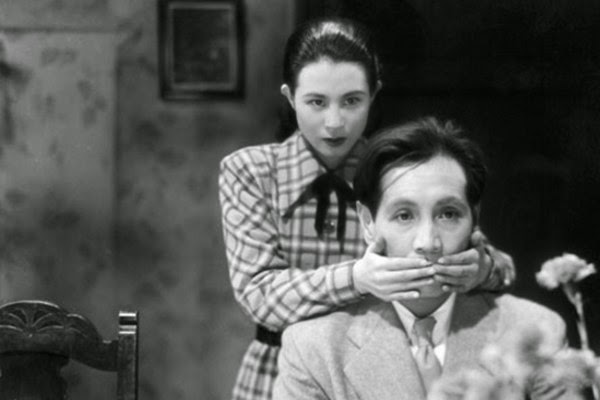
It's pretty difficult to judge this film fully. The first half is erratic, and filled with jolting edits, characters that appear and disappear without any introduction. It's a damn shame. The scatological nature of this epic project, adapted from the Russian classic by Fyodor Dostoyevsky, was due to it being horrendously cut down by the studio that funded it. Originally, Akira Kurosawa had created a 266 minute cut of the - incredibly faithful to the source novel - was shortened by 100 minutes. Unfortunately, it would seem that the world may never see the original version, as even when Kurosawa hunted for the missing scenes in the vaults several decades later, he was unable to locate them.

As it is in its now 166 minute format (the longest version available), it is still an incredibly important piece of melodrama. After the devastation of the war, Kinji Kameda (Masayuki Mori) and Denkichi Akama (Toshiro Mifune), travel back to a remote island. Kameda claims that he suffers from an illness, cause by the suffering of war, and simply referred to as idiocy - when expressed on film, this idiocy seems simply to be an innocent, and fundamentally naive view of people. He simply only sees good in people, even if this is not the case. On arriving they both seem to fall for a disgraced woman, Taeko Nasu (Setsuko Hara), who was someones concubine since the age of fourteen, and is being offered for marriage at a price.

What ensues is a strange love triangle that divides not only the two male protagonists, but the community. The film is beautifully shot in black and white by Toshio Ubukata, who had worked with Kurosawa on his previous film, Scandal (1950). It is unfortunate that the films first half suffers so evidently due to extensive cutting. However, it is the relationship between Kameda and Akama that provides the climax (which is seemingly more intact) that provides the films central theme, and its most poignant elements.


Directed by: Akira Kurosawa
Starring: Setsuko Hara, Masayuki Mori, Toshirô Mifune, Yoshiko Kuga
Country: Japan

Rating: ****

Marc Ivamy


The Idiot (1951) on IMDb

LinkWithin

Related Posts Plugin for WordPress, Blogger...