Showing posts with label 1930. Show all posts

Tuesday, 24 November 2015

Review #947: 'Just Imagine' (1930)

Here's a first for me - a pre-Hays Code science-fiction romantic musical comedy. Just Imagine, directed by David Butler, envisions a 1980 where everybody flies rather than use cars, are given numbers instead of names, eat food and drink alcohol in pill form, and have their life partners decided by a judge. Just Imagine is a true oddity, and should be seen by anybody interested in obscure curiosities or the evolution of sci-fi in cinema. Despite the wonderful Oscar-nominated set design, the film is also very, very bad, plagued by wooden acting, forgettable songs, and some plain old weirdness.

J-21 (John Garrick) is in love with LN-18 (Maureen O'Sullivan), but the fact that he has reached the peak in his field - aviation - is stopping him from achieving greater things. Due to the limits of his field. the judge deciding on LN-18's ideal partner is the favouring smug and loathsome aristocrat MT-3 (Kenneth Thomson) instead. After witnessing a successful experiment to bring back a man, who dubs himself Single O (vaudeville performer El Brendel), back to life after being frozen in 1930, J-21 is approached by a scientist who has perfected a 'rocket plane' capable of reaching Mars, and wants J-21 to be the pilot. Joined by Single-O and his best friend RT-42 (Frank Albertson), J-21 sets out on a mission into the unknown in the hope of becoming a hero and winning the hand of his true love.

Some early moments of Just Imagine are truly wonderful. Riding high above the city in their aircrafts, R-21 parks up next to LN-18 for a mid-air chat amidst the backdrop of skyscrapers. The special effects throughout are wonderfully charming and hold up well 75 years on. These brief delights are sadly few and far between, and the film spends the majority of its hefty 110 minute running-time churning out blandly-filmed song-and-dance routines, including a bizarre number about never killing a fly because it may be in love with another fly, Brendel's tiresome and unfunny shtick, and taking its sweet time to actually get into outer space. When we finally lands on Mars, we are in Ed Wood territory, with scantily-clad natives and plonky fight scenes. It flopped upon release due to the decreasing popularity of musicals at the time (pre-Busby Berkeley), but Just Imagine at the very least deserves to be seen once and never again.


Directed by: David Butler
Starring: John Garrick, Maureen O'Sullivan, El Brendel, Frank Albertson, Marjorie White
Country: USA

Rating: **

Tom Gillespie


Just Imagine (1930) on IMDb

Thursday, 24 October 2013

Review #667: 'Animal Crackers' (1930)

The greatest thing about the Marx Brothers was the diversity of their comedy. Groucho was ultimately a master of the one-liners, Chico alluded to ethnic stereotypes that were popular during his days doing vaudeville, and Harpo was the clown, pulling sight gags from every pocket he had in that huge overcoat he wore. Animal Crackers, their second film as The Marx Brothers, allows them free reign to indulge in their manic brand of comedy due to an absence of plot. What is immediately apparent upon viewing the film is just how postmodern it is. Groucho laments his inner thoughts to camera and a statue shoots back at a startled Harpo, all combining to make one truly insane 95 minutes, made all the more risqué with this being before the introduction of the Hays Code.

Famour explorer Captain James T. Spaulding (Groucho) arrives at a house party hosted by the upper-class Mrs. Rittenhouse (Margaret Dumont). Whilst there, he manages to swindle, insult and charm the various guests who are in attendance, namely Roscoe Chandler (Louis Sorin), an art collector who has brought one his most prized paintings to display to the guests. Also there is musician Signor Ravelli (Chico) and his mad sidekick The Professor (Harpo), who are harbouring a plan to steal the painting and replace it with a forgery. Unfortunately for them, there are others who wish to pull off the same trick for different reasons.

While the songs are nice and catchy (Groucho's intro song "Hooray for Captain Spaulding" was used in TV quiz show You Bet Your Life, which Groucho hosted), the technical aspects suffer the same way as many films did with the sudden introduction of sound. The screen is crammed with characters, much like a play would be, and this sense of disorganisation takes a little away from the film.

But it is all about the comedy after all, and here all three of the brothers are on top form, with Groucho providing the killer lines "one day I shot an elephant in my pajamas. How he got in my pajamas, I don't know" and "we took some pictures of the native girls, but they weren't developed. But we're going back again in a couple of weeks!" (Zeppo also appears, but only briefly). When the plot becomes too ridiculous or the action moves away from the Marx Brothers, stick around for another 30 seconds and they'll be something else to laugh at - it's just that funny.


Directed by: Victor Heerman
Starring: Groucho Marx, Chico Marx, Harpo Marx, Zeppo Marx, Lillian Roth, Margaret Dumont
Country: USA

Rating: *****

Tom Gillespie


Animal Crackers (1930) on IMDb

Sunday, 16 September 2012

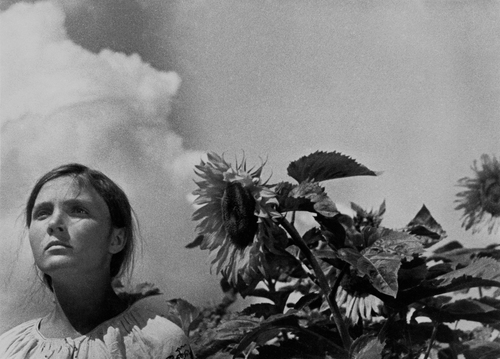
Review #488: 'Earth' (1930)

The Soviet Union's political and social journey throughout the first few decades of the twentieth century presented a wide and rich palette for film-making innovators to work from. The most popular of the Soviet visionaries was Sergei M. Eisenstein, master of the montage, and champion of the working-classes. So breathtaking was Eisenstein's work, that it is easy for other great film-makers to be relatively forgotten. Although it would be extreme to label Aleksandr Dovzhenko, director of the magnificent Earth, as forgotten, time has been unfair to the director who was arguably as visually innovative and socially aware as his counterpart.

Earth begins with the death of a farmer, Semyon (Nikolai Nademsky), who says his goodbye's beneath a pear tree, blissfully ignorant of the turbulence his death will cause. The village is cut down the middle. One half are the kulaks, private-land owning peasants, who were seen to be growing rich in their greed by Stalin, personified in the film as Arkhip (Ivan Franko), who discusses with his group the idea of collectivisation, to a united resistance. The other, is the sceptical Opanas (Stepan Shkurat), father to the pro-collectivisation Basil (Semyon Svashenko), who is a member of All-Union Leninist Youth Communist League. The arrival of a new tractor lifts the communities spirits, but a murder sparks off a feud.

One of the many social revolutions to come out of the Stalin-era Soviet Union was the idea of collectivisation. After Ukranian peasants were given rights to own land at the turn of the century, Stalin saw them growing rich beyond their means and vowed to eliminate what he saw as its own social class. Collectivisation was to bring land back to the community, therefore generating more product and boosting the economy. But the Soviet army met stubborn resistance from the peasants, who were seeing their land and goods seized and distributed.

Dovzhenko's film has a somewhat ambiguous message, focusing more of the individual plights of a select group of characters. The collectivists and communists are clearly the more sympathetic groups in the film, but the film is more human drama than political propaganda. Like Eisenstein, Dovzhenko treats us to a simply brilliant montage scene, as the delight of the farmers at the arrival of a new tractor (which they urinate in to get going) is juxtaposed alongside the mechanics of grain production. This feeling of the metaphorical prevails throughout the film, as the seemingly endless grain fields and growing fruit are filmed as if tiny gods, watching the human drama unfold beneath them. The film had a mixed reception upon release, forcing Dovzhenko into depression, but is now rightly heralded as one of the most important to come of the Soviet Union, alongside Eisenstein's Battleship Potemkin (1925).


Directed by: Aleksandr Dovzhenko
Starring: Stepan Shkurat, Semyon Svashenko, Yuliya Solntseva, Ivan Franko
Country: Soviet Union

Rating: *****

Tom Gillespie


Earth (1930) on IMDb

Sunday, 6 May 2012

Review #393: 'L'Age d'Or' (1930)

In 1929, the art world and movie-going audiences were shocked to the core when Luis Bunuel and Salvador Dali teamed-up to make the short surrealistic masterpiece Un Chien Andalou. Scenes of eye-slitting and ants crawling out of open palms caused revulsion and awe in equal measures. A year later, Bunuel and Dali planned another surreal satire, but the two had a fall-out, leading to Bunuel taking the solo reigns and using his film-making know-how to make a slightly more accessible and narrative-driven piece, and this time feature-length (well, 63 minutes). The result caused chaotic scenes of rioting, violence and destruction upon its premiere. Bunuel must have been laughing his ass off.

The film is basically a collection of small vignettes that revolve around a couple, the Man (Gaston Madot) and the Young Girl (Lya Lys) who are passionately in love. Yet their frequent attempts at expressing their love are repeatedly thwarted by various groups and people. There is also a short documentary about scorpions, a bourgeois party where a small boy is shot with a shotgun and a serving woman gets blown out of the kitchen by a fire, and an epilogue detailing an 120-day orgy (a reference to the Marquis de Sade's 120 Days of Sodom) which leads to the death and scalping of the participating women.

I have to admit that whilst viewing this mind-fucking masterpiece, I was dumbfounded as to what was going on or what the film was trying to get across. Yet like all great art, it stayed with me, and the more I thought about it, the clearer it became. The message seems to be how society and religion can suppress natural sexual urges and expression to the point that it can cause violence within humanity. The film is full of sexual imagery - most memorably in the scene where the Young Girl, seemingly nymphomaniacal in her lust for the Man, performs fellatio on the toe of a statue. The camera then amusingly cuts to the statues face, as if we are expecting a reaction from it.

It is relentless in its mockery of religion and the upper classes. In the most shocking scene (even by today's standards), we are shown an idealistic portrayal of a father-and-son. The father sits holding an object (I think he is rolling a cigarette) in the scenic garden of their home, while their son playfully hops about him. His son then knocks the object out of his hand and runs off, causing the father to fume. The father then picks up his shotgun and shoots the boy dead. And then shoots his limp body again. The son seems to represent free-spirit and the father society, and it seems the message here is that if you refuse to conform to society's wishes, then society will crush you. A relatively simple point sledge-hammered home. It wouldn't be too far-fetched to call this one of the most important films ever made, as it pushed the boundaries of what was possible at the time and remains just as shocking and as ground-breaking as it was 82 years ago.


Directed by: Luis Buñuel
Starring: Gaston Modot, Lya Lys, Caridad De Laberdesque, Max Ernst
Country: France

Rating: *****

Tom Gillespie


L'Age d'Or (1930) on IMDb

Sunday, 8 January 2012

Review #302: 'Le Sang d'un Poète' (1930)

Jean Cocteau was a French poet, painter, playwright, actor, as well as film maker, and was a huge part of the artistic community at the time. The Blood of a Poet (to use its English translation), is a very personal piece of avant-garde cinema, that reflects the ideas of the artist, and presented in a disjointed, surreal style, that is an enigma, even on viewing a second time.

The Blood of a Poet has four sections that seem to have no connection at all. We begin with Enrique Rivero as "the poet", who paints a face who's mouth begins to move. After erasing it with his hand, the mouth transfers to him. After pleasuring himself with the mouthed hand, the poet transfers it to a female statue, who orders him to climb through a mirror, where he enters a new realm, one that holds doors into which the poet views some strange scenes. In another sequence a boy is killed in a snow ball fight.

The Blood of a Poet was the first in what became Cocteau's Orphic Trilogy, which continued with Orphee (1950) and Le Testament d'Orphee (1960). It's slow, poetic movements through some very beautiful imagery, are in themselves interesting at times. The film is practically silent, except that there is a partial narrative (that incidentally is far too poetically esoteric that we get no indication of what is happening).

The film begins with a title card that states; "Every film is a coat of arms. It must be deciphered." This seems to be its intention, to be such a piece of art that its meaning requires unravelling. Whilst this kind of riddle is often pleasurable, in this cause it seems that you may need to know much about Cocteau himself - I have only read one biography of the man. Although, his film work does improve; the other two in the Orphic trilogy are splendid, along with his incredibly poetic, and dreamily beautiful adaptation La Belle et la Bete (1946).


Directed by: Jean Cocteau
Starring: Enrique Rivero, Elizabeth Lee Miller, Pauline Carton
Country: France

Rating: ***

Marc Ivamy


The Blood of a Poet (1932) on IMDb

Monday, 25 April 2011

Review #46: 'City Girl' (1930)

F.W. Murnau’s penultimate film, City Girl was made just a year before his tragic death. It tells the rather simple story of a waitress named Kate (Mary Duncan) who, tired of her hectic schedule and overbearing boss, dreams of a simpler life. In steps farmer’s son Lem (Charles Farrell) who is in the city in order to sell his father’s product. The two fall in love, and Kate agrees to move to the country with Lem to live the farmer’s life. Only after arriving, she realises that a farmer’s life isn’t as peaceful as she imagined, and she has to face Lem’s irate father.

Made as the silent era was sadly coming to an end, it was originally made as a hybrid, with long silent moments with the odd audible piece of dialogue. Apparently audiences could not take to its style and it bombed financially, but it has been recently re-discovered and restored in its complete silent form. And thank God it was, as although it comes nowhere near to the dizzying heights of Sunrise: A Song Of Two Humans (1927), the influential brilliance of Nosferatu (1922), and the biting social commentary of The Last Laugh (1924), it’s a fine example of Murnau’s ability as a filmmaker.

It cleverly juxtaposes the naivety of the two leads who both sample a very different life, only to discover that it is every bit as stressful and brutal as their former lives. It’s hardly groundbreaking, but Murnau handles the film with such a poetic elegance and intimacy rarely captured by other filmmakers. It makes it all the more tragic that most of his earlier films are now lost, including a version of Dr Jekyll and Mr Hyde (1920), and also that Murnau lost his life a year later after making his final film Tabu: A Story Of The South Seas (1931), to which he didn’t make the premiere.


Directed by: F.W. Murnau
Starring: Charles Farrell, Mary Duncan, David Torrence
Country: USA 

Rating: ***

Tom Gillespie


City Girl (1930) on IMDb

LinkWithin

Related Posts Plugin for WordPress, Blogger...