Showing posts with label 1975. Show all posts

Sunday, 17 September 2017

Review #1,247: 'Night Moves' (1975)

Cited by many critics as one of the best and most important American movies of the 1970s, Arthur Penn's Night Moves hasn't stood the test of time in terms of popularity. The legacy of the nouvelle vague in France had inspired a whole generation of American film-makers to try new things, and to subvert genres as much as the studios would allow them. This led to a re-emergence of the film noir, a genre stuck very much in the 1940s and 50s. With its chain-smoking, loose-skinned leading men and devilish, glamorous ladies, its tough demeanour is very much a product of the time. A couple of decades later, and filmmakers such as Roman Polanski, with Chinatown, and Robert Altman, with The Long Goodbye, found new ways to explore this dark world and its shady characters, and are widely remembered for it. But no film has been as successful at cutting to the heart of what drives these self-loathing deadbeats and the manipulating bombshells distracting them as Arthur Penn's Night Moves.

Private investigator and former American football star Harry Moseby (Gene Hackman) works freelance, preferring to gulp down coffees during long stakeouts on his own time than to be on the payroll of a larger agency. His wife Ellen (Susan Clark) tries to shake him out of his stubborn ways, but he's just an old-fashioned sort of guy. This lone wolf approach is in his blood, as after he turns down Ellen's invitation to the cinema, he monitors the situation anyway, discovering that his wife is having an affair in the process. Meanwhile, former actress Arlene Iverson (Janet Ward) hires Harry to track down her missing, promiscuous daughter Delly (Melanie Griffith). A conversation with mechanic Quentin (James Woods) leads Harry to a thrill-seeking movie stuntman, and then to the Florida Keys, where he discovers Delly hiding out with her stepfather Tom Iverson (John Crawford), and a striking woman named Paula (Jennifer Warren).

As a straight-forward detective story, Night Moves will likely divide an audience. With its unhurried approach and eagerness to explore Harry's troubled home-life and self-destructive behaviour, the jarring tones may not suit everybody's tastes. Night Moves is much more about the character than the case he is on. The movie mainly succeeds in this balancing act because of the performance of Gene Hackman, an actor working at the very top of his game. In the 70s, he was part of a group of actors who rebelled against Hollywood gloss, and portrayed real people in real situations. Harry is ultimately a good-hearted guy, tragically failing to see the irony when he demonstrates his knowledge of 'check mate' moves in chess to Paula, with sight of own possible fate in the unravelling mystery. As the plot moves on and Harry finds himself caught up in far more than he had bargained for, the revelations become increasingly confusing. But I didn't care:  It's the kind of convolution warmly embraced by the Coen Brothers in neo-noir The Big Lebowski. It isn't a masterpiece, but Night Moves deserves to be remembered as one of the most important American movies of its decade.


Directed by: Arthur Penn
Starring: Gene Hackman, Jennifer Warren, Edward Binns, John Crawford, Melanie Griffith, James Woods
Country: USA

Rating: ****

Tom Gillespie


Night Moves (1975) on IMDb

Saturday, 1 July 2017

Review #1,216: 'Overlord' (1975)

Stuart Cooper's Overlord is a meditation on the mechanics of war and the young souls swept into it. After winning the Silver Bear at the 25th Berlin International Film Festival, the film became incredibly obscure until recently, when it was given the restoration it deserved by the lovely folks at Criterion. Beginning in a quaint English home and ending on the beaches of Normandy for 'Operation Overlord' during World War II, it's a simple yet hypnotic story of a young private named Tom (Brian Stirner) and his slow journey to a death he feels is inevitable. The very first scene shows an out-of-focus soldier running from or towards an unknown threat before being shot down, only to be revealed as a dream sequence. This vision plagues Tom's thoughts, but he nevertheless remains somewhat chipper about it.

What makes this very personal journey so incredibly powerful is the sense of impending doom. Tom always seems to be on the move, be it on a train or an army jeep, as if he is making a slow trek towards his fate, and he chooses this time to daydream. Despite not knowing where the war is heading or if he'll even see combat, he somehow knows he is going to die but remains nonchalant about it. A nice boy, well spoken and slight, Tom is not built for the army, but he does what he is told and makes friends. The only time we really see his personality come to the fore is when he meets a pretty young lady (Julie Neesam) and the pair enjoy what little time they have together. He tells her they'll meet again, but we know they won't. In making Tom such an everyman, Overlord studies the anonymity of battle, and celebrates the millions of unknown soldiers who have charged into certain death without really understanding why.

Starting out life as a documentary, Cooper later made the bold decision to use the startling archive footage provided by the Imperial War Museum and weave a narrative through it. Cinematographer John Alcott (who collaborated with Stanley Kubrick on the likes of 2001: A Space Odyssey and Barry Lyndon) employs grainy black-and-white photography for the central story so it is interchangeable with the stock footage. The result is staggering. By adding sound, scenes of devastating city bombings become hellish nightmares, and a beach landing turns into something out of science-fiction. In a bizarre scene, a water wheel device powered by mini rockets rolls across the water and onto land, hoping to detonate any landmines or unexploded bombs before mightily toppling over. It's World War II like you've never seen it before, and it's real. It's a winning combination of observational and personal, making Overlord one of the most innovative and devastating humanist war films ever made.


Directed by: Stuart Cooper
Starring: Brian Stirner, Davyd Harries, Nicholas Ball, Julie Neesam
Country: UK

Rating: *****

Tom Gillespie


Overlord (1975) on IMDb

Tuesday, 26 April 2016

Review #1,012: 'Three Days of the Condor' (1975)

There was once a time that paranoid thrillers such as Sydney Pollack's magnificent Three Days of the Condor would have seemed like the mad ramblings of an extreme lefty. The government were not made up of powerful men with our best interests at heart, but a bunch of powerful men plotting, scheming and murdering their way to further themselves or whatever organisation-within-an-organisation they were working for. After the Watergate scandal, such cynicism didn't seem so out-there. It inspired a wave of great films, some of the finest in American history, with director Sydney Pollack and actor Robert Redford very much at the forefront.

Here Redford plays Joseph Turner, a CIA bookworm tasked with reading everything - books, newspapers, magazines - in the search for hidden codes and revolutionary ideas, operating from a small office with a close assortment of colleagues. After he pops out for lunch one day, he returns to find all of his co-workers murdered, and is plunged into a world of deep paranoia. When he seeks protection from the 'Company', he is almost murdered as he meets the man he thinks is bringing him in. With no-one to turn to, he kidnaps an artist named Kathy (Faye Dunaway) at gunpoint and shacks up with her, gradually bringing her to his side as his situation becomes utterly desperate.

Turner, now lumped with the knowledge that he can trust nobody, is forced to re-evaluate everything he knows about how his employees operate. The CIA are summed up in the film by two characters - the seemingly emotionless killer Joubert (Max von Sydow) and slick-talking suit Higgins (Cliff Robertson). It's a terrifying thought to think that someone may be listening to every phone call or reporting your whereabouts, and that every time there's a knock at the door it may be the delivery man with a machine-gun. It is Joubert's chilling monologue towards the end of the film that really speaks volumes about the men Turner is fleeing from. Pollack's direction is tight and clinical, effortlessly building suspense through Redford's increasingly rugged performance. An exciting, intelligent thriller from the greatest period in American cinema.


Directed by: Sydney Pollack
Starring: Robert Redford, Faye Dunaway, Cliff Robertson, Max Von Sydow, John Houseman
Country: USA

Rating: ****

Tom Gillespie


Three Days of the Condor (1975) on IMDb

Saturday, 12 January 2013

Review #562: 'Criminally Insane' (1975)

Nick Millard, director of obscure cult favourite Criminally Insane, must have been ashamed of himself. As well as this schlocky (yet quite enjoyable) effort, he has notched up as many Z-grade soft-core flicks as he has had aliases, such as the classics Fraulein Leather (1970), Pleasure Spots (1975), and, most hilariously, Sex Weirdo (1973). He has named himself Helmud Schuyler, Otto Wilmer and Alan Lindus, and here goes by the name of Nick Philips. Although he displays a unique talent for ineptness, Criminally Insane proves to be almost charming in its embracing of trash, and although features technical standards akin to Herschall Gordon Lewis, it channels the Midnight Movie sleaze of John Waters.

The obese and mentally ill Ethel (Priscilla Alden) is released from a mental hospital, where she moves back in with her mother Mrs. Janowski (Jane Lambert). Having been warned of Ethel's physical health and dangerous over-eating, Mrs. Janowski places her on a diet, locking all the cupboards and emptying the fridge. After being refused the key to the cupboard, Ethel stabs and killer her mother, and orders a big delivery (with extra ice-cream). Unable to pay the bill, Ethel kills the delivery boy as well, dragging him and her mother into the back room where they begin to rot. Things become complicated when Ethel's sister Rosalie (Lisa Farros) moves in, bringing her prostitute lifestyle as well as her sleazy pimp boyfriend John (Michael Flood), in with her.

From the synopsis alone, one could predict what they were letting themselves in for. This is shameless exploitation, made on an obviously tiny budget, and filmed in mainly one location (probably the director's grandma's house). Millard's takes people's natural disgust for obesity (now a much more sensitive issue in these PC days) and turns it into a movie monster. Alden, clearly possessing no acting ability, is nevertheless memorable, and more disturbingly, believable. I could imagine watching her on the Jerry Springer show being crane-lifted out the side of her house. At only 61 minutes, it doesn't demand much, but if a film this short can feel dragged out towards the end then you know you're in trouble. But ultimately, there are plenty of logic-defying moments that provide much-needed hilarity, and the thickest fake blood you've ever seen, and deserves it's place on the cult circuit.


Directed by: Nick Millard
Starring: Priscilla Alden, Michael Flood, Lisa Farros
Country: USA

Rating: **

Tom Gillespie


Criminally Insane (1975) on IMDb


Wednesday, 28 November 2012

Review #543: 'The Story of Adele H.' (1975)

"I'm still young and yet it sometimes seems to me that I've reached the autumn of my life." This tragic statement, taken from the diaries of Adele Hugo, daughter of Victor, is both the doomed statement of a young girl driven mad by love, and an ironic testament to the performance of a then 20 year old Isabelle Adjani. Francois Truffaut takes us back to 1863, with the American Civil War in full swing, and France and Great Britain still undecided in participation. Young Adele Hugo arrives at a camp in Nova Scotia seeking out her great love Lieutenant Pinson (Bruce Robinson), who she had embarked on a love affair with and whose potential marriage had been frowned upon.

What may have become a rather frustrating depiction of a desperate woman in love, Truffaut takes special care to create an air of Greek tragedy, as we witness the emotional deterioration of our protagonist, and her desperate pursuit of the unwilling Lieutenant Pinson. Adjani, simply unnervingly beautiful (seriously, how do the French keep doing it?), gives everything to the role. Adele herself, as depicted in the picture, is a time-bomb of emotions, giving every ounce of her strength into the tidal wave of pure love she feels - possibly a result of her father's grand romantic poems and novels - so anything less from Adjani wouldn't haven't done Adele justice.

This is a different kind of work to what I've previously seen from Truffaut - I'm more familiar with his New Wave productions. Adele H. is filmed in dark lighting, acting almost like a character itself signifying the darkness clouding in Adele's emotional torment. Victor Hugo's presence can be felt throughout the film, although he is never seen. Adele's story was taken from her diaries and the frequent letters she wrote to her parents, both of whom were concerned for her well-being. She attempts to keep her identity a secret, but friends are shocked when they uncover her secret, and the film works almost as a testament to Victor Hugo, a bow to his sheer immensity. But whether this is an ode to tragic intellectualism, or a human story that grabbed Truffaut's heart, I'll never know, but this is a gently haunting tale, and one that will make you want to personally open the eyes of Adele to the possibilities that are all around her, were she not so swept away by madness and love.


Directed by: François Truffaut
Starring: Isabelle Adjani, Bruce Robinson, Sylvia Marriott
Country: France

Rating: *****

Tom Gillespie


The Story of Adele H (1975) on IMDb

Sunday, 7 October 2012

Review #504: 'The Naughty Stewardesses' (1975)

"Where do I go from here?" ponders protagonist Debbie (Connie Hoffman) in the final scene of the film, "everywhere or nowhere?" Ironically, this is precisely what The Naughty Stewardesses spends its hefty 107-minute running-time going, everywhere, and more accurately, nowhere. Amongst the thread-bare 'plot', the film shifts gears and genres faster than the film's leading ladies get out of their clothes, going from the familiar small-town-girl-hits-the-big-city story, to soft-core exploitation flick, to relationship drama, to kidnap thriller, and disappointingly, none of these themes work at all.

Debbie arrives in Los Angeles to become a stewardess. She is a wandering soul, we learn this as she explains her situation to a hitch-hiker, and if she doesn't like it, she will simply hit the road again. Her first night in her new stewardess dormitory sees her fellow stewardesses indulge in a bit of man-eating at a house party, as a naked man covered in cream is brought out as the cake. Repulsed, Debbie embarks on a 'journey' on self-discovery, getting close to 70-odd year old Brewster (Robert Livingston), a rich and horny old dog who takes an interest in the beautiful Debbie. She also meets photographer Cal (Richard Smedley), who, after a nice day of photographing Debbie, reveals himself to be the psychopathic, jealous type.

Director Al Adamson, whose back catalogue include titles such as Psycho A Go-Go (1965), Satan's Sadists (1969) and Horror of the Blood Monsters (1970), doesn't do much to dismiss his reputation as one of cinema's most inept, as he brings very little titillation (which is what these type of sexploitation films we're made for) to the proceedings (Adamson was shockingly murdered in 1995). What we do get in a sex scene involving a 70 year old (who Debbie describes as being in his 50's - who is she fucking kidding?), wrinkly man boobs and all. The film isn't actually that awful. It's rather nicely filmed (given it's budget), and the script is far better than it should be, but at 107 minutes, it's a tough watch, and even the out-of-nowhere kidnapping and blackmail sub-plot fails to spice up what is ultimately a boring mess.


Directed by: Al Adamson
Starring: Connie Hoffman, Robert Livingston, Richard Smedley
Country: USA

Rating: **

Tom Gillespie


The Naughty Stewardesses (1975) on IMDb


Tuesday, 28 August 2012

Review #471: 'The Black Gestapo' (1975)

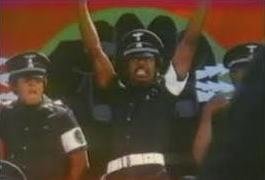
One of the many blaxploitation with the title prefix Black... (...Samurai, ...Caesar, ...Aphrodite), Gestapo also manages - rather uncomfortably - to incorporate the iconography of Nazism, bringing another of the popular sub-genre's of the exploitation market, that together make nazi-blaxploitation. "The People's Army", a vigilante group headed by General Ahmed (Rod Perry), are set up in Watts to protect black citizens in the inner city. After they run a white criminal organisation from the community, second in command Colonel Kojah (Charles Robinson), breaks the group in the middle to form his own, more fascistic group, indulging in money-making activities such as drug dealing, and orates for more direct, violent action.

Writer-director Lee frost (along with co-writer-producer Wes Bishop), has obviously, and incredibly insensitively, misinterpreted the black power movement in the late 1960's/'70's - particularly the Black Panthers - and presented it with Nazi iconography. It's an uncomfortable juxtaposition to see a group of black men congregated on a ghetto basketball pitch, dressed fully in the garments of the most vilified, ultra-racist political movement of the twentieth century. Why exactly would anyone (but particularly an ethnic minority), take on this most instantly recognisable of images?

There does seem to be an attempt to perhaps represent the opposing views of the two major iconic black figures of the 1960's. In Ahmed we have the message of non-violent protest from Dr. Martin Luther King Jr., whilst Kojah's view of violent actions mirrors the philosophy of Malcolm X, and his pronouncement of using violence in self-defence. But maybe I'm just reading into something that's not actually there. When the film isn't insulting its audience, it displays nothing new to an already lagging genre, and simply presents generic tropes: Blaxploitation was always criticised for perpetuating racial stereotypes, but this film could indeed be guilty of far more. With a series of scenes-we've-seen-before, such as the castration of a white man, after he raped a sister, the film also uses the contemporary necessities such as soft female nudity. Action scenes are played out with little excitement or even much vigorous movement, which along with the amateurish film making makes this film a totally dull squib. So... Hardly the "New Master Race," instead simply insulting to anyone who watches.


Directed by: Lee Frost
Starring: Rod Perry, Charles Robinson, Phil Hoover
Country: USA

Rating: *

Marc Ivamy


The Black Gestapo (1975) on IMDb


Monday, 23 April 2012

Review #386: 'Frozen Scream' (1975)

I was under the impression that the medical toxin Botox was a modern phenomenon in terms of its use on vacuous, rich, stupid peoples faces. However, watching this 1975 movie actually proved me completely wrong. The "actors" in this film seem to use the substance on a meteoric scale, and its as though the late '60's concept of drug sharing is taken to another level, like 'Fraternity of Men', "Don't bogart botox my friend, pass it over to me", seems to be what was happening between scenes. The faces of all involved here barely move. Their expressionless, vapid, and monotone deliveries are almost laughable; they simply have no emotions - even when delivering some (incredibly pedestrian admittedly) dialogue that simply drips from their chins, and is hardly audible.

Well, the film does also kind of have a story. It's about scientists who are experimenting on what appear to be implants that can extend life - becoming the epitome of love and immortality. Basically, they have discovered a way to revive the dead, bringing them life as cold, zombie-like creatures of control (like H. P. Lovecraft, but without any outrageous fun - of even simply fun for that matter). There are some strange figures in black robes who seem to kill those who find out. It's pretty hard to work out what is going on at times, it is a rather convoluted narrative. So it is yet again another pathetic, and preposterous entry into the video nasties list. All I can say here is simply that I curse the stupid choices that the director of public prosecutions made in the early 1980's, and also I want to extend my fist towards the man who's idea it was to review all these fucking films - cheers Tom, you knob.


Directed by: Frank Roach
Starring: Renee Harmon, Lynne Kocol, Wolf Muser
Country: USA

Rating: *

Marc Ivamy


Frozen Scream (1975) on IMDb


Tuesday, 20 March 2012

Review #355: 'Dolemite' (1975)

"Dolemite's the name, and fucking motherfuckers is my game." This line is symptomatic of the dialogue in most of the many blaxploitation films of the 1970's, a brand of exploitation cinema that revels in the violence and fashion of the black ghettos: It is in fact the first instance in cinema history that black actors were able to be the star. Dolemite (played by blaxploitation king/"godfather of rap"/disco godfather, Rudy Ray Moore) has been set up by corrupt cops, city mayor and the local king-pin, Willie Green (D'Urville Martin - also director), and sent to prison for 20 years. However, Queen Bee (Lady Reed) and a prison officer set him free so that he may get revenge on those who cheated him of his freedom, and clean the streets of these corrupt figures in society.

It is a pretty standard blaxploitation flick, with the requisite iconography: the ultimate '70's pimp look; a hareem of sexy girls (credited here as simply Dolemite girls); the obvious influence of Bruce Lee with a healthy dose of kung-fu; and, of course an almost perpetual presence of the boom-mic in-shot. It's unfortunate that through the majority of the list on our Grindhouse Project, we are offered pretty dull movies, which look incredibly action-packed and fun in a 2 minute trailer, but fails to be either when expanded to it's full 90 minutes.

This sub-genre was incredibly short-lived, and became pretty generic, and the acting throughout is appalling. However, despite the disappointment of the pace compared to the trailer, and the obvious stereo types, the film still has elements of fun, and a preacher who hoards a massive cache of weapons in his church. So I'm guessing that I should at some point watch the sequel, The Human Tornado (1976).


Directed by: D'Urville Martin
Starring: Rudy Ray Moore, D'Urville Martin, Lady Reed
Country: USA

Rating: **

Marc Ivamy


Dolemite (1975) on IMDb


Thursday, 9 February 2012

Review #327: 'Coonskin' (1975)

Randy (Philip Michael Thomas) and Pappy (Scatman Crothers) escape from prison and await a pick-up from their friends Sampson (Barry White) and Preacherman (Charles Gordone). Pappy begins to tell a strange story about three crooks, Brother Rabbit (voiced by Thomas), Brother Bear (White) and Preacher Fox (Gordone), who rise up throughout the Harlem crime ring. They come up against an evangelistic maniac who teaches his followers to kill whites, a crooked white cop with a hatred of Brother Rabbit, and a fat, Italian-American, Godfather-type who put out a contract on the trio.

Ralph Bakshi, one of the most revolutionary cartoonists in recent times, had a long history with the making of Coonskin. He experienced segregation first-hand growing up in Brooklyn where he was forced out of an all-black school due to the fear that the whites may discover it and cause havoc. These racist attitudes seem to have left their mark on Bakshi and he wanted to satirise it brutally, leading to the birth of Coonskin, a film that was picketed and protested against by various groups before any screenings of the film had been arranged, and a film that remained so misunderstood by many until recently.

Bakshi savagely attacks stereotyping and racist iconography by using, well, stereotyping and racist iconography. He employs characters in minstrel show blackface that were so popular in Civil War-era America, and portrays the black characters as loud, crude and violent. Yet no one is safe here - homosexuals, Italians, white-trash, Jews - all are portrayed as wildly over-the-top stereotypes. Bakshi conquers the problem by facing it head on, exaggerating it ten-fold, and then throwing it in our face. If you don't get satire or if you completely miss the point of Coonskin, then this is possibly the most offensive film ever made.

The animation is crude and dirty-looking, but I believe this was Bakshi's intention. By giving it a grimy, almost sloppy feel, he brings the story closer to the street, where his characters live out their lives. The mixture of animation set against real backdrops evokes Disney's still-banned Song of the South (1946), a film that Disney are so ashamed of due to the fact that it could be construed as racist, that they placed the ban on it themselves. The film is also quite strange, jumping between different styles and tones, and the result is as often confusing as it is mesmerising.

They are some truly inspired moments, such as the scene when our animated trio enter Harlem (the "home to every black man") to be greeted by a wailing saxophone in the street, as well as Scatman Crothers' rendition of Ah'm a Nigger Man over the opening credits. I would recommend anyone with a fleeting interest in racial history to watch this film as long as they can stomach the viciousness of the satire, as it is as powerful as it funny, and as smutty as it is sophisticated. How this film was managed to be made escapes me, and how it was made by a white man simply perplexes me. Essential viewing.


Directed by: Ralph Bakshi
Starring: Barry White, Charles Gordone, Scatman Crothers, Philip Michael Thomas
Country: USA

Rating: ****

Tom Gillespie


Coonskin (1975) on IMDb

Sunday, 22 January 2012

Review #320: 'Shivers' (1975)

Dr. Hobbes (Fred Doederlin) has been using unorthodox methods upon his transplant patients, placing large, penis-shaped worms in their bodies to act in place of the missing organ. He has placed one in his under-age patient, whom he strangles at the beginning of the film, only to slit his own throat with a razor blade. Nicholas Tudor (Allan Kolman) is a former patient and, after a violent episode, coughs up a worm off his balcony, and it sets about infecting others. Soon enough, the community (a sort of isolated holiday tower block) is overrun with sex-crazed zombies, and it's up to the resident doctor Roger St. Luc (Paul Hampton) to get to the bottom of it.

Shivers is David Cronenberg's first full-length feature film, and he offers an insight into a subject that would remain prominent throughout his career. That is the human psyche mixed with the sexual; whether it be sexual promiscuity or inner perversions, it is here wrapped up as a schlock horror. The bland inhabitants of the tower block appear bored and resigned to their positions in the social order. That is, until the parasite quickly spreads and their suppressed sexual desires come to the fore and they are soon fucking everything in sight and slavering at the mouth. The distinction between sex and horror are blurred to the point where it's difficult to ascertain who is being killed and who is being raped. Cronenberg took huge risks with the censors, exploring and mixing themes such as paedophilia, rape, medical experimentation and sexual disease. With the explosion of AIDS just round the corner, Shivers becomes almost prophetic.

This being Cronenberg's first 'proper' film, it is rough around the edges. The horror is manic to the point of ridiculous, as we are treated to an orgy of flesh and blood that is almost non-stop in the last 30 minutes. Cronenberg would soon learn that such gratuitousness is not needed to compliment his social and sexual commentary, and would refine it rather quickly, leading to such great films such as The Brood (1979) and Videodrome (1983). Not to say this ruins the film, after all, it is a Grindhouse favourite, so a bit of over-the-top exploitation is expected. Far from his best work, but a fascinating insight into the mind of one of the greatest horror directors of all time (although lately he has moved away from the genre).


Directed by: David Cronenberg
Starring: Paul Hampton, Joe Silver, Lynn Lowry, Allan Kolman
Country: Canada

Rating: ****

Tom Gillespie


They Came from Within (1975) on IMDb


Sunday, 20 November 2011

Review #272: 'Eyeball' (1975)

A tour bus carrying a handful of archetypal American tourists is making its way around Barcelona, hosted by an eccentric and sleazy tour guide. Mark Burton (John Richardson) has taken his mistress along with him who he is telling everyone is his secretary. Amongst the others in the group, there's a hip lesbian couple, a fun-seeking young daughter, a couple with a bit of an age difference, and a priest. They are all handed red raincoats to protect them from the torrential Spanish rain, when one of them is murdered by being repeatedly stabbed and having their eye removed. Burton suspects his ex-wife, who is apparently in Barcelona. Soon the tour group are being picked off by this mysterious, red-raincoat wearing psychopath.

My experience with Italian giallo director Umberto Lenzi is only limited at current. The only other work I've seen of his is the rather bad Video Nasty, Cannibal Ferox (1981). From what I've read, his work seems to be up and down, as is the case with the majority of the prolific Italian horror directors of his era. Eyeball, surprisingly, is not bad. It is, of course, unoriginal, cheesy, unsurprising, and rips-off horror master Dario Argento something rotten. Lenzi also makes the strange decision to have the murders take place in broad daylight, in public view. But it's also quite fun, and has a premise that is enjoyably ridiculous and a climatic revelation that blows it out of the water.

Giallos often don't make sense. Even some of the best works in the sub-genre, for example Argento's excellent Tenebrae (1982) is so mind-fucking and far-fetched that it just makes the whole experience that much better. I wouldn't go that far in the case of Eyeball, but Lenzi's sheer audacity come the climax made me chuckle, and gave the film that all-important charm. The murder scenes are filmed rather badly with no effort made for set-piece or tension, but there's plenty of enjoyment to be had here. Lenzi clearly knows this as he even throws a bonus lesbian scene in the middle, seemingly just for the hell of it, and there's plenty of humour that comes from the mismatched band of characters. Nothing to give Argento and Fulci sleepless nights then, but for fans of giallo and Grindhouse, definitely worth a watch.


Directed by: Umberto Lenzi
Starring: John Richardson, Martine Brochard, Ines Pellegrini
Country: Italy/Spain

Rating: ***

Tom Gillespie


Eyeball (1975) on IMDb

Wednesday, 28 September 2011

Review #230: 'Nashville' (1975)

Films with multiple storylines and an ensemble cast are commonplace nowadays, but it all stems, really, from this film - Robert Altman's formidable Nashville. Sure, there were films before that handled large casts before, but never before had a film so successfully told an overlying story using so many characters, and have their lives so delicately intertwined. These characters have full histories and complex natures, yet they are only glimpsed and suggested in short scenes that say more in two or three minutes than most films can manage in a feature length running time.

The film takes place over the course of five days in Nashville, Tennessee, and focuses around the minor and major players in the music business, and the hangers on that seem to always be around. The key characters are Haven Hamilton (Henry Gibson), a spangly-suited veteran singer with political ambitions, Barbara Jean (Ronee Blakley), a mentally unstable country music darling returning to her home town, Tom Frank (Keith Carradine), a member of a folk group trio who is trying to make it on his own and having as many woman as he can along the way, Linnea Reese (Lily Tomlin), a white gospel singer who is being pursued by Tom, and Del Reese (Ned Beatty), Linnea's manager husband, who seems to be oblivious to the strain on his marriage. All their lives are interconnected and are usually linked by an incident or a set-piece.

The first scene of the film sees the campaign van for Presidential candidate Hal Phillip Walker setting off for a tour around Nashville, and appears throughout the film. The film even climaxes at a political rally for Walker, with Hamilton and Barbara Jean both appearing on stage, and the scene brings together nearly all of the films' characters. Although I didn't get from the film that it is necessarily making any kind of political statement, it was made soon after the Watergate scandal, and was released to an America that was looking for answers. I think Nashville is making both a warm and cynical statement about the optimism and the arrogance of America, and also the confusion and the uncertainty that came with the 1970's.

Such is the beauty of Nashville. I couldn't sum up what it was about in one sentence, and couldn't describe a clear aim or message it was trying to deliver. It is a number of things, and touches a number of emotions. The real greatness is in its small moments, such as talentless and desperate aspiring country singer Sueleen Gay (Gwen Welles) singing to a room full of men, and then being told that she was brought there to strip; the cold detachment that Tom deals with Linnea when she reveals she can't stay any longer; the various characters who all think that Tom is singing to them in a crowded bar, as he gazes over them all to the back of the room; or the uncomfortable scene in which Barbara Jean keeps talking to an uneasy crowd rather than singing a song, as it becomes clear that she is truly losing her mind.

Nashville is one of the key films of the 1970's, and one of the finest examples of the American New Wave that emerged in that time, and produced some of the finest films to ever come out of the country. Although Altman had been around for a while at that time (he had already done the brilliant MASH (1970) and the thoroughly underrated revisionist western classic McCabe & Mrs. Miller (1971)), this is the film where he truly found his forte. It's been imitated endlessly, but never has a film managed to do so much with so many different stories. An absolute great, and one of the finest American films ever made.


Directed by: Robert Altman
Starring: Ned Beatty, Henry Gibson, Ronee Blakley, Lily TomlinKeith Carradine, Geraldine Chaplin, Michael Murphy, Gwen Welles, Scott Glenn
Country: USA

Rating: *****

Tom Gillespie


Nashville (1975) on IMDb

Sunday, 14 August 2011

Review #192: 'Monty Python and the Holy Grail' (1975)

This is one of those films that I can't believe I had never seen before now. Also on this list are the likes of It's A Wonderful Life (1946) and The Great Escape (1963), but they will be seen all in good time. It's a shame I had waited so long to be honest, as it is quite possibly the most hilarious and brilliant comedy I've ever seen. There's not much to say about Monty Python that hasn't already been said, but it is well known that the group (John Cleese, Graham Chapman, Eric Idle, Terry Jones, Terry Gilliam, Michael Palin) were revolutionaries in the art of comedy, combining a number of elements to create an overall surreal and ingenious sense of humour.

The film is based loosely on the legend of King Arthur (Chapman) and the Knights of the Round Table. Arthur is on a quest to find the Holy Grail, and with his fellow Knights, encounters a number of dangerous and ridiculous obstacles along the way. These include a castle guarded by French knights with 'outrageous accents', the Black Knight, the Knights Who Say Ni, the Three-Headed Giant, the Rabbit of Caebannog, and the Beast of Arrrrrrggggghhhhh.

Whereas Life of Brian (1979) was a very intelligent and quite biting satire on religion, Holy Grail is pretty much just an excuse to be extremely silly. From the opening scene, where Arthur arrives pretending to ride on his imaginary horse while his squire bangs two coconuts together to make a galloping noise, you know that the film is not going to play by any comedy rules, and is certainly not afraid of being just plain weird. It plays out in an episodic structure, much like The Flying Circus, but the team are clearly at their most comfortable here and are certainly no slouches when it comes to comedy set-pieces. My favourite would probably be the famous Black Knight, who when Arthur has hacked three of his limbs in a brilliantly gruesome manner, is still trying to fight ("'tis but a scratch!").

The comedy comes from all angles - word-play, visual gags, surrealism, post-modernism, blink-or-you'll-miss-it background gags, and simply pulling silly faces - and they come thick and fast, including more laughs per minute than most comedies will be lucky to muster in 90 minutes. This is simply a brilliant film, and will forever remain amongst the greatest comedies ever created.


Directed by: Terry Gilliam, Terry Jones
Starring: Graham Chapman, John Cleese, Eric Idle, Terry Gilliam, Terry Jones, Michael Palin
Country: UK

Rating: *****

Tom Gillespie


Monty Python and the Holy Grail (1975) on IMDb

Wednesday, 22 June 2011

Review #135: 'Boss Nigger' (1975)

Made at the height of the Black Power movement, Boss Nigger (or The Black Bounty Killer) is a blaxploitation western that was written and co-produced by genre legend Fred Williamson. Boss (Williamson) and his friend Amos (D'Urville Martin) are bounty hunters who are looking for wanted man Jed Clayton (William Smith), in order to claim a big reward. When they arrive at a small town where they suspect he may be, they discover it has no sheriff, and is instead being run by corrupt Mayor Griffin (R.G. Armstrong). Tired of being controlled by those damn 'whities', they instate themselves as sheriff and deputy, and stamp their own brand of law enforcement on the community.

Whether this is a genuinely angry film, made in the midst of racial tension and the rise of Black Power, or a satirical play on a familiar scenario with the roles reversed, I'm not sure. It certainly made me feel uncomfortable every now and then. There is only one white character in the whole town that treats the Boss as an equal, and he is quick to stamp his superiority over her as he seduces her. I know, this is a blaxploitation film and the theme is practically always sticking it to the whities, but this is the kind of stereotyping that the black community were experiencing themselves at the time, which leads me to believe that it may in fact be a play on this.

However, racial themes aside, this is actually a pretty enjoyable western. It doesn't break any boundaries, but it's a delightfully old-fashioned new-sheriff-in-town story, that is suitably both amusing and action-packed when it needs to be. As the Boss, Williamson employs his impressive screen presence the same way he did in Larry Cohen's Black Caesar (1973), taking no shit from the townsfolk, and charming the ladies. It also benefits from the fact that is had a bit of a budget, as opposed to most blaxploitation films which often looked cheap and amateurish. Good, bloodless fun, that drops more 'N' bombs than a BNP rally.


Directed by: Jack Arnold
Starring: Fred Williamson, D'Urville Martin, William Smith, R.G. Armstrong
Country: USA

Rating: ***

Tom Gillespie


Boss Nigger (1975) on IMDb

Sunday, 22 May 2011

Review #101: 'Strip Nude for Your Killer' (1975)

When a model unexpectedly dies during an abortion procedure, the doctor carrying the operation out phones for help and sets it up to look like the girl died of natural causes. Shortly after this, the doctor is brutally murdered outside of his home. And so begins a string of brutal killings, all connected by a modelling agency named Albatross. One of the main suspects is Carlo (Nino Castelnuovo - who had previously starred in The Umbrellas Of Cherbourg (1964) and Rocco And His Brothers (1960)), and slightly sleezy and ambitious young photographer who we first meet hiring a model and then trying to sleep with her in a steam room. He begins to date photographer Magda (Edwige Fenech), but can he protect her from the vicious killer who seems to be bringing down Albatross single handedly?

For all the perverts out there, this is possibly the greatest film ever made. For an apparently up-market modelling agency, the models seem to get their private parts out a hell of a lot. Well I suppose they had to get the audiences in somehow, as the film has very little else going for it. Even for a giallo, the dubbing is atrociously bad. The best they could come with for the killer is to dress him/her up in a motorcycle costume and helmet. And for all the usual style of the giallo genre, the scenes of violence and gore are disappointingly tame and bloodless (and when there is blood, it's clearly just paint!). No suspense is built by the quite boring set-pieces, and the director seems to think the longer the set-piece, the more tense it will be. Another case of great title, crap film.


Directed by: Andrea Bianchi
Starring: Edwige Fenech, Nino Castelnuovo, Femi Benussi
Country: Italy

Rating: **

Tom Gillespie


Strip Nude for Your Killer (1975) on IMDb

Saturday, 7 May 2011

Review #58: 'Capone' (1975)

Never one to be concerned with realism, historical accuracy or taste, Roger Corman took on the now legendary story of gangster Al Capone in 1975. Corman is on production duties here, but the film has his trademarks all over it. Capone (played by Ben Gazzara, a little more convincingly than Jason Robards in the enjoyable The St. Valentine's Day Massacre (1967)) is jailed and questioned after beating up two policemen, to be bailed out by Frankie Yale (John Cassavetes) and Johnny Torio (Harry Guardino) who hold a growing influence over the police department. Capone is then taken under Torio's wing, as they try to distribute alcohol in Prohibition-era Chicago, while trying to calm the ongoing gang wars that are getting increasingly bloody.

As stated earlier, don't expect The Godfather (1972). This is a gangsters tale, exploitation style. The film seems to want to tell Capone's story without getting bogged down in the details, and instead going for maximum entertainment value. And it does work to a certain degree - Ben Gazzara's ludicrously over-the-top performance is a lot of fun, and the fact that he's a genuinely very good actor adds a bit of class to the role. But I feel Corman's earlier gangster effort, The St. Valentine's Day Massacre (which he directed) was a lot more fun. That had a lot more going on to hold the attention, while the episodic nature of this film does get a bit repetitive after a while. Also, the majority of this film is not just a mere spin on the truth, it's outright lies. However, it's worth watching for Gazzara alone, and an early performance from Sylvester Stallone as Frank Nitti.


Directed by: Steve Carver
Starring: Ben Gazzara, Harry Guardino, Susan Blakely, Sylvester Stallone, John Cassavetes
Country: USA

Rating: ***

Tom Gillespie


Capone (1975) on IMDb

Monday, 2 May 2011

Review #54: 'Picnic at Hanging Rock' (1975)

Picnic At Hanging Rock opens on the serenity and excitement of Appleyard College, an all-girls school on St Valentine's day in 1900. As the girls run around, celebrating the day, it is announced that there is to be a trip to hanging rock, a local geological site where millions of years previous, a volcanic eruption formed a very distinctive cluster of rocks, containing many hidden cracks, and passageways to explore. The film is based on the true story of four girls who break away from the titles picnic group to take a closer look at hanging rock. They venture into the labyrinthine rock formations. Only one of the four return, dazed and confused, having no memory of what happened. One of their teachers had earlier gone looking for the foursome and still not returned.

What happens after this is the obvious search and rescue routine. The spread of the story also has an effect on the school, which begins to fail financially, and the head mistress turns to drink. In these searches only one girl is ever found. She also has no memory of what happened. I'm trying not to go into too many details of the narrative itself, as I feel that it is pretty self explanatory from a small synopsis. What is incredible, and distinctive about the film is its visual beauty. This is not to say that the story is not good. It is a story of loss and the effects this has on the people involved and surrounding the incident. Much like the effects that the death of Laura Palmer had on the population of Twin Peaks.

This was Peter Weirs second feature film after the excellent pseudo-exploitation movie The Cars That Ate Paris (1974). It is a piece of cinema that displays great direction, and an ability to work with actors. This is completely founded by Weirs subsequent work. This film also opened him up to American offers, as it was viewed as a prestige picture, more than likely viewed in the same vein as British costume dramas are in Hollywood. It also opened up Australia as a significant contender in the world cinema market.

The opening half of the film, particularly the scenes around the rock have an ethereal quality. This is exacerbated by a sound design that creates an unnerving atmosphere. The various sounds of wind reverberating through rocks, crevices and trees portray an impending sense of doom. The visuals also stunning here complimenting the sound design and incredible musical score. The visuals have a hazy, dream-like quality in these scenes. Cinematographer, Russell Boyd did clearly do a good job, even in the eyes of Weir, as they collaborated on much of his subsequent work.

Two of the four girls and the teacher who went searching for them were never found (and still their disappearance is a mystery). I like this kind of ambiguity. It is a natural element of life, and a narrative form that should be utilised more often. I thoroughly enjoyed the piece, and found its visual beauty illuminating. If I were the type of person to rate things with stars, I would undoubtedly give this full marks. A great introduction to an impressive filmmaker.


Directed by: Peter Weir
Starring: Rachel Roberts, Vivean Gray, Helen Morse
Country: Australia

Rating: *****

Marc Ivamy


Picnic at Hanging Rock (1975) on IMDb

LinkWithin

Related Posts Plugin for WordPress, Blogger...