Showing posts with label UK. Show all posts

Thursday, 16 May 2019

Review #1,480: 'Fighting with My Family' (2019)

Wrestling movies don't come along very often, at least not those that take the sport seriously. Perhaps the idea of adults dressing up in ridiculously skimpy costumes and acting out a pre-choreographed fight is theatrical enough already, so a leap to the big screen would be ultimately redundant, or maybe the sport is simply too niche to guarantee a healthy return on a studios investment. But ever since The Wrestler put Mickey Rourke through the ringer, there has been a newfound respect for wrestling and the athletes who push their bodies to the very limit, particularly from those who have never sat down to watch a WWE event in their lives. Fighting with My Family continues this trend, loosely retelling the story of Saraya-Jade Bevis , aka Paige, who emerged from a working-class wrestling family in Norwich, England to become a WWE champion.

The film begins in 2002, with wrestling-mad 10 year-old Zak Knight getting pumped for the start of a WWF pay-per-view event before his younger sister Saraya turns over the channel to watch her favourite show, Charmed. Fast-forward a decade, and the two siblings have embraced their parents' passion for wrestling and have adopted ring names of their own. Zak (Jack Lowden) has become 'Zodiac Zak' and Saraya (Florence Pugh) is now 'Britani Knight', and they perform regularly at their wrestling club. The dream of dad Ricky (Nick Frost) and mum Julia (Lena Headey) is for their kids to make the transition to the big leagues, and tapes are regularly sent off to promoters in the hope of catching their eye. They finally receive a call from WWE trainer Hutch Morgan (Vince Vaughn) and receive an invitation for try-outs, but after a gruelling audition, only Saraya, now using the stage name Paige, is selected.

As Zak is sent into a spiral of anger and depression, Paige struggles to work out who she is in Florida's sun-drenched world of golden-skinned models. Somewhat an outsider even back home (outside of the close-knit wrestling community), she feels isolated, mentally unprepared for the rigorous workout schedules and the standards required for the big-time. Fighting with My Family often flirts with cliche, but this is a sports movie after all. It works by developing characters we can relate to and truly root for, regardless of how ridiculous you may find the whole wrestling craze. This is down to the combined efforts of writer/director Stephen Merchant, who seems like the unlikeliest candidate to helm a wrestling picture, and the cast, who are all entirely believable.

Pugh in particular finds the right balance of inner vulnerability and the outer toughness Hutch no doubt signed her up for, and Merchant helps bring out these traits with the right balance of comedy, drama and sentiment. Frost is also perfectly cast, showing once again that he's a terrific actor in his own right and not just Simon Pegg's sidekick. For wrestling fans, there are plenty of cameos to spot, with Dwayne 'The Rock' Johnson showing up for an extended cameo that may feel like a gimmick until you learn of his role in Paige's real-life story. Above all, Fighting with My Family is a heartfelt tale that celebrates embracing the inner weirdo and the sport that welcomes such misfits with open arms - if you're tough enough.


Directed by: Stephen Merchant
Starring: Florence Pugh, Jack Lowden, Lena Headey, Nick Frost, Vince Vaughn, Dwayne Johnson
Country: UK/USA

Rating: ****

Tom Gillespie


Fighting with My Family (2019) on IMDb

Sunday, 12 May 2019

Review #1,478: 'Assassin's Creed' (2016)

Despite numerous critical and commercial failures over the last quarter of a century, Hollywood just cannot turn away from trying to capitalise on an industry that continues to out to out-gross them. Video game adaptations have been a thing ever since Nintendo tried and catastrophically failed to bring to life the colourful world of Mario and Luigi with 1993's Super Mario Bros., and it's become a running joke ever since that there has never been, and will unlikely ever be, a decent console-to-big-screen adaptation. But the $1 billion-plus success of Capcom's Resident Evil franchise lingers in the minds of many a studio head, so pretty much every year a new cast and crew are put together to develop a game series with a promise to break the trend. 

While the likes of Prince of Persia and Rampage are perfectly serviceable fluff, they are way overshadowed by the unbearable awfulness of a Lara Croft: Tomb Raider, or a Max Payne, or whatever hot turd Uwe Boll is serving up that month. We have gone through the disappointment too many times to believe it when a director promises to stick to the source material, but eyebrows were raised when it came to the inevitable movie adaptation of Ubisoft's hugely successful Assassin's Creed series, which plunged you into a centuries-old battle between the Knights Templar and a shadowy group known as the Assassins. Not only was Justin Kurzel, director of the truly unsettling Australian drama Snowtown and Shakespeare epic Macbeth, to helm the film, but Michael Fassbender and Marion Cotillard, two of the most respected actors in the business, were also signed up for the leads. Could this be the movie to finally bridge the two mediums and match the success of its source material?

The short answer is no, but by no means is Assassin's Creed a complete disaster. Its main problem is that it depicts two worlds from two different periods in time, but forgets to make them both interesting. We have the Inquisition-era Madrid, where hooded assassins move stealthily through the crowd armed with daggers and their wits, as they attempt to bring down those in power who seek peace in the land through control. The Assassins also long for peace, but peace gained through freedom, and they don't want a McGuffin known as the Apple of Eden, which somehow possesses the power to block humanity's free will, falling into their hands. This war has raged on for centuries, and in the modern era - a glum grey world full of murky corridors and empty rooms - the Templar continue their search for the Apple, employing a new technology that allows people to travel into the memories of their ancestors, to track down the allusive object through the centuries. 

We spend the bulk of the time in the present day, as convicted criminal Cal Lynch (Fassbender) is saved from the electric chair by Sofia (Cotillard) and spends much of his time brooding in his cell over the murder of his mother. I get the feeling that writers Michael Lesslie, Adam Cooper and Bill Collage want to keep you in the dark about who the good guys are here, but as soon as Jeremy Irons arrives with his black turtleneck sweater, you pretty much know how this is going to play out. The plot is an odd mixture of overly complicated and incredibly stupid, and much of the screentime is spent having these characters explain it to each other and the audience, or at least those in the crowd who have never played the game (like myself). When Cal finally straps up and enter the body of his ancestor Aguilar de Nerha, the movie springs into life, although this bleached-out world of questionable special effects and wannabe-Indiana Jones action may have seemed all the more exiting by the sheer dreariness of the alternative. 


Directed by: Justin Kurzel
Country: USA/France/UK/Hong Kong/Taiwan/Malta

Rating: **

Tom Gillespie


Assassin's Creed (2016) on IMDb

Wednesday, 13 March 2019

Review #1,459: 'The Reckoning' (1970)

Indicator are a small British blu-ray label who seem to have made it their ultimate goal to unearth some of the best and weirdest forgotten gems from Britain's cinematic past, routinely releasing titles I've never even heard of that turn out to be well worthy of a remaster and rediscovery. One such title is Jack Gold's The Reckoning, a tough, lean thriller about a no-nonsense businessman who travels up North seeking vengeance. Sound familiar? The Reckoning has been compared to Get Carter, which was released the following year, and the two films certainly share some similarities. Yet tonally and thematically the two are worlds apart, with Gold's film more eager to explore class divide and national identity than Carter's more straightforward revenge fantasy. The Reckoning may also be the better film: a punishing experience full of off-putting characters that leaves more of a lasting impression than what many consider to be Michael Caine's finest hour.

It tells the story of Mick Marler (Nicol Williamson), a corporate ball-buster who has worked his way up the ladder over the years with a combination of ruthless business savvy and sheer intimidation. He seems satisfied with his high income and strong social standing, but also has a button-pushing, gold-digging wife (Ann Bell) to contend with. After putting the pieces in place for a business manoeuvre that will favour both himself and his boss (as well as doing away with his biggest rival), Mick heads up north to Liverpool to visit his working-class Irish family. Immediately upon arrival, he discovers his father has died from a heart attack, but is disturbed when he discovers bruising on his father's body. After doing some digging, Mick learns that his father got into a fight with some English 'teddy boys', suffering the fatal heart attack after being punched and kicked to the ground by one of the gang. With his Irish blood boiling inside of him, Mick decides that he must avenge his father, but he also has responsibilities back home.

Torn between his two worlds, Mick goes on a journey of self-discovery that ultimately makes him even more loathsome. When he is in the South, he laughs at the idea of being bound by blood and tradition to avenge his father, but when he is back North, a beast is awoken inside him, and he is irresistibly drawn to embracing his primitive instincts. It's a tough, ugly film that asks you to stick with this part-thug, part-corporate psychopath for just shy of two hours, but John McGrath's screenplay - based on the novel by Patrick Hall - trusts the audience to at least try to understand the man who breezes between two equally brutal, yet entirely different, worlds. This isn't action-packed or even violent as you would expect from a man-on-a-revenge-mission movie, but takes its time to develop this hateful yet fascinating character who used his working-class upbringing to batter his way into the world of lavish dinner parties and fast cars, and was both intrigued and repulsed by what he found. Williamson is excellent, managing to emote both outer ferocity and inner turmoil at the same time, and it's a puzzle why the actor didn't go on to land bigger roles. While it's chaotic at times, The Reckoning is a true forgotten gem that highlights how important the work carried out by Indicator really is.


Directed by: Jack Gold
Starring: Nicol Williamson, Ann Bell, Rachel Roberts, Zena Walker, Paul Rogers, Tom Kempinski
Country: UK

Rating: ****

Tom Gillespie


The Reckoning (1970) on IMDb

Monday, 25 February 2019

Review #1,454: 'Fantastic Beasts: The Crimes of Grindelwald' (2018)

Aside from Peter Jackson's epic Lord of the Rings trilogy (the less said about his more recent adaptation of The Hobbit, the better), no cinematic journey into the realms of the fantastical has captured the imagination of audiences in recent years quite as much as J.K. Rowling's Harry Potter, a cash-making juggernaut for both Warner Bros. and the author herself. When the franchise came to a conclusion in 2011, it was never going to be away from our screens for very long, and the 'Wizarding World' universe was expanded in 2016 with the surprisingly charming Fantastic Beasts and Where to Find Them. Like Harry Potter, Beasts managed to find a nice balance between wand-swishing set-pieces, enduring us to a new set of compelling characters, and building a tangible new world for it all to take place in. And with Eddie Redmayne's Newt Scamander - a shy and awkward David Attenborough type - at the centre of it all, the pieces were in place for an engrossing - and different - saga to get out teeth into.

The delicate balance found by Rowling and director David Yates the first time around is sadly nowhere to be found in this follow-up, The Crimes of Grindelwald. This is part two of a five-part story, so introductions are brushed aside in favour of plot, plot and some more plot. The first hour is taken up by bringing this new group of characters back into the fold, finding Newt grounded by the Ministry of Magic following his shenanigans last time around, just as a new threat rears its ugly face in the form of Johnny Depp's muggle-hating Grindelwald. The bad wizard is searching for the troubled Credence (Ezra Miller), who has emerged in Paris with a circus performer called Nagini (Clauia Kim), but Auror Tina Goldstein (Katherine Waterston) is already on the case. It seems as though everybody is searching for Credence. Even the young Albus Dumbledore (Jude Law), who is mysteriously reluctant to face his old friend-gone-bad himself, tries to convince Newt to go to Paris in his stead. Muggle Kowalski (Dan Fogler) is also back with his memory mainly in tact, as is his girlfriend Queenie (Alison Sudol), who is struggling to deal with a Ministry ban on Wizard-Muggle relationships.

The Crimes of Grindelwald throws everything it can into the mix: a rain-soaked battle in the air, Newt caught up in no less than three romantic entanglements, a detour to Hogwarts, and more name-drops and Easter eggs than you can shake a stick at. It's an unfathomable wall of information, punctured by an occasional set-piece that only truly come to life when the titular (and frustratingly sidelined) beasts are involved. The Harry Potter films dodged this bullet by allowing the audience to grow into this world, and often grow up with the characters, but Fantastic Beasts goes all out without really justifying its flagrant disregard for coherency, or earning the right to take such an approach. Although he is often pushed out of the spotlight by the many side-plots occurring, Redmayne just about holds it all together with another endearingly twitchy performance, and Law, who combines some of Michael Gambon mannerisms with a more youthful swagger, proves to be a shrewd bit of casting. Ultimately, this follow-up is too busy moving the chess pieces into place to focus on character, and many are pushed into the background as a result. There are great revelations, but after two hours of trying to keep up with who's who and what's what, they don't have much impact. It isn't enough to derail the series completely, but I'll have a hard time remembering where the hell we are by the time the third entry rolls around.


Directed by: David Yates
Starring: Eddie Redmayne, Katherine Waterston, Dan Fogler, Alison Sudol, Johnny Depp, Ezra Miller, Zoƫ Kravitz, Jude Law, Callum Turner, Claudia Kim
Country: UK/USA

Rating: ***

Tom Gillespie


Fantastic Beasts: The Crimes of Grindelwald (2018) on IMDb

Wednesday, 20 February 2019

Review #1,452: 'Horror Express' (1972)

With a cast list boasting the names of both Christopher Lee and Peter Cushing and a claustrophobic setting aboard a high-speed train, it would be easy to assume that Horror Express is another low-budget gothic effort from Hammer, or perhaps a portmanteau effort from Amicus. It is neither, and is in fact a joint Spanish and UK production made at a time when gothic horror was falling out of favour with audiences, who were being treated to more graphic, socially-aware films such as Night of the Living Dead, and psychological horrors from the US. Helmed on a measly budget by Spanish director Eugenio Martin (so low-budget that the shadow of the camera and cameraman is clearly present in the very first shot), Horror Express actually deserves more attention. It may not be particularly original, but it's shockingly entertaining, utterly bonkers, and provides an interesting sci-fi twist to a familiar genre piece.

Stuffy British anthropologist Sir Alexander Saxton (Lee) discovers the mummified remains of what appears to be a primitive human in a Manchurian cave. With hopes of this find-of-the-century providing some insight on the missing link in human evolution, Saxton packs the body into a wooden crate and hops onto the Trans-Siberian Express from China to Moscow. Before boarding the train however, a Chinese thief attempts to pick the crate's lock, and is found dead just moments later with his eyes completely white. The discovery also catches the eye of Saxton's friendly rival Dr. Wells (Cushing), who pays a baggage handler to cut a hole in the box so he can sneak a peek. The porter is too found dead soon after, and the crate empty. With the beast now loose aboard a moving train, it isn't long until the bodies start to pile up. Saxton and Wells are on the case, but the commotion also catches the attention of Inspector Mirov (Julio Pena), Polish countess Irina (Silvia Tortosa) and crazy Orthodox monk Father Pujardov (Robert DeNiro lookalike Alberto de Mendoza).

It's a strange but enticing mixture of Agatha Christie and The Thing from Another World. The discovery that their foe is actually a body-hopping alien capable of devouring memories and knowledge with each kill allows for some whodunnit fun to be had in between the many gory moments, and gives the film a strange sci-fi kick that, while completely ridiculous, adds something different to an otherwise straight-forward monster flick. The special effects have also aged rather well. It isn't scary, but the sight of corpses frozen in shock with their eyes rolled to the back of their heads makes for a rather creepy sight, and graphic scenes of surgical procedures means that Martin's picture has a welcome nasty edge that helps it to distance itself from Hammer's campier gore. You can pick the film apart, but Horror Express is simply outrageously entertaining and never lets up. Once the horror starts, each scene seems to want to double-down on what came before, even introducing Telly Savalas late on as an intimidating, vodka-swilling Cossack officer named Captain Kazan. A must-see for any fans of European horror from the Lee/Cushing era.


Directed by: Eugenio MartĆ­n
Starring: Christopher Lee, Peter Cushing, Alberto de Mendoza, Silvia Tortosa, Julio PeƱa, Telly Savalas
Country: UK/Spain

Rating: ****

Tom Gillespie


Horror Express (1972) on IMDb

Friday, 15 February 2019

Review #1,450: 'Mowgli: Legend of the Jungle' (2018)

Whenever a director needs to lend a computer-generated character a much-needed dramatic weight and dimension, Andy Serkis is all but guaranteed to be at the top of anybody's list. The actor took the breath away as Gollum in The Lord of the Rings and again as the magnetic Caesar in the rebooted Planet of the Apes trilogy. So it makes perfect sense that his directorial debut would be motion-capture heavy, with the master himself playing one of the CGI characters. Adapting Rudyard Kipling's novel The Jungle Book has long been a passion project for Serkis, and the film, which was originally entitled Jungle Book: Origins, was scheduled for a 2016 release and set to compete against Disney's own remake of their 1967 classic. To allow more time to work on the special effects, the release date was pushed back to 2017, and then to 2018. As Warner Bros. seemingly became concerned at the idea of a potential box-office bomb, the distribution rights were eventually sold to Netflix. 

This transition to the small screen works both for and against Mowgli: Legend of the Jungle. Although he has voiced his delight at Netflix acquiring his film, it's difficult to believe that Serkis wasn't disappointed that such a personal project wouldn't be seen on the big screen. On the other hand, this has allowed for a much darker tone, and thus bringing it closer to Kipling's original text, without any concern for classification. It's a 12A on Netflix, but I feel the censors may have requested some cuts for a cinema release, and probably rightfully so. This doesn't feature any song-and-dance numbers or King Louie, and the once-cuddly Baloo the sloth bear is now a scarred brute with a Cockney accent. The story is familiar enough, with an orphan boy being left to die in the jungle before being carried to safety by the wise black panther Bageera (voiced by Christian Bale). A wolf pack takes him in, and the boy grows up to be Mowgli (Rohan Chand), only the wolves are never quite convinced of his importance and the man-cub struggles to find his place. 

All is relatively happy until the fearsome, man-killing Bengal tiger Shere Khan (Benedict Cumberbatch) arrives to kill Mowgli, who he feels threatens the very jungle itself. Cumberbatch is far more terrifying than Idris Elba's incarnation, and the effects work is rather astonishing. This level of quality is not maintained however, as for every jaw-dropping close-up of Bageera's face, there is a wolf that looks bizarrely unfinished. And this unevenness runs throughout the film, not only with the special effects, but also with the tone. Serkis' attempt to deliver a different take on the story is admirable and warranted, but the darkness occasionally veers into outright horror. The climax of the film is shockingly brutal when compared to the lighter moments before, and the fate of one of Mowgli's close friends is one of the most disturbing things I've seen for a very a long time. It's undeniably jarring, and will likely scar any unsuspecting children watching for life. While Serkis may struggle to find the perfect balance, it's a bold piece of work by a thoroughly underappreciated actor that at least strives to grasp the deeper themes within the story.


Directed by: Andy Serkis
Starring: Rohan Chand, Christian Bale, Cate Blanchett, Benedict Cumberbatch, Naomie Harris, Andy Serkis, Peter Mullan, Matthew Rhys, Freida Pinto
Country: UK/USA

Rating: ***

Tom Gillespie


Mowgli: Legend of the Jungle (2018) on IMDb

Monday, 4 February 2019

Review #1,446: 'Widows' (2018)

When 12 Years a Slave took home the Best Picture Academy Award back in 2013, many of us expected director Steve McQueen to go even bigger and more ambitious with his next project. After all, his previous films Hunger and Shame were hardly lacking in scope and weight. It's taken five years to finally arrive, but McQueen's new film Widows, adapted from the 1983 ITV drama series of the same name, takes his work into a whole new territory: the genre movie. Yes, Widows seemingly follows the traditions of the great heist movies of old, with Michael Mann's Thief and Heat coming immediately to mind, taking a crack team and handing them a near-impossible task which they must plan with expert precision if they ever hope to pull it off. It would seem that, on paper at least, McQueen has taken it down a notch, but by taking on such a familiar story, the writer/director has given himself an even greater task.

Widows opens with the immediate aftermath of a heist gone awry. We watch from inside a speeding van as the wounded gang make their getaway, with their gun-toting victims and the police giving chase. The twist is that they all perish in a warehouse explosion, with the stolen $2 million going up in flames with them. The gang's widows are the ones left feeling the aftershocks: not only are they left grieving for their husbands, but the guy they stole from - alderman campaigner and community leader Jamal Manning (Brian Tyree Henry) - wants his money back. Veronica (Viola Davis) takes the reigns when she finds her husband's notebook, which contains a detailed plan for a heist worth $5 million. Two of the other widows - Alice (Elizabeth Debicki) and Linda (Michelle Rodrgiguez) - have their own financial problems, so they agree to take on the job when Veronica comes a-knocking. They really have no choice. It's either find the money, or Jamal's psychopathic brother Jatemme (a frightening Daniel Kaluuya) will kill them and take everything they own anyway.

McQueen's task here is to deconstruct a slice of popcorn cinema and add the kind of punch and social commentary that made his previous work so great. He does so effortlessly, carefully developing each of the leads and making their story believable, later drafting in a fourth member in the form of Belle (Cynthia Erivo), a single mother working multiple jobs to pay the rent. McQueen and co-writer Gillian Flynn (Gone Girl) keep the action fast-paced and brutal, so the 130-minute running time breezes by. If there's a complaint to be had, it's that the film is too short and often feels crammed with too many characters and side-stories. Thrown into the mix is Jamal's campaign opposition Jack Mulligan (Colin Farrell), who has had past dealings with Veronica's husband Harry (Liam Neeson) but has come to the realisation that the political manoeuvring of his elderly father (Robert Duvall) is no longer feasible. Like the series it was based on, Widows may have worked better unravelling over the course of a few episodes. But this may have prevented McQueen from reminding us why he is one of the most important directors working today, as he takes the time to deliver a jaw-dropping shot from the side of a car that shows how quickly a city landscape can shift from dire poverty to luxurious wealth, and a run-in with some trigger-happy police that will remain with you long after the credits have rolled.


Directed by: Steve McQueen
Starring: Viola Davis, Elizabeth Debicki, Michelle Rodriguez, Cynthia Erivo, Colin Farrell, Brian Tyree Henry, Daniel Kaluuya, Liam Neeson, Carrie Coon
Country: UK/USA

Rating: ****

Tom Gillespie


Widows (2018) on IMDb

Saturday, 2 February 2019

Review #1,445: 'Bohemian Rhapsody' (2018)

Bohemian Rhapsody started out life way back in 2010, with Sacha Baron Cohen set to star as Queen's hypnotic frontman Freddie Mercury. With band members Brian May and Roger Taylor heavily involved in the development, Baron Cohen eventually left, citing creative differences with the way they wished to approach the story as the main reason for his departure. The years went by, and in 2017, the wheels were well and truly in motion with Bryan Singer in the director's chair and Rami Malek in the lead role. The production was famously dogged with problems, and when Singer was eventually fired for unprofessional behaviour (reports say he was frequently disruptive on set, even failing to turn up for three days straight), it felt like the film would never see the light of day. But Dexter Fletcher filled the vacant director's chair and Bohemian Rhapsody was released to huge box-office numbers, and recently received Academy Award nominations for Best Picture and Best Actor, amongst others.

Remarkably, despite the film's difficult production, there's no sign of patchwork or a clash of directorial styles. Bohemian Rhapsody actually has much greater problems, and while anybody looking for an easily-digestible Queen sing-a-long with find much to love here, anybody hoping for a deeper re-telling of one of the music's most enigmatic figures with likely be baffled at the film's eagerness to share the credit and Wikipedia-entry approach to story-telling. We briefly get to see Mercury before he took to the stage, working as a baggage-handler at Heathrow while his parents worry about his lack of academic ambition. His experience as a young immigrant is summarised by a single racial slur, and the film isn't too concerned with exploring this any further. Perhaps screenwriter Anthony McCarten (who wrote last year's similarly formulaic Oscar-baiter Darkest Hour) felt like this would be too much of a drag for the audience, so he quickly moves to Mercury introducing himself to Smile guitarist Brian May (Gwilym Lee) and drummer Roger Taylor (Ben Hardy), coincidentally mere seconds after the band loses its lead singer.

A few montages later and the band now known as Queen (bassist John Deacon (Joseph Mazzello) completes the group) are signed up by manager John Reid (Aidan Gillen) and land a contract with EMI Records. The characters act and talk like they already know how the story turns out, and the film only manages to scratch beneath the surface when dealing with Mercury's relationship with love-of-his-life Mary Austin (Lucy Boynton) and her gradual realisation of his sexuality. The rest consists of band squabbles that always seem to conclude with the writing of a hit song, rock movie cliches like the alcohol-fuelled parties and accelerating ego, and cartoon supporting characters (Mike Myers' meta appearance as EMI executive Ray Foster spectacularly misses the mark). By aiming for 12A/PG-13 certificate, Mercury's story is oddly sexless. For a man that radiated sex and sexiness with every air-punch and pout, the lack of raunchiness adds an unwelcome TV-movie quality. It only really comes alive when Malik is allowed to do his thing on stage, climaxing with an extended Live Aid performance that will have you singing along and waving your arms. It's a great impression by Malik, if hardly a great performance, and it helps reminds us of how great Queen really were and how timeless their sound is. Bohemian Rhapsody has certainly made me a bigger Queen fan, but this isn't the biopic the band deserve. That being said, I haven't come across a single person that agrees with me, so what do I know?


Directed by: Bryan Singer
Starring: Rami Malek, Lucy Boynton, Gwilym Lee, Ben Hardy, Joseph Mazzello, Aidan Gillen, Allen Leech, Tom Hollander, Mike Myers
Country: UK/USA

Rating: **

Tom Gillespie


Bohemian Rhapsody (2018) on IMDb

Friday, 18 January 2019

Review #1,440: 'Eye of the Needle' (1981)

Ken Follett's novel Eye of the Needle was a huge hit for the Welsh author when it was first published in 1978, mixing spy thrills and an unlikely romance as the Allies were preparing for D-Day during World War II. The film adaptation, which followed just three years later, simplifies Follet's text to fit a more comfortable three-act structure, and to deliver a more exciting thriller to audiences who were, at the time, being hit with spy movies left, right and centre. Eye of the Needle isn't your typical adventure yarn however, placing a dead-eyed Nazi spy at the centre of the story and throwing him into the arms of a lonely wife. The result is a thrilling, if often contrived film that is happy to toss logic out of the window as long as it offers the chance for another tense stand-off. The plot eventually lays the outcome of the entire war at the feet of the two leads alone on a remote Scottish island, and somehow gets away with it.

It's London, 1940, and an easy-going Brit named Henry Faber (Donald Sutherland) chats with a friend as young men around them head off to war. Nobody yet knows it, but this charming Englishman poses a greater threat to the Allies' war effort than any enemy overseas, as he is actually Heinrich Faber, a Nazi spy known as 'the Needle' who is transmitting information back to his superiors in the Fatherland. When his nice old landlady accidentally catches him speaking German into a radio, Faber brutally stabs her in the belly with a stiletto, the weapon of choice that earned him his nickname. Fast forward four years later, and British Intelligence are finally on to him, and must track him down before he reveals their country's biggest secret to the enemy. Faber has obtained photographs of an airfield full of fake plywood planes, designed to convince Hitler and his spies that the invasion will arrive in Calais, and not the beaches of Normandy, giving the Nazis a chance to end the war swiftly and brutally. However, on his journey back home, Faber's boat is smashed onto the rocks by high wind, washing him up on the nearby Storm Island, which has a population of 4.

The early scenes are juxtaposed with the happy wedding of Lucy (Kate Nelligan) and David (Christopher Cazenove), a young couple whose special day comes to an abrupt end when they crash their car on the way to their honeymoon. The accident results in David having his legs amputated, causing him to grow bitter and angry, choosing to spend most nights getting drunk with the alcoholic lighthouse keeper as his wife looks after their son and longs for affection. It's here that the two stories meet, with Faber washing up on the island and playing the role of mysterious stranger. There's an erotic scene between Faber and Lucy that is now dated and rather awkward, but mostly their dangerous romance is developed with care. They are stripped down as two lost souls both physically and mentally trapped, and the two leads are terrific. Faber is still dedicated to the cause however, and, as he coldly dispatches anyone that stands in his way, director Richard Marquand never lets us forget his evil nature. Yet the way the plot is forced into place to allow these strangers to cross paths is clunky to say the least. It seems strange that Faber couldn't simply radio the information back to Germany before he sets out to deliver the physical evidence, and seemingly clever characters do incredibly stupid things to allow themselves to be stuck with the needle. It's worth seeing for the fantastic central performances and the down-and-dirty atmosphere, but Eye of the Needle doesn't do quite enough to stand out in the plethora of spy movies from the same era.


Directed by: Richard Marquand
Starring: Donald Sutherland, Kate Nelligan, Ian Bannen, Christopher Cazenove
Country: UK

Rating: ***

Tom Gillespie


Eye of the Needle (1981) on IMDb

Friday, 4 January 2019

Review #1,436: 'Loving Vincent' (2017)

There have been many attempts over the years to comprehend the genius of Dutch artist Vincent van Gogh, from 1956's Lust for Life, to 1990's ambitious Vincent & Theo. While some of these movies are unquestionably good - perhaps none more masterful than Maurice Pialat's Van Gogh - the man himself remains an enigma, so filmmakers have now been forced to take more experimental measures when attempting to understand the painter who, while now regarded as one of art's most influential figures, only managed to sell one painting out of a rumoured 900 during his lifetime. Much focus is placed on the infamous ear-slicing incident, and this is where we began in Loving Vincent, a joint Polish and UK film that employed 125 painters to painstakingly recreate van Gogh's style over footage shot with actors in front of a green screen.

A year after van Gogh's suicide, postmaster and close friend of the troubled artist Joseph Roulin (Chris O'Dowd) tasks his street-fighting son Armand (Douglas Booth) with delivering van Gogh's final letter to his brother Theo. With questions surrounding the suicide still up in the air, Joseph finds van Gogh's sudden demise as suspicious, especially since the painter was in high spirits in the days leading up to the tragedy. It's a feeling that will eventually be shared by Joseph as he embarks on his journey, meeting faces familiar to us from van Gogh's portraits, including the likes of art dealer Pere Tanguy (John Sessions), cafe owner Adeline Ravoux (Eleanor Tomlinson) and close friend Doctor Gachet (Jerome Flynn). As Joseph learns of van Gogh's day-to-day life and his rocky relationship with Gachet and his daughter Marguerite (Saoirse Ronan), this may not be a cut-and-dry suicide carried out by an ear-chopping madman as previously thought.

By turning the subject of van Gogh into a dime-store detective story, Loving Vincent frequently runs the risk of tipping over into TV movie territory. What ultimately prevents this from happening is the time, care and love etched into every frame by directors Dorota Kobiela and Hugh Welchman and the tireless artists, who took approximately 6 years to recreate the likes of Starry Night, At Eternity's Gate and Bank of the Oise at Auvers, and weave these scenes into a convincing narrative. There's also great work by the ensemble cast, each bringing to life the portraits they're based on without feeling staged, and each character offering a unique viewpoint of van Gogh himself, and how he was treated by those around him. It's a fresh take on van Gogh's life, mixing traditional narrative with flashbacks and interpretations in the hope of understanding this mysterious figure or seeing him from a different angle. The man himself is here also, played by Robert Gulaczyk, but his actions and behaviours still remain a mystery. While the true crime slant is somewhat pulpy, Loving Vincent is a treat for fans of van Gogh's work, and undeniably crafted with tenderness and a genuine love of its subject.


Directed by: Dorota Kobiela, Hugh Welchman
Starring: Douglas Booth, Jerome Flynn, Saoirse Ronan, Helen McCrory, Chris O'Dowd, John Sessions, Eleanor Tomlinson, Aidan Turner
Country: Poland/UK/USA

Rating: ****

Tom Gillespie


Loving Vincent (2017) on IMDb

Thursday, 13 December 2018

Review #1,429: 'The Imaginarium of Doctor Parnassus' (2009)

There are few filmmakers working today with a vision quite as singular as Terry Gilliam, and even less possess the sheer force of will to bring it to the big screen. His battles with producers are now the stuff of legend and, as seen in the wonderful documentary Lost in La Mancha, it literally takes a force of nature to bring one his productions down. While he remains an endearing figure in cinema and will always be a director to watch, he hasn't really made a great film since Twelve Monkeys, and that was over twenty years ago. His more recent films, most notably The Brothers Grimm and Tideland, have underwhelmed and somewhat flown under the radar, and this may have also been the case for his 2009 effort The Imaginarium of Doctor Parnassus if it hadn't been for the tragic death of star Heath Ledger during production.

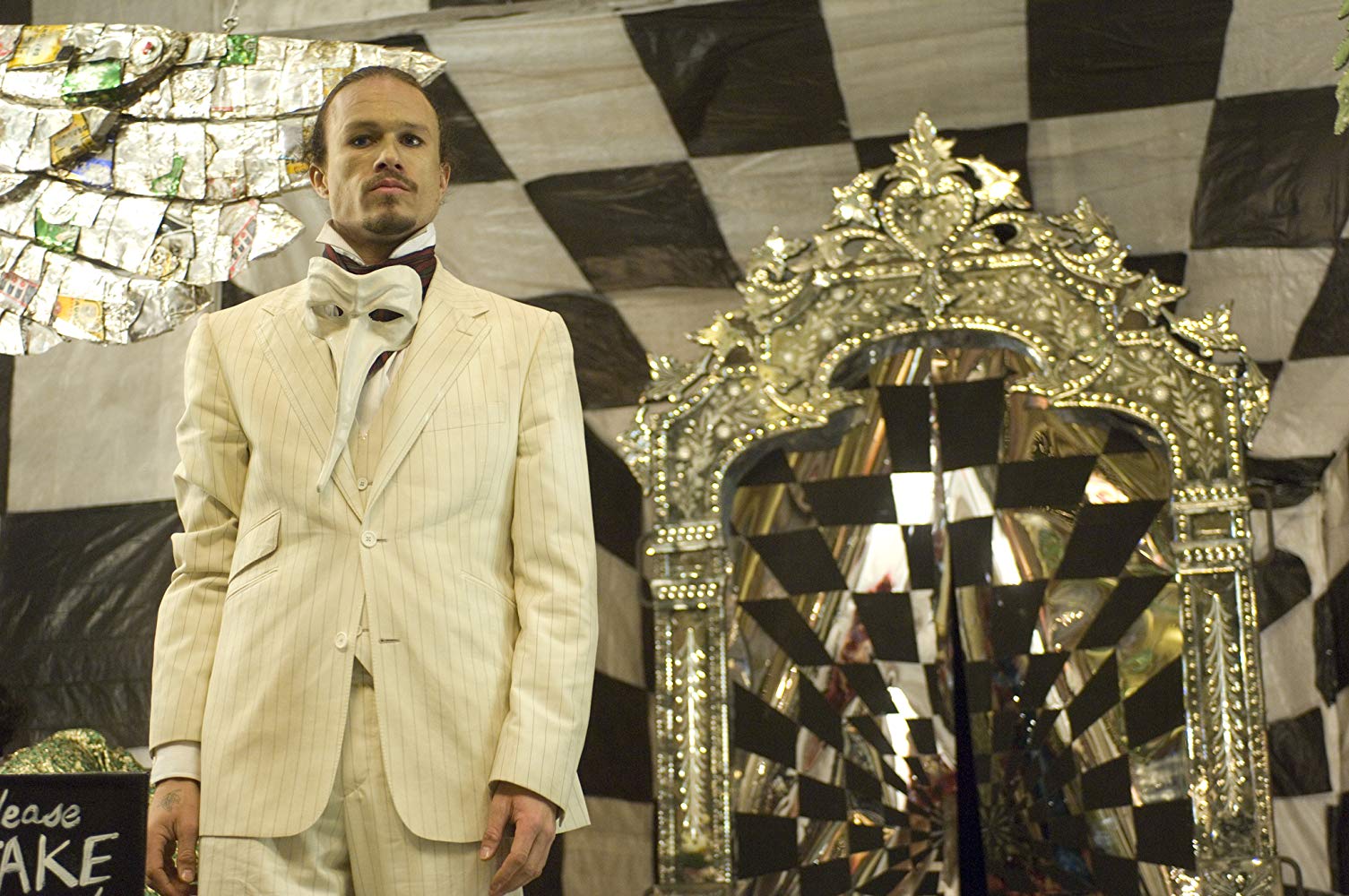
Ledger plays the mysterious Tony, a man found hanging from a bridge by a travelling theatre troupe headlined by the titular Doctor Parnassus (Christopher Plummer). The group also consists of the Parnassus' old friend, the wise Percy (Verne Troyer), the old man's daughter Valentina (a charming Lily Cole), and former beggar Anton (Andrew Garfield), who is head over heels in love with Valentina. Tony has a mysterious and shady past, so he is happy to work for the Imaginarium in an effort to disappear from a very public life, and soon sets about transforming the show's old-timer decor and feeble efforts to attract an audience. Usually setting up the stage in dingy car parks or other undesirable locations, Parnassus' only boast is that of a magical mirror that can transport anybody who enters it into their own imagination. Anton is unhappy at the sudden appearance of this handsome stranger, who naturally attracts the attentions of Valentina, but the troupe may face a larger threat thanks to Parnassus' ancient wager with the Devil (Tom Waits).

There's a great idea in there somewhere, but the script by Gilliam and co-writer Charles McKeown (who also worked together on Brazil and The Adventures of Baron Munchausen) is so haphazard and unsure of itself that it often feels like three films crammed into one. This is no doubt down to the in-production re-writes that were necessary following Ledger's death (Johnny Depp, Jude Law and Colin Farrell were brought in to play alternate versions of Tony when he ventures behind the mirror), so sections of the film feel awkwardly patched together. But there is also much to like. The design of the Imaginarium itself is wonderful in its own tatty, weather-beaten way, and Waits, complete with pencil moustache, cigarette-holder, and that signature raspy voice, is irresistible as Satan himself. The moments set within the imagination are often silly and plagued with questionable special effects, but they also occasionally sparkle with the same kind of magic of Gilliam's Monty Python animation. While it may not be the ideal film to finish his short career on, the film plays a lovely tribute to Ledger and will always be a reminder of the talent we lost far too soon. Sadly, this is likely all Imaginarium will be remembered for, but its a sporadically entertaining ride while it lasts.


Directed by: Terry Gilliam
Starring: Heath Ledger, Christopher Plummer, Andrew Garfield, Verne Troyer, Lily Cole, Tom Waits, Johnny Depp, Jude Law, Colin Farrell
Country: UK/Canada/France/USA

Rating: ***

Tom Gillespie


The Imaginarium of Doctor Parnassus (2009) on IMDb

Tuesday, 20 November 2018

Review #1,422: 'Outlaw King' (2018)

For all its thrilling battle scenes and quotable dialogue, Mel Gibson's Braveheart was hardly a textbook of historical accuracy, particularly with the way it seemed to promote William Wallace as Scotland's one and only saviour, and relegated the future king, Robert the Bruce, to coward and turncloak. A movie to set the record straight always seemed inevitable and necessary, but it took a long time coming. 23 years after Braveheart took home 5 Academy Awards, David Mackenzie's biopic of Bruce, Outlaw King, has finally arrived. It almost works as a quasi-sequel to Gibson's crowd-pleaser, beginning with the King of England gathering various Scottish nobles to sign a peace treaty that will signal an end to the fighting and climaxing with a bloody battle at Loudoun Hill. Times have changed since 1995, and Mackenzie seems intent on infusing the story with a gritty realism and greater attention to historical fact, meaning that there'll be no defiant final cry of "Freedom!" here.

Premiering at the Toronto International Film Festival and released on Netflix two months later, this sullen tale of bearded men going at each other with huge swords sets out to impress from the very get go. The likes of Robert the Bruce (Chris Pine), his father (James Cosmo), and their main rival for the Scottish crown John Comyn III (Callan Mulvey), have been summoned to the tent of Edward I (Stephen Dillane) to metaphorically lay down their swords and accept the invading English as their rulers. The camera glides across the room as they exchange pleasantries between gritted teeth, before moving outside for an impromptu sword fight between Robert and the Prince of Wales (Billy Howle). Filmed in one continuous take, the scene ends with the King demonstrating his power with his newest weapon, a ginormous catapult, which he fires into the besieged Stirling Castle. Both Edward and Mackenzie are showing off here, but its a thrilling moment nonetheless, and if anything is a sure sign of Netflix's intent to flex their own industry muscles. It propels the film into a breathless first half, as Robert defies the English by crowning himself King after Wallace is executed, and takes his threadbare army off to war.

The story moves at a relentless pace, with Robert suffering catastrophic defeats at the hands of both the English and rebellious Scottish clans, and his following grows increasingly smaller. Following these early skirmishes, Outlaw King struggles to fully engage, and this is mainly down to the portrayal of Robert himself. Pine is a highly charismatic actor with some serious chops (just look at Mackenzie's previous film, Hell or High Water), but the film never really seems sure of how to portray him. He leads his men from one battering to the next, and we never really understand why his troops stick with him. He marries Elizabeth de Burgh (Florence Pugh) for political reasons but they end up falling in love, with the outspoken Queen of Scots clearly seeing something in her husband that we cannot. The same can be said for one of Robert's most fearsome warriors, James Douglas (Aaron Taylor-Johnson), who amps the testosterone levels significantly in a foaming-at-the-mouth performance that borders on cartoonish. The highly engaging first hour is still enough reason to give Mackenzie two hours of your time, and fans will at least be treated to a Chris Pine full frontal. Just don't expect Outlaw King to subvert the historical drama in any way and try to enjoy it for what it is: a bruising adventure that school kids can enjoy when it's movie day in history class.


Directed by: David Mackenzie
Starring: Chris Pine, Aaron Taylor-Johnson, Florence Pugh, Stephen Dillane, Billy Howle, James Cosmo
Country: UK/USA

Rating: ***

Tom Gillespie


Outlaw King (2018) on IMDb

Wednesday, 14 November 2018

Review #1,419: 'Gothic' (1986)

The story goes that during the summer of 1816, renowned British poet and philanderer Lord Byron invited fellow poet Percy Bysshe Shelley and his wife Mary Godwin to stay at his grand Villa Diodati in Switzerland. As the weather took a nasty turn and a storm raged outside, the threesome, along with Byron's physician Dr. John Polidori and Mary's stepsister Claire Clairmont, gathered around the fire to share ghost stories. This event allegedly spawned two incredibly influential works of literature, although they didn't come from the poets. Mary Godwin, who would become Mary Shelley, released Frankenstein, or the Modern Prometheus in 1818, and Polidori would go on to pen The Vampyre, the first published vampire story and obvious inspiration for Bram Stoker's Dracula. It's the kind of myth rooted in fact that has filmmakers licking their lips. James Whale used this gathering as a framing device for The Bride of Frankenstein, but Ken Russell took his own idea and ran with it, and the result is a strange, psychosexual horror that fails to really fit into any discernible genre.

We begin with a group of socialites gossiping amongst themselves as they spy on Lord Byron's mansion through a telescope. I supposed this is meant to be us, the viewer, as we giddily peak behind the doors of a known rascal as he awaits the arrival of some of the most soon-to-be-revered writers in Britain. Percy (Julian Sands) and Mary (Natasha Richardson) arrive, and Byron, played by Gabriel Byrne, watches them with indifference. His mistress Claire (Myriam Cyr) and physician Polidori (Timothy Spall) are already there, enjoying the freedom of Byron's home. As the drinks start to flow, Byron start to read excerpts from Phatasmagoria, a book containing many horror stories, and the group decide to have a seance around a human skull. Immediately after, Claire has a seizure and strange events start to take place. Paintings come alive, odd noises can be heard around the house, and Polidori attempts suicide after experiencing paranoid episodes. Is Byron behind it all? Are supernatural forces really at work? Or are the literary darlings simply seeing their unpublished work come to life?

I'm a huge fan of Ken Russell and his unique, easily-distracted style of film-making, but Gothic is the first film I've seen of his that didn't quite work. He seems to have a million different directions he would like to take Gothic but heads towards all of them at same time. There are dark sexual undercurrents at play, particularly with Byron and Claire's apparently violent and toxic relationship, but they are never fully developed. It seems to have aspirations to be a horror, but Russell simply isn't disciplined enough to follow the genre rule-book. This refusal to conform can often achieve greatness, but Gothic ends up as little more than a collection of slightly camp vignettes involving characters running and screaming down corridors or making spooky statements as the thunder rumbles outside. It also isn't helped by Julian Sands' uniformly terrible performance, whose interpretation of a Romantic poet is to prance around shirtless and blubber like a child. Byrne is perfect casting as the bored poet yearning for new experiences, as is Spall as the creepy, reptilian Polidori. It also looks beautiful, from the sets to the costumes, but it isn't enough to save this from being a rare miss from Russell.


Directed by: Ken Russell
Starring: Gabriel Byrne, Julian Sands, Natasha Richardson, Myriam Cyr, Timothy Spall
Country: UK

Rating: **

Tom Gillespie


Gothic (1986) on IMDb

Monday, 5 November 2018

Review #1,416: 'Mandy' (2018)

Horror fans were foaming at the mouth as soon as the first trailer dropped for Panos Cosmatos' Mandy - a hallucinogenic mash-up of revenge thriller and psychedelic horror featuring a Nicolas Cage well and truly off the leash. And for good reason. Whilst Mandy may not have much to offer in terms of plot and actual meaning, as a purely sensory experience, this 80's heavy metal album come-to-life will get certainly get a rise out of you, whether you're on the film's side or not. The story concerns lumberjack Red Miller (Cage) and his artist girlfriend Mandy (Andrea Riseborough), who live in peaceful solitude in a cabin in the woods. They talk of their favourite planets and never leaving their isolated home, but their happy existence is soon to be pulled away from them. Nearby, a cult led by failed musician Jeremiah Sand (Linus Roache) happen to be passing through, and once the Manson-like prophet lays his eyes on Mandy, he simply must have her.

Sand trusts his second-in-command Brother Swan (Ned Dennehy) to kidnap Mandy and bring her to him, and he does so by summoning a band of leather-draped demons who look like they've stumbled off the set of the latest Hellraiser film. They tie Mandy up and force-feed her LSD in preparation for Jeremiah's grand seduction, which includes playing her his terrible music and flashing his naked torso. When Mandy doesn't play ball, they punish her insolence in front of the bound Red, who watches in horror as his one true love is snatched away forever. They leave Red for dead, only the gruff lumberjack manages to escape to plan his bloody revenge. Handed a small arsenal of brutal weapons by his friend Caruthers (Bill Duke), Red aims to take out the bikers first, before moving on to the hippy freaks. What unfolds is a sequence of battles played out almost like a computer game, as Red cuts, chops and snaps his way up to the main target. This is the kind of film in which an early sighting of a chainsaw is of a promise of its reappearance later down the line (and it'll be way better than you expected).

If you've ever slipped on some headphones, blasted out some classic heavy metal, and dropped a shit-ton of LSD, then you'll have likely experienced something similar to Mandy. Backed by a magnificently industrial score by the late Johan Johannsson, Mandy is a trip from start to finish. The first hour moves at a crawl, moving its characters into place and easing us into this strange world of scorched red skies and masked hitmen in gimp suits, before unleashing a second hour of hardcore violence and Nic Cage at his most Nic Cage-iest. The scene in which Cage breaks down in a bathroom drinking whatever vodka he doesn't pour into his gaping wounds while not wearing trousers would usually be the stuff of unintentional comedy gold, but it's actually damn fine acting, closer to Face/Off crazy than Dog Eat Dog crazy. Little makes sense and the characters spit hokey dialogue like something out of the fantasy novels Mandy loves so much, but the whole experience is so cerebral and in-your-face that it's difficult not to get swept up into the madness. It will divide most down the middle, between those who will find the pace and intensity off-putting and those who will appreciate the VHS-murkiness of it all. Personally, I'm somewhere in between. At two hours, it's too long, but there's a breathtaking 100-minute movie in there somewhere.


Directed by: Panos Cosmatos
Starring: Nicolas Cage, Andrea Riseborough, Linus Roache, Ned Dennehy, Richard Brake, Bill Duke
Country: USA/Belgium/UK

Rating: ***

Tom Gillespie


Mandy (2018) on IMDb

Monday, 17 September 2018

Review #1,393: 'A Prayer Before Dawn' (2017)

Opening with a shot of the muscly, pale-skinned and heaving back of our protagonist, Jean-Stephane Sauvaire's A Prayer Before Dawn - his first feature since the eye-opening Johnny Mad Dog in 2008 - begins and ends with British newcomer Joe Cole, and the talented young actor dominates every scene in between. Best known for his role in Peaky Blinders, Cole delivers a performance of pure ferocity, and if there's any justice, this will do for him what the likes of Bronson and Starred Up did, respectively, for then up-and-comers Tom Hardy and Jack O'Connell. Based on Billy Moore's brutal memoirs of his time served in one of Thailand's most unrelenting penitentiaries, the film tracks his journey from the only Westerner in his cell with a target on his back to Muay Thai champion. While it may dabble in the tropes of the prison and boxing genres, it never really relaxes into either, making for an unsettling and visceral two hours.

Rather than opting for a comfortable, straight-forward narrative, Sauvaire prefers to capture the sweaty, overbearing atmosphere of Moore's new lodgings, heightening the sound design so every breath sounds like it's coming from your own head, and every punch rattles your brain. David Ungaro's cinematography makes the most of the tight, damp spaces, as the inmate's bodies pile over each other like sardines in their overcrowded cells. The film feels almost like an invasion of your personal space, and the fact that Billy sticks out like a sore thumb only increases the feeling that danger lurks around every corner. Billy's physicality and willingness to fight may save him from regular beatings and even earn him a level of respect amongst his heavily-tattooed, dead-eyed cell-mates, but he is still forced to watch the gang-rape of a young newcomer to remind the Westerner of his place. Although the story leads up to a climactic fight, it avoids cliche by offering no sense of build-up. Billy simply must fight in order to survive the night and battle his own pent-up demons.

Without a main character to carry your interest, A Prayer Before Dawn may be too much to bear. But Billy, whose reasons for being in Thailand in the first place and dealing the drugs that landed him in the slammer aren't explored, is a true force. Never asking for your sympathy, Billy struggles with heroin addiction - fed to him by a prison guard played by Only God Forgives' Vithaya Pansringarm - and is more than willing to beat somebody half to death to earn his fix. The rage that drives him comes from deep within, and his anger and self-destruction carries us along with him. Even when he is finally allowed to train in the gym, thanks for a routine cigarette bribe, his tendency to self-sabotage sees him almost screw up everything he's worked for. Billy also finds solace in a ladyboy named Fame (Pornchanok Mabklang), who is in prison for murdering her father and is kept in a separate part of the prison for obvious reasons. They form a bond through shared feelings of misplacement, and these scenes offer a reprieve from the unrelenting harshness of Billy's everyday routine. It's a tough watch, but there's always much to admire in a film that can leave you so mentally and physically exhausted.


Directed by: Jean-StƩphane Sauvaire
Starring: Joe Cole, Pornchanok Mabklang, Vithaya Pansringarm, Panya Yimmumphai
Country: UK/France/China/Cambodia/USA

Rating: ****

Tom Gillespie


A Prayer Before Dawn (2017) on IMDb

Sunday, 16 September 2018

Review #1,392: 'American Animals' (2018)

For decades the movies have taught us how the perfect heist goes down. You need a group of big personalities - all experts in a required field - an intricate plan, blueprints to map out the target, and the best gadgets a cheeky crook can buy. And of course, you need a handsome, charismatic leader, usually in the form of a Frank Sinatra, George Clooney or Sandra Bullock. Yes, a director such as Steven Soderbergh knows how to deliver a robbery with style, panache and a sense of fun, but the real world operates a little differently. American Animals, based on the theft of some rare and valuable books from the Transylvania University library by four kids who seemingly had no reason to dare such a feat, has great fun combining these two worlds. Director Bart Layton, who warmed up with 2012's true crime documentary The Imposter, relays this tale as both documentary and dramatic reconstruction, like Touching the Void but with more interaction between the actors and real-life subjects.

It sounds like "look at me" film-making, and it arguably is, but the film is stitched together so wonderfully that you can only sit back and admire the swagger of it all. The world Layton captures is incredibly dark indeed, one of degrading fraternity initiation ceremonies and endless supermarkets isles lined with colourful food packaging designed to create the illusion of choice. At least, that's how our two protagonists - anti-heroes may be the more suitable term - see it. Spencer Reinhard (Barry Keoghan) is a talented art student who feels like there must be more to life than this. His best friend Warren Lipka (Evan Peters), the joint-smoking loudmouth who is up for anything, feels very much the same, only he's way more angry about it. During a routine tour of the University library, Spencer learns that the lightly-guarded building houses the valuable The Birds of America by John James Aubudon, and only a nice old lady is there to watch over it. Stealing it should be easy, so Spencer confides in Warren, who quickly takes the lead in planning and executing the audacious heist.

There's a wonderful moment during American Animals where the foursome (Jared Abrahamson's Eric Borsuk and Blake Jenner's Chas Allen are also drafted later on) imagine their plan playing out. It's like ballet, with every cabinet opening with ease and every book gathered up falling gently into their bags. And of course, they're all wearing tuxedos. Earlier on we see Spencer and Warren doing research, only people don't write books about the perfect robberies they've carried out, so they're left with movies. The likes of Rififii, The Killing and Reservoir Dogs are their textbooks, so it's no surprise when they're caught off-guard when the reality of the situation smacks them in the face. The biggest obstacle is the nice old lady, Betty Jean Gooch (the always-great Ann Dowd), who they imagine will fall gracefully into an unconscious state after a zap from a taser. In reality, she kicked, screamed and wet herself, but the boys carried on with their plan anyway. With the real Spencer, Warren, Eric and Chas telling their own stories to camera, American Animals could have run the risk of softening or even glamorising this story, but Layton is careful to point out the consequences, and the rippling effect it had on everybody caught up in it. It's an astonishing piece of work that ramps up the tension to unbearable levels, crafted by a film-maker keen to breathe new life into a well-worn genre.


Directed by: Bart Layton
Starring: Evan Peters, Barry Keoghan, Jared Abrahamson, Blake Jenner, Ann Dowd, Udo Kier
Country: UK/USA

Rating: ****

Tom Gillespie


American Animals (2018) on IMDb

LinkWithin

Related Posts Plugin for WordPress, Blogger...