Showing posts with label West Germany. Show all posts

Wednesday, 20 March 2019

Review #1,461: 'So Sweet... So Perverse' (1969)

The giallo may have been pioneered by the great Mario Bava and spectacularly refined by Dario Argento, but Umberto Lenzi was developing the techniques and stylings we now know and love from the mid-1960s. Before he became known for schlocky horror trash like Eaten Alive!, Nightmare City and Cannibal Ferox, Lenzi was toying with rich socialites and exploring pulpy, dime-store stories that often involved ridiculous, labyrinthine plots, psychedelic interiors, and beautiful, untrustworthy women. These are all ingredients of the giallo, and some of these early Lenzi efforts hint at a director with an eye for kitschy visuals, something that certainly doesn't come to mind when you watch a native tribesman scalp a poor traveller in the despicable Cannibal Ferox. These eye-catching visuals are certainly present in his 1969 film So Sweet... So Perverse, but there isn't much else to hold the attention in this plodding soap opera.

Handsome, jet-setting socialite Jean Reynaud (Jean-Louis Trintignant) enjoys a lavish lifestyle of cocktail parties and shooting ranges, but he has grown bored and frustrated with the lack of passion in his marriage to the beautiful Danielle (Erika Blanc). To counter this, Jean sleeps with anybody who happens to catch his eye, including his friend Helene (Helga Line), and his head is turned by the woman who has just moved upstairs, Nicole (Carroll Baker). When he hears screams coming from above, he rushes to Nicole's aid, learning that she is stuck in an abusive sexual relationship with her husband Klaus (Horst Frank). As they spend more time together, the couple inevitably fall in love, yet whenever they escape for a weekend, Klaus always manages to track them down. After a night of passion, Nicole reveals that she and Klaus have actually been paid a hefty sum to lure in and eventually kill Jean, but that the one doing the hiring has not yet revealed themselves.

With such a cool-sounding title (yet another famous trait of the gialli), there is nothing sweet and little perverse about the film itself. Argento eventually set a high standard for story-telling and the slow-building of tension within a vital set-piece, and the likes of Lucio Fulci and Sergio Martino added gory violence and a graceful style into the mix, but So Sweet... So Perverse is frustratingly tame, failing to ignite much interest in the plot or generate any excitement when events take a more sinister tone. Where Lenzi ultimately excels is in the glossy cinematography and dazzling interiors, which are garish enough to amusingly satirise the world of these detached characters and their materialistic lifestyles. Images of sun-drenched locations, expensive suits and beautiful, provocative women add a sleazy glamour and seductive glaze to the film, a hedonistic way-of-life Lenzi is happy to indulge as he shrewdly condemns it. It isn't quite enough to prevent So Sweet... So Perverse from becoming little more than a curious cinematic artefact, that ultimately paved the way for better directors to come along and take this new genre by the scruff.


Directed by: Umberto Lenzi
Starring: Carroll Baker, Jean-Louis Trintignant, Erika Blanc, Horst Frank, Helga Liné
Country: Italy/France/West Germany

Rating: **

Tom Gillespie


So Sweet... So Perverse (1969) on IMDb

Monday, 27 November 2017

Review #1,269: 'Mark Of The Devil' (1970)

Michael Reeves' horror classic Witchfinder General made an impressive turnaround at the box-office in spite of its modest budget. Following the witch-hunting exploits of Matthew Hopkins in 17th century England, the movie was disturbing, gruesome, and neatly disguised as a history lesson in an attempt to dodge the censors. The success of Witchfinder naturally led to more witch-trial horror films, most famously being Ken Russell's The Devils, although he denies he was inspired by a film he called "nauseous." It was a big hit in Germany, and their own stab at the folk horror sub-genre came in the form of Michael Armstrong's Mark of the Devil. Using clever marketing (posters warned of a V for Violence certificate and theatres handed out vomit bags to the audience), it was a runaway success, although it has spent the past few decades caught up in the video nasty storm and hacked to pieces in the editing room.

In a small town in early 18th-century Austria, residents are routinely treated to public executions of those accused of dabbling in the dark arts. In charge of finding the witches hiding in their midst and torturing them to confess is Albino (Reggie Nalder), an ugly man who accuses any unfortunate young woman who spurns his advances of performing witchcraft. Albino enjoys and abuses his position of power, until the dashing Count Christian von Meruh (Udo Kier) arrives in town, quickly catching the eye of beautiful, buxom barmaid Vanessa (Olivera Katarina). He is there to announce that famed and highly-respected witch hunger Lord Cumberland (Herbert Lom) will soon be joining him to put an end to the folly carried out by Albino and his cronies. But when Vanessa stands accused of false charges of baring the 'mark of the devil', the Count starts to question his master's methods and motivations, as well as that of the Church.

Mark of the Devil is one of those few horror movies that actually lives up to its reputation. While it certainly isn't the most horrifying film ever made and won't upset your stomach (as the poster claims), it revels in the many scenes of torture and death. Joints are ripped from sockets, digits are squashed, a tongue is removed, and many are burned alive, and almost every torture device imaginable is employed. These scenes initially have the desired effect, but the narrative quickly falls into a repetitive cycle of violence and badly handled love scenes between the Count and Vanessa frolicking on the grass, made all the worse by some atrocious dubbing. It does make a legitimate point however, and points a finger at the hypocrisy of an institution who torture and murder 'by the book' while looking down on the likes of Albino for doing the same for sexual gratification. It would be difficult to admit to 'liking' Mark of the Devil, but it sits as one of the more intriguing entries into the short-lived sub-genre.


Directed by: Michael Armstrong
Starring: Herbert Lom, Udo Kier, Olivera Katarina, Reggie Nalder, Herbert Fux
Country: West Germany

Rating: ***

Tom Gillespie


Mark of the Devil (1970) on IMDb

Saturday, 12 November 2016

Review #1,113: 'Cruising' (1980)

Dogged by protests from the gay community over what many believed to be a negative depiction of their subculture and a final cut having to be hacked of a whole 40 minutes in order to secure an R rating, it is no exaggeration to say that William Friedkin's Cruising was one of the most controversial films to be released in the 1980s. Based on the novel by New York Times reporter Gerald Walker, the project only interested Friedkin (after initially turning it down) when a man named Paul Bateson admitted to murdering members of the S & M community, having dismembered their bodies and tossed the remains into the nearby Hudson River. Friedkin worked with Bateson. a radiologist, on the set of The Exorcist (1973).

These murders are alluded to in Cruising, and ambitious cop Steve Burns (Al Pacino) is the man tasked with going undercover in the 'leather boy' community after a university professor is found tied-up and stabbed to death. Burns is young and handsome, and fits many of the victims' physical descriptions, and so is hand-picked for the job by police captain Edelson (Paul Sorvino). At first uncomfortable with a world where men openly 'cruise' for sex and wear different coloured handkerchiefs to signify their sexual preference, Burns nevertheless immerses himself in the role, deliberately keeping his wife Nancy (Karen Allen) in the dark about his work. As more victims turn up, the pressure on Steve to find the killer before they find him starts to affect him psychologically, especially when he starts to embrace the lifestyle.

Although there is still a stigma attached to Cruising 30 years after its release, the film has aged well. Claims that the film is negative and homophobic in its portrayal of the gay lifestyle seem somewhat misguided. While this is certainly a dark, pessimistic film, it never feels like the film is trying to convince you that what you are seeing is emblematic of the gay community as a whole. The scenes of writhing, sweaty men dressed in leather in the various clubs Burns frequents feel observational and free of judgement, with many real clubs and patrons employed for these moments. The friendship Burns chalks up with gay neighbour Ted (Don Scardino), who is in a fiery relationship with boyfriend Gregory (James Remar), represents gay life outside the S & M scene.

Controversies aside, the missing 40 minutes Friedkin was forced to leave on the cutting-room floor by the MPAA leave many questions unanswered. Cruising often feels like two-thirds of a complete film, with Burns' inner struggle with the stress and danger of his work, as well as the effect it starts to have on his home life, feeling particularly underdeveloped. With Burns inner psyche still a relative mystery at the end, the ambiguous ending is rather frustrating. Still, with no sign of the missing 40 minutes even existing anymore, Cruising works incredibly well as a mood piece. It has a grimy texture to it, as did many films to come out of New York in the 80s. Even if you aren't impressed by the twists and turns at the climax, the film still manages to crawl under your skin. It is also incredibly well performed, especially by Pacino, who was making some of the finest films of his career during this period.


Directed by: William Friedkin
Starring: Al Pacino, Paul Sorvino, Karen Allen, Don Scardino, Joe Spinell
Country: USA/West Germany

Rating: ****

Tom Gillespie


Cruising (1980) on IMDb

Tuesday, 20 September 2016

Review #1,085: 'Aguirre, the Wrath of God' (1972)

Werner Herzog quickly establishes the gaping void between civilised man and nature in his 1972 masterpiece Aguirre, the Wrath of God, with the sight of an expedition navigating a path down the side of a mountain in the Andes. They scuttle like ants, carrying objects unsuitable for such a perilous journey through the harshest of rainforests - a sedan chair, a huge cannon - and are adorned in sweltering metal armour, complete with helmets and weapons. This is the opening scene, and the message clear - these people simply should not be there, and whatever riches or glory they seek will surely result in death. Backed by Popol Vuh's haunting score, it is one of the finest shots in the history of cinema.

The filming of The Wrath of God is possibly as well-known as the film itself, with stories of poor planning, severe injuries, and leading man Klaus Kinski's generally disruptive and psychopathic behaviour emerging from the cast and crew after the film's release. Yet while a chaotic shoot can result in disaster for the finished product, every now and then a masterpiece will be born from the rubble - just look at Apocalypse Now (1979). And Herzog's first of five collaborations with Kinski is precisely that; a glorious, brutal and completely absorbing depiction of madness and greed that benefits from the bizarre happenings behind the scenes. Set in 1560, the film tells the story of the ill-fated expedition led by Gonzalo Pizarro (Alejandro Repulles) to find the fabled land of El Dorado.

Accompanied by a band of Spanish conquerors and a hundred Indian slaves, Pizarro soon realises that his expedition will soon be cut short by a lack of food, water and supplies and orders a smaller group of approximately 40 men to carry on with the search. He puts Don Pedro de Ursua (Ruy Guerra) in charge, with the maniacal but efficient Don Lope de Aguirre (Kinski) as his second-in-command. With them they take the fat representative of the Royal House of Spain, Don Fernando de Guzman (Peter Berling), Brother Gaspar de Carvajal (Del Negro), and, against Pizarro's wishes, Ursua's mistress Inez (Helen Rojo) and Aguirre's daughter Flores (Cecilia Rivera). The quest is soon in trouble, as one of their rafts is swept away by perilous rapids and Aguirre quickly overthrows Ursua, seating de Guzman in his place.

Herzog isn't interested in peppering the film with set-pieces. The Wrath of God moves along at a slow pace with not much happening for long periods of time, while the rainforest lurks all around the screen, proving itself to be a formidable and unpredictable presence. The German auteur has said before that there is nothing peaceful about nature, and here the eerie silence is frequently interrupted by the high shrill of some unseen animal. As the group journey further into the harsh terrain, their decreasing mental state starts to reflect their surroundings. They drift along the river in a raft made by slaves (the natives made them for the film), and occasionally come across an Indian. Brother Carvajal is there to spread the word of God and offers one a Bible. When he puts to his ear and wonders why it doesn't talk, he is put to death for blasphemy.

Nature, including humanity, is madness itself, and this message is hammered home further by the wide-eyed performance of Klaus Kinski, who was clearly mad himself. His spats with Herzog are the stuff of legend, and anyone with an interest should check out Herzog's documentary on his relationship with Kinski, My Best Fiend (1999). During the filming of The Wrath of God, he shot at some extras keeping him awake, removing the tip of one of their fingers in the process, and hit a cast member so hard with his sword that he still bares the scar (the incident can be seen in the film when they attack the village). Never has a film affected me, mentally and spiritually, with such power. In the final scene, Aguirre mutters to himself on board his tattered raft as some monkeys invade the screen. Herzog transports you there, and leaves you questioning the sanity of the world around you. Unquestionably my favourite film of all time.


Directed by: Werner Herzog
Starring: Klaus Kinski, Helena Rojo, Del Negro, Ruy Guerra, Peter Berling
Country: West Germany

Rating: *****

Tom Gillespie


Aguirre, the Wrath of God (1972) on IMDb

Tuesday, 5 April 2016

Review #1,005: 'The Red Queen Kills 7 Times' (1972)

Emilio Miraglia only directed a handful of films throughout his career (though he was more prolific as an assistant to the likes of Luciano Salce, Carlo Lizzani and Lucio Fulci), the two films he made between 1971 and 1972 - The Night Evelyn Came Out of the Grave and The Red Queen Kills 7 Times - stand out most of all. Although the two films are pretty recognisable titles to any giallo enthusiast, Miraglia's name hardly echoes throughout the annals of the genre, most likely down to his slim body work as it certainly isn't down a lack of quality.

The premise of The Red Queen is giallo at its most gleefully ludicrous. While the film is mostly a gory thriller, there are elements of gothic with its cobwebbed, desolate mansion setting during the opening scenes. A dying grandfather tells two of his granddaughters of the tale behind the gruesome painting overlooking his death-bed, of one sister ('The Red Queen') who stabbed and murdered the other sister ('The Black Queen'). This cycle repeats itself every 100 years, due again in 1972. When the dreaded year comes, the grown up Kitty (Barbara Bouchet) works as a fashion photographer and believes that her sister Evelyn died in a freak accident years ago. When people start dying, murdered by a manic woman in red, has Evelyn returned from beyond the grave as the Red Queen or is something even more sinister at play?

When the movie finished, I was left wondering how such a convoluted build-up could lead to such an easily-explained mystery, but that's the beauty of giallo and The Red Queen itself. The infusion of gothic undertones peppered throughout the film only add to the fun of the piece, although its feet lie firmly in its pulpy paperback roots. Complete with impressively staged, gory set-pieces, this adds pretty much every element of the genre into the mix - the world of high fashion photography, beautiful, big-eyed women, a gruff detective, and plenty of sexual deviancy. So, it offers little in the way of originality, but it's certainly a lot of fun (the scene with the fence spike is a cracker). See it for the bonkers plot and ghostly, Hammer-esque sets if nothing else.


Directed by: Emilio Miraglia
Starring: Barbara Bouchet, Ugo Pagliai, Marina Malfatti, Sybil Danning
Country: Italy/West Germany

Rating: ****

Tom Gillespie


The Lady in Red Kills Seven Times (1972) on IMDb

Saturday, 20 February 2016

Review #983: 'What Have You Done to Solange?' (1972)

Massimo Dallamano is rarely mentioned in the same breath as his fellow Italian heavyweights Dario Argento, Lucio Fulci or Umberto Lenzi, yet he was responsible for two gialli that can be considered two of the best of their kind. One is What Have They Done to Your Daughters? (1974) and the other another Edgar Wallace adaptation that poses a similarly eye-catching question in its title, What Have You Done to Solange? The latter is one of the finest giallo I've seen, favouring tension and character above blood and boobs - although there's plenty of the red stuff too, and an admittedly unnecessary all-girls-school-shower scene.

Enrico Rosseni (Fabio Testi) is a suave Italian teacher at a School for Girls in London. He is stuck in an unhappy marriage with Herta (Karin Baal), who works at the same school teaching German. To escape the tedium of married life, he embarks on an affair with one of his lovely young students Elizabeth (Cristina Galbo). When on a secret date in the woods, Elizabeth witnesses a murder in which a masked man murders a girl by knifing her between the legs. Enrico dismisses her claims, but when he hears the murder reported on the news, he re-visits the scene and is captured on camera in the process. With the police and his wife breathing down his neck, Enrico tries to divert suspicion without his secret getting out.

Backed by a tremendous Ennio Morricone score (are there any movies he didn't provide the music for?) and gorgeous cinematography by Aristide Massaccesi (a.k.a. shlockmeister Joe D'Amato), Solange's great hook is its engaging plot. Working out who the mysterious killer is as much fun as watching the likeable Testi squirm out of his increasingly desperate predicament. The Solange of the title doesn't get mentioned until the final third, but when she does turn up in the form of I Spit on Your Grave's Camille Keaton, the film avoids cheap thrills and delivers carefully constructed shocks during the fittingly upsetting climax. If there's any justice in the cinematic world, Dallamano will someday receive the respect he deserves.


Directed by: Massimo Dallamano
Starring: Fabio Testi, Cristina GalbĂ³, Karin Baal, Joachim Fuchsberger, Camille Keaton
Country: Italy/West Germany

Rating: ****

Tom Gillespie


What Have You Done to Solange? (1972) on IMDb

Friday, 14 August 2015

Review #905: 'Tenderness of the Wolves' (1973)

Surprisingly deemed too controversial a topic to direct himself, enfant terrible Rainer Werner Fassbinder handed the reins of Tenderness of the Wolves, a deeply unsettling portrayal of serial killer Fritz Haarmann, to his protege Ulli Lommel, the man later responsible for video nasty The Boogeyman (1980) and countless straight-to-video efforts that linger in the IMDb's Bottom 100 list. Despite this, the film looks and feels like a Fassbinder film. The characters inhabit the same sleazily-filmed world, many of Fassbinder's troupe of actors appear, and the great man himself has a small role as an ugly pimp.

Written by the great Kurt Raab, who also stars as Haarmann, Tenderness of the Wolves doesn't spend any time trying to understand the motivation of the man dubbed the Vampire of Hanover, but instead shows us a snippet of his debauched life. Moving the story from 1924 (when Haarmann was arrested in real-life) to post World War II, Germany is a country clearly feeling the economic strain of losing the war, where the black market is flourishing and con-man Haarmann is doing very well for himself. Along with his on-and-off lover and pimp Hans Grans (Jeff Roden), he swindles clothes from good Samaritans and sells them on for profit, as well as selling meat to bar owner Louise (Brigitte Mira) which may or may not be the bodies of his victims.

As a horror, it achieves it's disturbing atmosphere not through gratuitousness, but through the squalor of its setting, observant direction, and Raab's magnificent performance. Haartmann was a gay child molester who enjoyed throttling his victims, biting into their throats (often through the Adam's apple), before chopping them into pieces and throwing them into the Leine River. We don't see much of the murders, but when they do occur they are filmed without sensationalism, made all the more unsettling due to the full-frontal male nudity of some of the film's under-age actors, something extremely rare in horror even today.

Haartmann, shaven-headed and ghostly pale, manipulates his victims by posing as a police officer before drugging and overpowering them, often making little effort to cover his tracks or dispose of the bodies discretely. This arrogance, although it would eventually lead to his arrest, makes him even more of a monster, and Raab delivers a truly terrific performance. Without attempting to explain his actions or even offer a background of how Haarmann got into the criminal business and how he developed a taste for human blood, Tenderness of the Wolves becomes more about the world he inhabits and the creepy characters who surround him. It's hardly a film to discuss over breakfast, but it will no doubt stay with you for long after the credits have rolled.


Directed by: Ulli Lommel
Starring: Kurt Raab, Jeff Roden, Margit Carstensen, Ingrid Caven, Wolfgang Schenck, Brigitte Mira
Country: West Germany

Rating: ****

Tom Gillespie


Tenderness of the Wolves (1973) on IMDb

Thursday, 8 January 2015

Review #819: 'Day of Anger' (1967)

Lee Van Cleef has always been an unsung hero. Although an instantly recognisable face with those cat-like eyes and chiselled cheekbones, there will be few casual film-goers who will be able to name many films of his outside of For a Few Dollars More (1965) and The Good, The Bad and the Ugly (1966). In Day of Anger, he may not take the lead role, but his Frank Talby, the dangerous yet charismatic gunfighter who wanders into town one day, steals the screen and your attention thanks to Van Cleef's formidable presence, proving that he was one of cinema's greatest character actors.

In the small town of Clifton, bastard-born street sweeper Scott Mary (Euro-western legend Giuliano Gemma) is ridiculed and bullied due to his social status. When Frank Talby strolls into Clifton on the back of his horse, he sides with Scott, and ends up shooting a man in his defence. When Frank leaves, Scott follows in the hope of being taught how to be a great gunfighter. Frank agrees, but has some brutal lessons to teach him. But they find themselves returning to Clifton in the search of money owed to Frank by Wild Jack (Once Upon a Time in the West's (1968) Al Mulock), where Frank hopes to deal some swift justice and make a mark of his own.

A protege of Sergio Leone, this was director Tonino Valerri's second movie in the chair, and he certainly knows how to shoot a western. It doesn't share the extreme close-up's of Leone's work, but builds it's fair share of tension, climaxing in an inevitable yet thrilling climax between teacher and student. The film is superbly filmed, backed by a ridiculously catchy score by Riz Ortolani from which the title song was used in Django Unchained (2012). But the film's biggest boast is in the performances of Van Cleef and Gemma, the former proving he can play as good an anti-hero as any of his peers, and the latter convincing throughout his massive character shift. Highly recommended.


Directed by: Tonino Valerii
Starring: Lee Van Cleef, Giuliano Gemma, Walter Rilla, Al Mulock
Country: Italy/West Germany

Rating: ****

Tom Gillespie


Gunlaw (1967) on IMDb

Thursday, 23 October 2014

Review #798: 'Contamination' (1980)

Eager to cash in on the faux-sequel success of Lucio Fulci's Zombie Flesh Eaters (1979) - which was dubbed Zombi 2 in an attempt to dupe audiences into believing it was the sequel to George A. Romero's Dawn of the Dead (1978), Italian director Luigi Cozzi released Alien Contamination on the back of the success of Ridley Scott's Alien (1979). The similarities between Contamination (as it was named in the UK and on the infamous 'video nasty' list) and Flesh Eaters are quite striking - they shared the same production building, they both star Ian McCulloch, and they are both pretty bad.

When a large and apparently empty ship pulls into New York Harbor, obnoxious NYPD lieutenant Tony Aris (Marino Mase) steps in to investigate. Soon enough, a dead, mangled body falls out of a cupboard, and the rest of the crew are discovered in a cramped space, all dead. The ship is transporting a large quantity of strange eggs that, when heated, explode, releasing a deadly fluid which causes anyone it splashes on to explode. The military call in Colonel Stella Holmes (Louise Marleau), who links the eggs to a recent mission to Mars, where astronaut Hubbard (McCulloch) returned claiming to have seen a nest of alien eggs only to have his claims dismissed by fellow astronaut Hamilton (Siegfried Rauch).

The main problem with Contamination - and there are a lot of them - is that the film is so carelessly put together in an attempt to blend various successful genre tropes of the time, that it neglects to offer any kind of explanation or logic to the alien's plan. The eggs burst, killing anyone near, but don't hatch and therefore increasing the alien population on Earth. In fact, there's only one 'cyclops monster' who overlooks the eggs. Add to the mix an increasingly sagging middle section in which very little happens apart from dull exposition, the film becomes confusing and nonsensical. The exploding bodies offer a little light humour as the actor's bloated mechanism is clearly visible, but this just adds to the air of tragedy, as it tries to desperately cash-in on the success of Alien.


Directed by: Luigi Cozzi
Starring: Louise Marleau, Ian McCulloch, Marino Masé, Siegfried Rauch
Country: Italy/West Germany

Rating: **

Tom Gillespie


Contamination (1980) on IMDb


Wednesday, 5 March 2014

Review #719: 'Ballad of the Little Soldier' (1984)

German film-maker Werner Herzog is well-known for his obsession with, well, obsession, finding joy and producing some great documentaries over the years championing the quirkiness of the human spirit. With Ballad of the Little Soldier, the focus is not on the idiosyncratic but on the child soldiers serving in Nicaragua fighting for the native Miskito Indians against the oppressive Sandinistas. Although he may deny it, this is Herzog's most political film to date. With co-director Denis Reichle, who served the Nazi's in the Volkssturm, Herzog's interviews various Miskito inhabitants who have fallen victim of the brutal Sandinistan regime.

At only 45 minutes long, Herzog and Reichle manage to paint a large picture of what life was like for the Miskito's. A woman wails about her family, butchered at the hands of the Socialist Sandinistas, whose government initiative to move the Miskito's into civilised society has led to their villages being sacked and torched, and the mass murder of men, women and children. The persistent nature of Herzog and Reichle's interview techniques do often make things uncomfortable, but it certainly makes for devastating viewing.

Narratively, the film is all over the place. The cinema verite style contradicts the film's title, shifting focus away from the children far too often in favour of the adult soldiers, who march past the camera with similar resigned, weathered expressions. But this is still powerful stuff, with Herzog's narration lending the film a dream-like quality amidst the seriousness of the subject matter, and Reichle's recollection of his time in the Volksstrum as a child making for difficult viewing, especially told in the context of the events that were unfolding in Nicaragua. Although this is far from Herzog's best documentary, he manages to achieve more in 45 minutes than most documentarians could only dream of.


Directed by: Werner Herzog, Denis Reichle
Starring: Werner Herzog, Denis Reichle
Country: West Germany

Rating: ***

Tom Gillespie


Ballade vom kleinen Soldaten (1984) on IMDb

Wednesday, 22 August 2012

Review #455: 'Radio On' (1979)

Former Time Out critic, Christopher Petit's directorial debut, Radio On, shows its European credentials well. I say this for a couple of reasons. For one, like the French New Wave participants, Petit began as a film critic, and the sparing nature of this existential road movie, was self-consciously attempting to move British cinema towards a European style. Secondly, and far more telling, is the influence and participation of the New German Cinema of the 1970's. Whilst interviewing Wim Wenders, the subject of Petit's own screenplay arose, and Wenders was impressed. Therefore, Wenders became associate producer, and also lent the use of his cinematographer, Martin Schafer.

Beautifully shot in monochrome, the black and white imagery displays its artful intentions. We follow Robert (David Beames) as he drives from London to Bristol, after being informed that his brother has committed suicide. On his journey, he encounters several unhinged British citizens, including a Glaswegian squaddie with anger management issues, as well as meeting Sting at a petrol station, who seems to be obsessed with Eddie Cochran. Not much really happens in the film, but the most significant (at least the longest) "relationship" is with a German woman, Ingrid (Lisa Kreuzer - who was in Wenders' Alice in the Cities (1974 - Review #96)), who is searching for her missing daughter named Alice (a possible reference to the aforementioned German film.

This is a bleak representation of 1970's Britain. Not a hard task in itself (you could have pointed a camera anywhere in '70's Britain, and it would have been depressing). But what was fundamental to Petit's intentions, was actually a comment on the decline of British cinema. The main output of British cinema was within the prurient genre of the repressed "sex comedies" such as the on-going Carry On.. films, or the equally lamentable Confessions... series with Robin Askwith. When there was any serious attempt at British cinema, they were barely seen. Petit, felt that the Americanisation of our cinema's and the fact that our national cinema was laughable, was decreasing our cultural identity. Radio On is an attempt to move our cinema towards a more European, existential path, and with a more political consciousness.


Directed by: Christopher Petit
Starring: David Beames, Lisa Kreuzer, Sandy Ratcliff, Andrew Byatt
Country: UK/West Germany

Rating: ***

Marc Ivamy


Radio On (1979) on IMDb

Saturday, 19 May 2012

Review #398: 'Bloody Moon' (1981)

The film begins with facially-scarred Miguel (Alexander Waechter) raping and murdering a girl with a pair of scissors at a masquerade party. He is institutionalised for a number of years, but then released into the care of his sister Manuela (Nadja Gerganoff), whom he used to have a incestuous relationship with. Manuela runs a language Boarding School with her wheelchair-bound mother, who refuses to name Manuela in her will. When Manuela refuses Miguel's advances to resume their relationship, the friends of Angela (Olivia Pascal), whom Miguel's seems to be intrigued by, start disappearing. Angela knows they are being killed and even witnesses a murder, but no-one believes her.

When going into a horror film directed by exploitation legend Jess Franco, you know what you're in for. Lots of blood, lots of sleeze, and in particular, lots of tits. Bloody Moon does not fail to disappoint on this front, but unfortunately, it disappoints on practically every other front. On IMDb, he is credited with 194 titles as director, and he has churned out as many exploitation titles as I have shits after a curry. While I have only seen a small handful of his films (all pretty bad), this is undoubtedly the worst I've seen. As well as ripping off other, more impressive slasher films (Mario Bava's A Bay of Blood (1971) and Blood and Black Lace (1964) are two that I noticed), the film is poorly thrown together in a manner to get as much blood and breasts as possible. While that's not a terribly bad or unoriginal idea, all the in-between parts are painfully tedious and dull.

If you're in it for the blood, you won't be disappointed. There's plenty of outlandishly staged set-pieces here, most notably the scene in which a woman is decapitated by a power saw. The hilarious thing is that the woman volunteers to be tied down in an abandoned lumber mill, inches away from the giant saw, by a masked man. She says she finds it kinky. Well, maybe she deserves to die for being so fucking stupid. Perhaps I wasn't paying attention or I was so bored I was considering slitting my wrists, but when the big revelation came at the climax, I failed to see why the killer had to kill the girls in order to achieve their goal. Again, Franco was thinking blood and boobs, and all logic went out the window. Perhaps not the worst Video Nasty on the list so far, but it's certainly up there.


Directed by: Jess Franco
Starring: Olivia Pascal, Christoph Moosbrugger, Nadja Gerganoff, Alexander Waechter
Country: West Germany

Rating: *

Tom Gillespie


Bloody Moon (1981) on IMDb


Sunday, 26 February 2012

Review #341: 'Signs of Life' (1968)

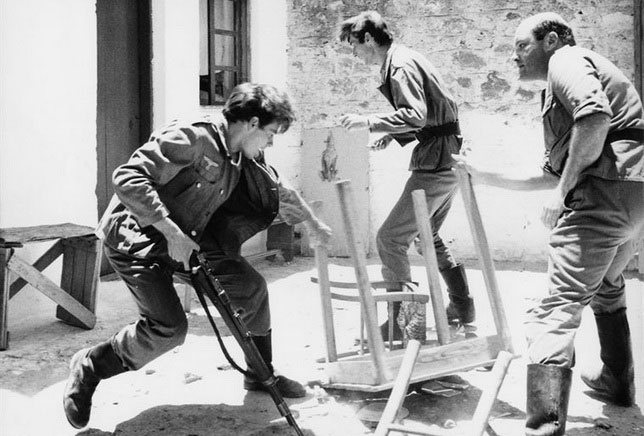
Werner Herzog's debut feature tells the story of a wounded German paratrooper Stroszek (Peter Brogle) who is transported to the Greek island of Kos to recover physically and mentally. Already there are fellow soldiers Meinhard (Wolfgang Reichmann) and Becker (Wolfgang Von Ungern-Sterngberg), who are taking life easy in the sun with little to nothing to do. Stroszek sets them to work, but soon, as the work begins to dry up, he becomes more and more unstable in the isolation and loneliness.

Nobody really knows what goes through Herzog's head, but it is clear he is a film-making genius and has one of the finest eyes for visuals in cinema. Signs of Life explores themes that Herzog would later become engrossed and almost obsessed with - isolation, obsession and madness. While he would later employ Klaus Kinski as the face of wide-eyed insanity, here the tone is quiet, contemplative and often very funny. The opening half of the film concentrates mainly on the three soldiers trying to find things to do. Meinhard becomes frustrated with the presence of cockroaches in their apartment and builds a trap to catch them. The feeling of being trapped appears throughout the film, usually using animals - the soldiers are given a strange toy that seems to move on its own, until they open it and find out that it's full of trapped flies; and we are shown how a hen is hypnotised.

But the comedy is soon put aside as Stroszek begins his descent into madness, holding himself up in the 14th century fortress where the soldiers are stationed with a horde of ammunition. It's in the second half that Herzog shows us the images he can conjure. It's breathtaking what he achieves with a stolen 35mm camera and a micro-budget. Amongst other things, we see a seemingly endless field of windmills, and fireworks set off into the night sky. The grainy black-and-white imagery gives the whole thing a fresh beauty. This is far from the greatest debut in cinema, but a very clear indication of a director's raw skill, and of course, Herzog would go on to make many fine films.


Directed by: Werner Herzog
Starring: Peter Brogle, Wolfgang Reichmann, Athina Zacharopoulou, Wolfgang Von Ungern-Sternberg
Country: West Germany

Rating: ****

Tom Gillespie


Signs of Life (1968) on IMDb

Monday, 9 January 2012

Review #304: 'Devil Hunter' (1980)

Directed by exploitation hack Jesus Franco (or Jess if you are that way inclined), Devil Hunter is clearly a film that producers wanted made, jumping on the bandwagon of cannibal films after the success of Ruggero Deodato's Cannibal Holocaust (1980). But this offering has no social or political points to make like Deodato's "classic" of the sub-genre. What Franco's cannibal film offers is a regular specific of the director. The films story (if we can call it that), is about a model and actress (Ursula Fellner) who is kidnapped and taken into the forests where she is tied to a tree, awaiting for the ransom to turn up. However, on this island, there is a strange, cannibal creature (a naked black guy with bloodied ping-pong balls for eyes that are stuck to the face using Play-Doh), roaming the forests eating women that have been offered by the tribal village.

The local tribe seem to worship the cannibal - they have a totem pole that seems to represent it. Basically, the entire film consists of the blonde model being captured and recaptured, and generally writhing about the ground naked, and usually being touched by naked tribal women. Devil Hunter is a serious bore. The entire experience makes no sense. It is simply a series of sequences involving pretty naked women.

Of course, if you are aware of Franco's main output (i.e. lesbian vampires etc - he also made many hard-core porn movies), and his lack of practice for coherent narrative, then you will know what to expect. There are many fans of his often camp work. His lesbian vampire films that he made in France are pretty well-known, and it would not be uncommon to find one shown on TV (Vampiros Lesbos (1970) and A Virgin Amongst the Living Dead (1971) to name just two). On the plus side (if you love the nudity aspect of the film making), the lead actress is incredibly stunning. This however, doth not maketh the movie!


Directed by: Jess Franco
Starring: Ursula Buchfellner, Al Cliver, Antonio Mayans
Country: Spain/France/West Germany

Rating: *

Marc Ivamy


Devil Hunter (1980) on IMDb


Sunday, 8 January 2012

Review #303: 'The Decameron' (1971)

The first of what became Pier Poalo Pasolini's Trilogy of Life, with each film adapting stories from archaic literature. In this case, Giovanni Boccaccio's book of the same name, written in 14th century Italy. The film takes nine of the 100 stories from the book and weaves them into vignettes of everyday Medieval life. We see nymphomaniac nuns, grave robbing, deceit, and cuckolding. In one segment, a boy is lured into the house of a pretty girl. She tells him that he is her brother. however, after taking his clothes and money, the boy is thrown out, where he is picked up by a couple of thieves who recruit him to climb inside of a tomb and steal the recently dead archbishop's ruby ring. The boy is left trapped in the grave.

This bawdy romp is a lot of fun. This was a surprise being Pasolini. The portmanteau style storytelling works well with this roaming tour through a debauched, ancient landscape. Many of the oddball characters were non-actors (something Pasolini had used throughout his career), and some have such incredibly rickety teeth, and are a strange and uncomfortable, yet thoroughly enjoyable watch.

The film ends with a statement by Pasolini himself (he played the painter, Giotto between, and within some of the stories), which is possibly a statement about the dream like quality the narrative has in its assemblage of the parts. He says: Why create a work of art, when you can just dream about it? Indeed, why create narrative cinema, when you can manoeuvre through scenes of life and create a patchwork of living, permeated with verisimilitude.


Directed by: Pier Paolo Pasolini
Starring: Franco Citti, Ninetto Davoli, Vincenzo Amato
Country: Italy/France/West Germany

Rating: ****

Marc Ivamy


The Decameron (1971) on IMDb

Sunday, 18 December 2011

Review #287: 'Deep End' (1970)

A British oddity (released through BFI's flipside series), written and directed by Polish emigre, Jerzy Skolimowski (whose previous work included the screenplay for Roman Polanski's masterful Knife in the Water (1962)), Deep End is a story of naive obsession. 15 year old Mike (John Moulder-Brown), takes a job in a typical Victorian, city bathhouse in London. The brooding, awkward teenager falls for Susan (Jane Asher), a beautiful redheaded attendant, with a colourful secret life, and a fiance. His obsession with her increases and he begins following her outside of work. In this act he falls upon a life-sized cardboard cut-out of Susan outside a strip club in the red-light district of Soho.

Whilst the film is primarily a marginally twisted drama, there are some intentionally funny scenes that elevate the narrative. A stand out moment in the bathhouse has Mike trapped in a room with Diana Dors' lady client, who coaxes him and pulls the unnerved child to her breasts, asking if he likes football, and then chanting "Georgie Best". Mike follows Susan and her fiance, Chris (Christopher Sandford), into a cinema and sits behind them. In a moment of  tactless teenage bravura, Mike grabs Susan's breast, and her reaction is to complain and press charges as the police arrive. Mike's futile stalking of Susan inevitably leads him to her secret world, which he does not favour, confronting her with the aforementioned two-dimensional replica of the topless Susan, demanding that she justify these occupations.

There is a coming-of-age narrative imbued in this film, with elements that many will recognise such as the inherent awkwardness that is teenage existence. And as our protagonist is male, he therefore has a deeply bungling nature, his hormones seething. The scale with which Mike's obsession with Susan becomes is bordering on the nature of John Fowles's Frederick Clegg character in his novel The Collector. He steals that Susan cardboard replica, throwing it into the swimming pool he stands over her floating duplicate on a diving board. A dive and sensual swim with it is reflected in the closing, relatively haunting closing images. An interesting, sometimes funny, but not altogether exciting piece of cinema.


Directed by: Jerzy Skolimowski
Starring: Jane Asher, John Moulder-Brown, Christopher Sandford, Diana Dors
Country: West Germany/UK

Rating: ***

Marc Ivamy


Deep End (1970) on IMDb

Thursday, 24 November 2011

Review #274: 'Jack the Ripper' (1976)

Dr. Orloff (Klaus Kinski) is a London doctor who has the unfortunate compulsion of murdering prostitutes. When he kills a young girl at the start of the film, a begging blind man picks up his scent and recognises the smell of a rare plant found only in the Botanic Gardens. Orloff murders his victims there and has their bodies disposed of by a woman infatuated by him. Inspector Selby (Andreas Mannkopff) is assigned to the case, and with the help of the local prostitutes and the blind man, is determined to track down the man dubbed Jack the Ripper.

One of the most prolific of the cult directors, Jess (or Jesus) Franco directed over 150 features. The majority of these were awful, low-budget horror or skin flicks, and he drifted in and out of porn for a large chunk of his career. When he was on-form, he was actually quite talented. Whereas Jack the Ripper isn't a very good film at all, it certainly displays some of Franco's talents. For a director so fond of breasts and genitals, Ripper is pleasantly genital-light, and even more surprisingly, rather low on gore. It's more interested in Kinski's Orloff and the police investigation that followed him. Historically, of course, it's a load of bull shit. There's very little (if any) fact on show, but this is forgiveable as it is a low-budget horror after all.

The ever-watchable Klaus Kinsi is memorable in the role, even though he is clearly sleep-walking throughout the film. But if you've read his fascinating autobiography you would know he had very little love for his art, so it's a testament to his ability that he manages to be so good with so little effort. But it's the police investigation that is the most entertaining in the film, as Selby is assisted by his ragtag group of witnesses, and a man that has to be the campest police chief in film history.

The gore is quite low like I said, but when it appears it is quite gruesome. There's breast removal, stabbings, corpse-raping, not of which is done convincingly, but it is a shame because the film does occasionally elevate itself above it's shlock roots. It's actually beautifully filmed in some scenes, especially when the moon shines through the trees in the woods scene. It's all a bit too funny-because-it's-bad to be any good, but it's certainly not terrible, and it's actually made me want to check out some of Franco's vast filmography. But I'll probably leave out the porn.


Directed by: Jess Franco
Starring: Klaus Kinski, Josephine Chaplin, Andreas Mannkopff
Country: Switzerland/West Germany

Rating: **

Tom Gillespie


Jack the Ripper (1976) on IMDb

Friday, 14 October 2011

Review #246: 'The Cat o' Nine Tails' (1971)

Blind, retired journalist Franco (Karl Malden) is walking with his niece when he overhears a man in a car talking about blackmail. Pretending to tie his shoe, he gets his niece to describe the man in the car. That same night, a research facility is broken into and a security guard is knocked unconscious. Reporter Carlo (James Franciscus) begins the investigation, bumping into Franco along the way who has taken a personal interest. They learn that apparently nothing was stolen from the break-in. Dr. Calabresi (Carlo Alighiero) knows what was taken, but before he can do anything about it, he is pushed in front of a moving train. Carlo and Franco begin their own investigation, but find themselves hampered by a killer who will stop at nothing to protect the truth from being uncovered.

Argento's second feature, made in between his excellent debut The Bird With The Crystal Plumage (1970) and the bollocks-but-enjoyable Four Flies On Grey Velvet (1971), The Cat O' Nine Tails is the second in his 'animal' trilogy, and one of his personal least favourites. It wouldn't be until four years later when Argento would properly find his stride, making the phenomenal Deep Red (1975) and following it with three of his finest films, including two of the most memorable horrors ever made, Suspiria (1977) and Inferno (1980). However, Cat does include some enjoyable set-pieces, if sadly they lack Argento's usual Hitchcock-esque masterful touch.

The plot of the film, which includes something about a breakthrough in XXY chromosome research, is one of Argento's silliest, most confusing, and least interesting. It never really hits top gear until the last fifteen to twenty minutes when the plot finally comes together. The film is also disappointingly gore-light. This would of course not be a problem if the rest of the film was involving enough, but it fleshes out a rather simplistic story with no excitement or intrigue. However, Franciscus and Malden are good value, and the final death, one of Argento's most squirm-inducing, will send shivers down your spine. It's still head and shoulders above the majority of giallo's that came out around the same time, but knowing what Argento is capable of, this is a minor work.


Directed by: Dario Argento
Starring: James Franciscus, Karl Malden, Catherine Spaak
Country: Italy/France/West Germany

Rating: ***

Tom Gillespie


The Cat o' Nine Tails (1971) on IMDb

Thursday, 6 October 2011

Review #234: 'Veronika Voss' (1981)

This sumptuous black and white period piece, tells the story of a once famous film star, Veronika Voss (Rosel Zech). After a chance encounter on a bus with Robert Krohn (Hilmar Thate), there lives are entwined, with Krohn finding himself trapped in a cat-and-mouse search for Voss's sanity, her past lives, and the many sycophants and gold diggers in 1950's Germany. Voss, now struggling to find work after a highly successful period, particularly in the 1940's, is addicted to drugs and alcohol and has paranoid delusions when out on the street; Krohn is pulled into this as he did not recognise who she was, and she vaguely sees him as protection.

One of the last of Fassbinder's films - he died of an overdose (the official conclusion was suicide) in 1982 - which was also the last of a trilogy focusing on Germany's economic boom in the 1950's (the others being The Marriage of Maria Braun (1979) and Lola (1981)), the film also reflects some of the themes that the New German Cinema at the time. It was a time that Germany was reflective of World War 2, and the trauma that prevailed in a country torn between guilt and a resurgence of decadence and wealth as in the 1920's Weimar Republic. It is stated in the film that Voss's best period was during this period, and that she had been the star of Nazi Germany. After the fall of Nazi domination, she was cast aside.

Like Billy Wilder's Sunset Boulevard (1950), Veronika Voss highlights an industry that can easily create monsters, and also devastate lives. But unlike Wilder's subtle version of lost fame, Fassbinder shows the devastating effects of drug addiction, and the underbelly of society that is encountered in this process. Historically though, this is deeper and a hell of a lot more emotionally charged and interesting than Sunset. After all, this is not a Hollywood story, but is a post-World War 2 story of judgement, and loss after such a integrally debasing event in human history. How do you continue after working under the despotic power of the Nazi party? The elements of Nazi Germany are still in process, in the form of Veronika's control.

The film is said to be based upon the real-life German film actress, Sybille Schmitz, who died of an overdose in 1955 at the tender age of 45. The film shows shows that the shadow of the war had a lasting effect on the German nation, that would take decades to come to terms with. This is film making par excellence. Haunting, beautiful, with a climax that is inevitable, shocking, but very satisfactory. Rosel Zech's performance is pitch perfect, her face in a constant state of anguish.


Directed by: Rainer Werner Fassbinder
Starring: Rosel Zech, Hilmar Thate, Cornelia Froboess
Country: West Germany

Rating: *****

Marc Ivamy


Veronika Voss (1982) on IMDb

LinkWithin

Related Posts Plugin for WordPress, Blogger...