Showing posts with label Soviet Union. Show all posts

Thursday, 31 January 2019

Review #1,444: 'A Cruel Romance' (1984)

Eldar Ryazanov's A Cruel Romance is a true gem of Soviet cinema; an under-seen period piece set in 1877 that is lavish, funny and devastating in equal measures. The bulk of the action is set in the fictional town of Bryakhimov on the bank of the Volga River, where many merchant men have made their fortune and now seek a wife. The Ogudalovas were once the richest family in the area, but now matriarch Kharita (Alisa Freyndlikh) struggles to pay her mortgage after the death of her husband, but still mingles with society's higher-ups in the hope of finding a husband for her three daughters. Two of them are now married, with the wedding of second daughter Olga (Olga Krasikova) to an overbearingly jealous prince from Tiflis opening the film. This is all witnessed by Larisa (Larisa Guzeeva), the most beautiful and desirable of the Ogudalova sisters, who is happy to see her sibling sail off to a new life, but feels shame at the thought of being sold off like property.

Larisa is the last remaining singleton, and there's no shortage of suitors, despite the fact that she will come without a dowry. The richest merchant in town, Mokiy Parmenovich Knurov (Aleksey Petrenko), harbours strong feelings towards Larisa, but he is married and too old. Perhaps better suited is Larisa's childhood friend Vasiliy Danilovich Vozhevatov (Viktor Proskurin), but he is not quite rich enough to take a bride without a dowry. Yuliy Kapitonovich Karandyshev (Andrey Myagkov), a postman of low social status, is madly in love with Larisa, or perhaps with how such a beautiful woman will feed his ego. Yuliy frequents the parties thrown by Kharita in the hope of convincing her, but is usually left embarrassed or overshadowed by the more charismatic men at the events. Yet Larisa only has eyes for one man, the rich, handsome and exciting Sergei Sergeyvich Paratov (Nikita Mikhalkov), a travelling merchant who surrounds himself with music-playing gypsies who utterly adore him. After spending a wonderful evening together, Paratov suddenly sets sail without saying goodbye, leaving Larisa at the mercy of the increasingly obsessive Yuliy.

Told in two parts, the first segment roughly covers the span of a year, while the second is merely a day and night. Larisa's sweeping romance with the reckless Sergei and his subsequent disappearance is a more personal story of a poor woman's seemingly hopeless search for love, while part two, which sees Sergei return and plot his seduction, makes larger statements about Russian society as a whole and the type of men that rot it to the core. As the merchants get together at a dinner party hosted by Vasily, these powerful, intelligent men toy with the drunk postman like an ant under a magnifying glass. It's often incredibly funny but uncomfortable to watch, and these brilliantly-acted scenes help build a sense of impending doom, particularly with the way Knurov watches over the Ogudalova family fortune like a vulture and plots Larisa's future like an all-knowing puppet-master. While it creeps slightly into melodramatic territory near the end, A Cruel Romance is a gorgeous costume drama with a ravishing score and haunting cinematography, capable of both sweeping you up into its arms and delivering a few cruel blows along the way.


Directed by: Eldar Ryazanov
Starring: Larisa Guzeeva, Alisa Freyndlikh, Nikita Mikhalkov, Andrey Myagkov, Aleksey Petrenko, Viktor Proskurin
Country: Soviet Union

Rating: *****

Tom Gillespie


A Cruel Romance (1984) on IMDb

Sunday, 11 November 2018

Review #1,418: 'Ivan's Childhood' (1962)

Many films have depicted the horrors of war and the loss of innocence that comes with it, but it's no coincidence that the very best tend to be viewed through the eyes of children. The big Hollywood productions tend to shy away from this angle for the simple fact that recent wars haven't been fought on their turf, leaving it to Europe and Asia to explore how war not only devastates the childhoods of youngsters, but destroys the development of their personality. Russian master Andrei Tarkovsky, making his feature debut, was keen to explore this idea in Ivan's Childhood, and the result was a work of art that can sit alongside the likes of Come and See and Grave of the Fireflies as one of the finest films to take this approach. We open in a dream, although we don't know it yet. Young Ivan  Bondarev (Nikolay Burlyaev) is enjoying happier times with his mother as birdsong plays in the background. There's a huge noise, and the expression of Ivan's mother's face suddenly changes.

We wake, with Ivan, from the dream and into the stark reality of life on the front during World War II. Ivan stumbles out of the windmill attic he's slept in and make his way across a battle-worn Soviet landscape, eventually reaching a swamp. Dodging enemy fire, the child makes it all the way across in near darkness, making contact with a small Russian platoon commanded by the young Lieutenant Galtsev (Evgeniy Zharikov). The brash and short-tempered Ivan insists that Galtsev contact headquarters to announce his arrival, while the inexperienced leader eyes the battered young soldier before him with curiosity. Eventually making the call, Galtsev is told by Lieutenant-Colonel Gryaznov (Nikolay Grinko) to give the boy a pen and paper so he can make his report on the positions of German soldiers, as well as giving Ivan a much-needed bath and hot meal. Having grown fond of Ivan, Gryaznov and his fellow soldiers aim to move him to military school, where he'll be safe from the fighting. But Ivan, after watching his family murdered before him, burns with the desire for revenge, revealing that if he is sent away he will only escape and join the local partisans.

Like all of Tarkovsky's work, there isn't really a definitive plot driving Ivan's Childhood. Instead, Tarkovsky uses the characters and setting as a means to explore deeper themes, like war, fear, rage, loss and, of course, childhood. The film flicks between dreams and reality, often leaving the viewer unaware of which state they're in, as Ivan is spurred forward by the traumatic events he has endured. He is cynical and battle-hardened like the men around him, but he is still a boy, leaping into the arms of an officer and friend like a son greeting his returning father. As Ivan, Burlyaev is tasked with playing a character torn in half, often having to switch between the two sides of his personality in the very same scene. He pulls it off miraculously, cementing his place as one of the most powerful child performances of all time. Burlyaev is able to retain a youthful demeanour while possessing the look of someone much older and wiser, the most difficult feat faced by any young performer looking to play a child forced to grow up too fast by the adult world around him. At the end, Tarkovsky leaves us haunted by images of endless death and pointless savagery, making Ivan's Childhood one of the most devastating anti-war pictures ever made.


Directed by: Andrei Tarkovsky
Starring: Nikolay Burlyaev, Valentin Zubkov, Evgeniy Zharikov, Stepan Krylov, Nikolay Grinko
Country: Soviet Union

Rating: *****

Tom Gillespie


Ivan's Childhood (1962) on IMDb

Tuesday, 9 October 2018

Review #1,403: 'Man with a Movie Camera' (1929)

David Abelvich Kaufman was born on January 2nd, 1896 in Bialystok, Ukraine, and came of age during the Russian Revolution, joining the movement headed by Lenin and Trotsky that would eventually overthrow the Russian Republic. At some point during this time, Kaufman changed his name to Denis Arkadievich to avoid the persecution of Ukranian Jews. He studied music and medicine until he found his true calling in the arts, writing essays on Futurism and French avant-garde and developing a keen interest in cinema, something he viewed with both curiosity and frustration, calling out traditional, sentimental cinema as "leprous". Learning his trade developing newsreels for Cinema Week and changing his name once again to Dziga Vertov, the filmmaker set out to develop something nobody had ever seen before: a film without narrative, characters or dialogue.

Man with a Movie Camera, released in 1929, did away with traditional storytelling techniques to the point that no story would be told at all, at least not in the way that audiences were - and still are - accustomed to. Vertov would spend over 3 years on the film, shooting in Soviet cities Moscow, Kharkiv, Kiev and Odessa to capture the hustle-and-bustle of everyday life, from faces on the street to the labourers keeping the cities in motion. But this is no ordinary documentary, and to call it a documentary at all is somewhat misleading. Vertov and his group, the kinoks, were rooted firmly in modernism and Marxist ideologies, and Man with a Movie Camera aimed to push the limits of what could be achieved with a camera and clever editing. What may sound like a dour experiment for the academics is actually incredibly entertaining, with Vertov having plenty of fun playing with his toys. After a short burst of intertitles, we see an audience arrive for a screening, their seats magically lowering themselves down before the film begins. Later, we see a woman editing a scene we've just watched.

It's a film being made before our very eyes, and Vertov even manages to make you feel part of the process. Not only do we have the pleasure of some dazzling, innovative camerawork, but we also get to see how such a shot was achieved. The only 'character' of the film is the man with a movie camera, played by Vertov's brother and cinematographer Mikhail Kaufman. We see him scaling great heights and perched on the side of a moving car, or lounging in the shallow sea as he shoots a crowd gathered at the beach. The film would pioneer techniques still used to this day, including the likes of double exposure, slow-motion, extreme close-ups, jump cuts, and in one of the most delightful segments, stop-motion animation. With an average shot length of 2 seconds - the same as many blockbusters today - it thunders along like a well-oiled machine, backed by The Alloy Orchestra's rousing score. Everything is constantly in motion, from the trains, trams and factories, to the people going about their business. Vertov juxtaposes life and death, marriage and divorce, happiness and hardship, almost like it's happening simultaneously. It's a head-spinning experience that remains one of the most significant moments in cinema history, and to think it was done over 50 years before Godfrey Reggio's Koyaanisqatsi attempted the same.


Directed by: Dziga Vertov
Starring: Mikhail Kaufman
Country: Soviet Union

Rating: *****

Tom Gillespie


Man with a Movie Camera (1929) on IMDb

Monday, 10 December 2012

Review #550: 'Amphibian Man' (1962)

Based upon the novel of the same name by Soviet science-fiction writer Alexander Beliaev, Amphibian Man tells the somewhat tragic tale of Ichtyander (Vladimir Korenev), a young, handsome man that has been given the use of gills by his father (Nikolai Simonov). Various sightings have led to him being dubbed a sea-devil, a monster of the sea who has attacked various boats. Rich fisherman Pedro (Mikhail Kozakov) is trying to win the affections of the beautiful Gutiere (Anastasiya Vertinskaya), but when she is attacked by a shark in the sea, Ichtyander rescues her and falls in love with her. She mistakenly thinks it was Pedro who saved her, and so Ichtyander must come onto land in search of his new love.

What is really on the surface a rather silly sci-fi movie that evokes the traditions of the U.S.'s B-movie output of the 1950's, it is actually a well-told fairytale love-story, giving most of its attentions to the doomed affair between Ichtyander and Gutiere. The loathsome Pedro is always on hand to scupper their attempts, with Gutiere trapped in a betrothal arranged by her father (Anatoliy Smiranin), who would rather see her marry into money than for true love. Themes of greed are ever-present throughout the film, reflecting the socialist realist attitudes of the time - a biting social commentary that the Soviet's were so good at (Soviet giants such as Eisenstein and Dovzhenko made their careers on propaganda) and helps add a gravitas to what might have been a straight forward B-movie.

Amphibian Man is also technically impressive. Directors Vladimir Chebotayrov and Gennadi Kazansky used a seaside community in Azerbaijan to film, and this results in some nice photography. One of the stand-out scenes follows the POV of Ichtyander as he searches the streets for Gutiere, with the hand-held photography adding a desperation to his quest. There are also moments that evoke the techniques of the silent greats, using tilted, close-up photography that heightens the psychological torment of the character, more prominently used in the climactic scenes with Pedro, as his lust for power and his alpha-male dominance over Gutiere reaches breaking point. I was surprised to learn after watching the film that it was a massive commercial success in 1962, as the film has since faded into obscurity. Although it's hardly a great film, there is enough in Amphibian Man to justify a re-discovery of the wealth of Societ sci-fi's from this era.


Directed by: Vladimir Chebotaryov, Gennadi Kazansky
Starring: Vladimir Korenev, Anastasiya Vertinskaya, Mikhail Kozakov, Anatoliy Smiranin
Country: Soviet Union

Rating: ***

Tom Gillespie


Amphibian Man (1962) on IMDb

Sunday, 16 September 2012

Review #488: 'Earth' (1930)

The Soviet Union's political and social journey throughout the first few decades of the twentieth century presented a wide and rich palette for film-making innovators to work from. The most popular of the Soviet visionaries was Sergei M. Eisenstein, master of the montage, and champion of the working-classes. So breathtaking was Eisenstein's work, that it is easy for other great film-makers to be relatively forgotten. Although it would be extreme to label Aleksandr Dovzhenko, director of the magnificent Earth, as forgotten, time has been unfair to the director who was arguably as visually innovative and socially aware as his counterpart.

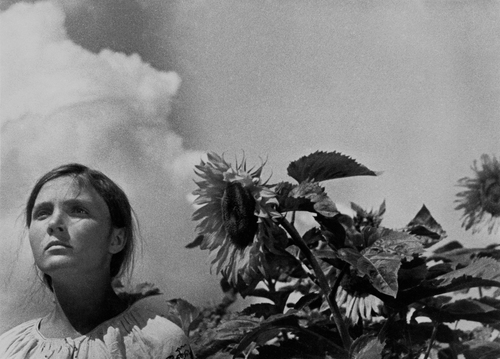
Earth begins with the death of a farmer, Semyon (Nikolai Nademsky), who says his goodbye's beneath a pear tree, blissfully ignorant of the turbulence his death will cause. The village is cut down the middle. One half are the kulaks, private-land owning peasants, who were seen to be growing rich in their greed by Stalin, personified in the film as Arkhip (Ivan Franko), who discusses with his group the idea of collectivisation, to a united resistance. The other, is the sceptical Opanas (Stepan Shkurat), father to the pro-collectivisation Basil (Semyon Svashenko), who is a member of All-Union Leninist Youth Communist League. The arrival of a new tractor lifts the communities spirits, but a murder sparks off a feud.

One of the many social revolutions to come out of the Stalin-era Soviet Union was the idea of collectivisation. After Ukranian peasants were given rights to own land at the turn of the century, Stalin saw them growing rich beyond their means and vowed to eliminate what he saw as its own social class. Collectivisation was to bring land back to the community, therefore generating more product and boosting the economy. But the Soviet army met stubborn resistance from the peasants, who were seeing their land and goods seized and distributed.

Dovzhenko's film has a somewhat ambiguous message, focusing more of the individual plights of a select group of characters. The collectivists and communists are clearly the more sympathetic groups in the film, but the film is more human drama than political propaganda. Like Eisenstein, Dovzhenko treats us to a simply brilliant montage scene, as the delight of the farmers at the arrival of a new tractor (which they urinate in to get going) is juxtaposed alongside the mechanics of grain production. This feeling of the metaphorical prevails throughout the film, as the seemingly endless grain fields and growing fruit are filmed as if tiny gods, watching the human drama unfold beneath them. The film had a mixed reception upon release, forcing Dovzhenko into depression, but is now rightly heralded as one of the most important to come of the Soviet Union, alongside Eisenstein's Battleship Potemkin (1925).


Directed by: Aleksandr Dovzhenko
Starring: Stepan Shkurat, Semyon Svashenko, Yuliya Solntseva, Ivan Franko
Country: Soviet Union

Rating: *****

Tom Gillespie


Earth (1930) on IMDb

Sunday, 1 July 2012

Review #408: 'October' (1928)

To mark the tenth anniversary of the overthrow of Russia's Provisional Government by the Bolsheviks (dubbed 'the October Revolution'), the Soviet government commissioned a propaganda film to be made depicting the events by Sergei Eisenstein. Fresh off the success of his masterpiece The Battleship Potemkin (1925), Eisenstein was seen as the ideal choice to celebrate one of the most significant revolutions in recent history. American John Reed's book Ten Days That Shook the World was the main inspiration for the film's execution and style. The final film, however, was not to the government's liking, describing it as unintelligible to the masses, with Eistenstein taking full advantage of his freedom of artistic expression. The result is a rapid and highly detailed account, full of Eisenstein's trademark fast editing and metaphorical cutaways.

It is useful for the viewer to have at least some prior knowledge of the events that took place and the various figures and parties that were involved, as Eisenstein quickly switches his focus from the lower classes, to the Bolsheviks and Lenin (Vasili Nikandrov), and to the Provisional Party and its leader Aleksandr Kerensky (Nikolay Popov). Even with my, admittedly somewhat limited, prior knowledge, I found the film confusing at times. This, however, is more of a damning indictment of my level of intelligence than a criticism of Eisenstein's abilities as a story teller. I would even go so far as saying that modern film-making was created here, as I have to see a pre-1928 film that is quite so technically innovative as this. It is part reconstructed documentary, part artistic interpretation.

It may not be quite up to the epic scale of Potemkin or his two Ivan the Terrible (1944/1958) films, but October does include a set-piece that eclipses even the Odessa steps sequence in Potemkin. After the government have beaten back a workers demonstration, many lay dead or dying. The bridge that they lie on begins to open from the middle, and we see a woman's corpse lie motionless, her long hair being lifted up by the opposing side of the bridge. And a dead horse, still attached to its cart, hangs limply from the edge, eventually falling into the river. It's a quite brilliant moment from Eisenstein, who, seemingly without effort, allows the audience to make an emotional connection to a historic event without having to establish any characters in and amongst the chaos. Not the Soviet masters finest achievement, but certainly his most visually impressive, and possibly the most exciting.


Directed by: Sergei M. Eisenstein
Starring: Nikolay Popov, Vasili Nikandrov, Boris Livanov
Country: Soviet Union

Rating: ****

Tom Gillespie


October (Ten Days that Shook the World) (1928) on IMDb

Thursday, 21 July 2011

Review #175: 'Strike' (1925)

In the Soviet Union in 1903, the workers of a factory are tired of poor wages, hard living, and harsh treatment by their superiors. Talk of a strike is rife, and when one innocent worker is accused of theft, he hangs himself on the production line and unwittingly becomes a martyr. The strike is decided, and the workers gather in masses to discuss their terms. Meanwhile, the fat cats upstairs are in uproar that the strike has been called, and employ a number of secret agents with animal code names to infiltrate, brutalise and spy on the strikers. As the workers begin to fight amongst themselves, the bosses tactics become increasingly brutal, especially when the police are called in.

Sergei Eisenstein is one of the Soviet Union's greatest ever filmmakers, and arguably one the world's greatest. This was his first feature-length film (he made The Battleship Potemkin (1925) later that year, one of the best and most influential films ever made) and his trickery and style is awe-inspiring, given his inexperience and the fact that cinema was still in its early stages. The most effective technique Eisenstein plays is in the early scenes, where he juxtaposes different animals with the key players (Eisenstein was known as the 'King of Montage'). For example, there is an owl, always watching, thinking and cunning, turning into a wild-eye spy; a fox, misleadingly beautiful and sly, becoming a shapeshifting and handsome con-artist - and dancing bears, that portray the workers. The use of this is at its most powerful at the end, when the police move in to overthrow the strike, cut with scenes of a cow having its throat cut, blood gushing out of its wound as it slowly dies.

It's an incredibly stylish piece for its day and moves along at an alarming pace, even when compared to some films today. It never slows down to develop any characters, instead using its revolutionary and Communist themes to play the main role, with the characters being mere pawns in a more important overlying theme. It's clear where Eisenstein's stance is, which does also work against the film. The factory bigwigs are no more than faceless fat men in expensive suits, drinking champagne and smoking cigars all day, laughing at the misfortune of the workers. There is also a scene where one wipes his shoes clean with the workers wage demands. By today's standards, it seems a bit stereotypical, and the metaphors quite obvious. But this is an alarmingly stylish debut from a truly great film-maker, that is both exciting, and come the end, really quite shocking.


Directed by: Sergei M. Eisenstein
Starring: Grigori Aleksandrov, Maksim Shtraukh, Mikhail Gomorov
Country: Soviet Union

Rating: ****

Tom Gillespie


Strike (1925) on IMDb

Tuesday, 25 January 2011

Review #5: 'Stalker' (1979)

Stalker begins in a black and white, industrialised, gated and despotic world. You feel the dampness permeated within the walls. Pools of water lay in mud; it falls from the walls and ceilings. This is the environment that we meet the main character ‘Stalker’ (played laconically by Aleksandr Kaidanovsky). His job is to guide people to their hopes and dreams. The place that he guides them through is ‘The Zone’. The zone is the perfect juxtaposition of the dank world we are first introduced to. A place occupied by the elements of nature. However, this space is unpredictable.
As the story goes, the zone is cordoned off to the masses as there was an unspecified ‘alien’ landing which, at its centre can give the answers – both philosophically and ideologically – to whomever reaches that core. Stalker is employed by people who want to find this out, as a guide through the treacherous landscape. They need a guide who knows how to manoeuvre through it as the land constantly changes, and can be utterly deadly. A writer (Anatoli Solonitsym) and a scientist (Nikolai Grinko), employ ‘Stalker’ as their guide through the terrain.

This is without question my favourite of all Andrei Tarkovsky films (easily beating Mirror (1975) and the more well known Solaris (1972)). There is always a particular beauty with which he is able to film nature, and to transcend the normality of it, and present it as pure imagistic poetry. In the opening sequences, he conjures beauty from damp, decaying environments, and offers the most perfect of juxtapositions of our industrialised world, next to the beauty of nature. But in this filmic world, the natural elements seem to be the enemy; the alien ‘other’.
The answers which the characters are looking for become almost irrelevant, as the sheer poetry of the filmmaking transcends story. I just implore you all to watch this film, which I have to say, is one of my favourite films of all time.


Directed by: Andrei Tarkovsky
Starring: Aleksandr Kaidanovsky, Anatoli Solonitsyn, Nikolai Grinko
Country: West Germany/Soviet Union

Rating: *****

Marc Ivamy


Stalker (1979) on IMDb

LinkWithin

Related Posts Plugin for WordPress, Blogger...