Showing posts with label 1993. Show all posts

Friday, 5 October 2018

Review #1,401: 'True Romance' (1993)

It's been many years since I last saw Tony Scott's True Romance, huddled up in my bedroom as a young teenager in fear of being caught with my older brother's VHS. I loved it then and I still like it very much, but it never struck me before just how much of a boy's fantasy the film is. This is a story in which a comic-book store worker forms a relationship with a gorgeous hooker-with-a-heart and successfully avenges her mistreatment at the hands of a despicable pimp, all before riding off to Hollywood with a case full of cocaine and dreams of an early retirement in mind. This is no surprise when you see who was behind the script - a young Quentin Tarantino - who at the time of writing was working in a video store dreaming of bigger and better things. But the fact that this is a fantasy isn't a bad thing. True Romance sweeps you up into its universe of outlaw love, mean-spirited gangsters and the ghost of Elvis Presley and doesn't allow you to pause for breath.

The hero at the centre of the story is Clarence Worley (Christian Slater). We meet him in a bar trying to chat up a woman by expressing his love for Elvis and inviting her to join him in a Sonny Chiba triple bill playing at the local theatre. You can almost imagine Tarantino speaking these words and being hit with a rejection, but Clarence is Tarantino's creation, so he has popcorn spilled over him by an attractive blonde named Alabama (Patricia Arquette) as he sits watching one of The Streefighter films alone. The two hit it off and spend the night together, before she reveals she is actually a call girl hired by his friends (the name should have been a hint). But she actually falls in love with Clarence, and him with her, and the two are quickly married before Clarence's attention turns to the pimp who is still holding her belongings, the milky-eyed and dreadlocked Drexl (Gary Oldman). Their confrontation leaves Clarence in possession of a suitcase chocked full of cocaine, so the newly weds head to Los Angeles to find a buyer, with the help of their clueless contact and aspiring actor Dick (Michael Rapaport).

Their road trip allows the opportunity for some familiar faces to flex their acting chops with the assistance of Tarantino's impeccable screenplay, including the likes of Dennis Hopper as Clarence's estranged father, Christopher Walken as fearsome gangster Don Vincenzo, Brad Pitt as Dick's useless stoner roommate Floyd, and a noticeably thinner James Gandolfini as one of Vincenzo's more sadistic thugs. It's a fast and furious two hours, with so much going on that you're barely given time to stop and realise that nothing much really adds up. The film sweeps you up into its silliness, forcing you to bow down to its own particular brand of cool. If you've seen Tarantino's directorial debut Reservoir Dogs, then many of True Romance's story beats will feel familiar (the story carefully moves its characters into place so they will eventually be in the same room at the same time with loaded guns pointed at each other), but Scott's style and energy make the ride exhilarating. The two leads are charming, with Slater convincing as a geek-turned-loose cannon and Arquette portraying just the right blend of cute and sexy, but the real star is Tarantino, who somehow manages to turn an adolescent fantasy into an exciting thrill ride.


Directed by: Tony Scott
Starring: Christian Slater, Patricia Arquette, Dennis Hopper, Val Kilmer, Gary Oldman, Brad Pitt, Christopher Walken, Michael Rapaport, James Gandolfini
Country: USA/France

Rating: ****

Tom Gillespie


True Romance (1993) on IMDb

Saturday, 28 July 2018

Review #1,370: 'Iron Monkey' (1993)

When Ang Lee's Crouching Tiger, Hidden Dragon was released back in 2000, it was hailed as the arrival of a new form of martial arts picture. The use of wirework and trampoline techniques combined with the natural fighting styles of the actors was actually nothing knew, and wuxia had in fact been around for decades. Nevertheless, the success of Crouching Tiger saw the re-release of many Hong Kong classics: titles that would be instantly recognisable to the initiated, but were fresh ground for those swept up in the martial arts explosion (which was arguably cranked up even further after Tarantino's Kill Bill films). One such title was Iron Monkey, an early 90s Golden Harvest production featuring an early performance from Donnie Yen. While it isn't quite as polished as Ang Lee's hit, Iron Monkey puts its fighting scenes to shame, delivering a rollicking 90 minutes of action and fun that I could have quite happily watched again straight after it had ended.

The name Wong Fei-hung may be unrecognisable to Westerners, but it is a name as popular as Robin Hood within Chinese folklore. He was a famous martial artist and physician, and his exploits have seen him become the subject of over a hundred movies and television shows, the most famous of which is Hark Tsui's Once Upon a Time in China, which starred Jet Li as Fei-hung. With Li wanting to call it a day on the role after Part III was released in 1993, attention turned to a prequel, and Iron Monkey was born. Fei-hung here is a 12 year old, and played immaculately by Sze-Man Tsang, a girl. Most of the attention is given to his father, Wong Kei-Ying (Yen), who arrives in town with his son in tow just as the governor's guards are rounding up anybody who looks suspicious. The corrupt governor is looking for Iron Monkey, a skilled martial artist who is causing a nuisance around town. Under the threat of execution, Kei-Ying agrees to track down Iron Monkey in return for his son's freedom, but quickly learns that there is more to his mysterious foe that initially thought.

The Iron Monkey is local physician Yang Tianchun (Rongguang Yu) who, along with the beautiful Miss Orchid (Jean Wang), battles to overthrow corruption and the mistreatment of the people. The plot is as thin as the wires launching the actors into a variety of graceful getaways, but director Woo-Ping Yuen grabs the attention with a non-stop wheel of dazzling action scenes. The speed with which Yen and Yu jab and spin beggars belief, dusting off faceless henchman with a spectacular array of inventive moves, all of which we get to learn as the characters are fond of announcing the title of each form of punishment upon delivery. Best of all is Tsang, who not only convinces as a boy (I didn't realise until I read up about the film after it had finished), but proves to be just as effective as her older colleagues in showing off her skills. As the bad guys get increasingly tougher, Iron Monkey becomes more ridiculous, but this is counter-balanced by a fine vein of humour throughout. It saves its best for last, as our heroes team up against the big bad on top of wooden poles wedged into the ground as a huge fire rages below them. They balance of vertical sticks, horizontal sticks, and at one point, they are on top of each other on one wobbly pole. It's breathtaking stuff, and proves that Hong Kong cinema had this action stuff worked out long before Hollywood caught on.


Directed by: Woo-Ping Yuen
Starring: Donnie Yen, Rongguang Yu, Jean Wang, Sze-Man Tsang, Shun-Yee Yuen
Country: Hong Kong

Rating: *****

Tom Gillespie


Iron Monkey (1993) on IMDb

Friday, 13 October 2017

Review #1,259: 'Maniac Cop 3: Badge of Silence' (1993)

With Maniac Cop 2, director William Lustig and screenwriter Larry Cohen imagined a mixture of bloody slasher and crime thriller The French Connection, and delivered just about the most satisfying sequel imaginable to an original that was hardly great. It delivered on car chases, action set-pieces and slasher mayhem, backed with a witty, sharp script and an impressive cast. It also delivered a full-body-burn climax that was as exciting as it was technically impressive. While part two looked at William Friedkin's classic thriller for inspiration, just where Maniac Cop 3: Badge of Silence found inspiration is anyone's guess, other than perhaps the sort of drivel you used to find buried on the bottom shelf of the video store. Lustig and Cohen have both disowned the movie since its release, and it isn't difficult to see why.

Citing studio interference, Lustig walked from the set half-way through filming for the movie to be picked up by inexperienced producer Joel Soisson, who is uncredited. The resulting film is less than a half-baked idea: a lumbering mess of a film, primarily made up of filler that is, at times, downright unwatchable. Having clear Matt Cordell's name and buried him with honours in tact, Detective Sean McKinney (Robert Davi) had hoped to have seen the last of the 'Maniac Cop'. His close father-daughter-like relationship with young police officer Katie Sullivan (Gretchen Becker) is ground to a halt when she is gunned down and placed into a coma by junkie Frank (Jackie Earle Haley), only for two 'nightcrawler' cameramen to smear her name with some edited footage. After being resurrected by a Voodoo priest, Cordell sees Sullivan as an equally tortured and unfairly disgraced soul, and sets about claiming her for his own.

It's hard to know where to start with Maniac Cop 3, as the film is so lacking in ideas and structure that it barely has a beginning, middle and end. When it hits a wall, it looks to its predecessor for ideas. So we are treated to another convenience store shootout, another high speed chase, and another finale involving a full body burn. In its defence, the climax mixes both a high speed chase and a full body burn, and while it goes on for a little too long, you have to appreciate the complexity of such an intricate set-piece. Cordell, again played by Robert Z'Dar, is relegated to little more than a glorified cameo in his own movie, appearing ever now and then to carry out a bloody deed seemingly for Voodoo priest Houngan (Julius Harris), whose motives are still unclear when the credits roll. As a fan of the first two Maniac Cop movies, it's easy to feel as cheated as Lustig did as he stormed off set.


Directed by: William Lustig
Starring: Robert Davi, Robert Z'Dar, Caitlin Dulany, Gretchen Becker, Jackie Earle Haley
Country: USA

Rating: *

Tom Gillespie


Maniac Cop 3: Badge of Silence (1993) on IMDb

Wednesday, 3 May 2017

Review #1,190: 'Killing Zoe' (1993)

I remember hearing whispers of the low-budget heist thriller Killing Zoe back in 1993, mainly because of its link to Quentin Tarantino, the then up-and-coming indie writer/director who was quickly becoming the poster boy for '90s cool following the controversial success of his debut Reservoir Dogs. Killing Zoe was directed by Roger Avary, the film enthusiast who worked in a video store with Tarantino. When the writing duo won an Academy Award for Pulp Fiction in 1994, Tarantino was the best thing since sliced bread, and Killing Zoe enjoyed a brief cult success due to the motor-mouth's name being plastered above the title, although only serving as executive producer. Almost a quarter-century later, Avary's film has faded into obscurity, and deservedly so.

American Zed (Eric Stoltz) arrives in Paris and quickly befriends a talkative cab driver, who offers to set him up for the night with a girl. Back at his hotel room, he is soon joined by the young and beautiful Zoe (Julie Delpy), who insists that she is not a prostitute but an art student looking to make some quick cash to get by. She inexplicably falls for the overwhelmingly passive Zed, until Parisian Eric (Jean-Hugues Anglade) barges in and throws her out. It turns out that Zed is in Paris to assist his old friend with a bank job, where he will use his expertise to crack open the tricky vault. Eric insists that the heist happens the very next day, and rather than take the time to mull over the plan in detail, Eric, Zed and the rest of the gang indulge in a night of excess, involving drink, women, and lots and lots of heroin.

It's no surprise that the eventual robbery goes spectacularly wrong, with the gang (including Gary Kemp) still tripping from the night before and feeling particularly trigger-happy. What occurs in the final third is a hateful and tedious orgy of blood and shouting. The crew aren't endearing in their ineptitude, but completely annoying and charmless. It certainly has a deliberate manic energy to it, but is done so with a lack of real substance. The movie is at its best during the moments building up to the heist, which use a mixture of out-of-focus photography and garbled dialogue to create a truly whacked-out atmosphere. It's almost like that moment when you realise you've had too much but your friends won't allow you to leave, only with a bunch of junkie psychopaths in your face spouting their own nonsensical philosophy. Overall, it's an unpleasantly nihilistic experience that offers only a glimpse into Avary's talents and obvious fondness for cinema. Keep your eyes peeled for a bizarre cameo by Ron Jeremy.


Directed by: Roger Avary
Starring: Eric Stoltz, Jean-Hugues Anglade, Julie Delpy, Gary Kemp
Country: France/USA

Rating: **

Tom Gillespie


Killing Zoe (1993) on IMDb

Tuesday, 27 September 2016

Review #1,092: 'Trauma' (1993)

Trauma is a particularly significant horror in that it was the first film to be made by Italian genre master Dario Argento on American soil. Following a string of eye-catching, kaleidoscopic gialli and superior supernatural tales, Argento found himself at the door of Hollywood, an industry which, at the time, was struggling to churn out much in terms of originality in the horror/thriller genre. While he had employed English-speaking actors before, such as Jennifer Connelly, David Hemmings and Karl Malden, their roles were often crudely dubbed, and Trauma offered the director a chance to reach a broader audience with his unique - if obviously Hitchcockian - blend of build-up and terror.

Disappointingly, Trauma, if anything, represents the beginning of Argento's drastic career decline. The opening is full of promise, as a familiar black-gloved killer stalks a victim before killing her in a brutal and stylish fashion, here with a device which allows the victim to be garroted with relative ease. Bolstered by a POV style and traditionally great effects work by Tom Savini, it's a scene that could have easily been taken from one of Argento's native works. However, as popular as the giallo craze was, it didn't quite reach the general American audience, and so Trauma gets watered-down and peppered with horror cliches in an attempt to cast a wider audience net. While the tropes are there - an everyman (Christopher Rydell) is forced into sleuthing while dodging the police - it does little but frustrate as you realise that somewhere, deep down, there's probably a great giallo trying to get out.

So while the film has it's odd moment, the result is an incoherent, and somehow quite boring, mess of ideas and clashing styles. Starting promisingly, the story goes on to place anorexia sufferer Aura (Asia Argento, the director's then 17 year-old daughter) in the hands of illustrator David (Rydell) after her parents are murdered by the masked killer, and it is during this period that the film does nothing but lay out a string of red herrings, as well as creepily leering at Argento's youthful beauty. The final third is an exhausting conveyor belt of anti-climaxes, before the ludicrous (and not in an entertaining way) reveal that feels like it was made by a sub-par Tobe Hooper or Wes Craven arrives. While it's nowhere near the level of atrociousness that Argento would vomit out in 2009 with Giallo, Trauma feels like it was made by a once-great visionary who had tiredly given in to the producers' voices in his ear.


Directed by: Dario Argento
Starring: Christopher Rydell, Asia Argento, Piper Laurie, Frederic Forrest, Brad Dourif
Country: Italy/USA

Rating: **

Tom Gillespie


Trauma (1993) on IMDb

Friday, 24 June 2016

Review #1,039: 'Matinee' (1993)

Joe Dante's Matinee is a bewilderingly overlooked little gem about a period when going to the movies was a far more innocent experience. Directors such as William Castle would turn a trip to the cinema into something all the more involving for the audience, pulling stunts such as rigging audience's seats with buzzers to shock the viewers whenever a fright occurred on screen, or even allowing them to choose their own ending. It was a time when a film-makers could make a decent buck with a bit of old-fashioned theatrics and a genuine passion for delivering an exciting experience for the paying punters. Matinee is also about the loss of such innocence, both at the movies and in the U.S.A. as a whole.

It's 1962, and avid young horror buff Gene Loomis (Simon Fenton) spends his days at the movies with his little brother while his father is away on a submarine. He's recently moved to Key West, Floria, where just over the horizon the Soviets are storing missiles in Cuba, and President Kennedy has just announced the threat of nuclear destruction. Gene dotes on the prettiest girl in school, Sandra (Lisa Jakub) while his new best friend Stan (Omri Katz) tries it on with Sherry (Kellie Martin), whose ex-boyfriend is a flick-knife wielding senior. While the whole town is in a subdued panic, charismatic B-movie schlock extraordinaire Lawrence Woolsey (John Goodman) arrives to personally promote his new film Mant!, a cheapo creature feature about a man turned into an ant by nuclear radiation or something or other.

There was very little time spent during my viewing of Matinee without a smile plastered across my face, which is what you would expect from a Joe Dante movie during the best spell of his career. This is a picture for those who truly love the movies from a guy who clearly loves movies too. In one of Matinee's most bewitching moments, the camera sweeps into Key West's cinema with the same sense of awe I experienced as a child, when I remember gazing at posters of the upcoming movies adorning the walls and being hit with that sickly smell of popcorn. Sadly, I wasn't around for the black-and-white kitschy B-movies of the 50's and 60's (the earliest memory I have is watching Robin Hood: Prince of Thieves with my brother back in 1991), but the affect is still the same.

Cathy Moriarty also stars as blonde bombshell Ruth Corday, an actress and also Woolsey's girlfriend, eternally grumpy with the man she sees as full of out-of-reach dreams and cheap gimmicks, but demonstrating loyalty by dressing up as a nurse stationed outside the screening in case anybody falls ill because of the 'horror' on show. The Cuban Missile Crisis coincided with the decline of such showmanship, as American cinema evolved into something all the more serious, cynical and paranoid, and Matinee waves goodbye to such innocence. But it does so with a smile, and Goodman is terrific as the larger-than-life promoter who is perhaps a version of Dante himself, or at least the more flamboyant directors Dante grew up admiring. Matinee has a lot to say about our love for the movies and of the important role it plays in our general society, but more importantly it is joyous, funny and often extremely touching.


Directed by: Joe Dante
Starring: John Goodman, Cathy Moriarty, Simon Fenton, Omri Katz, Lisa Jakub
Country: USA

Rating: *****

Tom Gillespie


Matinee (1993) on IMDb

Wednesday, 21 October 2015

Review #934: 'Jurassic Park' (1993)

Jurassic Park was one of the first movies I remember watching at the cinema as a youngster, and I was so blown away I quickly acquired a pirate video of it, which I routinely watched to death. The special effects, the music, the set-pieces, that familiar park logo - it all had me riveted. It's one of the game-changing blockbuster movies, and watching it again an astonishing 22 years later, it's remarkable just how well the movie has aged. It's not quite the perfect experience I remember - those Spielberg-isms are now clear as day - but Jurassic Park's mixture of robotics and CGI blows most modern films away in terms of tension and pure spectacle.

Eccentric millionaire John Hammond (Richard Attenborough) approaches palaeontologist Dr. Alan Grant (Sam Neill) and his palaeobotanist partner Dr. Ellie Satler (Laura Dern) to join him on a journey to his newly built theme park. With the promise of a life-changing experience, the young-ish doctors cannot resist, so they journey to Isla Nublar, an island off the coast of Costa Rica, along with mathematician Dr. Ian Malcolm (Jeff Goldblum) and lawyer Donald Gennaro (Martin Ferrero). Upon arrival, they are greeted with the sight of a living, breathing brachiosaurus. Using the preserved dinosaur DNA extracted from mosquitoes preserved in tree sap, Hammond and his company have used cloning technology to birth a wide range of dinosaurs, including the terrifying tyrannosaurus rex and a group of velociraptors.

With this revelation comes the debate of whether man creating life is ethical, or in this scenario, safe. The dangers quickly become apparent to the group of doctors, but they cannot restrain their curiosity and are whisked off on a tour of the park. So confident is Hammond in the safety of his park, he invites his grandchildren Tim (Joseph Mazzello) and Lex (Ariana Richards) to participate. However, disgruntled employee Dennis Nedry (Wayne Knight) has cut a deal to sell dinosaur embryos to a corporate rival, and when a storm hits the park, he shuts down all the power in order gain access to the eggs. With the electric fences keeping the dinosaurs in temporarily down, it isn't long before the dinosaurs are fleeing their pens.

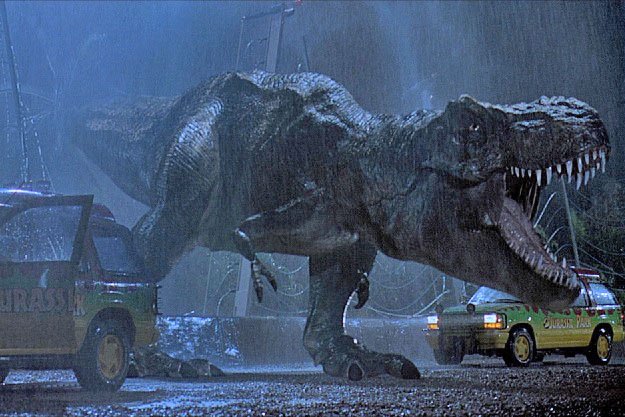
At first, this is the patient Spielberg who gave us Jaws (1975), opting for a slow build-up to the big reveal rather than giving the audience instant gratification. The introduction of the T-Rex is now an iconic moment in cinema, a thrilling combination of tension and pure terror, with a jump shock thrown in for good measure. But once Spielberg finally unleashes his monsters, the film simply doesn't stop. Delivering set-piece after set-piece, Jurassic Park abandons all restraint and packs it's second hour when it should be preparing us for the next big scene. Jaws gave us that wonderful moment when the crew compared battle scars, but there is no such scene here, just another problem for our relatively bland archetypal heroes to solve.

One of the most interesting aspects of the film is the character of John Hammond, Essentially the main antagonist, Hammond is a good-natured capitalist, a visionary who wants to bring wonder to the masses and make a tidy profit at the same time. Without a second thought for the consequences of his actions or the ethics of playing God, Hammond comes across as misguided, and too likeable to be labelled a villain. Hammond aside, Jurassic Park makes no apologies for its thinly-written characters, as this is a film of visual spectacle after all. When John Williams' famous score kicks in, it's easy to forget about the movie's many niggling problems and, for me at least, be reminded of that kid who would watch it on repeat with his nose a few inches from the screen.


Directed by: Steven Spielberg
Starring: Sam Neill, Laura Dern, Jeff Goldblum, Richard Attenborough, Bob Peck, Martin Ferrero, Joseph Mazzello, Ariana Richards, Samuel L. Jackson, Wayne Knight
Country: USA

Rating: ****

Tom Gillespie


Jurassic Park (1993) on IMDb

Wednesday, 30 September 2015

Review #924: 'Jason Goes to Hell: The Final Friday' (1993)

For the exhaustive ninth entry into the Friday the 13th franchise, the creative's behind the scenes made the huge mistake of believing that what this franchise needed was something fresh, something out of the left field. After all, we've had eight of what were basically the same film, with only the embarrassing Jason Takes Manhattan managing to move the action away from Crystal Lake. What this franchise needed was to simply stop, but while there are teenagers eager to hand over their cash for 90 minutes of undemanding trash, there's always more juice to be squeezed. So, with Jason as a supernatural being already established, he now has the ability to transfer his soul into different bodies.

With Jason (Kane Hodder) melted in toxic waste at the climax of the previous film, the machete-wielding psychopath is inexplicably back at Camp Crystal Lake stalking a woman taking a shower. When she escapes her log cabin, Jason pursues, but is trapped by a small army of FBI agents who routinely blow him to pieces. Yet somehow his heart survives unscathed, and his remains are taken to the morgue for further investigation. His soul passes into the coroner (Richard Gant), who butchers the hospital guards and heads back to Crystal Lake, where a group of partying teens await him. Jason turns into a media sensation, and infamous bounty hunter Creighton Duke (Steven Williams), who claims to be the only one who knows how to truly kill Jason, is employed to take the demon down once and for all.

Along with the aforementioned Jason Takes Manhattan, Jason Goes to Hell is the most hated of all the entries by fans of the series. Worst of all, the film leaves their biggest draw - Jason himself - in the background for the majority of the film, while B-movie actors stumble around like zombies doing the killing instead. But aside from the fact that this is particularly terrible entry into a beloved franchise, this is simply a badly made movie, and worst of all, a poorly executed horror. The acting, script, cinematography and score are offensively drab, and there are gaping holes in the story that are simply not explained. Why is Creighton suddenly in prison when he was free in his previous scene? Why does he break the fingers of the man who ultimately has the same goal? Why is Jason suddenly a spirit who can puke his black, putrid soul into other people? If the film at least offered one or two decent set-pieces or memorable murders these factors could have been forgiven. But Jason Goes to Hell is simply a waste of time and celluloid.


Directed by: Adam Marcus
Starring: John D. LeMay, Kari Keegan, Kane Hodder, Steven Williams
Country: USA

Rating: *

Tom Gillespie


Jason Goes to Hell: The Final Friday (1993) on IMDb

Sunday, 6 April 2014

Review #728: 'Schindler's List' (1993)

Schindler's List is a film that will no doubt forever grace the endless 'Best Movies' lists trumped up by various organisations and movie magazines. It's serious subject matter, black-and-white photography, rousing score and 'directed by Steven Spielberg' tag has cemented it's status as one of the best American movies of all time. But the more hardened movie-goer will more than likely pick holes in it, and tell you that this in fact not even Spielberg's greatest achievement. Which is why, 21 years after it's release, I decided to revisit Schindler's List, and although I would agree that Spielberg has made better (he did make Jaws (1975) after all), this is still a masterful work, a wonderfully mature step-up for the film-maker who had, up to 1993, leaned towards the visual spectacle of David Lean and Howard Hawks.

The Holocaust is now very much a roll-your-eyes focus for a film-maker, easily passed off as a desperate plea for awards and serious recognition, and the Oscar are routinely stacked with movies portraying this appalling historical event. But Spielberg's movie was the first one brave enough to show it for what it was - a sickening, bloody event that humiliated its victims and where the life of a Jew was worth less than the work the Nazi's could squeeze out of them before they were routinely disposed of. Documentaries such as Night and Fog (1955) and Shoah (1985) hit hard, much more so than in this movie, but Schindler's List feels like a documentary come to life, with Janusz Kaminski's cinematography giving the movie a sense of timelessness.

Liam Neeson is Oskar Schindler, a Czechoslovakian opportunist looking to use cheap Jewish labour during World War II to make him enough money to help him retire a very wealthy man. He employs Jewish accountant Itzhak Stern (Ben Kinsley) to hire his workers and run his factory for him, at first making kitchen utensils to be used in the war. After witnessing the liquidation of the Krakow ghetto under the direction of SS-Untersturmfuhrer Amon Goeth (Ralph Fiennes), in which many Jews are massacred, Schindler is profoundly affected. He begins to lavish gifts and bribes upon Goeth in order to protect his workers from being murdered, but as the Germans begin to lose the war, Goeth receives the orders to move the Jews from his camp onto Auschwitz.

Made the same year as his CGI blockbuster Jurassic Park, Schindler's List showed an unseen maturity in Spielberg's work. He had made 'serious' films before, but they were always in the style of classic Hollywood; grand, sweeping epics that were generally homages to better directors. Here, Spielberg is invisible, his hand nowhere to be seen until one of the final scenes. This was film-making closer to Italian neo-realism, with hand-held cameras, bleak cinematography, and a glorious lack of sentimentality. Rather than make you weep into a tissue, he has you looking away from the screen in utter shock. Hundreds of naked Jews are humiliated as decisions are made on their ability to work and Goeth coldly shoots workers with a rifle from his balcony before breakfast. In one of its most famous scenes, a group of women are led into a shower room that may just be a gas chamber. It's one of the most terrifying sequences in recent memory.

Spielberg wisely chose relatively unknown actors to fill the roles. Neeson, now inexplicably an action star, brings a complexity to Schindler as he changes between smug womaniser and Nazi suck-up to a man capable of great kindness and selflessness, and the film isn't afraid to show the darker side of his character. Kingsley, who was known for his Oscar-winning role in Gandhi (1982), is Schindler's consciousness, a constant reminder of the atrocities that were being committed outside of Schindler's comfortable bubble. As Amon Goeth, one of cinema's most memorable villains, Ralph Fiennes steals the film. He is a hypocritical, loathsome psychopath, embodying the sense of self-righteousness of the Nazi power trip. He despises the Jews, and preaches about their extermination, yet falls in love with his servant Helen Hirsch (Embeth Davidtz), only to beat her in his disgust.

Although there are better films out there that focus on World War II or the Holocaust, it is of no surprise that this is still one of Spielberg's most revered films. It is a brave, accomplished film that gives you a sense that this was the film the director was always meant to make. However, he seems unable to resist stamping his recognisable dose of sentimentality at the climax, as Schindler breaks down in front of his workers wishing he did that little bit more. It's an unnecessarily slushy scene, a piece of director self-indulgence in what is damn near a perfect film, that, if anything, lessens the brutal impact of what came before. But this is a staunch reminder of the atrocities that humanity is capable of, and, as all great movies do, feels incredibly short at over three hours.


Directed by: Steven Spielberg
Starring: Liam Neeson, Ben Kingsley, Ralph Fiennes, Caroline Goodall, Embeth Davidtz
Country: USA

Rating: *****

Tom Gillespie


Schindler's List (1993) on IMDb

Sunday, 10 March 2013

Review #592: 'The Cement Garden' (1993)

Based on the 1978 novel of the same name by Ian McEwan, Andrew Birkin's' screen adaptation of The Cement Garden is about masculine and social decay, and the power of female sexuality against the fragmentation of masculine dominance. Contained within the backdrop of a crumbling concrete landscape on the outskirts of town, a family home, block-like, grey and characterless seems to erupt from the ground which only sees plant life protruding from small cracks in the manufactured ground. In the opening the father (Hanns Zischler) of the isolated family is concreting over what plant life exists in their garden, but his evident ill-health (represented as a spluttering pipe-smoker) causes a heart attack, killing him. During this scene the film cuts from the impending heart attack to the increased masturbatory climax of eldest son, Jack (Andrew Robertson), a 16 year old who is clearly sexually frustrated, and is detached from the rest of the family. Just weeks later the mother (Sinead Cusack) dies of a mysterious illness, but on her death bed she speaks of orphanage's and fragmentation of the four children to her eldest, Jack and Julie (Charlotte Gainsbourg).

Not wanting to comply with the social structures of adoption and social services, Jack and Julie decide to bury the mother themselves in a block of cement in the basement. The eldest two vie for control over the siblings, acting as surrogate parents, but Julie, also at the stage of teenage-era where she is learning to use her sexuality to control and influence men. She plays against Jack's frustration by teasing him, sexually luring him to gain female dominance over the family. This idea of female sexual dominance is presented in the cross dressing whims of youngest child, Tom (Ned Birkin), who plays at being Julie with his friend (who consequently play-acts as Jack. Tom wears his mothers dress and a blond wig. After the death of the parents, the only adult presence is a slimy, business-dress, convertible sports car driving, Derek (Jochen Horst). A friend of Julie's, Derek is another masculine object that Julie is attempting to break down with her sexual teasing, but he becomes increasingly suspicious of the smell coming from the basement. After a confrontation, where Jack step up to become the man of the household, Derek is sent away, and Julie has her brother where she wants him.

The Cement Garden goes into some incredibly dark places, touching on incest and young sexual control. The film is also self-contained in its setting, and this isolation, and the very man made environment give the film substance and depth. This backdrop also juxtaposes the characters ideas of what natural is. Nature in this place is absent, so Julie and Jack's own perception of nature is skewed. Outside and inside the house everything external to their emotions are falling apart and rotten, and inevitably this decomposition (also of the mothers dead body) influences their ideas of natural acts - culminating in incestuous activities. The acting is superb, with Gainbourg's sexually promiscuous, flirting character she is seduction incarnate, and Robertson's detached, wanking teenager, is rife with sweaty, greasy complexion and brooding, on-the-edge-of-explosion sexual charge. It is not a beautiful film, but the culmination of all these elements creates a daring and alarming drama that highlights the symbiosis of place and human nature.


Directed by: Andrew Birkin
Starring: Andrew Robertson, Charlotte Gainsbourg, Alice Coulthard, Sinéad Cusack
Country: France/Germany/UK

Rating: ****

Marc Ivamy


The Cement Garden (1993) on IMDb

Saturday, 26 January 2013

Review #570: 'Wittgenstein' (1993)

I knew nothing of Austrian philosopher Ludwig Wittgenstein before seeing Derek Jarman's 'biopic' of the great thinker, and after the film, felt I didn't really know much more. Wittgenstein came from Vienna, born into an aristocracy that produced many geniuses in various mediums. Although his great mind would have no doubt seen him become prodigious in whatever he chose to do, his real love was philosophy, the only subject that gave him any true satisfaction. Through his publications and teachings at Cambridge, he amassed an almost disciple-like following of those who understood his radical musings. Plagued with a psychological affliction that saw three of his brothers commit suicide, he was often ashamed with his privilege and sought refuge in the working man, who he romanticised through the literature of Tolstoy and Dostoevsky.

Most of that knowledge I gained from internet research after watching the film, as Derek Jarman opts for a more interpretive approach - less of a timeline biopic and more of a quasi-abstract work of art. Jarman strips back all conventional cinematic methods and employs a plain black background, with the only presence on screen being the actors and few minimalistic props. He also ignores period detail, having the characters dress in costumes from various periods, often in bright, outlandish colours, using objects that had yet to be invented (similar to his excellent Caravaggio (1986)). This is successful in attempting to portray Wittgenstein's obviously haphazard look at the world, almost like being trapped between his deep ideas and reality (something that is observed by Maynard Keynes (John Quentin) later in the film), but this also makes the film so visually unappealing that it can be rather dull, like watching a small drama group enact a live play.

Yet although the film is rather un-inspirational in terms of cinematic techniques, Wittgenstein is undoubtedly intriguing, putting a fresh outlook on the tired sub-genre of the biopic. Welsh actor Karl Johnson is fine in the role of Wittgenstein, embodying the disconnection his character feels with the world. There is also fine support from Michael Gough, Jarman's muse Tilda Swinton, and Clancy Chassay, playing the narrating young Wittgenstein. His life was rich and full of incident, and Jarman's failure to really grasp the enormity of Wittgenstein makes the film ultimately a disappointment, focusing mainly on his relationship with a young philosopher called Johnny (Kevin Collins) - as though Wittgenstein's torment could have been the result of sexual repression - and only the skimming the surface of his time fighting in World War II, and the physical abuse he inflicted on his young pupils during his time as a schoolteacher. So Wittgenstein will remain somewhat an uncelebrated mystery, even though he is remembered as one of the greatest in his fields by his peers.


Directed by: Derek Jarman
Starring: Karl Johnson, Michael Gough, Clancy Chassay, Tilda Swinton
Country: Japan/UK

Rating: ***

Tom Gillespie


Wittgenstein (1993) on IMDb

Thursday, 10 January 2013

Review #561: 'The Piano' (1993)

Ada (Holly Hunter) arrives at a rainy New Zealand coast to meet her new husband - the gently-spoken frontiersman Stewart (Sam Neill) - along with her precious grand piano and her illegitimate daughter Flora (Anna Paquin). Ada has been a mute since she was 6 years old, and as she explains in her narration, no-one knows why. Stewart's friend Baines (Harvey Keitel) takes an interest in the piano and offers Stewart land in exchange for it, as well as lessons from Ada, to which Stewart agrees. Offering the chance to earn her piano back, Baines wants one visit per black key on the piano from Ada, who he is seemingly infatuated with.

Australian director Jane Campion's erotically-charged gothic love story was a huge success back in 1993, winning the Best Actress Academy Award for Holly Hunter and Best Supporting Actress for Paquin, who became the second youngest recipient ever. Hunter's shadowy Ada is the backbone of The Piano, and while it may appear that it is her piano that fuels her passion, it is very much her own mind and experiences that dictate her actions. She is quite a fascinating character - not merely the put-upon mute who longs for love and her piano - she is actually rather subtly manipulative and sexually powerful, weighing up the two love interests in her life, and playing a dangerous power game with her increasingly jealous husband.

The contrast between the two men in Ada's life couldn't be any obvious - Stewart playing dutiful, business-minded and quite inept in courtship, while Baines is hulking, living out in the forest, his face spotted with native Maori tattoos - but it is quite clear as to where Campion's preferences life. Ada's scenes with Baines, in which he listens to her play, become the centrepiece for some highly erotic moments, playing out more like animal foreplay than anything human. Ada seems not to bat an eyelid when Baines lies on the floor by her feet, fingering a hole in her stocking, or simply walks around the room completely naked. While these unconventional actions are there to channel Ada's sexual repression/release and Baines' animalistic nature, these scenes often appear forced, filled with lazy or nonsensical metaphors passed of as spiritual film-making.

As with many Australian period films, The Piano looks stunning. The exotic location is not filmed through a sun-tinted lens, and nor does it capture any of the colourful wildlife (something you would expect if Terence Malick had directed it), but is grey, wet and muddy. Like Peter Weir's Picnic at Hanging Rock (1975) and Gallipoli (1981), it has that lived-in feel, with Hunter's beautiful, ghostly face evoking a 19th-century photograph, where everyone looks grim and pale, and Campion's occasionally snapshot approach captures the mundane, everyday actions of the period. The performances are a revelation, with Hunter and Paquin deserving their accolades, and Keitel proving a formidable presence (I'll not mention the accent). The Piano is personal film-making, but too often the film seems to be striving for that mystical atmosphere rather than actually capturing it, occasionally getting lost amongst Campion's obvious adoration for her protagonist.


Directed by: Jane Campion
Starring: Holly Hunter, Harvey Keitel, Sam Neill, Anna Paquin
Country: Australia/New Zealand/France

Rating: ***

Tom Gillespie


The Piano (1993) on IMDb

Sunday, 19 February 2012

Review #335: 'Last Action Hero' (1993)

When young Danny Madigan (Austin O'Brien) is given a magic movie ticket by friendly cinema owner Nick (Robert Prosky) at an advance screening of new action movie Jack Slater IV, he is magically transported into the movie and into the car of supercop Jack Slater (Arnold Schwarzenegger). Danny starts to inform Slater about who the bad guys are after seeing them on screen, and the two are paired up as a mismatched investigative duo by Slater's screaming boss. Glass-eyed bad guy Mr. Benedict (Charles Dance) manages to get his hands on the magic ticket, and escapes into the real world, where he finds things are much easier for the bad guys. Slater must leave his action movie cliche of a world where he is nigh on invincible behind, and enter one where things are slightly more difficult.

Last Action Hero had one of the most expensive and turbulent page-to-screen stories in recent cinema history. Originally written as a self-mocking action movie that embraced the cliches of the genre, that was also a proper action movie in its own right. After an unexpected bidding war, the young scribes Zak Penn and Adam Leff were shocked to find that Arnold Schwarzenegger had taken a personal interest in it (the original hero name was Arno Slater). This was to be the turning point. Arnie saw the potential for a franchise as a kid's film and immediately wanted to tone down the violence, so Penn and Leff were fired, and genre legend Shane Black was hired to spruce up the script. Things changed yet again when director John McTiernan was brought in, and, due to the success of his previous films, was given full control.

A few script re-writes, firings, and storm-outs later, the film was shot and ready to hit the market. A toy franchise and a ridiculously expensive and calamitous advertising campaign (they paid half a million dollars to have the film's name on a NASA rocket, only to have the launched delayed till long after the film's release) were put into motion, and the film's release date was announced for the week after Jurassic Park's. Last Action Hero had disastrous test screenings, but the release date was not changed, and naturally, Jurassic Park stormed the box-office and merchandising range, and Last Action Hero was revealed to be an over-ambitious, confused dud of a movie. However, the legend is rather cruel on Schwarzenegger's biggest flop, as although it is a gigantic mess, it has plenty of interesting ideas than are unfortunately spewed out onto the film in ungraceful belches.

The biggest problem is that it doesn't know what kind of film it is. At its heart, its a kid's film, complete with annoying mop-haired child, a kindly old man, magic tickets and, um, a cartoon cat. Yet on its surface, its a rather uninspired action film that is actually rather violent and, once in the real world, is quite grim. The film never seems to know whether it wants to homage, spoof or simply in-joke. The movie world it creates is itself confused - while it has some funny touches such as the police line pairing together various mismatched partners - it also has women walking around in sexy, futuristic costumes, and the aforementioned cartoon cat called Whiskers (voiced by Danny DeVito). Seriously, whose idea was that? I've never seen a cartoon cat in a live-action action movie!

However, the sheer mess that is the complete film does prove Last Action Hero to be a curious little oddity. There have been much finer examples of action-movie send-ups, namely in Shane Black's own excellent Kiss Kiss Bang Bang (2005), so perhaps the producers weren't ready back in 1993 to take on such an ambitious project. Arnie is pleasantly game for sending himself up, and Charles Dance chews the screen with his gloriously hammy British bad guy. But Last Action Hero will ultimately always be a reminder of how the Hollywood system to suck up an interesting maverick project, fuck it over a few times, and bundle it over the finishing line with such unbelievable inefficiency. I did love it as a kid, however.


Directed by: John McTiernan
Starring: Arnold Schwarzenegger, Austin O'Brien, Charles Dance, Robert Prosky, F. Murray Abraham, Anthony Quinn
Country: USA

Rating: ***

Tom Gillespie


Last Action Hero (1993) on IMDb

LinkWithin

Related Posts Plugin for WordPress, Blogger...