Showing posts with label 1960. Show all posts

Wednesday, 30 August 2017

Review #1,240: 'Beat Girl' (1960)

Beat Girl, known as Wild for Kicks in the U.S., was another entry in the juvenile delinquent sub-genre started by the likes of High School Hell Cats and Teenage-Age Crime Wave, which took a look at the 'troubled' youth of the post-World War II generation when rock 'n' roll was moulding the clean-cut teenagers into misanthropic tearaways. Directed by Edmond T. Greville, Beat Girl is far too silly and melodramatic to leave any lasting impact, but there is a joy to be had with watching a bunch of pretty 1960's teenagers mope and complain in what would likely be classed as acceptable rebellious behaviour nowadays, and to see Swinging 60's London in all its glory.

The story concerns Jennifer (Gillian Hills), the 'beat girl' of the title, and her struggle to accept a new addition to the household. Her rich and rather liberal father Paul (Black Narcissus' David Farrar) dotes on his young, beautiful daughter, but remains concerned about her late night partying and dead-beat friends. Her behaviour takes a downturn when he brings home his new young and gorgeous French wife Nichole (Noelle Adam), who Jennifer takes an instant disliking to, as most children of divorce do. Nichole makes all the effort to bond with her new step-daughter, but Jennifer would rather be hanging out at the local jazz dive with her friends (including real-life musician and teen idol Adam Faith). After a chance encounter reveals Nichole's past life, Jennifer becomes intent on revealing the big secret to her work-obsessed father.

My main issue with Beat Girl is that it isn't totally clear whose side we're meant to be on. On one hand, the parents are shown as forward-thinking and modern while the youngsters (including a baby-faced Oliver Reed) squabble on a dusty floor over a half-drunk bottle of gin. On the other, the apparently misguided youth act out for good reason, and ultimately pose no actual threat ("Fighting's for squares, man!"). The film improves when it dabbles in the sleazy side of London, particularly as Jennifer's curiosity over strip joint Les Girls leads to shady club owner Kenny (Christopher Lee) trying to recruit the jailbait as one of his main attractions, which also leads to the sight of some surprisingly revealing routines. This is exploitation after all, and there's a wonderful sense of grime in these moments. Ultimately, Beat Girl suffers from long periods of off-putting melodrama and silly dancing, but there is a tremendous raunchiness to the film also.


Directed by: Edmond T. Gréville
Starring: Gillian Hills, Noëlle Adam, David Farrar, Christopher Lee, Adam Faith
Country: UK

Rating: ***

Tom Gillespie


Wild for Kicks (1960) on IMDb

Friday, 10 July 2015

Review #890: 'The Two Faces of Dr. Jekyll' (1960)

Robert Louis Stevenson's 1886 novella Strange Case of Dr. Jekyll and Mr. Hyde has provided inspiration for many a film-maker throughout the years, with various degrees of faithfulness shown to the source. Always eager to put their own gothic spin on a popular tale, Hammer Films tackled the story in 1960, not only ensuring that debauchery levels were maximised, but changed a key aspect to the plot that makes the whole experience all the more delightfully wicked. Here, in Terence Fisher's film, Dr. Jekyll is dull and ugly, while Mr. Hyde is handsome and highly charismatic, as well as being an utter bastard.

Believing the human mind to consist of two personalities from opposite sides of the spectrum - good and evil - outcast Dr. Jekyll (Paul Massie) sets out to separate the two in order to help mankind embrace the good. Living almost in solitude, he neglects his wife Kitty (Dawn Addams), a promiscuous, spoilt woman currently embarking on an affair with her husband's best friend, Paul Allen (Christopher Lee). Jekyll drinks his newly created potion and Hyde emerges, introducing himself at a social gathering with swagger and charm (and getting into a fight with a young Oliver Reed). There he meets Paul and Kitty, who don't recognise him, and begins to toy with the two of them, all the while indulging on the many seductive pleasures of London.

Although it's difficult to believe that Jekyll's wife and best friend wouldn't recognise him without his ludicrous fake beard and mono-brow, The Two Faces of Dr. Jekyll is a enjoyable romp from start to finish. Massie is clearly having a ball in the dual role, and convinces as Hyde grows bored with money, gambling and women, and soon turns to darker alternatives, notably murder and manipulation. It doesn't pull it's punches either, portraying Hyde's journey into the further extremities of debauchery as intoxicating as Hyde clearly finds it, featuring the odd swear word and a scene of heavily implied rape. Special mention must also go to the recently departed Lee, who somehow finds a shred of sympathy for his cocky and pathetic rich boy character. One of Hammer's most effortlessly gratifying gems.


Directed by: Terence Fisher
Starring: Paul Massie, Dawn Addams, Christopher Lee, David Kossoff
Country: UK

Rating: ****

Tom Gillespie


The Two Faces of Dr. Jekyll (1960) on IMDb

Tuesday, 4 November 2014

Review #800: 'The Bad Sleep Well' (1960)

Akira Kurosawa's lambasting of Japan's post-war corporate culture, The Bad Sleep Well, is one of many collaborations with actors Toshiro Mifune and Takashi Shimura and one of several of his film's rooted in the work of William Shakespeare. It's been somewhat unfairly overshadowed by the brilliance of those other films, but given the near-perfection of those movies, many of which regularly make those awful, generic 'top 100 movies' lists created by various magazines and websites, it's hardly surprising. But The Bad Sleep Well is one of Kurosawa's most ingeniously paced, clinically filmed and potently pessimistic movies.

Beginning with one of the most exceptional opening sequences in cinema, a crowd of journalists gather at the wedding reception of Nishi (Mifune) and Yoshiko (Kyoko Kagawa) attended by a host of corporate high-flyers. Yoshiko is the daughter of Corporation Vice President Iwabuchi (Masyuki Mori), whose company is facing scrutiny over suspected bid rigging and corruption. The press have gathered to witness the awkward toasts given by the various sweaty workers, delivered on a podium reminiscent of a witness stand. As the speeches are given, the wedding cake is wheeled in and revealed to be in the form of the corporate office building, with a single red rose protruding from the window in which Assistant Chief Furaya committed suicide from years earlier.

As a couple of higher-ups are arrested, Nishi steps in to reveal his plan of revenge. He has donned the disguise of a eager hopeful looking to marry himself up the corporate ladder, but is actually Furaya's son and has uncovered the trail of greed and corruption that led to his forced suicide. And all roads lead to Iwabuchi. Loosely based on Hamlet, The Bad Sleep Well is less faithful to the source material than Kurosawa's other Shakespeare adaptations. Working for the first time with his own production company, Kurosawa instead took the chance to voice his disgust at Japan's post-war capitalist takeover, where underlings are expected to take their own lives to save their boss's skin and back-hand dealings are less suspected than expected.

The title suggest something noir-ish, a genre Kurosawa is not unfamiliar with. But this has only brief shades of noir, and the title only serves as a warning of the grim pessimism smeared on thick throughout. At over two hours, the film is perhaps too long, becoming muddled at the points in which it should be tight and thrilling. But this is certainly a display of the director's formidable talent. The aforementioned opening wedding section is an expert mixture of comedy, tense drama and mystery, and was almost certainly paid homage to in The Godfather (1972). Mifune too, delivers a powerhouse performance as Nishi, stepping out of the shadows to become the beast he seeks to destroy. The climax may be too overtly bleak for some, but for the most part this is beautifully filmed, riveting stuff.


Directed by: Akira Kurosawa
Starring: Toshirô Mifune, Masayuki Mori, Kyôko Kagawa, Takashi Shimura
Country: Japan

Rating: ****

Tom Gillespie


The Bad Sleep Well (1960) on IMDb

Tuesday, 14 January 2014

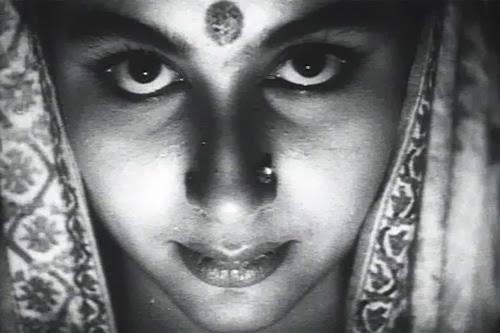
Review #700: 'Devi' (1960)

In 1860's Bengal, wealthy, powerful, yet mentally fragile landowner Kalikinkar (Chhabi Biswas) dreams that his daughter-in-law Doyamoyee (Sharmila Tagore) is the avatar of the Goddess of destruction, Kali. He falls to his knees in front of her, claiming that she embodies the living spirit of the much-feared deity. When his son Umaprasad (Soumitra Chatterjee) returns from Calcutta after his school exams, he is horrified to see that his wife is being worshipped by floods of people that have travelled to pray. He is unable to convince his father of his folly, and Kalikinkar's influence eventually manages to convince Doya herself.

Bengali director Satyajit Ray's sterling film shows the danger of idol worship, and how easy this influence can spread to people in need of escapism. When a dying child is brought to her, the small boy miraculously awakens apparently healed, convincing everyone apart from her husband and the women of the household of Doya's power. The women remain unconvinced, but as Kalikinkar is head of the household, they have no choice but to worship, exposing Indian's heavily matriarchal society, and women's role as the 'Mother'. Kalikinkar refers to Doya as 'mother' before his dream, and a beautiful song is heard from outside, singing of adoration for the mother.

The standout scene of Devi (meaning 'The Goddess') captures Umaprasad's utter horror at the sight of Doya, fitted out like a deity and confused at the new role flung upon her. There is little to no dialogue in the scene, but Ray understands the power of silence in film. As Doya, Tagore is so beautiful that you could almost mistake her for a goddess, and she carries her performance (at aged just 14 at time of filming) with remarkable maturity. As Umaprasad enters the room and sees her for the first time, they converse with their eyes, and Doya gives a simple and subtle shake of the head. With fundamentalism so commonplace amongst most religions these days, Devi is perhaps more relevant than ever, and with that heartbreaking and memorable final shot, still as powerful as it ever was.


Directed by: Satyajit Ray
Starring: Sharmila Tagore, Soumitra Chatterjee, Chhabi Biswas
Country: India

Rating: ****

Tom Gillespie


The Goddess (1960) on IMDb

Friday, 2 August 2013

Review #642: 'The Fall of the House of Usher' (1960)

Up until 1960, Roger Corman's American International Pictures (AIP) were making low-grade movies, mainly in the science-fiction and horror genre, but also branched out into JD and teen rebellion movies. They were making profit but little of it, mainly due to the rise in household televisions, and when people went to the movies they wanted to see a big budget and big stars, not square-jawed block heads and men in rubber suits. So, trusting Corman's abilities as a director, AIP coughed up the dough, brought in real film stars, and created what is widely believed to be their finest film, The Fall of the House of Usher, loosely based on the short story by Edgar Allen Poe, and what was the beginning of the Corman-Poe cycle of movies.

Philip Winthrop (Mark Damon) arrives at the House of Usher, a grand mansion that has fallen into decay, surrounded by murky swamps and a ghostly graveyard. He seeks his fiancée Madeline Usher (Myrna Fahey), but is instead met by her strange brother Roderick (Vincent Price). Roderick has a crippling disease that heightens his senses, meaning that a loud noise or any physical contact causes him extreme pain. Madeline, he says, has fallen deathly ill and is waiting to die, as is he. They will die along with the house, which is close to collapse. Philip is not convinced, and vows to stay until Madeline leaves with him, but Roderick is adamant that she will stay, and put an end to a cursed bloodline that has bred for centuries.

This has little similarity to the atmosphere of Poe's short story, and screenwriter Richard Matheson naturally takes creative liberties with the text. Poe's story is surrounded by mystery and metaphors on the human psyche, whereas Corman gives us less to imagine or ponder, and creates something that feels more like a traditional haunted house story. But this is not a criticism, as Corman had few pages of text to work with and so naturally expanded the story to fit the movie screen, and the film is absolutely beautiful. Bringing in cinematographer Floyd Crosby, who won an Oscar for his work on F.W. Murnau's Tabu (1931) and did extraordinary work on High Noon (1952), the camerawork creates a sense of claustrophobia. There is also a standout scene that uses colour saturation to create what feels like another level of reality, as the Usher spirits gather in the basement.

And, of course, it has Vincent Price, here without his moustache and almost peroxide blonde hair that evokes an albino, giving a performance of effortless creepiness. The man was simply born to do horror - his voice, appearance and undeniable presence is perfectly suited to the genre. His character is interesting - he is undoubtedly mad, crippled by a strange disease and a sense of guilt for his family's blood-stained legacy, but has arguably good intentions. It's the subtlety of his performance that makes it so effective, as is the subtlety of the movie as a whole. It doesn't need a monster or a vengeful ghost, or even a 'bad guy' at all, as it's the house that looms over them all. This is a fine film, efficiently polished and tightly directed by Roger Corman, who you would swear had been directing A-grade features for years before this.


Directed by: Roger Corman
Starring: Vincent Price, Mark Damon, Myrna Fahey, Harry Ellerbe
Country: USA

Rating: ****

Tom Gillespie


House of Usher (1960) on IMDb

Wednesday, 8 May 2013

Review #611: 'Black Sunday' (1960)

Loosely based on Nikolai Gogol's short story Viy, Mario Bava's first credited feature has become renown over the years for it's mixture of cinematographic beauty and bloody horror. Bava would go on to have an impressive career in the horror and peplum genres after receiving international recognition for Black Sunday, as well as catapulting lead actress Barbara Steele to stardom and helping her gain her reputation as the 'queen of horror'. The film begins with vampire witch Asa (Steele) being killed by her brother, who sledgehammers an iron mask with spikes on the inside onto her face. A couple of centuries later, Dr. Kruvajan (Andrea Checchi) and his assistant Dr. Gorobec (John Richardson) are on route to a medical conference when they stumble across the coffin of Asa. They accidentally awaken her when Kruvajan cuts himself and lets the blood drop into her mouth, allowing Asa to seek revenge on the descendants of those that wronged her.

Above all else this is a master-stroke of technical wizardry, encompassing the gothic beauty of the Universal horrors, and adding the blood-letting and sexual undertones of Hammer. Black Sunday is certainly more gory that any of Hammer's efforts (the sledgehammer opening is still quite wince-inducing), but by today's torture-porn standards, it's very mild. It is easy to why audiences were terrified by this film back in 1960, as although the film is by no means scary, the intensity of the atmosphere, brought on by the wonderful sets and camerawork, is successful in transporting you somewhere else entirely. You will accept the hokey plot and unexplained supernatural themes (is she a vampire, a witch or an undead entity?), and accept this as something much more - a work of art.

It's a setting seen a thousand times before - in literature as well as film. This is a world of midnight carriage rides through the woods, twisted trees with outstretched branches, creeping fog engulfing tombstones, old, tattered cobwebs, and old paintings coming to life. I would go as far as saying that Black Sunday is the only film from its era that succeeded in sucking out any elements of camp from this sort of setting, and creating a genuinely unsettling atmosphere. Bava achieves this by puncturing the film with sudden bursts of graphic violence, such as a steak through the head, that catches you off guard, and mixing this with the obvious sexual connotations, it becomes something far more sinister. Having influenced generations of film-makers with its innovations in sound and lighting, Black Sunday should be seen by all horror fans, and, in my opinion, deserves to be respected far more than it already is.


Directed by: Mario Bava
Starring: Barbara Steele, John Richardson, Andrea Checchi
Country: Italy

Rating: *****

Tom Gillespie


Black Sunday (1960) on IMDb

Tuesday, 3 April 2012

Review #370: 'Never Take Sweets from a Stranger' (1960)

Long before the likes of the Daily Mail newspaper incensed the British parental population, and indelibly creating an irrational fear, and the idea that there are paedophiles on every street corner, this subject was rarely tackled. Previously, Fritz Lang's excellent M (1931) gave Peter Lorre's child murderer a sinister screen presence, but in terms of directly commenting upon this sexual perversion, it wasn't until Cyril Frankel directed this little known gem of the Hammer studios. With none of the scaremongering tactics that would probably infect a film of this subject these days, this project - whilst observing a credible story of a young girl confronting a local "lover" of children - it's main purpose seems to be to highlight the power of money and social position.

The Carter family, new to a small insular town in Canada, are told by their daughter Jean (Janina Faye) of the events of her afternoon, which involved visiting an old man, Clarence Olderberry (Felix Aylmer), who gave her and her friend, Lucile, some sweets (referred to in the film in the American terms of candy - which also lead to the change in the title for the US release). Jean also advises that Mr Olderberry got the two girls to take off their clothes. Against all the advise from the townspeople, the Carters decide that this needs to be heard in a court of law. Unfortunately for the Carter family, Mr Olderberry is the head of the most powerful family in the town. They soon discover that the transgressions of the old man are well known within the town, and due to his social standing, the concept is forgotten - brushed under the carpet so to speak.

Beautifully shot by Hammer regular Freddie Francis, the film is absolutely stunning to look at. The tensions forming within the insular town - the gossip, which essentially accuses the "outsiders" of deliberately stirring the gentle balance of the community - is palpable. This is subtle, and sometimes sinister storytelling, which highlights the corruption within communities built upon commerce and familial business - as well as an indictment of the small-town small-mindedness. Never Take Sweets from a Stranger could be one of the finest examples of the Hammer studios output, demonstrating that they were not all about the traditional Gothic settings. A true and tragically forgotten piece of British cinema.


Directed by: Cyril Frankel
Starring: Gwen Watford, Patrick Allen, Felix Aylmer
Country: UK

Rating: ****

Marc Ivamy


Never Take Sweets from a Stranger (1960) on IMDb

Monday, 10 October 2011

Review #242: 'L'Avventura' (1960)

Three wealthy socialites, Anna (Lea Massari), her boyfriend Sandro (Gabriele Ferzetti), and their beautiful friend Claudia (Monica Vitti), take a boat trip to Lisca Bianca, a volcanic island off the coast of Sicily. Anna and Sandro are unhappy, and following an argument, Sandro wakes up from a nap to find Anna missing. After a frantic search, the group leaves the island, and Sandro and Claudia begin a guilty love affair. They carry on the search for Anna, but as the film goes on, she is gradually forgotten and the two indulge their desires.

Michelangelo Antonioni makes slow films. He is more concerned with setting a tone, and creating the world that his characters inhabit. This is evident in the two films of his I've seen, Blowup (1966), probably his most popular film, and The Passenger (1975), a film I consider to be one of the best, if not the best, film of the 1970's. L'Avventura is no different, and Antonioni takes his time showing the morally corrupt and emotionally shallow world these upper class characters seemingly float through. The pace allows time for the central mystery of Anna's disappearance to slowly leave our mind, as Sandro and Claudia's love affair comes to the fore. They are initially full of guilt, but it becomes clear that these characters will have what they want.

Released at the same time as Fellini's hugely successful La Dolce Vita (1960), the two films tackle similar subjects. The life of the rich and care-free are apparently soulless adventures in partying where the consequences of actions are irrelevant. While La Dolce Vita was an excellent film, L'Avventura shows ultimately the darker side of this society, and it's impact greater. The characters in La Dolce Vita look like they're having fun, but in this, they drift through their lives like ghosts. These are horrible people, entirely lacking in emotion or any true feeling, apart from disconnection and isolation.

The cinematography is jaw-droppingly beautiful, with nothing left out of focus. Every frame has a crisp and polished look to it, as if Antonioni is asking us to look at what else is happening, what else is lying beneath the surface. It was booed at Cannes, but went on to win the Jury Prize, and has since then gone on to be recognised as one of the greats of world cinema. I must admit the slow plotting did sometimes hamper my enjoyment of the film, but L'Avventura leaves its mark and it's beauty becomes apparent after the credits have rolled.


Directed by: Michelangelo Antonioni
Starring: Gabriele Ferzetti, Monica Vitti, Lea Massari
Country: Italy/France

Rating: *****

Tom Gillespie


L'avventura (1960) on IMDb

Monday, 26 September 2011

Review #226: 'The Naked Island' (1960)

On a tiny island in the Seto Inland Sea, a small family consisting of husband, wife, and two sons, struggle to get by. They are the island's sole inhabitants, and spend their days fetching water from the mainland and carrying up the steep hill in order to water their crops. One day when the mother and father are away from the island, one of the sons falls ill, and the father races to get help. Their lives are all portrayed in painstaking detail, and the film contains no dialogue whatsoever. The film is directed by Kaneto Shindo, who directed the two brilliant Japanese New Wave horror films, Kuroneko (1968) and Onibaba (1964), the only two other films of his I've seen.

This is a break in style and subject that I'm used to from Shindo. The two aforementioned horror films were similarly slow and detailed, but The Naked Island contains no action or atmosphere, but certainly shares their beauty. This is a film that shows how far humanity can be pushed in order to merely get by. The climax of the film (and I don't feel I'm ruining anything by revealing it, the story is not important) has their ill son dying, as his father and the doctor arrive too late. After the funeral, they are forced back to work. The mother, needing to grieve, throws down the water and screams into the ground, as the father watches helpless. Afterwards, she gets up, and methodically resumes watering.

Shindo tackles a universal subject with the neglect of the working class. Filmed with no dialogue, it emphasises their facial expressions and body movements in a way the silent era did, and forces the audience to live through the work they do, every step at a time. The director said he wanted to "capture the life of human beings struggling like ants against the forces of nature," and he certainly does that. The film is slow, and focuses a lot of time on the struggle of carrying the water up the hillside. Yet it's filmed with such elegance, it only hammers their struggle home. This is a beautiful and moving film, that is almost brutal in its relentlessness.


Directed by: Kaneto Shindô
Starring: Nobuko Otawa, Taiji Tonoyama, Shinji Tanaka
Country: Japan

Rating: ****

Tom Gillespie


The Naked Island (1960) on IMDb

Tuesday, 17 May 2011

Review #69: 'The Little Shop of Horrors' (1960)

Shot in just two days by B-movie maestro Roger Corman, this micro-budget horror-comedy tells the story of a florist's assistant who cross-breeds a plant that turns out to be a man-eater. With his business struggling and his idiotic assistant Seymour (Jonathan Haze) causing more trouble than good, Gravis Mushnik (Mel Welles) doesn't know where to turn. But as Seymour's oddity grows bigger by the day, it starts to attract the crowds. The only problem is, the bigger it gets, the more food it needs, and available human flesh isn't that easy to come by. If this wasn't hard enough, Seymour also has to romance the dippy Audrey (Jackie Joseph), and take care of his hypochondriac mother who thinks a bowl of baby oil makes a good meal.

The fact that it was shot in two days using the leftover sets of a previous production is quite amazing, even though the film isn't exactly of high quality. The problem is that it really shows. The lack of time didn't exactly open up opportunities for anything other than mundane camerawork and shaky sets. The main setting, the florists, basically has two cameras pointing to the centre from different sides, and the whole feels like a sitcom rather than a feature. Of course, this is Roger Corman, and things like that don't really matter in his films. They are about entertainment and shameless exploitation, and the film is both.

What surprised me the most about the film is how genuinely funny it is. What lacks in visual flair is made up for in the script, which is fast-paced, quirky and every now and then a little bit clever. It reminded me of the comedies of the Marx Brothers (of course, nowhere near the quality), where the characters would zip back and forth between jokes and innuendos. The comedy has a definite Jewish feel to it, similar to that of Woody Allen (again, nowhere near the quality).

The film is also outright bizarre and inventive. An early role for Jack Nicholson sees him play a creepy and over-excited sadomasochist who pays a visit to the dentist, looking to have his teeth torn from their roots. It's the role that Bill Murray would play to hilarious effect in the musical remake starring Rick Moranis. It will hardly appease gore-hounds as there is next to none and the effects are pretty bad and very silly. But this is more comedy than horror, and it is certainly enjoyable.


Directed by: Roger Corman
Starring: Jonathan Haze, Jackie Joseph, Mel Welles, Jack Nicholson
Country: USA

Rating: ***

Tom Gillespie


The Little Shop of Horrors (1960) on IMDb

LinkWithin

Related Posts Plugin for WordPress, Blogger...