Showing posts with label Comedy. Show all posts

Thursday, 16 May 2019

Review #1,480: 'Fighting with My Family' (2019)

Wrestling movies don't come along very often, at least not those that take the sport seriously. Perhaps the idea of adults dressing up in ridiculously skimpy costumes and acting out a pre-choreographed fight is theatrical enough already, so a leap to the big screen would be ultimately redundant, or maybe the sport is simply too niche to guarantee a healthy return on a studios investment. But ever since The Wrestler put Mickey Rourke through the ringer, there has been a newfound respect for wrestling and the athletes who push their bodies to the very limit, particularly from those who have never sat down to watch a WWE event in their lives. Fighting with My Family continues this trend, loosely retelling the story of Saraya-Jade Bevis , aka Paige, who emerged from a working-class wrestling family in Norwich, England to become a WWE champion.

The film begins in 2002, with wrestling-mad 10 year-old Zak Knight getting pumped for the start of a WWF pay-per-view event before his younger sister Saraya turns over the channel to watch her favourite show, Charmed. Fast-forward a decade, and the two siblings have embraced their parents' passion for wrestling and have adopted ring names of their own. Zak (Jack Lowden) has become 'Zodiac Zak' and Saraya (Florence Pugh) is now 'Britani Knight', and they perform regularly at their wrestling club. The dream of dad Ricky (Nick Frost) and mum Julia (Lena Headey) is for their kids to make the transition to the big leagues, and tapes are regularly sent off to promoters in the hope of catching their eye. They finally receive a call from WWE trainer Hutch Morgan (Vince Vaughn) and receive an invitation for try-outs, but after a gruelling audition, only Saraya, now using the stage name Paige, is selected.

As Zak is sent into a spiral of anger and depression, Paige struggles to work out who she is in Florida's sun-drenched world of golden-skinned models. Somewhat an outsider even back home (outside of the close-knit wrestling community), she feels isolated, mentally unprepared for the rigorous workout schedules and the standards required for the big-time. Fighting with My Family often flirts with cliche, but this is a sports movie after all. It works by developing characters we can relate to and truly root for, regardless of how ridiculous you may find the whole wrestling craze. This is down to the combined efforts of writer/director Stephen Merchant, who seems like the unlikeliest candidate to helm a wrestling picture, and the cast, who are all entirely believable.

Pugh in particular finds the right balance of inner vulnerability and the outer toughness Hutch no doubt signed her up for, and Merchant helps bring out these traits with the right balance of comedy, drama and sentiment. Frost is also perfectly cast, showing once again that he's a terrific actor in his own right and not just Simon Pegg's sidekick. For wrestling fans, there are plenty of cameos to spot, with Dwayne 'The Rock' Johnson showing up for an extended cameo that may feel like a gimmick until you learn of his role in Paige's real-life story. Above all, Fighting with My Family is a heartfelt tale that celebrates embracing the inner weirdo and the sport that welcomes such misfits with open arms - if you're tough enough.


Directed by: Stephen Merchant
Starring: Florence Pugh, Jack Lowden, Lena Headey, Nick Frost, Vince Vaughn, Dwayne Johnson
Country: UK/USA

Rating: ****

Tom Gillespie


Fighting with My Family (2019) on IMDb

Saturday, 4 May 2019

Review #1,475: 'The Lego Movie 2: The Second Part' (2019)

Before Phil Lord and Christopher Miller surprised everybody with one of the best films of 2014, the idea of a movie based on a toy line seemed like a rather hopeless idea. Yes, the building blocks and miniature figures of Lego have been adored by both children and adults alike for decades, but they are still produced by a company whose main focus is naturally on your wallets. It felt inevitable that The Lego Movie would be a soulless feature-length advertisement, but not only did it feature some of the most eye-popping CG animation in recent memory (which also felt hand-crafted), it also melted our hearts by taking the action into the real world, where we discover that events are being conjured by the imagination of a young boy. His father, an avid collector played by Will Ferrell, had forgotten the true meaning of playtime. Lego, after all, is about whatever you want it to be.

The Lego Movie wasn't just great, it was awesome. It was also unfairly snubbed by the Academy, but with a worldwide box-office gross of just shy of $500 million, Lord and Miller's film was a huge hit and seemingly the beginning of a lucrative new big-screen franchise. The Lego Batman Movie was next, successfully capitalising on the appeal of Will Arnett's supporting character and opening up Lego's own DC universe. The juggernaut started to creak and show signs of fatigue with The Lego Ninjago Movie however, which arrived the same year as Batman, so the brand was allowed a bit of time to breathe before its next instalment. The big question is does The Lego Movie 2: The Second Part steer this yellow-tinged universe back on course, or has it burnt itself out? The good news is that this sequel is far more the former than the latter, but despite the skills of Lord and Miller on the screenplay (Mike Mitchell has moved in to direct), it does suffer slightly from sequelitis.

The end of The Lego Movie saw the arrival of the real-world family's young girl on the playing field, and with her comes unicorns and Duplo, both unwelcome arrivals in the world built up by the young boy. As a result, Bricksburg has become Apocalypseburg, a Mad Max-esque wasteland turned to dust by the invading Duplo aliens. While Wyldstyle/Lucy (Elizabeth Banks) finds the wastelands a perfect place in which to brood and gaze seriously into the distance, Emmet (Chris Pratt) maintains an upbeat attitude, enthusiastically purchasing his morning coffees and listening to remixes of his favourite song, Everything Is Awesome. Despite being plagued by visions of Armageddon, Emmet builds Lucy their dream home, but their attempts to live a normal life are scuppered by the arrival of intergalactic traveller Sweet Mayhem (Stephanie Beatriz), a mini-doll from the 'Systar System' who has come to take the strongest leader away to marry Queen Watevra Wa'Nabi (Tiffany Haddish). Naturally, that leader is Batman, and he along with Lucy, Benny (Charlie Day), MetalBeard (Nick Offerman) and Unikitty (Alison Brie), find themselves kidnapped and taken to another galaxy.

The premise sounds fun and that's precisely what it is. It maintains the madcap energy of the first film and brings back memorable characters, throwing in more meta-jokes and visual gags than you can shake a stick at. But The Lego Movie was fun and so much more, and Lord and Miller really set the bar high for any future sequels. The Second Part keeps the family thread going, this time with Mom (Maya Rudolph) trying to keep the peace between older son and younger daughter, but doesn't bring anything new to the table. One of the funnest aspects of the original was tying to keep up the amount of characters from both pop culture and real life showing their faces, but the supporting cast seems much thinner this time around. There's a joke about Marvel not returning the calls, and in fact no characters from the world of Disney show their faces. More focus could have been given to other DC figures who show up, particularly Channing Tatum's Superman and Jonah Hill's Green Lantern, who both seem to be having a great time behind the microphone. It's still a rollicking ride, and it only seems like a slight let-down because, somehow, we have come to expect something special from these Lego romps. The film boasts a new catchy song called, um, Catchy Song, which warns 'This song's gonna get stuck inside your head." And in your head it will certainly remain, but the rest of the movie sadly won't.


Directed by: Mike Mitchell
Voices: Chris Pratt, Elizabeth Banks, Will ArnettTiffany Haddish, Stephanie Beatriz, Maya Rudolph
Country: Denmark/Norway/Australia/USA

Rating: ***

Tom Gillespie


The Lego Movie 2: The Second Part (2019) on IMDb

Tuesday, 30 April 2019

Review #1,473: 'Monsters vs. Aliens' (2009)

When it comes to big-screen animation, it's pretty widely accepted that Pixar frequently mines critical and commercial gold whilst their biggest rival, Dreamworks Animation, provides the fluff. Pixar certainly possess the largest awards cabinet, but Dreamworks know how to attract an audience, with the likes of Shrek, MadagascarKung Fu Panda and How to Train Your Dragon all developing into successful franchises with memorable characters. With the market now aggressively over-saturated with animated efforts for the whole family, a few of their titles have flown under the radar, and sometimes unfairly. 2009's Monsters vs. Aliens is one such example: a fun, funny and heartfelt throwback to 50's B-movies that spawned some spin-off shorts, but wasn't successful enough to warrant a sequel.

In California, Susan Murphy (Reese Witherspoon) is waiting to marry her vain TV weatherman fiance Derek (Paul Rudd), who has just announced the news of a job offer in another state. Before the wedding ceremony kicks off however, a huge asteroid crashes down on top of Susan. and although she appears unaffected at first, the mysterious energy given off by the rock causes her to grow to enormous size. With her head now peaking through the roof and the guests running for their lives, the military are quick on the scene, capturing Susan and taker her to a secret government facility ran by General W.R. Monger (Kiefer Sutherland), who has been hoarding a collection of strange monsters for decades.

There she meets fellow captives B.O.B. (Seth Rogen), a boneless blob of blue goo; Dr. Cockroach Ph.D. (Hugh Laurie), a genius half-man, half-insect; The Missing Link (Will Arnett), a hybrid of sea creature and ape, and Insectosaurus, a gargantuan mutated bug. Their futures look increasingly bleak, but when alien Gallaxhar (Rainn Wilson) arrives on Earth in search of the crashed meteorite, US President Hathaway (Stephen Colbert), gives Monger the go-ahead to put his freaky prisoners to the test and straight into battle with the intergalactic invader.

B-movie fans will spot the homages immediately, and there's enough of a modern twist to the rag-tag gang of 'monsters' to delight any children watching. The references are obvious: there's Attack of the 50 Foot Woman, The Blob, The Fly, Creature from the Black Lagoon and Mothra, but the characters are so lovingly crafted and terrifically voiced by a talented cast that they feel more love letter than straight rip-off. Although there are a few laugh-out-loud moments, Rob Letterman and Conrad Vernon's film, working from a script by no less than five writers, fails to be consistently funny, and the arrival of Gallaxhar is a one-note plot device designed to bring everybody together. But there are some exciting set-pieces, particularly whenever the weirdly adorable Insectosaurus is involved, and there is enough heart woven into its fabric to make Monsters vs. Aliens one of Dreamworks' most underappreciated animations.


Directed by: Rob Letterman, Conrad Vernon
Voices: Reese Witherspoon, Seth Rogen, Hugh Laurie, Will Arnett, Kiefer Sutherland, Rainn Wilson, Stephen Colbert, Paul Rudd
Country: USA

Rating: ***

Tom Gillespie


Monsters vs. Aliens (2009) on IMDb

Wednesday, 24 April 2019

Review #1,471: 'The Sisters Brothers' (2018)

French filmmaker Jacques Audiard has made a name for himself by focusing on morally-conflicted lead characters surviving any way they can in an environment they have no real control over. Whether it be the brutal prison setting of A Prophet, the street brawls of Rust and Bone, or the Sri Lanka torn apart by civil war in Dheepan, Audiard seems most at home when tossing his lead character in the deep end and observing as the survival instincts inevitably kick in. There is perhaps no greater time and place to explore humanity at its most savage and uncivilised as the Wild West, so Audiard feels right at home among the shootouts, saloon fights and general lawlessness of his latest film, the curiously-titled The Sisters Brothers.

Based on the novel by Patrick deWitt, The Sisters Brothers follows the titular siblings Eli (John C. Reilly) and Charlie (Joaquin Phoenix), two apparent opposites who seem to tolerate each other for their shared bloodline only. While their overall outlook on life couldn't be further apart, one skill the pair undoubtedly share is a knack for killing, and their exploits have granted them an almost mythical status throughout the land. They are hired killers in the employment of a shady businessman known only as the Commodore (Rutger Hauer), and their latest job is to track down and kill chemist Hermann Kermit Warm (Riz Ahmed), who has supposedly stolen from the old man. Their journey takes them from Jacksonville to San Francisco, but the mission is plagued by misfortune. Encountering everything from bear attacks to venomous spiders to rival hired hands, these mishaps allow plenty of time for the brothers to reflect on their life choices and their future, if they are ever to make it out alive.

As the elder of the brothers, Reilly's Eli hopes to eventually settle down and walk away from a life where death seems to await them at every turn. The drunken, unpredictable Charlie believes their lives couldn't get any better, and cannot imagine a world where his brother is not at his side. Little by little their backstories are revealed, and although he shares his younger sibling's flair for murder, it becomes clear that Eli's life would have turned out quite differently if he wasn't forced to pick up the pieces left in the wake of Charlie's destructive nature. The two actors are so good together that the film slows down when the action moves away from them, and more time is spent developing the relationship between Warm and softly-spoken private detective John Morris (Jake Gyllenhaal). Morris is actually working with the Sisters, but has a change of heart when Warm reveals his water-based formula that will potentially turn the tide for gold prospecting.

While these little detours slightly derail the film's pace, they prove intriguing enough in their own right. Despite the brutality of their surroundings and the natural hostility of the unexplored frontier, Warm and Morris are tidier, more articulate, and completely at odds with the survivalist nature of the anti-heroes of the title. They hint at a changing world, and the way the Old West is imagined by cinematographer Benoit Debie - shot in Spain - would be more at home with the auteur-driven revisionist westerns of the 1970s, but not so different to cause traditionalists to scoff. The key ingredients are all there: bursts of violence, whiskey-drenched brothel visits, and a long, perilous journey across country; but there is a sensitive, character-driven drama at its core. It was billed as a comedy of sorts upon its release, and although there are certainly laugh-out-loud moments, they serve only to reinforce the humanity lurking within its murky characters.


Directed by: Jacques Audiard
Starring: John C. Reilly, Joaquin Phoenix, Jake Gyllenhaal, Riz Ahmed, Rebecca Root, Rutger Hauer
Country: France/Spain/Romania/Belgium/USA

Rating: ****

Tom Gillespie


The Sisters Brothers (2018) on IMDb

Monday, 15 April 2019

Review #1,469: 'How to Train Your Dragon: The Hidden World' (2019)

Loosely based on the series of books by Cressida Cowell, the How to Train Your Dragon series has grown to become the jewel in the somewhat small and dusty crown of Dreamworks Animation. With Pixar killing it near enough year in, year out, the adventures of reluctant Viking leader Hiccup (Jay Baruchel) and his trusted Night Fury pal are the closest thing that Dreamworks have ever come to the quality and visual splendour of its most fearsome rivals. If you've kept up with the series since its debut in 2010, you'll have watched Hiccup grow out of his father's shadow into a battle-scarred warrior and forward-thinking frontiersman, who brought a close to his tribe's never-ending war with the dragons to discover the fire-breathing beasts actually make for useful and loving friends. The second instalment veered into incredibly dark territory, signalling a maturing tone that matched the protagonist's transformation from nervous kid to an innovator destined to change the lives of his people forever.

The third and presumably final entry into the series, The Hidden World, doesn't darken the tone further - it is still a kids' film after all - but you get the sense from very early on that we are heading inevitably towards an emotional parting of ways. Hiccup and his friends continue their quest to rescue captive dragons and bring them back to the village of Berk to live in harmony with humans. The problem is that they've become so good at their search-and-rescue missions that their home is now overcrowded with the lumbering beasts. Hiccup believes their only hope lies in 'the hidden world, a mysterious and possibly make-believe haven at the edge of the world spoken of by his late father Stoick (Gerard Butler). But cracks start to appear in the young chieftan's plans when his dragon and best friend Toothless happens across a Light Fury, the female of his species. Wild and distrusting of humans, the female bolts from Toothless' advances any time Hiccup shows his face to help, and it becomes clear that if he is ever to see his best bud happy, he must also let his dragon run free.

As ever, there's a dragon-hating antagonist to jeopardise Hiccup's plans in the form of renowned hunter Grimmel the Grisly (F. Murray Abraham), whose own mind-controlled dragons have the ability to vomit acid and melt pretty much anything in their wake. He certainly looks and sounds cool, but Grimmel shares much of the same motivation as the bad guys that come before him, and the character really symbolises the film's overall reluctance to dig that little bit deeper. For me, How to Train Your Dragon 2 really stepped up the game for this franchise, but it feels like returning director Dean DeBlois is happy to ease off the accelerator and ride this trilogy-closer out. If this were practically any other series, The Hidden World would be a delightful surprise, offering up great moments like the opening night-time raid and the sight of Toothless clumsily attempting win over his potential mate, the latter proving to be one of the most charming and heart-warming scenes of the entire trilogy. But with the knowledge of how great this could have been, The Hidden World is a disappointment, fizzling out with an ending that undoubtedly satisfies, but when compared to the emotional wallop of, say, Toy Story 3, plays it rather safe.


Directed by: Dean DeBlois
Voices: Jay Baruchel, America Ferrera, F. Murray Abraham, Cate Blanchett, Gerard Butler, Craig Ferguson, Jonah Hill, Christopher Mintz-Plasse
Country: USA

Rating: ***

Tom Gillespie


How to Train Your Dragon: The Hidden World (2019) on IMDb

Wednesday, 10 April 2019

Review #1,468: 'Dead Snow' (2009)

When it comes to B-movie hooks, they don't come any more mouth-watering than the promise of a horde of Nazi zombies stalking a group of horny, dim-witted teenagers. The set-up mirrors that of countless slasher and zombie movies, and writer/director Tommy Wirkola is more than happy than roll with the genre tropes. Wirkola even places a chubby film buff amongst the crowd of soon-to-be Nazi chow so he can throw in a few nods and winks to an already knowing audience as they trudge through the Norwegian snow to the cabin in the woods that awaits them. But even he is too dim to recognise the obvious danger that waits in store for them, and just like the movies Dead Snow is paying homage to, you wait with eagerness for their inevitable and gory demise. Fans of classic horrors The Evil Dead and Dawn of the Dead will lap it up, but Dead Snow takes far too long to find its stride. But by the end, those lucky enough to remain breathing finally pluck up the courage to fight back with the few tools at their disposal, and the barrage of blood, guts and Nazi corpses is just enough to make it worth the wait.

The film opens with a terrified young woman being chased through the snow by a group of bloodthirsty zombies dressed in SS uniforms. The woman, who is revealed to be Sara (Ane Dahl Torp), was due to meet up with her medical student friends for a weekend of tobogganing, snow-fights and potential casual sex. Luckily for them, Sarah's friends have decided to travel separately. After an exhausting hike through the mountains, the gang finally arrive at the cabin and immediately start drinking. Although Sara's no-show plays on some of their minds, a party is thrown, and all seems fine and dandy until a mysterious traveller (Bjorn Sundquist) arrives with a history lesson guaranteed to kill their buzz. Decades ago, near the end of World War II, a band of SS officers fled the advancing Russian army and met their end in the unforgiving snowy mountains. Ever since, whispers have been heard of an undead Nazi army roaming the area, killing and eating anyone that stands in their way. They are searching for treasure stolen during the war, and the prize chest just happens to be stored underneath the cabin. Soon enough, one by one, the hapless students start to disappear.

For the bulk of its running time, Dead Snow covers very familiar terrain, paying tribute to everything from Friday the 13th to The Evil Dead, as well as more recent efforts, such as Scream, which also leaned into genre cliches and employed them as a narrative tool. Dead Snow isn't as clever nor anywhere near as accomplished as those that inspired it, and spends way too much time moving the pieces into place and establishing relationships you'll have forgotten before the credits have rolled. But when Wirkola finally loosens his top button and starts to unleash the carnage, it doesn't fail to disappoint. There's something oddly beautiful about the sight of blood splashed across snow, and Dead Snow has plenty of both. The luscious, tranquil setting is truly glorious to behold, but don't let the beauty fool you, this is a world of deadly avalanches and fascist zombies. Just like in space, nobody can hear you scream in the Oksfjord wilderness, and it may just set off a landslide that will leave you buried beneath six feet of snow. The movie's top tip: before you start to try and dig your way out, be sure to spit so you know which way is up. Dead Snow may not fully grasp the potential of the idea of Nazi brain-munchers hunting their prey, but by the time the hammers and chainsaws are broken out, you'll feel a pleasant wave of satisfaction.


Directed by: Tommy Wirkola
Starring: Vegar Hoel, Stig Frode Henriksen, Charlotte Frogner, Lasse Valdal, Evy Kasseth Røsten
Country: Norway

Rating: ***

Tom Gillespie


Dead Snow (2009) on IMDb

Wednesday, 3 April 2019

Review #1,466: 'Mary Poppins Returns' (2018)

With many studios these days greenlighting reboots, spin-offs and remakes, it's actually quite refreshing to get a good old-fashioned sequel to a beloved classic. It worked for Blade Runner, and - somewhat surprisingly - it also works for Mary Poppins. A sequel to Robert Stevenson's 1964 family classic has been stuck in development hell for decades, with original author P. L. Travers proving notoriously difficult to work with. She despised what Walt Disney had done to her work, although she admired certain aspects, so while she was still alive, a follow-up would only see the light of the day on her own very strict terms. We almost saw the return of the nanny who is practically perfect in every way in the 1980s, with a screenplay by Travers and her friend Brian Sibley, but Julie Andrews' reluctance to return meant the film quickly fell apart. Some 55 years later, Poppins finally returns in the form of Emily Blunt, and there is plenty to enjoy for both adults who adored the original growing up and children new to this unique world.

It's 1930, and siblings Michael (Ben Whishaw) and Jane Banks (Emily Mortimer) are all grown up. They remember the nanny who raised them but believe the magic she displayed was all part of their youthful imaginations. Michael is now a widowed banker and takes after his father, while Jane mirrors her mother in that she is ever the optimist. Still living at Cherry Tree Lane and forced to raise his three children - Annabel (Pixie Davies), John (Nathanael Saleh) and Georgie (Joel Dawson) - on his own, things aren't going well for Michael. With grief consuming him, the bills have gone unpaid, and the bank, headed by new chairman William Wilkins (Colin Firth), have served a notice threatening to repossess the house if the loan isn't paid back in full. Spirits are lifted by the re-appearance of Mary Poppins, who offers to look after the children while the adults get their affairs in order. With the help of cheery Cockney lamplighter Jack (Lin-Manuel Miranda), Annabel, John and Georgie are whisked off into a world of musical numbers and talking cartoon animals, and learn that when you think you've reached the bottom, the only way is up.

There's not much going on in terms of plot in Mary Poppins Returns, but things weren't much different last time around. Director Rob Marshall and writer David Magee are far more concerned with pulling you into a fantastical world of catchy songs, breathtaking dance numbers, and lovingly rendered hand-drawn animation. Tunes like 'Tip a Little Light Fantastic' and '(Underneath the) London Sky' are clearly trying to copy iconic moments from the original (with Miranda playing the Dick Van Dyke supporting role), but composer Marc Shaiman and lyricist Scott Wittman have found a way to wonderfully capture the essence of the original while adding a modern twist. Blunt, who seems to be fan-cast for just about every upcoming role, proves to be the perfect choice for Poppins. Stern but playful, strict yet mischievous, she embraces Andrews' iconic performance and adds much sparkle of her own, displaying a knack for comedy timing that went unjustly unrecognised by the Academy. She wouldn't be complete without an enthusiastic sidekick, and Miranda is on great form, speaking with an accent that fares only slightly better than Van Dyke's, but that was all part of what made the original so memorable. Mary Poppins Returns isn't quite practically perfect in every way, but as far as sequels to childhood staples go, it rarely fails to charm or tug the heartstrings.


Directed by: Rob Marshall
Starring: Emily Blunt, Lin-Manuel Miranda, Ben Whishaw, Emily Mortimer, Pixie Davies, Nathanael Saleh, Joel Dawson, Julie Walters, Meryl Streep, Colin Firth
Country: USA

Rating: ****

Tom Gillespie


Mary Poppins Returns (2018) on IMDb

Sunday, 31 March 2019

Review #1,464: 'Vice' (2018)

After spending most of his career larking around with Will Ferrell in the likes of Talladega Nights: The Ballad of Ricky BobbyStep Brothers and The Other Guys, writer/director Adam McKay took a huge leap towards 'serious' film-making in 2015 when he released The Big Short, a funny, intelligent and unexpectedly engrossing account of the 2007-2008 financial crisis. The Big Short may not sound like much fun on paper, but McKay latched onto this idea, making the tedious subject of subprime loans and triple-A ratings interesting by entwining it with pop culture, employing the likes of Margot Robbie and Selena Gomez to dumb it down for the audience in a manner that was too wickedly clever to ever be patronising. With Academy recognition now under his belt, McKay strides into his next project - a biopic of one of the most fearsome yet enigmatic political figures in U.S. history - with confidence, and dare I say it, a touch of arrogance.

McKay is eager to perform the same trick again with Vice, a sporadically inspired but frustratingly blunt quasi-biography that feels to penetrate the skin of its subject or answer the big question of just what was the driving force behind the man who turned the symbolic position of Vice President into one of great power and influence. Rather than dig deeper, McKay prefers to allow Dick Cheney's actions to speak for themselves, occasionally cutting away to a visual metaphor, such as, in the case of Cheney's key meeting with Sam Rockwell's George W. Bush, a cheetah bringing down its prey. Cheney is a man McKay clearly views as a highly functioning psychopath, tracking his journey from working under Steve Carell's Donald Rumsfeld in the Nixon Administration, to his opportunistic lunge for control in the immediate aftermath of the 9/11 attacks. He fought to grant more power to a President he easily manipulated, praying on his short attention span and lack of political know-how, and to legalise torture, finding a massive legal loophole in the shape of Guantanamo Bay.

Vice is structured like a classic coming-of-age movie, with its 'hero' rising and falling, before dusting himself off and getting to his feet to rise again. After President Ford (Bill Camp) is voted out of office, seemingly closing all political doors for Cheney, McKay rolls the credits and pans away from the Cheney household, before an abrupt phone call reminds us that this story has barely begun. Like many of the jokes in Vice, the credit-roll-fake-out is funnier in theory than execution, and the film often takes the trickery so far that it threatens to undermine the seriousness of the subject matter. Satire must be funny, but it must also carry an emotional wallop that McKay struggles to find. At the centre of it all is Christian Bale's powerhouse performance, which explores a man whose obsessiveness could be compared to that of the actor's own extreme approach to his craft. Once again Bale takes his own body to the limit, piling on the pounds to resemble a man who suffered multiple heart attacks throughout his life (it becomes a running gag in the film), and adopting a deep growl capable of subtle intimidation. The performances of Bale, Carrel and Rockwell are all worth the entry fee alone, but Vice stutters to engage on a deeper level, failing to explain just how an oil company CEO can seize control of one of the most powerful countries in the world, and execute his plans with such cold indifference.


Directed by: Adam McKay
Starring: Christian Bale, Amy Adams, Steve Carell, Sam Rockwell, Alison Pill, Eddie Marsan, Justin Kirk, Jesse Plemons, Bill Camp, Tyler Perry
Country: USA

Rating: ***

Tom Gillespie


Vice (2018) on IMDb

Friday, 22 March 2019

Review #1,462: 'Bringing Up Baby' (1938)

Considering Howard Hawks' Bringing Up Baby is now regarded as one of the finest screwball comedies of all time, it's shocking to learn that it was hailed as a flop upon its release in 1938, and received a few unfairly scathing reviews. Romantic comedies are as popular now as they ever have been, and watching Bringing Up Baby 71 years after it was made almost feels as though it could have been released last week, only in black and white and starring two of the finest actors of their, or any other, generation. Its formula and structure is now a blueprint for any filmmakers hoping to make a successful rom-com, featuring all the ingredients now so closely associated with the genre, like the meet-cute, the obstacle standing in the way of happiness, and the quirk that sets the love interest apart from everybody else. The quirk here is a pet leopard named Baby, who - despite how ridiculous it all sounds - is the glue that holds the film together.

For the past four years, goofy palaeontologist David Huxley (Cary Grant) has been searching for the final fossilised piece to finish the Brontosaurus display he has been assembling for the museum. Much to his joy, the 'intercostal clavicle' has been located and will arrive within days, but David doesn't have time to celebrate. On top of his impending marriage to the sullen Alice Swallow (Virginia Walker), there's also the matter of impressing the wealthy Elizabeth Random (May Robson) and her lawyer Alexander Peabody (George Irving), who are considering making a million-dollar donation to the museum. David's plans are interrupted when, on the day before his wedding, he meets motor-mouthed Susan Vance (Katharine Hepburn) on a golf course when she accidentally plays his ball. From then on, Susan causes David to slip on an olive, tear his dinner jacket, and generally make his life a living hell. She takes a real shine to the mild-mannered and dashing scientist, and proceeds to manipulate him into whisking her and her brother's pet leopard off to a remote farm, where she steals his clothes and accidentally unleashes another leopard into the surrounding area.

It's a ridiculous premise that would look disastrous on paper, but the combined talents of Hawks, Hepburn, Grant and writers Dudley Nichols and Hagar Wilde not only make it work, but turn it into one of funniest films of its era. Similar to Hawks' 1940 masterpiece His Girl Friday, the script moves a mile a minute, cramming in more one-liners and shrewd observations than your brain can keep up with. Of course, the script only works when the actors can bring the words to life, and there has perhaps been no finer pairing in the screwball genre than Hepburn and Grant. Grant, with his vaudeville background, is always brilliant when playing these sorts of characters, but Hepburn, who had little experience doing comedy in 1938, struts into the role with confidence and ends up walking away with the film. Watching them work their magic helped me understand why modern neo-screwball comedies don't work. The actors are simply of a different breed, hailing from a time when live shows were the ruling visual medium and learning the craft was entirely different. Hilarious and romantic in equal measures, Bringing Up Baby helped write the genre rule-book, lending real weight to the idea that they just don't make 'em like that anymore.


Directed by: Howard Hawks
Starring: Katharine Hepburn, Cary Grant, Charles Ruggles, Walter Catlett, Barry Fitzgerald, May Robson, George Irving
Country: USA

Rating: *****

Tom Gillespie


Bringing Up Baby (1938) on IMDb

Monday, 4 March 2019

Review #1,455: 'Four Rooms' (1995)

The early 1990s saw a rise in independent film-making that gave a voice to the wannabe auteurs and allowed them to handpick their own posse of preferred actors. This movement was spearheaded by the likes of Richard Linklater, Steven Soderbergh and Quentin Tarantino, and backed by disgraced scumbag Harvey Weinstein. Fresh off the huge success of Reservoir Dogs and Pulp Fiction, Quentin Tarantino was becoming a household name, and his unique brand of motor-mouthed, pop-culture-heavy dialogue and extreme violence was striking a chord with moviegoers both young and old. He took this unexpected fame and influence and used it unite a group of indie up-and-comers - Allison Anders, Alexandre Rockwell and Robert Rodruguez - for an offbeat anthology film about a young bellhop named Ted (Tim Roth) and his encounters with the various oddballs staying at his hotel.

The result was Four Rooms, and there's a reason Tarantino chooses to forget his own segment behind the camera when his trailers announce the new film as the nth of his career. It begins promisingly with a quirky animated intro that sets the goofy, unpredictable tone of the film, before diving into a collection of stories that appear to have been dreamt up in between bong hits. One thing Four Rooms has going for it is that the short films improve as we progress, but even Tarantino's final section reeks of narcissism and smugness. Anders' first story, about a coven of witches (including Ione Skye, Madonna, Alicia Witt, Lili Taylor, Sammi Davis and Valeria Golino) attempting to resurrect a goddess, may have worked for an episode of Charmed, but falls flat as the opener of what is supposed to be a collaboration between some of cinema's most exciting maverick filmmakers. Rockwell's short plonks Ted in the middle of psycho-sexual game between married couple Sigfried (David Proval) and Angela (Jennifer Beals).

The first two segments may have raised a titter if the writers didn't have such a tin ear for comedy and had a lead actor with a natural gift for over-the-top comedy. I love Tim Roth and he has had many great roles, but his twitching, shrieking Ted belongs in a cartoon. Rodriguez and Tarantino's efforts fare better because they rely less on Roth's prat-falls and more on their own self-indulgences. The performance of Antonio Banderas as a ridiculously posturing father who leaves his children under Ted's protection is a particular highlight from the third story, as the children naturally decide to make Ted's night a living Hell. Tarantino's climactic entry is full of memorable dialogue and pop culture insights, but the director, who also plays the main role, fails to inject much life into what is otherwise a plodding re-hash of his favourite episode of Alfred Hitchcock Presents. Anthology films are always hit-and-miss, but Four Rooms fails to register a single hit. What was supposed to be a triumphant coming-together of a new wave of hip filmmakers is instead a limp and uneven slog through a tide of bad comedy and even worse ideas. One of the biggest disappointments of the 90s.


Directed by: Allison Anders, Alexandre Rockwell, Robert Rodriguez, Quentin Tarantino
Starring: Tim Roth, Antonio Banderas, Valeria Golino, Madonna, Alicia Witt, Sammi Davis, Lili Taylor, Ione Skye, David Proval
Country: USA

Rating: **

Tom Gillespie


Four Rooms (1995) on IMDb

Sunday, 24 February 2019

Review #1,453: 'Ralph Breaks the Internet' (2018)

While 2012's Wreck-It Ralph is far from Pixar's most accomplished achievement, it was a fun tale of friendship and nostalgia as our two lovable heroes romped their way through a variety of games, both modern and retro. Despite the appeal of its characters, the ending hardly cried out for a sequel, but the world created by Rich Moore and his team of animators offered endless possibilities with which the story could be taken. With demand for 80's and 90's nostalgia at an all-time high, you have to wonder why a sequel took a whole six years to arrive. While one of the main appeals of Wreck-It Ralph was seeing a bunch of familiar characters from your childhood weaved into the story and placed into everyday situations, this follow-up takes Ralph and best pal Vanellope out of their pixelated comfort-zone and into a brave new world of pop-up ads and nightmarish comment sections.

Six years have also passed for arcade-game villain Ralph (John C. Reilly) and glitchy Sugar Rush racer Vanellope (Sarah Silverman), who both enjoy a routine-based life of doing their video game duty by day and knocking back root beers together at night. But while Ralph finds comfort in familiarity, Vanellope longs for something different. In an attempt to cheer up his best friend, Ralph creates a special new track in Sugar Rush, but the stunt backfires when the steering-wheel breaks in the real world and Vanellope is left without a game. However, the shiny new arrival at Litwak's Family Fun Centre and Arcade - the internet - may offer a glimmer of hope in the form of eBay, where one user has a replacement steering-wheel up for auction. So, the two friends venture into this digital metropolis of corporate logos and dead-eyed avatars to buy the part, only they don't have any money to back up their winning bid.

Of course, there's always money to be made on the internet if you know how, and with the help of Yesss (Taraji P. Henson), the algorithm at video site BuzzzTube, Ralph racks up the likes and hearts by becoming a viral sensation. Vanellope's friendship with Ralph is tested when she discovers dangerous open-world racing game Slaughter Race and finds a like-minded friend in bad-ass racer Shank (Gal Gadot). There's a message about the dangers of toxic friendships in there somewhere, but the sweet relationship developed more carefully the first time around is often drowned out by the sheer noise of this online world. There are many great ideas here, such as Alan Tudyk's KnowsMore, an search engine who is always over-eager to predict what you're going to say, and Bill Hader's J.P. Spamley, a click-bait pop-up ad who acts like a desperate, down-on-his-luck salesman. A detour into a Disney fan-site initially reeks of self-promotion, but the company sends itself up rather well, conjuring up an inspired moment involving the entire roster of Disney princesses. Ralph Breaks the Internet is fun and packed with creativity, but struggles to find its heart amidst all the eye-catching chaos.


Directed by: Phil Johnston, Rich Moore
Voices: John C. Reilly, Sarah Silverman, Gal Gadot, Taraji P. Henson, Bill Hader, Jack McBrayer, Jane Lynch, Alan Tudyk, Alfred Molina
Country: USA

Rating: ***

Tom Gillespie


Ralph Breaks the Internet (2018) on IMDb

Monday, 11 February 2019

Review #1,448: 'Crimes and Misdemeanors' (1989)

Say what you will about the rapidly decreasing quality of Woody Allen's work of late, or about the writer/director/actor's character in the wake of the recent horrific allegations made against him, but look back at his filmography and there's a wealth of brilliance to be found. As he became a household name thanks to some of the most hilarious comedies of the 1970s, Allen moved away from playing the clown and into more serious territory. The comedy was still there, but as a fan of Ingmar Bergman and Marcel Ophuls, he was always eager to explore the darkness rooted in our souls. One of his most sobering works is also one of his best. Released in 1989, Crimes and Misdemeanors asked the question posed by many a philosopher: Can you live with yourself after committing a murder or will the shame gradually eat away your soul?

The man at the centre of the story, Judah Rosenthal (Martin Landau), seems to have it all. He's a respected doctor with a loving family and a group of adoring friends, and the film opens with a lavish dinner held in his honour. On the surface, Judah is a happily married man, but he holds a dark secret. Over the past few months, he has indulged in an affair with flight attendant Dolores Paley (Anjelica Huston), enjoying short breaks away and taking long walks on the beach. Only now Dolores is threatening to reveal his secret, sending a letter to Judah's wife which he manages to intercept at the last minute, and calling from the gas station down the road with ideas of turning up at the family's door. When she refuses to listen to Judah's pleas, the doctor turns to his brother Jack (Jerry Orbach), who has connections to the mob, for help. Jack has a simple answer: He will hire someone to murder Dolores and Judah won't have to lift a finger.

While all of this is going on, struggling documentary filmmaker Cliff Stern (Allen) is thrown a gig by his brother-in-law - the obnoxious, self-obsessed sitcom writer Lester (Alan Alda) - and meets cute associate producer Halley Reed (Mia Farrow) on the job. Unhappy in his own marriage, Cliff can't help but fall in love, but Lester has her in his sights also. It took me a while to figure out why these two seemingly unconnected stories were unravelling side-by-side, but it soon becomes clear that this is a film about the absurdity of guilt. Judah and Jack had it drilled into them from a young age by their rabbi father, but now they appear to be literally getting away with murder. Cliff may want to cheat on his berating wife, but he is ultimately a 'good' guy, yet life doesn't seem to want to throw him any luck. There's also a key character in Ben (Sam Waterston), a rabbi who still maintains a lust for life despite his deteriorating eyesight. It plays like a thriller, but it's also very funny. There's a depressing theme constantly at play, but Allen ensures that the story remains insightful, engrossing and occasionally heartbreaking. One of Allen's shrewdest and most humanistic pictures to date, assisted by a flawless ensemble.


Directed by: Woody Allen
Starring: Martin Landau, Woody Allen, Mia Farrow, Alan Alda, Anjelica Huston, Sam Waterston, Joanna GleasonClaire Bloom, Jerry Orbach
Country: USA

Rating: ****

Tom Gillespie


Crimes and Misdemeanors (1989) on IMDb

Thursday, 7 February 2019

Review #1,447: 'Cinderella 2000' (1977)

The Golden Age of Porn kicked off in 1969 following the release of Andy Warhol's Blue Movie and spread across the globe from there. Pornography always consisted of a few magazines found under your father's mattress, but Warhol helped usher the form into mainstream cinemas, and soon enough even movie critics were taking them seriously. The likes of The Devil in Miss Jones and Deep Throat were huge hits on modest budgets, and aspiring filmmakers were keen to take advantage once they had a camera and a few willing participants. One of the many tricks employed by these filmmakers to draw in audiences was to adapt a well-known story that required no rights purchase or special permission, and fairytales offered a bottomless barrel of stories to plunder. Al Adamson's Cinderella 2000, which transports the action to a near-future where society is ruled over by a dictator and 'fornication' is outlawed, is one of the most famous examples of these smutty fairytales.

The beautiful young Cindy (Catharine Burgess) lives with her horny stepmother (Renee Harmon) and two stepsisters Bella (Bhurni Cowans) and Stella (Adina Ross). Because sex is strictly prohibited by order of the totalitarian government ruled by 'The Controller' (Erwin Fuller), the women have never had sex, and spend most of their time trying to seduce moutachioed guards or writhing around on the floor. Young stud Tom Prince (Vaughn Armstrong) is one of the few deemed worthy enough by the Controller to make love, but the poor horndog has grown dismayed by the lack of passion shown by his partners. After voicing his concerns, the Controller agrees to hold a grand ball to ease the public's sexual frustrations. With the help of her Fairy Godfather (Jay B. Larson), Cindy is soon suited and booted and ready for the party. Of course, she is the only one to catch Tom's eye, and the couple enjoy a night of steamy passion. But when the clock strikes midnight, Cindy dashes off back home. Desperate to find the woman who reignited the fire within him, Tom sets off on his search, and he is prepared to sleep with every woman in the country if he must.

Cinderella 2000 is a rather bizarre concoction, blending sci-fi, musical, comedy and, of course, erotica, with often psychedelic results. While I'll certainly never see the film again, the sheer weirdness of it all means that I'm not likely to forget it anytime soon. There's a robot who strictly enforces the Controller's rules while singing about his desire to 'plug' himself into the other sexy devices around him. At least that's what I think he was singing about, as his voice is so muffled his dialogue is barely comprehensible. There are also Benny Hill-esque romps under the covers and sets so wobbly even Herchell Gordon Lewis would blush. Of course, it all adds to the charm of these kinds of films, but charm is always better in hindsight. To actually sit through the film - which runs for 100 minutes - is a chore. Cinderella 2000 just about gets away with it thanks to some surprisingly catchy musical numbers, a quirky sense of humour, and a script so completely bonkers that you just have to admire the creativity.


Directed by: Al Adamson
Starring: Catharine Burgess, Jay B. Larson, Vaughn Armstrong, Erwin Fuller, Renee Harmon
Country: USA

Rating: **

Tom Gillespie


Cinderella 2000 (1977) on IMDb


Monday, 31 December 2018

Review #1,435: 'Night of the Creeps' (1986)

Fred Dekker's Night of the Creeps is only of many 80's horror movies that failed to find much of an audience upon its initial release, but has gathered a cult following over the subsequent years through scuzzy VHS tapes passed between fans and late-night showings on cable TV. It's now available on near enough every format, so you have no excuse not to check out this endearing little gem, especially if you're a fan of genre film-making and movies of the 80s in general. Dekker, who made his debut here and would go on to direct The Monster Squad and Robocop 3, is clearly a fan of horror movies and blends many of his favourite influences into the increasingly gory events. The result is a blast for fans, who'll enjoy spotting the name-drops amongst the various characters and the way it sticks closely to the rules of the genre. Yet Night of the Creeps can also feel like a bunch of your favourite movies re-arranged and plastered together to form an admittedly fun 90 minutes.

In the 1950s, an alien craft carrying slug-like creatures crashes down to Earth. At a nearby lover's lane, a boy heads out into the woods to investigate and comes across a canister, which naturally explodes in his face and unleashes the squirmy extra-terrestrials, one of which makes its way inside the unsuspecting boy orally. The girl, who is left behind in the car, meets an unfortunate demise at the hands of an escaped serial killer before a rookie cop blows the mad man away. Fast-forward to 1986, and teenager Chris Romero (Jason Lively) wants desperately to hook up with sorority girl Cynthia Cronenberg (Jill Whitlow). Backed by his best friend J.C. (Steve Marshall), the clueless twosome figure that the only way to impress Cynthia is to join a fraternity. To enter the Beta Epsilon fraternity - which is headed by Cynthia's douchebag of a boyfriend - Chris and J.C. are tasked with stealing a corpse from the nearby medical centre and placing it front of a sorority house. They break in easily enough, but what awaits them is the cryogenically frozen body of the unfortunate boy from the opening scene. Naturally, the cadaver escapes, and soon enough the town is overrun with zombies and giant slugs looking for a host.

There's a real energy and spirit to Dekker's film that is lacking from many low-budget horror movies from the same era, but what drags the movie down is a lack of any original ideas of its own. While there's fun to be had with spotting references to other (and better) films (Dick Miller even shows up for an obligatory cameo), this can often feel like a lazy way to patch up the lack of anything fresh. They also missed a trick by relegating beaten-down detective Cameron (Tom Atkins) to a supporting character. He has all the best lines and Atkins is clearly enjoying himself in the role, so you can only wonder how better the film would have been if our guide was an emotionally-scarred and wise-cracking old dog rather than a couple of sad-sack horny teenagers looking to impress a girl. That said, Night of the Creeps delivers exactly what its target audience - those still awake in the early hours - requires, and manages to round-up practically everything that is charming about low-budget 80's B-movies, even touching on the teen sex comedies made popular by the likes of Porky's. It perfectly sets itself up for a sequel before its box-office returns put a quick end to that idea, but it's never too late.


Directed by: Fred Dekker
Starring: Jason Lively, Tom Atkins, Steve Marshall, Jill Whitlow, Wally Taylor
Country: USA

Rating: ***

Tom Gillespie


Night of the Creeps (1986) on IMDb

Saturday, 29 December 2018

Review #1,434: 'The Human Centipede 3 (Final Sequence)' (2015)

When The Human Centipede was released back in 2009, it became an instant talking point with both gore-hounds giddy at the prospect of such a repugnant idea actually making its way onto our screens, and those concerned with the idea of cinema reaching the very bottom of the barrel for the last dregs of bad taste. Of course, the result was nowhere near as horrific as many had thought. While it may have featured a scene of characters passing faeces directly from bottom to mouth, the whole thing was rather amusing, if ineptly made. Director Tom Six was keen to ensure that the hype wouldn't die down for the sequel, and did so by creating one of the vilest and most humourless shockers in horror history, and undoubtedly one of worst excuses for a movie ever made. It's a relief that humour has found its way back for part three, as is the presence of the word 'final' in its title. But that's where the positives end, as this is yet another button-pushing, attention-seeking vanity-project for Six.

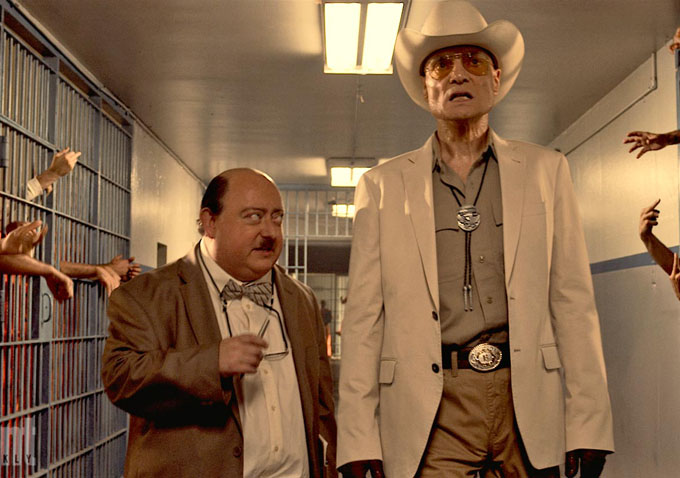
Psychopathic prison warden Bill Boss (Dieter Laser) rules over his inmates with an iron fist, punishing those that step out of line by breaking bones, removing testicles, and waterboarding with boiling water. With the violence spinning out of control, Governor Hughes (Eric Roberts) pays Boss a visit, informing the maniac that if he doesn't get a hold on things soon he will be fired and replaced. Having seen his brutal methods fail to bring the prisoners under control, Boss finally listens to his diminutive accountant Butler (Laurence R. Harvey) and his problem-solving idea. Armed with DVDs of The Human Centipede 1 and 2, Butler's scheme is to force the inmates to live out their sentences arse-to-mouth with their fellow incarcerates in one long, horrifying... well, you get the idea. With disgraced, struck-off prison doctor Jones (Clayton Rohner) on board in the hope of keeping his job, Boss and Butler even bring in Tom Six himself to discuss whether or not the director's claim of the procedure being 100% medically accurate is in fact correct.

It was admittedly an interesting move to make The Human Centipede 2 about a disturbed individual's reaction to seeing the first movie, but performing the same trick again simply reeks of narcissism, especially considering Six's decision to place himself within the narrative. While the second entry aimed to simply upset and disgust its audience with no trace of nuance, part three is all about the humour. Although rather than laughing, you'll be checking the running time to see how much you have left to endure. To Six, comedy is all about shouting, and Laser screams, rants and swears for the 100 minutes, stopping occasionally to munch on some dried clitorises imported from Africa or force his assistant Daisy (porn actress Bree Olson) to perform oral sex on him. Anyone voluntarily watching this film are here for one reason - to see the human centipede. It appears around the 85 minute mark, so there's a lot of arm-waving and general unpleasantness to get through before the big pay-off, which only appears on screen for about 5 minutes. I never thought I'd complain about the lack of poor souls being monstrously stitched together to form one grotesque digestive system, but that's The Human Centipede for you. Hopefully this series can now be laid to rest on the cinematic dung-pile.


Directed by: Tom Six
Starring: Dieter Laser, Laurence R. Harvey, Eric Roberts, Robert LaSardo, Bree Olson
Country: USA

Rating: *

Tom Gillespie


The Human Centipede III (Final Sequence) (2015) on IMDb

LinkWithin

Related Posts Plugin for WordPress, Blogger...