When it comes to big-screen animation, it's pretty widely accepted that Pixar frequently mines critical and commercial gold whilst their biggest rival, Dreamworks Animation, provides the fluff. Pixar certainly possess the largest awards cabinet, but Dreamworks know how to attract an audience, with the likes of Shrek, Madagascar, Kung Fu Panda and How to Train Your Dragon all developing into successful franchises with memorable characters. With the market now aggressively over-saturated with animated efforts for the whole family, a few of their titles have flown under the radar, and sometimes unfairly. 2009's Monsters vs. Aliens is one such example: a fun, funny and heartfelt throwback to 50's B-movies that spawned some spin-off shorts, but wasn't successful enough to warrant a sequel.
In California, Susan Murphy (Reese Witherspoon) is waiting to marry her vain TV weatherman fiance Derek (Paul Rudd), who has just announced the news of a job offer in another state. Before the wedding ceremony kicks off however, a huge asteroid crashes down on top of Susan. and although she appears unaffected at first, the mysterious energy given off by the rock causes her to grow to enormous size. With her head now peaking through the roof and the guests running for their lives, the military are quick on the scene, capturing Susan and taker her to a secret government facility ran by General W.R. Monger (Kiefer Sutherland), who has been hoarding a collection of strange monsters for decades.
There she meets fellow captives B.O.B. (Seth Rogen), a boneless blob of blue goo; Dr. Cockroach Ph.D. (Hugh Laurie), a genius half-man, half-insect; The Missing Link (Will Arnett), a hybrid of sea creature and ape, and Insectosaurus, a gargantuan mutated bug. Their futures look increasingly bleak, but when alien Gallaxhar (Rainn Wilson) arrives on Earth in search of the crashed meteorite, US President Hathaway (Stephen Colbert), gives Monger the go-ahead to put his freaky prisoners to the test and straight into battle with the intergalactic invader.
B-movie fans will spot the homages immediately, and there's enough of a modern twist to the rag-tag gang of 'monsters' to delight any children watching. The references are obvious: there's Attack of the 50 Foot Woman, The Blob, The Fly, Creature from the Black Lagoon and Mothra, but the characters are so lovingly crafted and terrifically voiced by a talented cast that they feel more love letter than straight rip-off. Although there are a few laugh-out-loud moments, Rob Letterman and Conrad Vernon's film, working from a script by no less than five writers, fails to be consistently funny, and the arrival of Gallaxhar is a one-note plot device designed to bring everybody together. But there are some exciting set-pieces, particularly whenever the weirdly adorable Insectosaurus is involved, and there is enough heart woven into its fabric to make Monsters vs. Aliens one of Dreamworks' most underappreciated animations.
When it comes to B-movie hooks, they don't come any more mouth-watering than the promise of a horde of Nazi zombies stalking a group of horny, dim-witted teenagers. The set-up mirrors that of countless slasher and zombie movies, and writer/director Tommy Wirkola is more than happy than roll with the genre tropes. Wirkola even places a chubby film buff amongst the crowd of soon-to-be Nazi chow so he can throw in a few nods and winks to an already knowing audience as they trudge through the Norwegian snow to the cabin in the woods that awaits them. But even he is too dim to recognise the obvious danger that waits in store for them, and just like the movies Dead Snow is paying homage to, you wait with eagerness for their inevitable and gory demise. Fans of classic horrors The Evil Dead and Dawn of the Dead will lap it up, but Dead Snow takes far too long to find its stride. But by the end, those lucky enough to remain breathing finally pluck up the courage to fight back with the few tools at their disposal, and the barrage of blood, guts and Nazi corpses is just enough to make it worth the wait.
The film opens with a terrified young woman being chased through the snow by a group of bloodthirsty zombies dressed in SS uniforms. The woman, who is revealed to be Sara (Ane Dahl Torp), was due to meet up with her medical student friends for a weekend of tobogganing, snow-fights and potential casual sex. Luckily for them, Sarah's friends have decided to travel separately. After an exhausting hike through the mountains, the gang finally arrive at the cabin and immediately start drinking. Although Sara's no-show plays on some of their minds, a party is thrown, and all seems fine and dandy until a mysterious traveller (Bjorn Sundquist) arrives with a history lesson guaranteed to kill their buzz. Decades ago, near the end of World War II, a band of SS officers fled the advancing Russian army and met their end in the unforgiving snowy mountains. Ever since, whispers have been heard of an undead Nazi army roaming the area, killing and eating anyone that stands in their way. They are searching for treasure stolen during the war, and the prize chest just happens to be stored underneath the cabin. Soon enough, one by one, the hapless students start to disappear.
For the bulk of its running time, Dead Snow covers very familiar terrain, paying tribute to everything from Friday the 13th to The Evil Dead, as well as more recent efforts, such as Scream, which also leaned into genre cliches and employed them as a narrative tool. Dead Snow isn't as clever nor anywhere near as accomplished as those that inspired it, and spends way too much time moving the pieces into place and establishing relationships you'll have forgotten before the credits have rolled. But when Wirkola finally loosens his top button and starts to unleash the carnage, it doesn't fail to disappoint. There's something oddly beautiful about the sight of blood splashed across snow, and Dead Snow has plenty of both. The luscious, tranquil setting is truly glorious to behold, but don't let the beauty fool you, this is a world of deadly avalanches and fascist zombies. Just like in space, nobody can hear you scream in the Oksfjord wilderness, and it may just set off a landslide that will leave you buried beneath six feet of snow. The movie's top tip: before you start to try and dig your way out, be sure to spit so you know which way is up. Dead Snow may not fully grasp the potential of the idea of Nazi brain-munchers hunting their prey, but by the time the hammers and chainsaws are broken out, you'll feel a pleasant wave of satisfaction.
There are few filmmakers working today with a vision quite as singular as Terry Gilliam, and even less possess the sheer force of will to bring it to the big screen. His battles with producers are now the stuff of legend and, as seen in the wonderful documentary Lost in La Mancha, it literally takes a force of nature to bring one his productions down. While he remains an endearing figure in cinema and will always be a director to watch, he hasn't really made a great film since Twelve Monkeys, and that was over twenty years ago. His more recent films, most notably The Brothers Grimm and Tideland, have underwhelmed and somewhat flown under the radar, and this may have also been the case for his 2009 effort The Imaginarium of Doctor Parnassus if it hadn't been for the tragic death of star Heath Ledger during production.
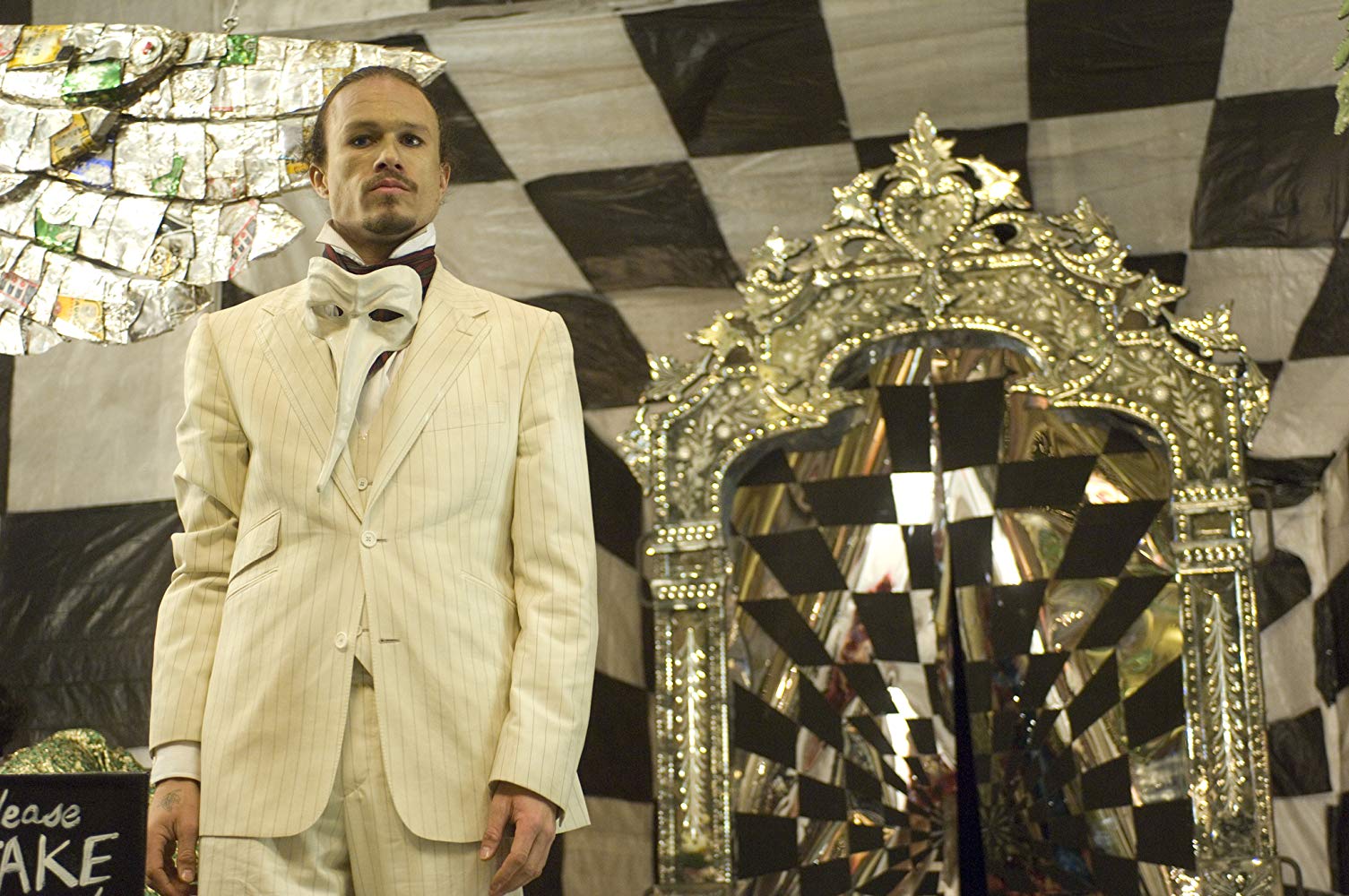
Ledger plays the mysterious Tony, a man found hanging from a bridge by a travelling theatre troupe headlined by the titular Doctor Parnassus (Christopher Plummer). The group also consists of the Parnassus' old friend, the wise Percy (Verne Troyer), the old man's daughter Valentina (a charming Lily Cole), and former beggar Anton (Andrew Garfield), who is head over heels in love with Valentina. Tony has a mysterious and shady past, so he is happy to work for the Imaginarium in an effort to disappear from a very public life, and soon sets about transforming the show's old-timer decor and feeble efforts to attract an audience. Usually setting up the stage in dingy car parks or other undesirable locations, Parnassus' only boast is that of a magical mirror that can transport anybody who enters it into their own imagination. Anton is unhappy at the sudden appearance of this handsome stranger, who naturally attracts the attentions of Valentina, but the troupe may face a larger threat thanks to Parnassus' ancient wager with the Devil (Tom Waits).
There's a great idea in there somewhere, but the script by Gilliam and co-writer Charles McKeown (who also worked together on Brazil and The Adventures of Baron Munchausen) is so haphazard and unsure of itself that it often feels like three films crammed into one. This is no doubt down to the in-production re-writes that were necessary following Ledger's death (Johnny Depp, Jude Law and Colin Farrell were brought in to play alternate versions of Tony when he ventures behind the mirror), so sections of the film feel awkwardly patched together. But there is also much to like. The design of the Imaginarium itself is wonderful in its own tatty, weather-beaten way, and Waits, complete with pencil moustache, cigarette-holder, and that signature raspy voice, is irresistible as Satan himself. The moments set within the imagination are often silly and plagued with questionable special effects, but they also occasionally sparkle with the same kind of magic of Gilliam's Monty Python animation. While it may not be the ideal film to finish his short career on, the film plays a lovely tribute to Ledger and will always be a reminder of the talent we lost far too soon. Sadly, this is likely all Imaginarium will be remembered for, but its a sporadically entertaining ride while it lasts.
From the opening moments of sitcom-inspired office hi-jinks in this plinky-plonky rom-com, the outcome is never in doubt. When we first glimpse our leads - beautiful people Sandra Bullock and Ryan Reynolds - the inevitability of how this film will leave us is cemented even further. There's a set formula to these kinds of movies, and knows well enough just how the target audience it so aggressively pursues wants to be left feeling. The key to a decent rom-com is having a funny script; one that will have you laughing and hoping the mismatched couple will finally realise their love for one another to care about how predictable the whole things is. Anne Fletcher's The Proposal does none of these things, and instead betrays the likeability of its leads by having little zip, and keeping them apart for what seems like a large chunk of the movie.
Margaret Tate (Bullock) is executive editor-in-chief in a successful New York-based publishing company. She has an icy reputation in the office, and her panicked underlings frequently alert the others of her arrival via group e-mail. Her dedicated but overworked assistant Andrew Paxton (Reyolds) is the only one who tolerates her, and that is because he hopes to win himself a promotion through his loyalty and hard work. Margaret also happens to be Canadian, and after a minor violation of the terms of her work visa, she finds herself facing deportation and without the job she has worked so hard to get. In a panic, she announces that she has been seeing Andrew for the past year and the happy couple are soon to be married, much to Andrew's dismay. Sensing foul play, U.S. immigration agent Mr. Gilbertson (Denis O'Hare) keeps a close watch on them, forcing Margaret to accompany Andrew to a family get-together in Sitka, Alaska.
Despite never really convincing as a couple, and neither really having moments of clarity that will help us understand when the script starts to push the two closer together, the two leads are a joy to watch. Bullock is now a legend of the genre, and Reynolds demonstrates the cheeky charisma he wouldn't be allowed to fully embrace until 2016's Deadpool. It's solid proof that the fault lies with the material they're given. Once in Alaska, The Proposal becomes a sickly loop of increasingly bizarre comedy set-pieces, including a moment where Margaret must fend off an eagle attacking the yappy family dog. It's a sea of white, middle-class faces, and the only person of colour seems to be the Hispanic Ramone (Oscar Nunez) who, in a slight racist twist, works just about every job in town from store-owner to stripper. There's also the dull sub-plot involving Andrew's father (Craig T. Nelson), who wants his son to ditch his New York adventure to join the family business, which exists solely to give Andrew something to do away from Margaret. The stars deserve much better.
Looking at the DVD cover of Down Terrace, you would be forgiven for dismissing it as yet another geezer-filled entry into the British crime genre, directed by somebody who watched Guy Ritchie's Lock, Stock and Two Smoking Barrels (1998) growing up and fancied themselves as capable of doing the same. Yet Ben Wheatley's debut feature goes out to do exactly the opposite, and instead of motor-mouthed crims with ridiculous nicknames and heists-gone-wrong, we get a kitchen-sink drama, at least for the first two-thirds, filmed almost entirely within the constraints of a run-of-the-mill house in Brighton.
After a stint in prison, Karl (Robin Hill, who co-wrote the script with Wheatley) returns to the family home with his father Bill (Robert Hill, Robin's real-life father) to try and sniff out the rat who is threatening to bring down their criminal organisation. With the help of mother Mags (Julia Deakin), they invite various associates, including idiot club owner Garvey (Tony Way), muscle Eric (David Schaal) and hitman Pringle (Michael Smiley), to their home in an attempt to suss them out. Karl is barely able to cope with the relentless criticism dished out by his father and his family's general dysfunction, and the atmosphere is made worse with the re-appearance of Valda (Kerry Peacock), an old flame now (apparently) pregnant with Karl's child.
Channelling the work of various British film-makers, including Ken Loach, Mike Leigh and Shane Meadows, Down Terrace attempts to draw you in slowly, creating an atmosphere of unease before unleashing its bloody final act. It should be a clever subversion of the genre, and in some ways it is, but this is hampered by a measured approach and a self-awareness, similar to the problems Sightseers (2012) had. There isn't a fault to be had with the performances, especially Robert Hill as the everyman crime boss with a slight aura of buffoonery about him. It's also very funny on occasion, and one of Wheatley's real strengths as a film-maker is luring you in with laughs while never allowing you to be completely comfortable. Ultimately, it's a distinctive test of endurance with flashes of brilliance, doing wonders with a micro-budget.
After the massive disappointment of the two sequels to 2001's dumb but entertaining The Fast and The Furious, the franchise got itself back on track by grounding itself (I use that term loosely) and bringing back the original quarter of Vin Diesel, Paul Walker, Michelle Rodriguez and Jordana Brewster. Tokyo Drift (2006) was mind-dumbingly dull, but the action scenes were more impressive than what came before and it teased fans of the series by bringing back Diesel for a last-minute cameo. Director Justin Lin is at the helm once again, and this fourth instalment is the best yet (at this point in the series).
Five years after fleeing Los Angeles, Dominic Toretto (Diesel) is up to his old tricks in the Dominican Republic with girlfriend Letty (Rodriguez) and Tokyo Drift's Han (Sung Kang). Sensing his presence in his new gang will only bring the law down upon them, Toretto flees to Panama, leaving Letty behind. A few months later, Toretto is brought back to America by an incident I cannot reveal with being spoilerific. He starts his own investigation, which leads him to a man named David Park (Ron Yuan). Meanwhile, F.B.I. agent Brian O'Conner (Walker) is also investigating Park, and all trails seem to lead to a mysterious drug lord named Arturo Braga.
Though the movie begins with a rather ridiculous action scene that brought flashbacks of the terrible xXx (2002), things settle down as an actual plot - the first of the series? - develops. It's simple but effective, and everything from the cinematography to the script feels cleaner and more mature. More focus is granted for the characters, and although they're relatively stoic and wafer-thin, it's nice to see them exchange words in a room rather than shouting at each other over the noise of an engine. Fans of the franchise need not to worry though, as Fast & Furious, which is in danger of being the most unimaginative title to a sequel ever, offers plenty of motor-porn, scantily-clad women and a pumping soundtrack.
Which is where the movie ultimately suffers. Although Justin Lin dims the sheen of street racing and shoots the obligatory gyrating lady parts with a less perverted and exploitative eye, the main crux of the plot still surrounds drug smuggling, a lazy McGuffin and a recycled excuse to get Brian and Toretto behind the wheel again. The action on the whole is exciting, especially the high-speed rush through an underground tunnel that crosses the Mexican-American border, and Lin manages to avoid getting lost in the mayhem. It will never be a work of high art, but there's enough here to reignite my passing interest in this glossy but fun series.
An Education's protagonist Jenny, expertly played by an Oscar-nominated Carey Mulligan, is the best reason to the see the film. Set in 1961, Jenny is one half middle-class good girl, the other half a rebellious and potentially wild 16 year old child with a thirst for all things French. Studying hard to be accepted into Oxford, Jenny really longs for the wonders of Paris, and in her spare time indulges in the free-spiritedness of the music and the New Wave movies of the time. Her parents, played by Alfred Molina and Cara Seymour, are proud but pushy. Her father especially longs to see his daughter succeed and his own social standing bumped up a couple of notches. That is until she meets the much-older David (Peter Sarsgaard).
David is a smooth-talking charmer who seduces Jenny by taking her out to opera's and expensive dinners with his flash friend Danny (Dominic Cooper) and his girlfriend Helen (Rosamund Pike). He charms her parents too, and convinces them to allow him to take Jenny to see his friends in Oxford, where she will stay with famous author C.S. Lewis. He also takes her to Paris and asks for her hand in marriage, and Jenny laps it up with a naive curiosity. But David is a philandering con-man, and when the truth is uncovered, Jenny is faced with important decisions about her own fate.
An Education is a perfectly nice and dainty British production that ultimately fails in it's attempts to tackle the big themes. The build-up is well paced, as Mulligan is exquisite, competently backed-up by a Colin Firth-channelling Sarsgaard. It looks and feels like 1961, and Nick Hornby's Oscar-nominated script sensitively handles the topic of a young girl and a much older man. But it's in the second half, when David is unravelled, that things become predictable and plodding, and Cooper and Pike's talents are wasted. The final moments try and wrap up every single aspect of Jenny's life and character in a few sentences, betraying the careful approach to Jenny's complex nature which came before. Nice enough, but hardly memorable.
Defiantly avoiding the familiar sign-posts of the early Harry Potter movies (Harry's troubles with the Dursley's, the journey to Hogwarts, meeting the new Defence Against the Dark Arts), returning director David Yates and the franchise in general has firmly settled into it's dark, brooding persona. The trouble is, Harry (Daniel Radcliffe) and his ever-present shadows Ron (Rupert Grint) and Hermione (Emma Watson) have developed into one-dimensional bores. Thankfully, The Half-Blood Prince is rich in snivelling villains and wise old wizards and witches, all portrayed by an embarrassingly rich line-up of British thesps, who liven up the proceedings somewhat and add that much-needed gravitas.
It's a cast so crammed with talent that the likes of two-time Oscar-winner Maggie Smith is reduced to a walk-on part. But the film is plagued by a lack of proper pacing, and Yates has trouble keeping a grip on the mixture of drama, comedy and action. Certain scenes that were utterly gripping in J.K. Rowling's novel whizz by without you realising what just happened, confusing the thick plot to the point that any audience members unfamiliar to the books, and have waited two years between the movie instalments, might be left scratching their heads at the mention of Horcruxes and Vanishing Cabinets. This time around, Harry and Dumbledore (Michael Gambon) partner up to gain information from new teacher Horace Slughorn (Jim Broadbent).
Seeking to destroy Lord Voldemort (Ralph Fiennes) once and for all, Dumbledore's biggest clue lies in a memory tampered with by it's owner, Slughorn. It's a conversation between him and a young Voldemort, Tom Riddle (Frank Dillane - son of Stephen), discussing a dark magic that Dumbledore believes to be the key to Voldemort's immortality. Harry is given the task to appeal to Slughorn's love of celebrity and reveal his secrets, and impresses the bumbling teacher in his Potions class after discovering a textbook marked with alterations by the mysterious 'half-blood prince'. But Harry also believes nemesis Draco Malfoy (Tom Felton) has been made a Death Eater and is up to no good, much to the scepticism of Ron and Hermione.
It's the best book of the series, in my opinion, and it's a shame that screenwriter Steve Kloves, who has written every Potter apart from Order of the Phoenix and has always done an excellent adapting the hefty books, can't quite get this one right. The moments in which Harry delves inside the Pensive, an apparatus that allows one to physically enter a memory, are impressive. We finally get some insight into the past, and the two young actors playing Tom Riddle (as well as Dillane, Hero Fiennes-Tiffin, nephew of Ralph, plays an 11 year-old incarnation) are excellent, showing us a younger, curious dark lord. But it isn't enough to stop the film feeling like it's dragging out the franchise that made many people millions of dollars, or allowing me to forgive the many narrative flaws and many moments of plain rushed storytelling.
It was only a matter of time before most people's favourite X-Man, Logan a.k.a. Wolverine, got his own stand-alone movie. After Brett Ratner's atrocious X-Men: The Last Stand (2006) almost killed the franchise in it's tracks, 2009 was the perfect time for not so much a re-boot, but a fresh take, employing the Oscar-winning director of 2005's wonderful Tsotsi, Gavin Hood, to tackle the indestructible mutant's origin story. The result is an ugly mess of meaningless CGI, repetitive fights, corny dialogue and an over-abundance of dull supporting mutants.
After taking an extended holiday following the events of William Stryker's (Danny Huston) violent Team X mission in Africa, Wolverine (Hugh Jackman) is happily living as a shirtless lumberjack in Canada with his beautiful girlfriend Kayla Silverfox (Lynn Collins). His estranged brother, Victor a.k.a. Sabretooth (Liev Schreiber), seems to be picking off members of Team X, so Wolverine is approached by Stryker to help with the problem. At first he declines, but when he finds Kayla's bloodied body in the forest bearing the marks of Victor, he joins Stryker who implants the alien metal adamantium into his body.
Origin stories are always difficult, and only Iron Man (2008) seems to have dodged the problem of making the creation of the superhero more interesting than what they can do with their newly-found powers. Origins takes the approach of practically ignoring it completely. We have a brief scene at the start with Logan and Victor as kids, and then a montage of the brothers fighting in the American Civil War, World War II and Vietnam. Within minutes, we have skipped well over 100 years of Wolverine's life (it appears he was born around 1840). It's main focus is the rivalry between Logan and Victor, and Schreiber snarls his way through some dodgy lines and somehow manages to come through unscathed.
Truth is, Origins has more in common with the previous X-Men films than any other superhero kick-start film, filling scenes with forgettable mutants such as Agent Zero (Daniel Henney), Fred Dukes a.k.a. The Blob (Kevin Durand), John Wraith (Will.i.am) and Chris Bradley a.k.a. Bolt (Dominic Monaghan). I would have happily paid extra to see more of Gambit (Taylor Kitsch), who was no doubt added to appease fans but is criminally ignored once he shows his face, and Deadpool (Ryan Reynolds), whose story arc left me dumbfounded at the missed opportunity. Because of this, Wolverine is almost left out to dry. Normally, Jackman's charisma shines through, but here he just scowls.
All in all, this is no better or worse than those recent comic-book hero disasters Ghost Rider (2007) and Jonah Hex (2010). The first two X-Men films, directed by Bryan Singer, were really quite good, but the franchise (at this point) had become nothing more than a wad of money thrown at the screen in the hope that the crash-bang-wallop action scenes would keep the audience distracted enough to not realise what they are watching is a large pile of crap. Schreiber at least keeps things lively, and Hood is wise enough to keep things well below the two hour mark. But that is scant praise indeed, and the best thing about the film is that the sight of Wolverine chopping wood brings to mind Monty Python's Lumberjack Song.
Bringing Alan Moore's cerebral and sprawling novel to the screen was always going to a near-impossible task. It's very much an anti-superhero story, where the 'heroes' are merciless psychopaths, government weapons of mass destruction, or sexually impotent. Spanning decades and featuring snippets from books, comics and newspaper reports within the world Moore creates, any film adaptation simply could not match the level of details and authenticity of the much-lauded novel. Zack Snyder, a fan of the original, and a director who was just off the back of the surprisingly excellent Dawn of the Dead (2004) and the shouty, crass 300 (2006), puts all of his heart and soul into Watchmen.
Using a no-name cast, a convoluted and dangerously slow story, and an adult rating thanks to all those snapped bones and a massive blue willy, it's a wonder this ever got made at all. It was in development hell for years, with names such as Terry Gilliam and Paul Greengrass becoming attached and then quickly detached from the project, and even the nerve-jangling possibility of Arnold Schwarzenegger as the movie's only true superhero was banded around in the mid 1990's. It's almost impossible to think of a more faithful adaptation than Snyder's, often re-creating frames from the comic in the minutest of detail, and even including Tales from the Black Freighter, the comic-within-a-comic from the novel with the voice of Gerard Butler (this is a review of the 215-minute cut, which I feel is the best version out there). Yet, you could still argue that Moore's book is un-filmable.
The 1980's, and President Nixon is running his fourth term in office, and superheroes have been outlawed. Ageing government assassin The Comedian (Jeffrey Dean Morgan), a former member of two superhero groups named the Minutemen, is murdered in his home. Vigilante and wanted man Rorschach (Jackie Earle Haley) investigates the murder, and brings his theory that someone is hunting down retired superheroes to his friend and former partner Dan Dreiberg (Patrick Wilson), formerly known as Nite Owl. With the threat of nuclear war with the Soviets becoming frequently more inevitable, heads turn to Dr. Manhattan (Billy Crudup), a neo-God with the ability to bend matter to his will. But when he learns that he may have given his friends and loved ones cancer, he flees to Mars, leaving the world vulnerable to complete annihilation.
The Watchmen world is thick and meaty, re-writing history as if masked heroes and super-villains actually existed. In the film's opening titles, we are treated to an impressive collage of famous historical events, such as the Moon landing, but here it's Dr. Manhattan photographing Neil Armstrong. It's a hell of a lot of back-story to fill in, and the movie spends most of it's time filling in the gaps between the 1940's and the 1980's. Luckily, the characters Alan Moore wrote so beautifully, are fascinating, and the extended segments dedicated to portray their personal evolution are arguably more interesting than the movie's main plot. These are not flawed superheroes like Batman or Wolverine, they are complete fuck-ups, getting sexual stimulation from violence, battering minor offenders to a bloody pulp, or, in Dr. Manhattan's case, literally losing every trace of his humanity.
Moore's novel made them a parody of the idea of masked superheroes protecting the weak. The Comedian especially is a piece of work, gleefully frying a Viet Cong with a flame thrower, while a giant Dr. Manhattan stalks the jungle vaporising any enemies in his way, helicopters whizzing by his head while 'Ride of the Valkyries' plays. Like with 300, Snyder way overplays it. The comic itself wasn't exactly subtle, but Watchmen the movie amps everything up to 11, and while this admittedly makes the film more exciting, it makes the themes heavy-handed and sometimes plain laughable. Dreiberg can only get it up for the Silk Spectre (Malin Akerman) after he's murdered some criminals, but when he finally does, Snyder captures it like a soft-core porn movie starring Shannon Tweed, with the cringe-worthy use of Leonard Cohen's 'Hallelujah' in the background. In fact, the entire soundtrack feels as if it's been picked by some stoner student with Jimi Hendrix posters on his wall.
It's no surprise that, after a very successful opening week, Watchmen plummeted once word-of-mouth got around. Audiences drawn in by the possibility of another superhero spectacle were no doubt left baffled by the existential musings of it's characters and the extreme darkness of the film's themes. Perhaps it was what the film deserved, as when it's good, it's the work of a true artist, and when it's bad, it's quite embarrassing. But it's the best that us fans are likely to ever get, and we must be thankful that a director who really knows and loves the source was on board, and insistent that it wasn't destroyed by the studio butchers. Snyder has also rounded up an excellent cast, with Haley and Crudup standing out especially (Akerman suffers from some dodgy delivery occasionally but she sure pulls off that costume). It will continue to divide it's viewers, but it'll be somewhat cherished by it's fans.
Based on the 1978 novel of the same name by Judi and Ron Barrett, directors Phil Lord and Chris Miller took the foundation of the literature and created a sort of 'origin' story. The book told of a fantastical town where it rained the inhabitant's daily meals until the portions span out of control, creating gigantic food storms and oversized grub. The film imagines this phenomena is caused by science-nut Flint Lockwood (Bill Hader), who after witnessing his small town getting shut off from the world and forced to eat nothing but sardines, thinks he can win the hearts of the townsfolk by creating a machine that turns water in the food of your choice.
At the opening of Sardine Land, hosted by Mayor Shelbourne (Bruce Campbell), Flint's contraption goes haywire and shoots off into the sky. Soon enough, pickles, buns and cheese are raining from the sky, which soon become full cheeseburgers. The townsfolk lap it up, plying Flint with requests, and even the intern reporter Sam Sparks (Anna Faris) starts to enjoy her pun-filled reports. That is until the machine starts to lose control and begins spewing out giant spaghetti tornado's and giant steaks.
Similar in a way to the Belgian madcap comedy A Town Called Panic, released the same year, Cloud With a Chance of Meatballs find most of it's charm in its relentless and hyperactive approach. Jokes litter both the foreground and background of the movie, producing some inventive, old-fashioned slapstick alongside some modern, more neurotic humour. It's an insane film at times, but there's a lot of genuine wit here. In a montage of Flint's failed inventions, we see televisions that walk to you on legs so you can change the channel, spray-on shoes that never come off, and ratbirds. The inventions are then seen throughout the film, either taking an active role in the plot or, in the television's case, looting the town's electronics store for an enjoyable throwaway gag.
But beneath all the frenetic energy, there's some heartfelt moments involving Flint's father (voiced by a gruff James Caan) who can't quite communicate with the son he doesn't understand. There is also some subtle commentary on humanity's wastefulness and penchant for greed. All the uneaten food gets flung miles over a hill so it can rot away out of sight, and as the dollar signs increase in size in Mayor Shelbourne's eyes, so does his waste size. The ending takes the disappointing route of continuing the current trend of animated films having overblown, action-packed climaxes, but if you can put that aside, there is a lot to savour here.
After Captain Picard and his crew crash-landed at the box office with Star Trek: Nemesis (2002) and the TV series Star Trek: Enterprise was canned, the Star Trek franchise was at a dead-end and in desperate need of fresh eyes. After TV success with the likes of Alias and Lost, and a decent franchise entry in Mission: Impossible III (2006) - which brought the series back on course after John Woo's horrible first sequel - in stepped J.J. Abrams, along with writers Roberto Orci and Alex Kurtzman. This would be a complete re-boot, going back to the very beginning of the careers of the characters from the original series - Kirk, Spock, Scotty et al, who are now some of the most recognisable faces in popular culture.
Born amidst the heroic death of his father, James T. Kirk (Chris Pine) is a rash, headstrong, yet intelligent adrenaline junkie, who, after a bar fight with some Starfleet cadets, is convinced by Captain Pike (Bruce Greenwood) to enlist in Starfleet academy. On Vulcan, Spock (Zachary Quinto) faces the decision whether to give himself over completely to the logic-based Vulcan way of life of his father, or embrace the emotions brought on by his human mother. After being invited to join the Vulcan Science Acacemy, but taking offence at a suggestion that his humanity is a 'disadvantage', Spock declines and enlists in Starfleet. Three years later, the cadets find themselves on the Enterprise commanded by Pike, where they answer a distress signal from Vulcan, who are facing destruction from Romulan Nero (Eric Bana).
While admittedly not a fan himself, Abrams clearly doesn't want to upset the huge fanbase that this franchise attracts, going as far as using a clever plot device that allows the rookie characters to pursue their own path, and therefore not eradicating everything that happened back when William Shatner was hamming it up. Occasionally, you'll see Shatner in Chris Pine, but Pine makes Kirk very much his own. Kirk is the humanity of the story - cocky and arrogant to the point of dangerous, but capable and confident like every leader needs to be, and here we see him discover where to draw the line. He is the polar opposite to Quinto's Spock, who, at this point of the story, is a cold, angry presence, but inwardly fighting his natural instinct to balance logic with emotion, seeing weakness in his humanity.
It is the interactions between these two characters that form the emotional core of the film, with the characters naturally learning from each other and starting on the path that would lead to their great friendship. This being an origin story, the focus should naturally be on character development, so Bana's Nero, although nailing the short time he has on screen, doesn't get much of a look in, becoming not much more than a plot device that allows the crew of the Enterprise to pull together. However, Nero's ruthlessness does allow for some fine action scenes, and one genuinely shocking moment. There's less 'set phasers to stun' and more hand-to-hand combat in the vein of the Bourne trilogy, with Spock displaying some chopsocky skills and Sulu (John Cho) revealing some unknown kung-fu abilities (he is Asian, after all!).
It won't please all the fans, certainly not the hardcore Trekkies. Original creator Gene Roddenberry fused philosophy and science and gave the world a series that, on the surface, could be misconstrued as just another cheesy sci-fi series from the 1960's, but was rooted in something far deeper and more intelligent. Abrams take on Star Trek all but throws away these ideas, and focuses more on action and comedy, aspects of the traditional blockbuster. Myself, I've seen very little of the TV series, so this didn't bother me in the slightest. Although I think the original Star Trek: The Motion Picture (1979) has an unfair bad rep, I generally find the original movie series quite tedious and very hit-and-miss (something the fans will admit), so I welcome the new take. It's Star Trek for the modern age, but shows enough respect for what came before that a fine balance is created, and, some lazy plot devices aside, is one of the most shamelessly entertaining films of the past few years.
Three close friends and the groom's strange brother-in-law travel to Vegas for a bachelor party they will never forget. Teacher Phil (Bradley Cooper) is a womaniser with a wife and kids, Stu (Ed Helms) is in an unhappy marriage with an overbearing, abusive wife, Doug (Justin Bartha) is the groom hoping for a send-off to end all send-off's, and Alan (Zach Galifianakis), is a naive man-child hoping to make friends. When they wake up in the morning, they find their suite demolished, a tiger in the bathroom, a baby in the closet, and most worryingly of all, Doug is missing. They clean themselves up and set out to find Doug, and using the various clues lying around, they begin to piece together the night.
Of course, bachelor party movies are hardly hard to come by, and they have been a staple of the gross-out comedy circuit since the 1980's. The Hangover finds its originality in the fact that it focuses on the morning after, rather than the actual night itself, which we see none of. It also has a sense of believability, as if three of the characters have genuinely been friends for years, and are gradually accepting the increasingly strange Alan into their wolf-pack. After all, Alan is often unnervingly strange, but the group find him funny too, and why wouldn't they? Cult stand-up comedian Galifianakis has been around for years, starring in various failed pilots and never quite getting the attention he deserved, but he is by far the best thing in The Hangover, with the mixture of his quite sweet innocence and his random one-liners fitting in with the film's heartfelt moments.
It also keeps the gross humour thankfully down to a minimum. Sure it's often bad taste, but there's a noticeable lack of bare-breasted women and any jokes involving bodily fluids. This is still R-rated, but the humour is in the script and the performances, and doesn't resort to someone shitting themselves for desperate laughs. It's similar in many ways to 2007's Superbad, where the language was filthy, but the laughs were genuine, and the situations, however absurd, still felt somewhat real. And when the credits rolled, I was left with that unfamiliar desire to spend more time with these characters. Special mention must also go to Chinese gangster Mr. Chow (played by Ken Jeong, who simply needs to be in more films), who has one of the best comedy burn lines in history, "so long, gay boys!".
After lying in production limbo for almost fifteen years, director Werner Herzog finally managed to make his film, loosely based on the story of Mark Yavorsky, with the help of producer David Lynch. You would think a collaboration of two such instantly recognisable auteurs may cause problems or lead to a clash of the two directors' film-making ideals, but My Son, My Son, What Have Ye Done is distinctively Herzogian, continuing the prolific German director's fascination with the quirky corners of the American South. By showing us the murder and the murderer within the first five minutes, Herzog removes any element of mystery surrounding the crime, and instead focuses on the mental disintegration of its protagonist, as well as placing his own spin on the familiar hostage crisis drama.
Detectives Havenhurst (Willem Dafoe) and Vargas (Michael Pena) arrive at the scene of a recent murder, where an elderly lady has been stabbed with an antique sword. Outside the crime scene, a man drinking coffee says something strange to Havenhurst, and shortly after, the detectives realise this man is Brad Macallam (Michael Shannon), the son of the murdered woman and also the murderer. Brad shacks himself up in his own home with two unseen hostages and a shotgun, so Havenhurst begins to delve into Brad's story, with the help of Brad's fiancé Ingrid (Chloe Sevigny) and his drama teacher Lee Meyers (Udo Kier). What they discover is a man changed by a recent trip to Peru, where he pulled out of a kayak trip at the last minute after hearing the voice of God telling him not to, only for everyone else to be killed.
This is certainly one of Herzog's 'smaller' films, following the almost mainstream and outlandish (but hugely entertaining) Bad Lieutenant earlier the same year. Yet Herzog is no stranger to budget, location and equipment constraints, and has made some of his best films under these conditions, and manages to tell an absorbing, sometime hypnotic tale of a wild man at odds with his surroundings. This is a recurring theme for Herzog - civilised man's struggle against the aggressive, unpredictable forces of nature - and here Brad seems to be isolated from society after witnessing the full force of nature at work. Why exactly does he kill his mother? No questions are truly answered, but the film is more interesting at showing you the factors that may have lead to this horrific act.
For the film to work at all, it must have an actor capable of delivering such complexities of the mind into his performance, and Shannon pulls it off perfectly. Quickly becoming my favourite working actor, Shannon is a towering presence, appearing uncomfortable in his own body, all mad eyes and slurred voice. At times it's almost hard to watch him, terrified at what he may do at any given time. Given that any mystery surrounding the murder is removed by Herzog at the beginning of the film, it's a real achievement that the film managed to be as exciting and absorbing as it is, with Herzog's unpredictable approach mixing flashbacks and faked freeze-frames with some of his familiar quirky topics such as wild animals, scarred terrains, dwarves and a haunting score. A little gem, and as Herzog and Lynch discussed in their successful meeting, "a return of essential film-making" for the director.
Said to have been portrayed by over 70 actors in over 200 adaptations, it was only a matter of time before Sherlock Holmes received a modern-day revision. The BBC cast Benedict Cumberbatch as the titular loose-cannon, with Martin Freeman as his sidekick Dr. Watson in the series Sherlock, but director Guy Ritchie wanted to revert back to the source novels for his Holmes, and who better than Robert Downey, Jr. to star as the bohemian detective-for-hire with a penchant for self-starvation and cocaine. Only this being rated 12A, the cocaine and needle abuse is somewhat glossed over in favour of a more 'teenage-friendly' preference to alcohol, though the unpredictable and near-schizophrenic personality is maintained, and his famous and iconic deerstalker hat (though never mentioned in the books) ridden of altogether.
After foiling the ritualistic sacrifice of a young girl at the hands of the aristocratic Lord Blackwood (Mark Strong), Sherlock Holmes retreats into a state of isolation while he awaits his next case. His good friend and colleague Dr. Watson (Jude Law) is getting married, and his invitation to Holmes to meet his bride-to-be finally brings Holmes back into the world. With Blackwood awaiting execution, his last wish is to talk with Holmes, who is warned of three more deaths to come. Blackwood is hanged and assumed dead, until his body goes missing and is replaced by a man reported missing by Irene Adler (Rachel McAdams), an American thief who has managed to escape Holmes in the past. Holmes' investigations leads them to the Temple of the Four Orders, a secretive magical organisation who seem terrified by Blackwood's apparent resurrection and eventual resurfacing.
I've never really been a fan of Guy Ritchie. Since his breakthrough début way back in 1998 with Lock, Stock & Two Smoking Barrels, he has done little of note, or at least nothing to develop on the promise of his début. Lock, Stock was an amusing and quite clever little throwback to the Cockney gangster films of the 1980's, featuring memorable dialogue and a funky score. He then made Snatch (2000), which is still lauded by its fanbase but offered nothing different apart from a new and annoying self-awareness, and Alan Ford calling himself "an 'orrible cant!". He then was almost forced to pack it in for good after making the embarrassing double-whammy that was Swept Away (2002), a love-letter to his then-wife Madonna, and Revolver (2005), a pretentious, insulting piece of shit starring Jason Statham and Ray Liotta. Seeing his dreams fading, Ritchie went back into his comfort zone - the criminal underbelly of London - and made RocknRolla (2008), which although being over-familiar, wasn't half bad and featured some nice cinematography.
With Holmes, Ritchie has gone mega-budget and handles it well. Though for all its CGI backdrops and grand set-pieces, Ritchie has stuck with the Cockney wide-boy dialogue and slow-motion fight scenes. From the very first scenes, his intentions are clear, as Holmes envisions his opponents weak-spots and we are narrated through the damage that each blow will inflict, all caught in that time-altering way he championed way back in '98. This is Holmes at his most action-heavy. I don't recall ever seeing Basil Rathbone taking out someone's knee-cap or getting involved in bare-knuckle boxing fights. But isn't that was revisions are all about - taking a beloved character and taking them to places never seen before? Well of course, but in this case, it's to take their character to the top of the box-office by attracting a less-demanding audience, and make a lot of money.
The Ritchie-isms aside, Sherlock Holmes is still entertaining, which is its primary goal. Although the story is weak, everything looks fake and like a computer effect, and the aspect that made Holmes such a popular read - the investigation and his almost supernatural ability to unravel the smallest of clues - isn't particularly clever, and is brushed aside in favour of Downey, Jr's admittedly excellent comedic performance. He is perfect for this Holmes, showing a lot of the cocky charm and general strangeness he injected into Tony Stark in the Iron Man films (2008-2013). After all, Downey, Jr. practically is (or was) Holmes, almost spurning his talent in favour of drug abuse. It's enough to make me watch the sequel someday, but not enough to make me warm to Ritchie. But it's 128 minutes of breezy, easy-watching entertainment.
In Turin, Italy, beautiful young model Celine (Elsa Pataky) is kidnapped by a taxi driver, who takes her to his torture chamber where a previous victim still lies half-dead. Celine was on her way to meet her sister Linda (Emmanuelle Seigner), who eventually suspects foul play. With the police unwilling to help, she turns to Italian-American detective Enzo (Adrien Brody), who is deep into an investigation that stretches way back, involving many missing girls who turn up tortured and murdered at seemingly random spots.
Former master of horror Dario Argento has been in deep decline since his 1970's heyday. Even his own fanboys admit that the visionary has lost his touch, and his films no longer have the gliding beauty he injected into the likes of Deep Red (1975), Suspiria (1977) and Inferno (1980). Thankfully (or should I say hopefully?), it would seem that Argento must be on the ascension, as Giallo, his homage to the sub-genre that prevailed in the 60's and 70's, must surely signal rock-bottom. He surely cannot produce anything so confusingly dire, or he should simply pack his bags and stop making movies. It beggars belief how the man that created some of the most elegant horror movies ever made can fail to raise even a moment of inspiration, and at times seems to parody the genre rather than showing any real love for it.
After being promoted as being something of a return to form for the auteur and a return to director's roots, Giallo was given a very limited release (I believe it went straight-to-DVD here in the UK) after a verbal slamming from audiences and critics alike. The most famous thing to come out of it was Adrien Brody's law-suit against the producers, claiming he had yet to be paid, and tried to halt any releases of the film until he was given what he was owed. Well, judging from his performance here, the Oscar-winner doesn't deserve a dime, sleep-walking through his role and bringing no life to his thinly-written, cliché-ridden character. Any attempts to blur the lines between his miserable detective and the sadistic killer comes across as laughable, and the 'big reveal' that explains his back-story is just plain silly.
For a film marketing itself as a giallo, the film lacks anything resembling the visual class or the sleazy atmosphere of the best of the genre, with Argento's camera glides feeling more like the director's futile attempts to polish a turd. It instead has more in common with that popular, ugly sub-genre of the modern age - torture porn. We see a girl's lips cut off with scissors, and a particularly nasty hammer-to-the-skull moment, cheap tricks that are more akin to the likes of Eli Roth's Hostel (2005) and its countless imitators. The killer looks like he's wandered in from the set of Joe D'Amato's Anthropophagus (1980), and is one of many plot devices that confuse and defy logic. Depressing then, seeing a once-great director stoop so low, but maybe his ambitious Dracula 3D (2012) will see a return to form.

 In California, Susan Murphy (Reese Witherspoon) is waiting to marry her vain TV weatherman fiance Derek (Paul Rudd), who has just announced the news of a job offer in another state. Before the wedding ceremony kicks off however, a huge asteroid crashes down on top of Susan. and although she appears unaffected at first, the mysterious energy given off by the rock causes her to grow to enormous size. With her head now peaking through the roof and the guests running for their lives, the military are quick on the scene, capturing Susan and taker her to a secret government facility ran by General W.R. Monger (Kiefer Sutherland), who has been hoarding a collection of strange monsters for decades.