Showing posts with label 1959. Show all posts

Monday, 16 July 2018

Review #1,364: 'The Stranglers of Bombay' (1959)

The closing title card of this lesser-known title from Hammer's back catalogue reads "if we have done nothing else for India, we have done this one good thing." Referring to the British East India Company's governance over India for over a hundred years, The Stranglers of Bombay depicts the disappearance of thousands of India's population at the hands of the 'Thugees', an organised gang of murderers and thieves who operated relatively undetected for more than 600 years, and how their operations were eventually brought to an end. It is a subject that would no doubt be handled more delicately if tackled today, and I'm sure that those sensitive to modern PC standards may be somewhat offended by the film, but Stranglers is well-balanced and ultimately apologetic for the Company's occupation, finding a positive note in what was a barbaric time.

Captain Harry Lewis (Guy Rolfe) of the East India Company is the only person interested in the reports of over a thousand disappearances, attempting to bring the mystery to the attention of his superiors. However, Colonel Henderson (Andrew Cruickshank) is more concerned with solving the mystery of how English merchants' caravans are similarly disappearing without a trace. To get Lewis off his back, Henderson agrees to an investigation, but opts to hand the reigns to the inexperienced and pompous Captain Connaught-Smith (Allan Cuthbertson). Frustrated at Connaught-Smith's bungling and the general disdain he has for the Indian people, Lewis quits the Company to carry out his own inquiry, and uncovers a murderous cult who make sacrifices in the name of their god, Kali. Led by the High Priest of Kali (George Pastell), the gang's influence goes all the way to the very top, which is how they have managed to remain in the shadows for centuries.

The Stranglers of Bombay is low on horror but higher on adventure. The violence is implied rather than shown, but the film doesn't shy away from their grotesque acts. Eyes and tongues are removed, but most are garrotted with a ceremonial silk scarf. It's off-camera, but nevertheless effective. When the action is away from the thugees, the story plays out more like a period detective thriller, as Lewis plunges himself deeper into this secret world while the population denies the group's very existence. It's no surprise then to learn that frequent Hammer collaborator Terence Fisher is behind the camera, who would always shoot efficiently and make his films appear more expensive than they actually were. The absence of Christopher Lee and Peter Cushing is almost always felt when watching a Hammer horror, but leading man Guy Rolfe proves to be a perfectly watchable leading man, earning our sympathy as the one decent white man in a company of incompetent and uncaring fellow officers. While more attention could have been given to the suffering of the Indian people, the film's heart is certainly in the right place, making it one of Hammer's most interesting, while not their most thrilling, entries into the genre.


Directed by: Terence Fisher
Starring: Guy Rolfe, Allan Cuthbertson, Andrew Cruickshank, George Pastell, Jan Holden
Country: UK

Rating: ***

Tom Gillespie


The Stranglers of Bombay (1959) on IMDb

Thursday, 14 June 2018

Review #1,353: 'The Man Who Could Cheat Death' (1959)

Its 1890, and a mysterious hidden figure stalks the smoggy streets searching for his next victim. The atmosphere and imagery may bring to mind the crimes of Jack the Ripper, but the setting here is in fact Paris, although I'm convinced this opening was purposely designed to evoke the planet's most notorious serial killers. The Man Who Could Cheat Death is an early effort by Hammer Film Productions, based on the Barre Lyndon's play The Man in Half Moon Street, during the era when the famous British studio was emerging as the most popular name in horror, usurping Universal Studios, who dominated the genre during the 1930s and 40s. Hammer produced a different breed of horror, one that was ghastly and sexy, and audiences lapped it up. But this is one of the studio's tamest and most plodding efforts, despite the presence of Terence Fisher behind the camera and Christopher Lee in front of it.

The story surrounds sculptor, doctor and socialite Dr. Georges Bonnet (Anton Diffring), who we meet entertaining his dinner guests with the unveiling of his new work. Bonnet's model Margo (Delphi Lawrence) marvels at the magnificent bust, but the eligible bachelor is eager to rush everyone out of the door when attendees start asking about purchasing the works of art he never sells. Bonnet thinks he's alone, and opens a hidden safe containing a bubbling green liquid he seems incredibly desperate to drink. Only Margo has stayed behind and startles him. When she refuses to leave, Bonnet kills her, but not before his skin seems to age and his eyes are drained of colour. The good doctor is in fact 104-years old, and must drink the potion to maintain his youthful appearance. On the eve of undergoing vital surgery that will keep him young forever, his old friend Dr. Ludwig Weiss (Arnold Marle) reveals he has suffered a stroke, and will be unable to perform the operation. With the police on his trail and the potion running dry, Bonnet must find a new surgeon fast before his crimes against nature are uncovered.

The main problem with The Man Who Could Cheat Death is that any potential mystery to the story is blown by the film's very title. We know that Bonnet has somehow cheated death and that the green liquid must be the thing sustaining his power, so the majority of the running time is filled with inane conversations and philosophy 101. There's also a love interest in Janine (Hazel Court), Bonnet's beautiful former muse who appears to be dating stoic surgeon Dr. Pierre Gerard (Lee), although it's clear she only has eyes for the man who was sculpted her. It's a glorified cameo for Lee, who makes more of an impression with a relatively small role than Diffring manages as the lead, and it's easy to wonder how much better the film would have been with the roles reversed. With limited sets and a minuscule cast, Fisher seems happy to continue the aesthetic of the story's theatrical roots, and unwilling to embrace the potential hideousness of this part Dr. Jekyll and Mr. Hyde, part The Picture of Dorian Gray tale. It isn't the worst of Hammer's back catalogue, but it's a hell of a distance away from their best.


Directed by: Terence Fisher
Country: UK

Rating: **

Tom Gillespie


The Man Who Could Cheat Death (1959) on IMDb

Wednesday, 2 November 2016

Review #1,107: 'House on Haunted Hill' (1959)

Horror icon Vincent Price has played the role of a wealthy eccentric countless times, usually holed up in a beautiful if macabre and mysterious castle while toying with his visitors. It's a role that fits his slightly creepy yet irresistibly likeable persona like a glove, and served him well throughout his extensive career. Before he became the wink-to-the-camera rogue in the films of Roger Corman and many others, he tended to play his parts more straight-faced, but always with a playful aura. One of his most enjoyable roles is in William Castle's House on Haunted Hill, a film that embraces cliche and camp, yet undoubtedly inspired countless haunted house movies that came in the years that followed.

Price plays a charismatic millionaire named Frederick Loren who, at the request of his wife Annabelle (Carol Ohmart), rents a supposedly haunted house to throw a party. He invites five guests - test pilot Lance Schroeder (Richard Long), psychiatrist Dr. David Trent (Alan Marshal), newspaper columnist Ruth Bridgers (Julie Mitchum), one of Loren's employees Nora Manning (Carolyn Craig), and the house's owner Watson Pritchard (Elisha Cook Jr.) - to survive the night for a $10,000 reward. They are each given a small coffin containing a gun, and are offered one last chance to leave before the doors close and lock at midnight. Needing the money and believing the spooky occurrences to be the work of cheap tricks, they all stay, but regret the decision when one of the group is found hanged.

It's incredibly basic stuff and only runs for 75 minutes, but Castle's ability to keep the audience guessing and Price's wonderful, brooding performance makes House on Haunted Hill stand out above its many imitators. Castle was known for his gimmicks in the theatre, and here employed 'Emergo', which involved a skeleton being dangled above its terrified audience. Watching it at home, the fun to be had back in the day is of course lost, but the film offers enough genuine jump frights and camp-yet-charming effects to make this an incredibly fun experience on its own. It's certainly not scary, and one scene in particular had me laughing out loud (if you've seen the film, you'll know which moment I mean), but Castle's finest movie makes for a nice alternative to the blood and guts that dominated the genre in the years to come. A silly, deliciously entertaining throwback.


Directed by: William Castle
Starring: Vincent Price, Carol Ohmart, Richard Long, Alan Marshal, Carolyn Craig, Elisha Cook Jr., Julie Mitchum
Country: USA

Rating: ****

Tom Gillespie


House on Haunted Hill (1959) on IMDb

Saturday, 10 October 2015

Review #927: 'The Hound of the Baskervilles' (1959)

After successfully re-stimulating cinema audience's thirst for classic horror with re-tellings of the Dracula and Frankenstein legends, Hammer Films turned their attention to another piece of classic British literature, Sir Arthur Conan Doyle's Sherlock Holmes. It seemed logical to adapt Doyle's arguably most popular story, The Hound of the Baskervilles, a tale translated to the screen countless times before and since 1959. This being Hammer however, the gothic atmosphere and supernatural elements took centre stage, and with Terence Fisher in the director's chair and Peter Cushing donning the famous deerstalker, this is not only one of the finest Holmes adaptations but one of Hammer's most memorable works.

Beginning centuries ago, the sadistic aristocrat Sir Hugo Baskerville (David Oxley) is enjoying a night of debauchery when a female prisoner escape and flees into the surrounding moors. Outraged, he pursues her with his pack of hounds, and eventually captures her and stabs her to death. Shortly after, Hugo is killed by an unseen entity that causes him to die with a look of terror on his face. Hundreds of years later, and Sir Charles Baskerville has been found dead under similar circumstances, leaving his only remaining heir Sir Henry (Christopher Lee) to take over Baskerville Hall. Now fearing that Sir Henry may become the next victim of the Baskerville curse, Dr. Richard Mortimer (Francis De Wolff) employs the talents of Sherlock Holmes and his trusted partner Dr. Watson (Andre Morell) to solve the mystery.

The film has its problems, mainly with Holmes going missing for a large chunk of the running time and leaving Dr. Watson in charge of the investigation, but thankfully Morell proves to be suitably refined in the role and capable of carrying the movie for this period. The hound at the final reveal is also anti-climatic and rather silly, although this is understandable given that there are no true supernatural powers at work here. These quibbles are overshadowed by some sumptuous cinematography by Hammer stalwart Jack Asher, whose smoky moors really drum up a genuinely spooky atmosphere at times, especially during the surprisingly violent opening scene and the tense climax. This being Hammer, liberties are taken with the source material, but it's all for the sake of good old-fashioned entertainment. It's a shame that Cushing and Hammer didn't adapt more Holmes stories following this.


Directed by: Terence Fisher
Starring: Peter Cushing, André Morell, Christopher LeeMarla Landi, Francis De Wolff
Country: UK

Rating: ****

Tom Gillespie


The Hound of the Baskervilles (1959) on IMDb

Sunday, 12 July 2015

Review #892: 'The Tingler' (1959)

Eager pathologist Dr. Warren Chapin (Vincent Price) studies the strange effects experiencing terror has on the human body. Operating on a convict recently executed in the electric chair, he notices that the dead man's spine has been almost completely severed in two. A silent movie theatre owner, Ollie Higgins (Philip Coolidge), befriends Chapin and introduces the doctor to his deaf-mute wife Martha (Judith Evelyn), who passes out from fright at the sight of Chapin drawing blood after cutting his finger. Chapin believes that the tingling in our spine when we are frightened is the work of the 'Tingler' a microscopic creature that grows rapidly when its host is scared, only to be neutralised by letting out a powerful scream.

Director William Castle, best known for B-movie gems such as House on Haunted Hill (1959) and The Old Dark House (1963), was a man who knew how to sell a ticket. Introducing the film and warning of the horrors to come, we are then treated to various heads screaming in terror at the screen. It's schlocky and camp - two factors that have endeared Castle to a dedicated cult following - but it immediately draws you into its giddy clutches. The premise itself is utterly ludicrous and little more than an excuse for Castle to use his new gimmick Percepto! - where audience members would receive small vibrations through their seat whenever the tingler - a rather cheap-looking rubber giant velvet worm - appeared on screen.

It's a time capsule of an era when the cinema was a communal experience rather than somewhere to have your ears damaged by the sound of fighting robots. At the climax, the tingler is on the loose inside a cinema showing silent movie Tol'able David (1924) while Chapin frantically searches for it. The screen goes black while Price's voice warns us not to panic and to scream as loud as we can. Of course, the full effect is lost when watching the movie through your laptop, but you can picture the excitement that must have been buzzing throughout the theatre back in 1959, whether it be with genuine terror or in stitches at the playful goofiness of it all. Although it is far from his best film, Castle knows how to put on a show and The Tingler is a fine example of his campy appeal. As a bonus, it also has Vincent Price on LSD in cinema's first acid trip.


Directed by: William Castle
Starring: Vincent Price, Darryl Hickman, Philip Coolidge, Judith Evelyn
Country: USA

Rating: ***

Tom Gillespie


The Tingler (1959) on IMDb

Saturday, 28 March 2015

Review #849: 'The Atomic Submarine' (1959)

Following a series of attacks on cargo ships and, most notably, nuclear submarine's, the Pentagon send their best ship, The Tigershark, to investigate. On board is Lieutenant Commander 'Reef' Holloway (Arthur Franz) and noted scientist Sir Ian Hunt (Tom Conway), who after examining the previous incidents and eye-witness statements, soon form the belief that they are dealing with some kind of underwater alien craft. Holloway's attack-first-ask-questions-later approach puts him at loggerheads with young pacifist Dr. Neilson, Jr. (Brett Halsey), the son of a revered scientist. They soon discover their speedy enemy, and Holloway finds himself confronted by a one-eyed monster intent on world domination.

There is a lot to criticise about The Atomic Submarine, regardless of the obvious budget limitations and drive-in aspirations. Sci-fi movies from the 1950's and 60's manufacture most of their charm from bad special effects and clunky dialogue, but The Atomic Submarine looks particularly ropey, with miniature toys and a fish-bowl filling-in for apparently state-of-the-art aquatic engineering and the great blue yonder. The first two-thirds of the film is extremely talky, which would be fine if not for the characters being little more than B-movie archetypes, either puffing their chest with patriotic defiance or providing some light comic relief.

Yet the climax, which sees a lot of the crew massacred by the drooling extra-terrestrial (voiced by John Hilliard), proves worth the wait. It's certainly formulaic, but it's full of wobbly, retro sets and a genuinely creepy score by Alexander Laszlo, key aspects in what makes these films so fun to watch. The face-off between Holloway and the spaceman also contains some unintentionally hilarious dialogue. "At last Commander, we meet as your people say... face to face!" says the alien. "That's a face?" Holloway replies. The Atomic Submarine is immediately forgettable, best watched late at night when you feel like you're the only person left awake in the world, but this effortlessly likeable fluff.


Directed by: Spencer Gordon Bennet
Starring: Arthur Franz, Dick Foran, Brett Halsey, Tom Conway, Bob Steele
Country: USA

Rating: ***

Tom Gillespie


The Atomic Submarine (1959) on IMDb

Sunday, 21 September 2014

Review #786: 'Sleeping Beauty' (1959)

If there's one thing that separates the classic Disney era from it's modern efforts, then it was their ability to truly bring a fairytale to life. The moral and narrative simplicity of the fairytale formula is now portrayed somewhat cynically, with their black-and-white ethics and la-de-da princesses receiving a lampooning in the likes of Shrek (2001) and Enchanted (2007). Although this can make for clever and amusing viewing, it makes it easy to forget how beguiling these stories can be. Sleeping Beauty is one of Disney's finest, and a perfect example of how the make-believe world of witches, fairies, kings and princesses can truly enthral and fill a young heart with wonder.

King Stefan and Queen Leah welcome the birth of their daughter, Princess Aurora (Mary Costa), and invite their subjects to pay homage at their castle. The baby is thrice blessed by the three good fairies, Flora (Verna Felton), Fauna (Barbara Jo Allen) and Merryweather (Barbara Luddy), until the evil sorceress Maleficent (Eleanor Audley) gate-crashes the party. Maleficent curses the princess and announces that on her sixteenth birthday, she will prick her finger on a spinning wheel and die. The curse is dented somewhat when Merryweather intercepts, meaning that Aurora will not die, but will fall into an eternal sleep unless she receives true love's kiss.

Inspired by the Brothers Grimm's Little Briar Rose and The Sleeping Beauty by Charles Perrault, the film, under the directorial supervision of Clyde Geronimi, has some of the finest animation work ever put out by Disney. The last Disney film to use hand-inked cells, animators Marc Davis, Milt Kahl, Frank Thomas, Ollie Johnston, John Lounsbery, Wolfgang Reitherman and Eric Larson, create a beautiful world reminiscent of the colourful Medievals film that were so popular in the 1950's, when Technicolor was a-booming. The climax, which sees the horned demon Maleficent turn into a dragon, was revolutionary in it's day and is still unnervingly striking today. The romance between Aurora and her betrothed - the amusingly named Prince Phillip (Bill Shirley) - is rather unconvincing and wishy-washy, but it does little damage to a movie that is a delight from start to finish.


Directed by: Clyde Geronimi
Voices: Mary Costa, Bill Shirley, Eleanor Audley, Verna Felton, Barbara Luddy, Barbara Jo Allen
Country: USA

Rating: ****

Tom Gillespie


Sleeping Beauty (1959) on IMDb

Friday, 13 July 2012

Review #413: 'Black Orpheus' (1959)

Eurydice (Marpessa Dawn) arrives in Rio de Janeiro in time for the festival to escape a man whom she believes is trying to kill her. She catches a tram driven by popular playboy Orfeu (Breno Mello), who naturally falls for Eurydice's youthful beauty. Ofeu is engaged to Mira (Lourdes De Oliveira) but is particularly unenthusiastic about the idea, and uses his new pay packet to get his guitar from the pawn shop in time for the carnival rather than to buy Mira an engagement ring. Discovering that Eurydice is staying next door to him with her cousin Serafina (Lea Garcia), Orfeu falls in love with her. But during the carnival, the man Eurydice believes is trying to kill her tracks her down, revealing that he is in fact Death dressed in a skeleton costume and has come to claim her.

Winner of the Palme d'Or at the 1959 Cannes Film Festival, as well as the Academy Award and Golden Globe for the Best Foreign Language Feature, Black Orpheus is a rather strange beast, and the surprise victor in a year that saw Francois Truffaut's The 400 Blows and Alain Resnais' Hiroshima Mon Amour released. Although it can be argued that these are technically better films, it's not hard to see why Black Orpheus won, as its sheer individualism in its beauty, colour and culture makes it stand out above the rest. Many directors, including Orson Welles, had tried to capture the wonder of Rio's carnival, but French director Marcel Camus somehow manages to place you there amongst the samba and the sun, yet never letting the visuals overshadow this poetic, and actually very funny, re-telling of the Orpheus myth.

Perhaps the most popular telling of this story in film is Jean Cocteau's Orphee (1950), the central film to his Orpheus trilogy. Cocteau invested his own ideas of surrealism, poetry and art into his film, and was more re-interpretation than re-telling, and as magnificent as that film is, it does tend to ignore the thing that Orpheus was known for, which is his almost God-like gift for music. Transporting the story to Rio's carnival, an explosion of tribal samba amongst an array of outlandish costumes, writhing bodies, and beautiful women, brings the story to life, and rather than Gods, we have voodoo doctors and fancy dress. It seems strange that Marcel Camus has done nothing of any real note since this film's success, as he somehow manages to juggle neo-realism and fantasy to a stunning degree, and created one of the most memorable films of the 1950's.


Directed by: Marcel Camus
Starring: Breno Mello, Marpessa Dawn, Lourdes De Oliviera, Léa Garcia
Country: Brazil/France/Italy

Rating: *****

Tom Gillespie


Black Orpheus (1959) on IMDb

Tuesday, 21 June 2011

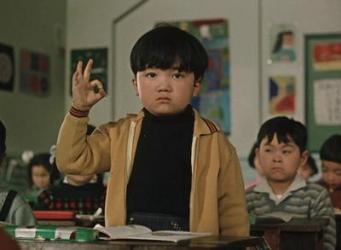
Review #134: 'Good Morning' (1959)

Japanese master Yasijuro Ozu repeated many themes in his movies. One of the key things running throughout  his films is the idea of communication, or the lack of it. Good Morning, or Ohayo (to give the film its native title) centres around two young brothers, Minoru (Koji Shitara) and Isamu (Masahiko Shimazu), who long to own a television set. Their parents refuse, citing the fact that it will kill the art of conversation as the reason why. The boys rebel after accusing grown ups of talking a lot but never saying anything worthwhile, and go on a vow of silence, much to their parents gratitude. In a key sub-plot, the town gossips accuse the neighbourhood treasurer Mrs. Haraguchi (Haruko Sugimura) of embezzling their funds in order to buy herself a new washing machine, when in fact one of the gossips' mothers had forgot to pass the money on.

Ozu's reputation as one of cinema's all-time greats and a director of elegance and sophistication is given a bit of a kick up the arse in this film. This is Ozu at his most hilarious. The mischievous brothers' increasingly desperate antics unwittingly causes mayhem amongst the townsfolk and inevitably has them bickering amongst themselves. It also contains lots of fart jokes. Yes, fart jokes, from Ozu. The brothers and their friends have a strange obsession with forcing out little farts as they push each others foreheads, which causes one unfortunate to repeatedly soil himself as he tries to take part.

The kids' accusations that grown-ups have nothing useful to say is as amusing as it is poignant. The communities breakdown in communication leads to all sorts of rumours flying around about where the treasuries money is, when a simple forgetful act is all that has taken place. Even when this is discovered and the matter appears to be cleared up, they still find ways to stir up trouble. And the scene where two singletons who are obviously attracted to each other talk about the weather to fill the awkward silences, is as heartbreaking as it is oddly magical. Only a true master such as Ozu can conjure two conflicting emotions from one scene. But beneath all the bittersweet comedy and social observations is a sobering message about the decline of community and the looming death of cinema. Stunning filmmaking from a true great.


Directed by: YasujirĂ´ Ozu
Starring: KĂ´ji Shitara, Masahiko Shimazu, Keiji Sada, ChisĂ» RyĂ»
Country: Japan

Rating: *****

Tom Gillespie


Good Morning (1959) on IMDb

Saturday, 23 April 2011

Review #45: 'Pillow Talk' (1959)

Jan Morrow (Doris Day) is a successful interior designer living in her cushy New York apartment, apparently content with her single life. Unfortunately for her, she shares a party line (a shared phone line) with composer and serial ladies man Brad Allen (Rock Hudson), and whenever she needs to make a call, she is always caught up in his crooning seduction technique which he tries on all the ladies. His arrogant playboy attitude riles Jan and she seeks to have the party line ended. Jan is also being wooed by millionaire client Jonathan Forbes (Tony Randall), who, unbeknownst to her, is Brad’s friend and business associate. After hearing about Jonathan’s infatuation with Jan, who Brad has never met, and after coincidentally coming across her in a bar, he adopts a fake Texan accent and backstory, and seduces Jan. Aiming to teach her a lesson, it’s only a matter of time before his cover is blown and the possibility that he may just fall in love with her.

The sight of Doris Day and Rock Hudson, with their squeaky-clean personas and rather smug characters, is usually enough to induce vomiting. However, in Pillow Talk, the first time I’ve seen the two together in one of their now-celebrated rom-com partnerships, I found them, and the film, a delight. Okay, so Doris Day is a tad annoying, but Rock Hudson is in great form here. Playing dual roles, he has the appeal to make his really quite nasty and obnoxious character still likeable. Tony Randall, always a reliable supporting character, is great fun too.

Modern-day romantic comedies should take notes from this on how to create a film with actual chemistry between the two leads, a witty script, and genuine charm. It has been attempted with films such as Down With Love (2003) and the Coen brothers’ Intolerable Cruelty (2003), but have ultimately failed to hit the mark. The film is also tightly directed by Michael Gordon, who maintains a snappy pace throughout.


Directed by: Michael Gordon
Starring: Rock Hudson, Doris Day, Tony Randall
Country: USA

Rating: ****

Tom Gillespie


Pillow Talk (1959) on IMDb

LinkWithin

Related Posts Plugin for WordPress, Blogger...