Showing posts with label France. Show all posts

Sunday, 12 May 2019

Review #1,478: 'Assassin's Creed' (2016)

Despite numerous critical and commercial failures over the last quarter of a century, Hollywood just cannot turn away from trying to capitalise on an industry that continues to out to out-gross them. Video game adaptations have been a thing ever since Nintendo tried and catastrophically failed to bring to life the colourful world of Mario and Luigi with 1993's Super Mario Bros., and it's become a running joke ever since that there has never been, and will unlikely ever be, a decent console-to-big-screen adaptation. But the $1 billion-plus success of Capcom's Resident Evil franchise lingers in the minds of many a studio head, so pretty much every year a new cast and crew are put together to develop a game series with a promise to break the trend. 

While the likes of Prince of Persia and Rampage are perfectly serviceable fluff, they are way overshadowed by the unbearable awfulness of a Lara Croft: Tomb Raider, or a Max Payne, or whatever hot turd Uwe Boll is serving up that month. We have gone through the disappointment too many times to believe it when a director promises to stick to the source material, but eyebrows were raised when it came to the inevitable movie adaptation of Ubisoft's hugely successful Assassin's Creed series, which plunged you into a centuries-old battle between the Knights Templar and a shadowy group known as the Assassins. Not only was Justin Kurzel, director of the truly unsettling Australian drama Snowtown and Shakespeare epic Macbeth, to helm the film, but Michael Fassbender and Marion Cotillard, two of the most respected actors in the business, were also signed up for the leads. Could this be the movie to finally bridge the two mediums and match the success of its source material?

The short answer is no, but by no means is Assassin's Creed a complete disaster. Its main problem is that it depicts two worlds from two different periods in time, but forgets to make them both interesting. We have the Inquisition-era Madrid, where hooded assassins move stealthily through the crowd armed with daggers and their wits, as they attempt to bring down those in power who seek peace in the land through control. The Assassins also long for peace, but peace gained through freedom, and they don't want a McGuffin known as the Apple of Eden, which somehow possesses the power to block humanity's free will, falling into their hands. This war has raged on for centuries, and in the modern era - a glum grey world full of murky corridors and empty rooms - the Templar continue their search for the Apple, employing a new technology that allows people to travel into the memories of their ancestors, to track down the allusive object through the centuries. 

We spend the bulk of the time in the present day, as convicted criminal Cal Lynch (Fassbender) is saved from the electric chair by Sofia (Cotillard) and spends much of his time brooding in his cell over the murder of his mother. I get the feeling that writers Michael Lesslie, Adam Cooper and Bill Collage want to keep you in the dark about who the good guys are here, but as soon as Jeremy Irons arrives with his black turtleneck sweater, you pretty much know how this is going to play out. The plot is an odd mixture of overly complicated and incredibly stupid, and much of the screentime is spent having these characters explain it to each other and the audience, or at least those in the crowd who have never played the game (like myself). When Cal finally straps up and enter the body of his ancestor Aguilar de Nerha, the movie springs into life, although this bleached-out world of questionable special effects and wannabe-Indiana Jones action may have seemed all the more exiting by the sheer dreariness of the alternative. 


Directed by: Justin Kurzel
Country: USA/France/UK/Hong Kong/Taiwan/Malta

Rating: **

Tom Gillespie


Assassin's Creed (2016) on IMDb

Friday, 3 May 2019

Review #1,474: 'Amour' (2012)

Austrian filmmaker Michael Haneke has been provoking - often outright antagonising - his audiences for decades, from the home invasion horror of Funny Games, to the ugly suburban murder of Benny's Video, to the bleak, post-apocalyptic vision of the future from Time of the Wolf. His 2012 effort, Amour, winner of the Palme d'Or at the Cannes Film Festival, is his most compassionate film to date, although Haneke's compassion still feels like a sledgehammer to the chest and a knife to the heart. The title, which translates as 'love' from French, is about precisely that, but this is not the syrupy, sentimental love we're used to from cinema, but the kind experienced by any couples lucky enough to have enjoyed a long-lasting relationship into old age.

The couple are retired music teachers Georges (Jean-Louis Trintignant) and Anne (Emmanuelle Riva), who both enjoy a comfortable bourgeois lifestyle in Paris. We are introduced to this grey-haired pair as they attend the concert of Alexandre (Alexandre Tharaud), one of Anne's former star pupils, and their subsequent car journey home. This is the only glimpse we are allowed of their everyday life, as once they arrive home to discover that someone has attempted to break in, we never leave the building again. The next morning, as they sit down to breakfast, Anne becomes unresponsive, gazing blankly into space as Georges tries to snap her out of it. Before the old man can get help, she is back to normal, completely unaware of this momentary void. Anne has suffered a stroke, and after an operation on her blocked carotid artery goes wrong, she is left wheelchair-bound and paralysed down one side.

In anybody else's hands, this could be a story of overcoming hopelessness and helplessness, and of a couple undeterred in the face of looming death. But Haneke isn't interesting in sentiment, and opts instead to observe the loving couple as Anne deteriorates further, pleading for an end to the pain and humiliation after a second stroke, while Georges cares for her as best as he can. Anne makes her husband promise never to take her back to the hospital, so their apartment becomes a tomb where any visitor is an unwelcome intrusion. Their daughter Eva (Isabelle Huppert) makes the occasional visit from London, where she lives with her British husband Geoff (William Shimell), to offer help, but she doesn't understand the emptiness of her offer. She isn't there for the diaper changes, the periods when Anne can do nothing but moan in pain, and Georges' struggle to move her whenever she needs to visit the bathroom.

It's tough, gruelling stuff, but it's heartbreaking in a way that anybody in a loving relationship can relate to. It's something we simultaneously hope to reach and ultimately dread, and there's a real unflinching honesty in the way Georges and Anne react to their new predicament. The idea that old age eventually catches up to everybody is hammered home by the casting of Trintignant and Riva, who have naturally grown into their 80s and are barely recognisable from their glamorous 60's heyday. However, Amour is not an exercise in misery. Haneke handles these characters with incredible delicacy, hinting at an unshakeable bond that, despite a few wobbles down the years, has only strengthened with time and has long since evolved into something greater than the word love can truly express. Amour certainly puts you through the ringer, but you'll likely emerge with a greater appreciation for your loved one.


Directed by: Michael Haneke
Starring: Jean-Louis Trintignant, Emmanuelle Riva, Isabelle Huppert, Alexandre Tharaud, William Shimell
Country: Austria/France/Germany

Rating: *****

Tom Gillespie


Amour (2012) on IMDb

Wednesday, 24 April 2019

Review #1,471: 'The Sisters Brothers' (2018)

French filmmaker Jacques Audiard has made a name for himself by focusing on morally-conflicted lead characters surviving any way they can in an environment they have no real control over. Whether it be the brutal prison setting of A Prophet, the street brawls of Rust and Bone, or the Sri Lanka torn apart by civil war in Dheepan, Audiard seems most at home when tossing his lead character in the deep end and observing as the survival instincts inevitably kick in. There is perhaps no greater time and place to explore humanity at its most savage and uncivilised as the Wild West, so Audiard feels right at home among the shootouts, saloon fights and general lawlessness of his latest film, the curiously-titled The Sisters Brothers.

Based on the novel by Patrick deWitt, The Sisters Brothers follows the titular siblings Eli (John C. Reilly) and Charlie (Joaquin Phoenix), two apparent opposites who seem to tolerate each other for their shared bloodline only. While their overall outlook on life couldn't be further apart, one skill the pair undoubtedly share is a knack for killing, and their exploits have granted them an almost mythical status throughout the land. They are hired killers in the employment of a shady businessman known only as the Commodore (Rutger Hauer), and their latest job is to track down and kill chemist Hermann Kermit Warm (Riz Ahmed), who has supposedly stolen from the old man. Their journey takes them from Jacksonville to San Francisco, but the mission is plagued by misfortune. Encountering everything from bear attacks to venomous spiders to rival hired hands, these mishaps allow plenty of time for the brothers to reflect on their life choices and their future, if they are ever to make it out alive.

As the elder of the brothers, Reilly's Eli hopes to eventually settle down and walk away from a life where death seems to await them at every turn. The drunken, unpredictable Charlie believes their lives couldn't get any better, and cannot imagine a world where his brother is not at his side. Little by little their backstories are revealed, and although he shares his younger sibling's flair for murder, it becomes clear that Eli's life would have turned out quite differently if he wasn't forced to pick up the pieces left in the wake of Charlie's destructive nature. The two actors are so good together that the film slows down when the action moves away from them, and more time is spent developing the relationship between Warm and softly-spoken private detective John Morris (Jake Gyllenhaal). Morris is actually working with the Sisters, but has a change of heart when Warm reveals his water-based formula that will potentially turn the tide for gold prospecting.

While these little detours slightly derail the film's pace, they prove intriguing enough in their own right. Despite the brutality of their surroundings and the natural hostility of the unexplored frontier, Warm and Morris are tidier, more articulate, and completely at odds with the survivalist nature of the anti-heroes of the title. They hint at a changing world, and the way the Old West is imagined by cinematographer Benoit Debie - shot in Spain - would be more at home with the auteur-driven revisionist westerns of the 1970s, but not so different to cause traditionalists to scoff. The key ingredients are all there: bursts of violence, whiskey-drenched brothel visits, and a long, perilous journey across country; but there is a sensitive, character-driven drama at its core. It was billed as a comedy of sorts upon its release, and although there are certainly laugh-out-loud moments, they serve only to reinforce the humanity lurking within its murky characters.


Directed by: Jacques Audiard
Starring: John C. Reilly, Joaquin Phoenix, Jake Gyllenhaal, Riz Ahmed, Rebecca Root, Rutger Hauer
Country: France/Spain/Romania/Belgium/USA

Rating: ****

Tom Gillespie


The Sisters Brothers (2018) on IMDb

Wednesday, 20 March 2019

Review #1,461: 'So Sweet... So Perverse' (1969)

The giallo may have been pioneered by the great Mario Bava and spectacularly refined by Dario Argento, but Umberto Lenzi was developing the techniques and stylings we now know and love from the mid-1960s. Before he became known for schlocky horror trash like Eaten Alive!, Nightmare City and Cannibal Ferox, Lenzi was toying with rich socialites and exploring pulpy, dime-store stories that often involved ridiculous, labyrinthine plots, psychedelic interiors, and beautiful, untrustworthy women. These are all ingredients of the giallo, and some of these early Lenzi efforts hint at a director with an eye for kitschy visuals, something that certainly doesn't come to mind when you watch a native tribesman scalp a poor traveller in the despicable Cannibal Ferox. These eye-catching visuals are certainly present in his 1969 film So Sweet... So Perverse, but there isn't much else to hold the attention in this plodding soap opera.

Handsome, jet-setting socialite Jean Reynaud (Jean-Louis Trintignant) enjoys a lavish lifestyle of cocktail parties and shooting ranges, but he has grown bored and frustrated with the lack of passion in his marriage to the beautiful Danielle (Erika Blanc). To counter this, Jean sleeps with anybody who happens to catch his eye, including his friend Helene (Helga Line), and his head is turned by the woman who has just moved upstairs, Nicole (Carroll Baker). When he hears screams coming from above, he rushes to Nicole's aid, learning that she is stuck in an abusive sexual relationship with her husband Klaus (Horst Frank). As they spend more time together, the couple inevitably fall in love, yet whenever they escape for a weekend, Klaus always manages to track them down. After a night of passion, Nicole reveals that she and Klaus have actually been paid a hefty sum to lure in and eventually kill Jean, but that the one doing the hiring has not yet revealed themselves.

With such a cool-sounding title (yet another famous trait of the gialli), there is nothing sweet and little perverse about the film itself. Argento eventually set a high standard for story-telling and the slow-building of tension within a vital set-piece, and the likes of Lucio Fulci and Sergio Martino added gory violence and a graceful style into the mix, but So Sweet... So Perverse is frustratingly tame, failing to ignite much interest in the plot or generate any excitement when events take a more sinister tone. Where Lenzi ultimately excels is in the glossy cinematography and dazzling interiors, which are garish enough to amusingly satirise the world of these detached characters and their materialistic lifestyles. Images of sun-drenched locations, expensive suits and beautiful, provocative women add a sleazy glamour and seductive glaze to the film, a hedonistic way-of-life Lenzi is happy to indulge as he shrewdly condemns it. It isn't quite enough to prevent So Sweet... So Perverse from becoming little more than a curious cinematic artefact, that ultimately paved the way for better directors to come along and take this new genre by the scruff.


Directed by: Umberto Lenzi
Starring: Carroll Baker, Jean-Louis Trintignant, Erika Blanc, Horst Frank, Helga Liné
Country: Italy/France/West Germany

Rating: **

Tom Gillespie


So Sweet... So Perverse (1969) on IMDb

Monday, 7 January 2019

Review #1,437: 'The House That Jack Built' (2018)

Seven years ago, Danish provocateur Lars von Trier found himself banned from the Cannes Film Festival after making a rather ill-timed joke about sympathising with Hitler during a press conference for Melancholia. For a festival that seems to inspire walk-outs and boos from audiences who have apparently never seen a film before, it was never going to be too long until von Trier wriggled his way back in. After all, for a director famous for clitoris-removal and the mocking of disabled people, the lure of free advertising from appalled cinema-goers would surely be too strong to resist. For his return, von Trier brought The House That Jack Built, a two and half hour serial killer movie that often feels like a stand-in for the director's self-satisfied smirk. Not only does the film feature animal cruelty, infanticide and open mocking of the #MeToo movement, but the anti-hero at its centre talks frequently at length about his real obsession. You guessed it: the Third Reich. This is a giant middle-finger to the Cannes board.

Jack (Matt Dillon) is a serial killer who, by the end, boasts more than 60 victims. He mainly kills women, but he also kills men and children if the subject is just right for his unique brand of 'art'. At the start of the film, he discusses his life and the nature of evil with an unseen man, played by Bruno Ganz, who we don't see until the very end. He defends his grisly past-times as artistic expression, claiming that everyone who died at his hands will be forever immortalised in his work. His story is recounted as a series of incidents, the first of which involves Uma Thurman as an impossibly stupid victim stranded by the road-side. Convincing Jack to give her a ride to a nearby garage that can fix her car jack, she almost talks the stranger into killing her, even handing him the murder weapon. When the brutal, sudden murder occurs, we almost feel a sense of relief. You can imagine von Trier stroking his chin and grinning at the thought of us feeling like she deserved it. Over the course of a decade, Jack ponders his favourite kills, taking the occasional detour to discuss architecture, literature and the work of Glenn Gould, and to repeatedly build and knock down his dream house.

For a film that understandably caused outrage at its premiere, The House That Jack Built isn't gory and full of spatter, but that isn't to say the film isn't frequently repugnant. An old lady is strangled to death for comic effect, a duckling has its leg snipped off, and worst of all, a child's corpse is contorted with wires and preserved in Jack's walk-in freezer, positioned in the background of many scenes just in case we happen to forget. Such blatant button-pushing would be forgivable, of even admirable, had this trudging vanity project been remotely convincing. Instead, its two and a half hours that feels two and a half hours, with a miscast Dillon delivering monologues on the beauty of genocide and the evolution of architecture while von Trier plans his next trick to make you feel uncomfortable. The film's best performance is delivered by Riley Keough as a young woman Jack cruelly names Simple. Jack toys with her low self-esteem before dispatching her in a horrendous manner, but there's real humanity lurking in this scene, and a real sense of dread conjured up by von Trier. The whole thing is almost saved by a climactic journey through a Hell seemingly inspired by the covers of death metal albums, which manages to be both truly eerie and cartoonishly comical. But then you remember what you had to get through to get there, and wonder how to get your 150 minutes back.


Directed by: Lars von Trier
Starring: Matt Dillon, Bruno Ganz, Uma Thurman, Siobhan Fallon Hogan, Sofie GrĂ¥bøl, Riley Keough, Jeremy Davies
Country: Denmark/France/Germany/Sweden

Rating: **

Tom Gillespie


The House That Jack Built (2018) on IMDb

Thursday, 13 December 2018

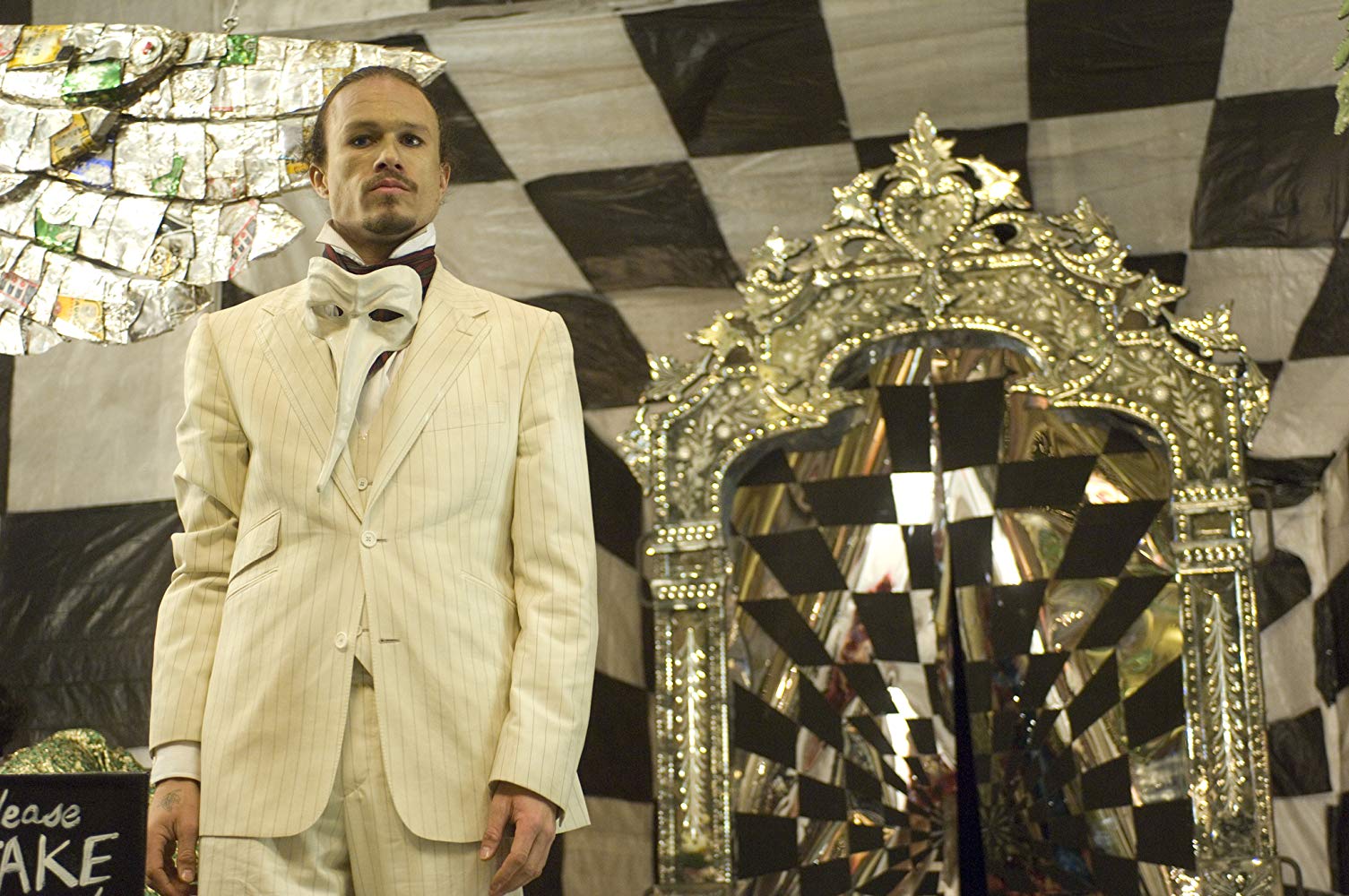
Review #1,429: 'The Imaginarium of Doctor Parnassus' (2009)

There are few filmmakers working today with a vision quite as singular as Terry Gilliam, and even less possess the sheer force of will to bring it to the big screen. His battles with producers are now the stuff of legend and, as seen in the wonderful documentary Lost in La Mancha, it literally takes a force of nature to bring one his productions down. While he remains an endearing figure in cinema and will always be a director to watch, he hasn't really made a great film since Twelve Monkeys, and that was over twenty years ago. His more recent films, most notably The Brothers Grimm and Tideland, have underwhelmed and somewhat flown under the radar, and this may have also been the case for his 2009 effort The Imaginarium of Doctor Parnassus if it hadn't been for the tragic death of star Heath Ledger during production.

Ledger plays the mysterious Tony, a man found hanging from a bridge by a travelling theatre troupe headlined by the titular Doctor Parnassus (Christopher Plummer). The group also consists of the Parnassus' old friend, the wise Percy (Verne Troyer), the old man's daughter Valentina (a charming Lily Cole), and former beggar Anton (Andrew Garfield), who is head over heels in love with Valentina. Tony has a mysterious and shady past, so he is happy to work for the Imaginarium in an effort to disappear from a very public life, and soon sets about transforming the show's old-timer decor and feeble efforts to attract an audience. Usually setting up the stage in dingy car parks or other undesirable locations, Parnassus' only boast is that of a magical mirror that can transport anybody who enters it into their own imagination. Anton is unhappy at the sudden appearance of this handsome stranger, who naturally attracts the attentions of Valentina, but the troupe may face a larger threat thanks to Parnassus' ancient wager with the Devil (Tom Waits).

There's a great idea in there somewhere, but the script by Gilliam and co-writer Charles McKeown (who also worked together on Brazil and The Adventures of Baron Munchausen) is so haphazard and unsure of itself that it often feels like three films crammed into one. This is no doubt down to the in-production re-writes that were necessary following Ledger's death (Johnny Depp, Jude Law and Colin Farrell were brought in to play alternate versions of Tony when he ventures behind the mirror), so sections of the film feel awkwardly patched together. But there is also much to like. The design of the Imaginarium itself is wonderful in its own tatty, weather-beaten way, and Waits, complete with pencil moustache, cigarette-holder, and that signature raspy voice, is irresistible as Satan himself. The moments set within the imagination are often silly and plagued with questionable special effects, but they also occasionally sparkle with the same kind of magic of Gilliam's Monty Python animation. While it may not be the ideal film to finish his short career on, the film plays a lovely tribute to Ledger and will always be a reminder of the talent we lost far too soon. Sadly, this is likely all Imaginarium will be remembered for, but its a sporadically entertaining ride while it lasts.


Directed by: Terry Gilliam
Starring: Heath Ledger, Christopher Plummer, Andrew Garfield, Verne Troyer, Lily Cole, Tom Waits, Johnny Depp, Jude Law, Colin Farrell
Country: UK/Canada/France/USA

Rating: ***

Tom Gillespie


The Imaginarium of Doctor Parnassus (2009) on IMDb

Thursday, 22 November 2018

Review #1,423: 'Mission: Impossible - Fallout' (2018)

Over the course of twenty-odd years, Tom Cruise has clung to the side of an aeroplane as it soared into the sky, had a knife held millimetres away from his eyeball, and ran down the side of the world's tallest building, all for the sake of the Mission: Impossible series, a franchise that no-one would have dreamt would still be packing cinema screens two decades later when it began back in 1996. Cruise's enthusiasm for putting himself at genuine risk of death has seen these movies continuously trying to outdo each other, and the sixth in the series, Christopher McQuarrie's Fallout, is not only the most ambitious in scale and clinical in its execution, but may also just be one of the finest action pictures ever made. I never believed the sight of Cruise running across the outside of the 119th floor of Dubai's Burj Khalifa would ever be topped, but Fallout delivers not one but two superior set-pieces, and that's not even mentioning the rooftop-hopping that saw Cruise break his leg and carry on with the scene. 

Ethan Hunt and his Impossible Mission Force team are tasked this time with intercepting three plutonium cores in Berlin before they fall into the hands on an organisation called The Apostles, a terrorist group made up of survivors from The Syndicate. Joined by Luther (Ving Rhames) and Benji (Simon Pegg), the team fail in their mission when Hunt refuses to let one his own die. As the terrorists make off with the plutonium to sell to a mysterious buyer called John Lark, Hunt receives a dressing-down from CIA director Erika Sloane (Angela Bassett), who is furious at their failure to secure the weapons of mass destruction. She forces Hunt to take on CIA operative August Walker (Henry Cavill) as a shadow, and the odd couple head off to Paris to track down Alanna (Vanessa Kirby), an arms dealer they believe has connections to Lark. Double-crosses and high-speed chases ensue, as well as Tom Cruise's trademark run, as all paths start to lead back to Solomon Lane (Sean Harris), the formidable villain from last time.

Christopher McQuarrie is the only director to have returned for a second stab at the Mission: Impossible gig, and the choice seems odd given how lacklustre Rogue Nation proved to be. But whatever he failed to grasp last time around he confidently nails here. McQuarrie and Cruise pull out all the stops, executing everything from a terrifying night-time sky-dive to a helicopter chase that sees Cruise plummet from the chopper's rails to the cargo swinging 40 feet below like veteran masters of the genre. The sheer risk and danger of some of the stunts pulled off here is gobsmacking, and Cruise can now comfortably sit alongside the likes of Jackie Chan as one of the greatest action stars ever. Cruise isn't the only star of course: Cavill particularly impresses as the deadpan slugger with a moustache so impressive it manage to cock up Justice League's re-shoots. Rhames and Pegg, who are both given larger roles than usual, can now banter like colleagues who have worked with each other for four movies, and reliable support is given by the likes of Rebecca Ferguson, Alec Baldwin and Michelle Monaghan. At two and a half hours, it can be argued that there's at least one climax too many, but I doubt anyone will be checking their watches. 


Directed by: Christopher McQuarrie
Country: USA/China/France/Norway

Rating: ****

Tom Gillespie


Mission: Impossible - Fallout (2018) on IMDb

Friday, 5 October 2018

Review #1,401: 'True Romance' (1993)

It's been many years since I last saw Tony Scott's True Romance, huddled up in my bedroom as a young teenager in fear of being caught with my older brother's VHS. I loved it then and I still like it very much, but it never struck me before just how much of a boy's fantasy the film is. This is a story in which a comic-book store worker forms a relationship with a gorgeous hooker-with-a-heart and successfully avenges her mistreatment at the hands of a despicable pimp, all before riding off to Hollywood with a case full of cocaine and dreams of an early retirement in mind. This is no surprise when you see who was behind the script - a young Quentin Tarantino - who at the time of writing was working in a video store dreaming of bigger and better things. But the fact that this is a fantasy isn't a bad thing. True Romance sweeps you up into its universe of outlaw love, mean-spirited gangsters and the ghost of Elvis Presley and doesn't allow you to pause for breath.

The hero at the centre of the story is Clarence Worley (Christian Slater). We meet him in a bar trying to chat up a woman by expressing his love for Elvis and inviting her to join him in a Sonny Chiba triple bill playing at the local theatre. You can almost imagine Tarantino speaking these words and being hit with a rejection, but Clarence is Tarantino's creation, so he has popcorn spilled over him by an attractive blonde named Alabama (Patricia Arquette) as he sits watching one of The Streefighter films alone. The two hit it off and spend the night together, before she reveals she is actually a call girl hired by his friends (the name should have been a hint). But she actually falls in love with Clarence, and him with her, and the two are quickly married before Clarence's attention turns to the pimp who is still holding her belongings, the milky-eyed and dreadlocked Drexl (Gary Oldman). Their confrontation leaves Clarence in possession of a suitcase chocked full of cocaine, so the newly weds head to Los Angeles to find a buyer, with the help of their clueless contact and aspiring actor Dick (Michael Rapaport).

Their road trip allows the opportunity for some familiar faces to flex their acting chops with the assistance of Tarantino's impeccable screenplay, including the likes of Dennis Hopper as Clarence's estranged father, Christopher Walken as fearsome gangster Don Vincenzo, Brad Pitt as Dick's useless stoner roommate Floyd, and a noticeably thinner James Gandolfini as one of Vincenzo's more sadistic thugs. It's a fast and furious two hours, with so much going on that you're barely given time to stop and realise that nothing much really adds up. The film sweeps you up into its silliness, forcing you to bow down to its own particular brand of cool. If you've seen Tarantino's directorial debut Reservoir Dogs, then many of True Romance's story beats will feel familiar (the story carefully moves its characters into place so they will eventually be in the same room at the same time with loaded guns pointed at each other), but Scott's style and energy make the ride exhilarating. The two leads are charming, with Slater convincing as a geek-turned-loose cannon and Arquette portraying just the right blend of cute and sexy, but the real star is Tarantino, who somehow manages to turn an adolescent fantasy into an exciting thrill ride.


Directed by: Tony Scott
Starring: Christian Slater, Patricia Arquette, Dennis Hopper, Val Kilmer, Gary Oldman, Brad Pitt, Christopher Walken, Michael Rapaport, James Gandolfini
Country: USA/France

Rating: ****

Tom Gillespie


True Romance (1993) on IMDb

Monday, 17 September 2018

Review #1,393: 'A Prayer Before Dawn' (2017)

Opening with a shot of the muscly, pale-skinned and heaving back of our protagonist, Jean-Stephane Sauvaire's A Prayer Before Dawn - his first feature since the eye-opening Johnny Mad Dog in 2008 - begins and ends with British newcomer Joe Cole, and the talented young actor dominates every scene in between. Best known for his role in Peaky Blinders, Cole delivers a performance of pure ferocity, and if there's any justice, this will do for him what the likes of Bronson and Starred Up did, respectively, for then up-and-comers Tom Hardy and Jack O'Connell. Based on Billy Moore's brutal memoirs of his time served in one of Thailand's most unrelenting penitentiaries, the film tracks his journey from the only Westerner in his cell with a target on his back to Muay Thai champion. While it may dabble in the tropes of the prison and boxing genres, it never really relaxes into either, making for an unsettling and visceral two hours.

Rather than opting for a comfortable, straight-forward narrative, Sauvaire prefers to capture the sweaty, overbearing atmosphere of Moore's new lodgings, heightening the sound design so every breath sounds like it's coming from your own head, and every punch rattles your brain. David Ungaro's cinematography makes the most of the tight, damp spaces, as the inmate's bodies pile over each other like sardines in their overcrowded cells. The film feels almost like an invasion of your personal space, and the fact that Billy sticks out like a sore thumb only increases the feeling that danger lurks around every corner. Billy's physicality and willingness to fight may save him from regular beatings and even earn him a level of respect amongst his heavily-tattooed, dead-eyed cell-mates, but he is still forced to watch the gang-rape of a young newcomer to remind the Westerner of his place. Although the story leads up to a climactic fight, it avoids cliche by offering no sense of build-up. Billy simply must fight in order to survive the night and battle his own pent-up demons.

Without a main character to carry your interest, A Prayer Before Dawn may be too much to bear. But Billy, whose reasons for being in Thailand in the first place and dealing the drugs that landed him in the slammer aren't explored, is a true force. Never asking for your sympathy, Billy struggles with heroin addiction - fed to him by a prison guard played by Only God Forgives' Vithaya Pansringarm - and is more than willing to beat somebody half to death to earn his fix. The rage that drives him comes from deep within, and his anger and self-destruction carries us along with him. Even when he is finally allowed to train in the gym, thanks for a routine cigarette bribe, his tendency to self-sabotage sees him almost screw up everything he's worked for. Billy also finds solace in a ladyboy named Fame (Pornchanok Mabklang), who is in prison for murdering her father and is kept in a separate part of the prison for obvious reasons. They form a bond through shared feelings of misplacement, and these scenes offer a reprieve from the unrelenting harshness of Billy's everyday routine. It's a tough watch, but there's always much to admire in a film that can leave you so mentally and physically exhausted.


Directed by: Jean-Stéphane Sauvaire
Starring: Joe Cole, Pornchanok Mabklang, Vithaya Pansringarm, Panya Yimmumphai
Country: UK/France/China/Cambodia/USA

Rating: ****

Tom Gillespie


A Prayer Before Dawn (2017) on IMDb

Friday, 22 June 2018

Review #1,354: 'The Neon Demon' (2016)

The arrival of a new movie by Danish director and enfant terrible Nicolas Winding Refn is always a cause for excitement. Not because the filmmaker's name is any kind of guaranteed stamp of quality, but because of our natural curiosity to see just how far he is willing to push his audience. His 2011 smash and Hollywood breakthrough Drive was a surprise treat: a neon-lit journey into the underbelly of L.A. that featured a career-defining performance by Ryan Gosling. His follow-up Only God Forgives was a massive disappointment and received a near-universal panning, but there was enough style there to maintain the belief that Refn was still capable of delivering something special. Sadly his next film, The Neon Demon, is similarly hollow, kicking up such a stink at Cannes that it inspired mass booing, although just as many were cheering it.

Where the L.A. of Drive was dangerous and seductive, the City of Angels depicted in The Neon Demon is one cut straight from a glossy fashion magazine. Models are dolled up to look like corpses, staring dead-eyed into the lens as the shady photographer watches ominously. The city's latest arrival is porcelain-skinned beauty Jesse (Elle Fanning), who natural golden curls and cute nose draw jealousy from her cosmetically-enhanced rivals. She has just celebrated her 16th birthday, but a modelling agency talent spotter (played by Christina Hendricks) advises her to claim she's 19, should anybody ask. She soon catches the eye of some of the best photographers in the business, all of whom seems instantly enchanted by her looks and youth. As make-up artist Ruby (Jena Malone) puts it, Jesse just has that 'thing'. That thing is innocence, but such a quality cannot last in a cut-throat industry where models eat each other alive.

There's always been a grimy quality to Refn's movies, even in his most polished output. The Neon Demon is his closest brush with horror, and the director initially seems like the perfect fit for the genre. Yet this button-pushing slog will likely inspired yawns and frustration rather than gasps and shudders. It seems like Refn has a list of taboos he's eager to tick off his body of work, and The Neon Demon is happy to indulge in everything from necrophilia to cannibalism. It's a premise built on the flimsiest of metaphors, and the resulting message ultimately seems to be that some men are sleazy, women can be bitches, and the fashion world is vacuous and materialistic. Sub-plots are introduced, such as an incredibly dull love interest (Karl Glusman) and an unscrupulous motel owner (Keanu Reeves), but they lead nowhere and serve no real purpose to the story. It's provocative for the sake of being provocative, which wouldn't be a huge problem if the film wasn't so utterly ponderous. Like his fellow countryman Lars von Trier, Refn is eager to shock, but there can be little to no impact when there is a complete lack of substance.


Directed by: Nicolas Winding Refn
Starring: Elle Fanning, Karl Glusman, Jena Malone, Bella Heathcote, Abbey Lee, Keanu Reeves, Alessandro Nivola, Christina Hendricks
Country: Denmark/France/USA/UK

Rating: **

Tom Gillespie


The Neon Demon (2016) on IMDb

Monday, 23 April 2018

Review #1,327: 'You Were Never Really Here' (2017)

In the latest offering from the great cinematic filmmaker Lynne Ramsay, Joaquin Phoenix stars as a psychologically scarred combat veteran who dishes out his own particularly brutal brand of justice without blinking an eye. With his massive beard generously flecked with grey and straggly long hair tightly pulled back into a man-bun, he hasn't looked so dishevelled since his faux-public breakdown for Casey Affleck's mockumentary I'm Still Here in 2010. His clothes look like they haven't been washed in months, and there's a redness look in his eyes that hints at a lack of sleep or a reliance on prescription medication. He is packing a bit of a gut and a lack of definition, but he carries himself like a fearless UFC fighter bounding into the ring, ready and eager to destroy whoever is thrown in with him. His character, Joe, is a modern day Travis Bickle. Yet while you would cross the street in fear that Bickle may say or do something weird, you would flee from Joe just in case he bashes your skull in with a hammer.

You Were Never Really Here, based on the novel by Jonathan Ames, is an incredibly violent, unflinching picture. But Ramsay is an intelligent, thoughtful filmmaker, way more interested in characters and mood to be distracted by the many horrors on show. She doesn't dwell on the violence, and instead views it through the eye of a security camera, or a half-seen reflection in a mirror. Sometimes even the sound alone, combined with Jonny Greenwood strange and hypnotic score, is more than enough to creature a vivid picture in your mind of what is transpiring. Ramsay simply isn't interested in visualising the bloodshed, and this shrewd approach skilfully makes the many horrific acts committed by Joe all the more wince-inducing. Her focus rests purely with Joe himself, beginning with a portrait of a man long pushed over the edge, before journeying even more inward and downward.

Joe earns his keep by hiring himself out for covert missions that may require action not necessarily permitted by law. A purposefully confusing and violent opening sets the tone: Joe is simply not to be messed with, and does not flinch at the possibility of violence. He has a reputation for brutality, which is precisely the reason he is paid by frustrated parents to find missing kids, usually those kidnapped for sex trafficking purposes, by man-in-the-middle John McCleary (The Wire's John Doman). In his downtime, he also cares for his elderly mother (Judith Roberts). Ambitious young New York Senator Albert Votto (Alex Manette) wants Joe to locate his missing daughter Nina (Ekaterina Samsonov), and carry out whatever it takes to make her abductors suffer for their crimes. Joe accepts the job, and it doesn't take long for him to find the shell-shocked teenager. What happens next would be venturing into spoiler territory, but Joe is sent down a dark path to redemption, unravelling a conspiracy way above his pay grade.

Despite what many critics have said, You Were Never Really Here isn't Lynne Ramsay's best film, and will surely be her most divisive. Some parts just don't work: Although it is by no means integral to film's themes and focus, the revelations of Joe's investigations may have attracted Liam Neeson with a vastly different director at the helm, and the final scene, which touches on fantasy, clashes uncomfortably with what came before. But these issues don't affect the film's sheer impact. At its best, You Were Never Really Here is pure cinema, dragging you through the squalor by the neck and plunging you into the mind of a truly damaged soul. I haven't felt so beaten up - in a good way - by a movie since the first time I saw Elem Klimov's Come and See. As Joe, Phoenix has probably never been better. He is a ticking time-bomb, favouring the use of a hammer against his enemies. In one of the film's finest scenes, Joe is asked by a young girl to take a picture of her and her friends. He mumbles and agrees, before a close-up of the girl reveals her to be crying. Is this a hallucination, or has she seen the pain etches across his face? Reality and dreams are melded together into a 90-minute punch to the gut, and Ramsay proves once again why she is one of the greatest working filmmakers.


Directed by: Lynne Ramsay
Starring: Joaquin Phoenix, Judith Roberts, Ekaterina Samsonov, John Doman, Alessandro Nivola
Country: UK/France/USA

Rating: ****

Tom Gillespie


You Were Never Really Here (2017) on IMDb

Sunday, 18 March 2018

Review #1,316: 'Paddington 2' (2017)

Paul King's Paddington was one of the great surprises of 2014: a re-imagining of a world-famous character beloved not only to children, but to the adults who grew up reading Michael Bond's stories or watching the various television incarnations since the 1970s. Aesthetically, it shared very little in common with the charmingly old-fashioned and quaint little adventures penned by Bond and illustrated by Peggy Fortnum, but shared much of its heart. Most who saw Paddington fell quickly under its spell, which was a wonderful amalgamation of Wes Anderson and Jean-Pierre Jeunet's proudly artificial visual splendour and the stiff upper lipped playfulness of Ealing Studios. This sequel's arrival is more than welcome, if not only to make us forget what's happening out there in the real world, but to allow us to spend more time in the company of Ben Whishaw's endearingly clumsy yet optimistic bear.

In almost every way, Paddington 2 is an improvement on its predecessor. The return of King and his co-writer Simon Farnaby is a no-brainer, and they have not only grown in confidence and in their willingness to push their kooky boundaries even further, but they have fixed what was arguably a weak link first time around - the villain. Nicole Kidman had a ball as evil taxidermist Millicent Clyde, but here they have tried something less terrifying for kids in Phoenix Buchanan, a washed-up thespian who dreams of bringing his one-man show to the West End, but finds himself in humiliating dog-food television adverts instead. Casting Hugh Grant was a stroke of genius, and it's no stretch to say that this is the finest he has ever been. He's pompous and full of himself, but takes pride in his ability to disappear into his characters. His desire to spark his festering career back to life leads to the theft of a valuable pop-up book from the store of Mr. Gruber (Jim Broadbent), which holds clues to the location of a treasure chest hidden somewhere in London.

Phoenix Buchanan may steal the film, but the attention rarely strays too far from the titular hero, who is once again voiced pitch-perfectly by Whishaw. He was Colin Firth's last-minute replacement first time around when the Kingsman actor's efforts didn't quite feel right, and it's difficult to imagine any other actor behind Paddington's soft features and wide-eyed curiosity. When we first meet him, it's clear that the charming little bear's community wouldn't quite function without him. The Brown family, again played by Hugh Bonneville, Sally Hawkins, Julie Walters et al, are happily getting on with their lives, although dad Henry is experiencing a midlife crisis at work and with his ageing appearance. With Aunt Lucy's 100th birthday coming up, Paddington finds the perfect present in the pop-up book of London in Mr. Gruber's store, which he hopes will compensate for the elderly bear never being able to see the big city for herself. He starts to work odd jobs to save up for the pricey gift, but all suspicion falls on Paddington when Buchanan steals the book for himself.

He is sentenced to ten years in prison for the crime, and if that seems unnecessarily harsh, you'll understand why when you see the film. This may seem like a somewhat grim direction for a family film to take, but thanks to a mishap involving a stray red sock in the laundry room, the scenes within the jail are some the film's funniest. This is also thanks to the character of Knuckles McGinty, the fearsome chef played brilliantly by Brendan Gleeson who Paddington naturally befriends over some marmalade sandwiches. Paddington 2 is unashamedly fanciful stuff, presenting a fantasy vision of London where the sun always shines and people on the street always greet you with a smile. It's an image many foreigners will no doubt have of the capital, but there's nothing wrong with playing up to this, especially when the film's fantasy sequences are quite as wonderful as they are. Production designer Gary Williamson and animation director Pablo Grillo are a crucial part of this, and King, who always displayed a flair for the fantastical in his early TV work, surely also had a hand in Paddington 2's overall magical feel.


Directed by: Paul King
Starring: Ben Whishaw, Hugh Bonneville, Sally Hawkins, Hugh Grant, Brendan Gleeson, Julie Walters, Jim Broadbent, Tom Conti, Peter Capaldi
Country: UK/France/USA

Rating: ****

Tom Gillespie


Paddington 2 (2017) on IMDb

Monday, 12 March 2018

Review #1,313: 'Goto, Isle of Love' (1969)

Polish-born, French-based filmmaker, animator and artist Walerian Borowczyk is mainly remembered for his erotic works such as The Beast and The Margin, and has been described as "a genius who also happened to be a pornographer." Before he dabbled in eroticism, he produced many animated shorts before his first feature-length piece, the wonderfully weird Mr. and Mrs. Kabal's Theatre. His first live-action film, Goto, Isle of Love, employed similar tactics to his hand-drawn experiments: a desolate island setting, limited camera movements, and frustratingly (yet fascinatingly) odd and unrelatable characters. The result is somewhat isolating, but often reminiscent of the surreal genius of Georges Franju, Luis Bunuel and Borowczyk's friend and sometime collaborator Chris Marker.

Tidal inundation has seen the island of Goto cut off from the rest of Europe for three generations. It has seen three leaders since - Goto I, Goto II, and the current ruler Goto III (Pierre Brasseur) - and the monarchy rules as a dictatorship, 'protecting' the island from outside dangers and influences. There seems to be little to do on the island, so Goto keeps himself and his wife Glossia (Ligia Branice) entertained by staging fights between prisoners. Petty thief Grozo (Guy Saint-Jean) manages to survive his battle with a towering lug-head and wins the sympathy of Goto. Grozo's reward is a job building fly-catchers and showing off his work to a classroom of under-educated children. He also uncovers an affair between Glossia and handsome captain-of-the-guard Gono (Jean-Pierre Andreani), and grows bolder and more ambitious in his scheming as he seeks to claw himself up the social ladder.

On an island populated by criminals, no-hopers and aristocrats, Glossia emerges as the only sympathetic character. Played by La Jetee's Ligia Branice, she longs to escape this grey, mundane world, her eyes shining with tears as she watches the boat she hoped to sail away on sank before her. With little to hold on to on an emotional level, Goto becomes an observational piece, a commentary on an isolated society with an obvious anti-dictatorship stance. This is a world so lacking in stimulation that the object which draws the most fascination is a cutting-edge fly-catcher stolen by Gozo and flogged as his own design. It's deliberately farcical but lacking in humour, with the world made even more soul-crushing by the stark black-and-white photography and Borowczyk's preference for limited camera movements. It's an interesting piece but one that will likely leave you feeling cold, but certainly a work of art deserving of rigorous study.


Directed by: Walerian Borowczyk
Starring: Guy Saint-Jean, Ligia Branice, Pierre Brasseur, Jean-Pierre Andréani
Country: France

Rating: ***

Tom Gillespie


Goto, Island of Love (1969) on IMDb

Friday, 9 March 2018

Review #1,312: 'The Death of Stalin' (2017)

After spending most of the 1990s helping create the likes of The Day Today and I'm Alan Partridge - two of the greatest comedy works to have ever come out of Britain - satirist Armando Iannucci really made a name for himself with The Thick of It, a political farce centred around a bunch of politicians and spin doctors within a fictional government department going to ridiculous lengths to further their own careers and avoid the sack at the behest of an unseen prime minister. This led to the brilliant spin-off feature film In the Loop, before he would go on to tackle U.S. politics with acclaimed HBO series Veep. These groundbreaking satires now seem like they were a mere warm-up for his most ambitious project yet, The Death of Stalin, which covers the panic-stricken aftermath following the demise of one of the Soviet Union most notorious dictators, Joseph Stalin.

For the film, Iannucci has gathered together some of the finest British actors working today: those who are as comfortable with improvisation as they are with brooding monologues. Michael Palin is Molotov, the nervously chirpy minister who remained loyal to Stalin after the execution of his wife; Andrea Riseborough is Svetlana, Stalin's emotionally crumbled daughter; and Rupert Fried is the drunken son Vasily. Most impressive of all is Simon Russell Beale as the reptilian Lavrenti Beria, a man renowned for his love of rape and torture who is now desperately picking up the scraps and trying to seize power. Working against Beria is Steve Buscemi's Khrushchev, the former cabinet jester who may actually be the country's best bet. Trying to hold it all together is Jeffrey Tambor's timid Malenkov, who despite unwavering loyalty to his leader discovers his name on a death list before the big guy drops dead, and is installed as acting Premier shortly after.

There are many belly laughs to be enjoyed in The Death of Stalin, but Iannucci's approach to the subject matter often approaches horror territory. While the worst the players in The Thick of It faced was public embarrassment or a dressing down from Malcolm Tucker, here one ill-timed comment can land you with a bullet in the head. It's an incredibly scary place, where characters stroll nonchalantly through grey buildings as screams and gunshots hum in the background, and people are taken from their homes by armed officers for some imagined slight. The comedy and tragedy are incredibly well-balanced, and intensifies the absurdity of political life to genuinely concerning levels. Watching the terrible events unfold as these desperate men stutter and scurry around like rats, willing to back-stab and manipulate their colleagues without pausing for breath if it means buying themselves some extra time, is irresistible. As you would expect, Iannucci's script (co-written by David Schneider and Ian Martin) is expletive-laden and sharp as a dagger, and the entire ensemble are at the top of their game. It's unlikely The Death of Stalin will ever see a release in Russia, but someone should definitely suggest Putin adds it to his IMDb watchlist.


Directed by: Armando Iannucci
Starring: Steve Buscemi, Simon Russell Beale, Jeffrey Tambor, Andrea Riseborough, Michael Palin, Paddy Considine, Jason Isaacs, Rupert Friend, Olga Kurylenko
Country: UK/France/Belgium

Rating: ****

Tom Gillespie


The Death of Stalin (2017) on IMDb

Friday, 12 January 2018

Review #1,292: 'Neds' (2010)

After spending much of the 1990's making a name for himself as an intense character actor in the likes of Trainspotting and My Name Is Joe, Peter Mullan announced himself as a director to watch with 1998's Cousins. He followed that four years later with the powerful The Magdalene Sisters, but didn't make another film until eight years later with his most personal project to date, Neds. His tough upbringing in a rough area of Glasgow meant that his talents in front of the camera would normally be employed in tough, intimidating roles, and Mullan drew upon his experiences as a young man for Neds, a social realist drama depicting an academically promising young boy's descent into gang culture and into the footsteps of his notorious older brother.

'Neds' stands for Non-Educated Delinquents, a term I heard often during my time living in Edinburgh, and one applied to the sort of tracksuit-wearing hooligans also labelled as 'scallies' or 'chavs', depending on which area of the UK you're from. The 'ned' here is John McGill, played by Greg Forrest as a youngster growing up in 70's Glasgow who hopes to use his intelligence to make something of himself, but finds himself pulled onto the streets due to a number of factors: from his disinterested, cane-happy teachers to the pressure of living up to his brother's reputation. He grows taller and broader (to be played by Conor McCarron) and quickly makes a name for himself, participating in petty crime and street fights, and rebelling against his school education. His home isn't a happy one, and the family live under the tyrannical rule of John's father (played by Mullan). Mr. McGill isn't much to look at, but he has a presence terrifying enough to silence a room when he enters, and a tendency to come home drunk and bawl abuse at his long-suffering wife.

Mullan has a real talent for staging tense situations, with some of the events played out in Neds no doubt taken directly from real experiences. A booze-fuelled neighbourhood party quickly deteriorates into smashed windows and a mass brawl, with the thugs brandishing the ugliest of weapons designed to cause maximum harm. There's heart and humour too, and Mullan manages to keep John sympathetic throughout, despite his questionable behaviour. Despite his concentration, Mullan drags the film out longer than is needed, and a number of the climactic scenes are suited to be the film's final moment. A swerve into drug-fuelled surrealist territory is well-intended but doesn't really work when wedged into the film's ultra-realist aesthetic, and the scene feels out-of-place and unintentionally amusing. Still, this is raw, unflinching film-making from a director clearly hoping to draw attention to the plight of youngsters growing up in such grim working-class surroundings, where respect is earned through brutality and allegiances are decided by which side of the bridge you live on.


Directed by: Peter Mullan
Starring: Conor McCarron, Greg Forrest, Joe Szula, Mhairi Anderson, Peter Mullan
Country: UK/France/Italy

Rating: ****

Tom Gillespie


Neds (2010) on IMDb

Thursday, 14 December 2017

Review #1,280: 'Dunkirk' (2017)

There are countless stories of courage and bravery that made their way out of World War II, but perhaps none more famous or as inspirational (at least to us British) as the story, or miracle, of the Dunkirk evacuation. Following the six-week long Battle of France, Allied forces found themselves holed up on the beaches of Dunkirk and surrounded by German forces. Over the course of eight days, over 300,000 troops were rescued by a hastily assembled civilian navy of fishing boats, yachts and lifeboats called into action from Britain. Although Churchill was quick to remind the people that "wars are not won by evacuations," the incident became a symbol of British stiff-upper lipped stoicism and a powerful propaganda tool.

Many movies have covered the event, from 1942's Mrs. Miniver to 2007's Atonement, as well as Leslie Norman's underrated 1958 film Dunkirk. But none have managed to capture the sheer horror of the situation these troops found themselves in as Christopher Nolan's latest, which is an out-and-out masterpiece of technical wizardry and raw, grinding sound design. Long a passion project for the director, Dunkirk drops you into the thick of the action from the get-go with the welcome assumption that audiences will enter the film with at least some prior knowledge, and doesn't let up until the very end of its relatively short 106 minute running-time with the constant ticking of what feels like an ever-present clock. Nolan is determined to put you through the wringer, and does so by placing you up close and personal with the men on land, at sea, and in the air.

The closest person we have to a leading character is Tommy (Fionn Whitehead), a young and resourceful grunt who stumbles onto the beach after evading the Germans. He quickly plots his escape by attempting to board a boat carrying a wounded soldier, and later teaming up with a young soldier played by Harry Styles (who is absolutely fine) as they try desperately to survive the growing carnage. At sea, proud mariner Mr. Dawson (Mark Rylance) sets sail from Britain to rescue "our boys" and do his part in the war. Picking up a shell-shocked soldier played by Cillian Murphy on the way, Dawson must navigate oil-soaked waters with burning ships all around and avoid the German planes screaming in the sky. Battling the Luftwaffe in the air are Spitfire pilots Farrier (Tom Hardy) and Collins (Jack Lowden), the former having to carry out his duty without the aid of his fuel gauge.

These stories do not take place chronologically, a gimmick now something of a Nolan trademark. While this works wonders in a film like Memento, it adds an unnecessary layer of confusion to the unfolding narrative in Dunkirk, occasionally removing you from the action as you try and establish where we are in the story. With Nolan's decision to do away with any backstory to the characters - who are still fully realised and wonderfully performed - there's also a lack of emotional investment. Yet it could be argued that this approach only adds to the fog of war and the terrifying randomness of combat, and this is the most thrilling depiction of battle since 1998's Saving Private Ryan, only without the spatter and gore. Nolan also avoids flag-waving patriotism and finger-pointing, something that Spielberg's Oscar-winner failed to do. Although it's not the complete masterpiece many of us hoped for (although I suspect the majority will disagree), Dunkirk is one of Nolan's most accomplished and dazzling pieces of work. It may not move you, but it will leave you in awe.


Directed by: Christopher Nolan
Starring: Fionn Whitehead, Mark Rylance, Tom Hardy, Kenneth Branagh, Jack Lowden, Harry Styles, Tom Glynn-Carney, Cillian Murphy
Country: UK/Netherlands/France/USA

Rating: ****

Tom Gillespie


Dunkirk (2017) on IMDb

LinkWithin

Related Posts Plugin for WordPress, Blogger...