A film that could easily be a how-to guide, 'How to Destroy Lives and Topple Corporations', sees Barbara Stanwyk's Lily Powers move from the drab surroundings of rural Eerie, to the bustling city of New York, Baby Face is a film about the power of sexuality, and it's inherent dangers. A local friend in Eerie, Professor Adolf Cragg (Alphonse Ethier), reads sections of Nietzsche's 'Will to Power', and asserts that she should move to the big city and exploit her sexuality to manipulate men to get what she wants. Powers proceeds to gain power and position in a bank, using men with sexual favours to climb the ladder, and fundamentally gain material wealth.
This was quite a common theme in Hollywood cinema of the 1930's, with the depression well under way, things were scarce. Jean Harlow had played a similar role in Jack Conway's Red-Headed Woman (1932). Of course this was exactly the kind of amoral characterisations that the Production code, often known as the Hays Code (after it's head Will Hays), was targeting as subversive and depraved for cinema audiences. The morality of the 1920's lingered for a short period into the Great Depression, which was seen by conservatives such as Hays, as a contributing part of the Wall Street crash.
With the progression of Powers through a succession of men within the bank, she inevitably leaves a line of men besotted with her. She becomes a kept woman by the head of the bank, and the confused and simple minds of the men are led to deceit. It's a terrifically twisted plot, but also it does not necessarily give the femme fatale her deserved conclusion. But she does learn the importance of people over the accumulation of material wealth - perhaps the perfect end to decadence in poverty stricken '30's America.
The film begins with a heavily-bandaged stranger arriving at a remote inn and demanding a room. He insists that he is to be left alone, only for the nosy innkeeper to keep interrupting his work. Tired of the intrusions, the stranger attacks the woman and her husband, and then later the police. He removes his bandages in a psychotic rage and escapes, randomly attacking the townsfolk as he flees. He is Dr. Jack Griffin, The Invisible Man, and as well as the obvious physical abnormality, his successful experiments have also driven him completely mad. As the police fret over their difficult search, The Invisible Man seeks out his old partner Dr. Kemp (Henry Travers), who he threatens to join him in his mad quest to reek havoc and live like a king.
Adapted from the novel of the same name by H.G. Welles, James Whale's film has everything you could possibly want from an old horror film. It is massively entertaining, and doesn't waste a second of its rather slight 71 minute running time. The most impressive thing is without a doubt the absolutely stunning special effects. How they managed to achieve such technical brilliance back in 1933 is beyond me. But with technical triumphs you also need an interesting protagonist, which they have in abundance in Claude Rains. His Invisible Man is a complete manic bastard, and Rains plays him with such a ferocity and a strange likeability that I was actually rooting for him the whole way through. And everything is controlled to perfection by the ever-brilliant James Whale. One of Universal's finest achievements.
This masterpiece from 1933 is one of the best examples I've seen of early Hollywood exploitation, although by today's standards if you didn't already know it was controversial at the time you probably wouldn't notice. With the introduction of the talkies in the late 1920's, Hollywood seemed unable to control various movies using subtle innuendos, and actresses displaying a bit more skin than they should until the Hays Code came into full force in 1934, which enforced the boundaries as to what was deemed acceptable on screen. Gangsters profited from crime, women displayed their legs, and in the case of Gold Diggers Of 1933, women used their sexuality to conquer men and gain what they wanted.
Set during the Depression, it follows a quartet of stage dancers after their show is stopped due to the creative director failing to pay the bills. Things look on the up when the girls are asked to return for a brand new show, which would tackle the effects of the Depression on the common man and the state of the country. The enthusiastic director Barney (Ned Sparks) overhears the girls' neighbour Brad (Dick Powell) crooning a tune playing his piano, and invites him to play more tunes and eventually write the score for the upcoming musical. Barney also needs a lot of money to fund, something that Brad is happy to pay in case, much to the girls' suspicion.
It comes across as a film with two halves - the first focusing on the development of the musical, the relationship between Brad and dancer Polly (Ruby Keeler), and the confusion surrounding the shady Brad's situation. The second seeing fellow dancers Carol (Joan Blondell) and Trixie's (Aline MacMahon) attempts to squeeze as much cash as possible out of Barney's upper-class brother Lawrence (a brilliant Warren William) and bumbling Peabody (Guy Kibbee). The first is a masterclass of beautiful stage numbers, fantastic songs, and good old-fashioned escapism. The second is where the film hits full stride, providing laugh out loud situations and some verbal comedy that wouldn't look out place today, as the girls flirt with and tease the old men as we cheer them on. It's the kind of thing that Sex And The City wishes it could pull off when it isn't being so materialistic and soulless.
When you think it's over it pulls off one last masterstroke in the highly effective 'Remember My Forgotten Man' musical number, as Joan Blondell sings about how her man fought for her country and now begs for food and resorts to picking up discarded cigarette butts, as bloody soldiers march through the street. It's a beautiful moment and really sums up the era. It offers an insight into the whole Pre-Code Hollywood movement, where people would go to the cinema to escape their everyday struggles to see an actress like Blondell revealing a bit more leg than she should, or a Pre-Code veteran such as Warren William sneer his way through some juicy lines and villainous roles. It gave the general public that little something extra to get excited about.
This is a film that has everything, and if you can track it down I would urge you to see it. It's a fascinating time capsule, and even has a very early role for Ginger Rogers as the flirty Fay. It has also been entered into the National Film Registry for preservation by the Library of Congress. A must-see.

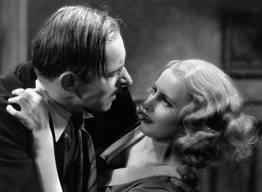 This was quite a common theme in Hollywood cinema of the 1930's, with the depression well under way, things were scarce. Jean Harlow had played a similar role in Jack Conway's Red-Headed Woman (1932). Of course this was exactly the kind of amoral characterisations that the Production code, often known as the Hays Code (after it's head Will Hays), was targeting as subversive and depraved for cinema audiences. The morality of the 1920's lingered for a short period into the Great Depression, which was seen by conservatives such as Hays, as a contributing part of the Wall Street crash.


