Showing posts with label 1989. Show all posts

Monday, 11 February 2019

Review #1,448: 'Crimes and Misdemeanors' (1989)

Say what you will about the rapidly decreasing quality of Woody Allen's work of late, or about the writer/director/actor's character in the wake of the recent horrific allegations made against him, but look back at his filmography and there's a wealth of brilliance to be found. As he became a household name thanks to some of the most hilarious comedies of the 1970s, Allen moved away from playing the clown and into more serious territory. The comedy was still there, but as a fan of Ingmar Bergman and Marcel Ophuls, he was always eager to explore the darkness rooted in our souls. One of his most sobering works is also one of his best. Released in 1989, Crimes and Misdemeanors asked the question posed by many a philosopher: Can you live with yourself after committing a murder or will the shame gradually eat away your soul?

The man at the centre of the story, Judah Rosenthal (Martin Landau), seems to have it all. He's a respected doctor with a loving family and a group of adoring friends, and the film opens with a lavish dinner held in his honour. On the surface, Judah is a happily married man, but he holds a dark secret. Over the past few months, he has indulged in an affair with flight attendant Dolores Paley (Anjelica Huston), enjoying short breaks away and taking long walks on the beach. Only now Dolores is threatening to reveal his secret, sending a letter to Judah's wife which he manages to intercept at the last minute, and calling from the gas station down the road with ideas of turning up at the family's door. When she refuses to listen to Judah's pleas, the doctor turns to his brother Jack (Jerry Orbach), who has connections to the mob, for help. Jack has a simple answer: He will hire someone to murder Dolores and Judah won't have to lift a finger.

While all of this is going on, struggling documentary filmmaker Cliff Stern (Allen) is thrown a gig by his brother-in-law - the obnoxious, self-obsessed sitcom writer Lester (Alan Alda) - and meets cute associate producer Halley Reed (Mia Farrow) on the job. Unhappy in his own marriage, Cliff can't help but fall in love, but Lester has her in his sights also. It took me a while to figure out why these two seemingly unconnected stories were unravelling side-by-side, but it soon becomes clear that this is a film about the absurdity of guilt. Judah and Jack had it drilled into them from a young age by their rabbi father, but now they appear to be literally getting away with murder. Cliff may want to cheat on his berating wife, but he is ultimately a 'good' guy, yet life doesn't seem to want to throw him any luck. There's also a key character in Ben (Sam Waterston), a rabbi who still maintains a lust for life despite his deteriorating eyesight. It plays like a thriller, but it's also very funny. There's a depressing theme constantly at play, but Allen ensures that the story remains insightful, engrossing and occasionally heartbreaking. One of Allen's shrewdest and most humanistic pictures to date, assisted by a flawless ensemble.


Directed by: Woody Allen
Starring: Martin Landau, Woody Allen, Mia Farrow, Alan Alda, Anjelica Huston, Sam Waterston, Joanna GleasonClaire Bloom, Jerry Orbach
Country: USA

Rating: ****

Tom Gillespie


Crimes and Misdemeanors (1989) on IMDb

Monday, 29 January 2018

Review #1,299: 'The Toxic Avenger Part III: The Last Temptation of Toxie' (1989)

When we last saw the first and only superhero from New Jersey with superhuman size and strength, he was returning from his journey of self-discovery in Japan to banish the evil Apocalypse Inc. corporation from his home town of Tromaville. The Toxic Avenger Part II was certainly a sluggish affair, but contained enough genuinely funny moments - specifically watching the terrified Japanese public run from the hideous monster - to justify its existence. Troma being Troma, they were never going to let their most famous and bankable character disappear after just one sequel, and in fact they released Part III, subtitled The Last Temptation of Toxie, later the same year. Yet clearly the brainstorming sessions didn't produce anything of note, as this third entry is not only clearly out of ideas, but uses deleted scenes from the previous instalment to stitch together what they obviously feel passes for a plot.

It begins much in the same way as before, with Tromaville living a peaceful existence due to Toxie's successful efforts to banish crime once and for all. While he previously passed his time working at the home for the blind, Apocalypse Inc. saw the end to all that when they blew it up. Now, Toxie (played by Ron Fazio and John Altamura) sinks into a deep depression due to sheer boredom, spending most of his time moping around the junkyard he calls home with his loyal blind wife Claire (Phoebe Legere). When the chairman of Apocalypse Inc. (played by Rick Collins) learns that Toxie needs $357,000 to pay for an operation to restore Claire's sight, he takes advantage, employing the superhero as his assistant and enforcer, manipulating him into keep the town's residents in line and ensure that Tromaville can be used as the company's toxic waste dumping ground.

It's a re-hash of everything that came before, which almost feels like a slap in the face for those of us who stuck with Part II to the very end, despite its exhaustive running-time. There's almost a complete absence of genuine wit, with returning directors Lloyd Kaufman and Michael Herz relying mostly of goofy slapstick and cheap effects to bulk up the running-time (which again runs at a painful 100 minutes). It's at its best when Toxie is disposing of bad guys, starting with a scuffle at a video store in which the disfigured brute mutilates and executes a gang in various horrific ways, including mincing one of their hands in a VHS player while onlookers scream in terror, in a set-piece that will have you questioning his status as a 'hero'. But with Troma's notoriously tight budgets, these moments are in short supply. The climax aims to up the daftness factor as high as it will go, but after 30 minutes of watching bad gore effects followed by the reactions of the shocked crowd gathering to watch, you'll likely wish that you were the one getting their head smashed to a pulp.


Directed by: Lloyd Kaufman, Michael Herz
Starring: Ron Fazio, John Altamura, Phoebe Legere, Rick Collins
Country: USA

Rating: **

Tom Gillespie


The Toxic Avenger Part III: The Last Temptation of Toxie (1989) on IMDb

Thursday, 28 December 2017

Review #1,286: 'The Toxic Avenger Part II' (1989)

Five years after he fell into a drum of toxic waste and stated taking revenge on the school bullies that had harassed him his entire life, Melvin Ferd AKA The Toxic Avenger (here renamed Melvin Junko) returned for a sequel as Troma's lucky charm. Troma are a small production company proudly trafficking in schlock, but 'Toxie', New Jersey's first and only superhero, was a surprise hit, spawning comic-books, action figures and even a stage musical. Directors Michael Herz and Lloyd Kaufman - also the company's founders - knew there was money to be made, and the character ended up getting three sequels. 1984's The Toxic Avenger, like Troma's fellow cult classic Class of Nuke 'Em High, was so memorable because it was funny, off-the-wall and had real heart buried deep within.

This cash-grab sequel seems to forget all of this, and in blowing its load far too early in the film, sucks all the fun out of Toxie and his crazy adventures. Having completely rid Tromaville of crime, Toxie (played by both Ron Fazio and John Altamura following the latter's dismissal), has made the town a haven, and the hideous but gentle creature with super size and strength enjoys life looking after the blind and shacking up at the junk yard with his (also blind) girlfriend Claire (Phoebe Legere). A life without crime has given Toxie a chance to reflect, and in his depressed state he decides that the only way to fill the void in his heart is by confronting his estranged father in Japan. With the good-hearted monster off to Asia in a sailboat, evil corporation Apocalypse Inc. move into town to spread toxic waste and evil in equal measures.

To give The Toxic Avenger Part II its due, there are quite a few very funny moments. A small appearance by Michael Jai White making his big-screen debut and watching the oblivious Japanese public gaze with curiosity and terror as the rubber-suited hero struts through Tokyo are some of the highlights, and an early extended fight scene is just absolutely bonkers. But Toxie's trip to Japan feels more of a diversion from the lack of care taken with the story, which is all over the place and takes way, way too long to reach its end. While some of the jokes land, around 90% fall flat on their face, with a heavy reliance on childish slapstick humour and silly costumes for cheap laughs. The daftness is quite endearing for a short period of time, but then it hits you that this is what you're getting for a whole 100 minutes, and the film quickly becomes an absolute chore.


Directed by: Michael Herz, Lloyd Kaufman
Starring: Ron Fazio, John Altamura, Phoebe Legere, Rick Collins
Country: USA

Rating: **

Tom Gillespie


The Toxic Avenger Part II (1989) on IMDb

Saturday, 10 June 2017

Review #1,209: 'Erik the Viking' (1989)

After the enormous success of Monty Python, the individual members of the innovative troupe started to branch out to work on their own passion projects, which often yielded fantastic results. Terry Gilliam's Time Bandits, for example, is now considered a family classic and remains a firm childhood favourite for many who grew up in the 1980s. A Fish Called Wanda, starring Python alumni John Cleese and Michael Palin was a hilariously farcical movie that went on to be Oscar nominated for Best Director and Best Screenplay, and winning for Kevin Kline's unhinged supporting turn. Some ventures, however, were less successful, although some Python loyalists may insist otherwise. Terry Jones adapted his own children's book for Erik the Viking, a movie that shares much in common with the aforementioned Time Bandits, but shares little of its sense of wonder, imagination and wit.

While on a routine raping-and-pillaging expedition, Viking Erik (Tim Robbins) realises he has grown tired of the never-ending circle of violence and misery celebrated by his people. He falls for a girl (Samantha Bond) after saving her from some of his bloodthirsty brothers, before accidentally killing her. The experience sends him seeking answers and wisdom from the wise woman Freya (Eartha Kitt), who explains to Erik that Fenrir the wolf has gobbled up the sun and plunged the world into the dark days of Ragnarok. Determined to see the sun again, Erik sets off on a quest to find the Horn Resounding which, when blown, will transport him to Asgard where he can confront the Gods. However, such a miracle will spell the end of war, thus putting blacksmiths Keitel (Gary Cady) and his underling Loki (Antony Sher) out of business, as well as threatening the reign of the brutal Halfdan the Black (John Cleese).

Erik the Viking takes Norse mythology so seriously that there are long stretches of the film during which it is easy to forget that it's a comedy. 10 or 20 minutes can easily go by without so much of a giggle, as Jones struggles to keep the tone consistent and, with an obviously limited budget, the action exciting. Still, although Erik pales in comparison to some of the wonderful work Jones has been involved in over the years, it certainly isn't a bad movie, and in no way deserves the stigma still attached to it. There are some laugh-out-loud moments, including the bickering relationship between beserks Sven (Tim McInnerny) and his father (Charles McKeown), and a Japanese slave master who berates his subjects with racial slurs ("You incomprehensible. horizontal-eyed western trousers wearers/How I abominate your lack of ancestor worship!"). Ultimately, the film is too inconsistent and tonally uneven to work, but go in expecting a handful of laughs and a few famous cameos and you may not be too disappointed.


Directed by: Terry Jones
Starring: Tim Robbins, Mickey Rooney, Eartha Kitt, Terry Jones, Imogen Stubbs, John Cleese
Country: UK/Sweden

Rating: ***

Tom Gillespie


Erik the Viking (1989) on IMDb

Thursday, 3 March 2016

Review #989: 'The Firm' (1989)

Long before Nick Love was helping stockpile DVD bargain bins with those terrible football hooligan movies (including a remake of this film), Alan Clarke - the highly underrated director responsible for such landmark British TV dramas Scum (1979) and Made in Britain (1982) - released The Firm, causing a moral public outcry that was the fashion of Thatcher-era Britain in the process. On the surface, it seems to glamorise these yobs and their violent tendencies, but viewing it in hindsight, it's actually about a Britain suddenly awash with money during the 'Lawson Boom', with the thugs caught up in it having grown bored and seeking out that extra buzz they receive from brutality.

Although they are essentially 'football' hooligans, Clarke makes a point of showing little of the game itself. Apart from the glimpse of Arsenal's old Highbury stadium and a Sunday-league kick-about at the start, the beautiful game is little more than an excuse for these idiots to go to town on each other. ICC ringleader Bex (Gary Oldman) hopes to unite rival firms in order to take on the Europeans in the upcoming Europeans Championships, but his opposite numbers, including the particularly loathsome Yeti (Philip Davis) of the Buccaneers, inform him that his firm must rumble with theirs first if he wants to be top dog. This however is only a loose plot that binds together what is ultimately a slice-of-life approach.

While the media portrayed these men as disaffected youth, a lot of them were in fact middle-class, able to afford fancy cars and suburban housing. Bex is happily married with a young son, making a comfortable living as an estate agent. When his son picks up his father's Stanley knife and starts to chew it, Bex's domestic life is thrown into disarray. It's in these quieter moments that the film is at its most disturbing, and in truth, there is less violence on show than the controversy drummed up on its release would have you believe. And when it does come - a young ICC member gets a particularly nasty face slashing - its all the more powerful. The open-ended final scene holds back from making any overt social or political statements but instead lingers with an observant fascination at these lager-swilling arseholes. Like with Scum and Made in Britain, The Firm defines the mentality of Britain at the time, and features what is undoubtedly Oldman's finest performance.


Directed by: Alan Clarke
Starring: Gary Oldman, Lesley Manville, Philip Davis, Charles Lawson
Country: UK

Rating: ****

Tom Gillespie


The Firm (1989) on IMDb

Saturday, 19 September 2015

Review #921: 'The BFG' (1989)

I never saw the 1989 film adaptation of Roald Dahl's children's book The BFG when I was growing up, and I don't know whether or not that's a good thing. On one hand, I could have enjoyed the film as a nostalgic trip down memory lane, yet I could have also been horrified at just how badly the film has aged. I did, however, read the book as a young nipper, along with other Dahl classics such as Charlie and the Chocolate Factory and Matilda, so I'm familiar with just how good a word-smith Dahl was, and how he managed to forge these often creepy and macabre tales into something that children could enjoy without being too terrified.

Brian Cosgrove's adaptation, for all its sporadic charm, has faded into obscurity since its 1989 release with good reason. Beginning at an orphanage run by the nasty Mrs. Clonkers (Myfanwy Talog), young girl Sophie (Amanda Root) sees the outline of a gigantic figure blowing a trumpet through the window of a house down the road. Before she has a chance to scream, she is grabbed by a huge fist and whisked away to another land inhabited by grotesque giants who feed on children. Lucky for her, she was taken by the Big Friendly Giant (David Jason), who is the only vegetarian giant in his world, and whose day job it is to blow happy dreams into the minds of sleeping children. But with the knowledge of the rest of the giants gobbling up scores of children, Sophie hatches a plan with the BFG to notify the Queen of England (Angela Thorne) and put a stop to the evil giants for good.

The first twenty minutes or so of The BFG is actually quite delightful, as we meet the lovable lunk and learn of his diet of the disgusting snozzcumbers, and he is wonderfully voiced by national treasure David Jason. The song 'Whizzpopping' isn't particularly good or catchy, but there is a giddy delight to be had with watching the BFG and Sophie farting with glee. Yet, without Dahl's written narrative, the film quickly becomes tedious and the story grinds to a near-halt. Cosgrove Hall - set up by director Cosgrove and his friend Mark Hall - animated countless children's TV adaptations from the 1970's up until its demise is 2009, but the animation here is stodgy. There were obvious budget constraints and this shows in the backgrounds, which are often so bland ad static it drains the film visually. It has its charms, especially if you grew up in Britain, but I would stick with the beloved book.


Directed by: Brian Cosgrove
Voices: David Jason, Amanda Root, Angela Thorne, Ballard Berkeley, Michael Knowles
Country: UK

Rating: **

Tom Gillespie


The BFG (1989) on IMDb

Monday, 31 August 2015

Review #911: 'Roger & Me' (1989)

Over a decade before he was annoying the likes of Charlton Heston and George W. Bush, documentary film-maker Michael Moore was out of work and witnessing first-hand the devastating effects the closure of several General Motors plants had on his home town of Flint, Michigan. Roger & Me, his first feature film, documents Moore's attempts to get an interview with Roger Smith, the CEO of General Motors whose decision it was to move several plants - after recording record profits - to countries such as Mexico, where labour is cheaper, laying off thousand of Michigan workers in the process.

Moore's frequently rebuffed attempts to talk to the elusive figure provides much of the film's humour, with Moore's sardonic wit helping make light of what is a serious issue. With no film-making credentials so early in his career and with a membership card to Chunky Cheese his equivalent of a business card, he must rely of guerilla tactics to try and snatch a word with the man. He is kicked out of private clubs and a building where the fourteenth floor is strictly out-of-bounds, and the film is so low-budget that it's a wonder the boom mic doesn't creep into every other shot. But Moore has managed to craft a thought-provoking film despite the budget restrictions, holding a mirror up to Reagan-era America when corporations could simply pack up and move, leaving an entire town crumbling in its trail.

When Moore isn't on the hunt for Mr. Smith, he's interviewing residents hit hard by sudden unemployment, following Sheriff's Deputy Fred Ross as he evicts one family after another, and showing the various, often laughable, attempts by Flint to reinvigorate their economy through tourism. Moore has been criticised for playing with timelines and editing in his favour, manipulating the truth to back up his own liberal agenda. While I can certainly agree that this can be a dangerous approach (especially with his later film, Bowling for Columbine (2002)), the documentary medium is rarely as neutral as it lets on and a director always has a right to artistic license . Unlike his later films, Moore thankfully stays out of the picture for the bulk of the film and this allows Roger & Me to tell a more devastating story. Bowling for Columbine and Fahrenheit 9/11 (2004) may have broken box-office records, but Roger & Me is Moore's best, and most honest, work.


Directed by: Michael Moore
Starring: Michael Moore, Roger B. Smith
Country: USA

Rating: ****

Tom Gillespie


Roger & Me (1989) on IMDb

Wednesday, 8 July 2015

Review #889: 'Friday the 13th Part VIII: Jason Takes Manhattan' (1989)

After sitting through seven rather torturous experiences with the Friday the 13th franchise - with perhaps one or two exceptions - part 8's title promises a break from the formula, finally removing everyone's favourite hockey mask-wearing serial killer from his favourite stomping ground Camp Crystal Lake and plonking him in an unfamiliar setting. However, this series made its fortune from repeating the same formula over and over again, so we get the same dull hack-and-slash hokum that came before. A more apt title would be Jason Takes a Boat Ride then Walks Around Manhattan for a Bit at the End. 

The film begins with a young couple frolicking on a boat, where the young boy tells the girl the story of Jason Voorhees (Kane Hodder), the deformed mass murderer responsible for the death's of many a teenage archetype. Jason, having been left chained to the bottom of the lake at the end of the previous film, is freed when the boat sails over some underwater cables, resurrecting Jason with electricity. Naturally, the young couple are butchered and Jason is on the loose again. Meanwhile, the SS Lazarus is bound for New York City and young aquaphobe Rennie (Jensen Daggett) is boarded, much to the annoyance of her uncle and stick-in-the-mud biology teacher Charles McCulloch (Peter Mark Richman). Rennie is plagued by visions of a young deformed boy, and soon enough the mutilated corpses of teenagers start to appear.

Notice how Manhattan is not mentioned once in the synopsis. Whether it was for budgetary reasons or plain bad writing, Jason's feet don't touch land until the final act. So the opportunity for Jason to be let loose in a city that may just be as deranged as he is - leaving a trail of guts in his wake - is wasted, choosing instead to have Jason chase the leads around smoky back-alleys. When Jason finally stumbles through Times Square barely noticed by passers-by, it's an amusing moment and proves what a wasted opportunity this was. The rest of the movie consists of the same slasher routine as every entry that came before, only less inventive and featuring characters even more grating than usual. Possibly the worst in the series, yet the franchise would somehow prevail.


Directed by: Rob Hedden
Starring: Jensen Daggett, Peter Mark Richman, Scott Reeves, Kane Hodder
Country: USA/Canada

Rating: **

Tom Gillespie


Friday the 13th Part VIII: Jason Takes Manhattan (1989) on IMDb

Friday, 20 February 2015

Review #836: 'The Little Mermaid' (1989)

Kicking off what is now known as the Disney Renaissance (following a brutal decade of flops and underachievers), The Little Mermaid reignited some of that old Disney magic, with some beautiful and lovingly-drawn animation and a good old-fashioned, yet familiar, story. Based on the fairy tale by Hans Christian Andersen, it's a tale of a beautiful princess who falls in love with a dashing prince, with the snag being that the girl, Ariel (voiced by Jodi Benson) has a flipper, lives under the sea, and is best friends with a Rastafarian crab and a cowardly tropical fish.

King of the sea Triton (Kenneth Mars) is obeyed by all in his realm, with the exception of the most important person in his life, his daughter Ariel. She has bigger dreams and is obsessed with the deadly world of ships and brutal men above the sea surface. One day, she swims to the world above and spots dashing prince Eric (Christopher Daniel Barnes), who she instantly falls in love with. Desperate to escape her father who forbids her wild adventures, she is taken by two eels, Flotsam and Jetsam (both voiced by Paddi Edwards) to Ursula (Pat Carroll), a sea witch with tentacles like an octopus. In exchange for Ariel's beautiful voice, Ursula transforms her into a human, but she must receive true love's kiss within three days or else she will turn back into a mermaid and belong to Ursula's garden of creepy souls.

The fact that The Little Mermaid is very much in the style of 'classic' Disney works both for and against the film. On one hand, it's beautifully drawn with memorable songs ('Under the Sea' is a particular stand-out), but it also treads the overly familiar fairytale tropes of princes, princesses, witches and the kiss of 'true love'. However, it brought Disney into the modern era. Ariel is not just a la-di-da maiden who enjoys cleaning whilst singing sickly tunes; she is independent and slightly wild, eager to explore the mysterious world she does not belong to. Her companions are also welcome, with crab Sebastian (Samuel E. Wright) providing many laughs, especially in his efforts to escape a pompous chef who wants to cook and serve him. It's perfectly likeable throughout, but Disney wouldn't find it's true magic again until two years later.


Directed by: Ron Clements, John Musker
Voices: Jodi Benson, Christopher Daniel Barnes, Samuel E. Wright, Pat Carroll, Kenneth Mars
Country: USA

Rating: ***

Tom Gillespie


The Little Mermaid (1989) on IMDb

Tuesday, 5 August 2014

Review #773: 'The 'Burbs' (1989)

Combining two genres that really flourished in the 1980's - horror and man-boy comedy - The 'Burbs is a slightly eerie minor work from Joe Dante, the director that gave us genre classics The Howling (1981) and Gremlins (1984), both of which blended spatters of gore with goofy comedy much more successfully. The 'Burbs just seems to be missing something. Whether it's the surprisingly subdued Tom Hanks, who is allowed only glimpses of the energy he was so famous for in his early days, or the film's failure to really subvert any of our expectations, it's unclear.

The grumpy Ray Peterson (Hanks) has just begun his one-week vacation, which he has decided to spend lounging around in his pyjamas and drinking beer rather than going fishing or taking his wife (Carrie Fisher) and son on a trip. He is soon drawn in to best friend Art's (Rick Ducommun) curiosity at the strange behaviour of the street's most recent additions, who have moved into a gothic building that sticks out like a sore thumb. They keep to themselves and are rarely seen outside the house, but at night, great discharges of electricity flash and boom from their basement. Just what are they up to? Ray, Art and ex-army nut Lt. Rumsfeld (Bruce Dern) are determined to find out, while lazy stoner Ricky (Corey Feldman) enjoys the show from his porch.

Every now and then, The 'Burbs throws in a bit of inspiration. Whether it's the crash-zoom, over-the-top screaming of Ray and Art upon learning of possible foul play, Ricky's discovery of reality 'TV' years before morons couldn't get enough of it, or the sight of the strange family digging holes in their lawn where you get a real sense of Dante's skill at horror, we get only glimpses of the film that perhaps could have been. Dante doesn't seem invested in the story somehow, as if it was a half-baked idea that was never given the dedication it needed. The observations of suburban life seem dated, as if torn out of a 1960's comic-strip, and the various vignettes which play out in the early scenes are not as funny as they should be.

Apart from Ducommun, whose prat-falls and incessant man-child behaviour gets old very quickly, the cast perform extremely well. When Hanks is occasionally let off the leash, his semi-improvised lunacy reminds us of what he did best before all the Oscar-winning nonsense of Forrest Gump (1994), and Dern is the only consistently funny character in the entire film. But when the credits rolled, I found myself pondering the point of the film. It doesn't sway the plot in any direction other than the one you expect it to go, and although it's a mildly pleasant ride along the way, when Feldman's Ricky says to camera at the climax "I love this street!", I couldn't help but think "why?".


Directed by: Joe Dante
Starring: Tom Hanks, Bruce Dern, Rick Ducommun, Carrie Fisher, Corey Feldman, Henry Gibson
Country: USA

Rating: ***

Tom Gillespie


The 'Burbs (1989) on IMDb

Tuesday, 3 December 2013

Review #682: 'Weekend at Bernie's' (1989)

Time has the knack of breathing fresh new life into a former piece of crap. Nostalgia sets in with the fashions and the music of its era, and familiar faces re-appear after we have seen their careers gradually collapse. Unfortunately for Ted Kotcheff's Weekend at Bernie's, it is the same cringe-inducing, one-joke farce it was 24 years ago. There was a real chance for some dark comedy here, given that the set up isn't a bad idea if you have the correct writers behind it. However, Norman Mailer did not write Weekend at Bernie's, Robert Klane did, and he was responsible for such classics as National Lampoon's European Vacation (1985), Folks! (1992), and, most unforgivably, Weekend at Bernie's II (1993).

Larry (Andrew McCarthy) and Richard (Jonathan Silverman) are two young, eager lower-level employees at a New York insurance firm. When Richard discovers that an employee has stolen 2 million dollars from the company, he and Larry think they're on their way to a promotion and take the findings to their boss, Bernie (Terry Kiser). As a reward, Bernie invites them to stay at his island beach-house, but secretly, Bernie is behind the theft and has hired a mob hitman to take them both out. However, Bernie himself is assassinated for sleeping with the mob boss' wife, and with party-seeking friends quickly turning up at the beach-house, Larry and Richard must maintain the illusion that Bernie is still alive and well if they want to party.

It seems strange that their has never been (to my mind) a decent comedy involving a dead body. Perhaps the presence of a cadaver is too macabre a subject to raise any laughs, or, as with Weekend at Bernie's, there's not much you can do with it apart from move its limbs and head in an attempt to squeeze out some laughs. And that pretty much sums up this film, raising the question of how moronic can these people be to not realise Bernie is dead? Perhaps it's because, inexplicably, rigor mortis fails to set in at any point and his bowels do not drop. This may even be forgiven if we had anyone to root for, but, as hard as McCarthy and Silverman try, their characters are nothing more than incompetent goofballs chasing that ever-so-80's dream of climbing the corporate ladder. 100 minutes of pure pain.


Directed by: Ted Kotcheff
Starring: Andrew McCarthy, Jonathan Silverman, Catherine Mary Stewart, Terry Kiser
Country: USA

Rating: *

Tom Gillespie


Weekend at Bernie's (1989) on IMDb

Sunday, 21 April 2013

Review #607: 'Meet the Feebles' (1989)

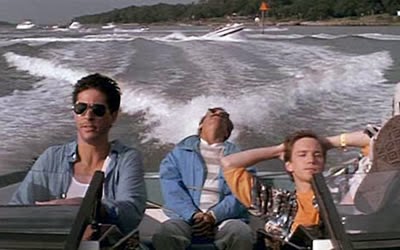
After his bad taste début, er, Bad Taste (1987), the young Peter Jackson made the decision to take his filth-laden sense of humour to a new level and direct Meet the Feebles, the kind of film you would expect Jim Henson to make if his life had gone in an entirely different direction and had formed a psychedelic drug habit. He still had little budget to work with, as well as the (understandable) concerns from his funders, but this was the first time he would work with his future wife Fran Walsh, who would work with him on every film after this. Maybe it is her influence that makes Feebles a noticeable step up from his début, or maybe it's not, but the film works thanks to a director seemingly more comfortable in his role, but still renegade enough to inject his guerilla sensibilities into it.

The basic 'plot' revolves around The Feebles variety show, of which the main attraction is singer Heidi the Hippo (voiced by Mark Hadlow, Dori in The Hobbit (2012)), a former big star who has formed an uncontrollable attraction to cakes. Amongst the various characters is newcomer Robert, a softly-spoken and naive hedgehog who goes to great lengths to attract a seductive poodle he has fallen for. It is mainly through his eyes that we witness the mayhem of the show, which is ran by Bletch the Walrus (Peter Vere-Jones). Bletch is involved with Heidi, but is secretly having sex with a slutty feline, and is always making money on the side through Trevor the Rat's (Brian Sergent) pornography films. The show comes under threat when sex-addicted Harry the Rabbit contracts an STD and is given a few hours to live, but is busted by the Fly, a pesky journalist.

What Meet the Feebles lacks for in taste and any sense of actual purpose, it makes up for in sheer invention and entertainment. It moves along furiously, never stopping to consider something as unnecessary as plot, drifting from one scene of complete debauchery to the next. If you would be offended by the sight of animal ejaculating through his elongated snout onto the the pierced udders of a dominatrix cow, then I would recommending passing on this one. The humour is almost akin to that of South Park, but doesn't get bogged down with satire or observational gags, and instead seems to seek to disgust. It is juvenile, certainly, but it's undeniably funny, and is simply too twisted and disturbing to go about unnoticed. It is the anti-Muppets, representing depravity where Henson's creations were driven by naive optimism (although the puppets here are quite wonderfully designed).

After the proceeding Braindead (1992), which employed a lawnmower as the answer to a house overrun by horny zombies, Jackson seemed to grow up and film the astonishingly dream-like Heavenly Creatures (1994). It is simply mind-boggling how the director of this, a film that has a contortionist get his head stuck up his own arse, would go on to be the biggest director in Hollywood and create one of the finest achievements of modern mainstream film-making, The Lord of the Rings (2001-2003). Although he never won any Oscars for them, there is plenty to enjoy in early Jackson. You could even say that some of the hideous creations in Feebles were a pretext to some of the monsters seen in Rings and The Hobbit. Although I don't remember seeing Gollum eating shit out of a toilet with a spoon.


Directed by: Peter Jackson
Starring: Danny Mulheron, Mark Hadlow, Brian Sergent, Peter Vere-Jones
Country: New Zealand

Rating: ****

Tom Gillespie


Meet the Feebles (1989) on IMDb

Saturday, 10 November 2012

Review #531: 'The Punisher' (1989)

The right-wing fascism of the Marvel comics character was incredibly well suited to the increasingly comic-book violence of late-'80's action cinema. With an ex-actor as the American president, and his campaign of reform that benefited the rich, it was inevitable that the heroes of cinema would move away from the morally ambiguous characters of the 1970's, and move to the more clearly defined, shoot first ask later, machismo of revenge against perceived evil. In Frank Castle, Gerry Conway and John Romita Jr, created a simplistic, one-dimensional man who fights the city's criminal organisation, after the mob had been involved in the murder of his family. After this event, Frank (dubbed The Punisher by police and the media) leaves the police force, and lives a subterranean life, disposing of those he sees as morally objectionable. In the comic world, Punisher was a very '70's creation (first appearing in 1974), but would not become as relevant to a "wider" audience until the excessive nature of the 80's action genre.

With such an easily defined origin, the film begins after Frank Castle (played by Dolph Lundgren) who is suspected by many to be the Punisher, has been in hiding for five years, and the accumulation of dead criminals are increasing. With the mob families combining their efforts, creating a syndicate, the Japanese Yakuza arrive to assimilate these groups and over take the city crime activities. Castle's ex-police partner, Jake Berkowitz (Louis Gossett Jr.), is on the case of the merging families, and the new threat of the "foreign" mafia, but is fundamentally after the famous vigilante. The inclusion of the Japanese elements seems to reflect America's entrenched fear of outsiders, and particularly the oriental superiority in technological advancement, and of course, a sewer-dwelling vigilante (and a tough American) can easily dispose of technology with his bare hands.

The Punisher is a pretty standard right-wing action film of the decade, and offers little excitement, and most certainly offers nothing new to the genre. It seems that life is disposable if those bodies are foreign. Like so many of these explosion-fuelled, testosterone enhanced films, The Punisher takes itself far too seriously. Lundgren's dialogue and delivery is so cliched, that even by 1989, this gravelly, monotone dialogue was ridiculous, and forged from what must have been the universal book of bad statements. (Even when Lundgren shoots large weaponry, his mouth seems to be filled with marbles.) With the major threat that the Yakuza has kidnapped the mob bosses kids, it is a pretty lame premise, and one which could easily have been solved by the Brady Bunch (in other words, the threat was limited, with no need for bulging biceps). The whole package though released cinematically (outside of America and Sweden at least), seems much like the pilot episode for a proposed television series, than a wholly satisfactory film experience, and fails as action or drama.


Directed by: Mark Goldblatt
Starring: Dolph Lundgren, Louis Gossett Jr., Jeroen Krabbé
Country: Australia/USA

Rating: *

Marc Ivamy


The Punisher (1989) on IMDb

Sunday, 18 December 2011

Review #288: 'The Seventh Continent' (1989)

A middle-class family, consisting of father Georg (Dieter Berner), mother Anna (Birgit Doll), and young daughter Evi (Leni Tanzer) live out their routine daily lives in apparent discomfort. The film is split into three sections - 1987, 1988, and 1989. The first two years, we are given an insight into their thinking as Anna narrates letters written to her parents. We witness the mundaneness of their lives in scenes showing them eating breakfast, at work, going through a car wash, driving in their car. They are trapped by their repetitive surroundings in an unavoidable consumerist world. The third section sees the parents quitting their jobs, buying power tools, and emptying their bank accounts. They tell people they're going to Australia, only they plan to destroy their home and kill themselves.

Haneke is the master of the cold and the uncomfortable. This was his debut feature, only he seemed to have already mastered this skill. In his later films, we witness brutal animal slaughter in Benny's Video (1992), genital mutilation in The Piano Teacher (2001), and possibly the most shocking suicide ever depicted on film in his masterpiece Hidden (2005). In The Seventh Continent, we know what is coming. It is laid out quite early in the film. When it comes, it is every bit as unpleasant as you would hope it wouldn't be. Haneke doesn't need blood or dramatic music. Instead he just lets us hear the last gargled breaths, taking place off-camera, of someone taken an overdose of pills. Powerful, terrible and profoundly disturbing.

Haneke, in my opinion, is the world's greatest living director. Granted, the likes of Godard and Herzog are still making films, but their heyday was in the 1960's and 70's respectively. Haneke is in his prime, and their is no-one making more skilful films. He based The Seventh Continent on a newspaper article he read about a family that committed suicide in a similar fashion (as we learn over the end credits), and uses it as a commentary on a world obsessed with formality. This is certainly not an enjoyable film, but it is one that will linger with me for a long time, which is similar to the effect Hidden had on me. It will occasionally test your patience (scenes are repeated and their are long periods without dialogue), but its power is undeniable. An assured debut.


Directed by: Michael Haneke
Starring: Birgit Doll, Dieter Berner, Leni Tanzer
Country: Austria

Rating: *****

Tom Gillespie


The Seventh Continent (1989) on IMDb

Sunday, 25 September 2011

Review #224: 'Monster High' (1989)

Two bald aliens arrive on Earth with the Doomsday Device, something they have stolen from their own alien planet, much to the behest of the Monster-in-Charge. They unwittingly unleash Mr. Armageddon (David Marriott) upon an all-American high school, and soon this long-fingernailed-bringer-of-doom is busy a-rapin', a-killin', and basically a-fuckin' with every kid in the school. Dorky loner Norm (Dean Iandoli) is too busy lusting after foreign exchange student Candice Cane (get it? - played by Diana Frank) to notice the arrival of horny gargoyle statues, the living dead, and deadly giant marijuana plants. But when he does, he strikes a deal with Armageddon to have a basketball game to end all games, and possibly the world.

I'm sure you can gather from the description that this isn't a film to take too seriously. It's a very 80's high school horror/sex flick that is very aware of what it's target audience wants - blood, tits, and goofy humour. And it delivers all that in abundance. It has everything a shlock hound could want. Where else can you find a monster with a computer for a head? Or a teen that gets eaten by his shoes? Or alien twins that were failed rappers on their own planet? Probably nowhere. This is of course an awful film. But where it lacks in subtlety and intelligence, it makes up for in sheer volume and creativity.

The edits come thick and fast. The film cuts back and forth between different characters and locations as if it were filmed by a giddy teenager. This approach certainly keeps the film fun and interesting, which is undoubtedly the sole aim of the film. Fans of Troma will love it, as will fans of 80's teen sex flicks such as Porky's (1982) and zero-taste gross-out comedies a la Animal House (1978). Special mention must go to the creation of Mr. Armageddon, who dons a crap cape and a long pinky fingernail, and has a voice which is deeper than Barry White. Clearly actor David Marriott, who had a short career starring in B-movie action films, is having a great time, as did I watching him. I feel guilty that I liked this film, as it is indeed awful.


Directed by: Rudy Poe
Starring: Dean Iandoli, Diana Frank, David Marriott
Country: USA

Rating: ***

Tom Gillespie


Monster High (1989) on IMDb

Tuesday, 19 July 2011

Review #172: 'Little Monsters' (1989)

After moving house and witnessing his parents' marriage crumbling in front of him, Brian (Fred Savage) investigates his brothers claims that monsters keep coming from under his bed and scaring him at night. After swapping rooms, Brian is visited by a big blue monster, and the next night Brian manages to trap him in his room using his engineering skills. The monster turns out to be hyperactive troublemaker Maurice (Howie Mandel) who befriends Brian, and shows him the wonders of the monster world under his bed, where every night, the monsters reek havoc in the homes of young children. But the mysterious monster Boy (Frank Whaley) wants Brian for himself and keep him under the bed until the sun comes up, and thus turning him into a monster.

Apart from the first four Rocky films (1976-1985), Little Monsters was hands down the main film I watched religiously as a child, my face no further than two feet from the TV screen. I remember finding it strangely eerie amongst all the fun, and being genuinely disturbed by some scenes. Boy's henchman Snik, a giant, hunchbacked monster with large bottom teeth, really frightened me, and the scene where he breaks one of Maurice's horns always shocked me. Re-visiting the film, roughly around fifteen years later, I can see that I was right to feel unnerved.

Yes, the film is certainly childish and playful, but has a surprising line of darkness flowing through it from beginning to end. From early on, where Brian finds an overturned TV in the darkness of his closet that is showing the climax of The Fly (1958), to the finale that sees Boy's face burned off to reveal a hideous face underneath, the film often steps out of the childhood safety area. It's certainly refreshing to see, and this sort of atmosphere can only be found in the Golden Age of kiddie flicks, the 80's, where films like The Dark Crystal (1982) and The Goonies (1985) showed creepy creatures and foul-mouthed kids that the target audience could really enjoy and relate to.

Not to say that Little Monsters quite matches up to the two films just mentioned - it has some annoying child characters and Maurice does become slightly tiresome - but it is certainly an imaginative, funny and exciting little film. It's sad to see another of the key child stars of the era, Fred Savage, come out of the decade and dissolve into the woodwork, similar to the likes of Corey Feldman and Corey Haim. Although his maniacal behaviour does occasionally become exhausting, Howie Mandel's performance is certainly energetic, and you can't help but love him when he drinks a bully's apple juice, only to refill it with piss. Hardly a classic, but certainly a film I will absolutely cherish from my youth, and will enjoy revisiting once every decade or so.


Directed by: Richard Greenberg
Country: USA

Rating: ***

Tom Gillespie


Little Monsters (1989) on IMDb


Tuesday, 5 July 2011

Review #156: 'Uncle Buck' (1989)

Having recently re-located from Indianapolis to Chicago, Bob Russell (Garrett M. Brown) is awoken in the middle of the night to the news that his father-in-law has had a heart attack. He and his wife Cindy (Elaine Bromka) must leave urgently and must need to someone to babysit their two young children Miles (Macauley Culkin) and Maizy (Gaby Hoffmann), and their angst-ridden teenage daughter Tia (Jean Louisa Kelly). Everyone seems to be unavailable, and they are forced to call Bob's brother Buck (John Candy), an overweight, lazy, jobless slob who is more than happy to his brother a favour.

Perhaps one of John Hughes' lesser remembered films (compared to the likes of The Breakfast Club (1985), Ferris Bueller's Day Off (1986) and Weird Science (1985)), it is also one of his underrated. While hardly reaching the heights of Breakfast and Bueller, it is still warm, nostalgic, and funny enough in its own right. As formulaic as the film is, Hughes' nack for the heartfelt sets it apart from the other similar films. And although he made very few films that were good enough to show his comedic ability, it reminded me just how funny and loveable John Candy could be before his unfortunate death (a sentence I never thought I would say/type).

The character of Tia has to be one of the most annoying characters in a Hughes movie since Anthony Michael Hall in Sixteen Candles (1984). She is selfish, selt-pitying, and quite frankly, a bitch. This is clearly the point but I was just wishing Buck would get it over and done with and give her a good beating, rather than trying to 'understand' all this teen angst crap.

It does allow for a very funny scene involving Buck kidnapping her two-timing boyfriend. An arsehole of a character getting hit in the head with a golf ball is always a winner in my book. And over a decade before Austin Powers made fun of a mole, Uncle Buck delivers possibly one of the best lines of the 80's - (to a stuffy teacher claiming his niece is a 'bad egg') "take this quarter, go downtown, and have a rat gnaw that thing off your face!". Even though the film threatens to be ruined by an embarrassingly unrealistic and cheesy ending, this is still a fun film. And one I remember fondly from my childhood when I watched it religiously on VHS, after my granddad purchased it from my father's record shop, uttering the immortal line "a-we're buying it" (private joke between me and my brother so apologies everyone else).


Directed by: John Hughes
Starring: John Candy, Jean Louisa Kelly, Gaby Hoffmann, Macauley Culkin, Amy Madigan
Country: USA

Rating: ***

Tom Gillespie


Uncle Buck (1989) on IMDb

LinkWithin

Related Posts Plugin for WordPress, Blogger...